CAA News Today
Recent Deaths in the Arts
posted Dec 18, 2008
CAA recognizes the lifetime professional and personal achievements of the following artists, art historians, curators, educators, and critics, who recently passed away.
- George Brecht, an artist who was a principle member of Fluxus, died on December 5, 2008, at age 82 in Cologne, Germany, where he had been living
- Mildred Constantine Bettelheim, a former curator of design at the Museum of Modern Art in New York and a CAA member since 1938, died on December 10, 2008. at her home in Nyack, NY. She was 95. A special obituary from Linda Downs, CAA executive director, has been published
- Derek Davis, a self-taught British ceramicist and painter, died on September 3, 2008, at age 82
- Lawrence Fane, an expressionist sculptor who worked with steel, bronze, wood, and concrete, died on November 28, 2008, in New York at age 75
- François-Xavier Lalanne, a French artists who created surrealistic animal sculptures in bronze that doubled as functional objects, and who was also well known in the fashion world, died on December 7, 2008, at his home in the village of Ury, south of Paris. He was 81
- William H. Pierson Jr., a member of the “art mafia” at Williams College who, with Whitney S. Stoddard and S. Lane Faison, Jr., helped to shape a generation of museum curators and directors, died on December 3, 2008, in North Adams, Massachusetts. He was 97 and resided in Williamstown
- Warren M. Robbins, founder of the Smithsonian Institution’s National Museum of African Art, died on December 4, 2008, in Washington, DC. He was 85
- Kathleen Michelle Robinson, an art historian of nineteenth-century art and a curator at the Figge Art Museum in Davenport, Iowa, died on November 16, 2008, in Leavenworth, Kansas. She was 57
- Willoughby Sharp, an artist, curator, teacher, and publisher of Avalanche magazine, died on December 17, 2008, in New York. He was 72
- Terry Toedtemeier, a photographer, professor, geologist, and curator of photography at the Portland Art Museum in Oregon, died on December 10, 2008, at the age of 61
- Jorn Utzon, an architect who designed the Sydney Opera House in Australia, died in Copenhagen, Denmark, on November 29, 2008, at the age of 90
- Cornelius C. Vermeule III, a curator of classical antiquities at the Museum of Fine Arts, Boston, for over four decades, died on November 27, 2008, in Cambridge, Massachusetts. He was 83
Read all past obituaries in the arts on the CAA website.
CONTEMPORARY ART GALLERIES IN DOWNTOWN LOS ANGELES
posted Dec 18, 2008
Since the mid-1950s, Los Angeles has been a hotbed of new art and groundbreaking galleries, museums, and other art spaces and institutions. Throughout the greater LA area are many pockets of art-world panache, from Malibu to Culver City to Chinatown. With the 2009 conference headquartered at the Los Angeles Convention Center in downtown LA, we thought we would start with a focus on the robust gallery culture there and in its subdistricts.
CHINATOWN
Claudia Parducci, Shatter-5, 2007, oil and acrylic on canvas, 72 x 72 in. (artwork © Claudia Parducci)
A short walk or cab ride from the conference, Chinatown has a long history of culture and commerce dating back to the late nineteenth century. In the 1930s, Chinatown’s central plaza saw development as a tourist attraction with the creative help of Hollywood set designers. The cinematic simulacrum of Chung King Road is now the high street of the area’s gallery scene. While the art that is shown is cutting-edge contemporary, the galleries still pay tribute to the culture and history of Chinatown, often repurposing the original storefront names to give us spaces called China Art Objects, Black Dragon Society, and the Happy Lion.
Recommended Galleries
A nonprofit organization since 2003, Telic Arts Exchange serves as a platform for exhibitions, performances, screenings, lectures, and discussions on art, architecture, and media, with an emphasis on social exchange, interactivity, and public participation. From its basement location, Betalevel similarly operates as a studio, club, stage, and screening space. Its members are artists, programmers, writers, designers, agitprop specialists, filmmakers, and reverse engineers.
The bad-boy scenesters of contemporary art, including Dash Snow, Dan Colen, Bruce Labruce, and Terence Koh, are represented by Peres Projects. Here you’ll find edgy, trendy, abrasive, and provocative art, often collaged from detritus and other nonart materials—the stuff recent biennials are made of.
Installation view of Christopher Michlig’s exhibition Negations at Jail in 2008 (artworks © Christopher Michlig; photograph by Peter Lograsso and provided by Jail)
Black Dragon Society is another uber-hip gallery that focuses largely on painting, such as the faux-naïve, Mad magazine–inspired work of Steve Canaday and the informal portraiture of Raffi Kalenderian. China Art Objects features artists such as Walead Beshty, Pae White, and Bjorn Copeland, who also performs in the noise band Black Dice.
Presenting installation, video, new media, and technology-minded work, Fringe Exhibitions opened in 2006 with work by Survival Research Laboratories. The gallery’s website features a Net art project each month.
Kontainer has a painting-heavy roster, and Acuna-Hansen Gallery presents a number of drawing specialists, such as Eric Beltz and Tracy Nakayama, in addition to artists who work in photography and sculpture. The Fifth Floor Gallery and David Salow Gallery were two of nine Chinatown venues that hosted CalArts’ MFA exhibition, We Want a New Object, in May 2008. Both feature artists working in diverse mediums.
Mesler and Hug Gallery is big on multimedia installation, and Bonelli Contemporary maintains an Italian presence in Chinatown, showing mostly painting and drawing. High Energy Constructs is an exhibition and performance venue, and the Mountain Bar, a nightclub and gallery space, is a central hangout spot for artists and anchors the area.
Other recommended spaces include Farmlab/Under Spring Gallery; Mandarin; Happy Lion Gallery; LMAN Gallery; and Sister. Cottage Home is a unique venue run by Sister, China Art Objects, and Tom Solomon Gallery, with monthly solo and group shows alternately staged by each gallery.
GALLERY ROW
Another area downtown, located just a short walk or bus ride from the convention-center complex, is Gallery Row. A seven-block concentration of galleries in the very center of downtown, Gallery Row was designated by city council in 2003 as a thriving, pedestrian-friendly, culturally abundant, urban locus of art and nightlife. In a few short years, this experiment in urban planning has changed these blocks into a spontaneous laboratory of street art and creative culture, with fashion shows, live music, spoken word, and traditional art exhibitions. The following galleries are located in or near this area.
Recommended Galleries
Pharmaka is a nonprofit gallery in downtown Los Angeles
Located in the main lobby of the Banco Popular Building, *BANK has developed a distinctive curatorial platform showcasing emerging and midcareer artists, such as the work of Paul Butler, known not only for his own work but also for his Collage Parties. MATERIAL, a critical arts journal, is a creation of the *BANK artist Kim Schoen and Ginny Cook. Similarly, a new nonprofit organization called Phantom Galleries LA places temporary art installations in vacant storefront windows throughout Los Angeles County; its call for proposals is open ended.
Established in spring 2007, Morono Kiang Gallery promotes contemporary art by both recognized and emerging artists, focusing on Chinese art from the last decade. Recently shown artists include Xu Bing, Ai Weiwei, Li Jin, and Liu Qinghe.
Jail presents solid curated group shows, including Hef, dedicated to the founder of Playboy magazine, as well as solo exhibitions by emerging artists such as Christopher Michlig. Bert Green Fine Art focuses on contemporary painting and work on paper. Recently shown were works by the underground fanzine legend Dame Darcy and the horror novelist Clive Barker.
Founded in 1979, LA Artcore is an established nonprofit with two gallery spaces for solo, two-person, and thematic group shows. The space also hosts international and regional exchange shows. The newer Pharmaka, another nonprofit space, stages curated exhibitions while also programming lectures, panel discussions, podcasts, and accessible community events.
Other neighborhood highlights include Compact Space, which recently moved to the area, and De Soto, which is strong on photography. The work of gallery artist Connie Samaras appeared on the cover of the Summer 2008 issue of X-TRA, a Los Angeles–based quarterly art magazine.
Rounding out the recommended downtown galleries is the Los Angeles Center for Digital Art, which in addition to staging group exhibitions offers large-format printing from artists’ and photographers’ digital files with an Epson 9800 archival printer.
MORE TO COME
There’s lots more to downtown Los Angeles, with the Museum of Contemporary Art, the REDCAT Galleries and Theater, and the Frank Gehry–designed Walt Disney Concert Hall. Keep an eye out in upcoming issues of CAA News and at www.collegeart.org to see the growing list of galleries, previews, and highlights of the Los Angeles scene, a West Coast bastion of culture and cool.
Conference Survival Guide Published
posted Dec 15, 2008
The Conference Survival Guide has just been published as a downloadable PDF. The guide offers guidance to students, emerging professionals, and others attending their first conference for traveling to Los Angeles and navigating conference activities. Suggestions provided in the guide include tips for finding travel funds, options for budget travel, suggestions for lodging and dining, information on transportation in Los Angeles, listings of events and ways to actively participate in the conference, and guidelines for successful networking during the four-day event. The Conference Survival Guide is an annual publication put together by CAA’s Student and Emerging Professionals Committee. For more details, contact Vanessa Jalet, CAA executive assistant.
Renew Your CAA Membership
posted Dec 15, 2008
CAA renews memberships on a rolling basis, much like a magazine subscription. However, because the previous renewal schedule before 2005 was based on the calendar year, many current individual and institutional memberships expire on December 31, 2008. Your access to essential online resources, printed materials, and journals, and to the 2009 Board of Directors election, is available only with a current membership.
In addition, special conference-registration discounts apply only to CAA members. The early registration deadline is December 19, 2008. Don’t miss out on these great savings—be sure your membership is current.
It’s easy to check your membership status or to renew your membership online: click on “Account Log In” at the upper right of this webpage; you can gain access to your profile with your CAA member number (located on your membership card or mailing address label) and password. Your preset password is included in your membership packet.
If you have forgotten your member number or password, please contact CAA’s Member Services at memsvcs@collegeart.org or by fax at 212-627-2381. You may also call 212-691-1051, ext. 12, during our office hours: Monday–Friday, 9:00 AM–5:00 PM EST.
Candidates for the 2009 Board of Directors Election
posted Dec 12, 2008
The 2008 Nominating Committee submits its slate of six candidates to serve on the CAA Board of Directors from 2009 to 2013. Please read each candidate’s statement and biography—and watch their special video introductions—before casting your vote. Voting begins on January 5, 2009, and ends on February 27.
The candidates are:
- Carol Crown, University of Memphis
- Jacqueline Francis, California College of the Arts and San Francisco State University
- DeWitt Godfrey, Colgate University
- Patricia Mathews, Hobart and William Smith Colleges
- Patricia McDonnell, Ulrich Museum of Art, Wichita State University
- Perri Lee Roberts, University of Miami
Voting begins on January 5. For full details about the election, visit the board-election webpage. Questions or comments? Please contact Vanessa Jalet, CAA executive assistant, at 212-691-1051, ext. 261.
Salary Data on Art-History Majors
posted Dec 12, 2008
From the Art History Newsletter:
In the Wall Street Journal, we read that according to “a year-long survey of 1.2 million people with only a bachelor’s degree by PayScale Inc.,” art-history majors have a median starting salary of $35,800. Ten years after graduation, their median salary is $64,900. In that respect, they beat majors in anthropology, biology, criminal justice, drama, education, English, forestry, graphic design, health care administration, hospitality, interior design, music, nutrition, psychology, religion, sociology, and Spanish. That said, philosophy majors are earning a median $81,200 ten years out.
CIHA Papers to Be Published in 2009
posted Dec 11, 2008
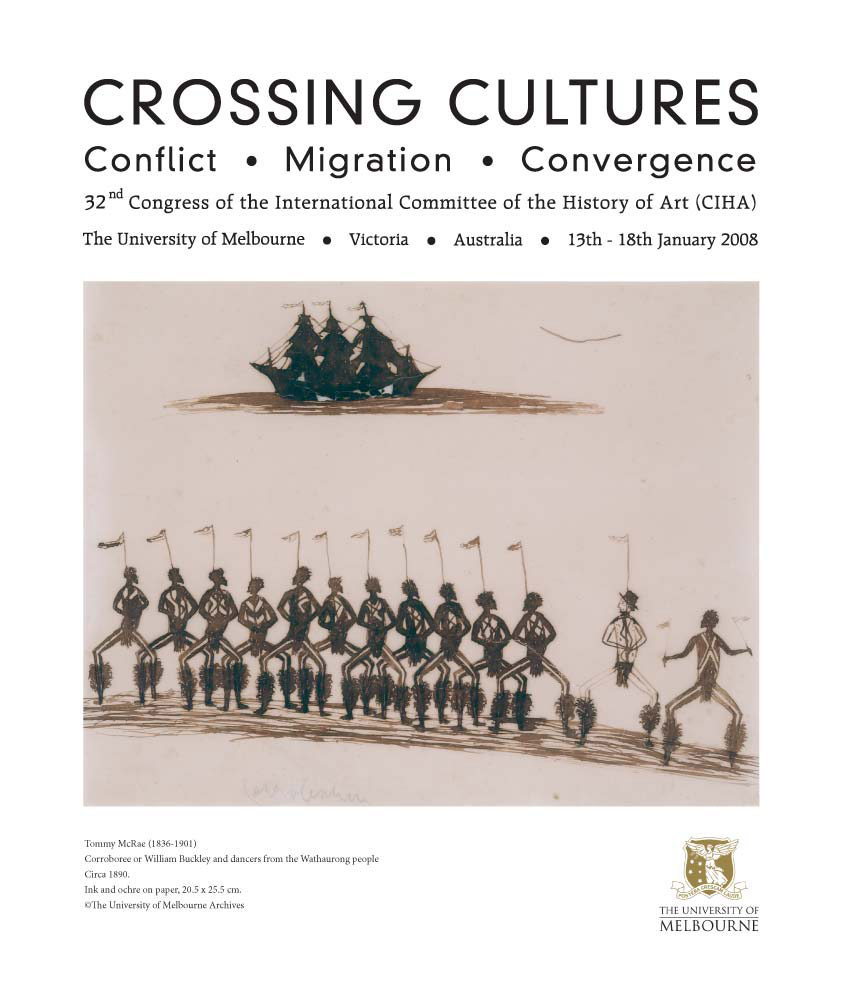 Conference papers from the 32nd Congress of the International Committee of the History of Art (CIHA), which convened in Melbourne, Australia, in January 2008, will soon be published by Miegunyah Press. Entitled Crossing Cultures: Conflict, Migration and Convergence, the book is edited by the conference convenor Jaynie Anderson.
Art and its history are not only created but are also discussed in one form or another on all the inhabited continents of the earth. Globalism has also assumed an art-historical aspect: indeed it has been described as art history’s most pressing issue. The themes are conflict, migration, and convergence in the visual, symbolic, and artistic exchanges between cultures throughout history. This publication will explore these themes.
This bound book is only available via a preorder form. It will not be available from any other outlets. Orders for this publication will be accepted until February 27, 2009—don’t miss this opportunity! Individual chapters of the book will also be available to purchase and download online in June 2009.
Conference Job Interviewing Advice
posted Dec 09, 2008
The Chronicle of Higher Education has published an article on what “Conference Rookies” should expect while on job hunts at academic conferences. Two academic career experts—Julie Miller Vick of the University of Pennsylvania and Jennifer S. Furlong of Columbia University’s Center for Career Education—provide tips and pointers on scheduling interviews, eating, organizing materials, and more.
CAA will soon publish its Career Services Guide on the conference website. The document will also appear in the forthcoming January issue of CAA News and be available at Orientation and in the Candidate Center at the 2009 Annual Conference in Los Angeles. In the meantime, both job candidates and interviewers are encouraged to review CAA’s two Standards and Guidelines dealing with the job search—Etiquette for CAA Interviewers and Standards for Professional Placement—as well as to read CAA’s recommendations for preparing CVs and résumés for artists, art historians, and museum professionals.
Arts Policy Brief Sent to Obama Transition Office
posted Dec 08, 2008
The Arts Education Network Weekly News reports that several national arts and arts education organizations have submitted a policy brief on the arts to President-elect Barack Obama and his transition team. The brief covers recommendations for the National Endowment for the Arts; cultural exchange; arts education in school, work, and life; national service and the arts; and the role of the arts in nonprofit communities. The brief also requests that the incoming president appoint a senior-level administration official to coordinate arts and cultural policy.
According to the brief, “The arts and cultural community welcomes the opportunity to communicate with President-Elect Obama and his staff in re-imagining how the federal government can inspire and support creativity in communities nationwide through robust policies that advance participation in the arts for all Americans.”
The following are the recommendations proposed for arts education:
- Prevent economic status and geographic location from denying students a comprehensive arts education
- Ensure equitable access to the full benefits of arts education when reauthorizing the Elementary and Secondary Education Act so that all, not just some, students can learn to their full potential
- Exercise leadership to encourage arts-based and other creative learning environments for academically at-risk students participating in Title I-funded programs
- Retain the arts in the definition of core academic subjects of learning and reauthorize the Arts in Education Programs of the US Department of Education
- Fund after-school arts learning opportunities and support arts-education partnerships between schools and community arts and cultural organizations
- Move federal policy beyond simply declaring the arts as a core academic subject to actually implementing arts education as an essential subject of learning
- Require states to issue annual public reports on the local status and condition of arts education and other core academic subjects
- Improve national data collection and research in arts education
- Invest in professional development opportunities for teachers in the arts
- Deploy arts education as an economic-development strategy
- Authorize and encourage inclusion of arts learning in STEM (science, technology, engineering, and mathematics) initiatives in order to foster imagination and innovation. Without the arts, STEM falls short of its potential to advance education and workforce development
- Fully preparing students with the creative skills they will need to advance our nation’s position in the twenty-first-century global economy requires implementing the arts as a core subject of learning and ensuring that all students attain cultural literacy
- Ensure that the full range of federal initiatives that advance workforce development, such as Department of Labor programs, provide training in the skills of creativity and imagination
Among the many joining organizations are Americans for the Arts, the American Association of Museums, the Association of Art Museum Directors, the Literary Network, the National Assembly of State Arts Agencies, the National Council for Traditional Arts, and the National Performance Network.
Arts Policy Brief Sent to Obama Transition Office
posted Dec 08, 2008
The Arts Education Network Weekly News reports that several national arts and arts education organizations have submitted a policy brief on the arts to President-elect Barack Obama and his transition team. The brief covers recommendations for the National Endowment for the Arts; cultural exchange; arts education in school, work, and life; national service and the arts; and the role of the arts in nonprofit communities. The brief also requests that the incoming president appoint a senior-level administration official to coordinate arts and cultural policy.
According to the brief, “The arts and cultural community welcomes the opportunity to communicate with President-Elect Obama and his staff in re-imagining how the federal government can inspire and support creativity in communities nationwide through robust policies that advance participation in the arts for all Americans.”
The following are the recommendations proposed for arts education:
- Prevent economic status and geographic location from denying students a comprehensive arts education
- Ensure equitable access to the full benefits of arts education when reauthorizing the Elementary and Secondary Education Act so that all, not just some, students can learn to their full potential
- Exercise leadership to encourage arts-based and other creative learning environments for academically at-risk students participating in Title I-funded programs
- Retain the arts in the definition of core academic subjects of learning and reauthorize the Arts in Education Programs of the US Department of Education
- Fund after-school arts learning opportunities and support arts-education partnerships between schools and community arts and cultural organizations
- Move federal policy beyond simply declaring the arts as a core academic subject to actually implementing arts education as an essential subject of learning
- Require states to issue annual public reports on the local status and condition of arts education and other core academic subjects
- Improve national data collection and research in arts education
- Invest in professional development opportunities for teachers in the arts
- Deploy arts education as an economic-development strategy
- Authorize and encourage inclusion of arts learning in STEM (science, technology, engineering, and mathematics) initiatives in order to foster imagination and innovation. Without the arts, STEM falls short of its potential to advance education and workforce development
- Fully preparing students with the creative skills they will need to advance our nation’s position in the twenty-first-century global economy requires implementing the arts as a core subject of learning and ensuring that all students attain cultural literacy
- Ensure that the full range of federal initiatives that advance workforce development, such as Department of Labor programs, provide training in the skills of creativity and imagination
Among the many joining organizations are Americans for the Arts, the American Association of Museums, the Association of Art Museum Directors, the Literary Network, the National Assembly of State Arts Agencies, the National Council for Traditional Arts, and the National Performance Network.