CAA News Today
NEA Survey Shows a Decline in Art Participation
posted by Christopher Howard — June 16, 2009
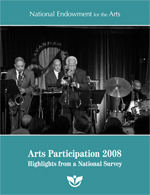 American audiences for the arts are getting older and their numbers are declining, according to new research released yesterday by the National Endowment for the Arts (NEA). Arts Participation 2008: Highlights from a National Survey, which can be ordered or downloaded from the NEA website, features top findings from the 2008 Survey of Public Participation in the Arts, the nation’s largest and most representative periodic study of adult participation in arts events and activities, conducted by the NEA in partnership with the US Census Bureau.
Five times since 1982, the survey has asked US adults eighteen and older about their patterns of arts participation over a twelve-month period. The 2008 survey reveals dwindling audiences for many art forms, but it also captures new data on internet use and other forms of arts participation. Although the 2008 recession likely affected survey responses, long-term trend analysis indicates that other factors also may have contributed to lower arts participation rates.
There are persistent patterns of decline in participation for most art forms. Although nearly 35 percent of US adults—an estimated 78 million—attended an art museum or an arts performance in the 2008 survey period, the figure is a decline from 40 percent reported in 1982, 1992, and 2002.
Attendance at the most popular types of arts events—such as art museums and craft or visual-arts festivals—saw notable declines. The US rate of attendance for art museums fell slightly from a high of 26 percent in 1992–2002 to 23 percent in 2008, comparable to the 1982 level.
Further, fewer adults are creating and performing art. Weaving and sewing remain popular as crafts, but the percentage of adults who do those activities has declined by 12 points. Only the number of adults doing photography has increased—from 12 percent in 1992 to 15 percent in 2008.
Historically the most dependable arts participants, forty-five to fifty-four-year-olds, showed the steepest declines in attendance for most art events, compared with other age groups. Educated Americans—the most likely to attend or participate in the arts—are doing so less than before, and less-educated adults have significantly reduced their already low levels of attendance.
In a positive trend, the internet and mass media are reaching substantial audiences for the arts. Consider these findings:
- About 70 percent of US adults went online for any purpose in 2008 survey, and of those adults, nearly 40 percent used the web to view, listen to, download, or post artworks or performances
- Thirty percent of internet-using adults download, watch, or listen to music, theater, or dance performances online at least once a week. More than 20 percent of them view paintings, sculpture, or photography at least once a week
- More Americans view or listen to broadcasts and recordings of arts events than attend them live (live theater being the sole exception). Classical and Latin or salsa music were the most popular music categories (with 40 and 33.5 million viewers/listeners, respectively), and 33.7 million adults reported listening to, or viewing programs or recordings about books and writers. The same number (33.7 million) enjoyed broadcasts or recordings about the visual arts.
The entire survey questionnaire, the raw data, and a user’s guide are available both on the NEA website and from Princeton University’s Cultural Policy and the Arts National Data Archive (CPANDA). More detailed study results will be available later this year.
Getty Research Institute on the Future of the BHA
posted by Christopher Howard — June 16, 2009
The Getty Research Institute just published a statement on its website regarding the future of the Bibliography on the History of Art (BHA, also known as the International Bibliography of Art, or IBA). The statement appears in full below:
In response to current economic conditions, the J. Paul Getty Trust recently announced it will significantly reduce its 2010 fiscal year budget. This will have an impact on all of the Getty’s operations, including the Getty Research Institute (GRI). Since news of the Getty’s budget reduction became public, including information about the Bibliography of the History of Art (BHA), we have received some inquiries about the BHA’s future. We thought it would be helpful to review the history of the Getty’s involvement with the BHA, the current status of the database, and our expectations for its future.
From 1990, when the International Repertory of the Literature of Art (RILA) and the Répertoire d’Art et d’Archéologie (RAA) came together to form BHA, it was a joint project between the Getty and the major database producer, the Institut de l’Information Scientifique et Technique-CNRS. At the end of 2007, this collaboration ceased and BHA formally came to an end. Since January 2008, the GRI has continued production of the database on its own, under the name of the International Bibliography of Art (IBA), and over the last sixteen months, the GRI has made an effort to forge collaborative partnerships on the IBA both nationally and internationally.
While there is interest in seeing the database continue, there have been no formal partnership commitments and no guarantees of outside funding for the project. Unfortunately, with the GRI facing severe budget challenges and without strong and committed partners to share the work, it has become impossible for the Getty to maintain the IBA on its own. Nevertheless, the GRI continues to be interested in seeing the IBA continue its service to the art historical field.
In the near term, the IBA will continue its work, and the first of three updates to the database will be on June 30, 2009. This update will include new data (IBA), and all of the past data of BHA and RILA. It will not contain RAA. This June 30 update will also include the updates from December 31, 2008 and March 31, 2009, which were delayed for technical reasons. All subscribers will also receive scheduled updates on September 30, and December 31, 2009.
Beginning January 1, 2010, the Getty will no longer support the ongoing IBA. We are hopeful that by this time the IBA will be transferred to an organization that can provide continuing support for this valuable resource. Our goal is to move the BHA/IBA to an organization that will provide a transfer in service smooth enough that subscribers may not even notice. We are hopeful that the same distributors will be used after January 1, 2010, and that updates will continue in a regular way.
We will keep the art historical community informed as this process develops. At this time, we would like to express our gratitude to the art reference librarians, art historians, and graduate students whose support has sustained RILA/BHA/IBA for over 29 years. We look forward to your continued support during this period of transition.
Last week CAA published a short statement addressing its concerns about this invaluable database for academic research in the visual arts.
NEA Survey Shows a Decline in Art Participation
posted by Christopher Howard — June 16, 2009
American audiences for the arts are getting older and their numbers are declining, according to new research released yesterday by the National Endowment for the Arts (NEA). Arts Participation 2008: Highlights from a National Survey, which can be ordered or downloaded from the NEA website, features top findings from the 2008 Survey of Public Participation in the Arts, the nation’s largest and most representative periodic study of adult participation in arts events and activities, conducted by the NEA in partnership with the US Census Bureau.
Five times since 1982, the survey has asked US adults eighteen and older about their patterns of arts participation over a twelve-month period. The 2008 survey reveals dwindling audiences for many art forms, but it also captures new data on internet use and other forms of arts participation. Although the 2008 recession likely affected survey responses, long-term trend analysis indicates that other factors also may have contributed to lower arts participation rates.
There are persistent patterns of decline in participation for most art forms. Although nearly 35 percent of US adults—an estimated 78 million—attended an art museum or an arts performance in the 2008 survey period, the figure is a decline from 40 percent reported in 1982, 1992, and 2002.
Attendance at the most popular types of arts events—such as art museums and craft or visual-arts festivals—saw notable declines. The US rate of attendance for art museums fell slightly from a high of 26 percent in 1992–2002 to 23 percent in 2008, comparable to the 1982 level.
Further, fewer adults are creating and performing art. Weaving and sewing remain popular as crafts, but the percentage of adults who do those activities has declined by 12 points. Only the number of adults doing photography has increased—from 12 percent in 1992 to 15 percent in 2008.
Historically the most dependable arts participants, forty-five to fifty-four-year-olds, showed the steepest declines in attendance for most art events, compared with other age groups. Educated Americans—the most likely to attend or participate in the arts—are doing so less than before, and less-educated adults have significantly reduced their already low levels of attendance.
In a positive trend, the internet and mass media are reaching substantial audiences for the arts. Consider these findings:
- About 70 percent of US adults went online for any purpose in 2008 survey, and of those adults, nearly 40 percent used the web to view, listen to, download, or post artworks or performances
- Thirty percent of internet-using adults download, watch, or listen to music, theater, or dance performances online at least once a week. More than 20 percent of them view paintings, sculpture, or photography at least once a week
- More Americans view or listen to broadcasts and recordings of arts events than attend them live (live theater being the sole exception). Classical and Latin or salsa music were the most popular music categories (with 40 and 33.5 million viewers/listeners, respectively), and 33.7 million adults reported listening to, or viewing programs or recordings about books and writers. The same number (33.7 million) enjoyed broadcasts or recordings about the visual arts.
The entire survey questionnaire, the raw data, and a user’s guide are available both on the NEA website and from Princeton University’s Cultural Policy and the Arts National Data Archive (CPANDA). More detailed study results will be available later this year.
CAA Statement on BHA and Getty Research Institute
posted by Michael Fahlund — June 12, 2009
Like many of our art colleagues and allied academic and cultural institutions in the field, the College Art Association is deeply concerned about the status of the Bibliography of the History of Art (BHA). CAA continues to communicate with the Getty Research Institute (copublisher of the BHA, along with the French Institut de l’Information Scientifique et Technique du Centre National de la Recherche Scientifique) about the future of the BHA and how this vital bibliographic resource can be maintained. We will do what we can as necessary to secure its longevity once we have had our inquiries answered by the Getty.
Obama Intends to Nominate Jim Leach as NEH Chairman
posted by Christopher Howard — June 04, 2009
Today, President Barack Obama announced his intent to nominate former Republican Congressman Jim Leach as Chairman of the National Endowment for the Humanities.
Obama said, “I am confident that with Jim as its head, the National Endowment for the Humanities will continue on its vital mission of supporting the humanities and giving the American public access to the rich resources of our culture. Jim is a valued and dedicated public servant and I look forward to working with him in the months and years ahead.”
Jim Leach served as a member of the US House of Representatives for the state of Iowa for thirty years. He founded and cochaired the Congressional Humanities Caucus, which is dedicated to advocating on behalf of the humanities in the House and to raising the profile of humanities in the United States. The caucus worked to promote and preserve humanities programs and commissions such as the Historical Publications and Records Commission. Leach and his cofounder, Rep. David Price, received the Sidney R. Yates Award for Distinguished Public Service to the Humanities from the National Humanities Alliance in 2005. During his tenure in Congress, Leach also served as chairman of the House Committee on Banking and Financial Services (1995-2001), a senior member of the House Committee on International Relations, and chairman of the committee’s Subcommittee on Asian and Pacific Affairs (2001-6). In addition, Leach is a member of the Council on Foreign Relations, the vice chairman of the Century Foundation’s board of trustees and has served on the boards of the Social Sciences Research Council, ProPublica, the Carnegie Endowment for International Peace and the Kettering Foundation. Since leaving Congress in 2007, he has taught at Princeton University and served as the interim director of the Institute of Politics at Harvard University’s John F. Kennedy School of Government.
Obama Intends to Nominate Jim Leach as NEH Chairman
posted by Christopher Howard — June 04, 2009
Today, President Barack Obama announced his intent to nominate former Republican Congressman Jim Leach as Chairman of the National Endowment for the Humanities.
Obama said, “I am confident that with Jim as its head, the National Endowment for the Humanities will continue on its vital mission of supporting the humanities and giving the American public access to the rich resources of our culture. Jim is a valued and dedicated public servant and I look forward to working with him in the months and years ahead.”
Jim Leach served as a member of the US House of Representatives for the state of Iowa for thirty years. He founded and cochaired the Congressional Humanities Caucus, which is dedicated to advocating on behalf of the humanities in the House and to raising the profile of humanities in the United States. The caucus worked to promote and preserve humanities programs and commissions such as the Historical Publications and Records Commission. Leach and his cofounder, Rep. David Price, received the Sidney R. Yates Award for Distinguished Public Service to the Humanities from the National Humanities Alliance in 2005. During his tenure in Congress, Leach also served as chairman of the House Committee on Banking and Financial Services (1995-2001), a senior member of the House Committee on International Relations, and chairman of the committee’s Subcommittee on Asian and Pacific Affairs (2001-6). In addition, Leach is a member of the Council on Foreign Relations, the vice chairman of the Century Foundation’s board of trustees and has served on the boards of the Social Sciences Research Council, ProPublica, the Carnegie Endowment for International Peace and the Kettering Foundation. Since leaving Congress in 2007, he has taught at Princeton University and served as the interim director of the Institute of Politics at Harvard University’s John F. Kennedy School of Government.
June 2009 Issue of The Art Bulletin Published
posted by Christopher Howard — June 02, 2009
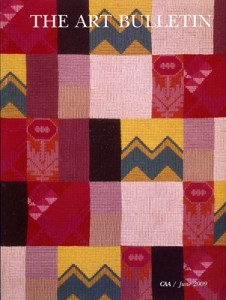 The June 2009 issue of The Art Bulletin, the leading publication of art-historical scholarship, has just been published. It will be mailed to those CAA members who elect to receive it, and to all institutional members.
On the cover is a detail of a pillowcase designed ca. 1916 by the Swiss artist Sophie Taeuber, which accompanies an essay by Bibiana Obler that considers the difference between Taeuber’s and Hans Arp’s public and private identities through a set of collaborative and closely related works and why they kept their most “advanced” work to themselves.
For her contribution, Stephanie Leitch investigates Hans Burgkmair’s images of non-Western communities in the woodcut frieze The Peoples of Africa and India (1508), which neither played into iconographic presets nor invented new stereotypes. Two more essays round out the issue: Norma Broude explores the political dynamics of gender informing the intentions, subjects, production, and reception of Giambattista Tiepolo’s frescoes for the palazzina of the Villa Valmarana, and Laura Morowitz examines the extraordinary popularity and religious undercurrents of the Hungarian artist Mihály Munkácsy’s paintings Christ before Pilate and Christ on Golgotha in late-nineteenth-century America.
The June issue of The Art Bulletin also contains reviews of books on Chinese epigraphy, Giovanni Bellini, Lucas Cranach the Elder, and Marcel Duchamp. Please read the full table of contents for more details.
Spring Meiss Grant Winners
posted by Christopher Howard — May 29, 2009
CAA has awarded three grants from the Millard Meiss Publication Fund for spring 2009. Thanks to the generous bequest of the late Prof. Millard Meiss, these grants are given twice annually to publishers to support the publication of scholarly books in art history and related fields.
The grantees are:
- Anna Arnar, The Book as Instrument: Stéphane Mallarmé, the Artist’s Book, and the Transformation of Print Culture, University of Chicago Press
- Nehabat Avcioglu, Turkish Architecture in Europe, 1737–1876, Ashgate
- Bissera Pentcheva, The Sensual Icon: Ritual, Space, and the Senses in Byzantium, Pennsylvania State University Press
Books eligible for a Meiss grant must already be under contract with a publisher and be on a subject in the arts or art history. Authors must be current CAA members.
Please note that the Millard Meiss Publication Fund has been suspended for fall 2009–spring 2010.
MLA and HASTAC Developing Tenure Guidelines for Digital Scholarship
posted by Christopher Howard — May 27, 2009
“Even as the use of electronic media has become common across fields for research and teaching,” reports Scott Jaschik at Insider Higher Ed, “what is taken for granted among young scholars is still foreign to many of those who sit on tenure and promotion committees.”
While junior professors lament the exclusion or diminution from tenure reviews of their born-digital work, whether publication or project, the Modern Language Association (MLA) and a group called the Humanities, Arts, Science, and Technology Advanced Collaboratory (HASTAC) are tackling the issue head on with new guides that offer tenure committees help in properly evaluating digital scholarship. MLA’s Information Technology Committee is developing these guides through a wiki, which publishes both finished and in-progress work.
In his article, “Tenure in a Digital Era,” Jaschik examines the many perceptions and problems at issue, including peer review; digital and print publications; and work that crosses traditional categories of research, teaching, and service.
NEH Funding Request for FY 2010
posted by Christopher Howard — May 20, 2009
“Serious long-term challenges posed by rapid globalization, economic crisis, and threats to our national security require solutions informed by the humanities,” wrote Pauline Yu, president of the American Council of Learned Societies, in a testimony submitted last month to the House of Representations in support of the National Endowment for the Humanities (NEH). Yu called for at least $230 million in funding for the NEH for fiscal year 2010—an increase of $75 million above the present year’s budget. (Download and read Yu’s full testimony to the Appropriations Subcommittee on Interior, Environment, and Related Agencies.)
Earlier this month, however, President Barack Obama’s FY 2010 budget allotted only $171.315 million for the endowment, far short of Yu’s request but $16.315 million more than the current year.
With this proposed increase, the NEH seeks to establish a new grant program, entitled Sustaining Cultural Heritage Collections, which will allow institutions to plan or implement preventative conservation measures that prolong the useful life of humanities collections. The endowment will also reintroduce preservation research and development grants for projects that address major challenges in preserving and maintaining access to humanities collections and resources. And through its We the People program, the NEH will continue to fund humanities projects that strengthen the teaching, study, and understanding of the nation’s history and culture.
Additionally, Obama’s request includes new oversight responsibility for the National Capital Arts and Cultural Affairs program. With the program’s transfer from the US Commission of Fine Arts, the NEH will manage a redesigned program of competitive grants to arts, historical, and cultural institutions in the District of Columbia.
In addition to a general overview of Obama’s NEH budget request, more information is available in the summary and highlights or the detailed budget request of the endowment’s FY 2010 appropriation request. A table with the FY 2010 funding request figures, by division and office with FY 2008 and FY 2009 appropriation amounts, is also available.
See also a brief report on funding for the National Endowment for the Art for FY 2010.