
CAA News Today
Bernard Hanson: In Memoriam
posted by CAA — September 22, 2009
Jay Garfield is Doris Silbert Professor in the Humanities, professor of philosophy, and director of the Logic Program and of the Five College Tibetan Studies in India Program at Smith College in Northampton, Massachusetts. He is also professor in the graduate faculty of philosophy at the University of Massachusetts, professor of philosophy at Melbourne University, and adjunct professor of philosophy at the Central Institute of Higher Tibetan Studies.
Bernard Allen Hanson, an art historian, critic, professor, and administrator, died on June 21, 2009, after a short illness. He was 86. For years he was recognized around New Haven, Connecticut, by his blue pickup truck with its elegantly lettered moniker, “Bernard Hanson. Art Critic.”
The youngest of five children, Hanson was born to Stephen Bernard (Bert) Hanson and Stella Cook Hanson on October 11, 1922, in Williamsburg, Iowa. He graduated from the University of Iowa in 1944 with a degree in English. While at the university he was a two-time Big Ten gymnastics champion, performing on the side horse, and was a member of the Scottish Highlanders. He earned his MA in art history at the same school and pursued doctoral research at New York University and the University of Pennsylvania.
Hanson enjoyed a distinguished career in art history. His research, teaching, and public lectures addressed the history of Indian art, the nature of public art, the history of architecture, and film theory. Hanson was not only a noted scholar, but also an eminent academic leader and a public intellectual. His teaching career spanned four decades, and included appointments at Northwestern University, the Philadelphia College of Art, and the Hartford Art School at the University of Hartford. Hanson served as director of the Humanities Division at the Philadelphia College of Art and as dean at the Hartford School of Art from 1970 to 1979 before returning to the teaching faculty until his retirement in 1987.
Hanson said once in an interview, “Before people are anything, they are human beings, and education in an art school should be basically humanistic,” and his approach to teaching, to academic leadership, and to public comment on the arts reflected this sentiment. His tenure as dean at Hartford was notable for the steady stream of distinguished artists he invited to visit the school, for the installations and happenings he initiated, for the vibrancy of the community under his leadership, and for his curricular innovations, encouraging broader academic study by art students. The Hartford Art School recently recognized his contributions by endowing the Bernard Hanson Scholarship for promising artists with financial need.
Hanson was a noted New England art critic, contributing for over two decades to the West Hartford News, the Hartford Courant (where he received an honorable mention in a national art criticism competition sponsored by Art/World Magazine), and the Middletown Press. His columns were noteworthy for their ability to bring serious erudition to bear in commentary accessible to ordinary readers.
After retiring from the University of Hartford, Hanson volunteered in Literacy Volunteers of America and as a teacher’s aide in Miss DeNuzzo’s second-grade class at the East Rock School in New Haven. He derived as much joy from contributing in these contexts as he did from his academic career.
Hanson was preceded in death by his wife and fellow art historian, Anne Coffin Hanson. He is survived by his daughter, Bridget, his stepchildren Robert, James, and Blaine Garson, his nephew Stephen, and their families, as well as his beloved dog, Sheldon.
Memorial contributions can be made to the Bernard Hanson Endowed Scholarship at the University of Hartford or the SPCA of Connecticut.
Recent Deaths in the Arts
posted by Christopher Howard — September 22, 2009
CAA recognizes the lives and achievements of the following artists, scholars, curators, photographers, and other professionals and important figures in the visual arts. Of special note is an obituary written especially for CAA: Jay Garfield on Bernard Hanson.
- David K. Anderson, a contemporary art dealer from Buffalo, NY, who donated his art gallery and part of his collection to the University at Buffalo, died on August 15, 2009, at the age of 74
- Hyman Bloom, a Latvian-born American artist whose pre–Abstract Expressionist paintings were influenced by his interest in mysticism and spirituality, died on August 26, 2009. He was 96
- Humphrey Case, an English prehistorian and archaeologist who specialized in Neolithic Beaker culture, died on June 13, 2009, at the age of 91
- Michael Dailey, a teacher and abstract painter from Seattle who continued to paint while living with multiple sclerosis, died on August 9, 2009, at age 71
- John Edwards, a British abstract painter, sculptor, and teacher whose later work was influenced by his time spent in India, died on August 22, 2009. He was 71
- Barry Flanagan, a sculptor and printmaker whose interdisciplinary interests in dance, poetry, and literature influenced his work, died on August 31, 2009, at the age of 68. He experimented with Minimalism and land art but is best known for his bronze hares
- Donald Hamilton Fraser, a British artist and journalist for Arts Review who, at different times, employed both abstraction and figuration in his painting, died on September 2, 2009, at the age of 80
- Robinson Fredenthal, a sculptor from Philadelphia whose work was influenced by his struggle with Parkinson’s disease, died on August 31, 2009, at age 69
- Frederick Gore, an English art teacher, author, and plein-air painter of landscapes and cityscapes, died on August 31, 2009, at the age of 95
- Max Gurvich, a Seattle arts patron who supported the Seattle Art Museum and the Cornish College of the Arts, died on June 15, 2009, at age 91
- Bernard Hanson, a New England-based art historian, art critic, and professor, died on June 21, 2009. He was 86. Jay Garfield of Smith College has written a special text for CAA
- Charles Harrison, an art historian, critic, and former editor of Art-Language and Studio International, died on August 6, 2009, at age 67. He also taught, organized exhibitions, and was instrumental in creating the anthology Art in Theory 1900–1990, with Paul Wood
- James Krenov, a Russian-born woodworker, teacher, and writer whose furniture designs are responsive to the unique characteristics of the wood he used, died on September 9, 2009, at the age of 88
- James Lord, a memoirist and biographer of Pablo Picasso and Alberto Giacometti, died on August 23, 2009. He was 86
- Janet MacLeod, a British sculptor of bronze, marble, and silver who focused on the theme of regeneration, died in summer 2009 at the age of 72
- Michael Mazur, a teacher, painter, printmaker, and illustrator who specialized in monotypes, died on August 18, 2009. He was 73
- Richard Merkin, a teacher, painter, and illustrator whose colorful images appeared in various publications, including the New Yorker, died on September 5, 2009, at age 70. His extravagant and flamboyant style not only influenced his art, but also led him to write a style column for GQ
- Milo M. Naeve, a former curator of American art at the Art Institute of Chicago, died on August 10, 2009. He was 77
- Mario Cravo Neto, a Brazilian photographer whose work, often spiritual, documented the people of the Bahia region where he was from, died on August 9, 2009, at age 62
- Alexander Podlashuc, a South African artist, teacher, and cofounder, with his wife, of the Bloemfontein Group, died on September 5, 2009, at the age of 79
- Willy Ronis, a French photographer and former photojournalist who documented street scenes in Paris, died on September 12, 2009. He was 99
- Buky Schwartz, an Israeli sculptor and video artist, died on September 2, 2009, at the age of 77
- Paul Shanley, a former publisher of the magazines Art in America and Arts, died on September 2, 2009. He was 83
- David Thomson, a British writer on art and architecture of the Renaissance and a lecturer on art history, died in summer 2009, at age 57
- Maurizio Valenzi, a Tunisian-born painter and a communist politician, died on June 23, 2009. He was 99
- Christina Von Hassell, an art critic and auction reporter in New York, died on August 15, 2009, at the age of 85
- Leslie Worth, an English watercolor artist, teacher, former president of the Royal Watercolour Society, and author of The Practice of Watercolour Painting, died on July 21, 2009, at age 86
Read all past obituaries in the arts on the CAA website.
Obama Names Committee on the Arts and the Humanities Leaders
posted by Christopher Howard — September 18, 2009
Barack Obama has appointed new leaders to the President’s Committee on the Arts and the Humanities. George Stevens, Jr., and Margo Lion will serve as cochairs, and Mary Schmidt Campbell will be vice chair.
This committee, founded in 1982 and comprised of private citizens from across the United States, advocates for the arts and humanities as core of a vital society. It works with the National Endowment for the Arts, the National Endowment for the Humanities, and the Institute of Museum and Library Services to advance nonpartisan cultural objectives of the Obama administration.
Stevens is a writer, director, producer of motion pictures and television, founder of the American Film Institute, and creator of the Kennedy Center Honors. He fostered a new generation of documentary filmmakers as head of the US Information Agency’s Motion Picture Service during the Kennedy presidency.
As a Broadway producer, Lion has worked with Tony Kushner, David Mamet, Arthur Miller, August Wilson, and George C. Wolfe, and her work has earned Tony and Olivier awards and a Pulitzer Prize. She is also an adjunct professor and a member of the Dean’s Council at New York University’s Tisch School of the Arts.
Tisch is also home to Campbell, where she is dean. A former chair of the New York State Council on the Arts, Campell was executive director of the Studio Museum in Harlem, where she wrote the catalogue for the exhibition Memory and Metaphor: The Art of Romare Bearden, 1940–1987.
In early August, President Obama appointed Rachel Goslins, an independent television and film producer, as the committee’s executive director.
Obama Names Committee on the Arts and the Humanities Leaders
posted by Christopher Howard — September 18, 2009
Barack Obama has appointed new leaders to the President’s Committee on the Arts and the Humanities. George Stevens, Jr., and Margo Lion will serve as cochairs, and Mary Schmidt Campbell will be vice chair.
This committee, founded in 1982 and comprised of private citizens from across the United States, advocates for the arts and humanities as core of a vital society. It works with the National Endowment for the Arts, the National Endowment for the Humanities, and the Institute of Museum and Library Services to advance nonpartisan cultural objectives of the Obama administration.
Stevens is a writer, director, producer of motion pictures and television, founder of the American Film Institute, and creator of the Kennedy Center Honors. He fostered a new generation of documentary filmmakers as head of the US Information Agency’s Motion Picture Service during the Kennedy presidency.
As a Broadway producer, Lion has worked with Tony Kushner, David Mamet, Arthur Miller, August Wilson, and George C. Wolfe, and her work has earned Tony and Olivier awards and a Pulitzer Prize. She is also an adjunct professor and a member of the Dean’s Council at New York University’s Tisch School of the Arts.
Tisch is also home to Campbell, where she is dean. A former chair of the New York State Council on the Arts, Campell was executive director of the Studio Museum in Harlem, where she wrote the catalogue for the exhibition Memory and Metaphor: The Art of Romare Bearden, 1940–1987.
In early August, President Obama appointed Rachel Goslins, an independent television and film producer, as the committee’s executive director.
September CAA News Published
posted by Christopher Howard — September 16, 2009
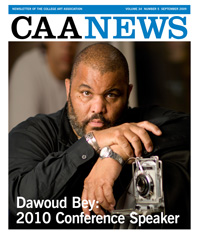 The September CAA News has just been published. All individual and institutional members may download the PDF from the CAA website.
Inside you’ll find early information about the upcoming Annual Conference. Among the special events for Chicago is a keynote address by the renowned photographer Dawoud Bey, who will speak at Convocation. In addition, the painter Phyllis Bramson has been named one of two artists to be interviewed in ARTspace.
Also included in the issue are details about two conference mentoring sessions—the Artists’ Portfolio Review and Career Development Mentoring—as well as an interview with Jackie Battenfield, the author of the recently published book, The Artist’s Guide: How to Make a Living Doing What You Love.
The September newsletter is the second in our return to a digital-only format. The layout has been changed to better fit your computer screen, and all images are now in color. If you prefer to read a hard copy, printed pages are clear and readable.
Submissions to the Endnotes section of the November CAA News are due by September 30; please review the guidelines before sending your listing. Questions or concerns? Please contact Christopher Howard, CAA managing editor.
Deadline for the Wyeth Book Grant Extended
posted by CAA — September 08, 2009
 The deadline for the Wyeth Foundation for American Art Publication Grant, established in 2005 with funding from the Wyeth Foundation for American Art, has been extended to Friday, October 9, 2009.
The Wyeth grant supports book-length scholarly manuscripts in the history of American art, visual studies, and related subjects that have been accepted by a publisher on their merits but cannot be published in the most desirable form without a subsidy. For purposes of the program, “American art” is defined as art created in the United States, Canada, and Mexico prior to 1970.
For more information, please contact Alex Gershuny, CAA editorial associate, at 212-691-1051, ext. 254.
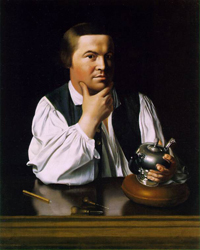
Image: John Singleton Copley, Paul Revere, 1768, oil on canvas, 35 1/8 x 28 1/2 in. Gift of Joseph W. Revere, William B. Revere and Edward H. R. Revere, 1930. 30.781 (artwork in the public domain)
September 2009 Issue of The Art Bulletin Published
posted by Christopher Howard — September 02, 2009
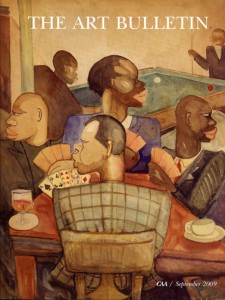 The September 2009 issue of The Art Bulletin, the leading publication of art-historical scholarship, has just been published. It will be mailed to those CAA members who elect to receive it, and to all institutional members.
Five articles make up the issue. Leading off is Rachel Kousser’s “Destruction and Memory on the Athenian Acropolis,” which argues that in the way it was commemorated, the Persians’ sack of the Acropolis in 480 BCE took on paradigmatic significance as an example of “Oriental violence.” Next is a text by Elena Boeck, who in “Simulating the Hippodrome: The Performance of Power in Kiev’s St. Sophia” analyzes strategies of display, appropriation, and simulation of Byzantine imperial symbols by Prince Iaroslav “the Wise” in the paintings of the hippodrome in Kiev’s St. Sophia.
In “Rubens and the Northern Past: The Michielsen Triptych and the Thresholds of Modernity,” Lynn F. Jacobs interrogates the miraculous thresholds of this work by Peter Paul Rubens, which negotiate relations between the donors and God and between the meanings inherent in the life and theology of Christ. Her essay is followed by “Nature and the Ideal in Khnopff’s Avec Verhaeren: Un Ange and Art, or the Caresses,” in which Brendan Cole examines the work of Fernand Khnopff from an iconographic perspective to reveal how the central concerns for all Symbolist artists—of duality and the reconciliation of opposites—are encoded in his paintings.
Last, Phoebe Wolfskill’s “Caricature and the New Negro in the Work of Archibald Motley Jr. and Palmer Hayden” evaluates the perplexing appearance of racial caricature in compositions by these two “New Negro” Renaissance painters and considers how pervasive stereotypes might inform self-perception. Hayden’s Nous quatre à Paris from ca. 1930 is the cover image for this issue.
Also included are seven reviews of books on Romanesque Partheny, Castilian culture, Inigo Jones, Utamaro, science in art, and more. Please read the full table of contents for more details.
CAA Joins Task Force on University Galleries and Museums
posted by Christopher Howard — September 01, 2009
In response to troubling trends in university museums and galleries—including the sale of Maier Art Museum paintings by Randolph College, the closure of the Rose Art Museum at Brandeis University, and the threat of sale of important modernist works at Fisk University—a task force was formed that includes CAA, the American Association of Museums, the Association of Art Museum Directors, the Association of College and University Museums and Galleries, and the Kress Foundation to address ways to educate university trustees about the educational value of university museums and to explore protective avenues. A petition was circulated to various associations and also set up online, which received several thousand signatures—including many from CAA members. The petition will be published in the Chronicle of Higher Education later this fall. Quiet conversations are continuing with Brandeis trustees, and several university accreditation commissions have been apprised of the concerns of the task force and the visual-arts field.
On the same topic, caa.reviews recently published an essay entitled “Curricular Connections: The College/University Art Museum as Site for Teaching and Learning.” The author, Laurel Bradley, who is director of exhibitions and curator of the College Art Collection at Carleton College, provides a brief history of university museums and galleries since the mid-twentieth century before exploring several recent initiatives—some funded by the Mellon Foundation’s College and University Art Museum Program—that combine academic and curatorial teaching and education in novel, and often successful, ways.
Witt and Conway Libraries at the Courtauld to Remain Open
posted by Christopher Howard — August 27, 2009
 Rumors have been circulating this summer about a possible closure of the Witt Library and the Conway Library at the Courtauld Institute of Art in England, a situation reported on last month by Martin Bailey in the Art Newspaper. The good news is that the two libraries will remain open for scholars and the public—but only after a two-month temporary shuttering beginning early next month. Yesterday CAA received the following missive from the venerable London-based art institution:
The Courtauld Institute of Art is pleased to confirm that the Witt and Conway Libraries will remain open to the public five days a week and [that] the Photographic Survey collections will continue to be accessible by appointment, contrary to concerns recently expressed by some members of the art community.
Like other higher education institutions worldwide, The Courtauld has had to review all its operational activities and services in the light of the current economic climate. This review has led to a decision to restructure the management of our image libraries in order to minimise their net cost to the Institute. To allow time to implement the agreed changes, these libraries will be temporarily closed from 7 September 2009 and will reopen on 2 November 2009. They will then be open to the public from Monday to Friday between the hours of 11am and 4pm (subject to usual Bank Holidays etc).
Requests for photographs, rights and reproduction rights from the Witt and Conway Libraries should continue to be addressed to Courtauld Images: +44 (0)20 7848 2879, images@courtauld.ac.uk or via www.courtauldimages.com.
The Witt Library houses a collection of about 2 million reproductions of Western paintings, drawings, and prints from 1200 AD to the present. The Conway Library has more than 1 million images, including photographs and cuttings of architecture, architectural drawings and publications, sculpture, ivories, seals, metalwork, manuscript illumination, stained glass, wall paintings, panel paintings, and textiles.
New CAA Affiliated Societies
posted by Emmanuel Lemakis — August 26, 2009
CAA welcomes two art organizations into its family of affiliated societies: the European Architectural History Network and Public Art Dialogue. Affiliated societies are groups of art professionals and other organizations whose goals are generally consonant with those of CAA, with a view toward facilitating intercommunication and mutual enrichment.
 The European Architectural History Network (EAHN) supports research and education by providing a public forum for the dissemination of knowledge about the histories of architecture. Based in Europe, it serves architectural historians and scholars in allied fields without restriction on their areas of study. The network seeks to overcome limitations imposed by national boundaries and institutional conventions through increasing the visibility of the discipline among scholars and the public; promoting scholarly excellence and innovation; fostering inclusive, transnational, interdisciplinary, and multicultural approaches to the history of the built environment; encouraging communication among the disciplines that study space; facilitating the open exchange of research results; and providing a clearinghouse for information related to the discipline.
 Public Art Dialogue (PAD), cochaired by Harriet F. Senie and Cher Krause Knight, is an organization devoted to public art. Its membership includes art historians, artists, curators, administrators, architects, landscape architects, and others engaged with the wide arc that encompasses public art. PAD’s goal is to provide platforms for dialogue among public-art professionals and students across disciplines.
For more information on CAA’s affiliated societies, please write to Emmanuel Lemakis, CAA director of programs.