CAA News Today
CAA Participates in Humanities Advocacy Day 2014
posted by Michael Fahlund — March 21, 2014
Humanities Advocacy Day 2014, sponsored by the National Humanities Alliance (NHA), took place in Washington, DC, on Monday and Tuesday, March 10 and 11, 2014. As a member of NHA, CAA supports that organization’s advocacy efforts and sends representatives to its annual meeting each year. CAA’s participation in these activities allows the association to promote the visual arts and to persuade others—in this case the members of both houses of Congress—to embrace the value of the humanities in education and in daily life.
The annual meeting on Monday included an opening welcome by George Washington University’s president, Steven Knapp, followed by a presentation by Stephen Kidd, NHA executive director, outlining the alliance’s advocacy agenda for the year. Knapp introduced additional speakers whose interests and projects intersect with the NHA’s four-pronged argument for stressing the value of the humanities: promoting opportunity for all Americans, fostering innovation and economic competitiveness, ensuring productive global engagement, and strengthening civic knowledge and practice. Knapp also identified two initiatives outside Congress to promote the humanities in the public sphere: Humanities Working Groups for Community Impact (see item 5) and Call for Videos. Aimed directly at the public rather than elected officials, these initiatives will help to establish to those outside the academy that the humanities are an area worth funding.
David Scobey, executive dean of the New School for Public Engagement, presented a talk called “E Pluribus Anthology: Why American Communities Need the Humanities,” which advocated a return to civic engagement as a way of reigniting the humanities. Carol Muller, professor of ethnomusicology at the University of Pennsylvania, discussed a community project that she directs, West Philadelphia Music, which amplified Scobey’s argument. Other speakers during the day included Elva LeBlanc, president of the Northwest Campus of Tarrant County College, who spoke on the relevancy of higher education and the importance of preparing students for change and complexity; and Francisco G. Cigarroa, chancellor of the University of Texas System. In the afternoon, Humanities Advocacy Day participants received issue briefs and background material concerning proposed funding levels for federal humanities programs and position papers that were helpful in preparing for congressional visits.
On Tuesday, six NHA delegates from the state of New York (listed in the next paragraph) visited the offices of Senators Kirsten Gillibrand and Charles Schumer and Representatives Jerrold Nadler, Eliot Engel, Carolyn Maloney, Tom Reed, and José E. Serrano. In each instance, the group urged senators and representatives to support specific fiscal-year budgets for the National Endowment for the Humanities ($154.4 million), the Institute for Museum and Library Services ($226.5 million), and the Library of Congress ($593 million), and to properly fund the National Historical Publications and Records Commission and Title VI/Fulbright-Hays international programs. NHA delegates also asked their legislators to sign “Dear Colleague” letters in support of these budgets based on the alliance’s funding recommendations, which are higher than those proposed by the Obama administration.
The New York delegates from NHA were: Kathleen Fitzpatrick, director of scholarly communication for the Modern Language Association; Peter Berkery Jr., executive director of the Association of American University Presses; Jennifer Steenshorne, junior associate editor for Columbia University Libraries; Jonathan Gilad, program assistant at the American Political Science Association; Michael Fahlund, CAA deputy director; and Betty Leigh Hutcheson, CAA director of publications.
Senate Museum Funding Push Is Now Bipartisan; Tell Your Senators to Join the Effort
posted by CAA — March 20, 2014
The American Alliance of Museums (AAM) sent the following email on March 19, 2014
Senate Museum Funding Push is Now Bipartisan; Tell Your Senators to Join the Effort
Senators Kirsten Gillibrand (D-NY) and Roy Blunt (R-MO) are now circulating a bipartisan letter urging the Senate Appropriations Committee to provide robust funding in FY 2015 for the Office of Museum Services (OMS) at the Institute of Museum and Library Services (IMLS). This is the fifth year that Senator Gillibrand has led this effort, but the first time Senator Blunt will co-lead the letter.
The deadline for Senators to sign on to this letter is March 25, 2014.
The Office of Museum Services is receiving $30.1 million this year, well below its authorized level of $38.6 million. The Gillibrand/Blunt letter is your Senators’ chance to go on record in support of museum funding, so ask them to sign on today!
“Following visits from his constituents during Museums Advocacy Day, Senator Blunt decided to co-lead this letter with Senator Gillibrand, making it a bipartisan effort and demonstrating the value of our field-wide efforts in Washington, D.C.,” said Alliance President Ford W. Bell. “I applaud Senators Gillibrand and Blunt for their leadership in supporting museums nationwide. We are especially thrilled that Senator Blunt has joined the cause this year; museums in Missouri should be proud to have such a responsive museum champion in Congress.”
Last year, you contacted legislators in record numbers and you made a real difference: a record-breaking number of Senators signed the letter supporting funding for the IMLS Office of Museum Services. Keep that momentum going by contacting your Senators now.
Thank you for acting on this important issue!
News from the Art and Academic Worlds
posted by Christopher Howard — March 19, 2014
Each week CAA News publishes summaries of eight articles, published around the web, that CAA members may find interesting and useful in their professional and creative lives.
Actual Raises for Faculty
Tenured and tenure-track faculty members at four-year colleges and universities are receiving raises this year that exceed the increase in the cost of living, according to a study that was released by the College and University Professional Association for Human Resources. The study found that the median increase in base salary is 2.1 percent, and that the annual increase in the Consumer Price Index for the period was 1.5 percent. (Read more from Inside Higher Ed.)
Average Salaries of Tenured and Tenure-Track Faculty at Four-Year Colleges, 2013–14
Law, business, and engineering again topped the list of the most lucrative disciplines for professors. But professors of theology and religious vocations saw one of the largest increases in salary, about 8 percent from 2012–13 to 2013–14. Where did the humanities and visual arts rank this year? (Read more from the Chronicle of Higher Education.)
DIA Grand Bargain Could Prove to Be a Work of Art, but Not a Done Deal
In 1919, with the Detroit Institute of Arts in dire financial straits and Detroit’s economy booming, museum leaders ceded ownership of the art and building to city hall in exchange for annual funding. Nearly a century later, history is preparing to do a somersault. Detroit is now bankrupt, DIA is more financially stable than it has been in decades, and the museum stands on the brink of being spun off into an independent charitable trust that would once again own the collection and building. (Read more from the Detroit Free Press.)
No More Silence of the Scholars
A bill introduced in the New York State Legislature seeks to protect art experts from what it describes as “frivolous” lawsuits. The proposed legislation aims to make it more difficult for owners, auctioneers, and dealers to bring lawsuits against art historians simply because they do not like their opinions. (Read more from the Art Newspaper.)
Museum Object Portfolio Performance
Most of us have some experience teaching with art “in the flesh”—in museums or galleries—rather than our usual fallback of classroom PowerPoint, Offline Image Viewer, which is ARTstor’s presentation technology, or Prezi presentations. And we often send students to a local museum or university gallery to write responses of one sort or another, giving them direct access to the original artwork. But in my undergraduate museum-studies class this semester, I wanted my students to consider the variety of ways that text can be used to introduce, augment, and/or constrain our response to the original object. (Read more from Art History Teaching Resources.)
The Ten Weirdest Artworks Ever
From sexy heels trussed and presented on a silver platter to Damien Hirst’s formaldehyde shark, the Guardian presents a tour through some of the strangest, most shocking surrealist art around. (Read more from the Guardian.)
Hoard d’Oeuvres: Art of the 1 Percent
Art collecting is the most esteemed form of shopping in our culture today. And in today’s digital economy, you can monitor this primal battle of achieving egos as it unfolds in real time, on computer screens. At auction you watch incomparable works of art vanish into exchange value: all that’s solid truly melts into air. The spectacle of yen, dollars, and euros mounting on the screen climaxes in the money shot: the sale price. (Read more from the Baffler.)
The Joys and Perils of Artistic Collaborations
Artists aren’t exactly known for their accommodating, easygoing ways. More often, it’s words such as “egocentric” and “introverted” that spring to mind. In reality, though, few artists work in total isolation, especially once they have achieved a certain level of success. Jeff Koons and Damien Hirst have teams of assistants making their work—yet these assistants can hardly be called collaborators. At the other end of the fame scale, collaboration is crucial for so-called emerging artists, through sharing materials and workspaces and exchanging ideas. (Read more from the Financial Times.)
New Faces for Art Journal
posted by Christopher Howard — March 18, 2014
Art Journal is inaugurating the new position of web editor. Following interviews in February and a strong recommendation from the journal’s editorial board, Anne Collins Goodyear, the president of CAA’s Board of Directors, has appointed Gloria Sutton to the position. The web editor will be responsible for the content and presentation of material on the journal’s website, which complements materials in the printed publication with freestanding projects, primarily by artists.
The step occurs as CAA moves to a partnership with Taylor & Francis, to publish all three of the organization’s journals: The Art Bulletin, Art Journal, and caa.reviews. CAA members will select the journal(s) they would like to receive in print, and for the first time all three journals will available online, free to CAA members.
Of the new position, Sutton writes, “I am excited to help shape Art Journal’s online presence during this pivotal period and foster new intellectual exchanges among artists, scholars, critics, and curators of contemporary art.”
Sutton, who is assistant professor of contemporary art history and new media at Northeastern University in Boston, Massachusetts, will serve a three-year term as web editor. She is an art historian, curator, and author of many works on new media, including the book The Experience Machine: Stan VanDerBeek’s Movie-Drome and Expanded Cinema, to be published by MIT Press this fall. Sutton has curated exhibitions at the Museum of Contemporary Art and the MAK Center for Art and Architecture, both in Los Angeles, California, and at Ars Electronica in Linz, Austria.
Also joining the Art Journal Editorial Board is the art historian Kate Mondloch, whose research focuses on the cultural, social, and aesthetic possibilities of new technologies. She is an associate professor of contemporary art and theory at the University of Oregon in Eugene, where she directs the certificate program in new media and culture. Mondloch is the author of Screens: Viewing Media Installation Art (Minneapolis: University of Minnesota Press, 2010).
Call for Session Chairs for CIHA 2016
posted by Christopher Howard — March 14, 2014
From the International Committee of the History of Art (Comité International de l’Histoire de l’Art, known as CIHA) and from the conveners of the Beijing Committee for the Congress: Professors LaoZhu, Fan Di’an, and Shao Dazhen.
Terms: Concepts of Art History
The organizing committee for the thirty-fourth Congress in the History of Art, which will take place in Beijing, China, in September 2016, warmly invites expressions of interest from the international community of art historians. The concepts for the sessions are outlined below. We ask for expressions of interest from scholars who wish to develop these themes as session chairs.
Each session will have an international chair and a Chinese chair. A Chinese chair may be from Chinese mainland, Taiwan, or abroad. An early career researcher might serve as associate chair, if necessary. The two cochairs (and an early career researcher, if there is one) will act as a committee to define and refine the session’s concept for the preliminary congress in 2015, and to select presenters for the major congress in Beijing in 2016.
Applications for chairs may be made by academics or independent scholars. We want to remind applicants that no member of the CIHA board, and no one having been a chair in the Nuremberg Congress in 2012, can apply for serving as chair of a session at the Beijing Congress.
Applicants should:
- Be thoroughly acquainted with the most recent developments in the field of art history relevant to the topic of their session
- Be able to develop the chosen concept by organizing relevant symposia and workshops before 2016, to initiate dialogue and discussion, and to identify important issues for discussion at CIHA 2016 in Beijing
- Be able to identify global experts in the appropriate fields and to collaborate with them
- To be present at CIHA 2016 in Beijing
Applicants should send the following to the CIHA scientific secretary with copy to Chinese committee:
- Number and title of the proposed session
- 1–2 pages explaining the perspective they intend to give to the session and the main ideas they would like to be developed and discussed
- A first draft of the call for papers to be developed with the Chinese chair if the session is selected
- A short CV stressing the activities and publications related to the session
The deadline for applications is April 10, 2014.
The list of the chairs will be established during the CIHA board meeting in Marseilles, France (June 25, 2014) and immediately announced on CIHA website and the Beijing Congress website.
Session Themes
The sessions as defined by the National Committee of the People’s Republic of China and the International Committee for the History of Art are as follows:
1. Words and Concepts【语词与概念】
The word for “art” has varied etymological origins and connotations in different languages, whether in Greek and Latin, in French and Italian, or in Japanese, Arabic, or Chinese. In each culture the concept of art has evolved over time. In some languages, such as Aboriginal Australian languages, there are no words for “art” at all.
This section explores the main theme of the 2016 CIHA Congress, different concepts of art in diverse cultures. The topic strives to achieve three goals. The first is to respond to the latest development of art history as a global discipline. The section aims to explore, through diverse definitions, art that exposes its relationship to the respective cultural framework, and to the disparities of different cultures in various periods throughout history, so as to gain a more comprehensive understanding of art as an essential part of human culture.
2. The Rank of Art【标准与品评】
How do we rank art, create cannons, and define taste as part of contemporaneity? How do we experience disparities in the interpretation of art, namely, judgments of art’s value, and how do we evolve different criteria for evaluating art?
This section explores how different concepts of art are rooted in consciously defined value systems. By contrast to interpretations of art, which abide by traditions and their evolution in specific cultural settings, there are self-conscious value systems and criteria that are part of theoretical reflection, part of an understanding, of self-awareness, and of a conscious establishment of norms. Different from general ideas or interpretations about/on art, these ideas have certain intentionality. The evaluation and ranking of art affects the development of art by defining the trends of art or restraining some aspects of its growth. In other words, the disparities of art arise from the disparities of evaluation criteria. Moreover, the same art could take on further disparities just because of different evaluation criteria. The idea of the contemporaneity in ranking and judgment is always changing. A work of art could, for instance, acquire completely different evaluations when it is presented in different regions or settings, or viewed by different groups of people.
3. Imagination and Projection【想象与投射】
What is the productive gaze? The imagination and projection produced by art varies with cultures. These imaginations and projections produce spectacles and images that in reality do not exist.
The third section investigates the social and cultural foundations of artistic difference. Besides the notion that the emergence of a certain concept of art is restricted by specific social and historical circumstances, special attention will be given to the fact that some societies and realities, in disparate historical periods, have been mythologized or embodied in legend, or in literature, so that they appear to be especially imaginative or hallucinatory. The goals are to observe and understand works of art as an interactive process and to bring art to a new level of knowledge and cultural experience. The discussion focuses on two aspects of this topic: the first is on the issue of the relationship between the sociocultural background and the artistic concept(s) it produces; the second the fermentation and symbiosis between imaginative and hallucinatory symbolization and the contemporaneous artistic concepts. Looking at nature or artifacts, artists could project their own imagination on them, producing spectacles and artworks.
4. Appreciation and Utility【欣赏与实用】
Artworks and artifacts. Objects that have a spiritual or emotional impact on people are designated as artworks; objects for daily use and consumption are defined as artifacts. The boundaries between artworks and artifacts shift constantly: how are artworks and artifacts distinguished, and what is the conceptual reasoning behind such definitions?
This session is about how a culture understands the function of art. For this topic, we recommend a discussion focusing on the functions of works of art or artifacts and how the function of artworks and artifacts is determined by the social roles that they play. There are many aspects to a culture’s understanding of art and different avenues of research: artworks and artifacts are variously differentiated in different cultures and different eras. How the utility of artifacts is chosen and preserved in a culture, and how its spiritual aspect transforms it into a work of art. Moreover, this transformation process provides circumstantial evidence for concepts of art in different cultures.
5. Self-Awareness or Self-Affirmation【自觉与自律】
How does art record and define itself? The self-consciousness of “art for art’s sake” occurs at times in art history. Within particular cultural spheres, self-definitions of art can vary. Every culture seems to have produced some art for art’s sake.
This topic entails an exploration of how art is understood in different cultures. This topic differs from the fourth one in that the latter deals with the distinction and relation between artworks and artifacts (most artworks are produced for purposes and functions other than being art per se; rather, they are considered historically significant cultural artifacts and are collected and preserved) while this topic focuses mainly on works that are created as “art for art’s sake.”
How does the self-definition of art occur and to what effect? The discussion will focus on the development of art during a period of independent self-development of a culture, or prior to the significant and widespread exchanges and mutual influence among cultures. In the self-aware process of defining art, the concept of art undergoes continual construction (constructivism), artworks are “consciously” formed and made in this way rather than that their self-affirmed distinctions construct a crucial aspect of the cultural multiplicity.
6. Politics of Identity: Tradition and Origin【传统与渊源】
Art as identity. Identity for so-called tradition and original art by different cultures and nations. Identity has its roots in a respective historical and social background.
This topic entails an exploration of the issues of identity in the art of different cultures. There is the matter of selection and identification both in the field of an artistic tradition and of artistic creation and evaluation criteria, which forms a distinct tendency in different eras and cultures. Whereas certain choices and identifications would inflate the disparities in art, others would enhance convergence among different cultures or eras, leading to entirely different results. Identity touches on two levels, from the large (society) to the small (community). Both involve the use of art to construct identity. The characters of different types of communities manifest themselves exactly through defining the social boundaries: be it geographic, racial, gender based, or just imaginative, in which art plays a crucial role. The analysis of social framework reveals differing social groups and different forms of reception for artistic concepts. Under cultural exchange the identity of art can be the awakening of cultural self-consciousness of an oppressed or colonized culture, it can be the propagandizing expansion of nationalism or cultural strategies of imperialism. Within a culture the emphasis on identity may be seen in two entirely different ways. On the one hand it may become a tool of cultural awakening for the local people; on the other hand it may be exploited by the autocratic authority to control and discipline others. Therefore, the identity of art creates or bridges the difference between cultures. How to self-identify, however, and what kind of disparity may then result is worth further study.
7. Translation and Change【流传与嬗变】
Art history on the road. The Silk Route. The Danube. Changes in the concepts of art induce changes in the production of art. After a work of art is completed, through the process of collection, circulation, and transfer, it is evaluated, judged, and often recorded. This type of process and later interpretation can add meaning to art; it can also ascribe meanings that are different from or even conflict to the original ones; the new understandings and interpretations can lead to changes in the production of art.
The seventh topic deals with the study of changes in art and specially deals with the way culture is spread through contacts made on trade routes. This topic intends to explore the development of art, which is not subject to explicit outside influence in those nations and regions. In different circumstances, the developmental process of art not only takes a different direction, but the speed and magnitude of change differs greatly. It is suggested that in discussing these differences, in addition to impact of politics, economics, science, and technology in a society, as well as that of its spiritual background (religion, thought), special attention will be paid to the role played by the qualities inherent in art itself.
8. Art and Taboo【禁忌与教化】
For religious and political reasons, art is used as an important tool to educate and evangelize. On the one hand this particular use can cause positive changes to art, but on the other hand political and religious interference can also negatively affect established art and outsider art. Censorship is seen as taboo.
This topic considers the relationship between “art and power.” The discussion focuses on how art, as a resource, is made use of and manipulated by political and religious authorities and the consequences of their employment and manipulation. Art is exploited as a tool and weapon for political instruction, cultural cultivation, and religious preaching. The power that makes art a means of taboo and propaganda manifests itself in the form of strong influence (such as in religion), or in that of coercion (such as political propaganda), or in the usage of certain customs (such as traditional taboo) by the human being. Propaganda (dissemination) and education (socialization, evangelization) have at times been seen as two important functions of art.
9. Autonomy and Elusion【独立与超脱】
Art has its own independence, consciousness, and autonomy. It has an impact on the dialectic of power. Art functions as a way of eluding power in a harsh situation. Neither influenced by economy and society nor intervened by politics or religion. Each culture has developed its own particular approach to protect art’s independence, consciousness, and autonomy.
The topic considers the independence of art as a force in resisting authority. The resistance shown that art can be seen neutrally as art’s transgression of rules which themselves are the consolidation of power. The rules may be ideological constructions or social norms. To various degrees, art displays its inherent function of dispelling, resisting, and dissipating power. For those social groups without authority, art functions to confront power and acts as a tool for obtaining independence, freedom, and solace. Disparate social forces, especially those among disadvantaged groups and the ruling classes, use art to express their own political aspirations and state of mind. They employ art for gaining independence and demonstrating resistance. At the same time artists themselves possess, in all cultures and eras, a degree of freedom of creation that rejects rational control and established norms, and they consciously make use of it.
10. Gendered Practices【性别与妇女】
The status and function of gender differ in different cultures across time. The norms of dealing with gender issues in art and its progression within a single culture may change. The relationship between gendered space, status, and power in society and the artworks is a crucial set of concerns. Gender issues exhibit complex structures in different cultures and ethnicities.
This topic concerns gender issues in the art of different cultures. The status and power of genders are rooted in their corresponding social structures, which can be seen not only in the physical and social space occupied by different genders but also in the art that depicts the gender disparities and the art made by different genders. The discussion focuses on how art represents, manifests, regulates, or even rejects this social structure in varying ways, and how gender awareness of a specific social-cultural community influences the formation of artistic concepts. The relationship between gender and art in different cultures can vary significantly. In some cultures, gender and art are more closely linked than in others. In some cultures certain art forms are based entirely on gender distinction. (For example, nüshu, or “women’s writing,” a mysterious symbolic system and art form used by a certain group of women in Hunan province in southern China.) It is important to understand how sexual identities and gender are constructed by artworks and art practice.
11. Landscape and Spectacle【风景与奇观】
Reading the world. Landscape is an acknowledgement and a response of the human being to the natural world. In different artistic traditions, different landscape consciousnesses are formed. “Spectacles” and images of the world-diagram also have a corresponding relationship. Natural scenery, manmade wonders, and artistic experience are directly and indirectly affected by the history of art.
This topic considers landscape as both a geographical constraint and a cultural projection. The focus of the discussion is not on Guy Debord’s “spectacle” as image; instead, we view landscape or spectacle as a projection of the relationship between the environment, both natural and urban environment, and the reflection of this environment in the artistic tradition. This topic also touches upon relevant issues of landscape planning, urban and community design, and public art.
12. Garden and Courtyard【园林与庭院】
Gardens give expression to particular ideals and function as artistic metaphors in different cultures. A garden is related to geography, humanity, and customs of life.
The twelfth topic concerns gardens and courtyards as a universal art form for cultural expressions. In enclosed spaces gardens and courtyards present comprehensively human (re)presentations and expressions of nature and art in an orderly form. Gardens and courtyards draw us closer to nature and place one’s ideals without keeping away from the institutional framework (such as the palace) and urban life. Some proposed examples for discussion: in the history of art, there has existed a strong disparity between the traditions of French gardens and English gardens, and between the traditions of Chinese gardens and Japanese gardens.[1]
13. Transmission and Adoption【传播与接受】
The spread of art concepts: transmission and adoption. Art and artistic concepts flow between different cultures often due to economic and political situations, namely international relationships rather than by the nature of art itself. But transcultural practice sometimes exists outside the limits of the economic and political relationships. In different societies, art is transmitted in various ways and to various degrees.
This topic investigates the intercultural transmission of art. The transcultural spread of art is often a by-product of trade, mission, conflict, and war. Case studies on the transmission of art induced by intercultural expansion have been thoroughly discussed on the Montreal and Melbourne congresses. The reason for choosing this topic again is that we hope to further emphasize the transmission of different art and artistic concepts. To sharpen the discussion, we propose to switch the focus to the different modes, means, and methods of transmission and thus to study how new modes and means of transmission can expand the value of relativity and strengthen perceptible impact onto humanity. The new modes and means of transmission of art concepts thereby change and expand the original patterns of interest and shape to new forms of expression. For instance it can be explored in post-colonial studies how dominant cultures impose their art concepts and visions on the subalterns.
14. Othering and Foreignness【他者与陌生】
Strange and unfamiliar aesthetic of foreign art. Acceptance and rejection of foreign art, depending on one’s own perspective: On the one hand, cultures enjoy the novelty of a foreign culture’s sentiments; on the other hand, cultures possess an inertia that rejects and resists outside ideas and influences.
This topic considers how a culture views and evaluates a foreign and unfamiliar art. The discussion focuses on the reaction of a culture to the others “prior” to extensive exchanges and transmissions among them take place. Every culture encounters foreign and unfamiliar art. Even within a same culture there could be those “foreign” and unfamiliar aspects of art that are not from the cultural center or do not conform to the traditional cultural milieu. These unfamiliar or foreign aspects can be praised and cherished and at the same time belittled and excluded from the recipient’s cultural mainstream. This paradox is the premise that both gives rise to impact and determines the nature and extent of the (cultural) exchange.
15. Creative Misunderstanding【误解与曲用】
Misunderstanding can occasion creativity. The utility of misunderstanding. In art history, the capacity for creativity and the harm that misunderstandings and misinterpretations may do. This type of dual nature creates rich cultural phenomena within art history.
The focus here is on misunderstanding and misinterpretation in the history of art. It intends to further study the problem of the reception of foreign, heterodox and nontraditional cultures. The difference between topics 14 and 15 is that topic 14 deals with how to view and treat other cultures (reception of an existing culture) prior to actually engaging with them. Topic 15 focuses on the consequences of cultural exchange: “misunderstandings” lead to changes of cultural and individual behavior, which can be either creative or disruptive. Disruptions can be corrected and thereof lead further to the emergence of new creativity. Relevant to this theme is the nature of misunderstanding—whether as a conscious choice or merely a result caused by distance, no matter chronologically or spatially.
16. Commodity and Market【商品与市场】
The art market’s effect on art arises perhaps largely from the goals of commerce, and art commerce also embodies alienation and deviation from political power. This session investigates the interactions and disparities between art’s noncommercial nature (poetic quality) and the repeated transactions of artworks. It also compares the connections and differences between the value of mainstream art and kitsch.
This topic is about the art market as a special and dedicated way of exchange and as a form of cultural interaction. In the posteconomic globalization era, the ways in which market transactions work are changing. We propose to focus the discussion on how the changed patterns of the art market have altered to a large extent the patterns of the dissemination of art and how they have affected the evolvement of artistic concepts. The circulation and transactions of artworks are reflected in the globalized economy. On the one hand the differences between the boundaries of cultures are somewhat smoothed out in order to gain a broader market, while on the other hand artistic novelty and peculiarity are intentionally created, so as to increase competitiveness of the art commodities in the globalized setting and to raise the value of the collectible artworks and their consumability. The artistic creation is consequently targeted to specific purchasing demand and becomes part of the cultural industry. New means of communication are changing the ways of pricing art, imposing a real impact on the art market. Virtual works of art based on digital technology are both different from traditional artworks and from the artworks that can be reproduced by machine. These new media have subverted the concept of “original work” and outstripped the “copyright” definition for replication of work, which also has an impact on the development of art.
17. Display and Observation【展示与观看】
Performing difference by showing art. Effect of exhibition on art-historical concepts and methodologies. Exhibitions also change the concept of historical art strongly. Evolution of art-historical concepts and methodology as reflected in the collection, conservation, and presentation of art; the change in both the content and the methodology of presentation, as well as the meaning of the museum’s role as a “composer” of different art history.
Exhibition serves as a channel for communication between cultures and a means of illustrating differences. The concern of this topic roots in the impact of the exhibition on art historical concepts and methods. We suggest a discussion on the changes in the content and methods of displaying art and on the changes of the concept of museum and especially on how to apply these (changes) to structure knowledge and spread civilization by means of comparing cultures and using different cultural perspectives. In traditional cultures displaying art is often related to private connoisseurship, but in the contemporary environment, in which intercultural contact has expanded significantly and an art exhibition serves as a channel of communication and a means of exchange. It could be understood as the advent of “public space.” The display and clash of intercultural differences meet the needs of the exhibition and the viewer’s interests. How a curator brings together different regions, cultures, and styles into an exhibition in order to display historical differences, attract the viewers’ curiosity, create special hybridity, or contrast scenes to expand knowledge (a new understanding of history), to break through historical boundaries and create a wholly new culture, and how virtual artistic expressions on the internet are threatening traditional means of exhibition are all important issues to be discussed in this section.
18. Media and Visuality【媒体与视觉】
Propagation of artworks in the information age. With the popularization and application of the internet and various digital-storage techniques and applied technology, traditional art has been affected by a high degree of challenge and substitution. Visual culture is currently changing the structure and spirituality of people’s lives; it also broadens gradually the methods of art’s creation, the techniques of its propagation, and the scope of its acceptance.
This topic resumes the corresponding discussion at CIHA 2012. Traditional artistic media have helped forming cultural identities in different cultures, for instance, the marble statues for the ancient Greek, the oil painting for the European, the Ukiyo-e for the Japanese, and the ink and wash for the Chinese. In the information age the new methods of communication have significant impact on the visual arts under the different cultural traditions and realities. In addition to the general impact of new media and methodologies, we propose to focus the discussion on how temporal and geographical barriers between cultures and regions gradually lose their traditional significance in the midst of the new media and visual culture. “Common time” alters people’s sense of history and temporal experience; synchronization and juxtaposition of spaces, explored in theories on “spatial turn,” change their tradition consciousness and cultural identification. Groups with new media and their audience are no longer divided by identity concepts of traditional culture, nationality, ethnicity or region. Has modern media, in a sense, transformed people into “media art”?
19. History of Beauty vs. History of Art【审美与艺术史】
New connections and disparities between aesthetics and the history of art. Traditionally, art is often associated with beauty—as reality’s perfect, idealized, and manmade form. However, art is not equal to beauty. It is even more so in today’s society. An enormous disparity emerged between the history of beauty and the history of art. Art has broken through the boundaries of aesthetics, sensory, and emotion and entered a realm of social responsibility and intervention of the reality. In turn, art tries to seek, beyond philosophies, interpretation of freedom and understanding of human rights.
This section is a study on how the revolution in new means of communication has changed art history and aesthetics. We propose here to focus the discussion on the different relation between art and aesthetics in different cultures and how this relation is constructed, strengthened, broken, and reconstructed. In the information age this relation has changed. Art has transcended aesthetics and feelings and expanded its traditional scope to play a more direct role in society and reality and, further, to the ideological and philosophical quest for interpreting freedom and human rights. We can further discuss from here new directions and methodologies in the study of art history, as well as the new mode of thinking following the “pictorial turn.”
20. Professional Education and Aesthetic Education【专业与美育】
That disparities in art and art history bring changes in methodology and reforms of professional art education is an important concern for the development of contemporary art and art history. Nonprofessional art education is an education technique for the citizenry. Using art for aesthetic education through new media has become an important way for improving the citizens’ quality of life.
The topic is about disparities of art education in different cultures. We propose to focus the discussion on different forms of art education before the advent of information age and on reform of art education in the information age. In each culture traditional art education has its own specific emphases. For instance, differences are apparent in the forms of apprenticeship, the relationship between master and apprentice or between teacher and student, and the administration of the workshop. The changes brought by new media and technology deal with three issues: (1) new artistic concepts, new categories, and new methods demand new specialized arts education; (2) how have the revolutionary changes in concepts, categories, and methods altered methodologies in art education, whether these changes affect specialized and/or professional arts education and art education for the public; (3) how new artistic concepts, categories, and methodologies, together with new modes of communication and transmission, will affect the development of art history, for example, via the emerging digital humanities.
21. Connecting Art Histories and World Art【多元与世界】
The relationship between local art history and global art history. Aside from the disparate academic traditions of the East and the West (and of the South?), what cultural circles and academic traditions are there in the world? How has and can art history become an open global discipline.
This last topic discusses art history within a framework of global art history. This section deals with the further development of art history and the art history in view of interdisciplinary research. We hope to gain responses from their respective positions by participating scholars in order to further promote understanding of the disparities and commonalities in art and art history among different cultures throughout the world. For example, there is a remarkable difference between East Asian art history (as represented by the art of South Korea, Japan, China, etc.) and Western art history. Besides this there are many distinct cultural spheres and schools in the world that have their own art and art-historical terms. The scope of world art history recognizes and understands the differences among artistic terms of each individual people and specific time. It places art terms beyond any unified single standard and thereby contributes to a globalized art history to encompass all world art in its research purview. At the same time, in cooperation with other fields, art history takes on an interdisciplinary approach, which promises to lead art history toward a new future-oriented era. With new and open scholarship on issues, CIHA 2016 strives to further explore and develop new energy, new directions, and a new mission!
[1] The suggested topics outlined above are issues that concern the different developmental paths and artistic productions created in disparate cultures. These differences can be divided into “internal art problems” and “external art problems” on the basis of the relationship that art engages with. The external art problems focus on the relationship between art and social, historical, and other (political, economical, religious, ideological, and scientific factors surrounding the artistic production in any given society and culture. Internal problems of art center around aesthetic, expressive, and creative aspects of art, as well as a society or culture’s own visual tradition. The remaining topics listed below concern interaction and exchange between arts of different cultures across time. The issues were the center of discussion at the 31 Kongress of 2004 Montréal Sites and Territories of Art History; XXXI eCongres, Montreal, QC, Canada 32. Kongress 2008 Melbourne Crossing Cultures: Conflict-Migration-Convergence.
Propose a Paper or Presentation for the 2015 Annual Conference
posted by Emmanuel Lemakis — March 13, 2014
 The 2015 Call for Participation for the 103rd Annual Conference, taking place February 11–14, 2015, in New York, describes many of next year’s programs sessions. CAA and the session chairs invite your participation: please follow the instructions in the booklet to submit a proposal for a paper or presentation. This publication also includes a call for Poster Session proposals and describes the seven Open Forms sessions.
Listing more than one hundred panels, the 2015 Call for Participation is only available as a PDF download; CAA will not mail hard copies of this twenty-eight-page document.
The deadline for proposals of papers and presentations for the New York conference is Friday, May 9, 2014.
In addition to dozens of wide-ranging panels on art history, studio art, contemporary issues, and professional and educational practices, CAA conference attendees can expect participation from many area schools, museums, galleries, and other institutions. The Hilton New York is the conference headquarters, holding most sessions, Career Services, the Book and Trade Fair, ARTspace, special events, and more. Deadline: May 9, 2014.
Contact
For more information about proposals of papers and presentations for the 2015 Annual Conference, please contact Lauren Stark, CAA manager of programs, at 212-392-4405.
News from the Art and Academic Worlds
posted by Christopher Howard — March 12, 2014
Each week CAA News publishes summaries of eight articles, published around the web, that CAA members may find interesting and useful in their professional and creative lives.
The No-Fail Secret to Writing a Dissertation
As a former journalist, assistant professor, and seasoned dissertation-writing-workshop coach at New York University, I can promise you there is only one fail-safe method, one secret, one guaranteed trick that you need in order to finish your dissertation: write. (Read more from Vitae.)
Who Knew? Arts Education Fuels the Economy
In public-policy battles, you might hear that arts education is closely linked to greater academic achievement, social and civic engagement, and even job success later in life. But what about the economic value of an arts education? Here even the field’s most eloquent champions have been at a loss for words, or rather numbers. Until now. (Read more from the Chronicle of Higher Education.)
Study Finds Gender Inequality in Art Museum Director’s Salaries
Fewer than 43 percent of art-museum directors are women, yet female directors, on average, are paid less than their male counterparts, according to a joint study from Southern Methodist University’s National Center for Arts Research and the Association of Art Museum Directors. The study also found that female directors at museums with budgets of more than $15 million earn 71 cents for every $1 that male directors earn. (Read more from Art and Seek.)
Arts Are Failing to Widen Access to Jobs
The cultural sector in the United Kingdom is failing to provide equal access to jobs, which is “stifling” the industry’s ability to grow and diversify, according to a new report written by leading skills-development body Creative and Cultural Skills. The report claims that employers are recruiting from too small a pool of applicants, which has resulted in unfair routes into work. (Read more from the Stage.)
Making History: Wikipedia Editing as Pedagogical and Public Intervention
On the first Saturday in February, the Brooklyn Museum’s Elizabeth A. Sackler Center for Feminist Art hosted an Art + Feminism Wikipedia Edit-a-Thon in partnership with Project Continua and in tandem with a nationwide initiative organized by Eyebeam Art and Technology Center in New York. We were thrilled by the turnout and enthusiasm of the participants—who ranged from professors of art history and women’s literature to long-time editors of Wikipedia to novices in both categories—and wrote about several personal interactions and specific changes that made the day memorable and impactful on the museum’s blog. (Read more from Art History Teaching Resources.)
When Is an Artwork Finished?
In nineteenth-century England, Varnishing Day was traditionally the time when artists arrived at an exhibition to put the finishing touches on their works and seal them with a coat of varnish. J. M. W. Turner famously arrived at one such event in 1835, where he proceeded to squeeze lumps of color onto a half-finished canvas and, according to various accounts, work without a break, using his fingers and a palette knife to coax the surface to life. In the end, the painting Turner produced was one of two versions depicting the burning of the Houses of Parliament a few months earlier. (Read more from ARTnews.)
Help Desk: Selling Unconventional Work
I work for a gallery that has become known as a place for artists to take risks. While this is exciting and great, it is also frustrating—especially for the owner of the gallery, who has been in business for around twenty years and whose patience and enthusiasm, and subsequent income, is waning as a result of these artists’ unconventional and less-popular work. How do we use this reputation to our advantage and pitch new work to potential collectors. (Read more from Daily Serving.)
The Price of “Free”
You’ve probably seen the news. Getty Images—not to be confused with the Getty Museum or Getty Research Center—has made millions of its photos free. Well, not exactly. You have to use their embedded code, which includes branding, a bit of surveillance, and other moneymaking potential. When you embed these images, you’re giving Getty access to information about who sees the image on your page and you provide them ad space on your site, a little virtual real estate where they might someday put up billboards. (Read more from Inside Higher Ed.)
Development of a Statement on Terminal-Degree Programs in the Visual Arts and Design
posted by CAA — March 12, 2014
While the College Art Association (CAA) continues to affirm that the Master of Fine Arts (MFA) is the terminal degree in visual arts and design practice, a growing number of PhD and other doctoral degree programs in the arts are being offered by institutions within the United States and abroad. Consistent with its commitment to offer guidance to its members, their institutions, and other professional arts organizations, CAA recognizes the need to develop a statement regarding terminal degree programs in the visual arts and design. In February 2013 CAA’s Professional Practices Committee (PPC) outlined a twenty-month course of action to develop a Statement on Terminal Degree Programs in the Visual Arts and Design. This process began with the formation of an ad hoc committee to lead the project.
The committee worked over the past year on collecting and comparing information about terminal degree programs and developing draft statements. The most recent draft was presented to members at the CAA Annual Conference in Chicago in February 2014. The session was extremely well attended and included an open discussion period and a mechanism for collecting post-conference feedback. In addition, the committee presented an earlier draft at the September 2013 National Council of Arts Administrators Annual Conference and many committee members attended an open hearing on the same subject at the October 2013 National Association of Schools of Art and Design Annual Meeting.
The committee continues its work on a timetable to submit a final draft statement for PPC review by June 1, 2014; for CAA staff and legal counsel review by September 1, 2014; and for CAA Board of Directors review in October 2014.
Please review the current draft statement. Members can offer responses, comments, and suggestions at feedback@collegeart.org until April 22, 2014. All submissions will be reviewed and considered. Please be aware that the committee will be unable to respond directly to members.

Linda Downs
Executive Director
JPASS Access for CAA Members
posted by Nia Page — March 11, 2014
 JPASS, a new JSTOR access plan for individuals, is ideal for CAA members who want individual access to JSTOR’s rich archival collections. It is especially valuable for individuals without institutional access; faculty members at institutions with limited access to JSTOR; and adjuncts with irregular access to library resources. Regardless of your professional affiliation, JPASS serves as your personal library card to the expansive selection of journals on JSTOR.
As part of your CAA membership, you may purchase a one-year JPASS access plan for $99—a 50 percent discount on the listed rate!
JPASS includes unlimited reading and up to 120 article downloads—not only to The Art Bulletin and Art Journal but also to more than 1,500 humanities, social science, and science journals in the JSTOR archival collections, including Design Issues, Gesta, Muqarnas, and October.
CAA invites you to review the JPASS collections at http://jpass.jstor.org/collections, where you can view all the journal titles and date ranges that are available to JPASS subscribers, as well as filter titles by subject to help you discover publications of interest to you.
Dedicated support personnel for JPASS are available Monday–Friday, 8:30 AM–5:30 PM EDT. You can also get real-time support via Twitter: @JSTORSupport. Here are other ways to learn more:
- Email: service@jstor.org
- Phone (toll free): 888-388-3574 (option 2)
- JPASS FAQs: http://jpass.jstor.org/faq
- JPASS web form: http://bit.ly/1940drP
To use your member discount to sign up for JPASS, log into your CAA account and click the Member Benefits link on the left and then refer to the JPASS instructions which includes the JSTOR custom link. This will admit you to the JPASS purchase website for CAA members.
JSTOR provides access to the complete back runs of CAA’s journals and preserves them in a long-term archive. Users may search, browse, view, and print full-text, high-resolution PDFs of articles from The Art Bulletin (published since 1913) and Art Journal (published since 1929). Coverage in JSTOR includes the journals’ previous titles from their first issues through 2010. Because of a moving wall that changes annually, the most recent three years (2011–13) are not yet available.
The Art Bulletin and Art Journal are available through JSTOR’s Arts & Sciences III Collection. Users at participating institutions can gain access to these two journals through their institutions—contact your librarian to find out if you are eligible and, if so, how to access the journals. In a separate benefit, CAA offers online access to back issues of its two print publications for CAA members unaffiliated with an institution for $20 a year through a special arrangement with JSTOR. Please contact CAA’s Member Services if you have questions about this benefit.
You can review the tables of contents for The Art Bulletin (1996–present) on the CAA website and for Art Journal (1998–present) on its own website.
Committee on Women in the Arts Picks for March 2014
posted by CAA — March 10, 2014
Each month, CAA’s Committee on Women in the Arts selects the best in feminist art and scholarship. The following exhibitions and events should not be missed. Check the archive of CWA Picks at the bottom of the page, as several museum and gallery shows listed in previous months may still be on view or touring.
March 2014

Anna Maria Maiolino, still from Y, 1974, 8mm film transferred to DVD, black and white with sound, 2:28 mins. (artwork © Anna Maria Maiolino; photograph by Max Nauenberg)
Anna Maria Maiolino: MATRIX 252
Berkeley Art Museum and Pacific Film Archive
University of California, Woo Hon Fai Hall, 2625 Durant Avenue, No. 2250, Berkeley, CA 94720
January 17–March 30, 2014
MATRIX 252 offers a selection of videos by the São Paulo–based artist Anna Maria Maiolino. For over five decades, Maiolino’s multidisciplinary practice comprised drawing, engraving, painting, sculpture, installation, and Super 8 films that led to the use of audio and video in her work. Through fragmentation and abstraction she has explored the “viscerality of embodied experience.” MATRIX 252 features a group of four videos, originally shot on Super 8 between 1973 and 1982.
Born in Italy in 1942, Maiolino emigrated with her family to Venezuela in 1954 before moving to Brazil in 1960. Previous to settling in São Paulo, she lived in Rio de Janeiro, where she took part of the exhibition Nova Objetividade Brasileira (New Brazilian Objectivity) alongside Lygia Clark, Antonio Dias, Rubens Gerchman, Hélio Oiticica, and Lygia Pape. The brutality of the Brazilian military dictatorship (1964–85) became a subject for Maiolino’s work. Based on Oswald de Andrade’s “Manifesto Antropófago” (“Cannibal Manifesto”) of 1928, In-Out (Antropofagia) (1973) shows a close-up of a male and a female mouth attempting to communicate while obstructed by various objects, such as a tape, an egg, and a string. Further close-up shots of faces appear in two works, X and Y (both 1974): eyes are imperiled by snapping scissors in X, while in Y they are blindfolded while the mouth emits a cry. Through these videos, the artist exposes a human body that struggles to find a mode of expression as a metaphor for living under political repression and censorship.
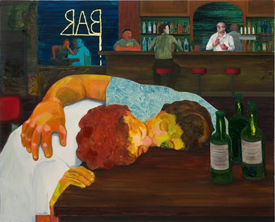
Nicole Eisenman, Sloppy Bar Room Kiss, 2011, oil on canvas, 39 x 48 in. (artwork © Nicole Eisenman)
Dear Nemesis: Nicole Eisenman, 1993–2013
Contemporary Art Museum Saint Louis
3750 Washington Boulevard, Saint Louis, MO 63108
January 24–April 13, 2014
Dear Nemesis, the largest midcareer survey of the work of the American artist Nicole Eisenman (b. France, 1965) to date, includes more than 120 paintings, prints, and drawings created between 1993 to 2013. The work of Eisenman bridges the absurd and abject with the introspective and irreverent, drawing on sources as varied as the iconography of classical myths and popular culture in general. Over the past two decades, she has developed a creative and versatile vision that combines high and low culture with virtuosic skill. Being her core concerns the depictions of community, identity, and sexuality, Eisenman demonstrates an uncanny capacity for capturing the joy, pain, embarrassment, and ecstasy of being human. Fusing images that fluctuate between the depiction of a world rooted in the visual language of art history and a critical and comedic meditation on contemporary life, she depicts settings and themes as varied as bar scenes, motherhood, and the dilemma of the artist. Through a recurrent representation of women, both as “butch” and “femme,” and female love, Eisenman infuses the practice of figurative painting with an audaciously queer bent that also re-presents art history in a feminist light. Through her wit and the uneasiness caused by her playful images, she is able to communicate with a critical—and yet visually breathtaking—absurdity the multifaceted depth of the human condition.

Alice Aycock, Hoodo (Laura) from the Series “How to Catch and Manufacture Ghosts” Vertical & Horizontal Cross-section of the Ether Wind (1981), 1990/2012, watercolor and ink on paper, 27½ x 39¼ in. Collection of the artist (artwork © Alice Aycock)
Alice Aycock Drawings: Some Stories Are Worth Repeating
Santa Barbara Museum of Art
1130 State Street, Santa Barbara, CA 93101
January 26–April 20, 2014
Alice Aycock Drawings: Some Stories Are Worth Repeating
Art, Design, and Architecture Museum
University of California, Santa Barbara, CA 93106
January 26–April 20, 2014
Including over one hundred works, Some Stories Are Worth Repeating is the first comprehensive exploration of Alice Aycock’s creative process. For this major retrospective, the Santa Barbara Museum of Art partnered the Art, Design, and Architecture (AD&A) Museum at the University of California, Santa Barbara, to present an exhibition that traces the artist’s career from 1971 to date. The display at the AD&A Museum focuses on Aycock’s work from 1971 to 1984 and includes detailed architectural drawings, sculptural maquettes, and photo documentation for both realized and imagined architectural projects. The Santa Barbara Museum of Art covers Aycock’s work from 1984 to present, a period in which she developed an increasingly elaborate visual vocabulary, drawing upon a multitude of sources that were partially informed by the use of computer programs.
This double-venue exhibition highlights the major themes that have governed Aycock’s artistic practice. While she is best known for her large-scale installations and outdoor sculptures, her drawings capture the full range of her ideas and sources, mirroring her conceptual clarity and formal depth. Her drawings and built projects achieved new complexity with the advent of computer-graphics programs in the 1990s. New technologies have enable Aycock to develop a digitally informed visual language that includes the generation of forms from multiple perspectives, mathematically perfect curve, and a precise construction drawings, while imagining points of view that are extraordinarily accurate.
A fully illustrated exhibition catalogue, published by the Parrish Art Museum and distributed by Yale University Press, features an interpretive essay by Jonathan Fineberg and an introduction by Terrie Sultan, director of the Parrish Art Museum. This book is the first scholarly exploration of the pivotal, enormously productive role that drawing has played in Aycock’s career over the course of her forty years as professional artist.
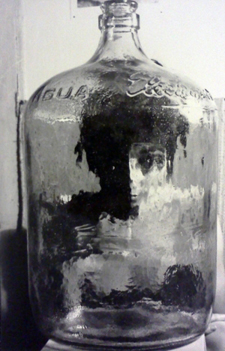
Kati Horna, Bottle, 1962, gelatin-silver print, 9 5/16 x 6½ in. (artwork © Kati Horna)
Kati Horna
Museo Amparo
2 Sur 708, Centro Histórico, Puebla, Pue., Mexico
December 7, 2013–April 28, 2014
Museo Amparo, in collaboration with Jeu de Paume in Paris (where the show will travel later this spring), presents the first major survey of the work of the photographer Kati Horna (Szilas-Balhas, Hungary, 1912–Mexico City, 2000). Horna turned to photography in the early 1930s in Hungary and, though still understudied, became one of the greatest documentary and surrealist photographers of Mexico. Seeking to define her contribution to photojournalism—and the photo-essay in particular—the exhibition brings together over 150 mostly unpublished or rarely seen works and contextualizes Horna’s career with personal photos and the European and Mexican journals with which she collaborated. It is chronologically organized along three axes that distinguish the changing geographic, cultural, and political contexts of her production.
The first part focuses on early work, conducted in Hungary, Berlin (where she relocated at age eighteen), and Paris, her early collages and photomontages illuminating the formation of her aesthetics in the context of the European avant-gardes of the 1930s (Bauhaus, Surrealism, and Neue Sachlichkeit). The second part focuses on Horna’s documentation of the Spanish Civil War, characterized by her compassionate look at civilians, an approach that radically complemented the perspective of her then partner, the war photographer Robert Capa, whom she followed to Spain. The last part of the exhibition examines her work as a chronicler of life in Mexico. Horna moved there on the eve of the Second World War with her husband Jose Jorna, joining various circles of the local intelligentsia, such as the movimiento pánico (Alejandro Jodorowsky) and the artistic, literary, and architectural avant-garde in Mexico (Mathias Goeritz, Germán Cueto, Pedro Friedeberg, Salvador Elizondo, Alfonso Reyes, and Ricardo Legorreta), while forming a close relationship with Leonora Carrington and Remedios Varo. The last twenty years of Horna’s life were dedicated—in addition to her creative work—to teaching photography at the Universidad Iberoamericana and the Academia de San Carlos (Univesidad Nacional Autónoma de México), where she influenced a new generation of contemporary photographers.

Posters (ca. 1991–present) from Riot Grrrl–related shows, conventions, and meetings internationally, solicited from institutional and personal archives through open calls, word of mouth, and invitations
Alien She
Vox Populi
319 North 11th Street, Philadelphia, PA 19107
March 7–April 27, 2014
Organized by two former Riot Grrrls, Astria Suparak and Ceci Moss, Alien She is the first exhibition to examine the lasting impact of the highly influential feminist punk movement from the 1990s on contemporary artists and cultural producers. Formed in reaction to the pervasive and violent sexism, racism, and homophobia in the punk-music scene and in culture at large, Riot Grrrl fomented a new generation of active feminists, inspiring them to create their own culture and communities in defiance of mainstream conventions. The movement also popularized the academic discourse of identity politics. Emphasizing female and youth empowerment, collaborative organization, creative resistance, and DIY ethics, Riot Grrrl had a pivotal influence, inspiring many around the world to pursue socially and politically progressive careers as artists, activists, authors, and educators.
Alien She focuses on seven artists—Ginger Brooks Takahashi (Pittsburgh), Tammy Rae Carland (Oakland), Miranda July (Los Angeles), Faythe Levine (Milwaukee), Allyson Mitchell (Toronto), L. J. Roberts (Brooklyn), and Stephanie Syjuco (San Francisco)—working in different media whose practices reflect the impact of Riot Grrrl; the exhibition also includes an open-ended historical section that reflects the multiplicity that was integral part of the original movement and its continuity, in the spirit of the Riot Grrrl’s principles. Each artist is represented by several projects from the last twenty years, including new and rarely seen works, providing an insight into the development of their creative practices and individual trajectories. The movement’s vast creative output is captured by hundreds of self-published zines and hand-designed posters (solicited from institutional and personal archives through open calls, word-of-mouth, and invitations, similar to the way Riot Grrrl expanded), different music playlists from Riot Grrrl scenes across the United States, Canada, South America, and Europe, while interviews and an ongoing, online Riot Grrrl Census provide an expanded oral history.
The exhibition’s title, Alien She, refers to a Bikini Kill song of the same name. The lyrics are about the negotiation of normalized gender roles, the uneasy line between feminist critique and collectivity, and the process of coming to a feminist consciousness, with the repeated refrain, “She is me, I am her.”

Installation view of Leonor Fini: Pourquoi pas? (artworks © Leonor Fini; photograph by Polly Yassin/Bildmuseet)
Leonor Fini: Pourquoi pas?
Bildmuseet
Umeå University, S-901 87 Umeå, Sweden
January 31–May 11, 2014
Leonor Fini: Pourquoi pas? is the first survey of the work of the Buenos Aires–born, Italian-French artist Leonor Fini (1907–1996) in the Nordic countries. Fini’s work challenged conventional ideas through questioning the frontiers between female and male, myth, and reality, the conscious and unconscious; it also expressed female desire, interfering in Surrealism from a transgressive female point of view. Though posthumously reduced to a footnote of art history, including feminist art history, Fini became a “queen of the Paris art world,” where she moved circa 1931 to become an artist, constantly featured in the news and celebrated for her paintings, illustrations, and theater designs, and above all for her flamboyant bohemian lifestyle, marked by her masquerades and ménages à trois. Fini was largely self-taught, having nurtured her prodigious talent and passion for portraiture by studying Flemish masters and Italian Mannerists; she also claimed dreams as the source of the irrational of her imagery. She was featured in major Surrealist exhibitions, including the 1936 International Exhibition of Surrealism in London, where she scandalized the critics with her erotic females. She also participated in Parisian Surrealist circles yet distanced herself from André Breton’s misogynistic circle.
The exhibition, which includes paintings, drawings, book illustrations, objects, text, film, and costume sketches for theater and opera, is accompanied by a richly illustrated bilingual catalogue (in English and Swedish) with previously unpublished texts by the artist alongside new essays by the poet and author Lasse Söderberg, the art historian Anna Rådström, and the curators Cecilia Andersson and Brita Täljedal.
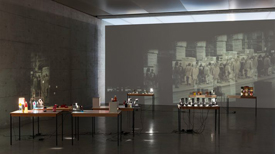
Installation view of Were I made of matter, I would color (photograph by Stephan Wyckoff)
Ulrike Grossarth: Were I made of matter, I would color
Generali Foundation
Wiedner Hauptstrasse 15, 1040 Vienna, Austria
January 24–June 29, 2014
Ulrike Grossarth (b. 1952) is a Berlin-based multimedia conceptual artist and professor of expanded concepts of art and mixed media art at the Academy of Fine Arts in Dresden since 1998. She is the founder of the Essen branch of Free International University initiated by Joseph Beuys and the recipient of the 2009 Kathe Kollwitz Prize. Though Grossarth began her career as a dancer, she became known since the late 1980s for sculptural milieus that variously manifest her interest in the corporeality of matter and create “radical and vivid spaces for thinking, spaces people can actually experience and use,” rather than artworks, as the artist puts it.
Curated by Sabine Folie and Ilse Lafer, Were I made of matter, I would color is a comprehensive retrospective that traces the evolution of Grossarth’s art, drawing connections from her early years as a dancer in the 1970s and 1980s, her sculptural settings and actions, and her most recent work, which interlaces an interest in history with the history of ideas.
The exhibition’s centerpiece, BAU I (1989–2000), is an experimental ensemble comprised of the “unmoved object-bodies” that Grossarth created over a decade and presented in a wide variety of constellations. Visualizing changed spaces of thought and action, the show bridges Grossarth’s early work, which is informed by Fluxus and punk and the attempt to come to terms with the postwar era, and her later art, with its focus on Eastern Europe. More recent works in the exhibition, such as the so-called Lublin projects (since 2006) and SYMBOL gotowe/Subject Aggregates, showcase the ways in which Grossarth seeks to reanimate lost cultural traditions, and her challenging of Occidental thought with her engagement with Jewish mysticism and the motif of the Shekhinah.