CAA News Today
Committee on Women in the Arts Picks for June 2014
posted by CAA — June 10, 2014
Each month, CAA’s Committee on Women in the Arts selects the best in feminist art and scholarship. The following exhibitions and events should not be missed. Check the archive of CWA Picks at the bottom of the page, as several museum and gallery shows listed in previous months may still be on view or touring.
June 2014
Swoon: Submerged Motherlands
Brooklyn Museum
Iris and B. Gerald Cantor Gallery, Fifth Floor, 200 Eastern Parkway, Brooklyn, NY 11238
April 11–August 24, 2014
Submerged Motherlands, a solo exhibition by the Brooklyn-based artist Swoon, is a collaborative inhabitable shelter that explores social and environmental issues. Born in Florida in 1977 as Caledonia Dance Curry, Swoon is best known for her large, intricate linocut prints that are wheat pasted onto industrial buildings in Brooklyn and Manhattan. In this occasion Swoon leaves the streets to appropriate the Brooklyn Museum as a temporary home for transforming the rotunda gallery into a “submerged motherland,” an inhabitable installation that includes previous traveling boats and rafts, figurative prints, drawings, and painting, dyed fabrics, and cut-paper foliage that grew around a monumental sculptural tree.
Swoon’s practice is rooted in collaboration, community, experimentation, and discovery. From conceptualization through production, her practice means an immersive, provocative, and transformative experience for both participants and visitors. She has translated her projects to both galleries and museums, but also to socially rooted arts activism in places such as Konbit Shelter Project in Haiti and Transformazium in Braddock, Pennsylvania, among others.
A meditation on humanity, climate change, and the artist’s own mother passing away during the ideation stage for the installation, Submerged Motherlands reflects on the notion of home—and the loss of it. In the artists’ words, the creative process of this inhabitable installation follows an “impulse to build a safe space in the world for herself and her community; some place to be a little bit different from the norm.” Swoon’s fantastic installation transformed the Iris and B. Gerald Cantor Rotunda Gallery in a temporary and yet memorable shelter for many.
Judith Shea
Kent Fine Art
210 Eleventh Avenue, Second Floor, New York, NY 10001
May 9–June 28, 2014
Judith Shea’s solo exhibition is a sculptural homage to the role of women in the arts. For decades, Shea studied the representation of the human figure through a constant observation of people and the exploration of materials. In absence or presence of the body, from her late 1970s clothes-based series to the present sculptures that honors the role of women in the arts, powerful human emotions are evident in Shea’s work.
Shea reflects on the origin of her sculptural approach to the human form to different and yet meaningful experiences of her educational upbringing. Being raised as a Catholic, she was a constant witness of the representation of religious statues in church. While being trained as a ballet dancer as a child, she grew connected with her own body.
Graduated with a fashion-design degree from Parsons in 1969, Shea continues pursuing her interests in visual art, earning her BFA at Parsons in 1975. Based on “her own style”—as titled the successful exhibition she curated on women self-portraits at National Academy Museum in 2012—“the artist who makes clothes” was invited to collaborate with Trisha Brown and the Eye and Ear Theater Company—working with artists such as Red Grooms and Elizabeth Murray.
At Kent Fine Arts, Shea presents seven new sculptures that pay tribute to the role of women in the arts. Through these sculptural portraits, Shea demonstrates her unique sense of observation and virtuosity with materials. A fully illustrated monograph documenting Shea’s work from 1976 to the present accompanies the exhibition.
Nalini Malani: Transgressions
Asia Society and Museum
725 Park Avenue, New York, NY 10021
February 19–August 3, 2014
Transgressions is a solo exhibition by Nalini Malani. Born in Karachi in 1946, Malani is considered one of the foremost artists from India today. Her work is influenced by her experiences as a refugee of the Partition of India in 1947. Trained as a painter at the Sir Jamsetjee Jeejebhoy School of Art in Mumbai, Malani has created work gradually evolved toward new media and international collaboration, expanding the pictorial surface into the surrounding environment, such as ephemeral wall drawing, installation, shadow play, and theater. In the 1980s, she became a pioneer in India for her attention to feminist issues. In the early 1990s, her innovative theater, installations, and multimedia projects featured recurring themes on gender, memory, race, and transnational politics, especially in reference to India’s postcolonial history after independence and partition.
Her current exhibition at the Asia Society and Museum includes Trangressions II (2009), a video that draws from the museum’s collection, exploring the nuances of Western postcolonial dominance in India, integrating the folk sensibility of traditional shadow plays with new technology. Using projections through transparent Lexan cylinders, painted by the artist in a fashion that references the nineteenth- and early-twentieth-century Bengal Kalighat style and inspired by the genre of reverse glass painting, brought to the subcontinent in the eighteenth century by the Chinese, Malani examines the power dynamics of transnational commerce in our increasingly globalized world. Through a mesmerizing projection of colors and imagery inspired by Edward Said’s book Orientalism, an ever-shifting tableau including wrathful female deity, boxers, and animals is accompanied by a recording of a poem written by the artist. The exhibition includes a selection of artist’s books that highlight the relevance of drawing and painting in Malani’s practice.
Zilia Sánchez: Heróicas Eróticas en Nueva York
Galerie Lelong
528 West 26th Street, New York, NY 10001
May 3–June 21, 2014
Heróicas Eróticas en Nueva York, Zilia Sánchez’s first solo exhibition at Galerie Lelong, offers a delightful opportunity to experience masterpieces of sensuous and haptic minimalism, while timely questioning the canonic premises of Minimalism as being reconstituted at the Jewish Museum. Spanning fifty years of her production, including recent works such as the monumental diptych Conversation (from the Eros and Communication series), the exhibition brings together “paintings” rarely seen outside Puerto Rico, made in the artist’s signature technique of stretching canvas over hand-molded wooden armatures—often in modular configurations or reworked as parts of ongoing series—that was developed during the period she lived in New York (1964–72). Heroically erotic, Sánchez’s curvy and soft minimalist hybrid objects “queer” hard-edge minimalism differently evoking the body in a manner that does not adhere to fixed categories of gender.
Born in Cuba in 1926, Sánchez studied at the Escuela Nacional de Bellas Artes San Alejandro and became associated with the group Sociedad Cultural Nuestro Tiempo. Under the influence of Victor Manuel, she developed her own modernist approach to formal abstraction through paintings and drawings, while also designing furniture and theater sets (especially for the anti-Batista guerilla theater group Los Yesistas). Several grants allowed her to travel in Europe, and in 1964 she settled in New York, where she first begun experimenting with shaped canvases. In 1972, Sánchez moved to Puerto Rico, where she became inspirational through her teaching at the Escuela de Artes Plásticas de Puerto Rico. From 1972 to 1975 she designed the influential experimental literary journal Zona de Carga y Descarga, while in the 1980s she renewed her signature style by including line drawing or drawing transfer of semaphores and sign language on her canvases.
Sharon Lockhart: Milena, Milena
Bonniers Konsthall
Torsgatan 19
SE-11390, Stockholm, Sweden
April 16–June 29, 2014
Bonniers Konsthall hosts the second iteration of the exhibition trilogy Sharon Lockhart: Milena Milena that begun in Warsaw in 2013 at the Center for Contemporary Art and will be concluded in Switzerland in 2015 at the Kunstmuseum Luzern. This exhibition is the first large-scale survey of the work of the renowned American photographer and filmmaker in Scandinavia, where Lockhart has been particularly influential. Drawing inspiration from filmmaking and documentary photography, as well as from ethnography and anthropology, she has distinguished herself since the 1990s for her fascinating portrayals of individuals and communities, and a minimalist attention to the everyday, the subjective, and the human.
As a cross-sectional presentation of both her photographic and filmic work in the past twenty years, the exhibition explores the middle ground between the filmic and the photographic that is inhabited by her meticulously staged photographs and almost still films, emphasizing the relationship they both maintain to time and space, while also claiming the biographical dimension of her work. As such, the exhibition opens with the cinematic Double Tide (2009)—filmed in Maine, where Lockhart spent her childhood—and concludes with the rarely exhibited series Untitled Studies (1993–ongoing), Lockhart’s photographic diary, composed of rephotographed snapshots found in her own family album.
At the center of the exhibition’s narrative is Milena, an enigmatic figure who remains disquietly absent, distilling different threads of identification in her very nonpresence. Lockhart first met Milena when nine years old in 2009 in Łódź, Poland, while filming Podwórka, also a centerpiece of the exhibition. Literally translated as “courtyard” from Polish, Podwórka displays six different courtyards in Łódź and the children that live and play there. Lockhart and Milena developed a friendship through the act of play. Upon the rekindling of their friendship when staging the show for Warsaw, Lockhart discovered Milena’s desire to write an autobiography about her life, which provided the impetus through which the two have explored artistic expression together. The exhibition at Bonniers Konsthall features a specially commissioned, monumental stained-glass portrait of the Polish master glass painter Piotr Ostrowski as a personal and culturally specific tribute.
Kalliopi Lemos: I Am I Between Worlds and Between Shadows
Ioakimion School for Girls
Fener, Istanbul
September 11, 2013–December 14, 2014
Curated by Beral Madra as a parallel event of the thirteenth Istanbul Biennale but now extended to December 2014, I Am I Between Worlds and Between Shadows is a major site-specific installation of new work by the London-based Greek artist Kalliopi Lemos. A painter, sculptor, and installation artist, Lemos has become internationally known for a series of public installations that make poignant commentaries about the hopes and tragedies that underpin illegal migration by using the abandoned relics of successful or failed illegal migration typical of the Aegean coasts—small wooden boats (such as Crossing, Eleusis, Greece [2006/9]; Round Voyage, Istanbul [2007]; At Crossroads, Brandenburg Gate, Berlin [2009]; and Pledges for a Safe Passage, Canakkale, Turkey [2012]). Complementing Lemos’s concern with the dispossessed from a transnational feminist perspective that links the injustices against the racial, classed, and religious underdogs of global capital—best represented by the illegal migrant—with those against the gendered others of patriarchal societies—women—I Am I Between Worlds and Between Shadows tackles the issue of violence against women in a poetic, multidisciplinary, and site-specific way.
I Am I Between Worlds and Between Shadows consists of a series of seven sculptures depicting variously violated hybrid creatures, a sound installation, and a constantly renewed archive of women’s abuse, comprised of world news print outs, all evocatively installed in the abandoned yet intact rooms of the Ioakimion Greek High School for Girls. A gem of the once booming Greek Orthodox minority in Fener, the latter was founded in nineteenth century but closed in the 1980s when its attendance dropped to six students. The sound collage of joyful schoolchildren playing and singing affectively evokes the lively atmosphere of the past of the school as a breeding ground of dreams for the girls who attended it. Yet the injustices awaiting women, even in Western societies, are hinted by the evocations of gendered violation and sacrifice embedded in the Greek folk songs and international fairy tales narrated by children (also part of the sound installation), echoing the monstrosity of contemporary actuality that marks the news’ readings of the absent schoolgirls with transcultural staples of patriarchal myth. Hung from a butcher’s hook, on crutches or on gigantic prosthetic devices or confined by rails—and more often than not mutilated, amputated, and violently dismembered—these sculptural bodies most poignantly hint at various kinds of bodily, psychic, and gendered abuse, both through their imaginative bodily articulations and their manner of installation. Masterfully cast in stonelike steel with embedded resin, these half-animal, half-human creatures evoke familiar mythological and Surrealist creatures that suggestively cut across a wide spectrum of cultural and artistic references. Melancholically posed in the place of the teacher, the beheaded mermaid, the multibreasted hung rabbit, and the decapitated hen with the splayed vulva hovering on crutches, for instance, become protagonists of a tale from a children’s book that keeps going wrong in the world of the adults, raising awareness of all kinds of abuse that, whether explicitly or implicitly, threatens not only the egalitarian realization of women in various societies, but also their unencumbered expression of difference, and above all their human dignity. A two-faced chicken, clumsily balancing on two bases—itself a metaphor of unstable youth, according to the artist—looms also as an evocative stand-in for liminal creatures of exile. With its gaze fixed here and there, it aids the artist by bringing in full circle her concerns by perhaps planting a metaphor for the modern transnational, subject—forced migrant or cosmopolitan—and its vulnerability in the heart of a charged site of convoluted transcultural and imperial histories—an abandoned stronghold of Greek and Christian culture in Istanbul in the era of globalization and yet renewed and bloody nationalisms and religious fundamentalisms that, like all kinds of violence, make children and women their primary victims.
Kara Walker: A Subtlety
Domino Sugar Factory
316 Kent Avenue, Brooklyn, NY 11249
May 10–July 6, 2014
Commissioned by Creative Time as a public-art farewell to a loaded site—the Domino Sugar Factory—where American industrial capitalism, consumerism, and racism have variously intersected and will be perhaps redefined through its upcoming neoliberal gentrification, Kara Walker’s A Subtlety is a both moving and canning, sugar-coated, monumental memorial to chief confectioners of the American Dream, black slaves and laborers, as well as the artist’s first large scale sculptural public work. The subtitle of the work tellingly summarizes its poignant agenda: Marvelous Sugar Baby, an Homage to the unpaid and overworked Artisans who have refined our Sweet tastes from the cane fields to the Kitchens of the New World on the Occasion of the demolition of the Domino Sugar Refining Plan.
A Subtlety comprises a gigantic sphinx whose hybrid body combines cliché apparitions of the black woman as domestic slave and sex object and a series of black boys cast in molasses. The latter are cast after contemporary giftware made in China but reference the original “subtleties”: sugar-made, edible sculptures and dinner emblems of power and wealth that decorated the tables of Middle Eastern sultans and European nobility.
“In Greek mythology the sphinx is a guardian of the city, a devourer of heroes and the possessor of a riddle that maybe can’t be answered,” says the artist, explaining its conception: “the factory is a modern-day ruin, and I think the sphinx contains the various readings of history that the place represents.” Exchanging her signature black for the site-specific whiteness of sugar, a material central to the slave trade and in effect of the American way, Walker has thus unsubtly “refined” the black body of her mighty benign monster, mixing references to the labor of sugar production and trade and white’s classical and sanctifying purity, in effect both honoring black bodies’ unsung contribution to Western pleasures while foregrounding the lasting whiteness of power in America. Moreover half a century after Niki de Saint Phalle’s Hon in the Moderna Museet in Stockholm, the temporary gigantic Nana that exorcised the riddles surrounding the female body, Sugar Baby toys with them yet also from the radical, even though controversial, perspective of a woman of color: “she’s a woman, a bootylicious figure with something paradoxical about her pose. She’s both a supplicant and an emblem of power. From the front, she seems to hold her ground. But what you see from behind is what happens when a nude woman bends over, raising a question of whether it’s a gesture of sexual passivity or not.”
As put by the project’s curator, Nato Thompson, A Subtlety speaks “of power, race, bodies, women, sexuality, slavery, sugar refining, sugar consumption, wealth inequity, and industrial might that uses the human body to get what it needs no matter the cost to life and limb. Looming over a plant whose entire history was one of sweetening tastes and aggregating wealth, of refining sweetness from dark to white, she stands mute, a riddle so wrapped up in the history of power and its sensual appeal that one can only stare stupefied, unable to answer.”
Committee on Women in the Arts Picks for May 2014
posted by CAA — May 10, 2014
Each month, CAA’s Committee on Women in the Arts selects the best in feminist art and scholarship. The following exhibitions and events should not be missed. Check the archive of CWA Picks at the bottom of the page, as several museum and gallery shows listed in previous months may still be on view or touring.
May 2014
Regina José Galindo: Estoy Viva
Pac/Padiglione d’Arte Contemporanea
Via Palestro, 14, Milan, Italy
March 25–June 8, 2014
Curated by Diego Sileo and Eugenio Viola, this is the first survey of the work of the acclaimed Guatemalan performance artist and poet Regina Jose Galindo (b. 1974). Galindo became first known for political performances in Guatemala in the late 1990s, including her bloody walk from the Congress of Guatemala building to the National Palace in protest against the presidential candidacy of Guatemala’s former dictator, Jose Efrain Rios Montt. In 2005 she received the Golden Lion award at the Venice Biennale, in the category of “artists under 30,” for her video Himenoplastia, a controversial feminist work featuring the artist undergoing surgical reconstruction of her hymen. Although Galindo has organized performances in which she does not take part, her work is distinguished for the political use of her own body in order to tackle a variety of social issues, including cultural traumas, and to denounce the ethical implications of social and cultural injustices, discriminations of race and sex, and, more in general, all kinds of abuses stemming from power. A postidentarian turning of her body into a symbolic evocation of the “social body differentiates the use of her self as the tool of her critique from the autobiographic one of several of her performance art progenitors.”
The exhibition Estoy Viva is divided in five sections that, conceived as permeable categories, illustrate the focus of her critique and poetics: politics, woman, violence, organic, and death. It is titled after the eponymous performance conceived and performed for the opening of the exhibition and featuring the artist naked in a white chilly room on a sort of tombstone, her life proved only by her invisible breath’s imprint on a mirror held by each visitor in front of her nose. The exhibition is accompanied by a film by Cosimo Alemà, a cinematographic reading of her work produced in collaboration with the artist as an emotional key to her work.
Sara VanDerBeek
Museum of Contemporary Art Cleveland
11400 Euclid Avenue, Cleveland, OH
March 7–June 8, 2014
The New York–based photographer Sara VanDerBeek (b. Baltimore, 1976) is known for her formally striking employment of photography, sculpture, and performative gestures that contemplate the construction of images, their relation to objects, and the passage of time. For her solo exhibition at MOCA Cleveland, organized by David Norr, VanDerBeek responded to the city of Cleveland in line with her recent work. She began by testing the relation of photograph to object by photographing architectural objects made in her studio that were in turn turned into photographic objects, but her most recent work explores photographically cities central to American history, such as Baltimore, New Orleans, and Detroit, their personal, historical, and political connotations, as well as their distinct urban features. Engaging the city as a physical site and a system undergoing continuous change, the displayed photographs are combined results of VanDerBeek’s experience of Cleveland’s landscape and cultural monuments within a range of material and cultural shifts.
Hito Steyerl: Junktime
Home Workspace Program
Ashkal Alwan, Building 110, First Floor, Jisr al Wati, Street 90, Beirut 2066-8421 Lebanon
April 16–May 31, 2014
Ashkal Alwan Home Workspace Program 2013–14 presents Hito Steyerl: Junktime, a series of video installations, screenings, and conversations as part of Creating and Dispersing Universes That Work without Working, led by the resident professors Jalal Toufic and Anton Vidokle. The screening series includes twelve films and video installations developed by Steyerl between 2004 and 2014. Between them is presented How Not to be Seen: A Fucking Didactic Educational .MOV File, launched in the Venice Biennale exhibition Il Palazzo Enciclopedico in 2013.
Born in Munich in 1966, Steyerl has produced a variety of work as a filmmaker and an author in the field of essayist documentary video. With the global circulation of images as her principal topic of interest, she focuses on the intersection of media technology, political violence, and desire. Departing from the digital image and using humor and charm as political means of expression, her films and essays envision a world in which war, genocide, capital flows, class conflicts, and digital detritus seem to take place only partially within images, thus reminding us we are no longer dealing with the virtual but with a “confusing concreteness.”
Eva Koťátková
Art en Valise
April 3–June 28, 2014
In collaboration with the scrap metal gallery in Dublin and the Unit E in Toronto, Art en Valise presents, as its inaugural project, the first solo exhibition of the multimedia Czech artist Eva Koťátková in Canada. Born in Prague (in 1982), where she lives and works today, Koťátková studied at the Academy of Fine Arts and the Academy of Applied Arts in Prague, as well as at the San Francisco Art Institute and the Akademie der Bildenden Künste in Vienna. The youngest-ever winner of the prestigious Jindrich Chalupecky Award for Czech artists, she has widely exhibited internationally, both in solo and group exhibitions, and her work was distinguished as one of the highlights of the exhibition The Encyclopedic Palace in the fifty-fifth Venice Biennale (2013).
Underpinned by her generation’s trauma—the contrast of her freedom to do what she wants as opposed to the suppression that haunted the dreams and desires of her parents generation—Koťátková creates work in various media, including collage, film collage, and “mad” sculptures, that seem to explore the often-failed attempts of people to both conform to and break free of the rules and codes of contemporary societal institutions, including family and school. Kotátková undermines and recontextualizes the values and mechanisms used to regulate our perception of the world, and, in turn, the way we perceive ourselves.
Bringing together drawing, collage, installation, sculpture, and performance, the exhibition investigates Kotátková’s process of deconstructing traditional behavioral systems to produce fragmented models that invite alternative ways of communication, while offering a unique opportunity to explore the idiosyncratic surrealist sensibility that underpins her multimedia practice, signature themes such as the cage, and her use of the body.
Dorothy Iannone: This Sweetness Outside of Time; Paintings, Objects, Books 1959–2014
Berlinische Galerie
Alte Jakobstraße 124–128, 10969 Berlin, Germany
February 20–June 2, 2014
The Berlinische Galerie presents This Sweetness Outside of Time, a major solo exhibition of the Berlin-based American artist Dorothy Iannone. This will be the first extensive retrospective to address the humorous and erotic oeuvre of one of the most unusual women artists of the twentieth and twenty-first century. This Sweetness Outside of Time includes paintings, objects, and books created by the self-taught artist between 1959 and 2014. The aim of this retrospective is to illustrate the radical subjectivity of this unique artist to a wider audience.
A pioneering spirit against censorship and for free love and autonomous female sexuality, Iannone (b. Boston, 1933) occupies a distinct place as an artist in the second half of the twentieth century. Her oeuvre spans more than fifty years and includes painting and visual narrative, autobiographical texts and films. Since the 1960s Iannone continues to go her own way without compromise, artistically and conceptually. She is a pioneer of women’s sexual and intellectual emancipation that draws uncompromisingly on her own life.
Iannone’s art frequently depicts the sexual union between man and woman with an unmistakably mystical dimension rooted in the spiritual and physical union of opposites. Through graphic paintings, object, and books, her visual universe portrays partly clothed and naked figures on bright psychedelic backgrounds of flora, mandalas, and biomorphic patterns in which male and female sexuality celebrate the joy of intimate relationships while subverting traditional gender stereotypes of control an dominance. This Sweetness Outside of Time presents a personal narrative of a passionate pursuit of “ecstatic unity” through transcendence and spirituality.
Tauba Auerbach: The New Ambidextrous Universe
Institute of Contemporary Arts
The Mall, London
SW1Y 5AH, United Kingdom
April 16–June 15, 2014
The Institute of Contemporary Art, London, presents The New Ambidextrous Universe, the first solo exhibition in the United Kingdom of Tauba Auerbach (b. San Francisco, 1981), a New York–based artist who works in sculpture, photography, painting, weaving, prints, artist’s books, and performance. In her early career she created graphic sign paintings, producing abstract renderings of calligraphy and typography. In recent work she has developed a signature practice of ironing creases into her canvases and using industrial paint guns or hand-painted Ben Day dots to create the illusion of three-dimensional folded fabric that Auerbach describes as “Fold” paintings that occupy “a liminal state between two and three dimensions.” The artist plays with perceptions of space, taking a highly innovative approach to mechanical processes and color. For The New Ambidextrous Universe, Auerbach presents newly created sculptures and photographs that translate the scientific principles of symmetry and reflection in pallid plywood as a means “to hint at an alternate, mirror universe.”
Open Engagement Conference 2014
Queens Museum of Art
New York City Building, Flushing Meadows, Corona Park, Queens, NY 11368
May 16–18, 2014
Open Engagement is a free international conference that sets out to explore various perspectives on art and social practice with the aim to expand the dialogue around socially engaged art making. The conference will examine how economic and social conditions connect to life values and philosophies, situating the everyday in relation to a larger political and social issues that includes labor, economics, food production, ways of being, and education.
Directed and founded by Jen Delos Reyes, the 2014 Open Engagement Conference is copresented by the Queens Museum of Art and A Blade of Grass and takes place in the Hall of Science, the Queens Theater, Immigrant Movement International, and various locations throughout New York. As in previous conferences, Open Engagement will include a partnership with graduate programs featuring art and social engagement. This year this partnership will include a number of New York–based programs led by Social Practice Queens at Queens College, City University of New York. The event also features two keynote presenters, Mierle Laderman Ukeles and J. Morgan Puett, and focuses on the theme of “life/work.” The legacies of these two seminal figures have through their practices defined and redefined how life and work can be the foundation for artistic exploration.
Affiliated Society News for May 2014
posted by CAA — May 09, 2014
American Council for Southern Asian Art
The American Council for Southern Asian Art (ACSAA) invites you to visit its newly updated website, where you can browse calls for papers, job and fellowship listings, and, for members, recent and past issues of the ACSAA Bulletin. Please send news and postings for the website to ACSAA’s webmaster, Cathleen Cummings.
Please also watch the ACSAA website and listserv for news about upcoming elections. ACSAA will be voting on new board members, changes to membership fees, and several other initiatives. You must be a member in good standing to be eligible to cast your vote. Help shape the future of ACSAA.
Association of Art Historians

The Association of Art Historians (AAH) has announced that Christine Riding is the new AAH chair, serving a three-year post. She takes over from Alison Yarrington. Riding is senior curator and head of art at the Royal Museums Greenwich in London. Previously she was curator of eighteenth- and nineteenth-century British art at Tate Britain and held curatorial positions at the Palace of Westminster, Museum of London, and the Wallace Collection. Riding has lectured and published widely on the history of eighteenth- and nineteenth-century British art and has organized a number of international exhibitions at Tate Britain and Tate Modern. Her current projects include curating Turner and the Sea, a major exhibition that opened at Greenwich in November 2013. She also served as an AAH trustee between 2004 and 2007 and was deputy editor of Art History between 2007 and 2012. Riding has participated on the Clore Leadership Programme and was recently appointed as an impact assessor for REF2014.
Community College Professors of Art and Art History
The Community College Professors of Art and Art History (CCPAAH) had a successful session at this year’s CAA Annual Conference in Chicago. “Starting the Conversation: Engaging Students in the Studio and Art History,”chaired by Susan Altman of Middlesex County College, featured: Tyrus Clutter, College of Central Florida, “Flipping the Classroom with Digital Demonstrations”; Monica Anke Hahn, Community College of Philadelphia, “Virtual Engagement: Conversations in Online and Hybrid Classes”; and Julianne Parse Sandlin, Portland Community College, “Low-Tech Engagement: Art History and the Class Discussion.” The prospectus for next year’s conference session will be posted later this spring on CCPAAH’s Facebook page. To become more involved in the organization, please email ccpaah@gmail.com.
Foundations in Art: Theory and Education

The next biennial conference of Foundations in Art: Theory and Education (FATE), called “Tectonic Shifts” and hosted by the Herron School of Art and Design at Indiana University–Purdue University Indianapolis, will be held March 25–28, 2015. The event will take place in the heart of downtown Indianapolis at the Westin Hotel Indianapolis, which just completed a $14 million renovation. You can access hotel registration information via the FATE website.
FATE’s Programming Committee is now reviewing the call for session proposals. While the call for sessions is now closed, a call for papers was sent in April 2014. Approximately one hundred sessions will run during the three-day conference. Papers will be accepted from all who contribute to the foundation experience. The “Tectonic Shifts” FATE members exhibition will take place in one of Indianapolis’s most respected exhibition venues, the Herron School Art and Design Galleries. A call for exhibition entries will go out in mid-May. The conference keynote speaker is Wayne White, an American artist, art director, illustrator, puppeteer, and much, much more.White has traveled the country delivering an incredibly entertaining hour-long talk in which he discusses his life and work, while making time for banjo and harmonica playing.
Historians of German and Central European Art and Architecture
The Historians of German and Central European Art and Architecture (HGCEA) has elected a new board of directors for a three-year term, 2014–17. They are: Marsha Morton, president; Jay Clarke, secretary; Jim Van Dyke, treasurer; Elizabeth Cronin, web manager; and Keith Holz, Karla Huebner, Juliet Koss, and Elizabeth Otto, at-large members.
Historians of Netherlandish Art
The Historians of Netherlandish Art (HNA) will hold its next conference June 5–7, 2014, in Boston, Massachusetts. The event will be held in cooperation with the American Association for Netherlandic Studies and involve sessions and workshops with focus on Netherlandish art from 1350 to 1750. Please see the HNA website for more information.
The next formal deadline for submitting manuscripts to the Journal of Historians of Netherlandish Art, HNA’s peer-reviewed, open-access ejournal, is August 1, 2014. In addition to longer articles, the journal welcomes shorter notes on archival discoveries, iconographical issues, technical studies, and rediscovered works. For submission guidelines, see the journal’s website or contact Alison Kettering, senior editor, at aketteri@carleton.edu or aketteri@jhna.org for more information.
International Association of Art Critics
The United States chapter of the International Association of Art Critics (AICA-USA) will hold its awards ceremony and dinner to honor the best exhibitions that opened between January and December 2013 at the studio of Izhar Patkin in New York on Monday, May 12, 2014, 6:00–9:00 PM.
Italian Art Society
The Italian Art Society (IAS) invites scholars in Italy this spring to attend the fifth annual IAS/Kress Lecture in Italy by Jean K. Cadogan, professor of fine arts at Trinity College in Hartford, Connecticut, whose paper is titled “‘Maravigliose istorie’: The Mural Decoration of the Camposanto in Pisa.” Cadogan will share her intriguing work on the multiphase, comprehensive program of painting on the walls of the Camposanto in a presentation on May 27, 2014, at the Gipsoteca of the Università di Pisa. See the IAS website for details.
In addition, the IAS website publishes information about the organization’s activities at the upcoming forty-ninth International Congress of Medieval Studies in Kalamazoo, Michigan, taking place May 8–11, 2014. IAS will hold a business meeting at 5:30 PM on Thursday, May 8 (in Valley II, Garneau Lounge), plus three IAS-sponsored sessions (all in Bernhard 209) and an IAS reception (in the second floor lobby of Bernhard) at 5:30 PM on Friday, May 9. All members and prospective members are welcome!
National Art Education Association

The National Art Education Association (NAEA) is accepting proposals for presentations for the 2015 NAEA national convention, to be held March 26–28 in New Orleans, Louisiana. You must be an NAEA member to submit a proposal. The deadline is May 15, 2014.
NAEA also announces two new publications: Practice Theory: Seeing the Power of Art Teacher Researchers and Purposes, Principles, and Standards for School Art Programs.
Studies in Art Education, the NAEA’s professional refereed journal, is a quarterly publication that reports quantitative, qualitative, historical, and philosophical research in art education. View a sample digital issue. The cost for a one-year subscription is $20 for NAEA members, $30 for nonmembers, and $45 for Canadian/foreign subscriptions.
NAEA announces SummerVision DC: Hands-On Learning in Art Museums. Choose from two sessions: July 8–11, 2014, or July 22–25, 2014. Now in its fifth year, NAEA SummerVision DC is an annual event offered by NAEA in partnership with Washington, DC–area art museums. Upon completion of the program, participants will receive a certificate of participation with thirty clock hours of professional development. The cost is $495 (NAEA members) and $549 (nonmembers). Each session is limited to twenty-five participants.
New Media Caucus
The New Media Caucus (NMC) has announced the results of its recent board and officer elections. The NMC board of directors voted to add two new officer positions to its Executive Committee: chair of the Communications Committee and chair of the Events and Exhibitions Committee. A. Bill Miller, assistant professor at the University of Wisconsin in Whitewater, joins the board and begins a one-year term as the chair of the Communications Committee. Joyce Rudinsky, associate professor at the University of North Carolina in Chapel Hill, was voted as the chair of Exhibitions and Events Committee. NMC also welcomes new and reelected board members: Barbara Rauch, Kevin Hamilton, Joshua Selman, A. Bill Miller, Rachel Clarke, and Mat Rappaport. Rappaport was reelected as secretary, and Vagner Whitehead, associate professor at Oakland University in Rochester, Michigan, begins his term as the fourth NMC president.
The NMC board would like to thank its former president, Paul Catanese, for his leadership over the past six years. Under his tenure NMC has grown into an organization of over nine hundred members and developed annual programming that highlights the practice and scholarship of new-media art and theory. He now sits on the Executive Committee as immediate past president. NMC also wants to thank board members whose terms have ended for all the work they have done in the past years: Mike Salmond, Dima Strakovsky, Leslie Raymond, and Gwyan Rhabyt (president emeritus). Finally, NMC thanks the members of the Nominations Committee who oversaw the election: Mina Cheon, Meredith Hoy, and Mat Rappaport.
Pacific Arts Association
The conference of the European chapter of Pacific Arts Association (PAA) was held April 24–26, 2014, at the Rautenstrauch-Joest-Museum-Cultures of the World in Cologne, Germany. The conference coincided with the exhibition Made in Oceania: Tapa – Art and Social Landscapes. Learn more about conference registration, programs, accommodations, and special events on the PAA website.
Public Art Dialogue

At CAA’s 2014 Annual Conference in Chicago, Jack Becker received the 2014 Public Art Dialogue Award for Achievement in the Field of Public Art. In honoring his thirty-five years of service to the profession, Harriet F. Senie, cochair of Public Art Dialogue (PAD), observed, “I don’t think there is anyone in the field who has done more to legitimize the field of public art than Jack Becker. I can’t begin to imagine where we would all be without the Public Art Review and its ongoing response to and expansion of our enterprise.”
A CAA session on “Public Art and Its Role in Placemaking from an International Perspective” featured the speakers Marisa D. Lerer, Norie Sato, and Jack Becker. Chaired by Erika Doss, another session, “Vandalism, Removal, Relocation, Destruction: The Dilemma of Public Art’s Permanence,” featured the following presentations: “Yankees, Automobiles, and Other Hazards: Shattered Monuments and the Problem of Confederate Memory,” by Sarah Beetham; “Marking Memory: Ambiguity and Amnesia in the Monument to Soviet Tank Crews in Prague,” by Jenelle Davis; “Maintaining Problematic Public Art,” by Christine Young-Kyung Hahn; “Distant Stars, Black Holes, and Burned Out Sculptures: Media Obsolescence and the Trouble with Public Art,” by Julia E. Marsh; and “The Sordid Pasts of Public Art and How We Go About Protecting Them,” by Michele Bogart.
Society for Photographic Education

The Society for Photographic Education (SPE) is accepting proposals for its 2015 conference, “Atmospheres: Climate, Equity, and Community in Photography.” Topics may include but are not limited to: image-making, history, contemporary theory and criticism, new technologies, effects of media and culture, educational issues, and funding. SPE membership is required to submit; proposals are peer reviewed. Proposals are due by June 1, 2014. Visit the SPE website for full proposal guidelines.
SPE is pleased to announce these award opportunities:
- Future Focus Project Support Grant: Established to recognize exceptional photographic work, this $5,000 grant is partially funded by the SPE Future Focus Campaign. The recipient also receives a complimentary one-year SPE membership and two years of conference registration
- Honored Educator Award: Bestowed upon a career educator recognizing significant contribution to the field of photographic education. The recipient receives a lifetime SPE membership and a $1,000 honorarium
- Insight Award: Given to up to five members annually who demonstrate excellence in innovative teaching, sustained mentoring of colleagues or students, broad contribution to technical, critical, pedagogical, or visual aspects of the field, breadth or depth of exhibition or publication, and/or sustained presence in the field
Applications and nominations are due by July 1, 2014. Visit the SPE website for more information about these awards.
Society of Architectural Historians
The Society of Architectural Historians (SAH) is accepting applications for its 2014 SAH/Mellon Author Awards, designed to support emerging authors publishing monographs on the history of the built environment who are responsible for paying for rights and permissions for images in their publications. The deadline is June 1, 2014.
SAH is also accepting abstracts for papers for its sixty-eighth annual conference, taking place April 15–19, 2015, in Chicago, Illinois. Abstracts may be submitted for one of the thirty-two thematic sessions or for an open session. The deadline to submit is June 6, 2014. Visit the SAH website for details.
Carolyn Garrett has been named SAH development director. She has over twelve years of experience in resource development and previously held positions at Changing Worlds and Chicago Foundation for Women.
Society of Historians of Eastern European, Eurasian, and Russian Art and Architecture
The Society of Historians of Eastern European, Eurasian and Russian Art and Architecture (SHERA) seeks proposals of papers for its sponsored session, “Reconsidering Art and Politics: Toward New Narratives of Russian and Eastern European Art” at CAA’s 2015 Annual Conference in New York. The session aims to move beyond conventional binary narratives of art and power by inviting papers that challenge these interpretations and highlight the complexity of artistic responses produced at the nexus of aesthetics and politics. The chairs seek historically grounded case studies of Russian, Eastern European, and Eurasian art from the Byzantine era to modern times that productively explore these issues. Interested contributors should see CAA’s 2015 Call for Participation and send proposals with other required materials to the session’s cochairs, Galina Mardilovich and Maria Taroutina. The deadline for proposals is May 9, 2014.
SHERA is delighted to welcome two new institutional members: the Russian American Cultural Center, an organization that sponsors exhibitions, arts events, and scholarly symposia in the greater New York area; and Centro Studi sulle Arti della Russia in Venice, Italy, a center for the research and study of Russia’s rich cultural heritage.
Southeastern College Art Conference

The Southeastern College Art Conference (SECAC) has announced the newly elected members of its board of directors: Sandra Reed, Savannah College of Art and Design; Reni Gower, Virginia Commonwealth University; and Ria O’Foghludha, Whittier College were reelected to a three-year term. In addition, Heather Stark of Marshall University and Ute Wachsmann-Linnan of Columbia College were elected to a three-year term.
The new issue of the Southeastern College Art Conference Review has been published. It is volume 17, number 3, 2013.
Visual Resources Association
The 2014 Summer Educational Institute for Visual Resources and Image Management (SEI) will be held June 10–13 at the University of Illinois in Urbana-Champaign. This intensive workshop features a curriculum addressing the latest requirements of today’s visual-resources and image-management professionals. Expert instructors will cover: intellectual-property rights; digital imaging and digital preservation; metadata and cataloging; project management; and professional development. SEI is open to all individuals interested in visual resources and image management. Past participants have included: current graduate students and recent graduates; visual-resources professionals; information, library, and museum professionals; art historians; and digital-collection managers.
Founded over ten years ago, SEI is a joint project of the Art Libraries Society of North America (ARLIS/NA) and the Visual Resources Association Foundation (VRAF). SEI provides information professionals with the information and experience needed to stay current in a rapidly changing field, and significant networking opportunities. Registration for members of VRA or ARLIS/NA and University of Illinois staff and students is $595; registration for nonmembers is $675. For more information or to register, visit the SEI website.
NEH and NEA Nominees Await Confirmation
posted by CAA — April 29, 2014
The American Alliance of Museums sent the following email on April 28, 2014.
Urge Congress to Confirm Nominees to Lead NEH and NEA
On April 10, President Obama announced Dr. William “Bro” Adams, president of Colby College, as his choice to serve as Chairman of the National Endowment for the Humanities. Two months earlier, on February 12, Obama announced Dr. Jane Chu, president and CEO of the Kauffman Center for the Performing Arts in Kansas City, as his choice to serve as the next Chairman of the National Endowment for the Arts.
These two nominees must now be confirmed by the U.S. Senate.
Take two minutes to ask the U.S. Senate to confirm Dr. Adams and Dr. Chu today!
“Dr. Adams will bring a vast array of experiences to the National Endowment for the Humanities, including as a First Lieutenant in the U.S. Army during the Vietnam War and as president of Colby College, home of the AAM-accredited Colby College Museum of Art,” said Alliance President Ford W. Bell.
“Dr. Chu has dedicated her life to the arts, from her early days as a pianist and music educator to her leadership at one of the nation’s finest performing arts centers,” said Bell. “It will be a great asset to have an NEA Chairman who instinctively understands the economic impact of the arts in our communities, recognizes the value of arts education and aspires to bring great art to all Americans.”
Please urge the U.S. Senate to confirm these nominees swiftly so these talented leaders can get right to work supporting our nation’s cultural and educational treasures.
“These two accomplished leaders will be terrific additions to the cultural landscape in Washington, DC and I urge the U.S. Senate to confirm them without delay,” said Bell.
Read Ford Bell’s complete statement on President Obama’s nominees to lead NEA and NEH.
Since the December 2012 departure of Chairman Rocco Landesman, NEA has been led by Acting Chairman Joan Shigekawa. Since the May 2013 departure of Chairman Jim Leach, NEH has been led by Acting Chairman Carole Watson. Read the American Alliance of Museums’ issues briefs on NEH and NEA.
Frederick Horowitz: In Memoriam
posted by CAA — April 23, 2014
Elaine Wilson is an artist and a former colleague of the deceased at Washtenaw Community College in Ann Arbor, Michigan.
Frederick Horowitz, an artist, art educator, writer, and passionate champion of the work and teaching philosophy of Josef Albers, died on September 12, 2013, in Ann Arbor, Michigan. He was 75 years old.
Horowitz was born and raised in New Haven, Connecticut, and attended Yale University, earning a BA in English in 1960 and a BFA in painting in 1962. His life was forever changed when he enrolled in Albers’s drawing class. Although Horowitz later received an MFA in painting at the University of Michigan in 1964, his contact with Albers at Yale was defining. In the book Josef Albers: To Open Eyes (New York: Phaidon, 2006), coauthored with Brenda Danilowitz, Horowitz recounts the comment Albers made about one of his drawings of the textural quality of a log of wood:
In his crit of one day’s results, Albers singled out a drawing in which repeated black strokes of a soft pencil had jabbed a hole in the newsprint. “Yah,” he exclaimed with delight, and only half ironically, “this boy is getting into it!”
The 12 x 18 inch newsprint pad in which Horowitz did many of the exercises for this class is preserved today, signaling the importance he placed on his experience in this course.
Horowitz spent thirty-five years teaching drawing, design, color, and art appreciation at Washtenaw Community College in Ann Arbor. He was widely respected in southeast Michigan as a teacher with authority and integrity. He mentored countless students who went on to become artists, transferring to four-year art programs around the country. Many of his students were older individuals whose lives were deeply enriched by his courses.
At Washtenaw Horowitz taught the art-appreciation course and wrote More Than You See: A Guide to Art (San Diego: Harcourt Brace Jovanovich, 1985) for use in it, while also widening the book’s scope for a broader audience. More Than You See departs from many textbooks for art appreciation and art history: instead of presenting artworks in a chronological order or grouping them by “ism,” it presents a series of questions about looking at a wide range of paintings and objects without necessarily providing the answers. These questions continually challenge readers to think for themselves.
One chapter, titled “Looking over the Artist’s Shoulder,” compares and contrasts an Italian Renaissance painting, Guercino’s Esther before Ahasuerus (1639) and the preparatory drawings for it, with a miniature painting from India and its preparatory drawing. Another chapter, “Reading Paintings,” examines the formal characteristics of several works of art. Horowitz was especially interested in process and in the artist’s choices. By including works from the museums and galleries close to his school, such as the University of Michigan Museum of Art and the Detroit Institute of Arts, he tied the book to the experience of his students whom he regularly took to these institutions to see the real thing.
In 1992 Horowitz began thinking about writing a book on Albers’s teaching. Brenda Danilowitz, chief curator at the Josef and Anni Albers Foundation in Bethany, Connecticut, worked with him and coauthored the book. Horowitz interviewed numerous artists who had studied with Albers, asking them about the teacher’s presence in the classroom and studio and about the impact and import of the particular projects he assigned. Research at the archives of the Bauhaus, Black Mountain College, Yale University, and the Albers Foundation yielded a rich trove of material, which Horowitz and Danilowitz eventually worked into Josef Albers: To Open Eyes. This groundbreaking book has already changed the teaching of numerous younger artists and art professors, reinvigorating their work in the studio classroom.
While writing To Open Eyes, Horowitz began two courses—on design and on color—at Washtenaw Community College, putting into practice the ideas he was acquiring from his research. His own experience taking the color class at Yale with Albers’s own student, Sewell “Si” Sillman, meant that he was well prepared.
As a teacher Horowitz was disciplined and demanding, a tough but kind critic and grader. He required a great deal from his students, but when he saw a need to mentor and foster the talent of particular individuals he went above and beyond his regular duties to help them. This approach led to developing personal relationships that would last well beyond their time at Washtenaw.
Horowitz’s mentoring did not stop with students. He routinely worked with the part-time faculty that he recruited to teach many sections of the studio-art and art-appreciation classes, discussing with them course assignments and curricula, student behavior, grading policy, and even their students’ artwork. He created an atmosphere of cooperation and collegiality within the college’s art area that made it a laboratory for good teaching, a unique place for the overworked and underpaid instructors to work in. He was honest and generous with everyone, while holding all to his own high standards.
After retiring from Washtenaw Community College in 2003, Horowitz continued to lecture around the country and give workshops on Albers and on color and design (including presentations at the Foundations in Art: Theory and Education conference in 1997 and 2003 and at Black Mountain College Museum and Art Center in Asheville, North Carolina.) Abroad he taught workshops at art schools in Mexico City and Jerusalem.
Horowitz’s recent research at the Albers Foundation included close examinations of several Homage to the Square paintings. He developed his thoughts into a manuscript, now awaiting publication. This text—unlike any other of which I know about this body of work—looks closely at how Albers’s color choices interact with each other in specific ways; it also describes poetically their effect after extended looking. Most people don’t spend the amount of time in front of these works to have the experience Horowitz recounts, but hopefully more of them will. In addition, Horowitz speaks about Albers’s color course in the new digital format of the artist’s influential book Interaction of Color (New Haven: Yale University Press, 2013. He was also part of a new online art-appreciation course being developed at Washtenaw Community College.
At a memorial celebration of Horowitz’s life at Washtenaw in late October 2013, family, friends, and colleagues remembered him as deeply humane, curious, warm, devoted to his family, funny, and generous with his time, intellect, and heart. He leaves behind a trail of people who loved him and a host of younger artists who, thanks to his inspiration, are devoted to teaching well.
Solo Exhibitions by Artist Members
posted by CAA — April 22, 2014
See when and where CAA members are exhibiting their art, and view images of their work.
Solo Exhibitions by Artist Members is published every two months: in February, April, June, August, October, and December. To learn more about submitting a listing, please follow the instructions on the main Member News page.
April 2014
Mid-Atlantic

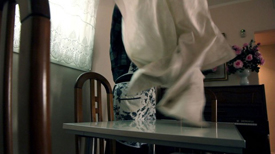 Ira Eduardovna, Mother, 2013, single-channel HD video (artwork © Ira Eduardovna)
Ira Eduardovna. Vox Populi, Philadelphia, Pennsylvania, January 3–26, 2014. Mother. Video.
Midwest

Stacy Leeman. Sharon Weiss Gallery, Columbus, Ohio, March 2–30, 2014. Hidden Presences. Painting.
Northeast
Blane De St. Croix. Fredericks and Freiser, New York, May 1–June 14, 2014. Dead Ice. Sculpture.

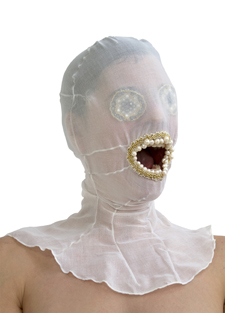 Laura Kalman, Hood (5), 2014, inkjet print, 20 x 28 in. (artwork © Laura Kalman)
Lauren Kalman. Sienna Patti Contemporary, Lenox, Massachusetts, February 8–April 6, 2014. But if the Crime is Beautiful … Part 1, Composition with Ornament and Object. Fine art and contemporary craft.
South

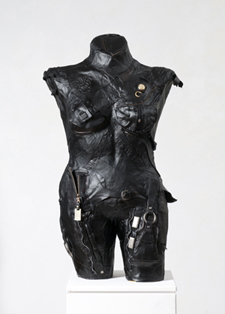 Linda Stein, Defender 696, 2010, leather, metal, and mixed media, 38 x 22 x 14 in. (artwork © Linda Stein)
Linda Stein. Rebecca Randall Bryan Art Gallery, Coastal Carolina University, Conway, South Carolina, January 15–February 28, 2014. The Fluidity of Gender: Sculpture by Linda Stein. Sculpture.
West
Kent Hayward. 7 Dudley Cinema, Beyond Baroque Arts Center, Venice, California, April 27, 2014. Retrospective of Filmmaker Kent Hayward’s Work. Experimental and documentary film.

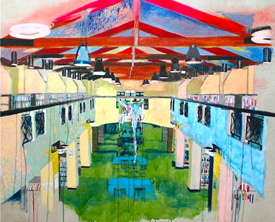 Katie Herzog, painting from Altered State Library (artwork © Katie Herzog)
 Katie Herzog. Monte Vista Projects, Los Angeles, California, February 15–March 9, 2014. Altered State Library. Painting.
People in the News
posted by CAA — April 17, 2014
People in the News lists new hires, positions, and promotions in three sections: Academe, Museums and Galleries, and Organizations and Publications.
The section is published every two months: in February, April, June, August, October, and December. To learn more about submitting a listing, please follow the instructions on the main Member News page.
April 2014
Academe
Christine Hahn has earned tenure in the Department of Art and Art History at Kalamazoo College in Kalamazoo, Michigan.
David Joselit has left Yale University in New Haven, Connecticut, for a new post as Distinguished Professor of Art History at the Graduate Center, City University of New York.
Museums and Galleries
Darby English, director of research and academic programming at the Sterling and Francine Clark Art Institute in Williamstown, Massachusetts, has been appointed consulting curator in the Department of Painting and Sculpture at the Museum of Modern Art in New York. He will retain his position at the Clark.
Sandra Q. Firmin, curator of the UB Art Galleries at the University at Buffalo, State University of New York, has accepted the directorship of the CU Art Museum at the University of Colorado in Boulder.
David Rubin has left his curatorial position at the San Antonio Museum of Art in San Antonio, Texas.
Organizations and Publications
Jill Deupi has joined the board of directors of the Association of Art Museums and Galleries as its New England representative.
Jessi DiTillio has been appointed interim administrative director of the Association of Art Museums and Galleries.
Reni Gower of Virginia Commonwealth University in Richmond has been reelected to the Southeastern College Art Conference’s board of directors for a three-year term.
Sandra Reed of the Savannah College of Art and Design in Savannah, Georgia, has been reelected to the Southeastern College Art Conference’s board of directors for a three-year term.
Institutional News
posted by CAA — April 17, 2014
Read about the latest news from institutional members.
Institutional News is published every two months: in February, April, June, August, October, and December. To learn more about submitting a listing, please follow the instructions on the main Member News page.
April 2014
The Arkansas Arts Center in Little Rock has received a spectacular gift of 290 watercolors and drawings by the American artist John Marin (1870–1953) from Norma B. Marin, the widow of the artist’s son.

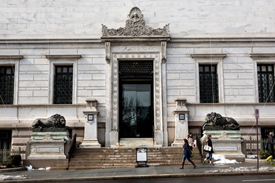 The Corcoran Gallery of Art and Corcoran College of Art and Design (photograph by William Atkins/George Washington University and © George Washington University Photography)
The Corcoran Gallery of Art and Corcoran College of Art and Design, both in Washington, DC, have announced a merger with the National Gallery of Art and George Washington University, also located in the nation’s capital.
The Courtauld Institute of Art in London, England, and the Iran Heritage Foundation have announced funding for a postgraduate and research-assistant post with a focus on Persian arts.
The Frick Art Reference Library and the William Randolph Hearst Archive at Long Island University (LIU) Post have completed a collaborative digitization project, Gilding the Gilded Age: Interior Decoration Tastes and Trends in New York City. With funding from the New York State Regional Bibliographic Databases Program, this project brings together a group of late-nineteenth and early-twentieth-century auction catalogues held by the library and the archive.
The Los Angeles County Museum of Art in California is one of five major American museums to have received funding for the Andrew W. Mellon Undergraduate Curatorial Fellowship Program, which provides specialized training in the curatorial field for students across the United States with diverse backgrounds.
The Metropolitan Museum of Art in New York has received a gift from Daniel Brodsky, the museum’s chairman, and his wife Estrellita B. Brodsky, an art historian, to endow two new curatorial positions in the museum’s Department of Modern and Contemporary Art. The two positions will be called the Estrellita B. Brodsky Curator of Latin American Art and the Daniel Brodsky Associate Curator of Architecture and Design.
The Museum of Fine Arts, Houston, is one of five major American museums to have received funding for the Andrew W. Mellon Undergraduate Curatorial Fellowship Program, which provides specialized training in the curatorial field for students across the United States with diverse backgrounds.

 Ann Hamilton
Ohio State University in Columbus has initiated the Ann Hamilton Project Archive, which contains more than one thousand downloadable, high-resolution images from thirty-five installation by Hamilton, an internationally acclaimed artist and Distinguished University Professor in the university’s Department of Art.
The Yale Center for British Art in New Haven, Connecticut, has reopened its Study Room after completing the first phase of a major building-conservation project.
The Yale School of Art in New Haven, Connecticut, has accepted a $5 million contribution from the Stavros Niarchos Foundation to create a permanent, unrestricted endowment to support the core priorities of the school, while naming in perpetuity the Stavros Niarchos Foundation Dean. A second gift of $900,000 will supplement three existing endowments, created by the foundation in 2010, to establish an artist’s residency, scholarships for international students, and a dean’s resource fund.

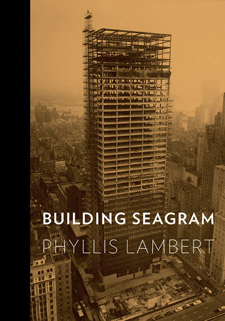
Yale University Press in New Haven, Connecticut, has accepted the 2013 Design Book of the Year Award by the editors of Designers & Books for Phyllis Lambert’s volume Building Seagram (2013). The press also received an honorable mention for another book, The Houses of Louis Kahn (2013) by George H. Marcus and William Whitaker.
Call for Peer Reviewers
posted by CAA — April 16, 2014
2014 Arts in Education Model Development and Dissemination & Professional Development for Arts Educators
CALL FOR PEER REVIEWERS
The U.S. Department of Education, Office of Innovation and Improvement (OII), is seeking individuals to review grant applications for the FY 2014 Arts in Education Model Development and Dissemination (AEMDD) and Professional Development for Arts Educators (PDAE) grant competitions. The AEMDD program supports research and evaluation, sustainability, documentation and dissemination of innovative models that demonstrate effectiveness for student improvement and performance in the elementary and middle school curricula. The PDAE program supports the implementation of a high-quality model for professional development of educators and instructional staff working with kindergarten through 12 grade students (K-12) in high-poverty schools. Integration of art disciplines for both programs includes: music, dance, drama, media arts, visual arts, and folk arts.
WHO: We are seeking peer reviewers from various backgrounds and professions including:
- Arts or Arts Education,
- Elementary through High School Education,
- College and University Educators
- Professional Development,
- Special Populations,
- Research and Evaluation,
- Curriculum Development,
- Model Development,
- Educational Partnerships,
- Non-Profit Organizations, and
- School Administration.
Peer reviewers may have expertise in various geographies, including urban, suburban, rural, and tribal communities.
REQUIRED AREAS OF EXPERTISE: The selected peer reviewers should have expertise in at least one of the following areas: professional and/or curriculum development, applied research and evaluation, arts based program management and design. Selected reviewers may choose to review applications for the AEMDD competition, the PDAE competition or both.
- Professional and Curriculum Development: Experience designing, evaluating, or implementing effective lesson plans and methods to learning for K-12, that focuses on teaching strategies and student engagement inside and outside of the classroom
- Experience integrating the arts into other core academic subjects
- Experience developing model in-service professional development programs for arts educators and other instructional staff
- Experience transferring or adapting projects/organizations to new settings
- Fluency in reviewing organizational assessment tools for project effectiveness
Applied Research and Evaluation:
- Extensive knowledge about current research findings in the What Works Clearinghouse (WWC) and comprehensive school reform models, with knowledge of how to apply those strategies in a variety of settings
- Knowledge of arts in education data sources and measures of program implementation and outcomes
- Knowledge and experience in developing logic models
- Expertise with experimental and quasi-experimental art based research designs
- Understanding of and experience with proven research methods successful in integrating effective practices
Arts Program Management and Design:
- Knowledge and understanding of effective operational and organizational/management infrastructures (e.g. people, processes, accountability structures, technology systems, program and grant management)
- Knowledge of or experience with building effective partnerships in a variety of sectors (education, legislative, private sectors, etc.) and successfully engaging diverse groups of stakeholders
- Experience using one or more of the following arts disciplines in program design: music, dance, drama, media arts, visual arts, and/or folk arts
- Experience building capacity and financial sustainability in organizations
- Experience developing policy to support adaptation of organizational change
- Expertise in recognizing and developing effective arts models in program implementation, particularly those for underserved students in high-poverty communities
- Experience reviewing grant applications
PEER REVIEWER EXPECTATIONS:
Application Review: Selected peer reviewers will independently read, score, and provide written comments for approximately 10 grant applications submitted to the U.S. Department of Education under the AEMDD and/or the PDAE grant programs.
Availability: Peer reviewers must generally be available for a 4 week time period and will work remotely and via teleconference. The peer review will devote time reading, scoring, developing comments, and discussing assigned applications. In addition, all reviewers will be required to participate in an online orientation webinar prior to reviewing applications.
AEMDD will require peer reviewers from May 12 until June 20, 2014.
PDAE will require peer reviewers from June 24 until July 31, 2014.
*These dates are estimates and will be confirmed upon peer reviewer selection*
Tools: Each reviewer must have access to the Internet, a phone, a computer, a printer and have the ability to access and navigate the G5 web-based system.
Quality of review: Each reviewer must provide detailed, objective, constructive, and timely written reviews for each assigned application. These reviews will be used to recommend applications for funding. They will also be shared with each applicant and the comments regarding winning applicants will be made available to the general public following the reviews.
Completion of review: Reviewers will receive an honorarium for the satisfactory completion of the above requirements during the grant review schedule. A satisfactory review requires that each application is read, scored, and discussed. The final, high-quality comments and corresponding scores will be reviewed and approved by a panel moderator prior to their final submission in the G5 system.
IF INTERESTED: If you would like to be considered as a peer reviewer, please click here and complete the Peer Reviewer Application Form. Even if you applied to be a peer reviewer for either the AEMDD and/or the PDAE grant competitions in the years prior, you must complete the Peer Reviewer Application Form. Please only submit one Peer Reviewer Application Form via the link provided above. Please also send your resume to the email address provided below no later than April 25, 2014.
Please do not exceed the three-page limit for resumes.
If you have any questions about the peer review process, please contact us by email: artspeerreviewcall@ed.gov
PROGRAM INFORMATION:
For more information about the AEMDD program, go to:
http://www2.ed.gov/programs/artsedmodel/index.html
For more information about the PDAE program, go to:
Grants, Awards, and Honors
posted by CAA — April 15, 2014
CAA recognizes its members for their professional achievements, be it a grant, fellowship, residency, book prize, honorary degree, or related award.
Grants, Awards, and Honors is published every two months: in February, April, June, August, October, and December. To learn more about submitting a listing, please follow the instructions on the main Member News page.
April 2014
Molly Emma Aitken, associate professor of art at City College, City University of New York, has accepted a Collaborative Research Grant from the American Council of Learned Societies for her project with Allison Renée Busch, called “Aesthetic Worlds of the Indian Heroine.”
Elizabeth Athens, an independent scholar based in Providence, Rhode Island, was named a Clark Graduate Summer Fellow for July–August 2013 by the Sterling and Francine Clark Art Institute in Williamstown, Massachusetts.

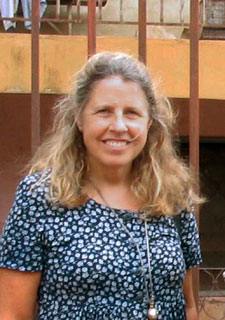 Suzanne Preston Blier
Suzanne Preston Blier, Allen Whitehill Clowes Professor of Fine Arts and of African and African American Studies in Cambridge, Massachusetts, received a Beinecke Fellowship from the Sterling and Francine Clark Art Institute in Williamstown, Massachusetts, for September–December 2013.
William L. Coleman, a PhD candidate in history of art at the University of California, Berkeley, has been awarded the 2014 Dora Wiebenson Prize by the Historians of Eighteenth-Century Art and Architecture. The paper honored as the best of the year by a graduate student was “‘Both instructive and pleasant’: The Country House Garden in Vitruvius Britannicus,” given at CAA Chicago.
Romy Golan, professor of art history at and Lehman College and the Graduate Center, City University of New York, won a fellowship from the Sterling and Francine Clark Art Institute in Williamstown, Massachusetts, for September–December 2013.
Michael Ann Holly, Starr director emeritus of research and academic programs at the Sterling and Francine Clark Art Institute in Williamstown, Massachusetts, has been awarded a fellowship from her institution for February–June 2014.
Simon Leung, an artist and professor of art for the University of California, Irvine, has earned a fellowship from the Sterling and Francine Clark Art Institute in Williamstown, Massachusetts, for February–June 2014.
Judith Rodenbeck, professor of modern and contemporary art at Sarah Lawrence College in Bronxville, New York, was named a fellow by the Sterling and Francine Clark Art Institute in Williamstown, Massachusetts, for September–December 2013.

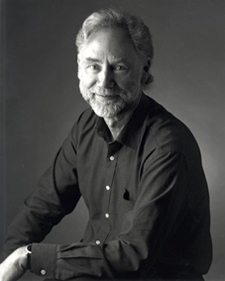 Terry Smith (photograph by John Williams)
Terence Smith, Andrew W. Mellon Professor of Contemporary Art History and Theory in the Department of the History of Art and Architecture at the University of Pittsburgh in Pennsylvania, has received a fellowship for February–June 2014 from the Sterling and Francine Clark Art Institute in Williamstown, Massachusetts.
Roberto Tejada, professor of art history in the Meadows School of the Arts at Southern Methodist University in Dallas, Texas, was named Clark/Oakley Humanities Fellow and Clark Mellon Curatorial Fellow by the Sterling and Francine Clark Art Institute in Williamstown, Massachusetts, for September–December 2013.