CAA News Today
Senate Museum Funding Push Is Now Bipartisan; Tell Your Senators to Join the Effort
posted by CAA — March 20, 2014
The American Alliance of Museums (AAM) sent the following email on March 19, 2014
Senate Museum Funding Push is Now Bipartisan; Tell Your Senators to Join the Effort
Senators Kirsten Gillibrand (D-NY) and Roy Blunt (R-MO) are now circulating a bipartisan letter urging the Senate Appropriations Committee to provide robust funding in FY 2015 for the Office of Museum Services (OMS) at the Institute of Museum and Library Services (IMLS). This is the fifth year that Senator Gillibrand has led this effort, but the first time Senator Blunt will co-lead the letter.
The deadline for Senators to sign on to this letter is March 25, 2014.
The Office of Museum Services is receiving $30.1 million this year, well below its authorized level of $38.6 million. The Gillibrand/Blunt letter is your Senators’ chance to go on record in support of museum funding, so ask them to sign on today!
“Following visits from his constituents during Museums Advocacy Day, Senator Blunt decided to co-lead this letter with Senator Gillibrand, making it a bipartisan effort and demonstrating the value of our field-wide efforts in Washington, D.C.,” said Alliance President Ford W. Bell. “I applaud Senators Gillibrand and Blunt for their leadership in supporting museums nationwide. We are especially thrilled that Senator Blunt has joined the cause this year; museums in Missouri should be proud to have such a responsive museum champion in Congress.”
Last year, you contacted legislators in record numbers and you made a real difference: a record-breaking number of Senators signed the letter supporting funding for the IMLS Office of Museum Services. Keep that momentum going by contacting your Senators now.
Thank you for acting on this important issue!
Development of a Statement on Terminal-Degree Programs in the Visual Arts and Design
posted by CAA — March 12, 2014
While the College Art Association (CAA) continues to affirm that the Master of Fine Arts (MFA) is the terminal degree in visual arts and design practice, a growing number of PhD and other doctoral degree programs in the arts are being offered by institutions within the United States and abroad. Consistent with its commitment to offer guidance to its members, their institutions, and other professional arts organizations, CAA recognizes the need to develop a statement regarding terminal degree programs in the visual arts and design. In February 2013 CAA’s Professional Practices Committee (PPC) outlined a twenty-month course of action to develop a Statement on Terminal Degree Programs in the Visual Arts and Design. This process began with the formation of an ad hoc committee to lead the project.
The committee worked over the past year on collecting and comparing information about terminal degree programs and developing draft statements. The most recent draft was presented to members at the CAA Annual Conference in Chicago in February 2014. The session was extremely well attended and included an open discussion period and a mechanism for collecting post-conference feedback. In addition, the committee presented an earlier draft at the September 2013 National Council of Arts Administrators Annual Conference and many committee members attended an open hearing on the same subject at the October 2013 National Association of Schools of Art and Design Annual Meeting.
The committee continues its work on a timetable to submit a final draft statement for PPC review by June 1, 2014; for CAA staff and legal counsel review by September 1, 2014; and for CAA Board of Directors review in October 2014.
Please review the current draft statement. Members can offer responses, comments, and suggestions at feedback@collegeart.org until April 22, 2014. All submissions will be reviewed and considered. Please be aware that the committee will be unable to respond directly to members.

Linda Downs
Executive Director
Committee on Women in the Arts Picks for March 2014
posted by CAA — March 10, 2014
Each month, CAA’s Committee on Women in the Arts selects the best in feminist art and scholarship. The following exhibitions and events should not be missed. Check the archive of CWA Picks at the bottom of the page, as several museum and gallery shows listed in previous months may still be on view or touring.
March 2014

Anna Maria Maiolino, still from Y, 1974, 8mm film transferred to DVD, black and white with sound, 2:28 mins. (artwork © Anna Maria Maiolino; photograph by Max Nauenberg)
Anna Maria Maiolino: MATRIX 252
Berkeley Art Museum and Pacific Film Archive
University of California, Woo Hon Fai Hall, 2625 Durant Avenue, No. 2250, Berkeley, CA 94720
January 17–March 30, 2014
MATRIX 252 offers a selection of videos by the São Paulo–based artist Anna Maria Maiolino. For over five decades, Maiolino’s multidisciplinary practice comprised drawing, engraving, painting, sculpture, installation, and Super 8 films that led to the use of audio and video in her work. Through fragmentation and abstraction she has explored the “viscerality of embodied experience.” MATRIX 252 features a group of four videos, originally shot on Super 8 between 1973 and 1982.
Born in Italy in 1942, Maiolino emigrated with her family to Venezuela in 1954 before moving to Brazil in 1960. Previous to settling in São Paulo, she lived in Rio de Janeiro, where she took part of the exhibition Nova Objetividade Brasileira (New Brazilian Objectivity) alongside Lygia Clark, Antonio Dias, Rubens Gerchman, Hélio Oiticica, and Lygia Pape. The brutality of the Brazilian military dictatorship (1964–85) became a subject for Maiolino’s work. Based on Oswald de Andrade’s “Manifesto Antropófago” (“Cannibal Manifesto”) of 1928, In-Out (Antropofagia) (1973) shows a close-up of a male and a female mouth attempting to communicate while obstructed by various objects, such as a tape, an egg, and a string. Further close-up shots of faces appear in two works, X and Y (both 1974): eyes are imperiled by snapping scissors in X, while in Y they are blindfolded while the mouth emits a cry. Through these videos, the artist exposes a human body that struggles to find a mode of expression as a metaphor for living under political repression and censorship.
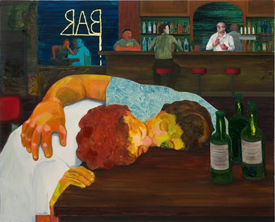
Nicole Eisenman, Sloppy Bar Room Kiss, 2011, oil on canvas, 39 x 48 in. (artwork © Nicole Eisenman)
Dear Nemesis: Nicole Eisenman, 1993–2013
Contemporary Art Museum Saint Louis
3750 Washington Boulevard, Saint Louis, MO 63108
January 24–April 13, 2014
Dear Nemesis, the largest midcareer survey of the work of the American artist Nicole Eisenman (b. France, 1965) to date, includes more than 120 paintings, prints, and drawings created between 1993 to 2013. The work of Eisenman bridges the absurd and abject with the introspective and irreverent, drawing on sources as varied as the iconography of classical myths and popular culture in general. Over the past two decades, she has developed a creative and versatile vision that combines high and low culture with virtuosic skill. Being her core concerns the depictions of community, identity, and sexuality, Eisenman demonstrates an uncanny capacity for capturing the joy, pain, embarrassment, and ecstasy of being human. Fusing images that fluctuate between the depiction of a world rooted in the visual language of art history and a critical and comedic meditation on contemporary life, she depicts settings and themes as varied as bar scenes, motherhood, and the dilemma of the artist. Through a recurrent representation of women, both as “butch” and “femme,” and female love, Eisenman infuses the practice of figurative painting with an audaciously queer bent that also re-presents art history in a feminist light. Through her wit and the uneasiness caused by her playful images, she is able to communicate with a critical—and yet visually breathtaking—absurdity the multifaceted depth of the human condition.

Alice Aycock, Hoodo (Laura) from the Series “How to Catch and Manufacture Ghosts” Vertical & Horizontal Cross-section of the Ether Wind (1981), 1990/2012, watercolor and ink on paper, 27½ x 39¼ in. Collection of the artist (artwork © Alice Aycock)
Alice Aycock Drawings: Some Stories Are Worth Repeating
Santa Barbara Museum of Art
1130 State Street, Santa Barbara, CA 93101
January 26–April 20, 2014
Alice Aycock Drawings: Some Stories Are Worth Repeating
Art, Design, and Architecture Museum
University of California, Santa Barbara, CA 93106
January 26–April 20, 2014
Including over one hundred works, Some Stories Are Worth Repeating is the first comprehensive exploration of Alice Aycock’s creative process. For this major retrospective, the Santa Barbara Museum of Art partnered the Art, Design, and Architecture (AD&A) Museum at the University of California, Santa Barbara, to present an exhibition that traces the artist’s career from 1971 to date. The display at the AD&A Museum focuses on Aycock’s work from 1971 to 1984 and includes detailed architectural drawings, sculptural maquettes, and photo documentation for both realized and imagined architectural projects. The Santa Barbara Museum of Art covers Aycock’s work from 1984 to present, a period in which she developed an increasingly elaborate visual vocabulary, drawing upon a multitude of sources that were partially informed by the use of computer programs.
This double-venue exhibition highlights the major themes that have governed Aycock’s artistic practice. While she is best known for her large-scale installations and outdoor sculptures, her drawings capture the full range of her ideas and sources, mirroring her conceptual clarity and formal depth. Her drawings and built projects achieved new complexity with the advent of computer-graphics programs in the 1990s. New technologies have enable Aycock to develop a digitally informed visual language that includes the generation of forms from multiple perspectives, mathematically perfect curve, and a precise construction drawings, while imagining points of view that are extraordinarily accurate.
A fully illustrated exhibition catalogue, published by the Parrish Art Museum and distributed by Yale University Press, features an interpretive essay by Jonathan Fineberg and an introduction by Terrie Sultan, director of the Parrish Art Museum. This book is the first scholarly exploration of the pivotal, enormously productive role that drawing has played in Aycock’s career over the course of her forty years as professional artist.
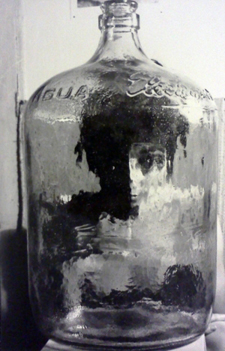
Kati Horna, Bottle, 1962, gelatin-silver print, 9 5/16 x 6½ in. (artwork © Kati Horna)
Kati Horna
Museo Amparo
2 Sur 708, Centro Histórico, Puebla, Pue., Mexico
December 7, 2013–April 28, 2014
Museo Amparo, in collaboration with Jeu de Paume in Paris (where the show will travel later this spring), presents the first major survey of the work of the photographer Kati Horna (Szilas-Balhas, Hungary, 1912–Mexico City, 2000). Horna turned to photography in the early 1930s in Hungary and, though still understudied, became one of the greatest documentary and surrealist photographers of Mexico. Seeking to define her contribution to photojournalism—and the photo-essay in particular—the exhibition brings together over 150 mostly unpublished or rarely seen works and contextualizes Horna’s career with personal photos and the European and Mexican journals with which she collaborated. It is chronologically organized along three axes that distinguish the changing geographic, cultural, and political contexts of her production.
The first part focuses on early work, conducted in Hungary, Berlin (where she relocated at age eighteen), and Paris, her early collages and photomontages illuminating the formation of her aesthetics in the context of the European avant-gardes of the 1930s (Bauhaus, Surrealism, and Neue Sachlichkeit). The second part focuses on Horna’s documentation of the Spanish Civil War, characterized by her compassionate look at civilians, an approach that radically complemented the perspective of her then partner, the war photographer Robert Capa, whom she followed to Spain. The last part of the exhibition examines her work as a chronicler of life in Mexico. Horna moved there on the eve of the Second World War with her husband Jose Jorna, joining various circles of the local intelligentsia, such as the movimiento pánico (Alejandro Jodorowsky) and the artistic, literary, and architectural avant-garde in Mexico (Mathias Goeritz, Germán Cueto, Pedro Friedeberg, Salvador Elizondo, Alfonso Reyes, and Ricardo Legorreta), while forming a close relationship with Leonora Carrington and Remedios Varo. The last twenty years of Horna’s life were dedicated—in addition to her creative work—to teaching photography at the Universidad Iberoamericana and the Academia de San Carlos (Univesidad Nacional Autónoma de México), where she influenced a new generation of contemporary photographers.

Posters (ca. 1991–present) from Riot Grrrl–related shows, conventions, and meetings internationally, solicited from institutional and personal archives through open calls, word of mouth, and invitations
Alien She
Vox Populi
319 North 11th Street, Philadelphia, PA 19107
March 7–April 27, 2014
Organized by two former Riot Grrrls, Astria Suparak and Ceci Moss, Alien She is the first exhibition to examine the lasting impact of the highly influential feminist punk movement from the 1990s on contemporary artists and cultural producers. Formed in reaction to the pervasive and violent sexism, racism, and homophobia in the punk-music scene and in culture at large, Riot Grrrl fomented a new generation of active feminists, inspiring them to create their own culture and communities in defiance of mainstream conventions. The movement also popularized the academic discourse of identity politics. Emphasizing female and youth empowerment, collaborative organization, creative resistance, and DIY ethics, Riot Grrrl had a pivotal influence, inspiring many around the world to pursue socially and politically progressive careers as artists, activists, authors, and educators.
Alien She focuses on seven artists—Ginger Brooks Takahashi (Pittsburgh), Tammy Rae Carland (Oakland), Miranda July (Los Angeles), Faythe Levine (Milwaukee), Allyson Mitchell (Toronto), L. J. Roberts (Brooklyn), and Stephanie Syjuco (San Francisco)—working in different media whose practices reflect the impact of Riot Grrrl; the exhibition also includes an open-ended historical section that reflects the multiplicity that was integral part of the original movement and its continuity, in the spirit of the Riot Grrrl’s principles. Each artist is represented by several projects from the last twenty years, including new and rarely seen works, providing an insight into the development of their creative practices and individual trajectories. The movement’s vast creative output is captured by hundreds of self-published zines and hand-designed posters (solicited from institutional and personal archives through open calls, word-of-mouth, and invitations, similar to the way Riot Grrrl expanded), different music playlists from Riot Grrrl scenes across the United States, Canada, South America, and Europe, while interviews and an ongoing, online Riot Grrrl Census provide an expanded oral history.
The exhibition’s title, Alien She, refers to a Bikini Kill song of the same name. The lyrics are about the negotiation of normalized gender roles, the uneasy line between feminist critique and collectivity, and the process of coming to a feminist consciousness, with the repeated refrain, “She is me, I am her.”

Installation view of Leonor Fini: Pourquoi pas? (artworks © Leonor Fini; photograph by Polly Yassin/Bildmuseet)
Leonor Fini: Pourquoi pas?
Bildmuseet
Umeå University, S-901 87 Umeå, Sweden
January 31–May 11, 2014
Leonor Fini: Pourquoi pas? is the first survey of the work of the Buenos Aires–born, Italian-French artist Leonor Fini (1907–1996) in the Nordic countries. Fini’s work challenged conventional ideas through questioning the frontiers between female and male, myth, and reality, the conscious and unconscious; it also expressed female desire, interfering in Surrealism from a transgressive female point of view. Though posthumously reduced to a footnote of art history, including feminist art history, Fini became a “queen of the Paris art world,” where she moved circa 1931 to become an artist, constantly featured in the news and celebrated for her paintings, illustrations, and theater designs, and above all for her flamboyant bohemian lifestyle, marked by her masquerades and ménages à trois. Fini was largely self-taught, having nurtured her prodigious talent and passion for portraiture by studying Flemish masters and Italian Mannerists; she also claimed dreams as the source of the irrational of her imagery. She was featured in major Surrealist exhibitions, including the 1936 International Exhibition of Surrealism in London, where she scandalized the critics with her erotic females. She also participated in Parisian Surrealist circles yet distanced herself from André Breton’s misogynistic circle.
The exhibition, which includes paintings, drawings, book illustrations, objects, text, film, and costume sketches for theater and opera, is accompanied by a richly illustrated bilingual catalogue (in English and Swedish) with previously unpublished texts by the artist alongside new essays by the poet and author Lasse Söderberg, the art historian Anna Rådström, and the curators Cecilia Andersson and Brita Täljedal.
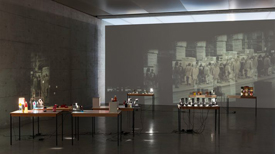
Installation view of Were I made of matter, I would color (photograph by Stephan Wyckoff)
Ulrike Grossarth: Were I made of matter, I would color
Generali Foundation
Wiedner Hauptstrasse 15, 1040 Vienna, Austria
January 24–June 29, 2014
Ulrike Grossarth (b. 1952) is a Berlin-based multimedia conceptual artist and professor of expanded concepts of art and mixed media art at the Academy of Fine Arts in Dresden since 1998. She is the founder of the Essen branch of Free International University initiated by Joseph Beuys and the recipient of the 2009 Kathe Kollwitz Prize. Though Grossarth began her career as a dancer, she became known since the late 1980s for sculptural milieus that variously manifest her interest in the corporeality of matter and create “radical and vivid spaces for thinking, spaces people can actually experience and use,” rather than artworks, as the artist puts it.
Curated by Sabine Folie and Ilse Lafer, Were I made of matter, I would color is a comprehensive retrospective that traces the evolution of Grossarth’s art, drawing connections from her early years as a dancer in the 1970s and 1980s, her sculptural settings and actions, and her most recent work, which interlaces an interest in history with the history of ideas.
The exhibition’s centerpiece, BAU I (1989–2000), is an experimental ensemble comprised of the “unmoved object-bodies” that Grossarth created over a decade and presented in a wide variety of constellations. Visualizing changed spaces of thought and action, the show bridges Grossarth’s early work, which is informed by Fluxus and punk and the attempt to come to terms with the postwar era, and her later art, with its focus on Eastern Europe. More recent works in the exhibition, such as the so-called Lublin projects (since 2006) and SYMBOL gotowe/Subject Aggregates, showcase the ways in which Grossarth seeks to reanimate lost cultural traditions, and her challenging of Occidental thought with her engagement with Jewish mysticism and the motif of the Shekhinah.
Affiliated Society News for March 2014
posted by CAA — March 09, 2014
American Institute for Conservation of Historic and Artistic Works
The American Institute for Conservation of Historic and Artistic Works (AIC) Journal of the American Institute for Conservation (JAIC) is being celebrated by Maney Publications as its Journal of the Month. All access restrictions on three years’ worth of journal content are being lifted until February 15, 2014. Go to http://www.maneyonline.com/page/jotm/jac to learn more. You will find:
- Commentaries on the conservation of textiles, archaeological artifacts, and electronic media, as well as a commentary on sustainability and a review of the archive
- Video interviews with Michele Derrick (editor-in-chief) and Pamela Hatchfield (AIC board president)
- “Best of the Archive”: ten articles handpicked by the editor that are free to download
- 20 percent discount on institutional subscriptions
Foundations in Art: Theory and Education
The Herron School of Art and Design, part of Indiana University–Purdue University Indianapolis (IUPUI), will host “Tectonic Shifts,” the thirty-fifth biennial national conference of Foundations in Art: Theory and Education (FATE) in Indianapolis, Indiana, March 25–28, 2015. As the title of the conference, “Tectonic Shifts” suggests, participants will be examining how the forces of change are shaping the foundations landscape. FATE is interested in hearing from foundations faculty and programs that are breaking new ground with their teaching practices. The Herron School of Art and Design looks forward to being the conference host and introducing attendees to its great city.
Glass Art Society
The forty-third annual conference of the Glass Art Society (GAS), titled “Strengthening Community, Collaboration, Forging New Bonds,” will be held March 19–22, 2014, in Chicago, Illinois. The Windy City is second to none when it comes to a thriving, diverse cultural scene: it is home to renowned architecture, public art displays, galleries, museums, and colleges, including the Art Institute of Chicago, the Museum of Contemporary Art, and Millennium Park. GAS will hosts its conference at well-known venues such as the historic Palmer House Hotel and the Chicago Cultural Center, both centrally located in the heart of downtown. GAS will partner with a new addition to Chicago’s flourishing art scene, Ignite Glass Studios, located in the West Loop neighborhood. Hot glass, flame working, and cold working will be showcased in this state-of-the-art learning center. The second demo site is West Supply, a unique facility that joins glass production with a foundry, which casts concrete and metals for many notable collections in the high-end design, interiors, and gallery markets.
View the complete list of presentations. GAS will also be hosting special conference events such as the preconference reception, live and silent auction, Goblet Grab, gallery hop, an international student exhibition, and a closing night party. For additional information about the conference schedule and to register, visit the website.
Italian Art Society
The Italian Art Society (IAS) is delighted to announce the selection of the fifth annual IAS/Kress Lecturer in Italy: Jean Cadogan, professor of fine arts at Trinity College in Hartford, Connecticut, who will speak on “‘Maravigliose istorie:’ The Mural Decoration of the Camposanto in Pisa.” Cadogan will share her intriguing work on the multiphase, comprehensive program of painting on the walls of the Camposanto in a presentation on May 27, 2014, in Pisa. IAS is happy to establish a link with a respected Italian university, as the lecture will take place in the Gipsoteca of the Università di Pisa. Mark your calendars to visit Pisa if you are in Italy in late May! More details to follow on the IAS website. In addition, please look at the organization’s website for details about the five IAS-sponsored sessions and a reception that IAS hopes to host at the upcoming Renaissance Society of America meeting in New York on March 27–29, 2014.
Leonardo Education and Art Forum
The chair of Leonardo Education and Art Forum (LEAF), Adrienne Klein of the Graduate Center, City University of New York, has announced the election of two new chairs-elect. Klein will be immediately succeeded by David Familian, who is artistic director of the Beall Center for Art and Technology at the University of California, Irvine. Familian will then be succeeded in 2015 by the newly elected Suzanne Anker and in 2016 by J. D. Talasek.
Anker is a visual artist and theorist working at the intersection of art and biology in a variety of media ranging from digital sculpture and installation to large-scale photography to plants grown by LED lights. She is chair of the Fine Arts Department in the School of Visual Arts in New York. Talasek is director of cultural programs of the National Academy of Sciences in Washington, DC, which explores the intersections of science, medicine, technology, and visual culture. For the past three years, Talasek has organized and moderated DC Art Science Evening Rendezvous events in Washington, DC, in collaboration with Leonardo/ISAST.
Midwest Art History Society
The Midwest Art History Society (MAHS) will hold its forty-first annual conference in Saint Louis, Missouri, from April 3 to 5, 2014. In addition to more than twenty scholarly sessions, conference activities will include a special viewing of the Pulitzer Foundation for the Arts and Contemporary Art Museum Saint Louis and a curator-led tour of Impressionist France at the Saint Louis Art Museum. Axel Ruger, director of the Van Gogh Museum in Amsterdam, will offer the keynote address. For more information about the conference and access to online registration forms, please visit the MAHS website.
National Council of Arts Administrators
The forty-second annual meeting of the National Council of Arts Administrators (NCAA) convenes September 23–26, 2014, in Nashville, Tennessee, hosted by Vanderbilt University.
Yes is a world
and in this world of yes…e.e. Cummings
(creativity in the expanding field)
The world is the new studio. Artists are involved in an ever-expanding production involving constituents beyond the art world and marketplace. As educational institutions, how do we respond to this massive shift in artistic attitude? Is there a balance between standard nineteenth- and twentieth-century production and the new twenty-first-century practice centered on global and social interconnectedness? This conference will investigate art’s expanding field by exploring the influences of globalization, art education, and integrated practice. Participants will consider their role as educators of creativity, how they influence our institutions, and their effect on local and world communities. Speakers include: Richard Lloyd, author of Neo-Bohemia: Art and Commerce in the Post Industrial City; David Owens, author of Creative People Must Be Stopped! Six Ways We Stop Innovation (without Even Trying); and Steven Tepper, author of Not Here, Not Now, Not That! Protest over Art and Culture in America.Visit the NCAA website to learn more about this conference and to join the organization.
Public Art Dialogue
Established in 2009, the Public Art Dialogue (PAD) award for achievement in the field of public art is given annually to an individual whose contributions have greatly influenced public art practice. Awardees are chosen from nominations made by PAD members. Award winners receive a three-year PAD membership, which includes a subscription to the journal and all other membership benefits. Each year, the recipient accepts the award at a ceremony during the CAA Annual Conference, at which he or she makes a special presentation open to the public. Nominations for the 2015 award are due on May 1, 2014. Past winners have been Suzanne Lacy, Mary Jane Jacob, Anne Pasternak, Ben Rubin, and Penny Balkin Bach. Jack Becker is the 2014 recipient. For more information see http://publicartdialogue.org/award.
Society for Photographic Education
Each spring, Society for Photographic Education (SPE) hosts a conference for the presentation of artistic work and research to a community of peers. “Atmospheres: Climate, Equity and Community in Photography,” SPE’s fifty-second national conference, will be held from March 12–15, 2015, in New Orleans, Louisiana. SPE is accepting proposals for the 2015 conference from March 6 to June 1, 2014. Topics are not required to be theme based and may include (but are not limited to): imagemaking, history, contemporary theory and criticism, new technologies, effects of media and culture, educational issues, and funding. SPE membership is required to submit and proposals are peer reviewed. The presentation formats are:
- Graduate Student: short presentation of your own artistic work and a brief introduction to your graduate program
- Imagemaker: presentation of your own artistic work (photography, film, video, performance and installation, multidisciplinary approaches)
- Lecture: presentation of a historical topic, theory, or another artist’s work
- Panel: group led by a moderator to discuss a chosen topic
- Teaching: presentations, workshops, demos that address educational issues, including teaching resources and strategies; curricula to serve diverse artists and changing student populations; seeking promotion and tenure; avoiding burnout, and professional exchange
Visit the SPE website for information on SPE membership and full proposal guidelines
Society for the Study of Early Modern Women
The Society for the Study of Early Modern Women (SSEMW) held its annual meeting at the Sixteenth Century Studies Conference in San Juan, Puerto Rico, in October 2013. The results of the election of new officers were announced. Megan Matchinske, Department of English and Comparative Literature, University of North Carolina, Chapel Hill, stepped into the office of president, which was vacated by Jane Couchman, emerita of the Department of French and Women’s Studies at York University in Glendon, Canada. A full list of the new officers will be available shortly on the SSEMW website.
An excerpt from Jane Couchman’s letter to the society’s membership at the close of her term as president in 2013:
The highlights of this year were our meetings at SCSC in San Juan, and especially the talk given jointly by Susan Amussen and Allyson Poska, “Shifting the Frame: Trans-imperial approaches to Gender in the Atlantic World,” a topic chosen to mark our presence in Puerto Rico. The large and enthusiastic audience found their gendered, collaborative, transnational, transatlantic approach relevant and exciting. Susan and Allyson modeled the best of the kind of scholarship that SSEMW encourages, and that we hope to offer to early modern scholarship more generally. The Society’s principal work is very visible and we can all be proud of it: Co-sponsored Sessions (17 panels at 6 different conferences in 2013), the Annual Meeting, Reception and Plenary talk, Travel grants to graduate students (5 each year), the slate of Nominations, the Awards for scholarly work (http://ssemw.org/2013-award-winners/), the SSEMW website and Listserv, our support for Early Modern Women, an Interdisciplinary Journal, our collaboration with Attending to Early Modern Women.
Society of Architectural Historians
Registration is open for the Society of Architectural Historians’ annual conference (#SAH2014), taking place April 9–13, 2014, at the Hyatt Regency Austin in Austin, Texas. The conference offers thirty-five paper sessions along with public programming that includes twenty-one guided architectural tours and the SAH Austin Seminar, “Austin and the Place of Historic Architecture in Rapidly Growing Cities.” Please visit sah.org/2014 for more information on the conference, including a complete schedule of events and how to register.
The call for papers for the 2015 conference in Chicago (April 15–19) opens on April 16, 2014. For abstract submission instructions, visit sah.org/2015.
Registration is open for the Croatia Study Tour, a land-and-cruise program tailored for architecture professionals and enthusiasts that will take place August 18–29, 2014. This customized tour from Sarajevo to Venice along the Adriatic Coast, developed by Boris Srdar, will include visits to UNESCO World Heritage sites, exclusive access to landmark buildings as well as those off the beaten path, and admission to the Venice Biennale on August 30. A fellowship is available for this program. To register, visit sah.org/study-tours.
Buildings of Vermont, the latest volume in the Buildings of the United States series, is now available.
Society of Historians of East European, Eurasian, and Russian Art and Architecture
Following elections in January, the Society of Historians of East European, Eurasian, and Russian Art and Architecture (SHERA) has updated its by-laws and added two new officers: Tamara Jhashi is now SHERA’s listserv administrator, a role she has filled since 2004, and Ksenya Gurshtein is web news editor. Joining SHERA’s board as members-at-large are Anna Novakov, Andrea Rusnock, and Nicolas Iljine, as well as one returning member, Eva Forgacs.
At CAA’s Annual Conference in Chicago, Eva Forgacs served as host to visitors from Eastern Europe and Russia who were part of CAA’s International Travel Grant Program. Along with the visitors, Forgacs participated in a full-day preconference program organized by the CAA International Committee about international issues in art history, as well as other events throughout the conference itself.
SHERA is delighted to welcome three new institutional members: the Kolodzei Art Foundation, which promotes the contemporary art of Russia and the former Soviet Union through exhibitions and grants; the Museum of Russian Icons in Clinton, Massachusetts, the largest private collection of Russian icons in North America; and the M. T. Abraham Foundation, a collection of Russian and European modern art.
Southeastern College Art Conference
The Southeastern College Art Conference (SECAC) will meet October 8–11, 2014, in Sarasota, Florida, hosted by the Ringling College of Art and Design. Submissions for the annual juried exhibition is April 1, 2014. The deadline for the call for papers is April 20, 2014. For more information, visit SECAC’s conference page.
Future conferences will be held: October 21–24, 2015 (Pittsburgh, Pennsylvania); October 19–22, 2016 Virginia Tech (Roanoke, Virginia); 2017 (dates TBA) Columbus College of Art and Design (Columbus, Ohio).
SECAC has introduced a new award, the William R. Levin Award for Research in the History of Art. Thanks to the generosity of William R. Levin, professor emeritus at Centre College in Danville, Kentucky, SECAC will offer an award of an annual total of $5000 to one or more art historians who are members of the organization. Levin has been a member of SECAC since 1987; served on the Board of Directors; published in the scholarly journal, Southeastern College Art Conference Review; received the SECAC Award for Excellence in Scholarly Research and Publication in 2004; and has been recognized with two of the organization’s highest honors, the Excellence in Teaching Award and the Exemplary Achievement Award. Deadline for applicants: March 1, 2014.
The deadline for a $5,000 SECAC Artist’s Fellowship is August 1, 2014.
Visual Resources Association
The Visual Resources Association’s thirty-second annual conference will be held March 12–15, 2014, at the historic Pfister Hotel in downtown Milwaukee, Wisconsin. Take a moment to view the full schedule. Selected highlights are:
- Sessions and case studies covering topics such as collaborative practices amongst traditional and nontraditional disciplines within archival and special collections, international copyright and resources, broadening professional roles, management of moving image collections, basic and advanced (RDF and LOD) cataloging procedures, DAM implementation, expanding VRA Core 4 capabilities, personal digital archiving
- Opening speaker, Philip Yenawine, cofounding director of Visual Thinking Strategies
- Tours of Harley-Davidson Museum and Design Archive and Lakefront Brewery
- Networking opportunities provided by Birds of a Feather Lunches throughout the conference and the Sponsors’ Meet and Greet and Poster Presentations
- Members and Awards Dinner
- Informative workshops (many free for conference registrants)
- Unwind with colleagues at the Drink ‘n’ Draw with Stephanie Barenz (Pfister Hotel’s artist in residence).
- Closing speaker Matthew Israel, director of the Art Genome Project at Artsy
The online conference schedule allows for sign up/log in via SCHED to connect with social-media sites, create custom schedules, and share interests with fellow attendees. Search for “vra32.sched.org“ on your mobile device to download the schedule.
President Reduces Support for NEA in 2015 Budget
posted by CAA — March 05, 2014
Americans for the Arts sent the following email on March 4, 2014.
President Reduces Support for NEA in 2015 Budget
Today, the Obama Administration released its FY 2015 budget request to Congress, which includes funding for the nation’s cultural agencies and programs, such as the National Endowment for the Arts (NEA), the Office of Museum Services, and the Department of Education’s Arts In Education program.
As Americans for the Arts President & CEO Robert Lynch noted in a statement:
The Administration’s FY 2015 request of level funding at $146 million for the National Endowment for the Arts is unfortunately insufficient, considering $154 million has been proposed by the Administration each of the two previous years. Senate appropriators were ready to match this funding each of these years. Investment in the arts is an investment in our nation’s culture, education, and economy. Although it is very welcoming to see the Administration continue support for Our Town and the NEA/Walter Reed Healing Arts Partnership programs, now is the time to boost investment, not reduce it. To reduce support provides both an inconsistent and confusing message for the creative economy in America. This is even more important as the President has recently nominated a new chair to lead the NEA. Arts advocates from across the country will join together on Capitol Hill for Arts Advocacy Day on March 25th to lobby Congress to increase NEA funding to $155 million.
This chart illustrates the inconsistent nature of the Obama Administration’s funding requests for the NEA:

The following is a comparison of the Administration’s FY 2015 budget request and FY 2014 enacted levels:
| Key Federally Funded Arts Program |
FY 2014 Enacted Appropriations (in millions) |
FY 2015 President’s Budget Request (in millions) |
| National Endowment for the Arts |
$146 |
$146 |
| National Endowment for the Humanities |
$146 |
$146 |
| U.S. Dept. of Education’s Arts In Education Program |
$25 |
$0* |
| Office of Museum Services |
$30 |
$31 |
| Corporation for Public Broadcasting (advanced) |
$445 |
$445 |
| U.S. Dept. of State’s Educational & Cultural Exchange |
$560 |
$578 |
*Similar to previous years, the Administration proposes to consolidate the Department of Education’s Arts In Education program.
WHAT COMES NEXT
The President’s request is traditionally just the first step in the legislative budgeting process. Next, the U.S. House of Representatives and U.S. Senate offer their proposals that will reflect their own particular priorities. Appropriations subcommittee work is already underway with several upcoming hearings scheduled.
We ask that advocates remain vigilant in the months ahead as Congress works to pass spending bills. Last year, the House Appropriations Interior subcommittee proposed cutting NEA funding nearly in half! Thanks to your messages to Congress, the nation’s signature cultural agency was spared such drastic cuts after an outpouring of support that helped enable Senate appropriators to drive the final result. We hope to count on your advocacy again this year.
Our kickoff advocacy effort will launch at our National Arts Advocacy Day conference on March 24–25. Join us in Washington, DC for the only national event that brings together a broad cross section of America’s cultural and civic organizations, along with hundreds of grassroots advocates from across the country. We encourage you to register for this national arts action summit and join us on Capitol Hill as the arts community brings a united message to Congress to increase funding for the NEA to $155 million! The deadline for advance registration is approaching quickly on Monday, March 10, 2014.
Help us continue this important work by also becoming an official member of the Arts Action Fund. If you are not already a member, play your part by joining the Arts Action Fund today—it’s free and easy to join.
Last chance to register for NHA Annual Meeting and Humanities Advocacy Day
posted by CAA — February 27, 2014
The National Humanities Alliance (NHA) sent the following email on February 27, 2014.
Last chance to register for NHA Annual Meeting and Humanities Advocacy Day
Registration deadline: Saturday, March 1, 2014
March 10–11, 2014
George Washington University’s Marvin Center and Capitol Hill
Washington, DC
Advocating Locally for National Impact
The 2014 NHA annual meeting will look beyond broad arguments for the value of the humanities to make the case that fostering and demonstrating impact in local communities is critical to increasing support for the humanities among elected officials and the general public. The meeting will feature a series of speakers who will explore: ways to engage local communities in humanities research, teaching, preservation, and programming; the benefits of publicly engaged work to institutions, students, and communities; the role that the humanities can play in the lives of students as they pursue a variety of career paths and goals; and ways to involve elected officials in this work.
Over the last five years, the humanities have faced particular challenges on the state level, as governors and state legislatures have sought to direct funding and students to other courses of study. This year’s annual meeting will feature two speakers from Texas who can speak to the importance of expanding the role of the humanities in their communities amid the challenging state context.
Participants will also learn about efforts to foster increased collaboration between academic institutions and public humanities organizations with the goal of increasing connections with the broader public.
Click here for a preliminary program.
Registration
Click here to register today.
Registration: $100
Deadline: March 1, 2014
Featured Speakers
Francisco Cigarroa, Chancellor, University of Texas System, and a Member of the Commission on the Humanities and Social Sciences
One of ten children, Francisco Cigarroa is a third generation physician. He graduated from Yale University in 1979 with a bachelor’s degree in biology and earned his medical degree in 1983 from the University of Texas Southwestern Medical Center at Dallas. Cigarroa joined the faculty of the University of Texas Health Science Center at San Antonio in 1995, where he served as director of pediatric surgery before serving as president of the institution from 2000 to 2009. In 2003, President George W. Bush appointed him to serve on the President’s Committee on the National Medal of Science. In 2009, Cigarroa became the first Hispanic to be named chancellor of the University of Texas System. As chancellor, he oversees one of the largest public systems of higher education in the nation, which consists of nine universities and six health institutions. President Barack Obama has appointed Cigarroa to serve as a commissioner on the White House Initiative on Educational Excellence for Hispanic Americans. A member of the American Academy of Arts and Sciences, he also serves on the academy’s Commission on the Humanities and Social Sciences. Cigarroa is a nationally renowned transplant surgeon and continues to perform liver and kidney transplant surgeries.
Elva Concha LeBlanc, President, Northwest Campus, Tarrant County College District
Elva Concha LeBlanc is president of the Northwest Campus of Tarrant County College District (TCCD). Northwest Campus is one of five campuses of TCCD, a multicampus, single college district of over 50,000 enrollments. Previously, as president of Galveston College, she led the transformation of that institute into a “learning college” with a focus on student learning, assessment, and outcomes. Prior to serving Galveston, LeBlanc was executive vice president for instructional affairs at Austin Community College. A former Tarrant County College student and alumna of the University of North Texas, LeBlanc served TCCD as professor, faculty chair, director of institutional effectiveness, and dean of instruction.
Carol Muller, Professor of Music, University of Pennsylvania
The South African–born Carol Muller is professor of music and current director of the Africa Center at the University of Pennsylvania. She has published widely on South African music, at home and in exile. Her intellectual interests are in issues of gender, religion, music, diaspora, and postcolonial studies, and her most recent is a book coauthored with South African jazz singer, Sathima Bea Benjamin, called Musical Echoes: South African Women Thinking in Jazz (Duke University Press, 2011); another book, Shembe Hymns (University of KwaZulu Natal Press, 2011), was edited by Muller and translated by Bongani Mthethwa. Muller was topic director for the Penn Humanities Forum (2003–4) on subject of Belief. She has done pioneering work in ethnomusicology on issues of civic engagement, community partner and student research in West Philadelphia, and has experimented with online learning over the last decade—her Coursera–Penn course Listening to World Music attracted 37,000 students in its first iteration—it was one of the first humanities courses offered as a MOOC. Muller is also a gumboot dancer.
David Scobey, Executive Dean, New School for Public Engagement
David Scobey is a national leader in developing innovative methods to engage institutions of higher education with communities outside the academy. He was previously director of the Harvard Center at Bates College in Maine, established to bring together community-based learning and research, cocurricular work, and environmental stewardship. He is the founder and former director of the University of Michigan’s Arts of Citizenship program, an initiative to integrate civic engagement and the liberal arts. He serves on the boards of Project Pericles, an organization that encourages universities to include civic engagement as an element of undergraduate education, and Bringing Theory to Practice, a project that links education as a public good with civic engagement and concern for the well-being of individual students.
Apply for a Publishing Grant from the Millard Meiss Publication Fund
posted by CAA — February 27, 2014
 CAA is accepting applications for spring 2014 grants through the Millard Meiss Publication Fund. Thanks to a generous bequest by the late art historian Millard Meiss, the twice-yearly program supports book-length scholarly manuscripts in any period of the history of art, visual studies, and related subjects that have been accepted by a publisher on their merits but cannot be published in the most desirable form without a subsidy.
The publisher, rather than the author, must submit the application to CAA. Awards are made at the discretion of the jury and vary according to merit, need, and number of applications. Awardees are announced six to eight weeks after the deadline. For the complete guidelines, application forms, and a grant description, please visit the Meiss section of the CAA website or send an email to nyoffice@collegeart.org. Deadline: March 15, 2014.
Image Caption
Bibiana K. Obler’s book Intimate Collaborations: Kandinsky and Münter, Arp and Taeuber won a Meiss grant in fall 2012.
AAMD Provenance Workshops
posted by CAA — February 25, 2014
The Association of Art Museum Directors (AAMD) will cosponsor two provenance workshops this spring: one in Seattle, Washington, and another in Washington, DC.
Seattle
This workshop will be held on May 18, 2014, in conjunction with the Association of Academic Museums and Galleries’s annual conference in Seattle. The workshop will review best practices for conducting provenance research in art museums, with a focus on Nazi-era provenance, as well as issues pertaining to antiquities and cultural property. The session is geared to all levels of experience and can serve as a how-to and a refresher. The workshop leaders will discuss due diligence and the acquisition process, online research tools, and the handling of restitution claims. The workshop is limited to fifty participants; ample time will be allotted for Q&A.
Victoria Reed, curator for provenance at the Museum of Fine Arts, Boston, and Nancy H. Yeide, head of the Department of Curatorial Records at the National Gallery of Art, will conduct the half-day workshop, which will be held at the Hotel Deca in Seattle. Each participant will receive a copy of Yeide’s book Beyond the Dreams of Avarice: The Hermann Goering Collection (2009), which is the first biography to focus on Hermann Goering’s personal collection and provides the first opportunity since the war to look at the collection as a whole and evaluate its place within art collecting and politics. This carefully documented volume is critical to the clarification of provenances of the objects featured and brings to light pictures whose histories and whereabouts have been hidden for decades.
Registration is available at www.aamg-us.org/registration; scroll down to “Sunday Morning Workshops.”
Washington, DC
In cooperation with the National Archives and Records Administration, the Smithsonian Institution, and the American Alliance of Museums, AAMD will sponsor a workshop for advanced researchers following the success of a two-day, Nazi-era provenance seminar that was held in 2011. Taking place at the National Archives on June 17, 2014, this workshop is limited to thirty participants who are experienced researchers working in museums. The event will provide a hands-on workshop on using new and updated online provenance research resources. Registration will include a copy of Holocaust-Era Assets, a Finding Aid to Records at the National Archives at College Park.
Nancy H. Yeide, head of the Department of Curatorial Records at the National Gallery of Art, and Chris Naylor, director of textual records for the National Archives, will lead the one-day workshop, which will be accompanied by an introduction to new materials at the Archives of American Art led by Marisa Bourgoin, chief of reference services for the Archives of American Art, and Laurie Stein, senior provenance advisor for the Smithsonian Provenance Research Initiative.
The cosponsors for the DC seminar express grateful appreciation to the Samuel H. Kress Foundation for support to defray expenses for workshop participants.
To apply for registration go and to learn more about Kress grants, visit the AAMD website.
Solo Exhibitions by Artist Members
posted by CAA — February 22, 2014
See when and where CAA members are exhibiting their art, and view images of their work.
Solo Exhibitions by Artist Members is published every two months: in February, April, June, August, October, and December. To learn more about submitting a listing, please follow the instructions on the main Member News page.
February 2014
Mid-Atlantic

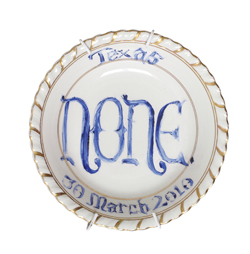 Julie Green, Texas 30 March 2010, from The Last Supper series (2000–ongoing), cobalt blue pigment painted on porcelain, kiln-fired ceramic, 6 x 6 x 1 in. (artwork © Julie Green)
Julie Green. Lore Degenstein Gallery, Susquehanna University Selinsgrove, Pennsylvania, January 18–March 1, 2014. The Last Supper: Final Meals of U.S. Death Row Inmates. 550 painted, kiln-fired ceramic plates.
Midwest

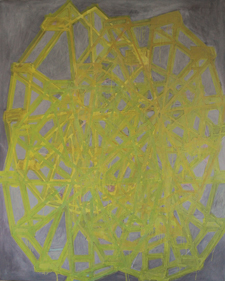 Hartmut Austen, Ferris, 2013, oil on canvas, 75 x 60 in. (artwork © Hartmut Austen)
Hartmut Austen. The Butcher’s Daughter, Detroit, Michigan, January 18–February 23, 2014. Approximate Territory. Painting.

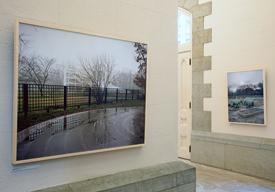 Regina Mamou, Chartres Cathedral (left), 2012, C-print, 40 x 50 in.; and Lustgarten (right), 2012, C-print, 40 x 32 in. (artworks © Regina Mamou)
Regina Mamou. City Gallery in the Historic Water Tower, Chicago, Illinois, October 11, 2013–January 19, 2014. Unfortunately, It Was Paradise. Photography.

Christopher Troutman. Mallin Gallery, Kansas City Artists Coalition, Kansas City, Missouri, December 13, 2013–January 17, 2014. Charcoal and ink drawing.
South

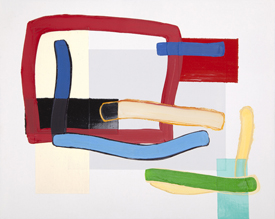 Sharon Louden, Community, 2013, oil and enamel on stretched paper mounted on panel, 11 x 14 x 1½ in. (artwork © Sharon Louden)
Sharon Louden. Beta Pictoris Gallery, Maus Contemporary Art, Birmingham, Alabama, January 7–February 16, 2014. The Dancing Line: New Paintings, New Drawings. Painting and drawing.
West

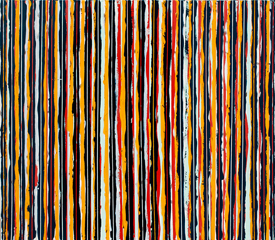 Jeffrey Glossip, Arrival (New Big), 2012, oil on canvas, 72 x 80 in. (artwork © Jeffrey Glossip)
Jeffrey Glossip. Lynnwood Convention Center, Lynnwood, Washington, January 8–July 31, 2014. Big Paint. Large-scale nonrepresentational painting.
People in the News
posted by CAA — February 17, 2014
People in the News lists new hires, positions, and promotions in three sections: Academe, Museums and Galleries, and Organizations and Publications.
The section is published every two months: in February, April, June, August, October, and December. To learn more about submitting a listing, please follow the instructions on the main Member News page.
February 2014
Museums and Galleries

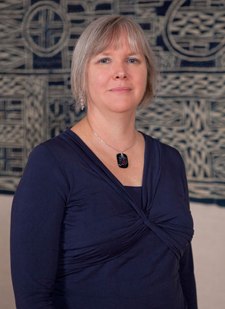 Kathleen Bickford Berzock
Kathleen Bickford Berzock, previously curator of African art at the Art Institute of Chicago, has been appointed associate director of curatorial affairs for the Mary and Leigh Block Museum of Art at Northwestern University in Evanston, Illinois.
Michael Brown, a researcher, lecturer, and formerly Mayer Curatorial Fellow for Spanish Colonial Art at the Denver Art Museum in Colorado, has become an associate curator of European art at the San Diego Museum of Art in California.

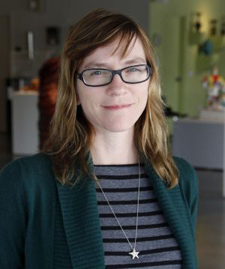 Elizabeth Kozlowski
Elizabeth Kozlowski, formerly Windgate Curatorial Fellow at the Arizona State University Museum in Tempe, has become a new curator for the Houston Center for Contemporary Craft in Texas.