CAA News Today
People in the News
posted by CAA — June 17, 2011
People in the News lists new hires, positions, and promotions in three sections: Academe, Museums and Galleries, and Organizations and Publications.
The section is published every two months: in February, April, June, August, October, and December. To learn more about submitting a listing, please follow the instructions on the main Member News page.
June 2011
Academe

Michaël J. Amy has been promoted to professor of the history of art in the College of Imaging Arts and Sciences at Rochester Institute of Technology in Rochester, New York.

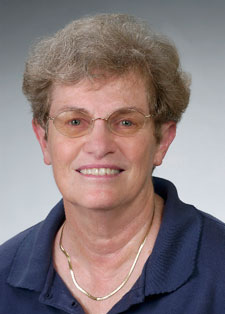 Mary D. Garrard
Mary D. Garrard, professor emerita of American University in Washington, DC, was the William Fleming Distinguished Visiting Professor at Syracuse University in Syracuse, New York, in April 2011.

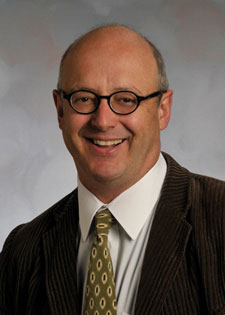 Beauvais Lyons
Beauvais Lyons, James R. Cox Professor of Art at the University of Tennessee in Knoxville, has been appointed a Chancellor Professor at his school. The honor comes with a $20,000 research stipend.
Museums and Galleries
Amy Brandt, formerly assistant curator at American Federation of Arts in New York, has been named McKinnon Curator of Modern and Contemporary Art at the Chrysler Museum of Art in Norfolk, Virginia.
Cosmin Costinas will join Para/Site, a contemporary art space in Hong Kong, China, as executive director and curator in September 2011. He was previously curator at Basis voor actuele kunst in Utrecht, the Netherlands.
Olivier Meslay, curator of European and American art at the Dallas Museum of Art in Texas, has been appointed interim director of his institution, following the resignation of Bonnie Pitman.
Joel Smith, curator of photography at the Princeton University Art Museum in Princeton, New Jersey, has been named Peter C. Bunnell Curator of Photography, a newly endowed position.
John R. Stomberg, currently deputy director and chief curator of the Williams College Museum of Art in Williamstown, Massachusetts, has been chosen to lead the Mount Holyoke College Art Museum in South Hadley, Massachusetts, as director. He begins the new job on August 1, 2011.
Michael Taylor, curator of modern art and department head of modern and contemporary art at the Philadelphia Museum of Art in Pennsylvania, has become director of the Hood Museum of Art in Hanover, New Hampshire.
Organizations and Publications
Heath Fox, assistant dean of arts and humanities at the University of California, San Diego, since 2006, has been appointed deputy director of operations at the Broad Museum in Los Angeles, California.

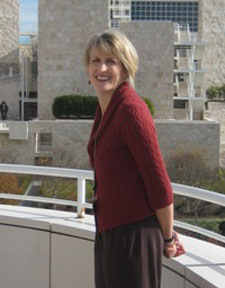 Anne Helmreich
Anne Helmreich, formerly director of the Baker-Nord Center for the Humanities and associate professor of art history at Case Western Reserve University in Cleveland, Ohio, has been appointed senior program officer at the Getty Foundation in Los Angeles, California.
Institutional News
posted by CAA — June 17, 2011
Read about the latest news from institutional members.
Institutional News is published every two months: in February, April, June, August, October, and December. To learn more about submitting a listing, please follow the instructions on the main Member News page.
June 2011
The Archives of American Art at the Smithsonian Institution, based in New York and Washington, DC, has received a $3 million grant from the Terra Foundation for American Art to support another five years of the archives’ digitization project and to fund a new position that will create and oversee related online scholarly and educational outreach initiatives. This second grant brings the Terra’s total gift to the archives to $6.6 million over a ten-year period.
The Currier Museum of Art in Manchester, New Hampshire, has received a grant from the National Endowment for the Arts to support the exhibition Jon Brooks: Bringing Art and Nature to Children and Families. A comprehensive selection of educational and community outreach activities will accompany the retrospective exhibition of works by Brooks, a New Hampshire artist who is a leading member of the American studio furniture movement.
The Honolulu Academy of Arts and the Contemporary Museum, both in Hawai‘i, have announced that the two institutions will merge, effective July 1, 2011. Under the agreement, the latter museum will gift its collection and assets to the former one.
The Philadelphia Museum of Art in Pennsylvania has been approved for reaccreditation by the Accreditation Commission of the Association of American Museums, a nonprofit organization based in Washington, DC.
Rutgers University’s Visual Arts Department has received a $3.4 million gift from Marlene A. and David A. Tepper to endow a faculty chair position at the Mason Gross School of the Arts and to fund scholarships in the painting program.
The Virginia Museum of Fine Arts in Richmond has received reaccreditation from the Accreditation Commission of the American Association of Museum, based in Washington, DC.
The Whitney Museum of American Art in New York has been reaccredited by the Accreditation Commission of the Washington, DC–based Association of American Museums.
Grants, Awards, and Honors
posted by CAA — June 15, 2011
Grants, Awards, and Honors
CAA recognizes its members for their professional achievements, be it a grant, fellowship, residency, book prize, honorary degree, or related award.
Grants, Awards, and Honors is published every two months: in February, April, June, August, October, and December. To learn more about submitting a listing, please follow the instructions on the main Member News page.
June 2011

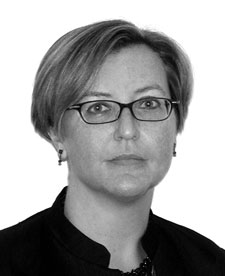 Elizabeth Bolman
Elizabeth Bolman, associate professor of art history in the Tyler School of Art at Temple University in Philadelphia, Pennsylvania, has received a 2011 John Simon Guggenheim Memorial Foundation Fellowship in fine-arts research. She will study magnificence and asceticism in Upper Egypt via the Red Monastery Church.
Michele Brody, an artist based in New York, has been awarded a summer residency at Quimby Colony in Portland, Maine, where she will focus on her Drawing Roots series.
Carissa Carman, an MFA student in fibers at Concordia University in Montreal, Quebec, has received a $2,000 Textile Society of America Travel Grant to attend and participate in the International Symposium and Exhibition on Natural Dyes, which took place April 24–30, 2011, in La Rochelle, France.
Mary D. Garrard, professor emerita of American University in Washington, DC, has received a Lifetime Achievement Award from the Mississippi Institute of Arts and Letters.
Charles Goldman, an artist based in Brooklyn, New York, has been award a 2011 John Simon Guggenheim Memorial Foundation Fellowship in fine arts.

 Michelle Handelman, still from Dorian, 2009, 4-channel HD video, 63 min. (artwork © Michelle Handelman)
Michelle Handelman has been awarded a 2011 John Simon Guggenheim Memorial Foundation Fellowship in film and video. She will spend the fellowship period working on her new project, Irma Vep, the last breath, a three-channel video installation based on the life of the actress and film director Musidora, and the silent-film character she was best known for, Irma Vep, from Les Vampires (1915, directed by Louis Feuillade).

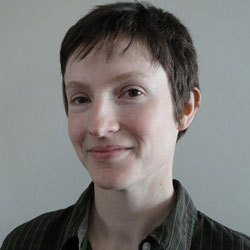 Jen P. Harris
Jen P. Harris, a New York–based artist, has been awarded a $2,500 grant from the Astraea Visual Arts Fund, which promotes the work of contemporary lesbian visual artists.
Anne D. Hedeman, professor of art and medieval studies at the University of Illinois, Urbana-Champaign, has received a 2011 John Simon Guggenheim Memorial Foundation Fellowship in medieval history.
Corin Hewitt, an artist and assistant professor of sculpture and extended media at Virginia Commonwealth University in Richmond, has been awarded a 2011 John Simon Guggenheim Memorial Foundation Fellowship in fine arts.
Alison Luchs has been tapped by the Italian Art Society to deliver the 2011 Italian Art Society–Kress Foundation Lecture in Florence, Italy, taking place on June 8, 2011.
Billie Grace Lynn has received the 2011 West Grand Prize. A $25,000 award will assist her project, called Mad Cow Motorcycle, in which she will develop a biodiesel motorcycle to raise awareness for greenhouses gases coming from commercial cattle farms.

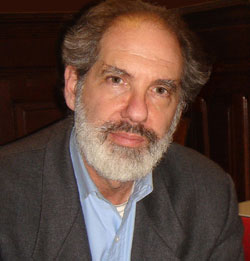 Richard Minsky (photograph by Richard Grosbard)
Richard Minsky has received the 2011 Worldwide Books Award for Publications for The Art of American Book Covers, 1875–1930 (New York: George Braziller, 2010). The Art Libraries Society of North America awarded him a certificate and a $1,000 prize for his book at its recent annual conference, held jointly with the Visual Resources Association.
Linda Nochlin, Lila Acheson Wallace Professor of Modern Art at the Institute of Fine Arts, New York University, has received a 2011 Icon Award in the Arts from the Bruce Museum in Greenwich, Connecticut.
Jennifer Ellen Robertson, professor of anthropology at the University of Michigan, Ann Arbor, has received a 2011 John Simon Guggenheim Memorial Foundation Fellowship in East Asian studies.
Allison Smith, a sculptor based in Oakland, California, has been awarded a $50,000 USA Fellowship for artistic excellence from United States Artists.
Susan Webster, Jane Williams Mahoney Professor of Art History and American Studies at the College of William and Mary in Williamsburg, Virginia, has received a 2011 John Simon Guggenheim Memorial Foundation Fellowship in fine-arts research. She will study European architecture and Andean masters in colonial Quito, Ecuador.

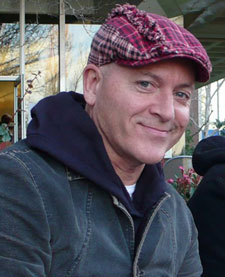 Bradley Wester
Bradley Wester, an artist based in New York, has been awarded two residencies. From September to November 2011, he will be a resident artist at AIR Antwerpen in Belgium. In February 2012, he will take part in the Hermitage Artist Retreat, based in Englewood, Florida, and comprised of writers, painters, composers, playwrights, poets, choreographers, performance artists, sculptors, and other artists whose work defies categorization. (He was also a resident there in March 2011).

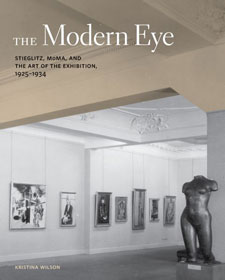
Kristina Wilson, associate professor of art history at Clark University in Worcester, Massachusetts, has received the twenty-third Charles C. Eldredge Prize for Distinguished Scholarship in American Art, awarded by the Smithsonian American Art Museum in Washington, DC, for her book, The Modern Eye: Stieglitz, MoMA, and the Art of the Exhibition, 1925–1934 (New Haven: Yale University Press, 2009).
Exhibitions Curated by CAA Members
posted by CAA — June 15, 2011
Exhibitions Curated by CAA Members
Check out details on recent shows organized by CAA members who are also curators.
Exhibitions Curated by CAA Members is published every two months: in February, April, June, August, October, and December. To learn more about submitting a listing, please follow the instructions on the main Member News page.
June 2011
John Chaich. Mixed Messages: A(I)DS, Art + Words. La MaMa La Galleria, New York, June 2–July 3, 2011.

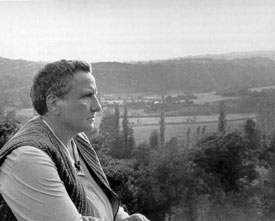 George Platt Lynes, Gertrude Stein, Bilignin, 1931, toned gelatin-silver print. Baltimore Museum of Art, Cone Collection, Gift of Adelyn D. Breeskin, BMA 1985.3 (artwork © Estate of George Platt Lynes)
Wanda M. Corn and Tirza True Latimer. Seeing Gertrude Stein: Five Stories. Contemporary Jewish Museum, San Francisco, California, May 12–September 6, 2011.

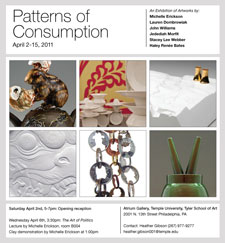 Promotional image for Patterns of Consumption
Heather Gibson. Patterns of Consumption. Atrium Gallery, Tyler School of Art, Temple University, Philadelphia, Pennsylvania, April 2–15, 2011.
Elizabeth Keithline. A Tool Is a Mirror. Danforth Museum of Art, Framingham, Massachusetts, May 4–June 5, 2011.

 Promotional image for Theodolite
John Silvis and Brett Dickinson. Theodolite. New York Center for Art and Media Studies, New York, April 6–21, 2011.
Robert Storr and Francesca Pietropaolo. North by New York: New Nordic Art. Third Floor Galleries, Scandinavia House, Nordic Center in America, American-Scandinavian Foundation, New York, April 14–August 19, 2011.
Virginia-Lee Webb. Ancestors of the Lake: Art of Lake Sentani and Humboldt Bay, New Guinea. Menil Collection, Houston, Texas, May 6–August 28, 2011.
Books Published by CAA Members
posted by CAA — June 15, 2011
Publishing a book is a major milestone for artists and scholars—browse a list of recent titles below.
Books Published by CAA Members appears every two months: in February, April, June, August, October, and December. To learn more about submitting a listing, please follow the instructions on the main Member News page.
June 2011

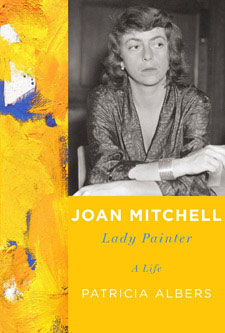
Patricia Albers. Joan Mitchell, Lady Painter: A Life (New York: Alfred A. Knopf, 2011).

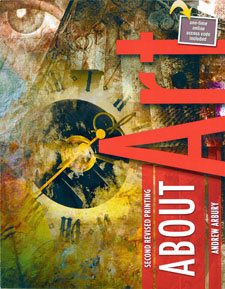
Andrew Arbury. About Art (Dubuque, IA: Kendall Hunt, 2011).

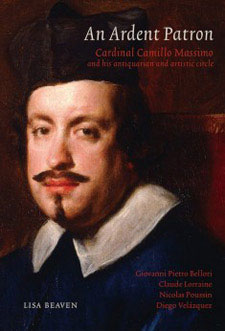
Lisa Beaven. An Ardent Patron: Cardinal Camillo Massimo and His Antiquarian and Artistic Circle (London: Paul Holbertson, in association with Centro de Estudios Europa Hispánica, 2010).

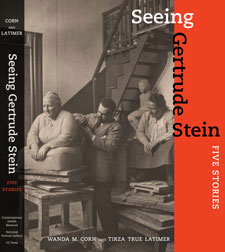
Wanda M. Corn and Tirza True Latimer. Seeing Gertrude Stein: Five Stories. (Berkeley: University of California Press; San Francisco: Contemporary Jewish Museum; Washington, DC, National Portrait Gallery, 2011).

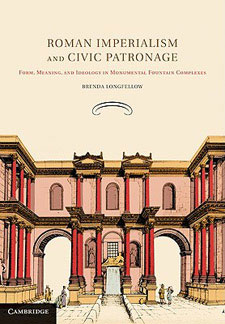
Brenda Longfellow. Roman Imperialism and Civic Patronage: Form, Meaning, and Ideology in Monumental Fountain Complexes (New York: Cambridge University Press, 2010).


Andreas Marks, ed. Fukami: Purity of Form (Hanford, CA: Clark Center for Japanese Art and Culture, 2011).

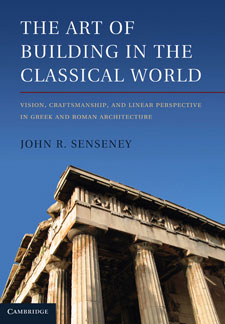
John R. Senseney. The Art of Building in the Classical World: Vision, Craftsmanship, and Linear Perspective in Greek and Roman Architecture (New York: Cambridge University Press, 2011).
Apply for a Meiss or Wyeth Publishing Grant
posted by CAA — June 13, 2011
CAA is offering two publishing-grant opportunities this fall—through the Millard Meiss Publication Fund and the Wyeth Foundation for American Art Publication Grant—that support new books in art history and related subjects. The publisher must submit the application to either grant or to both funds, though only one award can be given per title. Awards are made at the discretion of each jury and vary according to merit, need, and number of applications. Both programs have a deadline of October 1, 2011. CAA will announce the recipients of the Meiss and Wyeth grants in late November or early December 2011.
Millard Meiss Publication Fund
CAA awards grants from the Millard Meiss Publication Fund to support book-length scholarly manuscripts in the history of art and related subjects that have been accepted by a publisher on their merits but cannot be published in the most desirable form without a subsidy. For complete guidelines, application forms, and a grant description, please visit www.collegeart.org/meiss or write to nyoffice@collegeart.org. Deadline: October 1, 2011.
Wyeth Foundation for American Art Publication Grant
Thanks to generous funding from the Wyeth Foundation for American Art, CAA awards a publication grant to support book-length scholarly manuscripts in the history of American art and related subjects. For purposes of this program, “American art” is defined as art created in the United States, Canada, and Mexico prior to 1970. Books eligible for the Wyeth Grant have been accepted by a publisher on their merits but cannot be published in the most desirable form without a subsidy. For complete guidelines, application forms, and a grant description, please visit www.collegeart.org/wyeth or write to nyoffice@collegeart.org. Deadline: October 1, 2011.
Committee on Women in the Arts Picks for June 2011
posted by CAA — June 10, 2011
Each month, CAA’s Committee on Women in the Arts selects the best in feminist art and scholarship. The following exhibitions and events should not be missed. Check the archive of CWA Picks at the bottom of the page, as several museum and gallery shows listed in previous months may still be on view or touring.
June 2011
“Women and the Arts: Dialogues in Female Creativity in the U.S. and Beyond”
June 15–17, 2011
University of Lisbon Centre for English Studies
Centro de Saúde de Sete Rios, Lisbon, Portugal 1600-214
This three-day international gathering, organized by the American Studies Group of the University of Lisbon Centre for English Studies, will promote a reflection on women’s artistic production, contrasting the US context with other cultures. Featured sessions address such topics as “Dreaming, Doing, Being, & Seeing: The Woman Artist as Seen, Invisible, Witnessed and Observer”; “Women and the Crafts”; “Performance Arts”; “Art and Gender Politics”; “Portraits of the Artist as Woman”; “Women in Contemporary Art in the U.S. and Beyond”; and “Boundaries and Crossings in Theory and Art.”

!Women Art Revolution
Various locations across the United States
This eight-three-minute documentary film, directed by Lynn Hershman Leeson (and a CWA Pick in January 2011), relates the feminist art movement to the 1960s antiwar and civil rights causes and explains how historical events sparked feminist actions against major cultural institutions. Detailing major developments in women’s art of the 1970s, the film looks at early feminist art-education programs, political organizations and protests, and alternative art spaces such as A.I.R. Gallery and Franklin Furnace in New York and the Women’s Building in Los Angeles. Leeson also turns her attention to publications such as Chrysalis and Heresies and to landmark exhibitions, performances, and installations of public art that changed the direction of contemporary art.
In June, the following theaters and cultural institutions will screen the film:
- June 1–8: IFC Center, 323 Avenue of the Americas, New York, NY 10014
- June 2: Manhasset Cinemas, Gold Coast International Film Festival, 430 Plandome Road, Manhasset, NY 11030
- June 2–9: West End Cinema, 1 M Street NW, Washington, DC
- June 3: New Hyde Park Cinemas, Gold Coast International Film Festival, 3324 Hillside Avenue, New Hyde Park, NY 11040
- June 10: Institute of Contemporary Art, 100 Northern Avenue, Boston, MA 02210
- June 10: The Screen, Santa Fe University of Art and Design, 100 Saint Michaels Drive, Santa Fe, NM 87505
- June 14: Billy Wilder Theater, Hammer Museum, 10899 Wilshire Boulevard, Los Angeles, CA 90024
- June 15–19: Museum of Fine Arts, 100 Huntington Avenue, Boston, MA 02116
- June 17–23: Laemmle’s Music Hall 3, 9036 Wilshire Boulevard, Beverly Hills, CA 90211
- June 17–23: Northwest Film Forum, 1515 Twelfth Avenue, Seattle, WA 98122
- June 23–26: Noble Theater, Oklahoma City Museum of Art, 415 Couch Drive, Oklahoma City, OK 73102
- June 24–27: Northwest Film Center, 1119 Southwest Park Avenue, Portland, OR 97205
- June 24–30: Denver FilmCenter, Denver Film Society, 2601 Blake Street, Denver, CO 80205
- June 24–30: Real Art Ways, 56 Arbor Street, Hartford, CT 67401
- June 24–30: Salina Art Center, 150 South Santa Fe, Salina, KS 67401
Talks by the director and guest speakers—such as Howardena Pindell and Carey Lovelace in New York, Carrie Brownstein in Portland—and other special events will accompany selected screenings.

Guerrilla Girls, Untitled, from the series Guerrilla Girls Talk Back: The First Five Years, 1985–1990, 1986, color photolithograph on paper, 17 x 22 in. National Museum of Women in the Arts, Gift of Steven Scott, Baltimore, in honor of Wilhelmina Cole Holladay (artwork © Guerrilla Girls; photograph provided by the National Museum of Women in the Arts)
The Guerrilla Girls Talk Back
June 17–October 2, 2011
National Museum of Women in the Arts
1250 New York Avenue NW, Washington DC 20005
The Guerrilla Girls—anonymous females who take the names of dead women artists and appear in public wearing gorilla masks—use humor to expose sexism and racism in the art world, film, politics, and culture at large. This exhibition presents posters and ephemera from the group, including works from two portfolios, Guerrilla Girls Talk Back: The First Five Years, 1985–1990 and Guerrilla Girls Talk Back: Portfolio 2.
Tracey Emin: Love Is What You Want
May 18–August 29, 2011
Hayward Gallery
Southbank Centre, Belvedere Road, London SE1 8XX, England
The first major survey in London of Tracey Emin’s work occupies both floors and two outdoor sculpture terraces at the Southbank Centre. Works from every period of her career and in diverse media—painting, textiles, work on paper, photography, neon, film, and sculpture—will accompany a new series of outdoor sculptures made especially for the Hayward Gallery installation.
Discounts on Magazine and Journal Subscriptions for CAA Members
posted by CAA — May 17, 2011
 Every year CAA collaborates with publishers to offer special discounts on forty-seven magazines and journals covering art and culture. This longstanding member benefit encourages the exchange and dissemination of artistic and scholarly viewpoints and complements CAA’s three journals to which members have access.
Established magazines such as Artforum, Art in America, and October join more eclectic publications like Cabinet, McSweeney’s Quarterly Concern, and the Believer in a diverse stable of printed matter. CAA welcomes Critical Inquiry and History of Photography back into the fold and introduces West 86th, formerly known as Studies in the Decorative Arts. The discount program even includes a quarterly DVD series, called Wholphin.
If you are interested in starting a new subscription or renewing an existing one, please log into your CAA account and click the Member Benefits link at left. On the following page, click the link under the Subscription Discounts header to download the PDF file with the contact information and order coupon for each journal or magazine. If you have questions about this benefit, please contact Member Services at 212-691-1051, ext. 12.
Committee on Women in the Arts Picks for May 2011
posted by CAA — May 10, 2011
Each month, CAA’s Committee on Women in the Arts selects the best in feminist art and scholarship. The following exhibitions and events should not be missed. Check the archive of CWA Picks at the bottom of the page, as several museum and gallery shows listed in previous months may still be on view or touring.
May 2011

Poster for a Mahalia Jackson concert in Topeka, Kansas, 1962 (photograph provided by the Rock and Roll Hall of Fame and Museum)
Women Who Rock: Vision, Passion, Power
Rock and Roll Hall of Fame and Museum
1100 Rock and Roll Boulevard, Cleveland, OH 44114
May 13, 2011–February 26, 2012
The eight sections of Women Who Rock: Vision, Passion, Power will highlight how women have driven the engines of creation and change in popular music since the early twentieth century. Blues women from the 1920s such as Ma Rainey and Bessie Smith set the stage for those who followed: Brenda Lee, the Ronettes, Janis Joplin, Carol King, Donna Summer, Siouxsie Sioux, Madonna, Bikini Kill, Queen Latifah, and Lady Gaga. In addition to displays of artifacts and memorabilia, as well as videos and listening stations, the interactive exhibition will set up a recording booth where visitors can record a short story or moment of inspiration related to women in rock.
“From Portraits to Pinups: Women in Art and Popular Culture”
Iris and B. Gerald Cantor Auditorium
Brooklyn Museum
200 Eastern Parkway, Brooklyn, NY 11238
May 14, 2011
On Saturday, May 14, the Brooklyn Museum will hold a daylong symposium in conjunction with the exhibition Lorna Simpson: Gathered (a CWA Pick from February). Graduate students will present their research on topics such as the implications of women artists using images of women in their work, the connections between women’s history and contemporary art, and perceptions of race and gender. In addition, Wendy Steiner, an English professor and the founding director of the Penn Humanities Forum at the University of Pennsylvania, will speak about concepts of beauty, while a panel discussion will feature the comedian Erica Watson, the drag king Shelly Mars, and the illustrator Molly Crabapple.
Uta Barth
Art Institute of Chicago
111 South Michigan Avenue, Chicago, IL 60603
May 14–September 14, 2011
The photographer Uta Barth once intriguingly said that her contemplative images of domestic scenes devoid of action “are really not of anything in that sense, they register only that which is incidental and peripheral implied.” Curated by Elizabeth Siegel of the Art Institute of Chicago, this exhibition presents her latest series, called … and to draw a bright white line with light, alongside two earlier bodies of work: white blind (bright red) from 2002 and Sundial from 2007.

“Illustrated Lecture and Book Signing: Dr. Gail Levin”
Elizabeth A. Sackler Center for Feminist Art
Brooklyn Museum, 200 Eastern Parkway, Brooklyn, NY 11238
May 15, 2011
On Sunday, May 15, the art historian Gail Levin, who teaches at Baruch College and the Graduate Center in New York, will discuss her most recent book, Lee Krasner: A Biography (New York: William Morrow, 2011), which looks beyond Krasner’s relationship with her husband Jackson Pollock to detail her own brilliant career as a painter in New York. A book signing will follow the 2:00 PM talk.
Loïs Mailou Jones: A Life in Vibrant Color
Women’s Museum
3800 Parry Avenue, Dallas, TX 75226
May 21–July 23, 2011
This traveling exhibition surveys Loïs Mailou Jones’s seventy-five years as a painter, tracing the development of her work from her early career into her signature mixture of African, Caribbean, American, and African American iconography, design, and thematic elements. Comprised of over sixty paintings, drawings, and textile designs from public and private collections, Loïs Mailou Jones: A Life in Vibrant Color also includes, for the first time, major holdings from the late artist’s estate for public presentation. A CWA Pick in October 2010, the exhibition originated at the National Museum of Women in the Arts in Washington, DC.
Affiliated Society News for May 2011
posted by CAA — May 09, 2011
American Society of Hispanic Art Historical Studies

Janice Mann’s Romanesque Architecture and Its Sculptural Decoration in Christian Spain, 1000–1120 won the 2011 Eleanor Tufts Award
The American Society of Hispanic Art Historical Studies (ASHAHS) has announced the recipients of two annual awards, with one honorable mention, at a business meeting held during the CAA Annual Conference in February 2011. The Eleanor Tufts Award, which recognizes an outstanding English-language publication in Spanish or Portuguese art history, went to Janice Mann for Romanesque Architecture and Its Sculptural Decoration in Christian Spain, 1000–1120: Exploring Frontiers and Defining Identities (Toronto: University of Toronto Press, 2009). In addition, the jurors selected Giles Knox’s The Late Paintings of Velázquez: Theorizing Painterly Performance (Burlington, VT: Ashgate, 2009) as an honorable mention. The winner of the ASHAHS Photographs Grant is Kelly Watt of the University of Louisville, who is conducting research for her dissertation, “Medieval Churches on the Spanish Frontier: How Elite Emulation in Architecture Contributed to the Transformation of a Territorial Expansion into Reconquista.”
Art Libraries Society of North America
The Art Libraries Society of North America (ARLIS/NA) has awarded its 2010 George Wittenborn Memorial Book Award to Five Centuries of Indonesian Textiles: The Mary Hunt Kahlenberg Collection (New York: DelMonico Books/Prestel, 2010). Edited by Ruth Barnes and Mary Hunt Kahlenberg, this large, beautifully produced catalogue includes stunning, detailed photographs of many rare and unique textiles and essays by expert art historians and anthropologists that seamlessly connect the history and cultural significance of these aesthetically beautiful weavings for the reader. Aimée Brown Price’s Pierre Puvis de Chavannes (New Haven: Yale University Press, 2010) received the honorable mention. Her exceptional two-volume set includes a scholarly monograph on the artist and a catalogue raisonné of his painted works. ARLIS/NA presented the two awards at a joint conference with the Visual Resources Association, another CAA affiliated society, in Minneapolis, Minnesota, on March 25, 2011.
Association for Latin American Art
The Association for Latin American Art (ALAA) announces the election results for its executive committee: Margaret A. Jackson of the University of New Mexico holds the office of president; Elisa Mandell of California State University, Fullerton, is the new vice president; and Paul Niell of the University of North Texas becomes secretary-treasurer. As advocates for all areas and periods of Latin American art, committee members hold office for a three-year term (2011–13).
Association of Academic Museums and Galleries
The Association of Academic Museums and Galleries (AAMG) will hold its next annual conference, “Who’s Muse? Challenges to the Curatorial Profession in Academic Museums,” on May 21, 2011, at the University of Houston’s Blaffer Art Museum in Texas. Curatorial practices in academic museums and galleries are sometimes highly experimental. Faculty members from a wide variety of fields and with limited curatorial experience periodically recommend and help lead exhibition projects. The organization of exhibitions likewise engages both graduate and undergraduate students, museum-education professionals, librarians, and even area school classes in project leadership roles. Exhibitions thus generated offer unorthodox approaches to curatorial planning and execution. Appropriate to a scholarly mission, they can stretch disciplinary boundaries, cross-fertilize disciplinary methodologies, and generate wholly new paradigms for knowledge. Academic museums and galleries thus become vital centers of original research, interdisciplinary dialogue, and participatory learning. While this democratic and laboratory approach to curatorial practice contributes in significant ways to the groundbreaking research and all-important teaching missions of universities and colleges, it can also challenge conventional standards of the curatorial profession. Through the presentation of outstanding case studies and lively roundtable discussions, the 2011 conference will explore the pros and cons of the broad curatorial approaches found in academic museums and galleries.
Association of Art Historians
Art History, the flagship journal of the Association of Art Historians (AAH), has just published a special issue on “Creative Writing and Art History.” Guest edited by Patricia Rubin of the Institute of Fine Arts, New York University, and Catherine Grant of the Courtauld Institute of Art and Goldsmiths, University of London), this collection of articles and projects considers the ways in which the writing of art history intersects with creative writing, from the creative writing of art history to dialogues between modes of creative and art-historical writing. Essays range from the analysis of historical examples of scholarship that have a creative element to presentations of contemporary modes of creative writing about art.
Association of Historians of American Art
The Association of Historians of American Art (AHAA) has announced the names of new board members: Peter John (P. J.) Brownlee of the Terra Foundation of American Art is chair (2011–12); Jenny Carson of Maryland Institute College of Art is cochair (2011–12); Elizabeth Kuebler-Wolf of the University of Saint Francis is web coordinator (2011–14); and Melissa Renn of the Harvard University Art Museums is membership coordinator (2011–14).
AHAA has named the winner of the $500 AHAA Travel Grant: Maggie Cao, a graduate student at Harvard University and a predoctoral fellow at the Smithsonian American Art Museum. She delivered a paper, “Invisible Color: Abbott Handerson Thayer and Camouflage,” in the AHAA-sponsored scholarly session, “Color and Nineteenth-Century American Painting,” at the recent CAA Annual Conference in New York.
Association of Historians of Nineteenth-Century Art

Édouard Manet, Summer or the Amazon, ca. 1882, oil on canvas, 73 x 52 cm. Museo Thyssen-Bornemisza, Madrid (artwork in the public domain)
The Association of Historians of Nineteenth-Century Art (AHNCA) held its eighth annual graduate-student symposium in nineteenth-century art at the Graduate Center, City University of New York, on March 4, 2011. Speakers included ten doctoral candidates from the United States, France, Spain, and Switzerland. AHNCA will also hold a special event for its members this summer in conjunction with the current exhibition, Manet, the Man Who Invented Modernity, at the Musée d’Orsay in Paris.
Association of Modern and Contemporary Art of the Arab World, Iran, and Turkey
Created in honor of a dear friend and colleague, Rhonda A. Saad (1979–2010) and sponsored by donations from numerous generous individuals, the Association of Modern and Contemporary Art of the Arab World, Iran, and Turkey (AMCA) has established the Rhonda A. Saad Prize for Best Graduate Paper in Modern Arab Art. The award, which aims to recognize and promote excellence in scholarship on modern and contemporary art, is offered annually to a graduate student (defined as predissertation) working in any discipline whose paper is judged to provide the most significant contribution to Middle Eastern studies and art history. Papers will be evaluated according to the originality of research and methodological approach, cogency of argument, and clarity of writing. The submission must be written in English by a single author. AMCA will award $500 to the winner at the Middle East Studies Association annual meeting in December 2011. The paper must have been produced between June 2010 and June 2011; must not exceed thirty-five pages, excluding notes and bibliography; and must not be or have ever been submitted for publication. Applicants should send their entry for the inaugural prize to info@amcainternational.org by June 30, 2011.
Historians of British Art

Marcia Pointon won an HBA prize for post-1800, single-author book for Brilliant Effects: A Cultural History of Gem Stones and Jewellery
The Historians of British Art (HBA) recently announced the winners of its 2011 Book Prizes for publications on British art. Kevin Sharpe received the award for pre-1800, single-author book for Selling the Tudor Monarchy: Authority and Image in Sixteenth-Century England (New Haven: Yale University Press, 2009). Marcia Pointon won the prize for post-1800, single-author book for Brilliant Effects: A Cultural History of Gem Stones and Jewellery (New Haven: Paul Mellon Centre for Studies in British Art, in association with Yale University Press, 2010); and Elizabeth Prettejohn, Peter Trippi, Robert Upstone, and Patty Wageman received the multiauthor publication honor for J. W. Waterhouse: The Modern Pre-Raphaelite (London: Royal Academy of Arts, 2009).
The HBA awarded its Publication Grant to Leon Wainwright for Timed Out: Art and the Transnational Caribbean, forthcoming from Manchester University Press in 2011. Lyrica Taylor received the HBA Travel Grant to present a paper, “Winifred Knights and Interwar Artists at the British School at Rome, 1920–1925,” at the Association of Art Historians’s 2011 conference, held at the University of Warwick, March 31–April 2, 2011.
Historians of Islamic Art Association
At its 2011 annual business meeting, the Historians of Islamic Art Association (HIAA) recognized the visionary leadership of Renata Holod as president (2008–10) and welcomed Shreve Simpson as her successor (2010–12). Members chose Sheila Canby as president-elect (to follow Simpson), and Lara Tohme became the new webmaster. HIAA also decided to separate the secretary-treasurer position, currently held by Glaire Anderson. Anderson will continue serving as treasurer, and Ladan Akbarnia will be acting secretary for 2011.
HIAA also announced the winner of its 2011 Margaret B. Sevcenko Prize in Islamic Art and Culture for the best unpublished article written by a young scholar: Silvia Armando of the Università della Tuscia in Viterbo, Italy, for her paper on “Ugo Monneret de Villard (1881–1954) and the Establishment of Islamic Art Studies in Italy.” The organization then described several new initiatives, including the establishment of the Oleg Grabar Memorial Fund and the Richard Ettinghausen Achievement Award. The venue and dates for the third biennial symposium were given: the Metropolitan Museum of Art in New York, October 18–20, 2012. Finally, HIAA announced plans to organize a memorial service for Grabar with the Aga Khan Program in Islamic Architecture, which took place at Harvard University on April 23, 2011, at 2:00 PM.
International Center of Medieval Art
At its annual meeting for 2011, the International Center of Medieval Art (ICMA) announced the election of new officers and a new group of directors, all to serve three-year terms. Lawrence Nees is president, Nancy Sevcenko became vice president, and Gerry Guest is secretary. Rebecca Corrie continues as treasurer. The new directors elected by the membership are Eva Hoffman, Melanie Holcomb, Charles McClendon, Elizabeth Morrison, Kirsten Noreen, Elizabeth Teviotdale, Benjamin Withers.
At the CAA Annual Conference, ICMA sponsored a well-attended and stimulating interdisciplinary session, “Medicine and Science in Medieval Visual Culture.” Organized and chaired by Jennifer Borland, the panel features papers from Megan McNamee, Kathleen Crowther, Jean Givens, Talia Avisar, and Jack Hartnell. ICMA thanks the Samuel H. Kress Foundation for a generous grant that underwrote some of the travel costs for speakers.
ICMA seeks proposals for the 2011–12 Harvey Stahl Lectureship. Named in memory of a longtime professor of medieval art at the University of California, Berkeley, the fund supports talks by distinguished scholars in any field of medieval art history, to be held at one or more locations. The precise number of venues depends on the availability of funds and the readiness of local host institutions to provide hospitality. While lectures may take place anywhere in North America, proposals that involve a venue in the Southwest (particularly New Mexico) are given priority, with the goal of having at least one event in that region every three years. Due to the current financial climate, ICMA cannot fund speakers who must travel from outside North America. Applications for the 2011–12 Stahl Lectureship should consist of a completed application form (available on the ICMA website) and CV(s) of the host(s). Please direct all lectureship proposals and inquiries to: Kirk Ambrose, Department of Art and Art History, 318 UCB, University of Colorado, Boulder, CO 80309-0318. Deadline: May 15, 2011.
Italian Art Society
The Italian Art Society (IAS) has elected its new officers for 2011–13 terms: Kirstin Noreen of Loyola Marymount University is president, and Cathleen Fleck of Saint Louis University is vice president. The society also welcomes new committee members: Niall Atkinson, Jennie Hirsh, Martina Bagnoli, Sara Kozlowski, Catherine Hess, and Ian Verstegen. David Boffa, Rebekah Perry, Gilbert Jones, and Lisa Tom are members of a newly formed Graduate Student Committee. Jasmine Cloud of Temple University and Rebekah Perry of the University of Pittsburgh received 2011 Graduate Student Travel Grants to give papers, respectively, at the Renaissance Society of America’s annual meeting in Montreal, Quebec, and the International Congress on Medieval Studies in Kalamazoo, Michigan.
IAS has selected Alison Luchs, curator of early European sculpture at the National Gallery of Art in Washington, DC, to present the 2011 Italian Art Society–Kress Foundation Lecture. Her talk, entitled “The Wake of Desiderio: His Impact on Sculpture of the Late Quattrocento,” will take place at the historic Accademia delle Arti del Disegno in Florence at 4:00 PM on June 8, 2011.
Japanese Art History Forum

The new officers of the Japanese Art History Forum (JAHF) are: John Carpenter, School of Oriental and African Studies, University of London, president; Monika Dix, Saginaw Valley State University, vice president; John Szostak, University of Hawai‘i, Manoa, treasurer; Alicia Volk, University of Maryland, College Park, secretary; and Asato Ikeda, University of British Columbia, graduate-student representative.
Leonardo Education and Art Forum
Leonardo Education and Art Forum (LEAF) thanks those members who organized events, panels, and meetings at the 2011 CAA Annual Conference in New York. Special thanks goes to Ellen K. Levy, who, after making significant contributions on behalf of LEAF, has rotated off as former chair. Levy and Victoria Vesna hosted a LEAF event, called “ART SCI Salon,” at the former’s studio in New York on April 9, 2011. The salon theme was “Art and Neuroscience,” and attendees participated in a Pecha Kucha–style presentation of their work.
Midwest Art History Society
The Midwest Art History Society (MAHS) recently hosted its thirty-eighth annual conference in Grand Rapids, Michigan. Held April 14–16, 2011, the conference was hosted jointly by Frederik Meijer Gardens and Sculpture Park, with additional support from the Grand Rapids Art Museum and the Urban Institute for Contemporary Arts. The event offered twenty scholarly sessions, including special topics on the body in art, conservation, gardens as art, and public sculpture. Several featured events included an evening dialogue with the iconic American artist Jim Dine, who joined the conference at the Meijer Gardens on April 14, and a presentation by Rebecca Zorach, author of the acclaimed book Blood, Milk, Ink, Gold: Abundance and Excess in the French Renaissance (Chicago: University of Chicago Press, 2005).
National Council of Arts Administrators

Three National Council of Arts Administrators (NCAA) members, Cora Lynn Diebler, Kim Russo, and Andrea Eis, presented a highly successful CAA Annual Conference session on the uses of social media.
The next NCAA annual meeting, entitled “Push: The Artistic Engine of Innovation,” will take place November 2–5, 2011, at the Savannah College of Art and Design in Georgia. The NCAA board seeks proposals for presentations, sessions, and/or panels for the annual Arts Administrators Workshops, scheduled for Wednesday, November 2. Initial proposals should be no more than 350 words. Topics may include but are not limited to: leadership and management; promotion and tenure; interpersonal communication; succeeding with external constituencies; budget management; personnel evaluation; personal growth; career paths; and case studies (in any area related to arts administration). Please send proposals and inquiries to Sergio Soave by May 16, 2011. Selected entries will be asked to submit a 1,000-word abstract by June 20.
Radical Art Caucus
The Radical Art Caucus (RAC) had a strong presence at the CAA Annual Conference this year. Many thanks to Benj Gerdes and Nate Harrison for chairing “Video Art as Mass Medium” and to RAC copresident Travis Nygard for organizing “Environmental Sustainability in Art History, Theory, and Practice.” RAC especially is grateful to Dan S. Wang for his hard work on the beautifully designed RAC newsletter, reaching hundreds of participants at CAA. At the annual reception, the group held a compelling discussion on academic organizing, thanks to Nayla Wren. Please help RAC continue its important discussions by joining as a member or contributing to dialogues on Facebook or the listserv. For more information, please contact Joanna Gardner-Huggett, RAC secretary.
Society for Photographic Education

The Society for Photographic Education (SPE) seeks proposals for its forty-ninth national conference, called “Intimacy and Voyeurism: The Public/Private Divide in Photography” and taking place March 22–25, 2012, in San Francisco, California. Topics, which need not be theme based, may include but are not limited to: image making, history, contemporary theory and criticism, new technologies, effects of media and culture, educational issues, and funding. The conference offers six presentation formats: (1) Lecture: presentation on historical topic, theory, or another artist’s work; (2) Imagemaker: presentation on your own artistic work (photography, film, video, performance and installation, multidisciplinary approaches); (3) Panel: a moderator-led group discussing a chosen topic; (4) Demonstration: a how-to presentation; (5) Graduate Student: short presentation of your own artistic work and a brief introduction to your graduate program (you must be enrolled in a graduate program at the time of submission); and (6) Academic Practicum Workshop: lectures and panels that address educational issues. SPE membership is required to submit; proposals are peer reviewed. Visit the SPE website for information on membership and to read the full proposal guidelines. Deadline: June 1, 2011.
Society of Architectural Historians
The sixty-fourth annual meeting of the Society of Architectural Historians (SAH) was held April 13–17, 2011, in New Orleans, Louisiana. Thirty thematic paper sessions presented the latest research in the history of architecture, landscapes, and urbanism. In addition, the meeting featured more than twenty-five architectural tours to the Garden District, the Lower Ninth Ward, the Make it Right Foundation neighborhood, and other notable sites and landscapes throughout the city.
SAH currently seeks abstracts of papers for the sixty-fifth annual meeting, to be held April 18–22, 2012, in Detroit, Michigan. Visit the SAH website to view the full list of sessions and to read instructions on how to submit your abstract online. A PDF describing all session is also available. Deadline: June 1, 2011.
Visual Resources Association

The Visual Resources Association (VRA) republished its Intellectual Property Rights (IPR) webpage in a new format in January 2011, after the IPR Committee completed its reorganization project. Called Resources Providing Guidance on Academic Use of Images, the section is arranged into eight sections of information about copyright and fair use that are important to the educational community. Maintenance and workability of current information and the incorporation of new resources guided this revision, and the contents have been more efficiently laid out and are easier to navigate. In other news, VRA has developed fair-use guidelines regarding the use of images in educational settings, and the IPR Committee has begun publishing a monthly news blog, called IPR in the News.