CAA News Today
CWA Picks for April 2019
posted by CAA — April 02, 2019
CAA’s Committee on Women in the Arts selects the best in feminist art and scholarship to share with CAA members on a monthly basis. See the picks for April below.
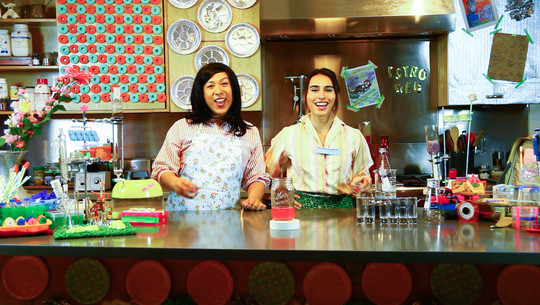
Video still from Mary Maggic, Housewives Making Drugs, 2017, on view in Producing Futures—An Exhibition on Post-Cyber-Feminisms at the Migros Museum für Gegenwartskunst through May 12th. Courtesy the artist.
SHE MATTERS
March 6 – April 26, 2019
Wright Gallery, Texas A&M University, College Station, Texas
Taking the 2015 arrest and subsequent death of Sandra Bland as its starting point, this exhibition aims to give a platform to women of color to respond creatively to issues around family separation, law enforcement brutality, sexual assault, and violence. Multi-media artist Rabéa Ballin used neon to highlight to represent Sandra Bland’s case number, in Case Number 02-F-00151, bringing attention to identity which is typically lost, and dehumanized in the prison system. Rosine Kouamen’s richly hued Required Solidarity, a fabric work using prints from Cameroon with women and a woman letting a dove go in front of Africa, is embroidered with, according to the artist, “powerful words to emphasize the progress that still needs to happen to have a truly equal society, where women, especially women of color are protected by the law and not victims of it.” Ann Johnson’s two-sided glass quilt, The Narrative, displays the scripted police transcript of Sandra Bland’s traffic stop, and on the other, the traditional “North Star” pattern which guided numerous slaves to freedom, as well as the written names of women who lost their lives to violence or law enforcement, with repeated words, “she matters / say her name / say it” emphasizing the significance of the exhibit; “We must tell these stories,” Johnson writes in her statement, “She matters.” Other equally impactful work in the exhibit includes laser print transparency on wood by Regina Agu, plaster relief and mixed media silhouettes by Lovie Olivia, fabric cast aluminum and mixed media fabrics by Kaneem Smith, and linocuts by Monica Villarreal. The nontraditional multi-colored painted pedestals and walls create an apt, progressive atmosphere for this inspiring art.
YELENA POPOVA, JOANNA RAJKOWSKIA, JAN ERIC VISSER: WHAT BRANCHES GROW OUT OF THIS STONY RUBBISH?
March 22 – May 4, 2019
l’étrangère, London
l’étrangère gallery in London brings into conversation the works of Yelena Popova, Joanna Rajkowska, and Jan Eric Visser who critically respond to ecological concerns in the context of industrial capitalism, neo-liberalism and consumerism. It is an intimate exhibition, which encourages reflection of the material legacy of Modernism. Rajkowska’s site-specific installation entitled Trafostation (2016) is introduced through a photographic documentation. The project, in Wrocław, Poland, turned a defunct 1930s transformer station into a living sculpture, which keeps evolving. The artist encouraged non-human organisms to take over the building and erode the concrete structure by growing plants and creating a new habitat. Rajkowska’s feminist ecological ethics is reflected in Popova’s practice. Called by the artist ‘Medieval Modernism’, it is concerned with the threshold states between the past and the future and the linear and cyclical modes of growth. Post-petrochemical Paintings (2016-ongoing) are made from mixed pigments from soil and wood ash collected by the artist during a number of walks in parks and forests, which are then grind according to medieval recipes. Jan Eric Visser makes sculptures from inorganic household garbage. The process, which he calls ‘Form Follows Garbage’, gives waste a new identity and emphasise the importance of valuing all matter. The artist is also engaged with issues concerning the post-industrial future, which is reflected in his use of two new innovative building materials called Translucent concrete, capable of degrading nitrogenoxides causing smog and Aquadyne, enabling the rooting of plants and vegetables.
PRODUCING FUTURES: AN EXHIBITION ON POST CYBER-FEMINISMS
February 16 – May 12, 2019
Migros Museum für Gegenwartskunst, Zurich
2017 marked the 20th anniversary of a meeting that took place at Documenta X entitled ‘The First Cyberfeminist International’. Issue that were raised then and revisited in a number of events that followed contributed to the emergence of a new movement branded as post-Cyberfeminism, a term coined in the early 1990s. The group exhibition Producing Futures—An Exhibition on Post-Cyber-Feminisms, including the works of artists such as VNS Matrix and Lynn Hershman Leeson, Wu Tsang, Guan Xiao and Anna Uddenberg, Juliana Huxtable, Shana Moulton or Anicka Yi, among others, at the Migros Museum für Gegenwartskunst in Zurich explores feminist methods of engagement in the era of developing networked technologies and in the post-internet era, which, on the contrary to what was predicted in 1990s, apart from functioning as spaces of liberation and arguable self-empowerment, introduced disciplining structures reinforcing hierarchies and patriarchal systems of power. Artists involved in the show question the legacy of the cyberfeminist movement, its currency and relevance while working through the intersections between the body, technology and gender across the real and the virtual. Exhibited works engage with Donna Haraway’s proposed alternative model of knowledge formation called “SF,” an abbreviation for “science fiction” but also “speculative feminism,” a practice open to speculations and intellectual experiments where alternative visions of the future may emerge. A number of events are organised in parallel to the exhibition. The Revolution of Digital Languages or When Cyber turns to sound of Poetry. A Symposium on Post-Cyber-Feminisms, organised in cooperation with MAS in Curating, Zürcher Hochschule der Künste and the PhD in Practice in Curating on April 11th and 12th, further explores and engages with issues raised at the show.
JUST TO BE ALIVE
March 7 – May 31, 2019
Sixteen Twenty-Eight Gallery, Cincinnati, Ohio
In celebration of Women’s History Month, Cincinnati’s 1628 Gallery devotes their spring exhibition to a juried exhibition featuring work by twenty local self-identifying women artists. The painting, collage, photography, sculpture, fiber art and more, reflect the complexity, challenge and passion of being a contemporary woman, as relayed in the title, referencing poem by Mary Oliver: “it’s a serious thing / just to be alive / on this fresh morning / in this broken world.” Kim Flora’s mixed media collage, something about those volcanos, too emits the multifaceted, sometimes daunting, sometimes rich, living experience of women through the bright red and orange fiery hues above the torn, charcoal paper and what appears to be a section of a woman in etching, slight smile barely seen in the bottom corner, her body ripped at right. The over thirty other works surely emphasizes the rich breadth of media and perspectives by women in the area in this “curated workspace” in downtown Cincinnati.
SERA WATERS: GOING ROUND IN SQUARES
March 9 – June 30, 2019
Ararat Gallery TAMA, Ararat, Victoria, Australia
Sera Waters is Adelaide based artist, arts writer and academic, who through her textile work engages with issues concerning boundaries and domesticity, and more specifically the concept of “home” in Australia in the aftermath of colonization. Those places of trauma and hauntings in settler colonial homes she calls “genealogical ghostscapes.” Going Round in Circles presented in Ararat Gallery TAMA explores the boundaries that have shaped Australian life since colonization. Waters calls them ‘geometric discipline’, suggesting structures of discomfort imposed on individuals aimed at disciplining them into docile subjects. She shares her frustration of ‘being stuck in a loop’ understood as repetitiveness and going round the same silencing and colonizing arguments and denials. Textile work, which is performed on the gridded warp and weft of fabric, is in itself an example of a discipline reinforcing social status of women as home makers confined to domestic spaces and their gendered roles often focused on practices of comforting and caring. Waters’s exercises disruptive agency, for example in Sampler for a Colonised land, 2018-2019, by working in repeated loops and rings within textiles’ squares and grids. She uses found materials such as pelts, needlework or wool, among others, to break the boundaries of colonizing structures and enable new patterns for shared togetherness.
SIXTY YEARS
From April 22, 2019
Tate Britain, London, UK
On April 22nd Tate Britain opens a new temporary display on its main floor as part of its commitment to increase the visibility of women in Tate’s galleries. It features approximately 60 works from Tate’s collection by around 30 women artists working across diverse media, including Mona Hatoum, Rachel Whiteread, Sarah Lucas, Monster Chetwynd, Susan Hiller and Bridget Riley, among others. The display focuses on narratives in British history from 1960 until the present day, covering a wide range of issues such as immigration, race, class struggle, Britain’s colonial past, sexual identity, feminism, AIDS activism and club culture. Particularly interesting is Black Audio Film Collective’s film Handsworth Songs (1986; directed by John Akomfrah and produced by Lina Gopaul), which was filmed during the 1985 riots in Handsworth and London. It raises not only issues specific to the riots and their cultural, social, and political context but also the continuity of some of those unresolved struggles reflecting on brutal policing and racism and their current insurrections. Tate’s promise to increase the visibility of women artists is reflected in its 2019 program, which features (across its galleries) other exhibitions and displays celebrating women.
See the Results of the 2019 CAA Annual Conference Survey
posted by CAA — April 02, 2019
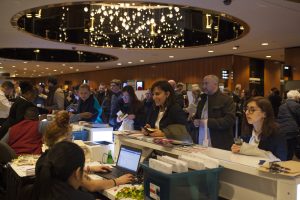
Registration at the 2019 CAA Annual Conference in New York. Photo: Ben Fractenberg
Thank you to everyone who participated in our 2019 Annual Conference survey! Each year we work to make the Annual Conference better than the year before. It’s a large effort that takes the time of many people. We only do it once year but we need to have it perfect from that first hour registration is open, and your direct feedback helps us make that happen.
Here is what you told us about your experience this year:
- Up from last year, 79% of you were satisfied with the Annual Conference
- 75% liked the content of the sessions but only half of you thought the sessions represented a balance of time periods
- 75% liked your online experience with CAA
- 74% liked the Book and Trade Fair
- 67% thought that the conference was welcoming and inclusive
Here’s what you liked about the conference:
- Professional development offerings and workshops
- Networking opportunities
- Diverse sessions, good variety, good from a scholarly point
- Staff—easy to find someone to help
- Very smooth check-in process
- Pay-as-you-Wish Day Pass
- Conference in one building (as opposed to LA)
- New York is a good destination – museums and galleries
- Length of the sessions, committees’ lunch, opportunity to participate on a panel
- Mentoring
- Welcoming and stimulating, not the “high-brow” style of years’ past; friendly, collegial spirit
- More inclusion of design
- Many people got to participate
- Planning features on website
- Childcare
- Book and Trade Fair
- Convocation
- Open sessions on diversity and other topics
- Tables where people could sit and talk
Here is what you want to think about for next year’s conference:
- Conference was too long, and conference fatigue was inevitable
- Need more offerings for mentoring and interviewing
- Bring back the free paper schedule program
- 90-minute sessions are too short for 5 presenters; 8:30 is too early for some sessions
- Too many things are scheduled at the same time
- Too much for art historians rather than artists
- Not enough for art historians
- New York is always a problem with weather and too expensive ($13 for a glass of wine?)
- Could never find the soul to the conference —leaves me feeling sad about our field
- Very few senior scholars or mid-career attended, making it feel like a graduate student mentoring event
- Too many sessions on the same topics and at the same time
- Needs more transparency on how sessions are selected and put together
- There was a lack of diverse topics
- Way too large and overwhelming—no one had a chance to network—conference is no longer an academic one
- Abstracts should be available online
- The website is very confusing
- Too many presenters read from their papers, looking down
- Nothing to attract scholars or historians
- Why are there almost no artists outside of academia at CAA
Here is what you told us about you:
- About 67% of you are art historians; 24% are practicing artists
- 77% of you are associated with a college or university and nearly half of you are either full-time faculty or department chairs
- 75% of you pay for your membership fees yourself; about half of you are fortunate to have your employer to pay for it
Planning to submit a proposal for CAA 2020? The submissions portal for next year’s Annual Conference in Chicago closes April 30. We invite proposals for sessions, lightning rounds, poster sessions, and workshops from visual arts professionals working across the field in all disciplines.
Rejoin CAA in April and Get 25% Off Your Membership
posted by CAA — April 01, 2019
There is strength in numbers. Every day, CAA is working on behalf of professionals in the visual arts to create resources, build networks, and encourage scholarship at the highest levels. The louder our voice, the more we can do.
Rejoin CAA during the month of April and get 25% off any Tiered membership level.
Plan on participating in the 2020 Annual Conference in Chicago, February 12-15, 2020? Submissions are due April 30, 2019.
Join your colleagues and fellow professionals in creating the programming for the largest gathering of art historians, artists, designers, curators, arts administrators, museum professionals, and others in the visual arts.
Now is the perfect time to rejoin and save.
Offer valid from April 1–April 30, 2019, 11:59 PM EST, to individual lapsed members for a one-year membership. Discount applies only to those whose membership has lapsed between January 1, 2012 and January 1, 2018. Log in to your CAA account to view the discount code.
Questions? Contact Member Services at 212-691-1051, ext. 1.
Alan Crockett and Alan Crockett, Jr.
posted by CAA — April 01, 2019
The weekly CAA Conversations Podcast continues the vibrant discussions initiated at our Annual Conference. Listen in each week as educators explore arts and pedagogy, tackling everything from the day-to-day grind to the big, universal questions of the field.
CAA podcasts are on iTunes. Click here to subscribe.
This week, Alan Crockett and Alan Crockett, Jr. discuss different approaches relative to community.
Alan Crockett is professor emeritus at Ohio State University.
Alan Crockett, Jr., is director at Klamath/Siskiyou Art Center, and an instructor at College of the Siskiyous.
New in caa.reviews
posted by CAA — March 29, 2019
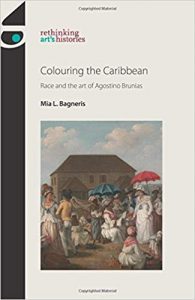
Meredith Gamer reviews Colouring the Caribbean: Race and the Art of Agostino Brunias by Mia L. Bagneris. Read the full review at caa.reviews.
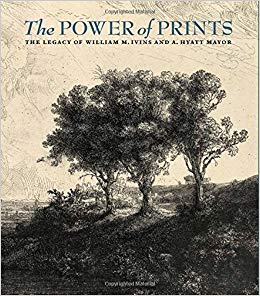
Christine Giviskos reviews The Power of Prints: The Legacy of William M. Ivins and A. Hyatt Mayor by Freyda Spira and Peter Parshall. Read the full review at caa.reviews.
Serve on a CAA Award Jury
posted by CAA — March 28, 2019
CAA invites nominations and self-nominations for individuals to serve on ten of the fourteen juries for the annual Awards for Distinction for three years (2019–22). Terms begin in May 2019; award years are 2020–22.
CAA’s fourteen awards honor artists, art historians, authors, curators, critics, and teachers whose accomplishments transcend their individual disciplines and contribute to the profession as a whole and to the world at large.
Candidates must possess expertise appropriate to the jury’s work and be current CAA members. They should not hold a position on a CAA committee or editorial board beyond May 31, 2019. CAA’s president and vice president for committees appoint jury members for service.
Jury vacancies for spring 2019:
- The Art Journal Award: two members
- Alfred H. Barr Jr. Award: three members
- Frank Jewett Mather Award for Art Criticism: one member
- Charles Rufus Morey Book Award: two members
- Arthur Kingsley Porter Prize: two members
- CAA/AIC Award for Distinction in Scholarship and Conservation: one member
- Distinguished Artist Award for Lifetime Achievement: one member
- Distinguished Lifetime Achievement Award for Writing on Art: two members
- Distinguished Feminist Award: one member
- Distinguished Teaching of Art Award: one member
Nominations and self-nominations should include a brief statement (no more than 150 words) outlining the individual’s qualifications and experience and a CV (an abbreviated CV no more than two pages may be submitted). Please send all materials by email to Cali Buckley, CAA grants and special programs manager; submissions must be sent as Microsoft Word or Adobe PDF attachments. For questions about jury service and responsibilities, contact Tiffany Dugan, CAA director of programs and publications.
Deadline: May 13, 2019
News from the Art and Academic Worlds
posted by CAA — March 27, 2019
Want articles like these in your inbox? Sign up: collegeart.org/newsletter

Protesters at the Guggenheim Museum last month dropped white slips of paper symbolizing OxyContin prescriptions. Last week the museum said it would no longer accept money from members of the Sackler family behind the drug. Image: New York Times
Museums Cut Ties With Sacklers as Outrage Over Opioid Crisis Grows
The scrutiny of the Sacklers comes amid a broader reckoning in the museum world about who sits on their boards and bankrolls their programs. (New York Times)
University of Tennessee Will Be Free for Low-Income Students Starting in Fall 2020
The school joins a small—but growing—list of US colleges and universities seeking to make higher education more accessible. (Think Progress)
Study: 40% of Community College Students Take Humanities Classes
Community colleges have seen massive growth in their humanities programs over the past few decades. (Education Dive)
Museums Need to Move with the Times – That’s Why Deaccessioning Isn’t Always Bad News
“Some may view this as pandering to the politically correct. But American art museums have a moral responsibility and historical mandate inscribed in their charters to reach the broadest possible public.” (Apollo Magazine)
$2.8 Million in Met Museum Admission Revenues Will Go to 175 Cultural Nonprofits
NYC officials announced last week that funds from the Met’s change in admissions policy will be redistributed. (Hyperallergic)
Opinion: A Bigger Scandal at Colleges — Underpaid Professors
“What these folks did is not the worst thing happening in our educational system.” (Boston Globe)
Anja Foerschner and Marta Jovanovic
posted by CAA — March 25, 2019
The weekly CAA Conversations Podcast continues the vibrant discussions initiated at our Annual Conference. Listen in each week as educators explore arts and pedagogy, tackling everything from the day-to-day grind to the big, universal questions of the field.
CAA podcasts are on iTunes. Click here to subscribe.
This week, Anja Foerschner and Marta Jovanovic discuss feminist art.
Dr. Anja Foerschner is a curator, scholar, and professor at the Node Center for Curatorial Studies in Berlin.
Marta Jovanovic is an artist and founder of PerformanceHUB in Belgrade.
New in caa.reviews
posted by CAA — March 22, 2019
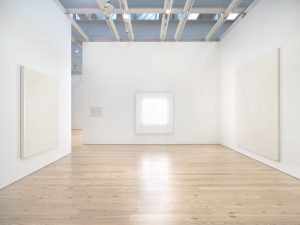
 Ginger Elliott Smith reviews Mary Corse: A Survey in Light, edited by Kim Conaty. Read the full review at caa.reviews.
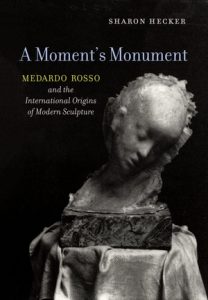
Caroline Levitt writes about A Moment’s Monument: Medardo Rosso and the International Origins of Modern Sculpture by Sharon Hecker. Read the full review at caa.reviews.
International Review: Opening of the Jameel Arts Centre, Dubai, United Arab Emirates by Sabrina DeTurk
posted by CAA — March 21, 2019
The following article was written in response to a call for submissions by CAA’s International Committee. It is by Sabrina DeTurk, associate professor, College of Arts and Creative Enterprises, Zayed University, Dubai, United Arab Emirates.
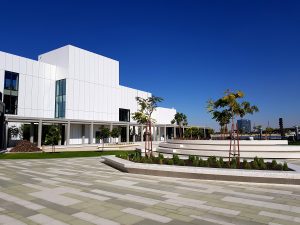
Fig. 1: Exterior of Jameel Arts Center, Jaddaf Waterfront, Dubai, UAE. Photo by Sabrina DeTurk.
In November 2018, Dubai witnessed the opening of the Jameel Arts Centre, the city’s first non-commercial contemporary arts space (Fig. 1). Located on the banks of the Dubai Creek, in the still-developing area of the Jaddaf Waterfront, the center is a project of the Saudi-based organization Art Jameel, a foundation focused on arts and culture programming that is sponsored by the Jameel family. The Jameel Arts Centre will be programmed as a kunsthalle, featuring temporary exhibitions showcasing works drawn from the Jameel collection as well as commissioned works by contemporary artists and those on loan from other institutions. Community events and educational outreach are also key elements of the center’s programming initiatives and the 107,640 square-foot space includes facilities such as an open-access library of over 3,000 volumes as well as coworking areas. There will also be a sculpture park as well as an outdoor arena for performing arts or film screenings.
The Jameel Arts Centre’s inaugural exhibitions included a series of artist’s rooms featuring the work of women artists from the Middle East whose work has garnered critical acclaim though not always international visibility. Maha Al Malluh (Saudi Arabia), Mounira Al Solh (Lebanon), Lala Rukh (Pakistan), and Chiharu Shiota (Japan) showed work that reflected on the personal, communal, and political, sometimes all in one piece.
In Maha Al Malluh’s sculpture, Food for Thought, dozens of well-used cooking pots of all sizes are affixed to two walls of the gallery with their undersides facing the viewer. The burns, scrapes and dents on these surfaces become both a pattern and a portrait, suggesting the many meals, large and small, cooked and served in these vessels. The pots invoke both an individual and collective activity of dining. One senses that these pots have traveled far to reach their current destination, perhaps reflecting the experience of refugees who have fled from so many troubled parts of the region, often with few possessions other than simple cooking utensils and basic clothing.
Lala Rukh’s minimalist and meditative prints and video speak to the personal experience of her mother’s death as well as the changing political landscape of Southeast Asia in the 1990s. However, the darkness of the room in which the works are displayed made it all but impossible to read the contextualizing and interpretive materials that are necessary to understand the meaning of Rukh’s subtle forms.
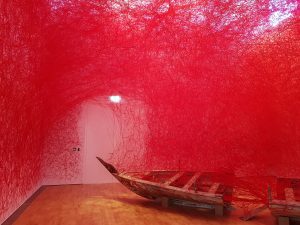
Fig. 2: Installation view of Chiharu Shiota, Departure (2018). Photo by Sabrina DeTurk.
The inclusion of a sculptural installation by Chiharu Shiota, featuring an Arabian dhow (sailing vessel) sourced from a local boatyard, struck an odd note among the rooms (Fig. 2). While Shiota’s sculpture, which featured her signature webs of red yarn, was visually compelling, there was little sense, beyond the inclusion of the local boat, of its contribution to the larger dialogues encouraged by the exhibitions. In an image-obsessed city such as Dubai, one can’t help but wonder if this installation served more as an Instagrammable photo opportunity than as a work of serious contemporary art.
The inaugural group exhibition at Jameel Arts Centre, Crude, was curated by Murtaza Vali and featured the work of eighteen artists and artist collectives. In the show’s catalogue, Antonia Carver, the Director of Art Jameel, described the exhibition as “presenting an innovative material reading of a substance so crucial in shaping local and regional histories and cultures.” The included works run the gamut from archival photographs to video to sculptural installations to found objects and reflect a diversity of artistic approaches to the cultural, political, and economic significance of oil in the region throughout the last six decades.
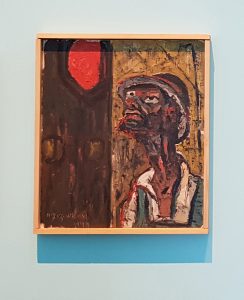
Fig. 3: Houshang Pezeshknia, Portrait d’homme (1949). Photo by Sabrina DeTurk.
The earliest works in the show, documentary photographs by the Iraqi, Latif Al Ani, and paintings by the Iranian, Houshang Pezeshknia (Portrait d’homme, 1949, Fig. 3), highlight the role that the discovery of oil played in shaping the modern culture and identity of both countries. Al Ani’s photographs focus on the material benefits of the oil industry, featuring images of new, modernist housing developments and smiling children showing the bottles of milk now provided as part of the government school lunch program. Pezeshknia’s paintings are more introspective; their rough brushstrokes emphasize the harsh features of those who work on the pipelines and the scars left on the Iranian landscape by the new technologies of oil extraction.
Several artists in the exhibition drew on found images and archival film footage for their works. These include Raja’a Khalid, whose Desert Golf series (2014) uses vintage print media from American publications such as Life magazine to document the seemingly inexorable, if equally inexplicable, compulsion that expatriate oil executives had for finding ways to play golf in the hostile desert landscape. In several of these images, bewildered local residents look on, setting up an us/them dichotomy and pervasive sense of cultural difference that still marks expatriate and local relations in the Gulf region.
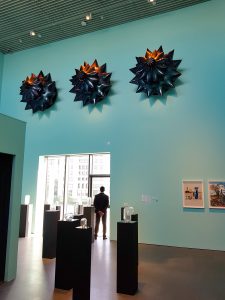
Fig. 4: Installation view of Crude exhibition. Monira Al Qadiri, Flower Drill (2016) is on the wall. Photo by Sabrina DeTurk.
Sculptural installations featured prominently in the exhibition. For example, Monira Al Qadiri’s Flower Drill (2016, Fig. 4), displayed high on the wall in one of the galleries, features fiberglass forms based on the design of drill heads and coated in two-toned automotive paint, connecting the work to both the initial and final stages of oil production and consumption. Alessandro Balteo-Yazbek’s Last Oil Barrel is a tiny wooden sculpture of a barrel, whose price is linked to oil futures and whose value will be determined only at some unspecified date in the future when a sale is fixed, reflecting the connections between the commodity value of both art and oil. The artist identifies the date of the work as “postponed,” indicating that it remains in some way incomplete until that time.
Although Crude was an intellectually rigorous and aesthetically compelling first exhibition from the Jameel Arts Centre, it remains to be seen whether there will be a sufficient audience for this type of show in Dubai over the long term. While the center’s opening weekend saw packed galleries, a weekday in January found the author almost alone in the spaces. The question of representation and inclusion of Emirati artists will undoubtedly also be raised at some point in the center’s development.
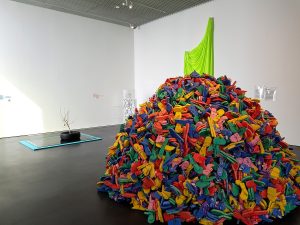
Fig. 5: Installation view of Crude exhibition. Hassan Sharif, Slippers and Wire (2009) is in the foreground. Photo by Sabrina DeTurk
A sculpture by the pioneering Emirati conceptualist artist Hassan Sharif (Fig. 5) was included in Crude and works by Emirati sculptors Shaikha Al-Mazrou and Mohammed Ahmed Ibrahim were shown in the lobby and outside garden respectively. However, this is but a small sample of the variety of contemporary art being produced in the United Arab Emirates and local artists may, understandably, begin to call for greater visibility in this high-profile contemporary arts space. The Jaddaf Waterfront remains under construction and as yet there is not a sustained community to support the idea of the Jameel Arts Centre thriving as a local creative hub. That said, the potential for growth and development is there and the openness with which the center is positioning itself is welcome in a city where the arts scene can often feel closed and difficult to penetrate. Jameel Arts Centre is a welcome addition to the creative landscape of Dubai and will hopefully continue to develop as a space for contemporary expression.