
CAA News Today
NEH Funding Request for FY 2010
posted by Christopher Howard — May 20, 2009
“Serious long-term challenges posed by rapid globalization, economic crisis, and threats to our national security require solutions informed by the humanities,” wrote Pauline Yu, president of the American Council of Learned Societies, in a testimony submitted last month to the House of Representations in support of the National Endowment for the Humanities (NEH). Yu called for at least $230 million in funding for the NEH for fiscal year 2010—an increase of $75 million above the present year’s budget. (Download and read Yu’s full testimony to the Appropriations Subcommittee on Interior, Environment, and Related Agencies.)
Earlier this month, however, President Barack Obama’s FY 2010 budget allotted only $171.315 million for the endowment, far short of Yu’s request but $16.315 million more than the current year.
With this proposed increase, the NEH seeks to establish a new grant program, entitled Sustaining Cultural Heritage Collections, which will allow institutions to plan or implement preventative conservation measures that prolong the useful life of humanities collections. The endowment will also reintroduce preservation research and development grants for projects that address major challenges in preserving and maintaining access to humanities collections and resources. And through its We the People program, the NEH will continue to fund humanities projects that strengthen the teaching, study, and understanding of the nation’s history and culture.
Additionally, Obama’s request includes new oversight responsibility for the National Capital Arts and Cultural Affairs program. With the program’s transfer from the US Commission of Fine Arts, the NEH will manage a redesigned program of competitive grants to arts, historical, and cultural institutions in the District of Columbia.
In addition to a general overview of Obama’s NEH budget request, more information is available in the summary and highlights or the detailed budget request of the endowment’s FY 2010 appropriation request. A table with the FY 2010 funding request figures, by division and office with FY 2008 and FY 2009 appropriation amounts, is also available.
See also a brief report on funding for the National Endowment for the Art for FY 2010.
Study Finds Overreliance on Part-Time Faculty in Higher Education
posted by Christopher Howard — May 18, 2009
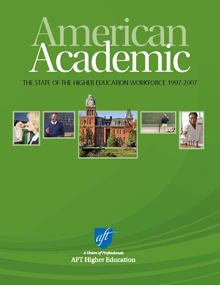 The primary finding of a report released last week by the American Federation of Teachers (AFT), entitled American Academic: The State of the Higher Education Workforce 1997–2007, presents a troubling picture of disinvestment in the higher-education teaching profession—notably, a reduction in the proportion of full-time tenured and tenure-track faculty, and an increased reliance on employing “contingent” faculty and instructors such as part-time faculty, full-time nontenure track faculty, and graduate employees.
An analysis of the most recent ten years of national data finds that the higher-education instructional workforce grew in the past decade, which is not surprising since college enrollments increased during that time by over 3 million. But to meet the needs of a growing student population, colleges and universities overwhelmingly relied on hiring undersupported contingent faculty and instructors. Previous reports have demonstrated the problems created when colleges hire contingent faculty and instructors without fair wages, job security, and professional support. This new report documents that, rather than working to reverse these trends and investing in a more secure higher-education teaching workforce, colleges and universities are expanding their reliance on contingent faculty and instructors.
Among the report’s other key findings:
- From 1997 to 2007, the proportion of full-time tenured and tenure-track faculty members declined from approximately one-third of the instructional staff to slightly more than one-quarter
- The increased reliance on contingent faculty and instructors was found in all sectors of higher education, with the most dramatic increase in community colleges
At the same time, the study notes an increase in the number of professional staff who provide direct student services, such as registrars, counselors, and financial-aid officers. Professional staff grew by 50 percent from 1997 to 2007, and the vast majority of these positions were full-time.
This report is the first in a new series on the higher-education workforce in colleges and universities. Each issue in AFT’s American Academic series will explore different aspects of trends in hiring, compensation, and working conditions among the increasingly diverse higher-education workforce. More higher education data can be found in AFT’s Higher Education Data Center.
The Chronicle of Higher Education and Insider Higher Ed have reported on the report, with extensive comments by readers posted to the latter article.
CAA encourages all colleges and universities to read and uphold its Guidelines for Part-Time Professional Employment, which give recommendations on fair compensation, office and studio space, benefits, and more for part-time workers.
May Obituaries in the Arts
posted by Christopher Howard — May 13, 2009
CAA recognizes the lives and achievements of the following artists, art historians, and theorists. Of special note are two obituaries written especially for CAA: Richard R. Ranta on Carol Purtle, and Clark V. Poling on John Howett.
- Ernie Barnes, an artist who was also a professional football player, died on April 27, 2009, at the age of 70
- John Howett, a professor emeritus of art history at Emory University, died on April 8, 2009, at the age of 82
- Jack Prip, a silversmith who taught for many years at the Rhode Island School of Design, died on April 8, 2009. He was 86
- Carol Purtle, a professor of art history at the University of Memphis, died on December 12, 2008, at the age of 69
- David W. Scott, an artist, art historian, and founding director of the National Museum of American Art, died on March 30, 2009. He was 92
- Eve Kosofsky Sedgwick, a literary theorist and pioneer of queer studies, died on April 12, 2009, at the age of 58
- Honoré Sharrer, a figurative American artist who rose to prominence in the 1940s, died on April 17, 2009. She was 88
Read all past obituaries in the arts on the CAA website.
Obama Requests NEA and Arts-Education Budget Increases
posted by Christopher Howard — May 08, 2009
President Barrack Obama has released his budget recommendations for fiscal year 2010, which includes $161.3 million in funding for the National Endowment for the Arts—$6.3 million over the previous year’s budget and the largest increase in fifteen years (about 4 percent). Obama’s administration also requested $38.16 million for the Arts in Education program at the US Department of Education.
CAA encourages you to contact your legislators to voice your support for these increases in arts and cultural funding through the Arts Action Center, sponsored by Americans for the Arts. You can use or modify existing letter templates to tell Congress to support Arts in Education and the National Endowment for the Arts.
Advocacy Days in Washington, DC
posted by Christopher Howard — May 08, 2009
 Andrea Kirsh, an independent art historian based in Philadelphia, Pennsylvania, and a member of the CAA Board of Directors, was one of several CAA delegates who attended Humanities Advocacy Day and Arts Advocacy Day, both of which took place in March 2009 in Washington, DC.
In an article for the forthcoming May issue of CAA News that is also posted online, she writes about her experiences advocating for increased funding for the National Endowment for the Arts and National Endowment for the Humanities, among other government programs and legislation.
Photo: The Grammy-nominated singer-songwriter Josh Groban (center) advocates for the arts with CAA board member Judith Thorpe (left) and Jean Miller at the Congressional Breakfast during Arts Advocacy Day
May CAA News Published
posted by Christopher Howard — May 08, 2009
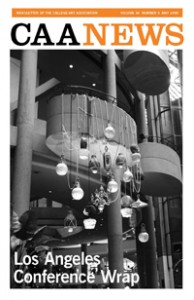 The May issue of CAA News has just been published. All individual and institutional members will receive it in the mail; you can also download a PDF of the issue now, reformatted to better fit your screen.
In the issue, CAA President Paul Jaskot and Director of Programs Emmanuel Lemakis sum up highlights from the 2009 Annual Conference in Los Angeles, and CAA Board Member Andrea Kirsh writes about her experiences at this year’s Arts Advocacy Day and Humanities Advocacy Day.
The May newsletter also includes instructions for proposing a session for the 2011 Annual Conference in New York—CAA’s centennial year. Please read the guidelines carefully before the submission process begins on June 16, 2009. Deadline: September 1, 2009.
Also published are calls for texts on “the contemporary” for Art Journal and for participation on CAA’s Professional Interests, Practices, and Standards Committees—plus the latest news from CAA’s affiliated societies and listings of solo exhibitions, books published, and exhibitions curated by CAA members.
Advocacy Days in Washington, DC
posted by Christopher Howard — May 07, 2009
Andrea Kirsh, an independent art historian based in Philadelphia, Pennsylvania, and a member of the CAA Board of Directors, was one of several CAA delegates who attended Humanities Advocacy Day and Arts Advocacy Day, both of which took place in March 2009 in Washington, DC.
In an article for the forthcoming May issue of CAA News that is also posted online, she writes about her experiences advocating for increased funding for the National Endowment for the Arts and National Endowment for the Humanities, among other government programs and legislation.
Photo: The Grammy-nominated singer-songwriter Josh Groban (center) advocates for the arts with CAA board member Judith Thorpe (left) and Jean Miller at the Congressional Breakfast during Arts Advocacy Day
Obama Requests NEA and Arts-Education Budget Increases
posted by Christopher Howard — May 07, 2009
President Barrack Obama has released his budget recommendations for fiscal year 2010, which includes $161 million in funding for the National Endowment for the Arts—$11 million over the previous year’s budget and the largest increase in fifteen years. Obama’s administration also requested $38.16 million for the Arts in Education program at the US Department of Education.
CAA encourages you to contact your legislators to voice your support for these increases in arts and cultural funding through the Arts Action Center, sponsored by Americans for the Arts. You can use or modify existing letter templates to tell Congress to support Arts in Education and the National Endowment for the Arts.
Call for Art Journal Texts on “the Contemporary”
posted by Christopher Howard — May 05, 2009
Katy Siegel is incoming editor-in-chief of Art Journal and associate professor of art history at Hunter College, City University of New York.
During my tenure as editor-in-chief of Art Journal, I would like to publish a wide-ranging series that assesses contemporary art—its making, exhibition, criticism, history, and social uses. This series could include the kind of state-of-the-field essays that have traditionally been written about historical areas of study for The Art Bulletin. It could also mean more focused historiographic subjects, such as the evolution of “the contemporary” or the rise and fall of postmodernism. Or theoretical discussions of, for example, the relationships between the modern and the contemporary (questions of periodization being of special interest), or more speculative considerations of the changing role of contemporary art in current economic, technological, and social conditions.
I welcome approaches that are ambitious and generalizing, but since “the contemporary” is not really a single unified disciplinary object, I am also seeking writing that is partisan and partial, local and medium-specific. While one person might approach postmodernism from a historical perspective, as an object in the past, another might argue for its continuing validity under current conditions. Different authors might investigate the social meaning of “the contemporary” as opposed to the modern in particular countries at particular moments (the US at midcentury, China today), or for particular institutions, such as the museum, biennial exhibition, or university/college course.
I would like to hear from curators, teachers, critics, and artists about their own concrete experiences in relation to these large, abstract questions. I am interested not only in a wide range of topics, but also a diversity of approaches to those topics: art criticism, discussions, shorter polemical essays, and artists’ projects are all possibilities in addition to the scholarly article.
For more information, please write to katy.siegel@gmail.com.
Spring Art Journal Published
posted by Christopher Howard — May 04, 2009
 In her introductory editor’s letter to the recently published Spring 2009 Art Journal, Judith Rodenbeck underlines the notion of retooling in the issue. The authors and contributors, she notes, confront three areas in particular: how the expansive global art world thrives in non-Western countries; how art education is undergoing progressive change outside traditional art academia; and how a history of early computer art can inform contemporary practice.
Gail Gelburd’s essay, “Cuba and the Art of ‘Trading with the Enemy,’ ” looks at Cuban-American relations over the past fifty years and their effect on cultural exchange. In her essay “Urban Claims and Visual Sources in the Making of Dakar’s Art World City,” Joanna Grabski discusses the Dak’Art Biennale in relation to Senghorian Négritude, the city’s School of Fine Arts, and Dakar’s urban fabric.
During the past several years, Art Journal has investigated retoolings in pedagogical issues. “The Currency of Practice: Reclaiming Autonomy for the MFA,” developed from a roundtable discussion that took place at the CAA Annual Conference in 2007, explores alternatives to traditional graduate degrees such as often-nomadic, nonaccredited schools, organizations led and run by artists, and programs for PhDs for artists.
Moving forward by looking back, three essays explore the history and practice of digital art. The artist Paul Hertz presents an overview that draws on his recent cocurated exhibition, Imaging by Numbers: A Historical View of the Computer Print. A computer scientist and pioneering artist, Frieder Nake, examines early European computer artists and their work, which he calls “algorithmic images accepted as art.” Patric D. Prince, a scholar, artist, and collector of computer art, provides a short history of computer-generated imagery and digital printmaking in America before the era of the home computer.
Reviews include texts on recent projects by Boris Groys (a collection of essays and an exhibition) and a book on Marcel Duchamp and artists’ labor. Letters to the editor include two replies to an Art Journal article, “Steps to an Ecology of Communication: Radical Software, Dan Graham, and the Legacy of Gregory Bateson,” from the Fall 2008 issue.