
CAA News Today
Recent Deaths in the Arts
posted by Christopher Howard — November 24, 2008
CAA recognizes the lifetime professional and personal achievements of the following artists, art historians, curators, educators, and critics, who recently passed away.
- Tracey Baran, a contemporary art photographer, died on November 18, 2008, at the age of 33
- Don Baum, a Chicago artist, teacher, and curator who exhibited early work by the Hairy Who, died on October 28, 2008. He was 86
- Cundo Bermudez, a second-generation modern artist from Cuba, died on October 30, 2008. He was 94
- Terry Fox, an American conceptual artist, died on October 14, 2008, in Cologne, Germany, at the age of 65
- Walter Gabrielson, a California-based artist and teacher, died on November 12, 2008, at age 73
- Ludger Gerdes, a German painter and sculptor, died in October 2008 at the age of 54
- Grace Hartigan, an Abstract Expressionist painter, died on November 16, 2008. She was 86
- James Johnson, an art historian, curator, and former dean of the School of Fine Arts at the University of Connecticut, died on October 8, 2008, at the age of 92
- Jan Krugier, a Swiss art dealer who displayed and sold old-master drawings, African art, and modern and contemporary art, died on November 15, 2008. He was 80
- Bill Martin, a landscape painter based in Mendocino, California, died on October 28, 2008, at age 65
- Muriel Oxenberg Murphy, who cofounded the American painting and sculpture department at the Metropolitan Museum of Art, died in October 2008. She was 82
- Ben Schaafsma, program director for the Elizabeth Foundation for the Arts in New York, died on October 25, 2008, in New York. He was 26
- Joel Weinstein, an art critic and publisher of the magazine Mississippi Mud, died on October 31, 2008, at age 62.
Read all past obituaries in the arts on the CAA website.
MFA Standards Updated
posted by Christopher Howard — November 13, 2008
Last month, the CAA Board of Directors approved revisions to the MFA Standards, one of the organization’s many Standards and Guidelines for visual-art professionals. The revised document, prepared by a subcommittee of the Professional Practices Committee (PPC), is now published to the CAA website.
During summer and fall 2008, Jean Miller, chair of the PPC-MFA Standards Review Committee, and Charles Wright, a PPC member who is also leading a discussion about the doctorate in studio art, worked on a draft of a revised MFA Standards. Last revised and approved in 1991, the document was submitted to the board by Maxine Payne, PPC chair.
The PPC-MFA Committee contacted art and design colleagues across the nation throughout the revision process to gather ideas for changes. The response was very good, with certain themes or points reoccurring. Many of those queried thought that the idea of the MFA as the terminal degree in art and design needed to be reinforced. Others found the language in the 1991 standards to be dated, so it was rewritten throughout to reflect present-day issues and concerns.
Contemporary and evolving studio practices, interpretation of ideas, and the role of art and design in innovation were all thought to be important concepts. Information about technology and experimental media, collaborative works, and interdisciplinary applications of art and design were also considered to be critical to current art practices for students in MFA programs.
Some respondents advocated for robust and comprehensive educational curricula that include critical studies, art history, and visual culture. The inclusion of statements about diversity and how curriculum must support non-Western and Western cultures was important to all.
The PPC thanks everyone who helped in the revision, in particular, Carmon Colangelo, Patricia Olynyk, Nora Sturges, Judith Thorpe, and Jim Hopfensperger.
MFA Standards Updated
posted by Christopher Howard — November 13, 2008
Last month, the CAA Board of Directors approved revisions to the MFA Standards, one of the organization’s many Standards and Guidelines for visual-art professionals. The revised document, prepared by a subcommittee of the Professional Practices Committee (PPC), is now published to the CAA website.
During summer and fall 2008, Jean Miller, chair of the PPC-MFA Standards Review Committee, and Charles Wright, a PPC member who is also leading a discussion about the doctorate in studio art, worked on a draft of a revised MFA Standards. Last revised and approved in 1991, the document was submitted to the board by Maxine Payne, PPC chair.
The PPC-MFA Committee contacted art and design colleagues across the nation throughout the revision process to gather ideas for changes. The response was very good, with certain themes or points reoccurring. Many of those queried thought that the idea of the MFA as the terminal degree in art and design needed to be reinforced. Others found the language in the 1991 standards to be dated, so it was rewritten throughout to reflect present-day issues and concerns.
Contemporary and evolving studio practices, interpretation of ideas, and the role of art and design in innovation were all thought to be important concepts. Information about technology and experimental media, collaborative works, and interdisciplinary applications of art and design were also considered to be critical to current art practices for students in MFA programs.
Some respondents advocated for robust and comprehensive educational curricula that include critical studies, art history, and visual culture. The inclusion of statements about diversity and how curriculum must support non-Western and Western cultures was important to all.
The PPC thanks everyone who helped in the revision, in particular, Carmon Colangelo, Patricia Olynyk, Nora Sturges, Judith Thorpe, and Jim Hopfensperger.
Bruce Cole to Leave the NEH
posted by Christopher Howard — November 12, 2008

The National Endowment for the Humanities has announced that Chairman Bruce Cole will leave the endowment to join the American Revolution Center as its president and chief executive officer, effective January 2009.
Appointed NEH chairman by President George W. Bush, Cole was confirmed by the Senate in 2001 and reconfirmed in 2005 for a second term. Cole is the longest serving chairman in NEH history. During his tenure, the NEH launched innovative humanities programs, including We the People and Picturing America. Under his leadership, the NEH led the application of digital technology to the humanities through its Office of Digital Humanities. The office established innovative new grant programs and formed ground-breaking partnerships with the Department of Energy and the National Science Foundation. Cole has also worked to broaden the international reach of NEH.
Bruce Cole to Leave the NEH
posted by Christopher Howard — November 12, 2008
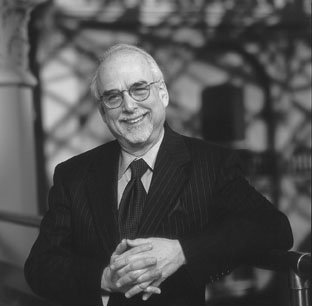
The National Endowment for the Humanities has announced that Chairman Bruce Cole will leave the endowment to join the American Revolution Center as its president and chief executive officer, effective January 2009.
Appointed NEH chairman by President George W. Bush, Cole was confirmed by the Senate in 2001 and reconfirmed in 2005 for a second term. Cole is the longest serving chairman in NEH history. During his tenure, the NEH launched innovative humanities programs, including We the People and Picturing America. Under his leadership, the NEH led the application of digital technology to the humanities through its Office of Digital Humanities. The office established innovative new grant programs and formed ground-breaking partnerships with the Department of Energy and the National Science Foundation. Cole has also worked to broaden the international reach of NEH.
Svetlana Alpers Is CAA Distinguished Scholar
posted by Christopher Howard — November 10, 2008
The honoree of the 2009 Distinguished Scholar Session is Svetlana Alpers, a historian of seventeenth-century art and professor emerita of the University of California, Berkeley. Inaugurated in 2001, this Annual Conference session pays tribute to a renowned scholar who has made significant contributions to the field.
The Distinguished Scholar Session, entitled “Paintings/Problems/Possibilities” and chaired by Mariët Westermann of New York University, centers on the art of painting. The panel—which includes Alpers, Carol Armstrong of Yale University, Thomas Crow from New York University’s Institute of Fine Arts, the painter James Hyde, and Stephen Melville of Ohio State University—will focus on six pictorial images proposed by Alpers. The session takes place on Thursday, February 26, 2009, 2:30–5:00 PM, at the Los Angeles Convention Center, Room 502AB, Level 2.
After earning a BA from Radcliffe College in 1957, Alpers completed her doctorate in fine arts at Harvard University in 1965. She began teaching at the University of California, Berkeley, in the early sixties and remained there until her retirement in 1994.
Her books—among them The Art of Describing: Dutch Art in the Seventeenth Century (1983); Rembrandt’s Enterprise: The Studio and the Market (1988), which won CAA’s Charles Rufus Morey Book Award in 1990; and Tiepolo and the Pictorial Intelligence (1994), written with Michael Baxandall—have had an enormous impact on the discipline of art history. In 1983, Alpers founded the interdisciplinary journal Representations with Stephen Greenblatt; she remains a corresponding editor to this day.
An artist and a scholar, Alpers, together with James Hyde and the photographer Barney Kulok, recently completed a series of prints, Painting Then For Now. Fragments of Tiepolo at the Ca’ Dolfin, that is based on three paintings in the Metropolitan Museum of Art by the eighteenth-century Venetian artist Giambattista Tiepolo. An exhibition of these works was held at David Krut Projects in New York in 2007 and accompanied by a publication.
Alpers is CAA’s ninth distinguished scholar, joining a list of illustrious past honorees: Robert L. Herbert (2008), Linda Nochlin (2007), John Szarkowski (2006), Richard Brilliant (2005), James Cahill (2004), Phyllis Pray Bober (2003), Leo Steinberg (2002), and James Ackerman (2001).
Please read Mariët Westermann’s article on Svetlana Alpers and her accomplishments, which is also published in the November 2008 CAA News.
Leonardo López Luján Is Convocation Speaker
posted by Christopher Howard — November 04, 2008
 Leonardo López Luján, senior researcher and professor of archaeology at the Museo del Templo Mayor, Instituto Nacional de Antropología e Historia (INAH), in Mexico City, will deliver the keynote address during Convocation at the 2009 CAA Annual Conference in Los Angeles. Convocation takes place at the Los Angeles Convention Center on Wednesday evening, February 25, 5:30–7:00 PM.
For nearly thirty years, López Luján has worked on the excavations of the Templo Mayor (Grand Temple), a fifteenth-century Aztec pyramid and its surroundings that are located in the heart of the Mexican capital; he has been director of the project since 1991. The temple lies beneath the Zócalo, also known as the Plaza de la Constitución, one of the largest public squares in the world. The project began when a monument to the Moon goddess Coyolxauhqui was found by electrical workers on the site of the old temple. During the last several years, other impressive monuments have been uncovered around the Great Temple of Tenochtitlan, among them the largest Aztec sculpture ever found, that of the Earth goddess Tlaltecuhtli.
In his talk, López Luján will focus on the most recent archaeological discoveries, while giving an overview of the history of archaeology in the Aztec capital. He will also discuss other topics, among them the recovery of the Tlaltecuhtli stone, an iconographic analysis that may unveil this sculpture’s functions and meanings, the rich offerings buried underneath it, and the possible presence of a royal tomb in this area of the sacred precinct.
Currently senior researcher at the Museo del Templo Mayor, where he has worked since 1988, López Luján is also senior professor at the Escuela Nacional de Antropología e Historia (ENAH) and the Escuela Nacional de Conservación, Restauración, y Museografía (ENCRyM) since 1987. He earned his doctorate in archaeology, with highest honors, at the Université de Paris-X in Nanterre in 1998. Before that he attended ENAH from 1983 to 1990, receiving a BA and MA—also with highest honors. López Luján was a fellow in Precolumbian studies in 2005–6 at Dumbarton Oaks in Washington, DC, and received a John S. Simon Guggenheim Fellowship in 2000. He has also taught and researched in Rome and Paris and at Princeton University.
López Luján has written and cowritten many books on the archaeology of Central Mexico. In The Offerings of the Templo Mayor of Tenochtitlan (originally published in Spanish in 1993; revised by the University of New Mexico Press in 2005), he presents the spectacular findings of Templo Mayor Project—masks, jewelry, skeletal remains of jaguars and alligators, statues of gods, precious stones, and human remains—from 1978 to 1997. The first English edition, published by the University Press of Colorado in 1994, was named Outstanding Academic Book by Choice and received the Eugene M. Kayden Humanities Award.
Mexico’s Indigenous Past, authored with Alfredo López Austin (1996; second English edition: University of Oklahoma Press, 2005), offers a panoramic view of the three super-areas of ancient Mexico—Mesoamerica, Aridamerica, and Oasisamerica—which stretched from present-day Costa Rica to what is now the southwestern United States. The book begins more than thirty thousand years ago and ends with European occupation in the sixteenth century.
With Davíd Carrasco and Eduardo Matos Moctezuma, he is most recently the author of Breaking through Mexico’s Past: Digging the Aztecs with Eduardo Matos Moctezuma (Albuquerque: University of New Mexico Press, 2007), an overview of their work on the Museo del Templo Mayor.
For more on López Luján and the Templo Mayor, please download Johanna Tuckman’s “In Search of an Aztec King” from the Summer 2008 issue of American Archaeology.
November CAA News Published
posted by Christopher Howard — November 03, 2008
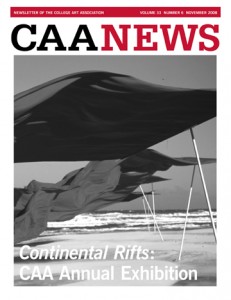 The November CAA News has just been posted to the CAA website. Click on the cover at left to download a PDF of the issue. Printed copies for individual and institutional members will be mailed soon, to arrive in mid-November.
Read about Leonardo López Luján, the renowned archaeologist who is giving the keynote address at Convocation at the 2009 Annual Conference in Los Angeles, and about Continental Rifts: Contemporary Time-Based Works of Africa, the CAA Annual Exhibition at UCLA’s Fowler Museum curated by Mary Nooter Roberts. The issue also contains important conference information, including how to apply to, and become a mentor for, the Artists’ Portfolio Review and Career Development Mentoring programs.
The deadline for submissions to the January issue is November 10, 2008. Please see the newsletter submission guidelines for instructions or write to Christopher Howard, CAA News editor.
Americans for the Arts Merges with Business Committee for the Arts
posted by Christopher Howard — October 31, 2008
Two nonprofit arts-advocacy groups, Americans for the Arts and Business Committee for the Arts (BCA), announced yesterday that they will merge their operations, creating the largest-ever advocacy group for the arts in the private sector. The partnership will further enable the organization to generate increased private-sector support for the arts and arts education by engaging and educating business leaders nationwide on the economic impact and value of the arts in business and community settings.
Americans for the Arts has issued a press release on the merger and also published two lists of frequently asked questions for its members and the general public.
Americans for the Arts Merges with Business Committee for the Arts
posted by Christopher Howard — October 31, 2008
Two nonprofit arts-advocacy groups, Americans for the Arts and Business Committee for the Arts (BCA), announced yesterday that they will merge their operations, creating the largest-ever advocacy group for the arts in the private sector. The partnership will further enable the organization to generate increased private-sector support for the arts and arts education by engaging and educating business leaders nationwide on the economic impact and value of the arts in business and community settings.
Americans for the Arts has issued a press release on the merger and also published two lists of frequently asked questions for its members and the general public.