
CAA News Today
Digital Technology in Art Education
posted by Christopher Howard — September 24, 2008
Richard Armstrong Succeeds Thomas Krens at Guggenheim
posted by Christopher Howard — September 24, 2008
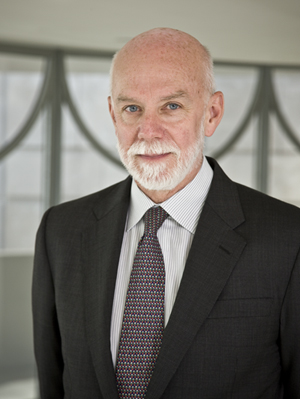 The Solomon R. Guggenheim Foundation has named Richard Armstrong to the position of director of the foundation, beginning November 4. He had served as Henry J. Heinz II Director of the Carnegie Museum of Art in Pittsburgh since 1996 before announcing his resignation in June. Armstrong succeeds Thomas Krens, who stepped down earlier this year. As director of both the foundation and its flagship museum in New York, Armstrong will focus on the pivotal role of that museum and its collection while also providing leadership and management for the three other Guggenheim institutions in Venice, Bilbao, and Berlin, as well as the Guggenheim Abu Dhabi Museum, scheduled to open in early 2013.
Photograph by David M. Heald and © Solomon R. Guggenheim Foundation
Lehman Collapse to Hurt Art Museums
posted by Christopher Howard — September 18, 2008
“The collapse of Lehman Brothers is destined to pass like a cold wind through the museum world,” reports Artnet.com, “which has leaned on the investment firm for untold millions of dollars in arts patronage.” Museums nationwide, from the Metropolitan Museum of Art and Asia Society in New York to major institutions in Los Angeles, Dallas, Philadelphia, Chicago, and San Francisco, will all need to look elsewhere for charitable donations. In addition, arts institutions in England, France, and Germany—not to mention domestic arts-education programs for school children in the US—will also see funding evaporate from the $39 million that Lehman Brothers gave as charitable gifts in 2007.
David Segal and Jacqueline Trescott at the Washington Post write that “Lehman may never hand out another charitable dime; the immediate future of the firm’s philanthropic foundation, like everything else about it, is now a matter of bankruptcy law. But the fear isn’t limited to those groups that were getting money from corporate America’s recently deceased and badly wounded. There’s agita all around.” Segal and Trescott talk to arts-institution directors and corporate funders to scope out the current state of funding in light of recent financial events.
See also Philip Boroff’s “Life After Lehman: Nonprofits Brace Amid Bankruptcy” on Bloomberg.com.
Congressional Arts Report Card Released
posted by Christopher Howard — September 18, 2008
The Americans for the Arts Action Fund PAC issued today its Congressional Arts Report Card, covering the 110th Congress (2007-2009). The entire Report Card contains letter grades and numerical scores of every member of Congress based on his or her voting record on arts issues.
“As the arts and arts education increasingly established a foothold during this year’s presidential campaign trail, the Report Card will serve as a compelling guide for the public to make overall arts-informed decisions at the ballot box on Election Day,” said Robert L. Lynch, president and CEO of the Americans for the Arts Action Fund. “Although the Report Card shows that Congress is progressively acknowledging the importance of the arts and arts education, further support is needed in arts funding.”
The 2008 Congressional Arts Report Card reveals that 181 members (43 percent) of Congress received a grade of A or higher. When the grades of the members of each state delegation are averaged on a state-by-state basis, the highest scoring state delegation is Maine, with a perfect score of 100. Alaska and Wyoming are the lowest scoring state delegations with a score of 20 points each. Additionally, the Arts Report Card shows that support for the arts is bipartisan and growing, as evidenced in the nearly 24 percent increase in membership of the Congressional Arts Caucus since 2000. Also, 21 representatives improved their Report Card scores by one letter grade or more from their 2006 Report Card grade.
Intellectual Property and the Arts
posted by Christopher Howard — September 15, 2008
CAA recently launched a new section of its website called Intellectual Property and the Arts. This section provides links to CAA’s activities on intellectual-property and copyright matters and to useful websites and resources of other organizations.
Included in the section are links to authoritative texts by universities, library organizations, and the US Copyright Office; suggestions for clearing permissions and rights for images used in publication; and articles by CAA’s Committee on Intellectual Property from past issues of CAA News, on topics such as the legal status of appropriation in art, work for hire, and artists’ moral rights in their artworks.
CAA’s members are both copyright owners and users of copyrighted material. Artists and authors create new works, and many also quote from or repurpose material created by others. CAA encourages all members to become familiar with intellectual-property law as it affects you.
NEA Chairman Dana Gioia Resigns
posted by Christopher Howard — September 12, 2008
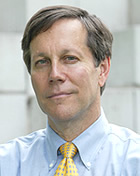
The National Endowment for the Arts announced today that Dana Gioia, chairman of the NEA since 2003, will leave his position in January 2009. He will return to writing, his primary occupation prior to leading the endowment. Gioia will also join the Aspen Institute on a half-time basis as the first director of the Harman/Eisner Program in the Arts.
Under Gioia’s leadership, the NEA has effectively democratized its programs and services, maintaining the highest artistic and educational standards and while achieving unprecedented outreach to millions of Americans. Gioia has also made arts education central to the agency’s mission, creating many programs that combine the presentation of arts with arts education to foster the next generation of artists, audiences and patrons.
Darsie Alexander Is Chief Curator at the Walker
posted by Christopher Howard — September 11, 2008
 The Star Tribune in Minneapolis–St. Paul recently reported that Darsie Alexander has been named chief curator at the Walker Art Center in Minnesota. Alexander, senior curator of contemporary art at the Baltimore Museum of Art in Maryland, starts her new position on November 10, replacing Philippe Vergne, who served as both the Walker’s deputy director and chief curator before he leaving last month to direct the Dia Art Foundation in New York.
Alexander’s recent exhibitions in Baltimore include SlideShow (2005) and Robert Motherwell: Meanings of Abstraction (2006). Two additional shows, Franz West, To Build a House You Start with the Roof: Work, 1972–2008, a retrospective of the Austrian sculptor’s work, and Front Room: Dieter Roth and Rachel Harrison, open next month.
Photograph by Mitro Hood and provided by the Walker Art Center.
CAA.REVIEWS AT TEN YEARS
posted by Christopher Howard — September 11, 2008
In October 1998, CAA launched its first online journal, caa.reviews. Founded by Larry Silver of the University of Pennsylvania and Robert Nelson of Yale University, the journal has since reviewed more than 1,100 books, exhibitions, and more.
Ten years ago, art and scholarly publishers were struggling. Few magazines or newspapers were giving serious attention to reviewing art books. The Art Bulletin and Art Journal were nearly alone, and they could review at most about several dozen books per year each. Meanwhile in academia, art scholarship was flourishing, but new publications couldn’t get the peer assessment they needed. CAA’s print journals are quarterlies; as a website that could regularly publish texts as they are written and edited, caa.reviews could be a means of reviewing new books more quickly.
Beginnings
In the early 1990s, Larry Silver, who was then CAA president, conceived of a reviews journal. He recalled, “I hoped that CAA could sponsor an inexpensive bimonthly reviews journal, on the model of the German Kunstchronik, to fill this gap.” A few years later, Robert Nelson had the idea to go from a print to online publication. At that time, he and Silver regularly read two scholarly reviews distributed electronically. Founded in 1993, the Medieval Review sent its reviews via an email listserv. The second review, the Bryn Mawr Classical Review also published its reviews via a listserv. Perhaps, they thought, CAA could do something similar.
In the mid-1990s, CAA had limited IT—no full-time staff, no website—so it was a steep learning curve all around. “In some ways caa.reviews was the tail that wagged the dog,” Silver said, “and got CAA to think about electronic communications, a homepage, and related services.” And as it turned out, CAA was ahead of most other scholarly societies in the arts and humanities in making this investment in electronic publishing. It had been common in the sciences for several years, but not in our world. Leila Kinney of the Massachusetts Institute of Technology joined Silver and Nelson to advocate for not only a reviews journal but also a homepage for the organization.
The board was enthusiastic, but CAA didn’t have the money to simply launch an entirely new publication. Funding was sought, and the Andrew W. Mellon Foundation awarded CAA a $79,000 grant to get the project started. The grant terms required that the journal eventually become financially self-sustaining, which was attractive to the board. CAA was able to offer the journal freely on the internet, with open access, for several years to non-CAA members, which built a readership and in turn helped to attract more reviewers. But in 2003 caa.reviews became a benefit of CAA membership, like The Art Bulletin and Art Journal are, and is now also available to institutions through a subscriber agreement.
Work began on both building the journal’s website and commissioning reviews. Nelson, Silver, and Kinney enlisted the library and computer expertise of Katherine Haskins, then at the University of Chicago libraries, for technical issues and assembled a small editorial board for leadership; Nelson served as editor-in-chief for the first year. Together they collected a group of about ten to fifteen field editors to commission reviews. This is still the working structure of the journal: editors specializing in one area of art or art history, and located anywhere in the world, commission reviews within that field or specialty.
The first handful of texts, posted in October 1998, reflected the diversity of scholarship in art history: reviewed were books on old masters such as Hans Holbein, Nicolas Poussin, and Édouard Manet, as well as on subjects like Byzantine ivories, women artists in the Renaissance, Islamic inscriptions, the art of late imperial and early modern China, aesthetic theory, and much more.
Silver, who took the editorial reins from Nelson in 1999 and served until 2005, said, “It didn’t take long for readers to find us and to send compliments on the quality of the reviews. I particularly remember getting a response to a review on a book on Dutch art from the author in Holland, who was delighted to have his book reviewed well and quickly, while there was still a chance to discuss ideas freshly.”
The New Medium
At first caa.reviews felt resistance about scholarly writing on the internet. Online publication was certainly seen as less prestigious at the beginning, so the editorial board had to work hard to make it clear that the standards for reviewing were the same as those at The Art Bulletin and Art Journal. Sheryl Reiss, currently teaching art history at the University of Southern California, was field editor for early modern Italian art from 1998 to 2003: “I generally didn’t have problems finding reviewers in a field rich in publications. Initially, though, some younger scholars were justifiably concerned whether an electronic book review would carry the same weight in tenure decisions as a print review.” More and more readers and academics, however, came to embrace the new publishing medium.
“I wonder how early readers felt about the change from handwritten manuscripts to the printed page,” said Frederick Asher, who joined as field editor of South Asian art in 1999 and then served as editor-in-chief from 2005 to 2008. “Did they resist that new access to knowledge? With caa.reviews and other carefully refereed and edited journals, we are only speaking of the mode of presentation, not the content, which is impeccable, no different from any other CAA publication.”
The resistance in some fields was problematic but understandable: both contemporary art and cinema were fields in which reviewers are accustomed to being paid and making a living as critics, and caa.reviews had difficulty for a while finding those who could write reviews for free. Contemporary art remains an underdeveloped area of coverage for this reason. Theory is a difficult field to encompass as well, though caa.reviews has always been sensitive to that topic and active in reviewing new works of importance since the journal began.
Despite these issues, the journal has flourished. “I think that the greatest strength of caa.reviews is its breadth of coverage,” said Silver, “particularly outside the traditional European strengths of the discipline. caa.reviews has vastly expanded the attention given to East Asian, Islamic, and other fields in art history, and the journal has striven to give more attention to exhibitions of importance in all fields. Certain publishers, such as the University of Hawai‘i Press, a leader in East Asian art books, have been particularly gratified to get coverage of their publications in caa.reviews.”
The art-publishing world took notice of the journal, and in the ensuing years blurbs from caa.reviews began appearing in print advertisements and on publishers’ websites, alongside quotes from reviews in more established publications. “I am pleased to see that our reviews are being cited by scholars and quoted by publishers just as much as print reviews,” Silver said. “After a decade of activity, we certainly do seem to be taken seriously and regarded as a peer institution of other academic journals.”
Exhibition Reviews
Reviews of exhibitions, while published regularly since the journal began, became a priority in 2004. A half-dozen field editors, representing geographic areas in the United States and internationally, began commissioning evaluations of shows in museums and university galleries. Lucy Oakley, the incoming editor-in-chief who is head of education and programs at the Grey Art Gallery at New York University, said, “caa.reviews aims to cover exhibitions at a wide spectrum of art institutions, from prominent museums such as the Metropolitan, National Gallery, Art Institute, and Getty to small university art galleries and alternative spaces. Indeed, it’s at university art museums where the quality of scholarship counts more than the admissions gate, where some of the most interesting, creative, and intellectually ambitious exhibitions are being presented. Typically such shows receive little notice in the commercial art and book review press. Here caa.reviews is poised to make a major contribution in helping to evaluate and spread the word about such exhibitions and their catalogues.”
With the new group of field editors in place, reviews of contemporary artists such as Robert Smithson, Rachel Harrison, and Louise Bourgeois soon appeared alongside considerations of monographic shows on Duccio, Peter Paul Rubens, and Georges Seurat; surveys on Minimal, Turkish, and American Indian art were also reviewed. Because of its immediacy, caa.reviews strives to publish an evaluation quickly, sometimes while an exhibition is still on the walls.
The author of many exhibition reviews himself, Silver said, “The crowds who attend museum exhibitions obviously love and care about art and are interested in how it’s shown. They deserve proper, thoughtful, informed reviews from people who know the material. So do the curators who put their scholarly efforts into a show. After all, these are the means by which generations of people learn about art. And I should think that living artists would particularly benefit from having shows reviewed by scholars, who are less interested in market issues than, perhaps, newspaper and magazine staff reviewers. That is one reason why I reviewed exhibitions in my hometown of Philadelphia for caa.reviews in the early days of the journal. American newspapers are afraid that scholars will write in obscurantist prose and speak only to their specialist peers. So caa.reviews has a wide-open field.”
Essays, Conferences, and More
Essays are still not a major part of the journal, nor are conference reviews, as originally envisioned, but these areas are growing and include many notable highlights. In celebration of the one hundredth anniversary of Meyer Schapiro’s birth in 2003, caa.reviews published a trio of essays on the renowned scholar’s writings, with authors looking at Schapiro’s books on nineteenth- and twentieth-century art, his approaches to methodologies on the study of medieval art, and his ideas on style and semiotics. Review essays on such topics as the 2006 Rembrandt Year, contemporary Asian art in biennials and triennials, the reopening of the Museum of Modern Art in New York, and the Walker Art Center expansion have appeared over the years.
Other projects soon developed. In 2006 caa.reviews published extensive reviews of general art-history survey textbooks—the first in CAA publications since the 1990s—and of survey books specific to nineteenth-century art and visual culture. And just last year, caa.reviews began realizing one of its original goals, reviewing academic conferences and symposia. Silver noted, “The dreams of the first year still provide a signpost for future editors of the journal to strive for.”
In a redesign and relaunch in 2007, caa.reviews added a new feature, Recent Books in the Arts. Replacing the traditional Books Received list, which accumulated only the titles of review copies of art publications sent to the CAA office, the new section collects titles published by university and commercial presses worldwide and divides them into disciplinary categories (e.g., Architectural History/Historic Preservation, Oceanic/Australian Art, and Critical Theory/Gender Studies/Visual Studies). Recent Books in the Arts is not only useful to the reviews editors of CAA’s three journals, but it’s also a great way to gauge the state of publishing in the arts.
Early concerns about the ephemeral nature of digital publishing and broader access to non-CAA readers will be met when the journal becomes available on JSTOR. The journal will initially be archived through Portico, an archiving service for scholarly electronic journals, and then be presented through the JSTOR platform, probably by early 2009. Broader access to caa.reviews is also available through institutional subscriptions, which authenticate users seamlessly through an institution’s website. And all reviews published since 1998 can still be accessed on the caa.reviews website by individual members using their CAA user ID and password.
A Digital Future
Many daily and weekly newspapers are cutting art and culture staff and decreasing column inches devoted to book reviews and arts features. The New York Times seldom reviews art books at all, even in its Christmas gift issue, and the Los Angeles Times Book Review just ceased publication. Though publications like caa.reviews, the Art Book, Bookforum, and the reviews section of Nineteenth-Century Art Worldwide, another born-digital journal, continue to carry the torch, this alarming shift indicates something about our current larger intellectual culture. The importance of the book and exhibition review is just as crucial in 2008 as it was in 1998.
Silver said: “When even the New York Times continues to call its Sunday section ‘Arts and Leisure,’ we know where review of exhibitions stand in terms of priority. And I have always lamented the absence of feuilleton sections, where scholars could communicate about exhibitions or books of wider interest to a larger public through serious newspapers, as they do in Germany, France, and the Netherlands. And why is it that museum reviews are done by John Updike in the New York Review of Books? Perhaps art scholars should review novels in exchange.”
“caa.reviews is much more than a review journal for art books,” Asher noted. “As we approach CAA’s centenary, all of us will be thinking about how the art disciplines have developed and matured. We can think historiographically by looking at the published work produced over the past century. And by ‘published’ I mean published in any venue, print or internet.”
At the time, Larry Silver was at Northwestern University and Robert Nelson was at the University of Chicago.
Katherine Haskins, now project development officer for Yale University’s library system, remains the journal’s technical advisor.
Thomas P. Campbell to Direct the Metropolitan Museum of Art
posted by Christopher Howard — September 10, 2008
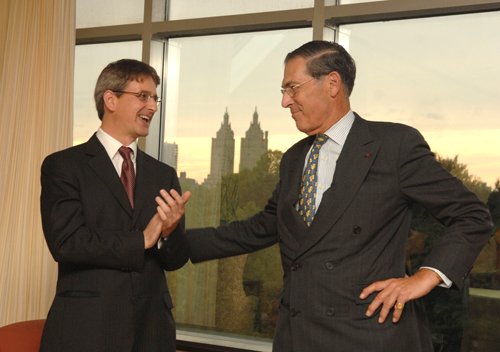 The Metropolitan Museum of Art announced today that Thomas P. Campbell—an accomplished curator with a specialty in European tapestry who has worked at the museum since 1995—has been elected its next director and chief executive officer, succeeding Philippe de Montebello, who announced in January his intention to retire from the Metropolitan Museum at the end of this year.
Campbell organized the groundbreaking and widely acclaimed exhibitions Tapestry in the Renaissance: Art and Magnificence (2002), whose catalogue won CAA’s Alfred H. Barr, Jr., Award in 2003, and Tapestry in the Baroque: Threads of Splendor (2007). Currently curator in the Department of European Sculpture and Decorative Arts as well as supervising curator of the museum’s Antonio Ratti Textile Center, Campbell was elected at yesterday’s meeting of the board of trustees and will assume the directorship of the Metropolitan Museum on January 1, 2009.
Image: Thomas P. Campbell (left) and Philippe de Montebello (photograph by Don Pollard and provided by the Metropolitan Museum of Art)
Congress to Hold Hearing on Museums and Libraries
posted by Christopher Howard — September 09, 2008
The Education and Labor Subcommittee on Healthy Families and Communities in the US House of Representatives is scheduled to hold an informational hearing on museums and libraries at 9:30 AM EST on Thursday, September 11, 2008. The subcommittee will be examining how museums and libraries help to strengthen communities and will specifically focus on programs where museums partner with local government entities to solve community problems. One such program expected to be highlighted is a children’s museum that uses an IMLS grant to support a collaborative initiative between the museum, the county’s child welfare agency, and the family court system.
“Museums and libraries are playing such a vital role in communities around the nation,” said Ford W. Bell, president of the American Association of Museums (AAM). “I commend Chairwoman Carolyn McCarthy (D-NY) and Ranking Member Todd Platts (R-PA) for calling this hearing to explore the exceptional work that museums and libraries are doing to strengthen communities.” He added, “I hope the museum field will be able to listen in on the Committee proceedings.”
The witness list for the hearing includes: Anne-Imelda M. Radice, director of the Institute of Museum and Library Services in Washington, DC; Suzanne LeBlanc, executive director of the Long Island Children’s Museum in New York; Mary Clare Zales, deputy secretary of education and commissioner for libraries in Harrisburg, Pennsylvania; Anna Nunez, executive director of the Arizona Health Science Library at the University of Arizona in Tucson; and Eric Jolly, president of the Science Museum of Minnesota in St. Paul, Minnesota.
For additional information about museum advocacy, visit AAM’s Museum Advocacy Action Center, Speak Up for Museums, or email AAM’s grassroots manager, Ember Farber. Please keep in mind that all Congressional action is subject to change, and the committee website will usually reflect any changes.