
CAA News Today
US Ratifies Treaty to Protect Cultural Property in Time of War
posted by Christopher Howard — October 02, 2008
On September 25, 2008, the United States Senate voted to ratify the 1954 Hague Convention for the Protection of Cultural Property in the Event of Armed Conflict. This international convention regulates the conduct of nations during war and military occupation in order to assure the protection of cultural sites, monuments, and repositories, including museums, libraries, and archives. Written in the wake of the widespread cultural devastation perpetrated by Nazi Germany during the Second World War, and modeled on instructions given by General Dwight Eisenhower to aid in the preservation of Europe’s cultural legacy, the Hague Convention is the oldest international agreement to address exclusively cultural-heritage preservation. The US now joins 121 other nations in becoming a party to this historic treaty. By taking this significant step, the US demonstrates its commitment to the preservation of the world’s cultural, artistic, religious, and historic legacy.
Although the US signed the convention soon after its writing, the Pentagon objected to ratification because of increasing cold-war tensions. Only with the collapse of the Soviet Union did the US military withdraw its objections, and President Bill Clinton transmitted the convention to the Senate in 1999. The public attention given to the looting of the Iraq Museum in Baghdad in 2003 and the looting of archaeological sites in southern Iraq during the ensuing years revived interest in the convention, and the Senate finally voted to give its advice and consent to ratification last week.
A number of understandings were established in connection with the ratification, mostly to ensure that the convention does not interfere substantially with the US military’s ability to wage war. The final element of the ratification is a “declaration,” which states that the treaty, though self-executing: (a) does not require the US government to prosecute anyone who violates the convention (implicitly meaning that such prosecution is required only if a US law is also violated); and (b) does not give individual persons a right of redress in US courts.
Peter Tompa at the Cultural Property Observer provides a summary and commentary on what happened in the Senate. CAA has posted PDFs of both the introduction of the Hague Convention to the Senate by the Senate Foreign Relations Committee and the ratification of the treaty, from the Congressional Record.
Statements by Hague Convention Advocates
While US policy has been to follow the principles of the convention, ratification will raise the imperative of protecting cultural heritage during conflict, including the incorporation of heritage preservation into military planning; ratification will also clarify the United States’ obligations and encourage the training of military personnel in cultural-heritage preservation and the recruitment of cultural-heritage professionals into the military. Cori Wegener, president of the US Committee of the Blue Shield (USCBS), noted that “Ratification of the Hague Convention provides a renewed opportunity to highlight cultural-property training for US military personnel at all levels, and to call attention to cultural-property considerations in the early stages of military planning. The US Committee of the Blue Shield will continue its commitment to offering cultural-property training and coordination with the US military and to increase public awareness about the 1954 Hague Convention and its international symbol, the Blue Shield.”
Patty Gerstenblith, president of the Lawyers’ Committee for Cultural Heritage Preservation (LCCHP), cited among the advantages of ratification, “Most importantly, it sends a clear signal to other nations that the United States respects their cultural heritage and will facilitate US cooperation with its allies and coalition partners in achieving more effective preservation efforts in areas of armed conflict.”
The Archaeological Institute of America (AIA) has advocated ratification of the Hague Convention for more than fifteen years. John Russell, AIA vice president for professional responsibilities, commented that “By ratifying the 1954 Hague Convention, the US has affirmed its commitment to protecting cultural property during armed conflict. The Archaeological Institute of America will continue to work with the Department of Defense to integrate the Convention’s provisions fully and consistently into the US military training curriculum at all levels.”
Since the founding of the Lawyers’ Committee for Cultural Heritage Preservation in 2004 and of the US Committee of the Blue Shield in 2006, ratification has been among their primary priorities. AIA, LCCHP, and USCBS formed a coalition of preservation organizations that submitted testimony to the Senate Foreign Relations Committee in support of ratification and worked with members of the Senate to achieve this historic step. The Statement in Support of US Ratification of the 1954 Hague Convention urging Senate ratification, joined by twelve other cultural preservation organizations, is available from LCCHP.
LCCHP acknowledges the additional assistance of the Society for American Archaeology and the Oriental Institute of the University of Chicago in the effort to achieve ratification of the Hague Convention.
CAA Standards and Guidelines
CAA has advocated for the ratification of the convention for decades. CAA has also published its own Standards and Guidelines on issues related to international cultural heritage: the CAA Statement on the Importance of Documenting the Historical Context of Objects and Sites (2004), A Code of Ethics for Art Historians and Guidelines for the Professional Practice of Art History (1995), part of which addresses trafficking in works of art; and the Resolution Concerning the Acquisition of Cultural Properties Originating in Foreign Countries (1973).
US Ratifies Treaty to Protect Cultural Property in Time of War
posted by Christopher Howard — October 02, 2008
On September 25, 2008, the United States Senate voted to ratify the 1954 Hague Convention for the Protection of Cultural Property in the Event of Armed Conflict. This international convention regulates the conduct of nations during war and military occupation in order to assure the protection of cultural sites, monuments, and repositories, including museums, libraries, and archives. Written in the wake of the widespread cultural devastation perpetrated by Nazi Germany during the Second World War, and modeled on instructions given by General Dwight Eisenhower to aid in the preservation of Europe’s cultural legacy, the Hague Convention is the oldest international agreement to address exclusively cultural-heritage preservation. The US now joins 121 other nations in becoming a party to this historic treaty. By taking this significant step, the US demonstrates its commitment to the preservation of the world’s cultural, artistic, religious, and historic legacy.
Although the US signed the convention soon after its writing, the Pentagon objected to ratification because of increasing cold-war tensions. Only with the collapse of the Soviet Union did the US military withdraw its objections, and President Bill Clinton transmitted the convention to the Senate in 1999. The public attention given to the looting of the Iraq Museum in Baghdad in 2003 and the looting of archaeological sites in southern Iraq during the ensuing years revived interest in the convention, and the Senate finally voted to give its advice and consent to ratification last week.
A number of understandings were established in connection with the ratification, mostly to ensure that the convention does not interfere substantially with the US military’s ability to wage war. The final element of the ratification is a “declaration,” which states that the treaty, though self-executing: (a) does not require the US government to prosecute anyone who violates the convention (implicitly meaning that such prosecution is required only if a US law is also violated); and (b) does not give individual persons a right of redress in US courts.
Peter Tompa at the Cultural Property Observer provides a summary and commentary on what happened in the Senate. CAA has posted PDFs of both the introduction of the Hague Convention to the Senate by the Senate Foreign Relations Committee and the ratification of the treaty, from the Congressional Record.
Statements by Hague Convention Advocates
While US policy has been to follow the principles of the convention, ratification will raise the imperative of protecting cultural heritage during conflict, including the incorporation of heritage preservation into military planning; ratification will also clarify the United States’ obligations and encourage the training of military personnel in cultural-heritage preservation and the recruitment of cultural-heritage professionals into the military. Cori Wegener, president of the US Committee of the Blue Shield (USCBS), noted that “Ratification of the Hague Convention provides a renewed opportunity to highlight cultural-property training for US military personnel at all levels, and to call attention to cultural-property considerations in the early stages of military planning. The US Committee of the Blue Shield will continue its commitment to offering cultural-property training and coordination with the US military and to increase public awareness about the 1954 Hague Convention and its international symbol, the Blue Shield.”
Patty Gerstenblith, president of the Lawyers’ Committee for Cultural Heritage Preservation (LCCHP), cited among the advantages of ratification, “Most importantly, it sends a clear signal to other nations that the United States respects their cultural heritage and will facilitate US cooperation with its allies and coalition partners in achieving more effective preservation efforts in areas of armed conflict.”
The Archaeological Institute of America (AIA) has advocated ratification of the Hague Convention for more than fifteen years. John Russell, AIA vice president for professional responsibilities, commented that “By ratifying the 1954 Hague Convention, the US has affirmed its commitment to protecting cultural property during armed conflict. The Archaeological Institute of America will continue to work with the Department of Defense to integrate the Convention’s provisions fully and consistently into the US military training curriculum at all levels.”
Since the founding of the Lawyers’ Committee for Cultural Heritage Preservation in 2004 and of the US Committee of the Blue Shield in 2006, ratification has been among their primary priorities. AIA, LCCHP, and USCBS formed a coalition of preservation organizations that submitted testimony to the Senate Foreign Relations Committee in support of ratification and worked with members of the Senate to achieve this historic step. The Statement in Support of US Ratification of the 1954 Hague Convention urging Senate ratification, joined by twelve other cultural preservation organizations, is available from LCCHP.
LCCHP acknowledges the additional assistance of the Society for American Archaeology and the Oriental Institute of the University of Chicago in the effort to achieve ratification of the Hague Convention.
CAA Standards and Guidelines
CAA has advocated for the ratification of the convention for decades. CAA has also published its own Standards and Guidelines on issues related to international cultural heritage: the CAA Statement on the Importance of Documenting the Historical Context of Objects and Sites (2004), A Code of Ethics for Art Historians and Guidelines for the Professional Practice of Art History (1995), part of which addresses trafficking in works of art; and the Resolution Concerning the Acquisition of Cultural Properties Originating in Foreign Countries (1973).
Join Americans for the Arts’ Cultural Policy Listserv
posted by Christopher Howard — October 01, 2008
Interested in receiving the latest policy-relevant arts and culture news, sent directly to your email inbox? The Cultural Policy listserv, operated by Americans for the Arts, is the ideal way to spot emerging trends, track ongoing issues, and connect to a world of news and ideas. In each weekly update you’ll also get information on upcoming conferences, events, and news from colleague organizations.
Just click on the listserv link above, provide your name and email address, then click the “Join now” button. You can unsubscribe at any time, and Americans for the Arts promises not to give your name or contact information to other organizations.
Based in Washington, DC, and New York, Americans for the Arts is the nation’s leading nonprofit organization for promoting and advancing the arts in America. With forty-five years of service, it is dedicated to representing and serving local communities and creating opportunities for every American to participate in and appreciate all forms of the arts.
CAA Supports Free Speech Protection Act of 2008
posted by Christopher Howard — September 30, 2008
On September 25, 2008, Paul Jaskot and Linda Downs, respectively CAA’s president and executive director, sent the following letter to the US Senate’s Committee on the Judiciary in support of S. 2977, the Free Speech Protection Act of 2008:
The Hon. Arlen Specter, Sponsor
The Hon. Patrick Leahy, Chairman
Members of the Committee on the Judiciary
United States Senate
433 Russell Senate Office Building
Washington, DC 20510
S. 2977: The Free Speech Protection Act of 2008
We write in support of the proposed Free Speech Protection Act of 2008 (S. 2977). We are a professional organization of over 16,000 members that represents the interests of scholars, authors, artists, libraries, museums, and other individuals and institutions who work in the arts in the United States. We publish three scholarly journals, and support the publication of books and other scholarship through grant programs, an influential annual conference, a website, and other activities. As publishers, and as the representative of authors, artists, and scholars, we urge the Senate to approve S. 2977 expeditiously in this congressional session.
The United States is a beacon of free and open discourse. We produce some of the most widely respected and valued scholarship in the world, as well as some of the most influential art. Other countries and individuals worldwide look to us to set the highest standard for the free exchange of ideas, and our Constitution and Bill of Rights give us the ability to meet that standard.
Now, as publishing becomes ever more globalized, our freedom to publish under United States law is threatened. Libel suits filed in foreign countries pose a grave danger to the free speech rights of American authors, journalists, publishers, and readers. S. 2977 provides authors and publishers with urgently needed protections. This is an excellent bill, and its broad bipartisan support shows that Americans are united in our respect for and reliance on our cherished independence. We must not allow the libel laws of other countries to undermine American laws or chill protected speech.
We concur with the American Association of University Professors, American Booksellers Foundation for Free Expression, American Library Association, American Society of Newspaper Editors, Association of American Publishers, Association of American University Presses, the National Coalition Against Censorship, PEN American Center, and others, who wrote to you on September 10, 2008, stating: “Increasingly in recent years, individuals who challenge the accuracy of published materials have attempted to strike back at their authors by filing lawsuits in foreign countries, most commonly England. U.S. law requires the party alleging libel to prove that the statements objected to are actually false. To avoid this burden, libel plaintiffs have engaged in forum shopping—filing lawsuits in countries with either different burdens of proof or different definitions of libel or both.”
S. 2977 is modeled on the recent New York state law that broadens the jurisdiction of New York courts to ensure that foreign libel judgments not be enforced unless they meet New York and U.S. constitutional standards. S. 2977 adds further force to this excellent law by authorizing authors to countersue foreign plaintiffs in a U.S. court for damages of up to three times the amount of the foreign judgment if the foreign plaintiff acted to suppress the speech of the U.S. person.
Passage of S. 2977, the Free Speech Protection Act, is essential to ensure that weaker protections for free speech in other countries do not undermine our fundamental First Amendment freedoms.
Yours sincerely,
Paul Jaskot, CAA President and Professor of Art and Art History, DePaul University; and Linda Downs, Executive Director
CAA Supports Free Speech Protection Act of 2008
posted by Christopher Howard — September 30, 2008
On September 25, 2008, Paul Jaskot and Linda Downs, respectively CAA’s president and executive director, sent the following letter to the US Senate’s Committee on the Judiciary in support of S. 2977, the Free Speech Protection Act of 2008:
The Hon. Arlen Specter, Sponsor
The Hon. Patrick Leahy, Chairman
Members of the Committee on the Judiciary
United States Senate
433 Russell Senate Office Building
Washington, DC 20510
S. 2977: The Free Speech Protection Act of 2008
We write in support of the proposed Free Speech Protection Act of 2008 (S. 2977). We are a professional organization of over 16,000 members that represents the interests of scholars, authors, artists, libraries, museums, and other individuals and institutions who work in the arts in the United States. We publish three scholarly journals, and support the publication of books and other scholarship through grant programs, an influential annual conference, a website, and other activities. As publishers, and as the representative of authors, artists, and scholars, we urge the Senate to approve S. 2977 expeditiously in this congressional session.
The United States is a beacon of free and open discourse. We produce some of the most widely respected and valued scholarship in the world, as well as some of the most influential art. Other countries and individuals worldwide look to us to set the highest standard for the free exchange of ideas, and our Constitution and Bill of Rights give us the ability to meet that standard.
Now, as publishing becomes ever more globalized, our freedom to publish under United States law is threatened. Libel suits filed in foreign countries pose a grave danger to the free speech rights of American authors, journalists, publishers, and readers. S. 2977 provides authors and publishers with urgently needed protections. This is an excellent bill, and its broad bipartisan support shows that Americans are united in our respect for and reliance on our cherished independence. We must not allow the libel laws of other countries to undermine American laws or chill protected speech.
We concur with the American Association of University Professors, American Booksellers Foundation for Free Expression, American Library Association, American Society of Newspaper Editors, Association of American Publishers, Association of American University Presses, the National Coalition Against Censorship, PEN American Center, and others, who wrote to you on September 10, 2008, stating: “Increasingly in recent years, individuals who challenge the accuracy of published materials have attempted to strike back at their authors by filing lawsuits in foreign countries, most commonly England. U.S. law requires the party alleging libel to prove that the statements objected to are actually false. To avoid this burden, libel plaintiffs have engaged in forum shopping—filing lawsuits in countries with either different burdens of proof or different definitions of libel or both.”
S. 2977 is modeled on the recent New York state law that broadens the jurisdiction of New York courts to ensure that foreign libel judgments not be enforced unless they meet New York and U.S. constitutional standards. S. 2977 adds further force to this excellent law by authorizing authors to countersue foreign plaintiffs in a U.S. court for damages of up to three times the amount of the foreign judgment if the foreign plaintiff acted to suppress the speech of the U.S. person.
Passage of S. 2977, the Free Speech Protection Act, is essential to ensure that weaker protections for free speech in other countries do not undermine our fundamental First Amendment freedoms.
Yours sincerely,
Paul Jaskot, CAA President and Professor of Art and Art History, DePaul University; and Linda Downs, Executive Director
Congressional Arts Report Card Released
posted by Christopher Howard — September 18, 2008
The Americans for the Arts Action Fund PAC issued today its Congressional Arts Report Card, covering the 110th Congress (2007-2009). The entire Report Card contains letter grades and numerical scores of every member of Congress based on his or her voting record on arts issues.
“As the arts and arts education increasingly established a foothold during this year’s presidential campaign trail, the Report Card will serve as a compelling guide for the public to make overall arts-informed decisions at the ballot box on Election Day,” said Robert L. Lynch, president and CEO of the Americans for the Arts Action Fund. “Although the Report Card shows that Congress is progressively acknowledging the importance of the arts and arts education, further support is needed in arts funding.”
The 2008 Congressional Arts Report Card reveals that 181 members (43 percent) of Congress received a grade of A or higher. When the grades of the members of each state delegation are averaged on a state-by-state basis, the highest scoring state delegation is Maine, with a perfect score of 100. Alaska and Wyoming are the lowest scoring state delegations with a score of 20 points each. Additionally, the Arts Report Card shows that support for the arts is bipartisan and growing, as evidenced in the nearly 24 percent increase in membership of the Congressional Arts Caucus since 2000. Also, 21 representatives improved their Report Card scores by one letter grade or more from their 2006 Report Card grade.
NEA Chairman Dana Gioia Resigns
posted by Christopher Howard — September 12, 2008

The National Endowment for the Arts announced today that Dana Gioia, chairman of the NEA since 2003, will leave his position in January 2009. He will return to writing, his primary occupation prior to leading the endowment. Gioia will also join the Aspen Institute on a half-time basis as the first director of the Harman/Eisner Program in the Arts.
Under Gioia’s leadership, the NEA has effectively democratized its programs and services, maintaining the highest artistic and educational standards and while achieving unprecedented outreach to millions of Americans. Gioia has also made arts education central to the agency’s mission, creating many programs that combine the presentation of arts with arts education to foster the next generation of artists, audiences and patrons.
Congress to Hold Hearing on Museums and Libraries
posted by Christopher Howard — September 09, 2008
The Education and Labor Subcommittee on Healthy Families and Communities in the US House of Representatives is scheduled to hold an informational hearing on museums and libraries at 9:30 AM EST on Thursday, September 11, 2008. The subcommittee will be examining how museums and libraries help to strengthen communities and will specifically focus on programs where museums partner with local government entities to solve community problems. One such program expected to be highlighted is a children’s museum that uses an IMLS grant to support a collaborative initiative between the museum, the county’s child welfare agency, and the family court system.
“Museums and libraries are playing such a vital role in communities around the nation,” said Ford W. Bell, president of the American Association of Museums (AAM). “I commend Chairwoman Carolyn McCarthy (D-NY) and Ranking Member Todd Platts (R-PA) for calling this hearing to explore the exceptional work that museums and libraries are doing to strengthen communities.” He added, “I hope the museum field will be able to listen in on the Committee proceedings.”
The witness list for the hearing includes: Anne-Imelda M. Radice, director of the Institute of Museum and Library Services in Washington, DC; Suzanne LeBlanc, executive director of the Long Island Children’s Museum in New York; Mary Clare Zales, deputy secretary of education and commissioner for libraries in Harrisburg, Pennsylvania; Anna Nunez, executive director of the Arizona Health Science Library at the University of Arizona in Tucson; and Eric Jolly, president of the Science Museum of Minnesota in St. Paul, Minnesota.
For additional information about museum advocacy, visit AAM’s Museum Advocacy Action Center, Speak Up for Museums, or email AAM’s grassroots manager, Ember Farber. Please keep in mind that all Congressional action is subject to change, and the committee website will usually reflect any changes.
Report on Arts Education and Funding Published
posted by Christopher Howard — September 09, 2008
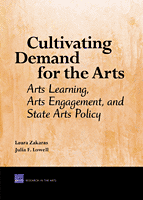 Policymakers have underestimated the critical role of arts learning in supporting a vibrant nonprofit cultural sector, according to a RAND Corporation report just published. The study, written by Laura Zakaras and Julia F. Lowell and entitled Cultivating Demand for the Arts: Arts Learning, Arts Engagement, and State Arts Policy, was commissioned by the Wallace Foundation and conducted by RAND.
Despite decades of effort to make high-quality works of art available to Americans, demand for the arts has failed to keep pace with supply. Audiences for classical music, jazz, opera, theater, and the visual arts have declined as a percentage of the population, and the percentage of these audiences age thirty and younger has fallen even more.
“For decades, public funding of the arts has focused on building supply and expanding access to the arts, but it has neglected the cultivation of audiences capable of appreciating the arts,” said the coauthor Laura Zakaras, an arts researcher at RAND. “If we are not teaching the young how to engage with works of art, they are not likely to become involved in the arts as adults.”
Calling on evidence that experiencing and studying the arts in childhood increase the likelihood of arts participation later in life, the study recommends policymakers in both the arts and education to devote greater attention to cultivating demand for the arts by supporting more and better arts education.
At the public school level, researchers note, arts content standards have been almost universally mandated by the states and are broadening teaching practices, but state, local, and district policies are not providing the resources or time in the school day to implement these standards. In fact, there is evidence that high-stakes standardized testing has led to reduced class time for the arts and humanities in the past five years, according to the study. Arts organizations and colleges have been helpful in complementing school-based arts education, but it is not enough to fill the void.
Analyzing grant-making data, researchers show that state arts agencies, which have historically focused on providing grants to arts organizations, have directed less than 10 percent of their grants over the last twenty years toward activities that target arts learning. In most states, grants are not part of a comprehensive strategy to promote youth or adult arts learning.
However, some state arts agencies are bucking this trend. Rhode Island and New Jersey, for example, have forged relationships with their state departments of education, other state agencies, and members of the arts community to develop comprehensive statewide plans for improving arts education in public schools.
In New Jersey, the state’s arts agency helped develop a survey of arts education that has raised awareness of the inadequacy of its provision in the schools. Concerned residents are now pushing for the adoption of a number of new policies, including inclusion of per-pupil arts spending in New Jersey’s Comparative Spending Guide for public schools. In Rhode Island, the state arts agency was instrumental in successful efforts to adopt a standards-based high school graduation requirement in the arts.
Based on these findings, the authors recommend that state arts agencies and policymakers gauge how well their states are doing by conducting surveys of arts education; developing specific high school graduation requirements in the arts; recognizing and publicizing arts learning programs considered exceptional by experts in the field; and advocating for changes in state policy that increase the amount and breadth of arts learning opportunities. According to the authors, a healthy demand for the arts is critical to a vibrant nonprofit arts sector. Policies that focus on supporting the supply of the arts and broadening access to the arts are not sufficient for building that demand.
New AAM Standards on Cultural Property
posted by Christopher Howard — September 04, 2008
The American Association of Museums (AAM) has established new standards for the museum acquisition of archaeological material and ancient art that emphasize proper provenance of such objects and complete transparency on the part of the acquiring institutions. The product of two years of concerted research and vetting from the museum field, the Standards Regarding Archaeological Material and Ancient Art provide clear ethical guidance on collecting such material to discourage illicit excavation of archaeological sites and monuments. The standards also require museums to create a publicly available collections policy that sets institutional standards for provenance when acquiring archaeological material and ancient art.
CAA has also established Standards and Guidelines on similar topics, including the Resolution Concerning the Acquisition of Cultural Properties Originating in Foreign Countries (1973) and the Statement on the Importance of Documenting the Historical Context of Objects and Sites (2004).