
CAA News Today
Exhibitor and Advertiser Prospectus for the 2013 Annual Conference
posted by CAA — August 10, 2012
 The Exhibitor and Advertiser Prospectus for the 2013 Annual Conference in New York is now available for download. Featuring essential details for participation in the Book and Trade Fair, the booklet also contains options for sponsorship opportunities and advertisements in conference publications and on the conference website.
The Exhibitor and Advertiser Prospectus will help you reach a core audience of artists, art historians, educators, students, and administrators, who will converge in New York for CAA’s 101st Annual Conference, taking place February 13–16, 2013. With three days of exhibit time, the Book and Trade Fair will be centrally located at the Hilton New York, where most programs sessions and special events take place. CAA offers several options for booths and tables that can help you to connect with conference attendees in person.
In addition, sponsorship packages will allow you to maintain a high profile throughout the conference. Companies, organizations, and publishers may choose one of four visibility packages, sponsor specific areas and events such as the Student and Emerging Professionals Lounge, or work with CAA staff to design a custom package. Advertising possibilities include the Conference Program, distributed to over six thousand registrants, and the conference website, seen by thousands more.
The priority deadline for Book and Trade Fair applications has been extended to Friday, November 16, 2012; the final deadline for all applications and full payments, and for sponsorships and advertisements in the Conference Program, is Friday, December 7, 2012.
Questions about the 2013 Book and Trade Fair? Please contact Paul Skiff, CAA assistant director for Annual Conference, at 212-392-4412. For sponsorship and advertising queries, speak to Helen Bayer, CAA marketing and communications associate, at 212-392-4426.
Art Journal Publishes Special Issue on Pacific Standard Time
posted by Christopher Howard — July 18, 2012
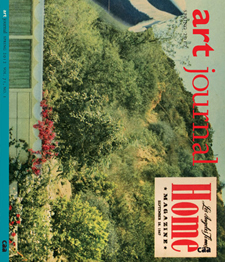 Pacific Standard Time, the massive project on art in southern California that concluded in June, is the topic of a special issue of Art Journal that has just been published. An unprecedented collaboration of some sixty southern Californian cultural institutions brought together by the Getty, the Pacific Standard Time exhibitions and events offered a near-encyclopedic view of the work artists created in the region from 1945 to 1980.
At the center of the journal’s coverage is a conversation with Andrew Perchuk, deputy director of the Getty Research Institute (GRI), and Thomas Crow, former director of the GRI and now a professor at the Institute of Fine Arts of New York University; they speak with the art historian Howard Singerman, reviews editor of Art Journal.
The issue features a commissioned artist’s project by Allen Ruppersberg, PST: Before and After, which appears on the covers of the issue and every interior page. In her introduction to the issue, the editor-in-chief Katy Siegel notes that Ruppersberg “is often seen as the classic Los Angeles artist.” His project draws on press treatment of art in southern California during the years covered by Pacific Standard Time.
In addition, many of the Pacific Standard Time exhibitions are reviewed or discussed in extended essays by historians, curators, and artists: Connie Butler, Jan Tumlir, Lucia Sanromán, Malik Gaines, Michael Ned Holte, and Ken Gonzales-Day. An essay by Lucy Bradnock considers the Angeleno curator Walter Hopps, and Maria Elena Buszek interviews the artists Suzanne Lacy and Andrea Bowers about their joint projects.
This special issue of Art Journal is the leading edge of the flood of scholarship on postwar art in southern California that Pacific Standard Time is expected to engender.
New Leaders for CAA’s Publications
posted by Christopher Howard — July 10, 2012
The president of the CAA Board of Directors, Anne Collins Goodyear, has confirmed new appointments to the editorial boards of CAA’s three scholarly journals and to the Publications Committee, in consultation with the vice president for publications, Randall C. Griffin. The appointments took effect on July 1, 2012.
The Art Bulletin
The Art Bulletin has announced its next editor-in-chief: Kirk Ambrose, associate professor and chair of the Department of Art and Art History at the University of Colorado in Boulder. In addition to numerous essays and book chapters, he is the author of The Nave Sculpture of Vézelay: The Art of Monastic Viewing (Toronto: Pontifical Institute of Mediaeval Studies, 2006) and the coeditor, with Robert A. Maxwell, of Current Directions in Eleventh- and Twelfth-Century Romanesque Sculpture Studies (Turnhout, Belgium: Brepols, 2010). His book Monsters in Twelfth-Century European Sculpture is forthcoming from Boydell and Brewer. Other future projects include a volume on Portuguese Romanesque sculpture and an exhibition at the University of Colorado Art Museum, tentatively entitled Aby Warburg and the Beginning of Cultural Studies in the American Southwest and scheduled for 2014. Ambrose will succeed Karen Lang of the University of Warwick in England, beginning his three-year term as editor-in-chief on July 1, 2013, with the preceding year as editor designate.
David J. Getsy, the Goldabelle McComb Finn Distinguished Professor of Art History, Theory, and Criticism at the School of the Art Institute of Chicago, has joined the Art Bulletin Editorial Board for a four-year term. His work focuses on modern and contemporary art in Europe and America from the 1870s to the present day. Among his books are Body Doubles: Sculpture in Britain, 1877–1905 (New Haven: Paul Mellon Centre for Studies in British Art and Yale University Press, 2004) and Rodin: Sex and the Making of Modern Sculpture (New Haven: Yale University Press, 2010). Getsy is currently editing the critical writings of the American postminimalist artist Scott Burton, for publication later this year by Soberscove Press.
Rachael DeLue, associate professor of art history at Princeton University in Princeton, New Jersey, has begun a three-year term as the reviews editor of The Art Bulletin, succeeding Michael Cole of Columbia University in New York. Her first section will appear in the March 2013 issue. Thelma K. Thomas, associate professor of fine arts at the Institute of Fine Arts, New York University, has now entered the second year of her two-year service as the chair of the editorial board of the journal.
Art Journal
Michael Corris, professor of art and chair of the Division of Art in the Meadows School of the Arts at Southern Methodist University in Dallas, Texas, was appointed Art Journal reviews editor. He will serve one year as reviews editor designate, taking over from Howard Singerman of the University of Virginia in July 2013. Corris is both an artist and an author of many works on postwar and contemporary art and theory. The Peacock Gallery in London and the Reading Room in Dallas hosted his most recent solo shows; he has also exhibited widely as a member of the collaborative group Art & Language. Among Corris’s many publications are monographs on Ad Reinhardt (London: Reaktion Books, 2008) and David Diao (Beijing: Timezone 8, 2005). Two books forthcoming in 2013 are The Artist Out of Work: Selected Writings on Art (Les Presses du réel and JRP | Ringier) and What Do Artists Know? The Response to Deskilling in Art (Reaktion Books). Corris is a cofounder and editor of Transmission Annual, a collaborative project of Sheffield Hallam University in England and the Meadows School of the Arts.
Joining the Art Journal Editorial Board for four-year terms are Catherine Lord and Hilary Robinson. Lord is a writer, artist, and curator whose work addresses issues of feminism, cultural politics, and colonialism. She is a professor of studio art and women’s studies at the University of California, Irvine. Recent solo exhibitions were held at ONE National Gay and Lesbian Archives and Jancar Gallery, both in Los Angeles. Lord is the author of the text-image experimental narrative The Summer of Her Baldness: A Cancer Improvisation (Austin: University of Texas Press, 2004), and her forthcoming book project coedited with Richard Meyer, to be published by Phaidon, is called Art and Queer Culture, 1885–2005. Robinson is a professor of art theory and criticism in the College of Fine Arts at Carnegie Mellon University in Pittsburgh, Pennsylvania. The focus of her scholarship is the history and theory of feminist art. Her books include Reading Art, Reading Irigaray: The Politics of Art by Women (London: I. B. Tauris, 2006) and Feminism-Art-Theory: A History, forthcoming from Blackwell. She is the editor of Visibly Female: Feminism and Art: An Anthology (London: Camden, 1987) and Feminism-Art-Theory: An Anthology 1968–2000 (Malden, MA: Blackwell, 2001).
Lane Relyea, an art critic and associate professor in the Department of Art Theory and Practice at Northwestern University in Evanston, Illinois, has finished his year as editor designate of Art Journal and now assumes the position of editor-in-chief, succeeding Katy Siegel of Hunter College, City University of New York. His first edited issue will appear in spring 2013. Rachel Weiss, a professor at the School of the Art Institute of Chicago whose work focuses on the art of Cuba, is the new chair of the journal’s editorial board. Weiss recently published To and from Utopia in the New Cuban Art (Minneapolis: University of Minnesota Press, 2011).
caa.reviews
The caa.reviews Editorial Board welcomes a new member, Tanya Sheehan, assistant professor in the Department of Art History at Rutgers University in New Brunswick, New Jersey, who will serve for four years. Currently the journal’s field editor for books on photography, she is the author of Doctored: The Medicine of Photography in Nineteenth-Century America, published by Pennsylvania State University Press in 2011.
Six new field editors for books and exhibitions have recently been chosen by the editorial board to serve three-year terms. Gloria Williams will commission reviews of exhibitions of pre-1800 art on the West Coast; Eve Straussman-Pflanzer will oversee reviews of exhibitions in the Midwest; and Jennifer Kingsley will commission reviews of exhibitions in the Southeast. Kirsten Swenson will assign books on contemporary art for review, and Megan O’Neil will commission reviews of books and related media on Precolumbian art. Michael Schreffler will handle reviews of books on early modern Iberian and colonial Latin American art.
Publications Committee
S. Hollis Clayson, Bergen Evans Professor in the Humanities and professor of art history at Northwestern University in Evanston, Illinois, was appointed to the Publications Committee as member-at-large. Clayson specializes in nineteenth-century modern European art, particularly French art; her most recent book is Paris in Despair: Art and Everyday Life under Siege (1870–71) (Chicago: University of Chicago Press, 2002). She is the recipient of numerous research and teaching awards and, as director of the Alice Kaplan Institute for the Humanities at Northwestern, promotes discussion and projects focusing on humanities in the digital era. A former chair and member of the Art Bulletin Editorial Board, Clayson has served on CAA’s Annual Conference Committee and on the juries for three CAA awards: the Distinguished Lifetime Achievement Award for Writing on Art, the Arthur Kingsley Porter Prize, and the Distinguished Teaching of Art History Award.
Intellectual Property and the Arts
posted by Christopher Howard — June 25, 2012
The Committee on Intellectual Property (CIP) is pleased to announce the posting of the revised and expanded Intellectual Property and the Arts pages on CAA’s website. CIP monitors and interprets copyright legislation for the benefit of CAA’s various constituencies. In so doing, it seeks to offer educational programs and opportunities for discussion and debate in response to copyright legislation affecting educators, scholars, museum professionals, and artists.
The section is divided into the following eight categories: US Copyright: Fundamentals & Documents; Visual Art/Visual Artists; Publishing in the Visual Arts; Libraries, Archives, and Museums; Image Sources and Rights Clearance Agencies; Fair Use Guidelines, Practices, and Policies; Copyright Outside the United States; and Legal Assistance.
Education is essential for informed communication. The committee hopes that the resources presented in the updated pages will answer your questions about intellectual property and inform your discussions and debates.
Survey Results on Contingent Faculty in Higher Education
posted by Christopher Howard — June 20, 2012
 The results of a 2010 survey of contingent faculty members and instructors in American higher education, published today by the Coalition on the Academic Workforce (CAW), have confirmed much of what has been reported anecdotally: part-time faculty members demonstrate a dedicated level of commitment to teaching and to the institutions that employ them, but this commitment is not reciprocated by those institutions through compensation or other professional support. The findings also describe larger course loads for teachers, imbalances in compensation in relation to not only professional credentials but also gender and race, and minimal participation in academic decision-making. Further, contingent faculty face longer durations of provisional employment and slim prospects for career advancement, with schools failing to meet their preference for full-time status.
According to a 2009 government study, 75.5 percent of all faculty members at colleges and universities in the United States are contingent: that is, they hold part-time or adjunct positions, have full-time non-tenure-track jobs, or serve as graduate-student teaching assistants. Part-timers alone make up nearly half the total professoriate. The US Department of Education, however, has not kept statistics on contingent-faculty salaries since 2003, when it last carried out its National Study of Postsecondary Faculty. CAW’s comprehensive survey, administered in fall 2010, was conducted in an effort to provide meaningful data for this rapidly growing concern. Of the nearly 30,000 survey respondents, 1,102 were CAA members: 591 in studio art and design, 362 in art history, and 149 in art education. The CAW report focuses on the largest group of contingent faculty: part-timers.
CAA is a founding member (1997) of CAW, which is a group of higher-education associations, disciplinary associations, and faculty organizations committed to addressing issues associated with deteriorating faculty working conditions and their effect on college and university students in the United States. Specifically, CAW’s purpose is to: collect and disseminate information on the use and treatment of full- and part-time faculty members serving off the tenure track and the implications for students, parents, other faculty members, and institutions; articulate and clarify differences in the extent and consequences of changes in the faculty within and among the various academic disciplines and fields of study; evaluate the short-term and long-term consequences of changes in the academic workforce for society and the public good; identify and promote strategies for solving the problems created by inappropriate use and exploitation of part-time, adjunct, and similar faculty appointments; promote conditions by which all faculty members, including full- and part-time non-tenure-track faculty members, can strengthen their teaching and scholarship, better serve their students, and advance their professional careers.
Andrew Delbanco, the author of College: What It Was, Is, and Should Be (2012), stated that, in 1975, 60 percent of college professors were full-time faculty with tenure. The reasons for the accelerated shift toward contingent labor since that time are many. Decreases in state funding, capital expansion without commensurate revenue, increases in specialized knowledge requiring thousands of course offerings, and swelling student enrollment all have had a detrimental effect on faculty budgets, more so than on any other area of expenditures in higher education. Jane Wellman, who led the Delta Project on Postsecondary Education Costs, Productivity, and Accountability, affirmed these observations in a recent New York Times interview:
What the evidence shows is that we’ve done more to cut costs in the faculty area than elsewhere in the budget, and we’ve done it by bringing in more adjuncts and part-timers. So there’s a handful of professors with tenure, who don’t teach very much, and then there’s [a] lot of people who have no benefits who do more of the teaching. I think it’s probably hurting academic quality, especially at institutions where the students are not well prepared. The attrition [of students] is mostly in the first two years, and that’s mostly where the adjuncts are.
While no hard evidence has determined that an increase of adjuncts has diminished the quality of teaching in higher education, the CAW survey results clearly demonstrate pressure on part-time faculty due to not only expanding workloads and larger classes—especially for part-time faculty teaching at multiple institutions—but also expectations to be involved in academic decision-making without additional compensation.
Professors of studio art and art history are acutely aware of all these issues. Enrollment has risen persistently for art-history and studio courses for years, while tenured positions have diminished. The survey results do bring some slightly positive news: median pay for contingent faculty in studio art and design and in art history is $3,000 per three-credit course (the nationwide median is approximately $2,700). In addition, workers at campuses with a union presence earn more than those at nonunion schools. Compensation is lower, however, for survey respondents who identified themselves as black, although the number of African Americans who participated in the survey was low. Please visit the CAW website for details on these issues and more.
The CAW report will provide important data for discussions taking place in several of CAA’s Professional Interests, Practices, and Standards Committees. The Student and Emerging Professionals Committee will be addressing contingent-faculty issues at a panel at the 2013 Annual Conference in New York, which will include Michael Bérubé, president of the Modern Language Association and director of the Institute for the Arts and Humanities at Pennsylvania State University, who will present an overview of the Academic Workforce Data Center, a compilation of historical data of the growth of contingent faculty by universities. Bérubé will also discuss the need to nationalize the academic-job market. Jeanne Brody, an adjunct professor at Villanova University and Saint Joseph’s University, will summarize the ways in which adjunct faculty members are effectively organizing and advocating better treatment within the university system. Victoria H. F. Scott of Emory University will discuss the establishment of an Art History Society of the Americas, which would explore abolishing adjunct position types, raising salaries, collecting statistics, and setting policies to improve and monitor working conditions.
The Committee on Women in the Arts, which focuses on women’s issues in the workplace and beyond, will respond to survey results on gender. Although women make up two-thirds of all CAA members, they tend to occupy the lowest rungs of academia, while men continue filling the higher-ranking and higher-paid positions. To continue the discussion, the committee will present a panel at the 2013 conference, chaired by the artist and professor Claudia Sbrissa, on how the “feminization” of art history may have contributed to lower salaries and prestige for women.
Similarly, the Committee on Diversity Practices will discuss issues related to retention of faculty members of color during its panel at the 2013 conference.
CAA would like to thank the individuals who generously volunteered their time and expertise to develop and tabulate CAW’s survey: John Curtis, director of research and public policy, American Association of University Professors; David Laurence, director of research, Modern Language Association; Kathleen Terry-Sharp, director of academic relations and practicing and applied programs, American Anthropological Society; Craig Smith, director of higher education, American Federation of Teachers; and Robert B. Townsend, deputy director, American Historical Association.
Survey Results on Contingent Faculty in Higher Education
posted by Christopher Howard — June 20, 2012
The results of a 2010 survey of contingent faculty members and instructors in American higher education, published today by the Coalition on the Academic Workforce (CAW), have confirmed much of what has been reported anecdotally: part-time faculty members demonstrate a dedicated level of commitment to teaching and to the institutions that employ them, but this commitment is not reciprocated by those institutions through compensation or other professional support. The findings also describe larger course loads for teachers, imbalances in compensation in relation to not only professional credentials but also gender and race, and minimal participation in academic decision-making. Further, contingent faculty face longer durations of provisional employment and slim prospects for career advancement, with schools failing to meet their preference for full-time status.
According to a 2009 government study, 75.5 percent of all faculty members at colleges and universities in the United States are contingent: that is, they hold part-time or adjunct positions, have full-time non-tenure-track jobs, or serve as graduate-student teaching assistants. Part-timers alone make up nearly half the total professoriate. The US Department of Education, however, has not kept statistics on contingent-faculty salaries since 2003, when it last carried out its National Study of Postsecondary Faculty. CAW’s comprehensive survey, administered in fall 2010, was conducted in an effort to provide meaningful data for this rapidly growing concern. Of the nearly 30,000 survey respondents, 1,102 were CAA members: 591 in studio art and design, 362 in art history, and 149 in art education. The CAW report focuses on the largest group of contingent faculty: part-timers.
CAA is a founding member (1997) of CAW, which is a group of higher-education associations, disciplinary associations, and faculty organizations committed to addressing issues associated with deteriorating faculty working conditions and their effect on college and university students in the United States. Specifically, CAW’s purpose is to: collect and disseminate information on the use and treatment of full- and part-time faculty members serving off the tenure track and the implications for students, parents, other faculty members, and institutions; articulate and clarify differences in the extent and consequences of changes in the faculty within and among the various academic disciplines and fields of study; evaluate the short-term and long-term consequences of changes in the academic workforce for society and the public good; identify and promote strategies for solving the problems created by inappropriate use and exploitation of part-time, adjunct, and similar faculty appointments; promote conditions by which all faculty members, including full- and part-time non-tenure-track faculty members, can strengthen their teaching and scholarship, better serve their students, and advance their professional careers.
Andrew Delbanco, the author of College: What It Was, Is, and Should Be (2012), stated that, in 1975, 60 percent of college professors were full-time faculty with tenure. The reasons for the accelerated shift toward contingent labor since that time are many. Decreases in state funding, capital expansion without commensurate revenue, increases in specialized knowledge requiring thousands of course offerings, and swelling student enrollment all have had a detrimental effect on faculty budgets, more so than on any other area of expenditures in higher education. Jane Wellman, who led the Delta Project on Postsecondary Education Costs, Productivity, and Accountability, affirmed these observations in a recent New York Times interview:
What the evidence shows is that we’ve done more to cut costs in the faculty area than elsewhere in the budget, and we’ve done it by bringing in more adjuncts and part-timers. So there’s a handful of professors with tenure, who don’t teach very much, and then there’s [a] lot of people who have no benefits who do more of the teaching. I think it’s probably hurting academic quality, especially at institutions where the students are not well prepared. The attrition [of students] is mostly in the first two years, and that’s mostly where the adjuncts are.
While no hard evidence has determined that an increase of adjuncts has diminished the quality of teaching in higher education, the CAW survey results clearly demonstrate pressure on part-time faculty due to not only expanding workloads and larger classes—especially for part-time faculty teaching at multiple institutions—but also expectations to be involved in academic decision-making without additional compensation.
Professors of studio art and art history are acutely aware of all these issues. Enrollment has risen persistently for art-history and studio courses for years, while tenured positions have diminished. The survey results do bring some slightly positive news: median pay for contingent faculty in studio art and design and in art history is $3,000 per three-credit course (the nationwide median is approximately $2,700). In addition, workers at campuses with a union presence earn more than those at nonunion schools. Compensation is lower, however, for survey respondents who identified themselves as black, although the number of African Americans who participated in the survey was low. Please visit the CAW website for details on these issues and more.
The CAW report will provide important data for discussions taking place in several of CAA’s Professional Interests, Practices, and Standards Committees. The Student and Emerging Professionals Committee will be addressing contingent-faculty issues at a panel at the 2013 Annual Conference in New York, which will include Michael Bérubé, president of the Modern Language Association and director of the Institute for the Arts and Humanities at Pennsylvania State University, who will present an overview of the Academic Workforce Data Center, a compilation of historical data of the growth of contingent faculty by universities. Bérubé will also discuss the need to nationalize the academic-job market. Jeanne Brody, an adjunct professor at Villanova University and Saint Joseph’s University, will summarize the ways in which adjunct faculty members are effectively organizing and advocating better treatment within the university system. Victoria H. F. Scott of Emory University will discuss the establishment of an Art History Society of the Americas, which would explore abolishing adjunct position types, raising salaries, collecting statistics, and setting policies to improve and monitor working conditions.
The Committee on Women in the Arts, which focuses on women’s issues in the workplace and beyond, will respond to survey results on gender. Although women make up two-thirds of all CAA members, they tend to occupy the lowest rungs of academia, while men continue filling the higher-ranking and higher-paid positions. To continue the discussion, the committee will present a panel at the 2013 conference, chaired by the artist and professor Claudia Sbrissa, on how the “feminization” of art history may have contributed to lower salaries and prestige for women.
Similarly, the Committee on Diversity Practices will discuss issues related to retention of faculty members of color during its panel at the 2013 conference.
CAA would like to thank the individuals who generously volunteered their time and expertise to develop and tabulate CAW’s survey: John Curtis, director of research and public policy, American Association of University Professors; David Laurence, director of research, Modern Language Association; Kathleen Terry-Sharp, director of academic relations and practicing and applied programs, American Anthropological Society; Craig Smith, director of higher education, American Federation of Teachers; and Robert B. Townsend, deputy director, American Historical Association.
June 2012 Issue of The Art Bulletin
posted by Christopher Howard — June 13, 2012
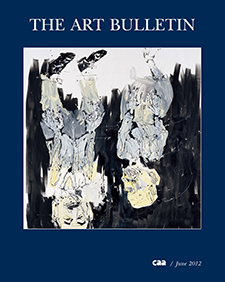 The cover image of the June 2012 issue of The Art Bulletin shows the unmistakable signature style of the contemporary artist Georg Baselitz, who has also written the lead text for the issue’s Notes from the Field. In this section, nine scholars from divergent fields—among them Kirk Ambrose, Elizabeth Edwards, Cordula Grewe, Daniel Heller-Roazen, and Ian McLean—join the artist in writing on the theme of appropriation. The June issue presents the second installment of new features in The Art Bulletin, sections that will continue for several years in the leading publication of international art-historical scholarship. In Regarding Art and Art History, Andrew Hemingway revisits his early fascination with a John Constable painting, Chain Pier, Brighton (1826–27), and describes how the work has shaped his methodological approach to writing art history. Finally, in a wide-ranging interview with Dan Karlholm, the art historian Linda Nochlin discusses her five-decade career.
The June Art Bulletin features four essays that cover a wide range of topics and time periods in the history of art. Sonya S. Lee examines the role of patronage and appropriation in tenth-century Dunhuang through her analysis of the pictorial program of Cave 61 at Mogao in northwestern China. Kishwar Rizvi’s article explores the dynamic relationship between image and text in the 1605 manuscript Shahnama (Book of Kings) and how the folio’s paintings can be viewed as a surrogate portrait of the charismatic king, Shah ‘Abbas. Next, Katherine M. Kuenzli explores the “total work of art” that is Henry van de Velde’s 1914 Werkbund Theater Building and its role in shaping German modernism and national identity before and after World War I. In “Picasso’s First Constructed Sculpture: A Tale of Two Guitars,” Christine Poggi analyzes the artist’s 1912 paper Guitar as a modernist masterpiece unto itself, and not merely as the model for subsequent versions made from sheet metal; Poggi’s essay also features unusual new photographs of several paper sculptures that she discusses.
In the Reviews section, Cammy Brothers assesses Marvin Trachtenberg’s book, Building-in-Time: From Giotto to Alberti and Modern Oblivion, and Diane H. Bodart reviews two books, Joanna Woodall’s Anthonis Mor: Art and Authority and Laura R. Bass’s The Drama of the Portrait: Theatre and Visual Culture in Early Modern Spain. Then, Victor I. Stoichita looks at Michael Fried’s The Moment of Caravaggio, and Jonathan Hay discusses Craig Clunas’s approach to Chinese art history through a reading of five of his recent books on the subject. Finally, Barbara Wittmann reviews two catalogues—The Spectacular Art of Jean-Léon Gérôme (1824–1904) and Reconsidering Gérôme—that accompanied a 2011 exhibition at the J. Paul Getty Museum in Los Angeles and the Musée d’Orsay in Paris.
Please see the full table of contents for June to learn more. CAA sends The Art Bulletin to all institutional members and to those individuals who choose to receive the journal as a benefit of their membership.
The next issue of The Art Bulletin, to be published in September 2012, will feature the art historian Richard Shiff on the concept of interpretation in Regarding Art and Art History, “contingency” as the topic in Notes from the Field, and an interview with the architectural historian James S. Ackerman. The long-form essays will examine iconoclasm and the image as representation in the eighth century, Francesco Rosselli’s engravings and the development of print culture in Renaissance Italy, seventeenth-century Chinese handscroll painting, and the trials of the modern Viennese architect Adolf Loos. The Reviews section will include analyses of books on Giotto, Willem de Kooning, civil rights, photography, and the image of the wind.
Join the Millard Meiss Publication Fund Jury
posted by CAA — June 11, 2012
 CAA seeks nominations and self-nominations from one member/individual with a specialization in a historic period in Asian, Southeast Asian, American, or Pre-Columbian art to serve on the jury for the Millard Meiss Publication Fund for a four-year term, ending on June 30, 2016. Candidates must be actively publishing scholars with demonstrated seniority and achievement; institutional affiliation is not required.
The Meiss jury awards grants that subsidize the publication of book-length scholarly manuscripts in the history of art and related subjects. Members review manuscripts and grant applications twice a year and meet in New York in the spring and fall to select the awardees. CAA reimburses jury members for travel and lodging expenses in accordance with its travel policy.
Candidates must be current CAA members and should not be serving on another CAA editorial board or committee. Jury members may not themselves apply for a grant in this program during their term of service. Nominators should ascertain their nominee’s willingness to serve before submitting a name; self-nominations are also welcome. Please send a letter describing your interest in and qualifications for appointment, a CV, and contact information to: Millard Meiss Publication Fund Jury, College Art Association, 50 Broadway, 21st Floor, New York, NY 10004; or send all materials as email attachments to Alex Gershuny, CAA editorial associate. Deadline: August 8, 2012.
Spring 2012 Recipients of the Millard Meiss Publication Fund
posted by Christopher Howard — June 04, 2012
This spring, CAA awarded grants to the publishers of six books in art history and visual culture through the Millard Meiss Publication Fund. Thanks to the generous bequest of the late professor Millard Meiss, CAA gives these grants to support the publication of scholarly books in art history and related fields.
The six grantees for spring 2012 are:
- Todd Cronan, Matisse, Bergson, and the Philosophical Temper of Modernism, University of Minnesota Press
- John J. Curley, Andy Warhol, Gerhard Richter, and Cold War Visuality: A Conspiracy of Images, Yale University Press
- Laurinda Dixon, The Dark Side of Genius: The Melancholic Persona in Art, ca. 1500–1700, Pennsylvania State University Press
- Dorothy Habel, “When All of Rome Was under Construction”: The Building Process in Baroque Rome, Pennsylvania State University Press
- Mary Ellen Miller and Claudia Lozoff Brittenham, The Spectacle of the Late Maya Court: Reflections on the Paintings of Bonampak, University of Texas Press
- Diane Radycki, Paula Modersohn-Becker: The First Modern Woman Artist, Yale University Press
Books eligible for Meiss grants must already be under contract with a publisher and on a subject in the visual arts or art history. Authors must be current CAA members. Please review the application guidelines for more information. The deadline for the fall 2012 grant cycle is October 1, 2012.
CAA Seeks Publications Committee Member
posted by Alyssa Pavley — April 04, 2012
CAA invites nominations and self-nominations for one member-at-large to serve on its Publications Committee for a three-year term, July 1, 2012–June 30, 2015. Candidates must possess expertise appropriate to the committee’s work.
Meeting three times a year, the Publications Committee is a consultative body that advises the CAA Publications Department staff and the CAA Board of Directors on publications projects. It supervises the editorial boards of The Art Bulletin, Art Journal, and caa.reviews, as well as CAA’s book-grant juries; sponsors a practicum session at the Annual Conference; and, with the CAA vice president for publications, serves as liaison to the board, membership, editorial boards, book-grant juries, and other CAA committees.
The Publications Committee meets three times a year: twice in New York in the spring and fall and once at the CAA Annual Conference in February. CAA reimburses members for travel and lodging expenses for the two New York meetings in accordance with its travel policy, but members pay these expenses to attend the conference. Members of all CAA committees volunteer their services without compensation.
Candidates must be current CAA members and should not be serving on another CAA editorial board or committee. In addition, they may not be individuals who have served as members of a CAA editorial board within the past five years. Nominators should ascertain their nominee’s willingness to serve before submitting a name; self-nominations are also welcome. Appointments are made by the CAA president in consultation with the vice president for publications. Please send a statement describing your interest in and qualifications for appointment, a CV, and your contact information to: Publications Committee, College Art Association, 50 Broadway, 21st Floor, New York, NY 10004; or email the documents to Alyssa Pavley, CAA editorial assistant. Deadline: May 2, 2012.