
CAA News Today
Affiliated Society News for May 2017
posted May 18, 2017
Association for Latin American Art
At ALAA’s annual business meeting held at CAA in New York, a new slate of officers was elected: Michele Greet, President; Ananda Cohen-Aponte, Vice President; and Helen Ellis, Secretary-Treasurer. ALAA presented its 17th Annual Arvey Book Award to George Flaherty for Hotel Mexico: Dwelling on the ’68 Movement (University of California Press, 2015). Alessandra Russo, Gerhard Wolf, and Diana Fane, eds., received honorable mention for their book, Images Take Flight: Feather Art in Mexico and Europe 1400–1700 (Kunsthistorisches Institut-Max-Planck Institut and the Museo Nacional de Arte, 2015).
The prize for the best dissertation in Latin American Art History was given to Sara Ryu for “Calendar, Column, Crucifix: Material Reuse in the Early Modern Transatlantic World” (Yale University). ALAA’s sponsored session for 2017 was “The Evolving Canon: Collecting and Displaying Spanish Colonial Art” chaired by Ilona Katzew and Ellen Dooley. Elisa C. Mandell, Georgina G. Gluzman, and Ana Mannarino chaired the “Open Session for Emerging Scholars of Latin American Art.” ALAA currently has 460 members (up from 377 last year) from universities, museums, and foundations in the United States, Canada, Costa Rica, Brazil, Mexico, Argentina, Peru, Bolivia, Chile, and Spain. Members conduct research in all major time periods and geographic regions of Latin America, as well as on Latino/a art of the United States.
FATE (Foundations in Art: Theory and Education)
 Thank you to all who attended the 16th Biennial FATE Conference, “To the Core and Beyond” in Kansas City in April! We had an excellent turn out! And, please welcome the new and returning board members elected during the conference.
In Episode 9 of Positive Space, FATE’s monthly podcast, Valerie Powell has a thoughtful conversation with FATE’s 2017 keynote speaker, artist and author Enrique Martinez, about the artistic process and the ongoing choice to live a creative life.
More info here and listen to episodes on our Apple iTunes page.
In addition, FATE in Review seeks thoughtful articles relating to all areas of foundations education, including expanding the practicum, flexing the core, and re-visioning visual culture. Conference papers and/or presentations, as well as papers written solely for publication, may be submitted throughout the year. We are also interested in reviews of newer books that inform foundations discussion and curriculum. Contact FATE in Review Editor, Michael Marks.
Upcoming for CAA 2018: FATE’s CAA Affiliate representative, Naomi J. Falk, is looking for panelists for FATE’s affiliate conference session, entitled, “Let’s Dance, But Don’t Call Me Baby: Dialogue, Empathy, and Inclusion in the Classroom and Beyond.” Feeling welcome, acknowledged, and heard encourages learning. Fostering inclusiveness and empathy on behalf of minority students legitimizes perspectives. How do we build trust and empathy between faculty, students, peers, and others in our classrooms and communities? How do we create a welcoming and inclusive environment? What has worked? What has gone terribly wrong? Where do we go from here? Examples of readings, projects, tools, and exercises for building inclusive, encouraging, and productive dialogues are all of interest. More info? Please contact: Naomi J. Falk.
The Feminist Art Project
 The Feminist Art Project is pleased to announce that the second issue of Rejoinder is now available. The theme of the issue is Borders, Bodies, Homes. Contributors explore how these concepts shape our understandings of selfhood and exile in an environment marked by migratory population flows, resurgent nationalisms, and state-sanctioned violence. Rejoinder features essays, fiction, and artwork by Joshua G. Adair, Connie Freid, Yishay Garbasz, Uddipana Gosswami, Leigh Johnson, Elinor Meeks, Vukasin Nedeljkovic, Jeffrey Shandler, Rachida Yassine, and Helena Zeweri. Sarah Tobias is the editor.
Rejoinder is an online journal published by the Institute for Research on Women in partnership with The Feminist Art Project, both at Rutgers, The State University of New Jersey. Please subscribe in order not to miss out on future issues!
Historians of Netherlandish Art
The Historians of Netherlandish Art are pleased to announce their new officers for the term 2017–2021: President: Paul Crenshaw; Vice-President: Louisa Wood Ruby; immediate past president: Amy Golahny. Please visit our website for more information.
The current issue of the Journal of the Historians of Netherlandish Art (JHNA vol. 9:1, Winter 2017) is dedicated to Walter Liedtke and includes seventeen articles that reference works in the Metropolitan Museum of Art under his care. The formal deadline for submissions to the Winter 2018 and Summer 2018 issues is August 1, 2017, although the editors accept submissions throughout the year.
From Thursday 24 May to Saturday 26 May 2018, the three-day conference of the Historians of Netherlandish art will take place at Het Pand in Ghent (BE). The call for sessions and workshops can be found here.
For further information, visit: www.hnanews.org.
The International Center of Medieval Art
Newly-elected officers Helen Evans (President), Nina Rowe (Vice President), and Anne Rudloff Stanton (Secretary), and several other new board members, have begun their three-year terms.
The ICMA invites submissions for their annual Book Prize, to be awarded to the best single-authored book on any topic in medieval art published in 2016 (deadline May 31). Through the generosity of the Samuel H. Kress foundation, they also award Research and Publication Grants (deadline August 31) as well as Travel Grants supporting the travel of speakers in ICMA-sponsored sessions (rolling deadlines).
Recent print and digital publications include the organization’s peer-reviewed journal Gesta (volume 56, number 1, Spring 2017). The ICMA’s newest digital initiative to go public is Lordship and Commune: A Collaboratory, an interactive digital website about the cathedrals of Reims and Amiens in their medieval and modern contexts. This project is an innovative way to invite conversation and collaboration around the major unfinished study on these two cathedrals by the late Barbara Abou-El-Haj, and is intended to be accessible as a teaching and research resource.
Society of Architectural Historians (SAH)
 The Society of Architectural Historians is now accepting abstracts for its 71st Annual International Conference in Saint Paul, MN, April 18–22, 2018. Please submit an abstract no later than 5:00 p.m. CDT on June 15, 2017, to one of the 45 thematic sessions, the Graduate Student Lightning Talks or the open sessions. SAH encourages submissions from architectural, landscape, and urban historians; museum curators; preservationists; independent scholars; architects; scholars in related fields; and members of SAH chapters and partner organizations. View the call for papers.
SAH is partnering with the Global Architectural History Teaching Collaborative to offer Research-to-Teaching Grants and Field Seminar Travel Grants. These new grants are part of the GAHTC’s nearly $500,000 in funding to build new content for its free, digital platform of teaching materials.
SAH seeks partners to organize tours of the built environment for our youth-oriented American Architecture and Landscape Field Trip program. Created to provide opportunities for underserved students from the third grade through high school, SAH offers grants to not-for-profits to organize tours for young people on the history of architecture, parks, gardens, and town/city planning. Application details here.
Registration is open for the SAH Field Seminar to China led by Chinese architectural historian Nancy Steinhardt. This twelve-day trip (December 26, 2017–January 7, 2018) will offer an in-depth view of South China’s cities, buildings, and sites through the course of two millennia. In addition to the buildings and museums on every tourist itinerary, we will visit UNESCO and World Heritage sites, a second-century BCE tomb, a glass pagoda, churches, a mosque, a rare example of “beamless” construction, memorials to Sun Yat-sen, sixteenth-century merchant residences, nineteenth-century European residences, and a Dong drum tower, and we will meet practicing architect-architectural historians. Fellowship deadline is August 31.
The Society of Historians of East European, Eurasian, and Russian Art and Architecture (SHERA)
SHERA moved to H-SHERA network and is now live in the H-Net Commons. Anyone can browse the site, but you’ll need to log in to post.
SHERA also voiced protest against the close down of the Central European University in Budapest.
The U.S. Latinx Art Forum (USLAF)
USLAF is a new CAA affiliated society. We held our first business meeting at the 2017 Annual Conference and also hosted a plenary session on the state of U.S. Latinx art. The plenary was structured as a two-part discussion beginning with Adriana Zavala (USLAF and Associate Professor, Tufts University) in conversation with Roberto Tejada (secretary, CAA Board of Directors; Professor, University of Houston) and Hunter O’Hanian (executive director, CAA) about the representation of Latinx art history within academia and arts organizations. Curators Rocío Aranda-Alvarado (El Museo del Barrio), Tey Marianna Nunn (National Hispanic Cultural Center) and David Breslin (Whitney Museum of American Art) followed with a discussion on structural barriers impacting the exhibition and acquisition of Latinx art. The session concluded with a roundtable and important interventions from the audience.
For the 2018 Annual Conference, USLAF’s affiliated session will be “Chican@ Art History: Interdisciplinary Foundations and New Directions,” co-chaired by Karen Mary Davalos and Mary Thomas. The session’s CFP will go out in June 2017.
USLAF was founded in 2015 to create a network of artists and scholars committed to expanding and enhancing the visibility of U.S. Latinx art within academia, exhibition spaces, and private and institutional collections. We now boast over 220 members and hope that all CAA members interested in expanding the discipline and/or learning more about US Latinx art will join. To become a member, please visit our website or send an email to info@uslaf.org.
USLAF’s founding Executive Committee is: Adriana Zavala (Director), Rose Salseda (Associate Director), Josh T Franco (Secretary and Membership Coordinator), Sonja Gandert (Social Media), and Sam Romero (Creative Director and Web Developer).
Visual Resources Association (VRA)
The Visual Resources Association (VRA) honored the recipients of the organization’s awards at a Members & Awards lunch on Friday, March 31, 2017, during its 35th annual conference in Louisville, Kentucky. The 2017 Nancy DeLaurier Award was presented to Anne M. Young, Manager of Rights and Reproductions at the Indianapolis Museum of Art. She was honored for the publication, Rights and Reproductions: The Handbook for Cultural Institutions (Indianapolis Museum of Art and American Alliance of Museums, 2015) that she compiled and edited.
For his many years of remarkable dedication, leadership, and service to the VRA and to the visual resources and library professions, the 2017 Distinguished Service Award was presented to Allan T. Kohl, Visual Resources Librarian at the Minneapolis College of Art and Design. As one nomination letter stated, “Allan embodies the professionalism for which we as visual resources professionals strive.” Allan achieved this high honor through his ten consecutive years serving on the VRA Board as president-elect, president, past president, and treasurer. He was a founding director of the VRA Foundation and has chaired and served on many committees and task forces throughout his years as a VRA member. Allan continues to be a leader on VRA’s Intellectual Property Rights Committee, contributing pragmatic tools such as the Digital Rights Computator (DIRC). He generously developed and maintains Art Images for College Teaching (AICT) as an open website populated with his superb photographs depicting world monuments. Allan is a regular presenter and leader in various capacities at VRA conferences. Allan’s “what can I do to help” perspective is a true representation of the VRA community. The recipients and donors of the twelve 2017 Travel Awards were also recognized during the event.
CAA Salutes Its Fifty-Year Members
posted May 18, 2017
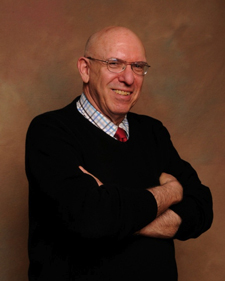
Gabriel Weisberg joined CAA in 1967
CAA warmly thanks the many contributions of the following dedicated members who joined the organization in 1967 or earlier.
1967: R. Ward Bissell, D. Sherman Clarke, Christie Fengler-Stephany, Dorothy Gillerman, Eric Hirshler, Renata Holod, Claire Kelleher, Alison Kettering, Dale Kinney, Marjorie Kinsey, Franklin K. B. Toker, Deborah Waite, Gabriel Weisberg, and David Wilkins.
1966: Madeline Caviness, Gilbert Edelson, Jonathan Fineberg, Ann Sutherland Harris, Sara Henry, Cecelia Klein, Henry Klein, Anne-Marie Logan, Peter Moak, Anne Morganstern, James Morganstern, Peter Schabacker, David Sokol, Marcia Werner, and Barbara White.
1965: Jean Borgatti, Norma Broude, Wanda Corn, Elaine Gazda, Diana Gisolfi, Dorothy Glass, Andree Hayum, Ellen Kosmer, Lillian MacBrayne, Jerry Meyer, Ann Lee Morgan, Myra Rosenfeld-Little, Ted Stebbins, Eugenia Summer, MaryJo Viola, Michele Vishny, and Wallace Weston.
1964: Richard Betts, Ruth Bowman, Vivian Cameron, Kathleen Cohen, Paula Gerson, Ronald Johnson, Jim Jordan, William Kloss, Rose-Carol Long, Phyllis Anina Moriarty, Annie Shaver-Crandell, and Alan Wallach.
1963: Lilian Armstrong, Richard Brilliant, Vivian Ebersman, Francoise Forster-Hahn, Caroline Houser, Susan Koslow, E. Solomon, Lauren Soth, Richard Spear, Virginia Stotz, Roxanna Sway, Athena Tacha, and Roger Welchans.
1962: Jo Anne Bernstein, Jacquelyn Clinton, Shirley Crosman, Frances Fergusson, Gloria Fiero, Jaroslav Folda, Harlan Holladay, Seymour Howard, David Merrill, John Paoletti, Aimee Brown Price, Thomas Sloan, Elisabeth Stevens, Anne Betty Weinshenker, and William Wixom.
1961: Matthew Baigell, Margaret Diane David, Bowdoin Davis, David Farmer, J. Forbes, Isabelle Hyman, Clifton Olds, Marion Roberts, and Conrad Ross.
1960: Shirley Blum, Kathleen Brandt, Eugene Kleinbauer, Edward Navone, Linda Nochlin, and J. Pollitt.
1959: Geraldine Fowle, Carol Krinsky, James O’Gorman, and Ann Warren.
1958: Samuel Edgerton, Carla Lord, Damie Stillman, and Clare Vincent.
1957: Marcel Franciscono, Bruce Glaser, Jane Hutchison, and Susan McKillop.
1956: Svetlana Alpers, David Driskell, John Goelet, Joel Isaacson, and Jack Spector.
1955: Lola Gellman, Irving Lavin, and Suzanne Lewis.
1954: Franklin Hazlehurst, Thomas McCormick, Jules Prown, Irving Sandler, and Lucy Freeman Sandler.
1953: Dorathea Beard, Margaret McCormick, and Jack Wasserman.
1951: Wen C. Fong.
1950: Alan Fern.
1949: Dario Covi and Ann-Sofi Lindsten.
1947: Ellen Conant and Ilene Forsyth.
News from the Art and Academic Worlds
posted May 17, 2017
Each week CAA News summarizes eight articles, published around the web, that CAA members may find interesting and useful in their professional and creative lives.
Damien Hirst Show Sparks Accusations of Cultural Appropriation
Damien Hirst launched his first major show of new works in ten years earlier this month in Venice, shortly ahead of the opening of the Venice Biennale. But along with massive crowds, Treasures from the Wreck of the Unbelievable is attracting charges of cultural appropriation, with one of Hirst’s sculptures replicating a Nigerian work from the fourteenth century without proper historical context. (Read more from Artsy.)
Cultural Appropriation and the Privilege of Creative Assumption
When the Canadian writer W. P. Kinsella died last year at age 81, many laudatory obituaries politely noted that he had been the subject of controversy involving cultural appropriation in the 1980s. Critics, both white and Indigenous, had objected vociferously to Kinsella’s “Indian” stories, in which the writer used a first-person narrator to tell funny tales of reserve life that included bumbling white bureaucrats and native tricksters. (Read more from the Globe and Mail.)
Words Fly on Free-Speech Bill
Numerous states are considering legislation designed to ensure free speech on college campuses, following violent protests over speakers at the University of California, Berkeley, and Middlebury College. Some of the bills would, controversially, mandate punishing students who disrupt campus speakers and require institutions to keep mum on political issues—and perhaps nowhere has the debate been as contentious as in Wisconsin. (Read more from Inside Higher Ed.)
Student Rights and the Role of Faculty
Despite the few reasonable similarities between students and customers, it’s still a hair-raising comparison for most faculty. I wonder if we might look at the issue more constructively by considering it from the vantage of student rights. (Read more from Faculty Focus.)
For Robert Rauschenberg, No Artist Is an Island
We tend to think of artists as natural loners, off in their studios, wrestling with their inner selves. But Robert Rauschenberg: Among Friends, which opens soon at the Museum of Modern Art, points us in a different direction. It situates Rauschenberg’s work amid that of two dozen fellow artists who provided an audience for one another in New York City during the 1950s and 1960s. (Read more from the New York Times.)
The Arts Brand
“Branding” is a somewhat confusing topic. Briefly, our “brand” is the public’s awareness and perception of our organizations and the goods and services we offer. It is the sum of their perceptions and experiences and is created by all the various parts of our organizations. (Read more from Barry’s Blog.)
Demystifying the Journal Article
One of the most important parts of professionalization is publishing your research. Much of what I’ve learned about publishing comes from submitting papers to journals, incorporating reviewer comments, workshopping papers, and having conversations with colleagues and mentors. (Read more from Inside Higher Ed.)
Artists’ Commissions, Tech Gift, and Guns: The Legal Issues Facing US Museums
What’s keeping museum lawyers up at night? The new future. That was the message at the annual meeting of over two hundred museum professionals and lawyers in Dallas. They discussed how to stay out of trouble when commissioning installation and performance art, how to prepare for changes to US tax law, and how best to collaborate with technology companies. (Read more from the Art Newspaper.)
Should Lynda.com be the next CAA benefit?
posted May 16, 2017
Lynda.com is an elearning platform offering nearly six thousand online courses—including design, photography, and web development—that are taught by experts in the field. Courses consist of videos and tutorials.
An annual membership to Lynda.com is $360 and we are hoping to offer it for far less—like more than $200 less. As members, would you take advantage of the deal?
Let us know by answering yes or no below:
CAA Announces the Opening of 2018 Terra Foundation and 2017 Wyeth Foundation Publications Grants
posted May 15, 2017
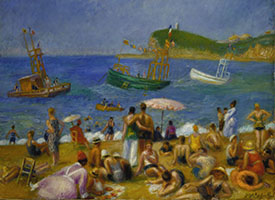
Image credit: William Glackens, “Beach, St. Jean de Luz.” 1929, oil on canvas, Terra Foundation for American Art, Daniel J. Terra Collection, 1988.8
CAA welcomes applications and letters of intent for the 2018 Terra Foundation for American Art International Publication Grant and the 2017 Wyeth Foundation for American Art Publication Grant.
The Terra Foundation grant provides financial support for the publication of book-length scholarly manuscripts in the history of American art circa 1500–1980. The grant considers submissions covering what is the current-day geographic United States.
The deadline for letters of intent is September 15, 2017.
Awards of up to $15,000 will be made in three distinct categories:
- Grants to US publishers for manuscripts considering American art in an international context
- Grants to non-US publishers for manuscripts on topics in American art
- Grants for the translation of books on topics in American art to or from English.
The Wyeth Foundation for American Art Publication Grant supports the publication of books on American art through the Wyeth Foundation for American Art Publication Grant, administered by CAA.
The deadline for submissions is September 15, 2017.
For this grant program, “American art” is defined as art created in the United States, Canada, and Mexico. Eligible for the grant are book-length scholarly manuscripts in the history of American art, visual studies, and related subjects that have been accepted by a publisher on their merits but cannot be published in the most desirable form without a subsidy. The deadline for the receipt of applications is September 15 of each year.
We’ve partnered with MOO!
posted May 12, 2017
 Here at CAA, we are constantly thinking of how we can enhance our members’ career and professional development needs. We know for many of you, it’s a large part of why you’ve decided to join the CAA community. That is why we have added MOO as a member benefit partner. MOO is an award-winning print and design company specializing in premium business stationery and promotional materials. We think our members will find lots to be happy about using MOO.
Starting today, every CAA member can receive 20% off MOO products.
We liked that MOO is passionate about helping people of all abilities design the best looking and highest quality print products.
Simply log in to your CAA account for instructions and the sign-up link. What are you waiting for? Get a MOO-ve on taking advantage of this great benefit!
Not a CAA member? Join today.
New in caa.reviews
posted May 12, 2017
John Hawley reviews Rembrandt’s First Masterpiece at the Morgan Library and Museum. The show provided “a rare opportunity to engage with Rembrandt’s painted Judas Returning the Thirty Pieces of Silver (1629) and the three surviving preparatory drawings associated with it.” Despite some “flaws in conception and execution,” the exhibition offered a “once-in-a-lifetime opportunity for visitors.” Read the full review at caa.reviews.
Laura Roulet visits Puerto Rican Light (Cueva Vientos) (2015), a site-specific installation created by Allora & Calzadilla and commissioned by the Dia Art Foundation. Set in a remote cave in Puerto Rico, the project “is a post-colonial inversion and commentary on the complicated state of U.S.-Puerto Rican relations” and “a way of putting Puerto Rico on the map for serious international art travelers.” Read the full review at caa.reviews.
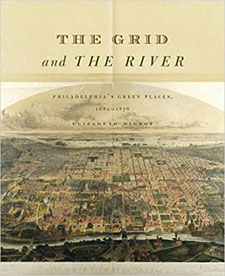 Eric Kramer reads The Grid and the River: Philadelphia’s Green Places, 1682–1876 by Elizabeth Milroy. An “authoritative and compelling portrait of how a city’s actual landscape fabric has been fashioned through a process of negotiating and representing a dominant idea about landscape’s place in American culture,” the volume builds “a more nuanced and positive image of how cities and landscapes coexist.”
Through a generous grant from the Wyeth Foundation for American Art in 2014, CAA provided financial support for the publication of Elizabeth Murray’s The Grid and the River: Philadelphia’s Green Places, 1682–1876. Read the full review at caa.reviews.
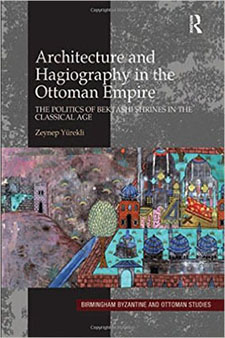 Maxime Durocher dicusses Zeynep Yürekli’s Architecture and Hagiography in the Ottoman Empire: The Politics of Bektashi Shrines in the Classical Age. “Combining a study of hagiographical texts with an advanced analysis of the sixteenth-century architectural transformation of two Anatolian shrines,” the author “provides an insightful study” that “contributes to the revival of Sufi studies.” Read the full review at caa.reviews.
An Interview with Holly Hughes of the NEA Four
posted May 11, 2017
Hunter O’Hanian, CAA executive director, recently spoke to the artist Holly Hughes about proposed budget cuts for the National Endowment for the Arts. Hughes is known for being one of the NEA Four—artists whose work was described by Republican lawmakers as controversial and even pornographic. The debacle over the NEA Four led to the closing of the federal agency’s program of giving grants to individual artists.
O’Hanian and Hughes discuss ten points that originated with the Heritage Foundation, a conservative think tank that advised Trump on his recent federal budget proposal. The two take on each suggestion point by point, offering a rebuttal to the Heritage Foundation’s logic.
Though we know the most recent budget does fund the NEA and NEH through the fall of 2017 with a small increase in funding—and we are thrilled about that—we do not believe we are in the clear. When funding is allocated again in the fall this conversation should serve as a reminder to why the arts and humanities are so important to our world.
News from the Art and Academic Worlds
posted May 10, 2017
Each week CAA News summarizes eight articles, published around the web, that CAA members may find interesting and useful in their professional and creative lives.
In Higher Ed, Adjuncts May Have Most to Lose if Obamacare Is Repealed
Perhaps no group working on college campuses had more at stake in last week’s vote in the US House of Representatives to repeal the Affordable Care Act than contingent faculty members. Full-time faculty and staff members can typically count on their institutions to provide health insurance, but most part-time professors are on their own. (Read more from the Chronicle of Higher Education.)
Defying Trump, Bipartisan Deal Would Boost Funding for NEA and NEH (with Strings Attached)
Far from slashing or even zeroing the budgets for the NEA and NEH, a bipartisan budget agreement to avoid a government shutdown—which, at this writing, awaits final passage and President Trump’s signature—includes moderate increases culture-related institutions and programs. (Read more from CultureGrrl.)
The NEA Really Isn’t “Welfare for Rich, Liberal Élites”
Killing the NEA has long been a cause célèbre for budget hawks and social conservatives. But contrary to claims from Trump and Fox News, and to the insecurities of artists, the NEA is not a federal spigot for decadent city élites. Rather, its grant-making effectively spans the country and helps rural, not–New York, not-wealthy, Trump-friendly districts. (Read more from the New Yorker.)
Beyond Aesthetic: Art That Wills Change
Last weekend, seven artists from around the world gathered in the Logan Center for the Arts to address a weighty question: “What Is an Artistic Practice of Human Rights?” Through a multiday summit that explored issues such as US criminal policies, the refugee crisis, and the hypocrisy of governments, the artists not only formed a community among themselves, but constructed a discourse with the audience. (Read more from the Chicago Maroon.)
Help Desk: The Penis Award
I am a midcareer (female) artist married to an established (male) artist. Throughout our relationship, I have endured innumerable comments and actions that validate my husband and cast me into the shadows. The sexism of the art world astounds me, but I’m not sure what I can do. (Read more from Daily Serving.)
Ten Art Schools That Promise a Healthy Return on Investment
A career in the arts is not generally thought of as a pathway to a great salary, job security and financial fortune. But where you go to school to get your degree can have an impact. With that in mind, Forbes examined a recent report from PayScale.com, a salary, benefits, and compensation information company based in Seattle. (Read more from Forbes.)
A Fair-Use Primer for Graduate Students
When I try to imagine what a Campbell’s Soup can looks like, I am not sure if what I see is the actual object or one of Andy Warhol’s famous works. These iconic cans, regardless of their importance to modern art and American history, are a tangle of popular culture, artistic expression, and copyright litigation, all of which knot around the concept of fair use. (Read more from Inside Higher Ed.)
Arts Groups on Edge as New York City Reevaluates Cultural Funding
The elite, marble-arched museums of Manhattan never had to worry about competing for city money with the small-fry arts groups of Brooklyn, Queens, Staten Island, and the Bronx. But this two-tiered system of haves and have-nots is poised to undergo its biggest transformation in decades. (Read more from the New York Times.)
CAA Goes to France
posted May 08, 2017
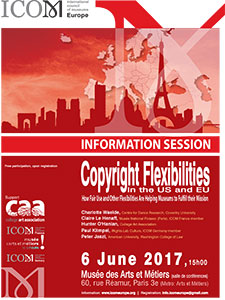 The College Art Association has been invited to speak about its Code of Best Practices in Fair Use for the Visual Arts at two conferences taking place in France in early June. On June 4 in Fontainebleau, executive director Hunter O’Hanian will participate in a session on “Fair Use and Open Content” at the seventh annual Festival of Art History, along with speakers from the Paul Mellon Center for Studies in British Art (UK), the J. Paul Getty Trust, and the French Institut National d’Histoire de l’Art.
Two days later, on June 6, Hunter will join Peter Jaszi, lead principal investigator on the Code of Best Practices in Fair Use for the Visual Arts, in Paris to speak at a session on fair use during the annual conference of ICOM Europe. They will be joined by speakers from England, France, and Germany, to discuss “Copyright Flexibilities in the US and EU: How Fair Use and Other Flexibilities are Helping Museums to Fulfill their Mission.”
Both conferences provide opportunities for CAA to share its work on fair use with EU visual arts professionals. Though this feature of copyright law is virtually unique to the United States, there is increasing interest in Europe to provide greater access to copyrighted materials, especially in the cultural sectors of these countries. Travel costs for CAA’s participation are underwritten by a generous grant from the Samuel H. Kress Foundation.