CAA News Today
Advocacy Matters
posted May 05, 2017
 Back in January, CAA was one of the first national organizations to speak against the threatened cuts to the NEA and NEH by the new administration. We participated in the national advocacy days for both the NEA and NEH and CAA staff made more than 20 visits to Congressional offices. In addition, we put together an Advocacy Toolkit to help CAA members reach out to their elected representatives to make their voices heard.
We were pleased to learn that the both the NEA and NEH (along with many other important Federal agencies) will continue to be funded in the current fiscal year. In fact, they even received a slight increase. Importantly, we saw strong bipartisan support for these programs in Congress as they understood the importance of art and culture in the lives of so many people in this country.
However, we don’t believe that these programs are out of the woods yet. Later this summer the president will offer a more detailed budget for the next fiscal year which will begin this fall. We are concerned that the president’s proposal will try to make the same cuts we saw in the budget he prepared last March. We ask you to stay alert to the news and to continue to reach out to your elected representatives to let them know how important these agencies are to our well being.
In advance, many thanks for all of your support.
Best,
Hunter O’Hanian
Executive Director
New in caa.reviews
posted May 05, 2017
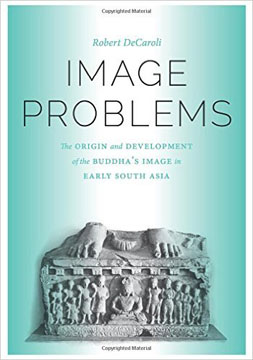 Frederick M. Asher reads Image Problems: The Origin and Development of the Buddha’s Image in Early South Asia by Robert DeCaroli. The author “provides some remarkable insights into the conception and production of images, both Buddhist and Brahmanical, in enormously impressive ways.” The volume is an “important work, one that should shape our thinking and teaching about early South Asian images.” Read the full review at caa.reviews.
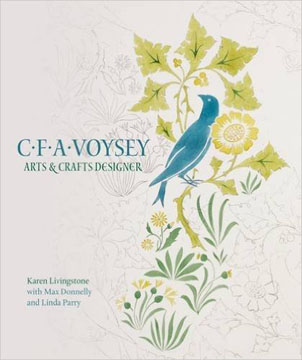 Marie Frank reviews The Art and Architecture of C. F. A. Voysey: English Pioneer Modernist Architect and Designer by David Cole and C. F. A. Voysey: Arts and Crafts Designer by Karen Livingstone. “Both books are handsomely produced” and “draw extensively on archival and museum collections,” making “significant contributions” to the study of Voysey, whose “resistance to easy classification may in part help explain the remarkable staying power of his work.” Read the full review at caa.reviews.
CAA Seeks Jury Members for the Terra Foundation Publication Grant
posted May 04, 2017
 The College Art Association (CAA) seeks nominations and self-nominations for one US scholar and two scholars based outside the United States to serve on the jury of CAA’s Terra Foundation for American Art International Publication Grant through June 30, 2020. Candidates must be actively publishing scholars with expertise in any branch of American art history, visual studies, or a related field with demonstrated seniority and achievement; institutional affiliation is not required.
The Terra Foundation for American Art awarded CAA a major, three-year grant to administer an annual program to support book-length scholarly manuscripts in the history of American art, defined as art of the geographic United States from 1500 to 1980. The Terra Foundation for American Art International Publication Grant will award funds of up to $15,000 to US and non-US publishers for books that examine American art in an international context, increase awareness of American art internationally through publication outside the United States, allow wider audiences to access important texts through translation, and/or result from international collaboration. For more information, visit http://www.collegeart.org/programs/publishing-grants/terra-foundation.
Members of the Terra Foundation International Publication Jury review letters of intent for eligibility and meet once each year to select awardees. The first meeting of the jury will take place at CAA’s Annual Conference in Los Angeles, February 21–24, 2018. The 2019 meeting will also take place at the Annual Conference, while the 2020 meetings will take place via teleconference. Two months prior to the meeting, CAA staff will provide all application materials and reader’s reports to jurors for review prior to the jury meeting. Jurors for this grant would serve as volunteers and would not be entitled to receive compensation for service; however, travel and hotel expenses for the 2018 and 2019 jury meetings will be paid by the College Art Association.
US candidates must be CAA members in good standing and should not currently serve on another CAA editorial board or committee. Jury members may not themselves apply for a grant in this program during their three-year term of service. Nominators should ascertain their nominee’s willingness to serve before submitting a name; self-nominations are also welcome. Please send a letter describing your interest in and qualifications for appointment, a curriculum vitae, and contact information to: Terra Foundation for American Art International Publication Grant, College Art Association, 50 Broadway, 21st Floor, New York, NY 10004; or send all materials as email attachments to Sarah Zabrodski, szabrodski@collegeart.org. Deadline: June 20, 2017.
About CAA
The College Art Association is dedicated to providing professional services and resources for artists, art historians, and students in the visual arts. CAA serves as an advocate and a resource for individuals and institutions nationally and internationally by offering forums to discuss the latest developments in the visual arts and art history through its Annual Conference, publications, exhibitions, website, and other programs, services, and events. CAA focuses on a wide range of advocacy issues, including education in the arts, freedom of expression, intellectual-property rights, cultural heritage and preservation, workforce topics in universities and museums, and access to networked information technologies. Representing its members’ professional needs since 1911, CAA is committed to the highest professional and ethical standards of scholarship, creativity, criticism, and teaching. Learn more about CAA at www.collegeart.org.
About the Terra Foundation
The Terra Foundation for American Art is dedicated to fostering exploration, understanding, and enjoyment of the visual arts of the United States for national and international audiences. Recognizing the importance of experiencing original works of art, the foundation provides opportunities for interaction and study, beginning with the presentation and growth of its own art collection in Chicago. To further cross-cultural dialogue on American art, the foundation supports and collaborates on innovative exhibitions, research, and educational programs. Implicit in such activities is the belief that art has the potential both to distinguish cultures and to unite them.
Join the Wyeth Publication Grant Jury
posted May 04, 2017
 CAA seeks nominations and self-nominations for three individuals with expertise in any branch of American art history, visual studies, or a related field to serve on the jury for the Wyeth Foundation for American Art Publication Grant for a three-year term, July 1, 2017–June 30, 2020. Candidates must be actively publishing scholars with demonstrated seniority and achievement; institutional affiliation is not required.
Since 2005, the Wyeth Foundation for American Art has supported the publication of books on American art through the Wyeth Foundation for American Art Publication Grant, administered by CAA.
For this grant program, “American art” is defined as art created in the United States, Canada, and Mexico. Eligible for the grant are book-length scholarly manuscripts in the history of American art, visual studies, and related subjects that have been accepted by a publisher on their merits but cannot be published in the most desirable form without a subsidy. The deadline for the receipt of applications is September 15 of each year.
The Wyeth jury awards funds that subsidize the publication of book-length scholarly manuscripts in the history of American art and related subjects. Members review manuscripts and grant applications once a year and meet in New York in the fall to select awardees. CAA reimburses jury members for travel and lodging expenses in accordance with its travel policy.
Candidates must be current CAA members and should not currently serve on another CAA editorial board or committee. Jury members may not themselves apply for a grant in this program during their term of service. Nominators should ascertain their nominee’s willingness to serve before submitting a name; self-nominations are also welcome. Please send a letter of interest describing your interest in and qualifications for appointment, a CV, and contact information to: Wyeth Foundation for American Art Publication Grant, College Art Association, 50 Broadway, 21st Floor, New York, NY 10004; or send all materials as email attachments to Sarah Zabrodski, szabrodski@collegeart.org. Deadline: June 20, 2017.
CAA 2018: Los Angeles Travelogue
posted May 03, 2017
Director of Programs Tiffany Dugan and I just returned from a week in Los Angeles to make plans for CAA’s Annual Conference in 2018.
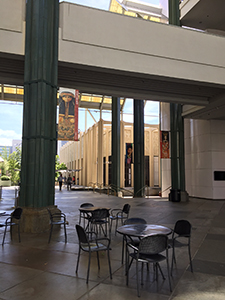
Los Angeles County Museum of Art
Scheduled for February 21-24 at the LA Convention Center, the 106th CAA Annual Conference promises to be one of the strongest ever. When the online session submissions portal closed last week, we had more than 800 submissions – one of the largest numbers in recent years. The Annual Conference Committee is reviewing the submissions this month and will be making final selections.
Based on past conference attendance, we anticipate more than 4,000 conference attendees in Los Angeles. We expect to schedule more than 250 sessions and over 200 events, including meetings, receptions, and tours. To house everyone, we secured three principal hotels, all within walking distance of the Convention Center, guaranteeing 6,000 guest nights.
We visited with the staffs and toured the Westin Bonaventure, Millennium Biltmore LA, and JW Marriott. Hotel rooms for the conference will range from $139 to $269 a night, depending on which hotel you select and the type of room you want. The John Portman designed Westin Bonaventure will be our host hotel and has the cool elegance reflecting the beginning of LA’s downtown revival in the mid-1970s. The Biltmore, which opened in 1923, reflects the opulence and beaux-arts style from LA’s golden age as the film industry was in its burgeoning stage. The new, swank JW Marriot is closest to the Convention Center and at the door of all the urban excitement of L.A. Live. All three hotels are within walking distance of the Convention Center. And the Westin even has a good cup of coffee below $2 in the lobby!
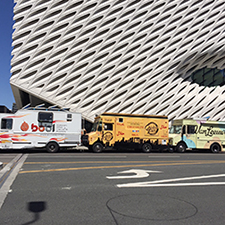
Food trucks in front of the Broad
Near the hotels, we found lots of great restaurants – everything from a hearty breakfast at the Original Pantry Café (which is open 24 hours) to the Blue Cow Kitchen & Bar, Bunker Hill Bar & Grill, Bottega Louie, Eat.Drink.Americano, and Water Grill. Food trucks are on virtually every corner (you have to try the sushi burrito). And there are plenty of artisanal coffee shops as well. In the coming months we will be working on setting up discounts at local restaurants and businesses for our attendees. Our hosts at the LA Convention Center gave us a great tour and we were able to see where the registration area, book and trade fair, and sessions rooms will be. We were able to secure more creature comforts like additional seating between sessions for impromptu conversations, charging stations for phone and laptops, and a quiet room to decompress from the hustle and bustle of the conference.
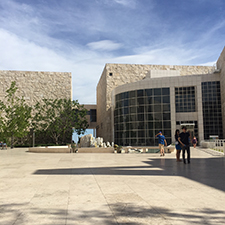
Getty Center
The Getty Museum, LACMA, and MOCA all opened their doors to us and we had great meetings. Each institution is looking forward to CAA 2018 and is making plans to ensure that your visit is meaningful. We met with leaders at UCLA and USC. In upcoming trips, we will be meeting with leaders at the Norton Simon Museum, The Huntington Library, Hammer Museum, Fisher Museum, and The Broad, as well as Otis College of Art and Design, Pasadena City College, Santa Monica College, and many others.
We also toured other cultural organizations including REDCAT, The Brewery Artist Lofts, Japanese American Museum, Chinese American Museum, 18th Street Arts Center, A+D Architecture and Design Museum, Craft and Folk Art Museum and many others. They are looking forward to welcoming CAA members to visit during the conference. We are planning on a day of programing for local LA area artists at the Annual Conference similar to what we did in NYC this year.
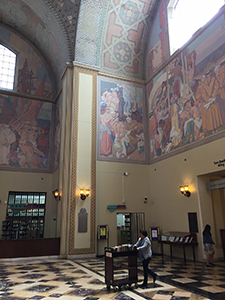
Los Angeles Public Library
Colleges and universities interested in holding reunions and receptions at the Annual Conference will also be able to find great spaces for their events. While there are some beautiful rooms available at the CAA hotels, we saw great spaces at the Hilton Checkers (check out the roof top terrace), the LA Public Library (check out the rotunda and courtyards), the gallery district in Chinatown (check out the Charlie James Gallery and A.G. Geiger Fine Art Books), and Hauser & Wirth. There are plenty of galleries in Hollywood and the Arts District, which will be available as well. We will keep adding to this list to create alternative reception options. Since the weather will be mild, there will be plenty of opportunities to sneak away from the Conference Center and check out what LA has to offer.
If you have not been to LA in a while, you will be happy to discover that getting around is easier than ever. While your CAA membership can get you a discount on an Avis rental car, ride sharing programs such as Uber and Lyft are popular and often cost less than $5 per trip between key cultural locations. LA has also been making great progress on its public transportation system as Metro stations are popping up everywhere.
Many thanks to Annual Conference Chair Judith Rodenbeck and CAA Regional Reps John Tain and Neha Choksi, who, along with Anu Vikram and Niku Kashef, made lots of great recommendations. If you have any more ideas of places you would like to see, just let Tiffany or me know.
Finally, we’ve pulled together all the details for the Getty sponsored Pacific Standard Time and will be offering that information in the months to come. You may want to arrive earlier to make sure that you take in as much as you can. President’s Day weekend is just before the Annual Conference. Be sure to watch CAA News for more updates about the conference as we solidify our planning.
Hunter O’Hanian
Executive Director
News from the Art and Academic Worlds
posted May 03, 2017
Each week CAA News summarizes eight articles, published around the web, that CAA members may find interesting and useful in their professional and creative lives.
Top Twenty Most Vibrant Arts Communities in America
Southern Methodist University’s National Center for Arts Research has announced its third annual Arts Vibrancy Index, which ranks more than nine hundred communities across the country, examining the level of supply, demand, and government support for the arts in each city. (Read more from the National Center for Arts Research.)
What Other States Can Learn from Rhode Island’s Arts Incentives
While Rhode Island may be the smallest state in the country, it has become a powerhouse for attracting artists and art lovers to its shores. And the method by which state leaders have leveraged Rhode Island’s tax code to benefit the creative community could serve as a model for other states looking to cultivate a stronger arts economy. (Read more from Charleston City Paper.)
US Students Are Struggling in the Arts. Donald Trump’s Budget Would Make the Problem Worse
American teenagers are not excelling in the arts, and President Trump’s proposed budget cuts will likely make matters worse, experts say. The most recent results of a wide-ranging national educational assessment known as the Nation’s Report Card left significant room for improvement in the visual arts and music, the National Center for Education Statistics reported last week. (Read more from the Huffington Post.)
Want Happier Professors? Try Being Nice
When it comes to keeping tenured professors content in their jobs, you can catch more flies with honey than you can with big faculty-focused strategic initiatives. A new study has found that their organizational commitment hinged far more on whether they believed they worked in a caring, supportive environment than on their sense that administrators had undertaken broad efforts to support the faculty. (Read more from the Chronicle of Higher Education.)
Frieze New York Gets Reframed for the Post-Truth Era
Reflecting director Victoria Siddall’s aim that Frieze, true to its editorial roots, should be “a place where art is made, discussed, and debated,” there will be protest in the air when the fair unfurls its serpentine white tent for its sixth edition in New York. Some galleries are using Frieze as a platform to respond to current events. (Read more from the Art Newspaper.)
Wait—What Was That? History’s Bygone Art Movements
“Fame,” according to art critic Henry McBride, “is a most uncertain garment.” The same is true of art movements and labels. Some—Abstract Expressionism, for instance—are familiar to the average museumgoer. However, others that were at one time in the vanguard have slipped into the shadows and are now the province of art historians and other specialists. (Read more from ARTnews.)
Was Robert Rauschenberg the Con Man of Art?
There’s a volubility about Rauschenberg’s visual imagination that is irreconcilable with the discipline art demands. However monumental or panoramic a work of art may be, there must always be some acknowledgment of the limits of the artist’s vision. There was something of the outrageousness of a Ponzi scheme in the way Rauschenberg took this or that avant-garde idea and inflated it—over and over again. (Read more from the New York Review of Books.)
How Big Is the Online Art Market?
Despite a relative slowdown in the global art market, the online art market grew by 15 percent, to $3.75 billion, last year, according to Robert Read, head of art and private clients for Hiscox. The online art market’s share of the total art market also grew last year, from 7.4 percent in 2015 to 8.4 percent. While that may seem small, it is roughly equivalent to ecommerce sales’ share of the total retail market, which reached 8.3 percent last year, according to the US census. (Read more from Artnet News.)
CWA Picks for May 2017
posted May 01, 2017
Each month, CAA’s Committee on Women in the Arts selects the best in feminist art and scholarship. The following exhibitions and events should not be missed.
Louise Lawler: A Movie Will Be Shown Without a Picture
Museum of Modern Art
11 W 53 Street, New York, NY
May 2 and 10, 2017
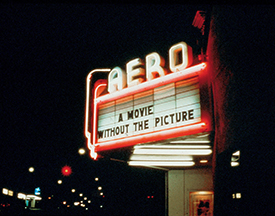
Marquee for A Movie Will Be Shown Without the Picture, Aero Theatre, Santa Monica, California, December 7, 1979 (photograph by Louise Lawler)
An appropriately deadpan announcement, now in the collection of the Metropolitan Museum of Art, for Louise Lawler’s cinematic event A Movie Will Be Shown Without A Picture (1979), reproduced the work’s title on a flat black card. Indeed, this is what viewers to the Aeron Theater in Santa Monica would have encountered on the night of Lawler’s event: a film shown without its flickering image. We might understand Lawler’s gesture as a riposte to Laura Mulvey’s influential text “Visual Pleasure and Narrative Cinema,” published five years before in the British film journal Screen. The filmic performance deprives audiences of the picture of the chosen film (the film changes with each iteration), instead asking them to rely on sound and soundtrack. Thus viewers are left to imagine and project their own fantasies (if they haven’t seen the film) or cobble together their memories of the film (if they have). As an arm of the programming for Louise Lawler’s retrospective at the Museum of Modern Art in New York, A Movie Will Be Shown Without a Picture will be screened two times.
Black Women Artists for Black Lives Matter
Project Row Houses
2521 Holman St., Houston, TX
March 25–June 4, 2017
Usually the curatorial and programming staff at Project Row Houses determine a theme and invite a series of artists to make installations and public programming inside the block of row houses in Houston’s Third Ward. This time Public Art Director Ryan Dennis and artist Simone Leigh cocurated the round to be exclusively for Black Women Artists for Black Lives Matter, a collective group that Leigh founded during her residency at the New Museum last year, and which now has chapters in London, Los Angeles, and Chicago. Performances, installations, platforms for dialogue and activation—these are the things that tie Project Row Houses and Black Women Artists for Black Lives Matter together. What began with an incubation period to get Houston’s chapter of BWA for BLM started, and was inaugurated with a processional performance, is now a full-tilt community platform for building generative ideas and actions for entering into the movement. As if to sum up the sentiments of the current round, one of the row houses is emblazoned with a supergraphic of the following sentiment: “YOU’VE GOTTA LOVE US OR LEAVE US ALONE.”
Katharina Fritsch: Multiples
Walker Art Museum
725 Vineland Place, Minneapolis, Minnesota
May 11–October 15, 2017
Katharina Fritsch’s sculpture, which seeks to defamiliarize the familiar and query the boundaries between the natural and the symbolic, will be on view at the Walker Art Museum for the next several months. Animals, religious figurines, body parts, and other objects drawn from the history and fairy tales of her native Germany take one new meanings when color, scale, and materials of everyday objects are altered. The show will include some forty objects, ranging from her early work as a student to her more recent pieces, drawn from the museum’s permanent collection. Katharina Fritsch: Multiples is a companion exhibition to the installation of her monumental, ultramarine blue Hahn/Cock in the Minneapolis Sculpture Garden in June. Described by the artist as “a feminist sculpture,” this work was first displayed on the fourth plinth in Trafalgar Square in the summer of 2013.
Musée Camille Claudel
Musée Camille Claudel
10, rue Gustave Flaubert, 10 400 Nogent-sur-Seine, France
Opened March 26, 2017
At long last, the beloved nineteenth-century French sculptor and feminist art icon Camille Claudel is receiving her due with a museum devoted to her work. Located in the small town of Nogent-sur-Seine, the Musée Camille Claudel is built around the family home where she spent her early adolescence. After a temporary exhibition of her work in 2003 brought over forty thousand visitors to Nogent-sur-Seine (pop. 6,000), it was determined that a museum dedicated to its most famous resident was in order. The Musée Camille Claudel now houses the world’s largest collection of the sculptor’s work. Visitors, who will be gratified to see such well-known pieces as The Waltz and The Gossips, will also be able to discover similarly remarkable works such as Abandon and Fortune. It takes under an hour by train to reach Nogent-sur-Seine from Paris.
Power: Work by African American Women from the Nineteenth Century to Now
Sprüth Magers
5900 Wilshire Blvd, Los Angeles, CA
March 29–June 10, 2017
The exhibition Power at Sprüth Magers features thirty-seven African American women artists from the nineteenth century until now. Works span fine-art and folk-art traditions covering multiple mediums, including painting, photography, video, sculpture, and installation. The title of the exhibition takes its name from a 1970 gospel song by Sister Gertrude Morgan, a self-taught, musician, poet, artist, and preacher. The works, engaging in issues of race, gender, and class, trace the threads of the craft-based folk traditions to a newer, academically trained generation of artists, depicting the “struggle to establish themselves as equal players on the uneven field of the American republic.”
In a review of the show published in the Los Angeles Times on April 11, 2017, the author Leah Ollman writes, “Artists here treat the physical body and the emblematic body of the nation as contested sites. Historical trauma persists within both, and both serve as ready—if not always willing—vehicles for self-determination.”
Artists in the exhibition, which was curated by Todd Levin, include: Beverly Buchanan, Elizabeth Catlett, Sonya Clark, Renee Cox, Njideka Akunyili Crosby, Karon Davis, Minnie Evans, Nona Faustine, LaToya Ruby Frazier, Ellen Gallagher, Leslie Hewitt, Clementine Hunter, Steffani Jemison, Jennie C. Jones, Simone Leigh, Julie Mehretu, Sister Gertrude Morgan, Senga Nengudi, Lorraine O’Grady, Sondra Perry, Howardena Pindell, Faith Ringgold, Betye Saar, Joyce J. Scott, Emmer Sewell, Ntozake Shange, Xaviera Simmons, Lorna Simpson, Shinique Smith, Renee Stout, Mickalene Thomas, Alma Woodsey Thomas, Rosie Lee Tompkins, Kara Walker, Meta Vaux Warrick Fuller, Carrie Mae Weems, and Brenna Youngblood.
Power will also include an installation of over one hundred African American vernacular photographs from the early twentieth century on loan from the Ralph DeLuca Collection. They offer a diverse view into everyday lives of African American women, from images of positive change to difficult scenes of negative stereotyping and violence. Offered as an exhibition-within-an-exhibition, these images from a century ago encourage reflection upon the continued struggles of black lives in America today.
We Wanted a Revolution: Black Radical Women, 1965–85
Brooklyn Museum
Elizabeth A. Sackler Center for Feminist Art and Stephanie and Tim Ingrassia Gallery of Contemporary Art, Fourth Floor, 200 Eastern Parkway, Brooklyn, New York
April 21–September 17, 2017
The exhibition We Wanted a Revolution: Black Radical Women, 1965–85 explores the intersections of avant-garde art worlds, radical political movements, and profound social change through photography, sculpture, printmaking, photography, performance, film, and video. Examining the political, social, cultural, and aesthetic priorities of women of color during the emergence of second-wave feminism, this exhibition is the first “to highlight the voices and experiences of women of color—distinct from the primarily white, middle-class mainstream feminist movement—in order to reorient conversations around race, feminism, political action, art production, and art history in this significant historical period.”
The artists represented in the exhibition include: Emma Amos, Camille Billops, Kay Brown, Vivian E. Browne, Linda Goode Bryant, Beverly Buchanan, Carole Byard, Elizabeth Catlett, Barbara Chase-Riboud, Ayoka Chenzira, Christine Choy and Susan Robeson, Blondell Cummings, Julie Dash, Pat Davis, Jeff Donaldson, Maren Hassinger, Janet Henry, Virginia Jaramillo, Jae Jarrell, Wadsworth Jarrell, Lisa Jones, Loïs Mailou Jones, Barbara Jones-Hogu, Carolyn Lawrence, Samella Lewis, Dindga McCannon, Barbara McCullough, Ana Mendieta, Senga Nengudi, Lorraine O’Grady, Howardena Pindell, Faith Ringgold, Alva Rogers, Alison Saar, Betye Saar, Coreen Simpson, Lorna Simpson, Ming Smith, and Carrie Mae Weems.
A host of events accompanied the exhibition. In addition to the DJ reception on April 20, which paid tribute to the revolutionary music of black women, the week-long opening celebration also included a symposium on April 21, a Julie Dash film marathon on April 22, and a Black Lunch Table on April 23.
We Wanted a Revolution, organized by Catherine Morris, Sackler Family Senior Curator for the Elizabeth A. Sackler Center for Feminist Art, and Rujeko Hockley, former assistant curator of contemporary art at the Brooklyn Museum, is part of A Year of Yes: Reimagining Feminism at the Brooklyn Museum, a yearlong series of exhibitions celebrating the tenth anniversary of the Elizabeth A. Sackler Center for Feminist Art.
CAA Members among the 2017–18 Rome Prize Winners
posted Apr 28, 2017
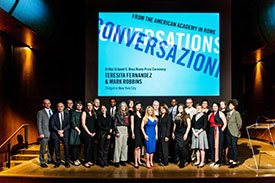 The American Academy in Rome has announced the recipients of its 2017–18 fellowships. The following CAA members are among the newest group of talented artists, scholars, writers, and composers chosen by the academy.
- Charles K. Williams II Rome Prize: Lisa Deleonardis, Austen-Stokes Professor, Department of the History of Art, Johns Hopkins University, “A Transatlantic Response to Worlds That Shake: Jesuit Contributions to Anti-Seismic Building Design in Early Modern Italy and Peru”
- Millicent Mercer Johnsen Post-Doctoral Rome Prize: Bissera V. Pentcheva, Professor, Department of Art History, Stanford University, “Animation in Medieval Art”
- Phyllis W. G. Gordan/Lily Auchincloss/Samuel H. Kress Foundation Pre-Doctoral Rome Prize: Joseph Williams, PhD Candidate, Department of Art, Art History, and Visual Studies, Duke University, “The Practice and Production of Architecture during the Mediterranean Commercial Revolution: The Church of S. Corrado in Moletta (ca. 1185–1303)”
- Andrew W. Mellon Foundation/National Endowment for the Humanities Post-Doctoral Rome Prize: Leslie Cozzi, Curatorial Associate, Hammer Museum, “Fra: Relation and Collaboration in Contemporary Italian Art”
- American Academy in Rome—Rome Prize: Cécile Fromont, Assistant Professor, Department of Art History, University of Chicago, “Images on a Mission: Cross-Cultural Encounters and Visual Mediation in Early Modern Kongo and Angola”
For over a century, the American Academy in Rome has awarded the Rome Prize to support innovative and cross-disciplinary work in the arts and humanities. Rome Prize fellowships include a stipend, room and board, and an individual work space at the institute’s eleven-acre campus in Rome.
New in caa.reviews
posted Apr 28, 2017
Alise Tifentale reviews Anri Sala: Answer Me, an exhibition and catalogue organized by the New Museum. As the Albanian artist’s “first comprehensive survey exhibition in the United States,” the show primarily features video and sound works and “introduces Sala’s artistic strategies that often are aimed at multisensory confusion and a questioning of temporal and spatial coherence.” Read the full review at caa.reviews.
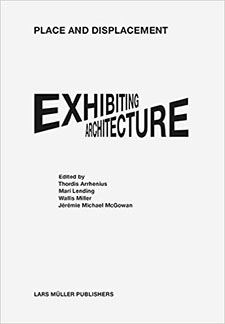 Nikolas Drosos reads Place and Displacement: Exhibiting Architecture, an edited collection of fifteen essays. Focusing on “the institutional structures that underpin architectural practice, theoretical discourse and its dissemination, as well as architecture’s relationship to its publics and to mass media,” the volume “reflects a greater tendency in scholarship to focus less on individual buildings.” Read the full review at caa.reviews.
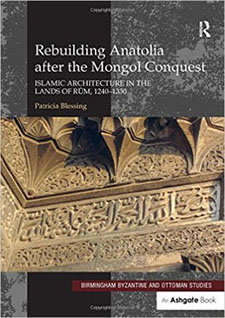 Christiana Maranci discusses Rebuilding Anatolia after the Mongol Conquest: Islamic Architecture in the Lands of Rūm by Patricia Blessing. The author “emphasizes the local circumstances in which the monuments were produced” and “argues that the lack of centralized control in Anatolia led … to a diverse and dynamic tradition best understood on its own terms.” Read the full review at caa.reviews.
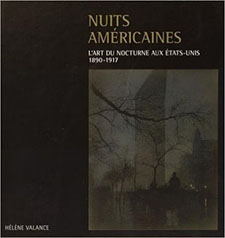 William Sharpe examines Hélène Valance’s Nuits américaines: L’art du nocturne aux États-Unis, 1890–1917. This “much-needed history” shows “how image makers reacted to the ways in which the American night was lit, exploited, and commercialized from the turn of the twentieth-century until the U.S. entry into World War I,” often in relation to “aesthetic, racial, imperial, and economic interests.” Read the full review at caa.reviews.
Communing with Dore Ashton
posted Apr 28, 2017
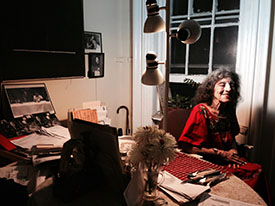
Dore Ashton at the kitchen table in her home on East Eleventh Street, New York, New York, 2011 (photograph © Madeline Djerejian)
“Communing with Dore Ashton” by Michael Corris has just been published at the open-access Art Journal Open. Corris, an artist and author based in Dallas, writes that Ashton, who died on January 30, was “one of the most energetic, widely published, and politicized American writers on art, and one of the chief proponents of the artists of the New York School (she decried the label Abstract Expressionism).” In addition to Corris’s personal memories of Ashton and their friendship, the project includes the audio and transcribed text of their 2011 conversation about Ashton’s experiences in New York art world during the 1950s and 1960s. Also included is a 2015 film by the artist Alfredo Jaar, Dore Ashton, you know, which features Ashton speaking candidly about her life, writing career, politics, and relationships with artists and writers, among them Harold Rosenberg, Philip Guston, and Louise Bourgeois. Recent photographs by Madeline Djerejian and Polly Bradford-Corris portray Ashton in her working and living spaces in New York City and Springs, Long Island.