
CAA News Today
Art Journal Editorial Board Seeks New Member
posted Jan 24, 2017
CAA invites nominations and self-nominations for one individual to serve on the Art Journal Editorial Board for a four-year term: July 1, 2017–June 30, 2021. Candidates may be artists, art historians, art critics, art educators, curators, or other art professionals; institutional affiliation is not required. Art Journal, published quarterly by CAA, is devoted to twentieth- and twenty-first-century art and visual culture.
The editorial board advises the Art Journal editor-in-chief and assists her or him in seeking authors, articles, artists’ projects, and other content for the journal; performs peer review and recommends peer reviewers; guides its editorial program and may propose new initiatives for it; and may support fundraising efforts on the journal’s behalf. Members also assist the editor-in-chief to keep abreast of trends and issues in the field by attending and reporting on sessions at the CAA Annual Conference and other academic conferences, symposia, and other events in their fields.
The Art Journal Editorial Board meets three times a year, with meetings in the spring and fall plus one at the CAA Annual Conference in February. The spring and fall meetings are currently held by teleconference, but at a later date CAA may reimburse members for travel and lodging expenses for New York meetings in accordance with its travel policy. Members pay travel and lodging expenses to attend the conference in February. Members of all editorial boards volunteer their services to CAA without compensation.
Candidates must be current CAA members in good standing and should not be serving on the editorial board of a competitive journal or on another CAA editorial board or committee. Members may not publish their own work in the journal during the term of service. CAA encourages applications from colleagues who will contribute to the diversity of perspectives on the Art Journal Editorial Board and who will engage actively with conversations about the discipline’s engagements with differences of culture, religion, nationality, race, gender, sexuality, and access. Nominators should ascertain their nominee’s willingness to serve before submitting a name; self-nominations are also welcome. Please send a letter describing your interest in and qualifications for appointment, a CV, and your contact information to: Chair, Art Journal Editorial Board, College Art Association, 50 Broadway, 21st Floor, New York, NY 10004; or email the documents or inquiries to Joe Hannan, CAA editorial director. Deadline: April 17, 2017.
Art Journal Seeks Editor-in-Chief
posted Jan 24, 2017
The Art Journal Editorial Board invites nominations and self-nominations for the position of editor-in-chief for the term July 1, 2018–June 30, 2021 (with service on the Art Journal Editorial Board in 2017–18 as editor designate, and in 2021–22 as past editor). Art Journal, published quarterly by CAA, is devoted to twentieth- and twenty-first-century art and visual culture.
Working with the editorial board, the editor-in-chief is responsible for the content and character of the journal. He or she solicits content, reads all submitted manuscripts, sends submissions to peer reviewers, and provides guidance to authors concerning the form and content of submissions; develops projects; makes final decisions regarding content; and may support fundraising efforts on the journal’s behalf. A candidate may be an artist, art historian, art critic, art educator, curator, or other art professional. The editor-in-chief works closely with CAA’s New York staff.
The editor-in-chief attends the three meetings each year of the Art Journal Editorial Board— held in the spring and fall by teleconference or in New York, and in February at the CAA Annual Conference—and submits an annual report to CAA’s Board of Directors. CAA may reimburse the editor for travel and lodging expenses for spring and fall New York meetings in accordance with its travel policy, but the editor pays his or her own expenses for the Annual Conference.
The position usually requires one-half of an editor’s working time. CAA provides financial compensation for course release, usually to an editor’s employer.
Candidates must be current CAA members in good standing and should not be serving on the editorial board of a competitive journal or on another CAA editorial board or committee. CAA encourages applications from colleagues who will contribute to the diversity of perspectives on the Art Journal Editorial Board and who will engage actively with conversations about the discipline’s engagements with differences of culture, religion, nationality, race, gender, sexuality, and access. Nominators should ascertain their nominee’s willingness to serve before submitting a name; self-nominations are also welcome. A CV, a letter of interest from the nominee, and at least one letter of recommendation must accompany each nomination. Please mail to: Art Journal Editor-in-Chief Search, College Art Association, 50 Broadway, 21st Floor, New York, NY 10004; or email the documents or inquiries to Joe Hannan, CAA editorial director. Deadline: April 3, 2017. Finalists will be interviewed on the afternoon of May 4, in New York.
CAA Statement on Government Spending Cuts for Arts and Humanities
posted Jan 23, 2017
For more than a century, the College Art Association (CAA) has represented art historians, artists, museum professionals, designers, and others who think and care about the visual arts and its impact on our culture. We do this in part through direct advocacy for artistic and academic freedom.
Like many other Americans, we have closely watched the proposed changes to the federal government. Recent news reports reveal that the US President intends to propose the elimination of funding for the National Endowment for the Arts (NEA) and the National Endowment for the Humanities (NEH). This proposal is reportedly based in part on a recommendation by the Heritage Foundation that states, “As the U.S. Congress struggles to balance the federal budget and end the decades-long spiral of deficit spending, few programs seem more worthy of outright elimination than the National Endowment for the Arts.”
We offer our complete and total opposition to these efforts.
Since the 1960s, the NEA and NEH have supported artists, writers, museum professionals, and a wide array of scholars of various disciplines in creating new work and scholarship. The NEA supports thousands of cultural and educational organizations, and, in a few cases, individual artists. The NEH, which strengthens teaching and learning in schools and colleges—as well as the work of independent scholars—creates access to educational scholarship and research nationwide. In addition, the NEH is a strong supporter of museum exhibitions throughout the country. Combined, the budgets for the two agencies are less than $300 million. The organizational grantees generate hundreds of millions of dollars in matching support and countless new works of art and scholarship. These works and related projects are studied and enjoyed by millions of Americans in museums and other venues. The cultural sector of the US economy generates more the $135 billion in revenue and employs over three million people in small towns and large cities countrywide.
Given that the respective budgets of the NEA and NEH represent only a tiny fraction of the entire federal budget, their planned elimination cannot logically be seen as a cost-saving measure. Rather, it appears to be a deliberate, ominous effort to silence artistic and academic voices, representing a potentially chilling next step in an apparent effort to stifle and eradicate oppositional voices and cultural output from civic life. By eliminating the support for these agencies, the government undermines the unifying potential of the arts, culture, and education that encourages and nurtures communication and positive discussion.
CAA leadership is monitoring the possible elimination and/or reduction of funding for the NEA and NEH and how it may affect our members and the work they do. CAA will communicate and collaborate with other cultural and educational organizations and learned societies to determine potential future advocacy options.
We urge our fellow CAA members to contact their representatives in Congress to let them know the importance of maintaining a robust, national, publicly supported framework for artistic and academic freedom. When you contact your representative, we ask that you let them know you are a member of CAA and together we are advocating for continued public funding for the arts. We also encourage you to contact the National Humanities Alliance and Americans for the Arts to become further involved.
Through our collective strength, we can ensure that public funding of scholarship and art making continues, free from political and commercial interference.
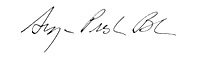 Suzanne Preston Blier President |
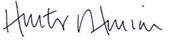 Hunter O’Hanian Executive Director Chief Executive Officer |
2016 Recipients of CAA’s Professional Development Fellowships
posted Jan 23, 2017
CAA has awarded two 2016 Professional-Development Fellowships—one in visual art and one in art history—to graduate students in MFA and PhD programs across the United States. In addition, CAA has named one honorable mention in art history and two in visual art. The fellows and honorable mentions also receive a complimentary one-year CAA membership and free registration for the 2017 Annual Conference in New York.
Accepting the $10,000 fellowship in visual art is Daniel Seth Krauss, an MFA student in photography in the Tyler School of Art at Temple University in Philadelphia, Pennsylvania. The recipient of the $10,000 fellowship in art history is Sara Blaylock, a doctoral candidate in visual studies at the University of California, Santa Cruz.
The honorable mention for art history goes to Lex Lancaster, a PhD student at the University of Wisconsin, Madison. The two honorable mentions in visual art are Allison Rose Craver, an MFA candidate at Ohio State University in Columbus, and Andrew Jilka, an MFA student at the School of Visual Arts in New York.
Suzanne Preston Blier, president of the CAA Board of Directors, will formally recognize the two fellows and three honorable mentions at the 105th Annual Conference during Convocation, taking place on Wednesday, February 15, 2017, at the New York Hilton Midtown.
CAA’s fellowship program supports promising artists and art historians who are enrolled in MFA and PhD programs nationwide. Awards are intended to help them with various aspects of their work, whether for job-search expenses or purchasing materials for the studio. CAA believes a grant of this kind, without contingencies, can best facilitate the transition between graduate studies and professional careers. The program is open to all eligible graduate students in the visual arts and art history. Applications for the 2017 fellowship cycle will open in the late spring.
FELLOW IN VISUAL ART
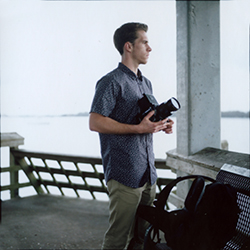 Daniel Seth Kraus
Daniel Seth Kraus‘s work blends historical research with photographic practice to deepen our understanding of people and places. Currently his research investigates faith and work in the American South. Kraus’s work has been featured in numerous print and online publications, including Fraction Magazine, SeeSaw Magazine, Oxford American, and Aint Bad Magazine. His photographs have been exhibited in national and international juried exhibitions, including one at the Morris Museum of Art in Augusta, Georgia. He earned a BFA in photography and a BA in history from the University of North Florida in Jacksonville and is pursuing a MFA in photography at the Tyler School of Art at Temple University in Philadelphia, Pennsylvania.
FELLOW IN ART HISTORY
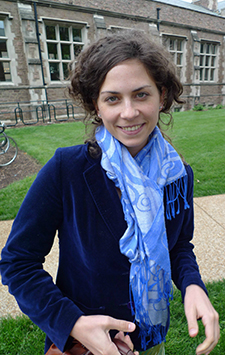 Sara Blaylock
Sara Blaylock will complete her PhD in visual studies at the University of California, Santa Cruz, in spring 2017. To date, the bulk of her research has concerned the experimental film, art, and visual culture of the German Democratic Republic during the 1980s. Her dissertation, “Magnitudes of Dissent: Art from the East German Margins,” focuses on how photography and film, body-based practices, print media, and galleries addressed issues of representation, performativity, and collectivity. It argues that experimental practice in a 1980s GDR was not only an antidote for but also an interpretation of a weakening state—a foil and a mirror to official culture.
Blaylock’s dissertation research has been supported by the German Academic Exchange Service and the Rosa Luxemburg Foundation, as well as by numerous grants from the University of California, Santa Cruz. She has published in numerous academic forums. Most recently, an article appeared in Gradhiva, a French-language journal of art history and anthropology, and Blaylock contributed an essay in both German and English to the catalogue for the exhibition Gegenstimmen. Kunst in der DDR 1976–1989 [Voices of Dissent: Art in the GDR 1976–1989], held at the Martin-Gropius-Bau in Berlin. Another article, “Bringing the War Home to the United States and East Germany: In the Year of the Pig and Pilots in Pajamas,” will appear in Cinema Journal later this year.
Blaylock was recently invited to codirect the International Association for Visual Culture, a scholarly organization that encourages inquiry and debate within the field and that advocates the critical and theoretical expansion of visual-culture studies in academic and artistic venues. She looks forward to helping to advance and strengthen the association’s vision.
HONORABLE MENTIONS IN VISUAL ART AND ART HISTORY
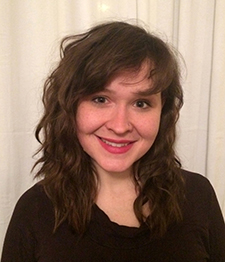 Allison Rose Craver
Allison Rose Craver will complete her MFA, with a concentration in ceramics, at Ohio State University in in Columbus in May 2017. Craver grew up in East Aurora, New York, and earned a BFA in 2010 from New York State College of Ceramics at Alfred University in Alfred. A year later she studied as a special student at the University of Wisconsin, Madison. Craver has shown her work nationally, including exhibitions at the Archie Bray Foundation for the Ceramic Arts in Helena, Montana, and the Arrowmont School of Arts and Crafts in Gatlinburg, Tennessee. In 2014 she was invited to demonstrate in the Process Room at the annual National Council on Education for the Ceramic Arts conference in Milwaukee. Craver’s work is process driven, using ceramics materials in conjunction with fiber and found objects to explore the nature of care and work.
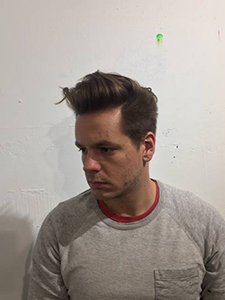 Andrew Jilka
Andrew Jilka was born in in 1986 to a working-class home in Salina, Kansas. The son of a bus driver and a lunch lady, Jilka has been employed as a fast-food worker, a cigarette warehouse stocker, a furniture deliveryman, a Hewlett-Packard call-center representative, a bartender, and later an assistant to the artist Tom Sachs. After selling his Camaro, he enrolled at the University of Kansas in Lawrence, where he received a BFA in printmaking in 2009, as well as a scholarship to study printmaking at Hongik University in Seoul, Korea. Jilka’s work is greatly influenced by the instabilities and anxieties of his Midwestern upbringing. His painting is an attempt to reconcile the “high” of the history and lineage of contemporary painting with the Walmart culture he was raised in. Jilka approaches painting with both the deference of Brahms and the irreverence of the Ramones—and perhaps a touch of Taylor Swift. His work has been shown in group and solo exhibitions in Kansas City, Atlanta, New York, and Seoul. He is currently an MFA candidate at the School of Visual Arts in New York.
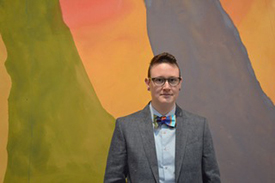 Lex Lancaster
Lex Morgan Lancaster is a PhD candidate in the Department of Art History at the University of Wisconsin, Madison, where they will complete their degree in May 2017. Lancaster’s dissertation, “Dragging Away: Queer Abstraction in Contemporary Art,” investigates abstraction as a tactic of queering in the work of contemporary artists who deploy nonrepresentational form for political ends. Their related article, “Feeling the Grid: Lorna Simpson’s Concrete Abstraction,” was published in ASAP/Journal (2017), and “The Wipe: Sadie Benning’s Queer Abstraction” is forthcoming in Discourse: Journal for Theoretical Studies in Media and Culture. Lancaster is chairing the session on “New Materialisms in Contemporary Art” at CAA’s 2017 Annual Conference in New York.
Lancaster received their BA in art history from Case Western Reserve University in Cleveland, Ohio. They have assisted with exhibitions and public programs at the Cleveland Museum of Art as coordinator of teen programs and intern to the curator of contemporary art, and at the National Gallery of Art in Washington, DC, as a paid summer intern in the Department of Photographs. At the University of Wisconsin, Madison, Lancaster curated the exhibition Our House! Unsettling the Domestic, Queering the Spaces of Home at the Chazen Museum of Art.
myCAA Post-it Wall
posted Jan 20, 2017
The myCAA Post-it Wall, located near registration on the Hilton’s second floor, is where attendees can post their notes, scribbles, messages, heartfelt missives, and anything else they feel like sharing on a myCAA Post-it. The myCAA Post-it pads will be easy to find and pick up around the conference. Get yours at CAA’s booth in the Book and Trade Fair, in the registration booth, or at the hospitality booth.
New in caa.reviews
posted Jan 20, 2017
Amanda Cachia visits Electronic Superhighway (2016–1966) at Whitechapel Gallery in London. The “ambitious exhibition” covers “fifty years of digital culture” and considers “how the world’s ceaseless flow of electronic information and unrelenting proliferation of images have come to impact contemporary art.” Read the full review at caa.reviews.
Lauran Whitworth reviews Art AIDS America, organized by the Tacoma Museum of Art and the Bronx Museum of the Arts. Aiming “to be the most comprehensive exploration of the impact of AIDS on the course of American art,” the “powerful” show is “haunted by loss and erasure but simultaneously teeming with verve and resistance.” Read the full review at caa.reviews.
Elizabeth M. Molacek discusses the Power and Pathos: Bronze Sculpture of the Hellenistic World exhibition, curated by Jens Daehner and Kenneth Lapatin of the Getty Villa. “A feast for the eyes,” the exhibition provided “an unprecedented opportunity” to see nearly fifty objects and “succeeded in demonstrating the significance of bronze and defining the trajectory of monumental sculpture in the Hellenistic period.” Read the full review at caa.reviews.
Anna Blume reads Images Take Flight: Feather Art in Mexico and Europe, 1400–1700, edited by Alessandra Russo, Gerhard Wolf, and Diana Fane. The “scholarly and magnificent book” features thirty-three essays “that reveal how feathers, birds, and images of flight became defining signifiers within art, thinking, and history during the geographical expansion of Europe into the Americas.” Read the full review at caa.reviews.
Hospitality Booth
posted Jan 19, 2017
At the New York conference you will find a hospitality booth, where CAA staff and conference help will be stationed to answer questions about sessions and the Book and Trade Fair, or for directions to the restrooms, the lactation room, or the quiet room. Located on the second floor of the Hilton near the registration area, the hospitality booth is intended to make CAA members feel welcome at the conference. The CAA team will also be filming interviews with members at the hospitality booth.
J20 Art Strike Closure
posted Jan 19, 2017
 CAA is taking part in the J20 Art Strike, an Act of Noncompliance on Inauguration Day. We apologize if this has caused you any inconvenience, but we consider this action important to take. This call concerns more than the art field. It is made in solidarity with the nation-wide demand that on January 20 and beyond, business should not proceed as usual.
For more information on the J20 Art Strike, including the long list of art critics, artists, curators, and institutions taking part please visit the J20 Art Strike website.
Online registration for the Annual Conference, February 15-18 in New York, will remain open.
We will be back in the office on January 23, 2017.
News from the Art and Academic Worlds
posted Jan 18, 2017
Each week CAA News summarizes eight articles, published around the web, that CAA members may find interesting and useful in their professional and creative lives.
Controversial Capitol Painting by Former St. Louis Student Taken Down
The painting by a former St. Louis high school student was removed over the Martin Luther King Jr. holiday weekend. Rep. Dave Reichert, who petitioned its removal, said it would be taken down by the Architect of the Capitol’s office, which ultimately determines the art that hangs on the walls of the congressional art competition. On Tuesday morning, not only was the painting gone, but the placard describing it was removed, too. (Read more from the St. Louis Post-Dispatch.)
What’s Missing in the Teaching of Islam
In high school history books, there is little mention of the intertwined histories of Europe, Asia, and Africa in the middle ages and the Renaissance. There is even less mention of the flowering of art, literature, and architecture during this time. (Read more from the Conversation.)
Keeping God Out of the Gallery
“My work has proven to be difficult to place in commercial art galleries,” said the painter Edward Knippers. Well, we’ve heard that before. Plenty of artists say the problem isn’t the quality of their work but the gallery owner’s narrow-mindedness or something to that effect. But Knippers, a figurative painter of biblical subjects, said the real problem is what he chooses to paint: religious figures. (Read more from the Observer.)
Learning from Decolonize This Place
“You can’t talk about indigenous struggle without indigenous people involved,” said the artist, activist, and MTL+ cofounder Amin Husain. He was explaining a core principle of Decolonize This Place, a three-month residency that brought together multiple movements at the New York nonprofit Artists Space for art making, organizing, and activism, all based around direct actions targeting five issues: Free Palestine, Indigenous Struggle, Black Liberation, Global Wage Workers, and de-gentrification. (Read more from Hyperallergic.)
Citizenship, the Body, and the Ethics of Exposure
We live in a society that relishes exposure—see nude photo leaks, the Kardashians, and diaries and private correspondence cloaked with the pretense of literary or political interest—and that does not value privacy equally for all. On top of the inequity, unmediated exposure does not exist. There is always an implicit or explicit narrative being constructed in the act of baring. (Read more from Art Practical.)
Art Museums by the Numbers 2016
First released in 2014, Art Museums by the Numbers is based on aggregated data drawn from AAMD’s member survey and tracks changes over time. Comparisons between 2014, 2015, and 2016 data show little fluctuation, indicating continued stability in the field of art museums. (Read more from the Association of Art Museum Directors.)
Why Art History Might Be the Most Important Subject You Could Study Today
We Americans tend to think of the British as infinitely more refined and cultivated than we are, but England almost eliminated art history as a field of study for high school students. But after much protest from the liberal intellectual establishment, art history was “saved” and will stay on British curricula. If the cultured British nearly did away with art history, then what hope have we Americans? (Read more from Salon.)
The Problem of Predatory Journals: Fake Academia Joins Fake News
We’ve heard all about fakes this year: fake scandals, fake food, fake news. Now fraud emerges from an unexpected corner: academia—or rather, its counterfeit. Fraudulent academic groups have been soliciting papers from researchers for conferences and journals, but do not adhere to publication standards like peer review; instead, they accept papers unquestioningly and charge authors enormous fees. (Read more from Nonprofit Quarterly.)
Committee on Women in the Arts Picks January 2017
posted Jan 16, 2017
Each month, CAA’s Committee on Women in the Arts selects the best in feminist art and scholarship. The following exhibitions and events should not be missed. Check the archive of CWA Picks at the bottom of the page, as several museum and gallery shows listed in previous months may still be on view or touring.
January 2017
The Future is Female
21c Museum Hotel
700 West Main Street, Louisville, Kentucky
November 2016–May 2017
The Future is Female at the Louisville, KY, 21c Museum Hotel, features feminist art from the 21c collection, including painting, video, photography, and installation. Works on view include pieces by Carrie Mae Weems, Jenny Holzer, Nandipha Mntambo, Kiki Smith, and Frances Goodman, among many others. “Gleaming acrylic fingernails glued into patterned, reptilian forms that emerge from the wall; barnacles and ceramic teeth encrusted in life-size human figures in decay; cement seeping through lace and paint; haunting words about the present overlaid on imagery of the past: surface tension abounds in this exploration of contemporary feminist art.”
Curated by Alice Gray Stites, chief curator and museum director, the exhibition fuses celebration and critique through engaging and evocative art. In Alison Saar’s work on view, Hades D.W.P., five glass jars are filled with water to varying levels. Each jar is “tagged with lines of poetry, their surfaces etched with figures that float between life and death.” While the work hints the water is meant for drinking, its toxic colors indicate otherwise, alluding to the drinking water disaster in Flint, Michigan.
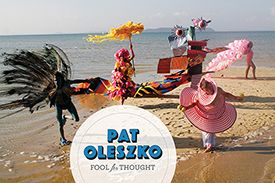
Pat Oleszko: Fool for Thought
Women’s Studies Research Center/Kniznick Gallery
Brandeis University, Epstein Building, 515 South Street, Waltham, MA
November 21, 2016–March 3, 2017
The visual and performance artist Pat Oleszko brings her signature style to the Kniznick Gallery, which presents an exhibition of her costumes, inflatables, videos, and props. “With elaborate handmade costumes and props, Oleszko utilizes the body as armature for ideas in an array of lampoons that call her audience to action.” Through humor and the absurd, Oleszko touches on issues from the personal to the political. Fool for Thought highlights her performances, including Hello Folly: The Floes & Cons of Arctic Drilling, Oldiloks and the Bewares, Stalking Walking Topiary, and the Pat and the Hats. Self-identified as the Fool in question and the questioning Fool, Oleszko fans the flames with rousing absurdity and maintains that she who laughs, lasts.
The exhibition also includes several events, including an artist’s lecture with Oleszko and a reception on January 25 and a lecture on February 2 with Barbara Bodenhorn. The lecture will focus on the combination of art and science as it seeks to engage young people in ecologically vulnerable regions.
A Woman’s Afterlife: Gender Transformation in Ancient Egypt
tBrooklyn Museum
200 Eastern Parkway, Brooklyn, New York
Starting December 15, 2016
Through new research and scholarship, the Egyptian artifacts in A Woman’s Afterlife explore the gender transformation of deceased women and the difference between male and female access to the afterlife. The exhibition is part of A Year of Yes: Reimagining Feminism at the Brooklyn Museum, a yearlong project celebrating a decade of feminist thinking at the institution.
“Egyptian medicine taught that a woman, once in her tomb, faced a biological barrier to rebirth. Because the ancient Egyptians believed that in human reproduction it was the man who created the fetus, transferring it to the woman during intercourse, rebirth was impossible for a woman alone.” It was the priest’s role to magically transform the woman’s mummy into a man, thus creating a fetus. This was accomplished through incanted spells with masculine pronouns, graphic representations of those spells on the coffin, and adding red skin—a color assigned to men. The centerpiece, a painted coffin and mask of Weretwahset, exemplifies these steps and depicts her fleeting transformation from female to male.
The exhibition was sparked by researched published by the scholars Kathlyn M. Cooney (University of California, Los Angeles), Heather McCarthy (New York University), Gay Robins (Emory University), and Ann Macy Roth (New York University). “This research has led to a better understanding of the logic behind this unexpected gender transformation by discovering that women were intentionally represented with red skin and with masculine pronouns. Previously, these representations were regarded as mere mistakes,” said Edward Bleiberg, curator of Egyptian art. “Feminism has changed the questions we ask of ancient history as well as the answers we offer. This is a striking example of how feminism has provided a basis for new scholarship that reinterprets an ancient puzzle.”
Catalina Schliebener: Growing Sideways
Bureau of General Services—Queer Division
208 West 13th Street, Room 210, New York
Open until January 22, 2017
The Bureau of General Services Queer Division presents Growing Sideways, an exhibition of new work by the Buenos Aires–based Chilean artist Catalina Schliebener (b. Santiago, 1980). Organized by the independent curator John Chaich, the exhibition takes its title—and somewhat its conceptual and formal inspiration—from the queer scholar Kathryn Stockton Bond’s notion that rather than the normative view of “growing up,” the nonstraight child grows sideways through life-long, lateral interactions between childhood motivations and adult identifications, formed by sly intentions, blurred chronologies, and animalistic attachments.
Growing Sideways presents over five dozen drawings on collage that frame the space and culminate in a floor-to-ceiling mural, growing across two- and three-dimensional surfaces and creating a disjointed narrative exploring gender formation and erotic curiosity through Schiebener’s combination of cuttings from found children’s books with abstract drawings and vinyl mural recalling organic sensual shapes in nature and the body. An artist-curated selection of books accompanies the site-specific installation.
A dialogue with the artist, Chaich, and Kris Grey will take place on January 12, 2017, at 7:00 PM.
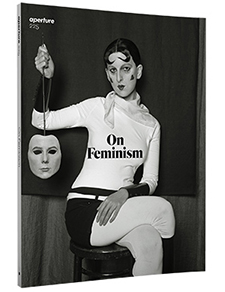
On Feminism
Aperture #225 (Winter 2016)
Aperture’s winter issue has focused “On Feminism.” In a moment that the very idea of gender is central to local and global conversations about equality, this approach arrives at a right moment to address the power and influence that women hold on the stage of the art world and beyond.
This issue focuses on intergenerational dialogues, debates, and strategies of feminism in photography, acknowledging the immense contributions by artists whose work articulates or interrogates representations of women in media and society. “On Feminism” features include a lively roundtable with curators from Paris and New York on modernist photographers between the wars, Nancy Princenthal on the feminist avant-garde of the 1970s, Eva Díaz on protest and visual politics, Laura Guy on lesbian erotica as critical rebellion, Eva Respini on abstraction, Julia Bryan-Wilson on visions of trans feminism, and a conversation with Renée Cox about black feminist icons, plus contributions from Martha Rosler and Maria Nicolacopoulou, among others, as well as portfolios by Farah Al Qasimi, Jennifer Blessing, Zackary Drucker, Catherine Morris, A. L. Steiner, Zanele Muholi, Yurie Nagashima, Elle Pérez, Laurie Simmons, Cosey Fanni Tutti, and Gillian Wearing.
The issue’s contents are organized in two main sections that underscores how photography has shaped feminism as much as how feminism has shaped photography. Use #OnFeminism to join the conversation on Twitter, Instagram, and Facebook.
Nairy Baghramian: Déformation Professionnelle
S.M.A.K.
Jan Hoetplein 1, 9000 Ghent, Belgium
November 26, 2016–February 19, 2017
S.M.A.K. presents Déformation Professionnelle, a solo exhibition by influential Iranian sculptor Nairy Baghramian. Born in 1971 in Isfahan, Iran, Baghramian is currently living and working in Berlin. She has become internationally known for her contextual approach to exhibition-making via sculpture and photography. Focusing in a site-responsive practice, her works explore the body and its supportive functions.
Déformation Professionnelle is a new production which builds on eighteen works in the artist’s oeuvre from 1999 to 2016. Baghramian alludes to existing work from discarded ideas to working material. In the artist’ words, she is “surveying the survey.” This body of work formulates fundamental questions about progress and economy, while interrogating what happens when something ceases to exist, and how something new comes into being.
The exhibition includes several large-scale works such as Class Reunion (2008), Retainer (2012), and French Curve (2014). Both inside and outside the museum,the display evidences the artist complex engagement with the transformation and consequent deformation of form, language, and meaning in its translation from one series into the other.
Nairy Baghramian | Déformation Professionnelle is organized by S.M.A.K. and the Walker Art Center in Minneapolis, where the exhibition will travel in October 2017.