
CAA News Today
Grants and Special Programs Manager
posted Aug 04, 2017
College Art Association
50 Broadway, Fl 21
New York, NY 10004
Date posted: August 3, 2017
Position Title: Grants and Special Programs Manager
Supervisor: Director of Programs and Publications
Full-time, salaried with benefits.
Founded in 1911, the College Art Association (CAA) is the preeminent international leadership organization in the visual arts, promoting the field through intellectual engagement, advocacy, programs and a commitment to the diversity of practices and practitioners. Each year, CAA offers an Annual Conference, publishes two scholarly journals and offers a variety of other programs. Visit CollegeArt.org for a complete description of programs and offerings.
CAA has more than 9,000 members worldwide. The majority of members are curators, art historians, scholars, visual artists and designers.
Responsibilities include:
- Develop and foster relationships with foundation representatives, jury members, and Affiliated Society liaisons.
- Working with the Development Manager and other CAA employees, generate and oversee proposals for identified programs and projects. Write proposals, budgets, reports, and other ancillary materials.
- Manage grants by: developing internal reporting systems, managing the grants calendar, writing reports, maintaining detailed historical records, working with staff to ensure each program or project is meeting proposal conditions and expectations. Monitor and manage grants income goal.
Program Support:
- Manages all administrative tasks related to Fair Use Initiative, Affiliated Societies, RAAMP, awards and other CAA programs.
- Provides support to the Committee on Intellectual Property, which promotes education and programming about Fair Use.
- Supports other CAA grant-based projects by providing outreach to targeted communities; supporting program development; and assisting with documents related to grant management.
Publication Grants Program Support:
- Responsible for one semiannual and two annual publication grants, serves as liaison to grant juries, originates grant proposals with other CAA employees, and writes report narratives.
- Coordinates grant applications, circulates applications to jury members, and attends jury meetings.
- Additional responsibilities include: processes requests for grant payment, checks incoming book proofs for adherence to grant guidelines, manages correspondence with applicants, and maintains records of grant activities.
Manages Awards for Distinction Program:
- Manages thirteen awards-jury activities, including jury appointments, conference calls to select awardees, and notification to awardees.
- In collaboration with Program Manager, coordinates the CAA conference awards ceremony including arrangements for awardees as needed, content creation for awards, and publication of award citations. Maintains database of awardees.
Manages Affiliated Societies Program:
- Reviews applications and cultivates programs and services for CAA’s Affiliated Societies.
- Ensures that all databases and webpages are up to date and accurate.
Required Qualifications:
- Minimum B.A., preferably in the visual arts, art history or related field.
- Minimum of three years experience with grant writing and management.
- Program development experience and previous experience with non-profit administration preferred.
- Experience with budget development and monitoring.
- Knowledge of contracts and agreements preferred.
- Ability to organize work, follow through on details, and meet deadlines. Must be able to communicate clearly and regularly about project goals.
- Excellent writing and editing skills and oral communication.
- Flexibility, creativity, and initiative.
- Ability to work independently and in collaboration with others. Some night and weekend work may be required, as well as some travel.
Interested individuals should submit a cover letter, resume and salary requirements to Tiffany Dugan, Director of Programs and Publications via email (with “Grants and Special Programs manager” and applicant’s last name in subject line) at tdugan@collegeart.org. No telephone inquiries will be accepted. Applications accepted until all positions are filled. Please include the names and contact information for three references who can speak to your ability to perform the tasks requested.
The College Art Association is an equal opportunity employer and considers all candidates for employment regardless of race, color, sex, age, national origin, creed, disability, marital status, sexual orientation, gender expression or political affiliation.
HOH/TD/August 3, 2017
IT Manager
posted Aug 04, 2017
College Art Association
50 Broadway, Fl 21
New York, NY 10004
Date posted: August 4, 2017
Position Title: IT Manager
Supervisor: COO
Full-time, salaried with benefits.
Founded in 1911, the College Art Association (CAA) is the preeminent international leadership organization in the visual arts, promoting the field through intellectual engagement, advocacy, programs and a commitment to the diversity of practices and practitioners. Each year, CAA offers an Annual Conference, publishes two scholarly journals and offers a variety of other programs. Visit CollegeArt.org for a complete description of programs and offerings.
CAA has more than 9,000 members worldwide. The majority of members are curators, art historians, scholars, visual artists and designers.
Responsibilities include:
- Network and Information Systems Management and Administration: Plan additions, deletions and major modifications to the supporting technology infrastructure; oversee maintenance, and upkeep of all hardware and software; oversee the implementation of network security; oversee communications systems; evaluate CAA’s use of currently-available technology, and work with the Executive Director to plan the purchase and installation of needed upgrades and/or additions as appropriate and within budget; oversee the planning and management of CAA’s information- and data-processing systems; manage relationships and contracts with outside IT consultants and vendors.
- Database Management: Lead and oversee the implementation and ongoing use of CAA databases to ensure that the databases support overall goals and objectives of the organization. The databases responsibilities include, but are not limited to: (1) the association management system (AMS), used for membership, event registration, committee management & fundraising (2) the conference content management system, used to facilitate the sessions at CAA’s annual conference, and (3) CAA’s accounting system. Develop MS SQL queries and reports for AMS as well maintaining Member portal using AMS’ proprietary CMS function.
- Project Manager: Work with staff members to supervise and/or implement specific technology projects as necessary. This includes, but is not limited to, Directories of Graduate Programs publications and CAA Commons. Fulfill grant required IT needs including RAAMP project.
- General Management and Communications: Work with all staff; participate in senior staff meetings to represent the IT interests of CAA and to hear technology-related requests or concerns from all parts of the organization; represent CAA professionally to outside vendors, members, and the Board of Directors. Work within and plan IT department annual budget.
- Annual Conference: Configure all conference related events in AMS. Configure Member portal to process conference event registrations. Provide on-site support for the IT needs of all functions at the Annual Conference, including one week travel when not held in NYC; supervise the set-up, operation, and “take-down” of hardware and software systems at Conference sites.
- Supervise Systems Administrator position.
Required Qualifications:
- Minimum B.A. in computer science or equivalent.
- Proven working experience as an IT manager or relevant experience and minimum of two years database administration/programming experience.
- Excellent knowledge of technical management, information analysis/quantitative skills and of computer hardware/software systems.
- Technical understanding of database structures and familiarity with database design.
- Proven work experience with MS SQL.
- Excellent customer services skills. Pleasant demeanor. Ability to remain poised under pressure.
- Ability to work collegially and effectively with all staff at all levels using non-technical, as well as technical, communication.
- Ability to organize work, follow through on details, and meet deadlines. Must be able to communicate clearly and regularly about project goals.
- Excellent writing and editing skills and oral communication.
- The ability and willingness to work on-site at annual conference as well as hours outside typical business day, as needed.
- Flexibility, creativity, and initiative.
- Ability to work independently and in collaboration with others.
Interested individuals should submit a cover letter, resume and salary requirements to Michael Goodman, Director of IT via email at MGoodman@collegeart.org. No telephone inquiries will be accepted. Applications accepted until position is filled. Please include the names and contact information for three references who can speak to your qualifications and ability to perform the tasks requested.
The College Art Association is an equal opportunity employer and considers all candidates for employment regardless of race, color, sex, age, national origin, creed, disability, marital status, sexual orientation, gender expression or political affiliation.
HOH/MG/TL August 3, 2017
Sponsorship and Partnership Manager
posted Aug 04, 2017
College Art Association
50 Broadway, Fl 21
New York, NY 10004
Date posted: August 2, 2017
Position Title: Sponsorship and Partnership Manager
Supervisors: Director of Communications, Marketing, and Membership
Full-time, salaried with benefits.
Founded in 1911, the College Art Association (CAA) is the preeminent international leadership organization in the visual arts, promoting the field through intellectual engagement, advocacy, programs and a commitment to the diversity of practices and practitioners. Each year, CAA offers an Annual Conference, publishes two scholarly journals and offers a variety of other programs. Visit CollegeArt.org for a complete description of programs and offerings.
CAA has more than 9,000 members worldwide. The majority of members are curators, art historians, scholars, visual artists and designers.
Responsibilities include:
- Seeking and securing new partnership and sponsorship relationships for CAA, while caring for and expanding the existing relationships with sponsors and partners. The role will create new sponsorship and partnership relationships for the CAA Annual Conference and year-round CAA programs.
- Cultivate new and oversee current institutional member relationships for CAA.
- Manage the CAA Career Center and Opportunity Center, two of the most popular resources CAA offers it members and constituents. This will entail maintaining a strong relationship with a third-party job placement vendor and addressing questions and concerns related to the jobs and opportunities pages of the website as needed.
- Manage incoming advertising for CAA. The role will serve as the main point person and work-flow manager of the ads placed on CAA properties coming from our third-party ad sales company.
- The person will also strategically oversee outgoing ad placement for CAA programs and initiatives.
- Additional responsibilities as needed.
Required Qualifications:
- Minimum of four years of college, preferably in the visual arts, art history or related fields.
- Track record building relationships with high-profile non-profit and for-profit partners across industries.
- Experience in sponsorship arrangements related to large-scale events and/or arts organizations.
- Understanding of membership organizations and/or non-profits, preferably in the arts.
- Strategic thinker who thrives in a mission-driven organization
- Pleasant demeanor.
- Flexibility, creativity, and initiative.
- Ability to work independently and in collaboration with others.
Interested individuals should submit a cover letter, resume and salary requirements to Nick Obourn via email at nobourn@collegeart.org with Sponsorship Manager and applicant’s last name in the subject line. Applications accepted until all positions are filled. Please include the names and contact information for three references who can speak to your ability to perform the tasks requested. No telephone inquiries will be accepted.
The College Art Association is an equal opportunity employer and considers all candidates for employment regardless of race, color, sex, age, national origin, creed, disability, marital status, sexual orientation, gender expression or political affiliation.
HOH/August 1, 2017
Manager of Annual Conference
posted Aug 04, 2017
College Art Association
50 Broadway, Fl 21
New York, NY 10004
Date posted: August 2, 2017
Position Title: Manager of Annual Conference
Supervisor: Director of Programs and Publications
Full-time, salaried with benefits.
Founded in 1911, the College Art Association (CAA) is the preeminent international leadership organization in the visual arts, promoting the field through intellectual engagement, advocacy, programs and a commitment to the diversity of practices and practitioners. Each year, CAA offers an Annual Conference, publishes two scholarly journals and offers a variety of other programs. Visit CollegeArt.org for a complete description of programs and offerings.
CAA has more than 9,000 members worldwide. The majority of members are curators, art historians, scholars, visual artists and designers.
Responsibilities include:
- Answers inquiries and provides information related to the CAA conference. Maintain all conference-related records.
- Manages and maintains all proposal submissions for the CAA conference through the proposal submission database. Manages related correspondence.
- Assists Director with meetings of the Annual Conference Committee and with the scheduling of Annual Conference program including conference sessions, meetings, workshops, events, etc.
- Manages all aspects of applications to poster sessions and ARTexchange.
- Develops and maintains a pool of volunteers and mentors to serve CAA’s professional development program needs. Selects and assigns mentors and mentees. Manages mentoring workshops at the CAA conference.
- Assists Student and Emerging Professionals Committee and Services to Artists Committee with program planning and scheduling of activities and events.
- Assists Director with the planning of and correspondence related to special panels.
- Manages conference registration, reimbursements, and/or payments for special guest scholars, artists, and workshop leaders.
- Coordinates the CAA conference Awards for Distinction ceremony including: making arrangements for awardees; assisting with Convocation production.
- Assists with the development and drafting of all conference publications. Coordinates with designer. Maintains session information on website.
- Provides Communications department with content for CAA conference communications and presentations.
- Creates CAA staff schedule for the conference.
- Manages complimentary hotel reservations, including staff rooms, and acts as point person with service provider.
- Coordinates all aspects of on-site temporary conference staff including hiring, scheduling, training, supervising, and following up on invoicing and payments.
- Facilitates conference sessions and activities on-site. Oversees all AV needs for sessions. Acts as primary contact with AV service provider during the conference.
- Administers various travel grant programs. Maintains records and coordinates applications for travel grant applicants and recipients. Manages reimbursements.
- Works collaboratively to ensure smooth planning, operation, and close out of the annual conference.
- Assists with other program management as assigned.
Required Qualifications:
- Minimum B.A., preferably in the visual arts, art history or related field.
- A minimum of three years experience planning large events and/or supporting academic conferences is required.
- Ability to work independently, organize work, and follow through on details.
- Experience with spreadsheets, systems and database management, and generally accepted programs and office equipment required.
- Excellent writing and editing skills and oral communication.
- Excellent customer services skills. Pleasant demeanor. Ability to remain poised under pressure.
- Flexibility, creativity, and initiative.
- Should possess tact, discretion, and the ability to work confidentially.
- Ability to work independently and in collaboration with others.
- The ability and willingness to work evening and weekend hours as needed. Some travel may be required.
Interested individuals should submit a cover letter, resume and salary requirements to Tiffany Dugan, Director of Programs and Publications via email (with “Manager AC” and applicant’s last name in subject line) at tdugan@collegeart.org. Applications accepted until all positions are filled. Please include the names and contact information for three references who can speak to your ability to perform the tasks requested. No telephone inquiries will be accepted.
The College Art Association is an equal opportunity employer and considers all candidates for employment regardless of race, color, sex, age, national origin, creed, disability, marital status, sexual orientation, gender expression or political affiliation.
HOH/TD/August 2, 2017
Media and Content Manager
posted Aug 04, 2017
College Art Association
50 Broadway, Fl 21
New York, NY 10004
Date posted: August 2, 2017
Position Title: Media and Content Manager
Supervisors: Director of Communications, Marketing, and Membership
Full-time, salaried with benefits.
Founded in 1911, the College Art Association (CAA) is the preeminent international leadership organization in the visual arts, promoting the field through intellectual engagement, advocacy, programs and a commitment to the diversity of practices and practitioners. Each year, CAA offers an Annual Conference, publishes two scholarly journals and offers a variety of other programs. Visit CollegeArt.org for a complete description of programs and offerings.
CAA has more than 9,000 members worldwide. The majority of members are curators, art historians, scholars, visual artists and designers.
Responsibilities include:
- Act as lead writer and editor for the communications, marketing, and membership department. He/she will be responsible for editing and creating content for CAA’s websites, newsletters, and member communications. The content and media manager is the protector of the CAA style guide and will convey a strong understanding of CAA voice.
- Strategize and collaborate on CAA’s social media growth and outreach. The content and media manager oversees content creation for social media platforms at CAA. The media manager should feel at home in the world of social media, both at CAA offices and outside the offices. A strong grasp on digital analytics is desirable with the ability to translate those analytical findings into actionable steps for social media growth.
- Serve as point person for a variety of incoming regular member communications and updates from CAA constituencies for editing and posting to website
- Handle press relations with the director of the department, acting as a writer of press releases and disseminator of news about CAA to the media. The media and content manager will also track press mentions and coverage of CAA.
- On occasion, the media and content manager may be asked to take on editing for other CAA departments.
- Additional responsibilities as needed.
Required Qualifications:
- Minimum of four years of college, preferably in the visual arts, art history or related fields.
- Strategic thinker and strong writer who thrives in a mission-driven organization
- Experience working with the press and media, including pitching stories and writing press releases
- Understanding of membership organizations and/or non-profits, preferably in the arts.
- A passion for social media practices and growth
- A strong grasp on digital analytics for social media
- Pleasant demeanor.
- Flexibility, creativity, and initiative.
- Ability to work independently and in collaboration with others.
Interested individuals should submit a cover letter, resume and salary requirements to Nick Obourn via email at nobourn@collegeart.org with Media and Content Manager and applicant’s last name in the subject line. Applications accepted until all positions are filled. Please include the names and contact information for three references who can speak to your ability to perform the tasks requested. No telephone inquiries will be accepted.
The College Art Association is an equal opportunity employer and considers all candidates for employment regardless of race, color, sex, age, national origin, creed, disability, marital status, sexual orientation, gender expression or political affiliation.
HOH/NO/August 2, 2017
Programs Assistant
posted Aug 04, 2017
Please note: This position has been filled. Thank you.
College Art Association
50 Broadway, Fl 21
New York, NY 10004
Date posted: August 3, 2017
Position Title: Programs Assistant
Supervisor: Manager of Programs
Reporting to: Assistant Director for Annual Conference and Director of Programs and Publications
(Part-time position, with approximately 25 hours per week, schedule may vary with flexible hours
Salary range: $20.00/hour. Limited benefits available.
Founded in 1911, the College Art Association (CAA) is the preeminent international leadership organization in the visual arts, promoting the field through intellectual engagement, advocacy, programs and a commitment to the diversity of practices and practitioners. Each year, CAA offers an Annual Conference, publishes two scholarly journals and offers a variety of other programs. Visit CollegeArt.org for a complete description of programs and offerings.
CAA has more than 9,000 members worldwide. The majority of members are curators, art historians, scholars, visual artists and designers.
Responsibilities include:
- Assists with data entry support, detailed record keeping, database document production, and producing reports.
- Assists with the coordination of the scheduling of the CAA conference sessions and events. This includes, but is not limited to, data entry, preparing spreadsheets, proof reading, and creating reports. Communicates with CAA departments on conference details as requested.
- Corresponds with conference participants, service providers, book and trade fair exhibitors, and general membership on conference-related matters.
- Provides internet research to source prospects for the CAA conference book and trade fair and college and university network hall.
- Prepare mailings sent to conference participants, exhibitors, advertisers, jurors, committee members, and volunteers. Document production and photo-copying.
- Assist with the development of all conference publications.
- Assists with the coordination of temporary conference staff including, scheduling, correspondence, and training.
- Provides on-site conference support, including but not limited to assisting with all aspects of conference logistics, checking set-up arrangements, posting signs, and providing hospitality as needed.
- Staffs Speaker Ready Room during the conference providing assistance to conference presenters and chairs as needed.
- Provides post-conference support including compiling and summarizing event statistics.
- Assists with financial recording keeping, including but not limited to, processing purchase orders and transactions, creating invoices, tracking expenses, and preparing ledgers and reconciliation reports.
- Provides research and creates reports.
- Assists with the Affiliated Society program.
- Performs various administrative and clerical duties for the Director of Programs and Publications.
Required Qualifications:
- Minimum B.A., preferably in the visual arts, art history or related field.
- Ability to work independently, organize work, and follow through on details.
- Experience with spreadsheets, systems and database management, and generally accepted programs and office equipment required.
- Excellent writing and editing skills and oral communication.
- Excellent customer services skills. Pleasant demeanor. Ability to remain poised under pressure.
- Flexibility, creativity, and initiative.
- Should possess tact, discretion, and the ability to work confidentially.
- The ability and willingness to work on-site at annual conference as well as hours outside typical business day, as needed.
Interested individuals should submit a cover letter and resume to Tiffany Dugan, Director of Programs and Publications via email (with “Programs Assistant”and applicant’s last name in subject line) at tdugan@collegeart.org. Applications accepted until all positions are filled. Please include the names and contact information for three references who can speak to your ability to perform the tasks requested. No telephone inquiries will be accepted.
The College Art Association is an equal opportunity employer and considers all candidates for employment regardless of race, color, sex, age, national origin, creed, disability, marital status, sexual orientation, gender expression or political affiliation.
HOH/TD/August 1, 2017
New in caa.reviews
posted Aug 04, 2017
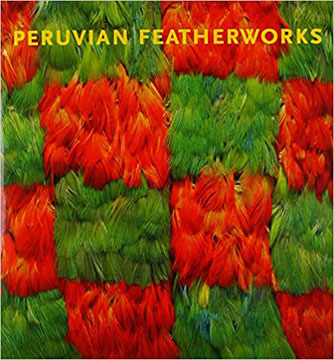 Amy Buono reads Peruvian Featherworks: Art of the Precolumbian Era, edited by Heidi King. The volume is “an important contribution to a profoundly complex yet largely overlooked artistic genre: Andean featherwork.” It “highlights both the difficulties of interpreting ancient Andean featherworking and its rich scholarly potential” and “is a superb resource for understanding how featherwork fits into the larger arena of Andean artistic practices.” Read the full review at caa.reviews.
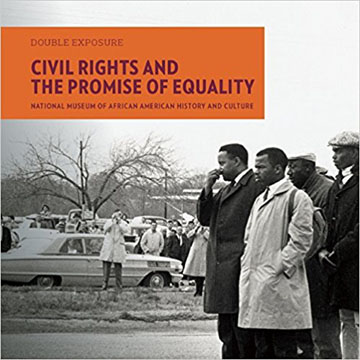 Rhonda L. Reymond reviews Civil Rights and the Promise of Equality and African American Women, both edited by Laura Coyle and Michèle Gates Moresi, which are part of a series published by the National Museum of African American History and Culture. “These volumes deserve a place on library bookshelves enriching the photographic section in general and adding to the significant number of books examining or reproducing images of African Americans.” Read the full review at caa.reviews.
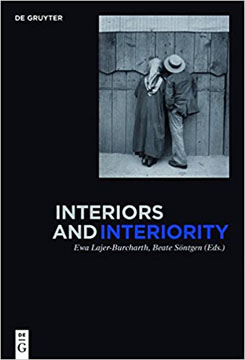 Anne Leonard discusses Interiors and Interiority, edited by Ewa Lajer-Burcharth and Beate Söntgen. Featuring “twenty-two essays, mostly by German and U.S. scholars,” the book argues that “the relationship between interiors and interiority is not limited to private spaces and individual psychology but engages just as ineluctably with complex dynamics of performativity, cultural mobility, technology, and material agency.” Read the full review at caa.reviews.
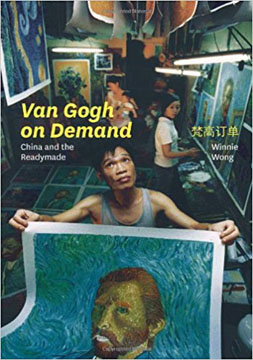 Jenny Lin examines Van Gogh on Demand: China and the Readymade by Winnie Won Yin Wong. The author “not only overturns accounts of Dafen as a factory full of exploited assembly-line painters, which she successfully reveals as strategically crafted fictions, but also unsettles contemporary art’s unspoken hierarchies and topples modernist and postmodernist assumptions about originality, authenticity, and authorship.” Read the full review at caa.reviews.
CAA Launches CAA Commons in Partnership with MLA
posted Aug 03, 2017
Dear CAA members,
For the past year we have watched conversations grow in discussion groups on CAA Connect, our online social community for members. We see how our members want to stay in touch and develop ideas around the visual arts and their work outside of our Annual Conference. Our CAA-Getty International Program Scholars, for example, have a discussion group with 280 posts and twenty library items. Our Resources for Academic Art Museum Professionals (RAAMP) group has over 100 resources posted.
Now it’s time to expand the network. CAA is joining forces with the Modern Language Association (MLA) to become part of their Humanities Commons platform, and CAA will also have its own CAA Commons network as part of the partnership. The two networks (Humanities Commons and CAA Commons) will serve different purposes for our members, but we believe each will be of value. Humanities Commons is an open-access network where one can create a professional profile, discuss common interests in groups, develop new publications, and share work. The Humanities Commons network is open to anyone. CAA Commons will be the CAA member portal on the same network, where CAA members only can start discussion groups, contribute to discussion groups, and post resources for professionals in the visual arts.
CAA is not alone in joining Humanities Commons. Other members include The Association for Slavic, East European, and Eurasian Studies (ASEEES), Association for Jewish Studies (AJS), and the Modern Language Association (MLA), of course. Going forward we expect many more associations and organizations to join the network, creating a dynamic, interdisciplinary forum that CAA members can explore and use to expand the reach of their professional work.
Features of CAA Commons and Humanities Commons
- Join discussion groups or create your own on CAA Commons or on Humanities Commons
- Browse the Core Repository or deposit your own work: A collection of papers, images, and materials with open-access
- Create your own WordPress Website
Logging in to CAA Commons and Humanities Commons
Which email should I use to create an account?
If you do not have a Humanities Commons or CAA Commons account, you must create one. The CAA Support page can guide you through creating an account. Please note when creating an account, you must use your primary CAA member email address. If you do not remember this email address please log in to your CAA account to check.
I already have a Humanities Commons account
If you already have a Humanities Commons account, then you will automatically be added to the CAA Commons platform and have full access.
Please note that you DO NOT use your CAA Member ID to log into Humanities Commons or CAA Commons.
For more information about creating an account and extensive FAQs about CAA Commons and Humanities Commons, please visit the CAA Support page.
By joining CAA Commons, you are accepting the Terms & Conditions of the platform.
If you have any questions, please contact us at caa@hcommons.org.
Sincerely,
Hunter O’Hanian
Executive Director
Chief Executive Officer

Kathleen FitzpatricK
Project Director,
Humanities Commons, Modern Language Association
News from the Art and Academic Worlds
posted Aug 02, 2017
Each week CAA News summarizes eight articles, published around the web, that CAA members may find interesting and useful in their professional and creative lives.
How Do Artists Get Gallery Representation?
While it’s possible to go it alone, it’s hard to understate the importance of a supportive, dedicated gallery to your career. The right gallerist doubles as a sounding board while you develop your work, a public platform for your practice, and a source of income. (Read more from Artsy.)
Seven Residencies That Can Help Emerging Artists
For young artists fresh from art school or an MFA program, studio space may be prohibitively expensive, and leaving the nurturing bubble of school is daunting. Residencies can fill that gap—if these up-and-coming artists know which ones to apply for. (Read more from Artnet News.)
The Distracted Classroom: Transparency, Autonomy, and Pedagogy
If we want to make a dent in the problem of digital distractions in class, we must begin by clarifying the policies we have created and the reasons behind them. Those reasons might look different from teacher to teacher. (Read more from the Chronicle of Higher Education.)
Another Year on the Academic Job Market
Perhaps the summer months can provide you some time for concentrated focus on your next—and hopefully last—round on the market. Here is one person’s perspective on what you might do between now and the next academic hiring season. (Read more from Inside Higher Ed.)
Your Syllabus Doesn’t Have to Look Like a Contract
Zac Wendler was tired of the same routine at the beginning of every semester. He would hand out his syllabus—five or so pages of text—and students would glance at it and wait for him to walk them through it. Then for the rest of the semester, they would ask him questions that could be easily answered if they had read the syllabus. (Read more from Vitae.)
Protesters Call on ICA Boston to Cancel Dana Schutz Show
An exhibition of Dana Schutz’s recent work opened at the Institute of Contemporary Art in Boston, and it won’t be without controversy. Protestors released an open letter expressing their disappointment that the museum is honoring an artist they believe should instead be held accountable for her portrait of Emmett Till, Open Casket. (Read more from Hyperallergic.)
Why We Shouldn’t Punish Small Museums for Deaccessioning
AAM and AAMD contend that their member institutions should only deaccession artworks in their holdings for the express purpose of either acquiring new works or, in the AAM’s case, caring for existing works. It’s an ideologically pure, dependably crowd-pleasing position to take. (Read more from Artnet News.)
Look Up, See a Masterpiece
You’re strolling around an art museum, and one painting catches your eye. Intrigued and mesmerized, you think to yourself, “Now that’s a masterpiece!” Many intangibles go into that judgment, but new research suggests it is partially inspired by one easily measured variable: the painting’s placement on the wall. (Read more from Pacific Standard.)
August 2017 Picks from CAA’s Committee on Women in the Arts
posted Aug 01, 2017
Hương Ngô: To Name It is to See It
Firelei Báez: Vessels of Genealogies
DePaul Art Museum
935 W Fullerton, Chicago, IL
April 27–August 6, 2017
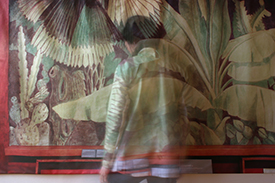
Hương Ngô, study for the video Hidden from Plain Sight, 2017 (artwork © Hương Ngô)
In concurrent exhibitions, the DePaul Art Museum presents Firelei Báez, Vessels of Genealogies, and Hương Ngô, To Name It is to See It. Báez, a Miami-based Dominican-American artist, is known for her use of textiles, patterns, and bright colors. She often depicts identity through the use of hairstyles and tattoos in her large-scale paintings, evoking both beauty and political implications “for those whose cultural identities have remained traditionally absent from dominant culture.” While Báez migrated to the United States, her work also addresses identity formation experienced by those who grew up in Latin, Caribbean, and African regions. She “challenges the basic idea of how race is experienced in the US—a condition defined as binary and black or white. In her work, one can appreciate that she is many cultures. She expresses the consciousness of a new generation eager to embrace their cultural prowess in terms of hybridity.”
In To Name It is to See It, Ngô, focuses on Vietnamese anticolonial organizer Nguyễn Thị Minh Khai. Ngô draws connections between language and seeing. The artist said, “‘To Name It Is To See It’ evokes the promise of a discursive practice, identifying an injustice by name is the first step to understanding it and working towards change. At the same time, there is deception to the title because identification was a preoccupation of the colonial authorities….” The exhibition by Ngô features more than twenty-five individual pieces of art ranging from photos to video and fabrics.
SaveArtSpace: The Future is Female
Through Summer 2017
Various locations throughout New York City
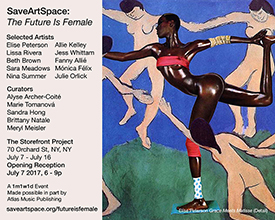 In this all-woman gallery and public art exhibition, The Future Is Female by SaveArtSpact features female artists on advertising spaces and billboards throughout the New York City area during summer 2017. The exhibit aims to expand upon the mainstream definition of “the female gaze” through works that reflect the multifaceted reality of womanhood in the twenty-first century and that expand upon society’s traditional ideals of femininity.
“One such woman is artist Elise Peterson,” writes Priscilla Frank in a HuffPost review, “whose piece Grace Meets Matisse injects a photographic image of Grace Jones into Henri Matisse’s 1910 Dance, placing her in the center of a ring of naked dancers. The image puts Jones’ black body into an image previously filled with white bodies, juxtaposing the flesh of the painted figures with the three-dimensional glow of Jones’ self-actualized body, mid-performance.” (http://www.huffingtonpost.com/entry/feminist-art-new-york-billboards_us_594abba7e4b0312cfb60fb92)
The work was curated by Meryl Meisler, Marie Tomanova, Alyse Archer-Coité, Sandra Hong, and Brittany Natale. In addition to Peterson, artists include Allie Kelley, Beth Brown, Fanny Allié, Jess Whittam, Julie Orlick, Lissa Rivera, Mónica Félix, Nina Summer, and Sara Meadows. Peterson’s work can be viewed in various locations throughout New York City, including Grand Street and Ludlow Street (343 Grand Street).
Jeanine Oleson
Commonwealth & Council
3006 W 7th St. Suite 220, Los Angeles, CA
July 8–August 19, 2017
The amplification of sound and image is at the center of Jeanine Oleson’s powerful exhibition at Commonwealth & Council. Using natural materials such as shell and glass within a performance-based lexicon, Oleson examines the effects of production under late capitalism, the meanings of community, and bodily experience. Three-dimensional imaging technology is employed to render visible what we already see but which we might not value; and elsewhere a transducer speaker made of shell expertly turns an object of childlike wonder into a proxy for political speech. Although not specifically positioned as a pendant to Oleson’s Hammer exhibition, concurrently on view, many of the interests in the two shows are similar, and benefit from a close read. At issue in both is how one might become a conductor—realizing the longing for a political elsewhere—using materials of the body and the world?
CUNT
Venus Over Los Angeles
601 S Anderson St, Los Angeles, CA
July 15–September 2
Although more iconographic than strictly historical, this group exhibition brings together six feminist artists who address the visuality of female bodies and their attendant sexualities. Betty Thompkins, Carolee Schneemann, VALIE EXPORT, Judith Bernstein, Dorothy Iannone, and Marilyn Minter may each depict the vulvic, but their similarities end there. Iannone’s confessional work, I Was Thinking of You (1975/2006), displays a video of artist’s face while she masturbates, housed in a lovingly decorated cabinet which recounts an old story of love and abuse (the text on the cabinet’s exterior begins: “You walk into my quarters 2000 years ago which are outside the city gates….”) The exhibition features new work by some of the artists—most notably a large black-light mural by Bernstein, in which a giant limp phallus covered in swastikas comes to stand for the “Trumpery” of America’s current political hierarchy. Nearby, a vagina dentata seems to be growing out of the official seal of the United States. It is a caustic and damning work—one filled with heaps of rage and anger—revealing why explicitness in our lives, politics, and art are as necessary as ever.
As in Nature: Helen Frankenthaler Paintings
225 South Street
Williamstown, MA 01267
July 1–October 9, 2017
As in Nature: Helen Frankenthaler Paintings presents twelve of this major Abstract Expressionist artist’s large-scale paintings. Made over the course of her long career, these works explore the tension between abstraction and representation and demonstrate her engagement with the landscape painting tradition. In particular, she found inspiration in the idyllic, wooded landscapes of the northeastern United States, home of the Clark Art Institute. Spanning the full range of styles, techniques, and formal preoccupations that Frankenthaler explored over five decades of work, these paintings are primarily abstract, yet reveal recognizable elements from the landscape that function, paradoxically, to reinforce their abstraction: as in nature, but not as in nature. As she said of one of her most iconic paintings, Mountain and Sea (1952), “The landscapes were in my arms as I did it. I didn’t realize all that I was doing. I was trying to get at something—I didn’t know what until it was manifest.”
A publication, authored by guest curator Alexandra Schwartz, with contributions by Christina Kee, accompanies this exhibition.
Marina Abramović: The Cleaner
Gammel Strandvej 13
DK 3050 Humlebaek, Denmark, Copenhagen
June 17–October 22, 2017
This summer, the Louisiana Museum of Art presents Marina Abramović: The Cleaner, the first major European retrospective presentation of this pioneering body and performance artist. The exhibition at Louisiana comprises more than one hundred works and spans more than five decades—from early concept sketches, paintings, and sound works to presentations of the artist’s performances—including her collaboration with former partner Ulay. Reperformances of an early work form part of the exhibition as well. The exhibition is structured chronologically, beginning with her Sound Corridor (War) of 1971, where the spectator is inundated with the sounds of gunfire, and ending with her quieter and more transformative works.
Marina Abramović: The Cleaner has been developed in a dialogue with the artist and is organized by Moderna Museet, Stockholm, in collaboration with the Louisiana Museum of Modern Art, Henie Onstad Kunstsenter, and Bundeskunsthalle, Bonn.