
CAA News Today
Institutional News
posted Dec 15, 2016
Read about the latest news from institutional members.
Institutional News is published every two months: in February, April, June, August, October, and December. To learn more about submitting a listing, please follow the instructions on the main Member News page.
December 2016

The Archives of American Art, part of the Smithsonian Institution in Washington, DC, has received a three-year grant of up to $900,000 from the Walton Family Foundation to support the ongoing digitization of the archives’ collection, enabling the organization to double its current rate. The Archives of American Art is obliged to match the grant, to be given in three installments.
The Archives of American Art, part of the Smithsonian Institution in Washington, DC, has announced a long-term partnership with the Terra Foundation for American Art to support the digitization of the archives’ collections. Terra has made a $4.5 million commitment, $4 million of which is a challenge grant to be matched by the Smithsonian, to seed an endowment for ongoing digitization. The remaining $500,000 will provide operating support for the current digitization program.
California State University, Long Beach, has received a grant from the Graham Foundation to support an exhibition, Robert Irwin: Site Determined, at the University Art Museum.

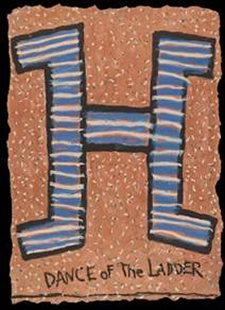 Harmony Hammond, Dance of the Ladder, 1981 (artwork © Harmony Hammond; photograph provided by the Getty Research Institute)
The Getty Research Institute in Los Angeles, California, has acquired the archive of the artist, writer, curator, and scholar Harmony Hammond. The donation includes correspondence, photographs, original source material for her art, professional papers, publication drafts, editioned prints, original artwork, files, and a slide registry devoted to lesbian artists.

 The main entrance to the Metropolitan Museum of Art (photograph by Brett Beyer)
The Metropolitan Museum of Art in New York has reaffirmed its long-term cooperative partnership with the Ministry of Culture of the Government of India by renewing a Memorandum of Understanding for five additional years.
The Metropolitan Museum of Art in New York has been named the world’s top museum in TravelAdvisor’s Travelers’ Choice Awards, based on the quality and quantity of reviews and ratings over a twelve-month period, for the second year in a row.
The Museum of Modern Art in New York has received a grant from the Graham Foundation to support an exhibition, Frank Lloyd Wright at 150: Unpacking the Archive, scheduled for June 12–October 1, 2017.

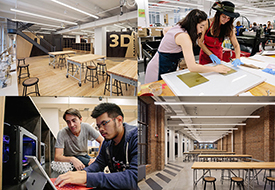 Scenes from the Parsons Making Center at the New School (photographs by Matt Matthews and Michael Moran)
Parsons School of Design in New York has opened the Parsons Making Center at the New School, a hub for a network of making spaces that provide university students with state-of-the-art tools to design projects in a range of disciplines.
Princeton University Art Museum in Princeton, New Jersey, has received a $150,000 Museums for America grant from the Institute of Museum and Library Services to support the ongoing Collections Discovery Initiative, designed to ensure that Princeton’s Asian art collection can be shared with the broadest possible audiences, especially with scholars and researchers. The grant will allow the museum to enhance and standardize the cataloguing of its Asian art holdings, develop rich educational materials, and restructure its Asian art microsite into an in-depth sustainable resource with an innovative new interface.

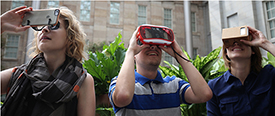 Using virtual-reality technology, you can now experience the exhibition WONDER on your mobile device (photograph provided by the Smithsonian American Art Museum)
The Smithsonian American Art Museum in Washington, DC, has launched Renwick Gallery WONDER 360, an immersive 360-degree virtual-reality app for Apple and Android mobile devices. The app allows audiences to explore the entirety of the museum’s 2015–16 exhibition WONDER, presented at its Renwick Gallery, in 3D; it also expands the visitor experience through emerging technologies and is the first virtual-reality mobile app the Smithsonian has offered.
The Society of Architectural Historians, based in Chicago, Illinois, has received a grant from the Graham Foundation to support a public program, a half-day seminar on “Making and Re-Making Glasgow: Heritage and Sustainability,” at its upcoming conference in Scotland.
The University of Houston in Texas has created a new College of the Arts, comprising the School of Art, the Moores School of Music, the School of Theatre and Dance, the Blaffer Art Museum, the Cynthia Mitchell Woods Center for the Arts, the Center for Arts Leadership, and the Graduate Program for Arts Management.

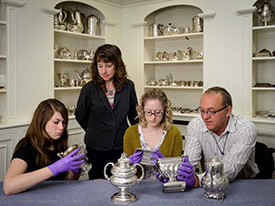 Bruno Pouliot, senior objects conservator (far right), and Ann Wagner, curator of decorative arts (standing), examine coatings on silver objects during Phase I (2013–15) of the IMLS-funded project, alongside the former conservation technicians Maggie Bearden (left) and Kaitlin Andrews (right) (photograph provided by the Winterthur Museum, Garden, and Library)
The Winterthur Museum, Garden, and Library in Winterthur, Delaware, has received a $110,759 grant from the Institute of Museum and Library Services for a project on preventive care for metal objects, which Winterthur deems its highest conservation treatment priority.
Grants, Awards, and Honors
posted Dec 15, 2016
CAA recognizes its members for their professional achievements, be it a grant, fellowship, residency, book prize, honorary degree, or related award.
Grants, Awards, and Honors is published every two months: in February, April, June, August, October, and December. To learn more about submitting a listing, please follow the instructions on the main Member News page.
December 2016

Devon Baker, a PhD student in art history at Temple University in Philadelphia, Pennsylvania, has been awarded a 2016–17 Jane and Morgan Whitney Fellowship by the Metropolitan Museum of Art in New York. She will conduct research for her dissertation, which explores print culture in Renaissance Lombardy, using printmaking to examine larger themes of mobility, north-south exchange, and transmateriality.
Amy Beecher, an artist based in New York and Providence, Rhode Island, has received a fall 2016 fellowship from the MacDowell Colony in Peterborough, New Hampshire, in the interdisciplinary artist category.
Daniella Berman, a doctoral candidate at New York University’s Institute of Fine Arts, has been awarded a 2016–17 Theodore Rousseau Fellowship by the Metropolitan Museum of Art to work on her dissertation, which considers the unfinished history paintings of the French Revolution and identifies an emergent aesthetic of “unfinishedness” developed by artists in response to the shifting sociopolitical landscape.
Douglas Brine, associate professor of art history at Trinity University in San Antonio, Texas, has accepted a 2016–17 J. Clawson Mills Scholarship at the Metropolitan Museum of Art in New York to undertake research and writing for his book project, “The Art of Brass in the Burgundian Netherlands: Makers, Markets, Patrons, Products.”
Emily Casey, a PhD candidate in art history at the University of Delaware in Newark, has been given a Sylvan C. Coleman and Pam Coleman Memorial Fund Fellowship for 2016–17 by the Metropolitan Museum of Art in New York. She will examine representations of oceanic space in American art and material culture to show how colonial and early national identities were constructed in relation to these.
Joshua Cohen, assistant professor at City College, City University of New York, has received a 2016–17 Jane and Morgan Whitney Fellowship from the Metropolitan Museum of Art to complete a book that tracks modernist appropriations of African sculpture by European and African artists between 1905 and 1980.
Joelle Dietrick, assistant professor of art and digital studies at Davidson College in Davidson, North Carolina, has accepted a Pollock-Krasner Foundation award to support her studio production during the 2016–17 academic year before she goes to Hamburg, Germany, for her Fulbright Global Award (April–July 2017). As part of the Fulbright, Dietrick will travel to Santiago, Chile, and Hong Kong, China, during the next two winter breaks.
Brad Hostetler, who earned a PhD in art history last year at Florida State University in Tallahassee, has been awarded a 2016–17 Jane and Morgan Whitney Fellowship from the Metropolitan Museum of Art in New York to complete revisions for a book project, “Enshrining Sacred Matter: The Form, Function, and Meaning of Reliquaries in Byzantium, 843–1204.”
Amy Huang, a doctoral candidate in the history of art and architecture at Brown University in Providence, Rhode Island, and an adjunct lecturer for Boston University in Massachusetts, has received a 2016–17 Jane and Morgan Whitney Fellowship from the Metropolitan Museum of Art in New York. She will research visual modes of remembrance in Chinese paintings through seventeenth-century Nanjing and investigate how memory operated through texts, images, and historic sites.
Frances Jacobus-Parker, a PhD student in art and archaeology at Princeton University in Princeton, New Jersey, has been given a Jane and Morgan Whitney Fellowship for 2016–17 by the Metropolitan Museum of Art in New York, where he will work on the first comprehensive study of the oeuvre of the pivotal American artist Vija Celmins.
Samuel Johnson, who earned his PhD in the history of art and architecture at Harvard University in Cambridge, Massachusetts, in 2015, has been awarded a Leonard A. Lauder Fellowship by the Metropolitan Museum of Art in New York. In 2016–17 Johnson will study the effects of the papiers collés of Georges Braques and Pablo Picasso on the photographs of El Lissitzky, László Moholy-Nagy, and Man Ray.
Anna Jozefacka, an adjunct professor at Hunter College, City University of New York, has been awarded a 2016–17 Leonard A. Lauder Fellowship by the Metropolitan Museum of Art to conduct research on Cubism’s relationship to the evolution of modern architectural and interior design in the first three decades of the twentieth century.
Julia McHugh, a doctoral student in art history at the University of California, Los Angeles, has accepted a Douglass Foundation Fellowship in American Art for 2016–17 from the Metropolitan Museum of Art in New York to work on her dissertation, which examines the ways in which patrons used tapestries and other textiles to adorn interiors, both domestic and sacred, in seventeenth- and eighteenth-century Peru.

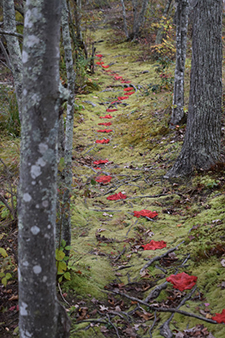 Patricia Miranda, Invasive, 2016 (artwork © Patricia Miranda)
Patricia Miranda, an artist, curator, educator, and founder of MAPSpace, a gallery in Port Chester, New York, has completed an October 2016 residency at I-Park Residency in East Haddam, Connecticut.
Jiha Moon, an artist who lives and works in Atlanta, Georgia, has received a 2016 Artadia Award.
Elyse Nelson, a PhD candidate in the history of art at New York University’s Institute of Fine Arts, has been given a Jane and Morgan Whitney Fellowship by the Metropolitan Museum of Art. During 2016–17 she will work on a dissertation that explores the Italian neoclassical sculptor Antonio Canova’s renewed relationship with his British patrons after Napoleon’s defeat in 1814.
Giulia Paoletti, a core lecturer at Columbia University in New York, has been awarded a 2016–17 Andrew W. Mellon Postdoctoral Curatorial Fellowship by the Metropolitan Museum of Art to research and assist with the development and preparation for a planned reinstallation and renovation of the African art galleries.
John Richardson, professor of art and chair of the James Pearson Duffy Department of Art and Art History at Wayne State University in Detroit, Michigan, has received the 2016 Lifetime Achievement Award from the Mid America College Art Association.
Miriam Said, a doctoral student in the history of art at the University of California, Berkeley, has accepted a 2016–17 Frances Markoe Fellowship by the Metropolitan Museum of Art in New York to explore material-based mechanisms of ritual affect as it was manifested in and between the Near East and Greece in the first millennium BC.
John A. Tyson, a recent recipient of a PhD in art history from Emory University in Atlanta, Georgia, has joined the National Gallery of Art in Washington, DC, as a 2016–17 participant in the fellowship and internships program. He will assist the Department of Modern Art with research for the upcoming Rachel Whiteread retrospective and lead tours in the newly reinstalled East Building permanent and special exhibition galleries.
Aaron Wile, a PhD candidate in the history of art and architecture at Harvard University in Cambridge, Massachusetts, has accepted a Chester Dale Fellowship from the Metropolitan Museum of Art in New York. During 2016–17 he will complete his dissertation, “Painting, Authority, and Experience at the Twighlight of the Grand Siècle, 1690–1721,” and begin transforming it into a book manuscript, consulting materials at the museum.
Katharine Wright, who earned her PhD in art history at the Institute of Fine Arts, New York University, in 2015, has been awarded an Andrew W. Mellon Curatorial Research/Collections Specialist Fellowship for 2016–17 by the Metropolitan Museum of Art to catalogue the Department of Modern and Contemporary Art’s collection of American modernism.
Tara Zanardi, an associate professor at Hunter College, City University of New York, has accepted a 2016–17 Jane and Morgan Whitney Fellowship from the Metropolitan Museum of Art to research the Porcelain Room at the Royal Palace in Aranjuez, a tour-de-force in its implementation and display of porcelain, the interior exemplifies Charles III’s innovative artistic and political strategies at court.
Exhibitions Curated by CAA Members
posted Dec 15, 2016
Check out details on recent shows organized by CAA members who are also curators.
Exhibitions Curated by CAA Members is published every two months: in February, April, June, August, October, and December. To learn more about submitting a listing, please follow the instructions on the main Member News page.
December 2016

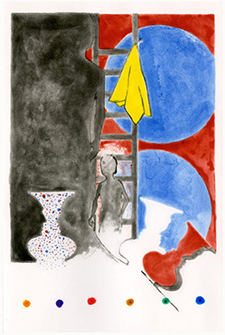 Jasper Johns, Untitled, 2012, intaglio (spitbite, aquatint), 21 x 16 in., edition of 30 (artwork © Jasper Johns)
Guy Ben-Ari and Leah Wolff. No Regrets. LeRoy Neiman Gallery, Columbia University, New York, October 19–November 10, 2016.

 Chitra Ganesh, Shimmering Pulse, 2009, exhibition print from a digital file (artwork © Chitra Ganesh)
Rashmi Viswanathan and Zoe S. Kwok. Contemporary Stories: Revisiting South Asian Art Narratives. Princeton University Art Museum, Princeton, New Jersey, October 22, 2016–January 22, 2017.
Noon Forum Programs at the 2017 Conference Open to the Public
posted Dec 15, 2016
Special forums at the 2017 Annual Conference in New York—taking place during the lunch hour on Wednesday, Thursday, and Saturday—will provide an opportunity for attendees to hear from colleagues, address critical issues, and continue the conversation outside the session grid. With these forums CAA hopes to provide open access to the conference to the public.
The Noon Forum Programs offer two formats. Hot Topics will address critical, time-sensitive issues in the field. The New York conference has slated sessions on “Advocating for Your Department” and “Art Criticism.”
Key Conversations feature scholars, artists, and arts professionals discussing key issues in their fields. Already scheduled for the February meeting are “Navigating Public Opposition to Museum Exhibitions,” “Learning from Experience: Fair Use in Practice,” “Hrag Vartanian with Amin Husain and Nitasha Dhillon,” and “Memorial Session.”
These programs will begin at 12:15 PM and end at 1:15 PM; they are free and open to the public. Please feel free to bring your lunch!
Books Published by CAA Members
posted Dec 15, 2016
Publishing a book is a major milestone for artists and scholars—browse a list of recent titles below.
Books Published by CAA Members appears every two months: in February, April, June, August, October, and December. To learn more about submitting a listing, please follow the instructions on the main Member News page.
December 2016

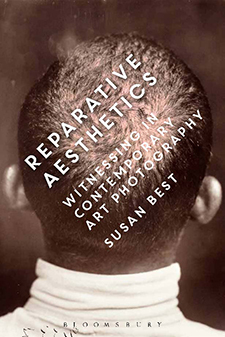
Susan Best. Reparative Aesthetics: Witnessing in Contemporary Art Photography (London: Bloomsbury, 2016).

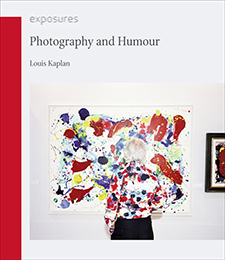
Louis Kaplan. Photography and Humour (London: Reaktion Books, 2016).

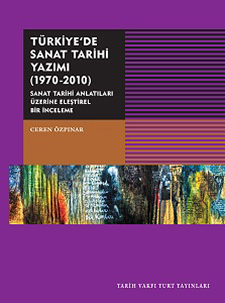
Ceren Özpınar. Turkiye’de Sanat Tarihi Yazimi (1970–2010) [The Art Historiography in Turkey (1970–2010)] (Istanbul: History Foundation Yurt Publications, 2016).
News from the Art and Academic Worlds
posted Dec 14, 2016
Each week CAA News summarizes eight articles, published around the web, that CAA members may find interesting and useful in their professional and creative lives.
How Trump Should Support the Arts
Since Donald Trump has given few clues as to how he will approach arts policy, I thought I would lay out what a Trump administration ought to do. First, it must save the federal government money, to appeal to the Republican Congress. Second, it should stand a chance of appealing to Trump, given his stances on other issues. Third, it should offer a reasonable chance of improving the quality of the arts in the US, and fourth, the arts community should not hate every aspect of the changes. (Read more from Bloomberg View.)
What Can Artists Do to Oppose Trump?
When Vice President–elect Mike Pence went to see Hamilton on Broadway, he was doing more than enjoying a night at the theater—he was there to triumph over an enemy. For if any work of art represented the liberal hope of the Obama years, it was surely Hamilton. Here was a patriotic attempt to open the canon of American history to people of color, to tell the stories of the past in the language of the present. (Read more from Slate.)
How Big Data Is Set to Change the Art Market
In late October, Sotheby’s announced it had acquired the Mei Moses Art Indices, a database of repeat auction sales that tracks value over time. Shortly after, Artnet said it had brought Tutela Capital, an analytics firm headed by Fabian Bocart, into its portfolio, which also includes a sizeable database of auction prices. Each company has different aims, but one thing is clear: data will play a key role in how they—and the art market—move forward. (Read more from the Art Newspaper.)
Arts Diversity: The Quota Conversation
Ask anyone in the arts about quotas and, more likely than not, you’ll get some form of commitment to a “conversation.” As in, “We should talk about whether or not to use quotas” rather than “Quotas should or should not be applied.” It’s less “Show me a quota and I’ll show you a failure” and more “These tools are limited, but I can’t bring myself to dismiss them.” (Read more from Art Professional.)
The New PhDs
American universities awarded a record number of doctorates in 2015—although the rate of growth in the number of PhD recipients continued a several-year decline. And the 55,006 recipients were more likely to be men and to be American citizens or permanent residents than they were the year before. Those are among the findings of the newest version of the federally supported Survey of Earned Doctorates, covering the year 2015. (Read more from Inside Higher Ed.)
How to Fix the Art World, Part 4
Last August ARTnews embarked on an epic project: finding out what inhabitants of the art world think is wrong with their world and how they would fix it. In the ensuing months, the magazine spoke with more than fifty individuals—artists and curators, critics and historians, art dealers and an art-fair director—to gather a range of perspectives. (Read more from ARTnews.)
The Museum of the Present
What’s a museum? This is a question I have asked more than once in the New Criterion. It’s one this magazine has been asking since its first issue. And it’s one that I wish museums would ask more frequently of themselves. Because the answers are changing—through assumptions that are often unannounced, unacknowledged, and unexplored. (Read more from the New Criterion.)
Advice on Being Advised
It’s difficult to offer general advice on the adviser-advisee relationship because it varies so much—by discipline, professor, student, or institution. How friendly, how hierarchical, or how useful the relationship differs from one pair to the next. Still, there are some near-universal implicit rules that govern this relationship. More often than not, a student learns them the hard way. (Read more from Vitae.)
2017 CAA Annual Conference in the News
posted Dec 12, 2016
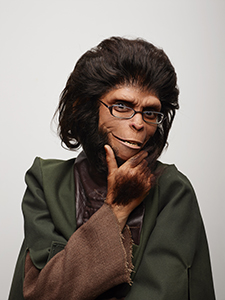
Coco Fusco in costume as Dr. Zira from the Planet of the Apes. Photo Gene Pittman, courtesy Walker Art Center.
Word has spread about some of the sessions and our keynote speaker at the 2017 CAA Annual Conference and Artnet News and Artnews have taken notice.
Diversity has long been a part of CAA’s history and this year’s conference is no different. Artnet News notes how race and politics are “at the forefront” of our programming this year. Our effort to find more ways to involve artists and makers in the conference has not gone overlooked either. Brian Boucher, author of the Artnet piece, cites the CAA collaboration with NYFA to offer professional development programming.
At Artnews, writer
Annual Conference Committee Seeks Members
posted Dec 12, 2016
CAA invites nominations and self-nominations for at-large members of the Annual Conference Committee to serve a three-year term, beginning February 2017, immediately following the 105th Annual Conference. We welcome all members to participation in the nomination process. Working with the Programs Department staff, this committee selects the sessions and shapes the program of the Annual Conference. The committee ensures that the program will reflect the goals of the association and of the Annual Conference, namely, to make the conference an effective place for intellectual, aesthetic, and professional learning and exchange, and to provide opportunities for participation that are fair, equal, and balanced.
The Annual Conference Committee meets at least two times a year via conference call and once during the Annual Conference at the call of the vice president for Annual Conference and the committee’s chair. Members must be available throughout May and June to review a significant amount of material and select 2018 conference content from the submitted proposals.
Please send a 150-word letter of interest and a CV to Katie Apsey, CAA manager of programs. Deadline: January 31, 2017.
Notice of 105th Annual Business Meeting
posted Dec 12, 2016
College Art Association
Notice of 105th Annual Business Meeting
Annual Conference Convocation
February 15, 2017
 The 105th Annual Business Meeting of the members of the College Art Association will be called to order at 5:30 p.m. on Wednesday, February 15th, at the Convocation of the 2017 Annual Conference, in West/East Ballroom, 3rd Floor, New York Hilton Midtown Hotel, 1335 Avenue of the Americas, NY, NY 10019.
CAA President, Suzanne Preston Blier, will preside. The Annual Business Meeting will be held in two parts.
AGENDA
The Agenda for the first part of the Annual Business Meeting is as follows:
- Call to Order and President’s Report – Suzanne Preston Blier
- Report by Annual Conference Chair and VP for Annual Conference – Judith Rodenbeck and N. Elizabeth Schlatter
- Report by Executive Director – Hunter O’Hanian
- Presentation of Annual Awards for Distinction – Suzanne Preston Blier
- Keynote Address – Mary Miller
After the Keynote Address, the Meeting will be recessed and will reconvene on Friday, February 17, 2017 from 12:15 – 1:15 p.m. in the East Ballroom, 3rd Floor at the New York Hilton Midtown Hotel, 1335 Avenue of the Americas, NY, NY 10019. The Agenda for the second part of the Annual Business Meeting is as follows:
- Approval of Minutes of 104th Annual Business Meeting, February 3, 2016 [ACTION ITEM] – see http://www.collegeart.org/pdf/2016-annual-business-meeting-minutes.pdf
- Financial Report: Teresa Lopez, Chief Financial Officer
- Old Business
- New Business
- Results of Election of New Directors: Suzanne Preston Blier
- MY CAA – Open discussion with members, board and staff regarding future growth of the Association.
Proxies
If you are unable to attend the Annual Business Meeting, please complete a proxy online to appoint the individuals named thereon to (i) vote, as directed by you, for directors, and, at their discretion, on such other matters as may properly come before the Annual Business Meeting; and (ii) to vote in any and all adjournments thereof. CAA Members will be notified when the proxy for casting votes becomes available online in early January 2017. A proxy, with your vote for directors, must be received no later than 6:00 p.m. EST Thursday, February 16, 2017.
Next Meeting
The 106th Annual Business Meeting of the College Art Association will take place on February 21, 2018, in Los Angeles.
Roberto Tejada, Secretary
College Art Association
December 12, 2016
New in caa.reviews
posted Dec 09, 2016
 John Hawley visits Van Dyck: The Anatomy of Portraiture at the Frick Collection. The “more than one hundred paintings, drawings, and prints” by Anthony van Dyke and his contemporaries look “exclusively at portraiture, with special attention given to the way drawings (which account for nearly half the exhibited works) highlight Van Dyke’s inimitable process as a portraitist.” Read the full review at caa.reviews.
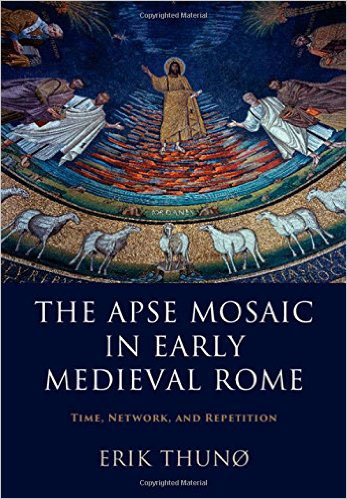
Stephen J. Lucey reads The Apse Mosaic in Early Medieval Rome: Time, Network, and Repetition by Erik Thunø. Presenting “an alternative ‘non-diachronic’ art-historical interpretation of the Roman apse decorations from the sixth through ninth centuries,” the author “promotes the continuity of imagery as a ‘synchronic’ manifestation, which reflects a timeless ecclesiological essence.” Read the full review at caa.reviews.
Jennifer Nelson reviews Visual Acuity and the Arts of Communication in Early Modern Germany, edited by Jeffrey Chipps Smith. The essays “consider German visual culture from the late fifteenth to early eighteenth centuries by means of healthy reliance on present-day creativity and hermeneutic skill” and put “productive pressure on its period’s blind spots.” Read the full review at caa.reviews.
Amy F. Ogata discusses Marta Gutman’s A City for Children: Women, Architecture, and the Charitable Landscapes of Oakland, 1850–1950. The author “explores the long tradition of benevolent concern for the poorest children in the rapidly urbanizing context of Oakland, California,” and argues that the structures “reveal a complex history of adaptive reuse against the drama of class and racial politics.” Read the full review at caa.reviews.
caa.reviews publishes over 150 reviews each year. Founded in 1998, the site publishes timely scholarly and critical reviews of studies and projects in all areas and periods of art history, visual studies, and the fine arts, providing peer review for the disciplines served by the College Art Association. Publications and projects reviewed include books, articles, exhibitions, conferences, digital scholarship, and other works as appropriate. Read more reviews at caa.reviews.