
CAA News Today
Suzanne Preston Blier Is the New CAA President
posted Apr 04, 2016
Suzanne Preston Blier, a historian of African art and architecture at Harvard University, has been elected president of CAA for a two-year term, beginning in May 2016. A member of the board since 2012, Blier has served as vice president for publications (2013–15) and vice president of Annual Conference (2015–16), and has served on task forces related to the development of CAA’s Code of Best Practices in Fair Use for the Visual Arts and Guidelines for the Evaluation of Digital Scholarship in Art and Art History. She will succeed DeWitt Godfrey, professor of art and art history at Colgate University.
In her statement for candidacy, Blier wrote, “My priorities as president will focus on increasing membership in part through changes to the Annual Conference and enhancing CAA’s place in the community of discourse nationally and internationally through more effective social media engagement and the use of digital technologies. I hope also to broaden our engagement not only at the local and national levels but also internationally.”
Blier earned a BA from the University of Vermont in 1973 and completed a PhD in art history from Columbia University. Blier taught at Northwestern University for two years (1981–83) and returned to Columbia (1983–93) before landing at Harvard, where she is currently Allen Whitehill Clowes Professor of Fine Arts and Professor of African and African American Studies.
In 2008, Blier helped found an on-line GIS-enhanced database and mapping project supported by the Center for Geographic Analysis at her school that in 2011 was relaunched as Worldmap.
Blier’s involvement in CAA spans several decades. She originally served on the board from 1989 to 1994. She was a member of the Art Bulletin Editorial Board from 2003 to 2007, serving one year as chair, and participated on the juries for CAA’s Distinguished Lifetime Achievement Award for Writing on Art (2004–6) and Charles Rufus Morey Book Award (2009–11). Blier also helped to shape CAA’s Strategic Plan 2015–2020 and, in her role as vice president, chaired both the Annual Conference Committee and the 2016 task force that brought significant changes to the Annual Conference organization and structure.
“In my own academic work,” Blier continued in her statement, “I have come to understand firsthand the importance of engaging broad and diverse communities of participants; my work initiating an open source website focused on an array of mapping projects, has offered me opportunities to see the imprint that new technologies can have in the lives of both faculty and students.”
 Blier’s most recent book is Art and Risk in Ancient Yoruba: Ife History, Power, and Identity, c. 1300 (New York: Cambridge University Press, 2015), which won the 2016 PROSE Award for Art History and Criticism. She also wrote several other books of note: African Royal Art: The Majesty of Form (London: Calmann and King, 1998); African Vodun: Art, Psychology, and Power (Chicago: University of Chicago Press, 1995), which received CAA’s Morey Book Award in 1997; and The Anatomy of Architecture: Ontology and Metaphor in Batammaliba Architectural Expression (Cambridge, MA: Harvard University Press, 1987), which won the inaugural Arnold Rubin Outstanding Publication Award from the Arts Council of the African Studies Association. The production of both African Vodun and The Anatomy of Architecture were supported by grants from CAA’s Millard Meiss Publication Fund. Blier’s books have been translated into Spanish, Italian, Chinese, and Korean. A publication edited with David Bindman, called The Image of the Black in African and Asian Art, is forthcoming from Harvard University Press.
Her scholarship has appeared in numerous magazines and journals, including African Arts, Journal of African History, American Journal of Semiotics, Anthropology and Art, and Journal of the Society of Architectural Historians. A short essay “Art, Mimesis, and Tigritude” can be found in the June 2013 issue of The Art Bulletin as part of the series Notes from the Field: Mimesis. Other essays in CAA’s flagship journal are “Kings, Crowns, and Rights of Succession: Obalufon Arts at Ife and Other Yoruba Centers” (September 1985) and “Imaging Otherness in Ivory: African Portrayals of the Portuguese ca. 1492” (September 1993). Both articles were selected by members of the Art Bulletin Editorial Board for the Centennial Anthology of the Art Bulletin’s “greatest hits,” designating important articles and reviews since the journal’s 1913 founding to mark CAA¹s Centennial in 2011.
CAA at the 2016 National Art Education Association Conference
posted Mar 31, 2016
 Staff members from CAA flew to the windy city to exhibit and meet the attendees at the 2016 National Art Education Association (NAEA) Convention from March 17-19. The NAEA, a CAA Affiliated Society, is the leading professional membership organization exclusively for visual arts educators. Similar to CAA’s own Annual Conference, the NAEA Convention provides professional development services including sessions, workshops, events, and activities aimed at improving visual arts instruction in American schools.
The NAEA Convention was held at the McCormick Place Convention Center and the Hilton Chicago Hotel, where CAA will hold its 108th Annual Conference in February of 2020. In the Exhibit Hall, CAA’s booth was visited by hundreds of NAEA members working and practicing across all areas of arts education. CAA staff Tiffany Dugan, director of programs, and Vivian Woo, marketing and development manager, talked with attendees and provided CAA information including institutional and individual membership brochures; the Code of Best Practices in Fair Use for the Visual Arts and Use Fair Use buttons; and information about the 2017 CAA Annual Conference in New York. Examples of Art Journal and The Art Bulletin were also on hand.
CAA looks forward to reconnecting with NAEA attendees next year in New York. For a limited time only, all NAEA members can receive a $10 discount off membership with CAA. For more information please contact the CAA Membership Department at 212-691-1051, ext. 1.
News from the Art and Academic Worlds
posted Mar 30, 2016
Each week CAA News publishes summaries of eight articles, published around the web, that CAA members may find interesting and useful in their professional and creative lives.
How to Be an Unprofessional Artist
No one likes being called an amateur, a dilettante, a dabbler. “Unprofessional” is an easy insult. The professional always makes the right moves, knows the right thing to say, the right name to check. Controlled and measured, the professional never sleeps with the wrong person or drinks too much at the party. (Read more from Momus.)
The Complicated Relationship between Animals and Art
At this year’s CAA Annual Conference, I organized a session on “The Art of Animal Activism” with Keri Cronin of Brock University. The session explored art since the nineteenth century that has taken nonhuman animals seriously as subjects with sentience and agency—not just as decorative ornaments or symbols. I was pleased, and somewhat surprised, that the session was so well received. (Read more from National Public Radio.)
Volume, Weight, and Pigment to Oil Ratios
Oil painters concerned with fat over lean will often turn to information about the oil absorption values for particular pigments as a way to compare how oily or lean certain colors might be. This has led to many misconceptions and outright wrong conclusions that seem to persist in various forums and articles. (Read more from Just Paint.)
Can an Art Critic Fairly Review an Artist Friend’s Work?
There’s no upside for an artist to be friends with an art critic. The personal connection means the critic must pass on reviewing the artist’s work, and while the loss of critical wisdom may be negligible, the loss of exposure is a nuisance for the artist. I have wanted to write about Maggie Michael’s work for years now but can’t without first offering the reader a huge caveat. (Read more from the Washington Post.)
Hundreds of Looted Ancient Artifacts Are Returned to Italy
Hundreds of looted archaeological artifacts that officials say were handled by the London dealer Robin Symes and destined for markets in the United States, Japan, and Britain have been returned to Italy. The artifacts—dating from the seventh century BC to the second century AD—were found two years ago in a storage unit at the Geneva Freeport that investigators traced to Symes. (Read more from the New York Times.)
Business Looms Larger in Art Classes
The new art expert is not necessarily an expert in art. Art-history students used to tackle questions of symbolism, social context, and style in art. Now, many young scholars are at least as focused on prices as they are on the art itself. (Read more from the Wall Street Journal.)
What You Teach Is What You Earn
A new assistant professor of computer science at a public four-year college or university in 2015–16 earns, on average, a little more than $85,000. A full professor of history—likely with twenty-plus more years of teaching experience—earns on average a little less than $90,000 and will likely have his or her salary passed by the new computer-science professor in a few years. (Read more from Inside Higher Ed.)
University Press Redux: Preserving Heritage, Charting the Future
University presses in the United Kingdom are enjoying something of a renaissance. Over the past few years, established presses such as Cambridge, Edinburgh, Liverpool, Manchester, Oxford, and Wales have been joined by a raft of new publishers. (Read more from the Scholarly Kitchen.)
Going Back
posted Mar 29, 2016
In 2014, while I was literally printing my dissertation, I received an email saying I had been awarded a travel grant to attend the upcoming CAA Annual Conference. I had applied to the grant without any real expectations. I was so happy, yet so busy, so I replied to the email without even looking at the dates. I was in the middle of a lot of excitement—years of work were becoming printed words.
The conference had a lot of meaning to me. My tutor, Laura Malosetti Costa, had spoken about it several times, and nothing says “important academic event” than something your beloved tutor recommends. There was something mystical about receiving the grant at that specific moment in time!
I could say many things about my participation in the conference and the preconference colloquium in 2015, but I want to write about the experience of returning to the conference in 2016. I attended, along with three other former CAA-Getty grantees, and had the opportunity to present a paper.
I spoke on the Emerging Scholars in Latin American Art panel. Sounds like a big deal, right? I was so incredibly nervous. The other speakers were also excited, happy, and shaking. I delivered the paper, without collapsing, during the longest twenty minutes I have ever experienced at an academic event. Fortunately, I liked my paper and thought it was well-constructed, so I knew I was speaking with true passion—and commitment—about my topic.
The waiting was the hardest part. After I had finished, I lifted my eyes from the printed sheets in front of me and stared at the audience. I thought no one would ask me any questions and was prepared for that outcome, so I was surprised by the many questions I was asked. I have never received so many questions after delivering a paper. These were not your everyday pro-forma questions. The people expressed sincere interest, and their questions were all remarkably interesting. I answered. Some people asked follow-up questions. I stopped shaking. I talked.
When everything was over, I sat down and took notes of the questions and comments. I still keep those notes as a memento of speaking at a CAA conference. If I had not been lucky enough to be invited to the conference in 2015, I would not have been ready to present my work there a year later. And for that, I feel thankful.
CAA at Arts Advocacy Day and Humanities Advocacy Day
posted Mar 24, 2016
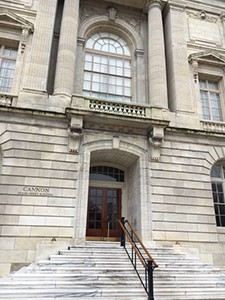
Cannon House, offices of the House of Representatives
CAA had the opportunity this year to attend Arts Advocacy Day, hosted by Americans for the Arts, and Humanities Advocacy Day, hosted by the National Humanities Alliance. One week apart from each other, both events filled Washington, DC with advocates of all ages ready to speak up for the arts and humanities and who were armed with data and statistics.
Arts Advocacy Day, which took place on March 7-8, was headquartered at the OMNI Shoreham Hotel in Washington, DC, just a stone’s throw from the Washington Marriott Wardman Park, where CAA held its 104th Annual Conference in February of this year. The first day of Arts Advocacy Day, now in its 29th year, was jam packed with presentations. Americans for the Arts staff members presented sessions on arts education legislation, such as the recent bipartisan passing of the Every Child Succeeds Act (ESSA), and they presented attendees with dense tables and statistical charts on the economic impact of the arts across the United States. For example, the non-profits arts industry supports 4.13 million jobs in the United States, and the industry contributes a whopping $698 billion annually to the economy. This and many other figures came from the 2016 Congressional Arts Handbook: Facts & Figures at Your Fingertips, which every attendee received. The first day served as foundational preparation for the visits with our local and state representatives the following day.
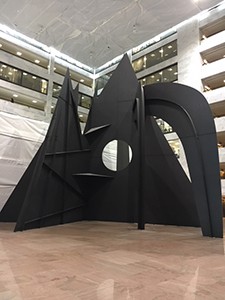
Alexander Calder looming in the Hart Senate Building
March 14-15 marked Humanities Advocacy Day, organized by the National Humanities Alliance. Humanities Advocacy Day, like Arts Advocacy Day, consisted of one day of talks and preparation and one day of Congressional and Senatorial office visits. William Adams, Chairman of the National Endowment for the Humanities, gave a talk on the first day on the NEH’s look toward the future as it shifts its grantmaking structure and adapts to global and domestic changes. The NEH will take on the challenges facing humanities enrollment in higher education and the reduction in humanities and arts programs offered in secondary schools. The NEH will also continue to support work in digital humanities and publishing through a partnership with the Andrew W. Mellon Foundation. Of continued interest to the NEH is increasing access to the humanities through its The Common Good: The Humanities in the Public Square, a program that establishes pathways and means for scholars, educators, and organizations to bring their work into the public sphere.
At lunch, attendees were treated to a presentation by Max Kenner, Executive Director and Founder of the Bard Prison Initiative. BPI offers currently incarcerated individuals the opportunity to obtain a liberal arts college degree from Bard. Since its founding in 1999, the program has grown to become one of the most academically rigorous and successful of its kind.
The National Humanities Alliance scheduled over 200 meetings with Congressman and Congresswomen and Senators for the second day. The New York City delegation, comprised of CAA Director of Programs, Tiffany Dugan, and CAA Director of Communications, Nick Obourn, met with the offices of Congressman Lee Zeldin, Senator Chuck Schumer, and Congresswoman Carolyn Maloney.
News from the Art and Academic Worlds
posted Mar 23, 2016
Each week CAA News publishes summaries of eight articles, published around the web, that CAA members may find interesting and useful in their professional and creative lives.
The Cost of Being Decent to Adjuncts
Even if the adjunct movement for better working conditions succeeds, most adjuncts will lose. That’s one bold claim of a recent paper on the costs associated with a number of the movement’s goals, such as better pay and benefits. While activists and scholars have criticized what they call the paper’s inherently flawed logic, the study’s authors say it is a first step toward a more critical dialogue. (Read more from Inside Higher Ed.)
Abstraction Isn’t Neutral: Sondra Perry on the NCAA, Subjecthood, and Her Upcoming Projects
Earlier this month Ella Coon spoke with the video artist Sondra Perry to talk about recent projects, her upcoming exhibitions, and her thoughts on a variety of other subjects, including the role of generosity in her life and work. (Read more from ARTnews.)
Halting Academic Incivility (That’s the Nice Word for It)
A report published last year in the Journal of Applied Psychology confirms what many might say is obvious: “Incivility … defined as insensitive behavior that displays a lack of regard for others, is rampant and on the rise.” This will not be news for academics. Consider the regular calls for an end to faculty incivility—the rudeness, abusive language, bullying, and general meanness that seem to characterize many of our interactions. (Read more from the Chronicle of Higher Education.)
European Museums Adapt to the American Way of Giving
Museums in the United States, helped by favorable tax laws, are sustained by a culture of giving by private donors and a universe of trained development officials. That culture isn’t common in other parts of the world, where governments often support museums. That is changing. (Read more from the New York Times.)
Managing an MOOC
Several years ago I wrote a MOOC, “The Modern Genius: Art and Culture in the 19th Century,” which initially ran through the Canvas network, and then Kadenze. I had never assigned the MOOC course to any of my students, but that changed this January, when my honors modern art students enrolled in the MOOC, and we experimented with a completely flipped classroom. (Read more from Art History Teaching Resources.)
Whither the Digital Humanities?
The digital humanities can be viewed in two ways: as emerging and as emergent. The tension between them is a central force animating the field today. There are two areas—writing and the university—in which this tension is especially apparent, as digital technologies are upending, questioning, or reframing traditional or cherished assumptions. (Read more from Digital Pedagogy Lab.)
Pirating Papers
Peer-to-peer research sharing looks a lot like sharing of other forms of media, a new study suggests. While some researchers are personally opposed to copyright, others pirate research simply for the sake of convenience. (Read more from Inside Higher Ed.)
Asia Week Raids: New Details on the Christie’s Seizures
Last week, a series of five federal raids during New York’s Asia Week led to the seizure of at least eight looted antiquities and the arrest of at least one dealer. This is the first of several posts that will discuss the alleged smuggling networks disrupted by those raids. (Read more from Chasing Aphrodite.)
caa.reviews Seeks Field Editors
posted Mar 18, 2016
 caa.reviews invites nominations and self-nominations for individuals to join its Council of Field Editors, which commissions reviews within an area of expertise or geographic region, for a term ending June 30, 2019. An online journal, caa.reviews is devoted to reviewing books, museum exhibitions, and projects relevant to art history, visual studies, and the arts.
The journal seeks field editors for books in the following subject areas: early modern Iberian and Latin American art; design history; American art; architecture and urbanism, pre-1800; eighteenth-century art; and Japanese art. The journal also seeks field editors for exhibitions in the following areas: modern and contemporary art; New York and international; and west coast pre-1900. Candidates may be artists, art or design historians, critics, curators, or other professionals in the visual arts; institutional affiliation is not required.
Working with the caa.reviews editor-in-chief, the editorial board, and CAA’s staff editor, each field editor selects content to be reviewed, commissions reviewers, and reviews manuscripts for publication. Field editors for books are expected to keep abreast of newly published and important books and related media in their fields of expertise, and field editors for exhibitions should be aware of current and upcoming exhibitions (and other related projects) in their geographic regions. The Council of Field Editors meets annually at the CAA Annual Conference. Field editors must pay travel and lodging expenses to attend the conference.
Candidates must be current CAA members and should not currently serve on the editorial board of a competitive journal or on another CAA editorial board or committee. Nominators should ascertain their nominee’s willingness to serve before submitting a name; self-nominations are also welcome. Please send a statement describing your interest in and qualifications for appointment, a CV, and your contact information to: caa.reviews Editorial Board, College Art Association, 50 Broadway, 21st Floor, New York, NY 10004; or email the documents to Deidre Thompson, CAA publications assistant. Deadline: April 15, 2016.
News from the Art and Academic Worlds
posted Mar 16, 2016
Each week CAA News publishes summaries of eight articles, published around the web, that CAA members may find interesting and useful in their professional and creative lives.
Announcing NEH-Mellon Fellowships for Digital Publication
The National Endowment for the Humanities and the Andrew W. Mellon Foundation, the two largest funders of humanities research in the United States, have announced a new joint fellowship opportunity to support high-quality, born-digital research in the humanities. (Read more from the National Endowment for the Humanities.)
Go Pro: The Hyper-Professionalization of the Emerging Artist
I can understand the widespread notion among curators and critics that the role of the emerging artist has changed dramatically during the past few years. The shift toward professionalization is further encouraged by the growing involvement of wealthy individuals in the art market who first made their capital by investing in financial markets, real estate, or related industries. (Read more from ARTnews.)
Ten Upcoming Shows by Groundbreaking Female Artists
March is Women’s History Month, so there’s no better time to outline a few upcoming shows by female artists admired by Artnet News. From Hong Kong to Los Angeles, 2016 is brimming with exhibitions by awesome artists, who range in age from twentysomethings to one very impressive centenarian. (Read more from Artnet News.)
Winning Strategies for Journal Publishers
“The Inexorable Path of the Professional Society Publisher” takes the view of the underdog—the small or midsized professional society publisher—that struggles to remain competitive in an environment in which administrative costs explode, budgets of customers are flat or declining, and libraries invite consolidation among vendors in order to reduce administrative costs. While few journals truly lose out entirely, some publishers win bigger than others. (Read more from the Scholarly Kitchen.)
Should All Research Papers Be Free?
Drawing comparisons to Edward Snowden, a graduate student from Kazakhstan named Alexandra Elbakyan is believed to be hiding out in Russia after illegally leaking millions of documents. While she didn’t reveal state secrets, she took a stand for the public’s right to know by providing free online access to just about every scientific paper ever published, on topics ranging from acoustics to zymology. (Read more from the New York Times.)
Job-Market Challenges for Tenure-Track Academics
Often in life our personal experience is limited, and thus we fail to understand the total, complex reality. That is certainly true of the academic job market. Many of us participate in that market only a handful of times as a candidate, and even if we serve on search committees regularly, that experience tends to be limited to certain fields and to our own institutions. (Read more from Vitae.)
Why They Stay and Why They Go
Whether the separation is voluntary or not, losing a tenure-line or otherwise full-time faculty member is always a costly to an institution. The departing professor will take any external research grants with him or her, not to mention the sunk costs of hiring and training. Then there are additional costs that are harder to quantify, such as those to morale, mentorship, service, and leadership. (Read more from Inside Higher Ed.)
What’s the Value of a Liberal-Arts Education in Our Twenty-First Century Digital Economy?
Achieving goals associated with liberal-arts education would require business schools to move into territory more traditionally related to the liberal arts: multidisciplinary approaches, an understanding of global and historical context, a greater focus on leadership and social responsibility, and learning to think critically. (Read more from the Wall Street Journal.)
Aaron M. Wile, Winner of the James L. Clifford Prize
posted Mar 15, 2016
Aaron M. Wile is the winner of the 2015-16 prize. The Prize is awarded annually by the American Society for Eighteenth-Century Studies to the author of the best article regarding any aspect of eighteenth-century culture. Receiving the award is Wile’s “Watteau, Reverie, and Selfhood” published by College Art Association in The Art Bulletin.
The Clifford Fund was originally established to support an annual prize in honor of James L. Clifford. Clifford founded The Johnsonian News Letter in 1940, was Secretary to the English Institute, twice a Guggenheim Fellow, a Fellow of the Royal Society of Literature, and third President of the American Society for Eighteenth-Century Studies. During his long and energetic life, he produced numerous books, articles, bibliographies, essays, edited collections, editions and, of course, the much beloved, imitated, and quoted Johnsonian News Letter. Accordingly, the Clifford Prize is awarded to the author of the best article on an eighteenth-century subject, interesting to any eighteenth-century specialist, regardless of discipline.
The American Society for Eighteenth-Century Studies is a non-profit, educational group founded to promote the study of all aspects of the eighteenth century. It sponsors conferences, awards, fellowships and prizes, and publishes Eighteenth-Century Studies and Studies in Eighteenth-Century Culture. Requests for information about the Clifford Prize and nominations may be addressed to:
ASECS
PO Box 7867, Wake Forest University
Winston-Salem, NC 27109 USA
Telephone (336) 727-4694
Fax (336) 727-4697
E-mail asecs@wfu.edu
CAA’s Fair-Use Specialists Answer Your Questions
posted Mar 14, 2016
Patricia Aufderheide is a professor in the School of Communication and director of its Center for Media & Social Impact, School of Communication, American University; and Peter Jaszi is a professor at the Washington College of Law, Program on Information Justice and Intellectual Property, American University.
Since CAA’s Code of Best Practices was released in February 2015, we have met with many groups and individuals in the visual arts, and we have witnessed major policy changes taking place across the visual arts field as a result of the Code.
Recently, two major organizations announced an easing of copyright restrictions that will make publishing about art infinitely easier. In late February, the Robert Rauschenberg Foundation announced new guidelines for fair use that will “make images of Rauschenberg’s artwork more accessible to museums, scholars, artists, and the public.” In its press release, the foundation cites the prohibitive costs associated with rights and licensing, as well as the obstacles copyright restrictions create in converting print publications to online formats. http://www.rauschenbergfoundation.org/newsfeed/foundation-announces-pioneering-fair-use-image-policy.
Also in the past few weeks, the Association of Art Museum Directors (AAMD) announced that it is revoking its guidelines on thumbnail images in online publications, which restricted the fair use of works of art to small-scale reproductions with low resolutions. Furthermore, it encouraged its members to rely on CAA’s Code of Best Practices until such time that they prepare new policies of their own. Additional important changes have taken place at Yale University Press, where they now support reliance on fair use in scholarly catalogues, and at the Museum of Fine Arts, Houston, which relied on CAA’s Code when designing the online catalogue of its collection. Other museums are following suit, as are visual artists.
As we look back on one year living with and promoting the Code, we wanted to pull together some of the most common questions we received, with answers! (You will also find these questions added to the FAQs on CAA’s website.) We have been consistently amazed, but not surprised, by the interest, curiosity, and the sheer will the visual arts field has employed in applying fair use.
—
Is fair use only applicable to non-commercial uses?
Fair use is applicable whether the use is commercial or non-commercial. That fact is very well established in law. Recently, the appeals court decision supporting Google Books’ use of copyrighted books as fair use explicitly says, “Google’s profit motivation does not in these circumstances [that is, Google’s transformative use of the information] justify denial of fair use.” The same would be true when an otherwise qualifying fair use occurred in the setting of a print publication offered for sale.
This is not a new or novel proposition. In fact, for the last 175 years, almost all of the creators who successfully asserted fair use have been engaged in commerce, in a big or small way. That’s because, under the prevailing definition copyright law, most things that we do in our professional lives (write, make art, publish books) are “commercial.” If money will or may change hands, that’s enough – even if the transaction is done without the expectation of profit. So treating commerciality as a knock-out factor would be the death knell of a meaningful fair use doctrine.
It is true that the non-commercial character of a use may be one feature that can add to a fair use claim. But it is not a particularly important one. Likewise, the size of the print run generally is not a relevant consideration in assessing the validity of fair use. The key to fair use is making sure your use is “transformative,” that is, using the material for a different purpose than the market purpose.
There’s more about this at pages 15-16 of the Code.
Is the Code only applicable to the so-called fine arts? What about artists working in design or photography?
The Code is carefully crafted to provide a reasoning framework in five common situations in the visual arts: analytic writing, teaching, making art, museum work, and archive/collections digital display. Any artist, teacher, writer, or curator can apply the Code’s fair use reasoning if they are engaged in one (or several) of these activities. So can students in the field, and so can independent visual arts professionals, and even amateurs. Many of the activities that graphic designers and photographers engage in give rise to the same copyright questions that confront other visual arts professionals. Sometimes, however, their work may involve other issues—trademark questions, for example, contractual disputes, that fall outside the scope of the Code. The important point is that fair use is for everyone, not just for a privileged few.
What if rights holders or brokers such as ARS and VAGA don’t accept my fair use claim?
In the first instance, of course, what is (or isn’t) fair use is for the user to decide. Rights holders and their agents don’t have the last word (or any word) on this determination. And, at least so far, they haven’t chosen to make a case of any situation in which a user proceeded without license. If your uses are made within the terms of the Code, and you are able to explain how that is true, you have such a solid argument for fair use that rights holders will be in deep peril of wasting their money and time by bringing any legal action. That doesn’t mean that “nastygrams”—letters demanding payment or expressing outrage and issuing threats of legal action—couldn’t be sent. People are free to write whatever they want in letters, even if it is not true.
You may decide, of course, not to employ fair use if you think rights holders may see it as an unfriendly act, and decide not to like you any more. Personal relationships matter in any field.
But if a rights holder threatens action in an unrelated area—for instance, threatening to withhold access to an artist for a later project, or to raise fees for an unrelated work to cover the lost license—you might want to document it. This might be an illegal act on their part.
How big can images get under fair use on a website? We used to have the pixel sizes that AAMD prescribed, but they have retired those, and currently refer us to the Code. But the Code has no specifics on that.
The Code offers no specific recommendations on image size for any purpose, and that is a deliberate choice. The heart of fair use is repurposing material and using what is appropriate for that new purpose. Therefore, individual visual arts professionals need to ask themselves what size is appropriate for any image used to accomplish their objectives. The question always is the same: what amount is (or what reproduction quality) is reasonable. And the answer to this question will always vary according to circumstance. The requirements of a scholarly monograph, for example, may be different from those of a local art blog. No one wants a document that provides a reasoning framework across fields to offer numerical prescriptions. That would not only be hazardous legally (uses have to be appropriate to the specific transformative purpose), but would run the risk of being sadly and quickly outdated, given the fast pace of digital change.
The decision of the AAMD to withdraw its 2011 recommendations on the size of “thumbnails” is an illustration of this fact. Only a few years ago, this was a pioneering document, but as visual arts professionals have become more familiar with fair use, and both practices and expectations around the use of images to support discourse (especially on-line) changed, what had once offered freedom came quickly to feel like a straitjacket.
Of course, institutions may still choose to adopt rules of thumb on image size for internal use, to simplify day-to-day decision-making. But these always should yield to case-by-case consideration when they stand in the way of completing worthwhile projects.
I don’t understand how to employ fair use when I have to get an image from a museum or archive. Often, they will want to charge me a fee just to obtain that reproduction.
Yes, if you need someone’s permission to get access to material you need, you can’t rely on fair use to get it. As a practical matter, fair use only can be employed by someone who already has independent access to the same or similar documentation. The flip side of this proposition, of course, is that if you can find appropriate documentation from another source, you don’t have to pay reproduction or access fees to the collection that holds the original. Reproduction and access fees are common; many collections still use them to cover the costs of serving you. Sometimes people confuse these with copyright licenses, but it should be clear in the contract what exactly you’re paying for. Increasingly, public museums are posting images, particularly of works in the public domain, to digital platforms. Their goal is to increase public access and limit the amount of work their own staffs have to do.