
CAA News Today
News from the Art and Academic Worlds
posted Jul 01, 2015
Each week CAA News publishes summaries of eight articles, published around the web, that CAA members may find interesting and useful in their professional and creative lives.
Despite Fears about Trigger Warnings, Survey Suggests Few Faculty Are Forced to Use Them
Very few college professors are forced to use trigger warnings in class, according to an online survey of CAA and MLA members. Out of 808 who responded, less than 1 percent said their college or university had adopted a trigger-warning policy. Eighty-five percent said in the survey that students had never asked them to use trigger warnings, and 93 percent did not know of any student-initiated efforts at their school to require them in class. (Read more from the Huffington Post.)
The Hostile Renegotiation of the Professor-Student Relationship
There is a scourge on college campuses today, driving a wedge between students and faculty. Political correctness? Maybe that, too. But I’m referring instead to the newly triumphant caricature of today’s undergrad (and perhaps some grad students as well) as a hypersensitive, helicoptered student-customer who will file a Title IX complaint if the dining hall kale isn’t organic. Today’s undergrad is so entitled as to demand to be employable after graduation. (Read more from the New Republic.)
Why State Lawmakers Must Support Tenure at Public Universities
Critics dismiss tenure as “a job for life.” Tenure, however, is not about protecting people but rather about protecting open conversation and debate. It is about academic freedom—the ability to research and teach on all topics, without fear of reprisal. Public universities, as state-chartered institutions, may be particularly prone to intervention when faculty members express politically unpopular ideas. (Read more from the Chronicle of Higher Education.)
Fake Painting
Noah Charney, the founder of the Association for Research into Crimes against Art and the author of the novel The Art Thief, spoke to the New Inquiry editor Malcolm Harris about his new book, The Art of Forgery. (Read more from the New Inquiry.)
Why Are There Still So Few Successful Female Artists?
What will it take to finally put an end to sexism in art? Things are a lot better than in the mid-1980s, when the Guerrilla Girls formed to picket a Museum of Modern Art survey that contained just 13 women in a show of 169 artists. But they are still not great: of all artists represented by galleries in the US today, just 30 percent are female, according to the stats from Micol Hebron’s Gallery Tally project. And that total seems to have been stuck more or less in place for some time. (Read more from Artnet News.)
How a New Librarian of Congress Could Improve US Copyright
The Librarian of Congress has a somewhat strange position. He or she both runs the world’s largest library—which has a staff in the thousands and a collection in the millions—and oversees the Copyright Office, the government office that manages the register of all copyrighted materials. So when the current Librarian of Congress, James Billington, announced plans to retire, it wasn’t only librarians who perked up. Copyright advocates did so too, because of the librarian’s incredible power. (Read more from the Atlantic.)
Historian Uses Lasers to Unlock Mysteries of Gothic Cathedrals
Thirteen million people visit the Notre Dame Cathedral in Paris every year, entering through massive wooden doors at the base of towers as solidly planted as mountains. They stand in front of walls filigreed with stained glass and gaze at a ceiling supported by delicate ribs of stone. If its beauty and magnificence is instantly apparent, so much about Notre Dame is not. To begin with, we don’t know who built this cathedral—or how. (Read more from National Geographic.)
A Realistic Summer Writing Schedule
The grueling grading period is over. The semester is finally finished. You’ve probably taken a few well-deserved weeks off, but now it’s time to start working on your own research and writing projects. Many of us use our precious summer “vacation” to churn out articles and book chapters. But as the tenure-track market tightens and pressure to publish increases, many people—especially junior faculty—feel intense anxiety over their summer writing schedules. (Read more from Vitae.)
Rebecca M. Brown Is the Next Editor-in-Chief of Art Journal
posted Jun 26, 2015
 On July 1, Rebecca M. Brown becomes the new editor-in-chief of Art Journal, CAA’s quarterly journal of modern and contemporary art. A scholar of colonial and post-1947 South Asian art and visual culture, Brown is associate professor of history of art at Johns Hopkins University in Baltimore, Maryland. She also chairs Hopkins’s Advanced Academic Program in Museum Studies. Brown succeeds Lane Relyea, associate professor in the Department of Art Theory and Practice at Northwestern University in Evanston, Illinois, who has led the journal since 2012.
In her nomination letter, Brown wrote, “In putting my name forward for editor, I am keenly aware that if I am selected my editorship would confirm a shift already well underway within the discipline—namely, the incorporation of questions related to global modern and contemporary art, transnational visual culture, and the machinations of art-making not solely in the northern Atlantic cities of Paris, London, and New York, but also in Lagos, Durban, Mexico City, Rio, Mumbai, Singapore, Beijing, Osaka, and Auckland. I believe the time has come for such a statement, but I also want to assert that in my own work I have been at pains to articulate a global modern that acknowledges the centrality of Europe and America as touchstones around the world. That is, rather than privilege such locations I suggest that thinking of the global modern as a set of distinct regional ‘modernisms’ is dishonest to the global interrelations of power that operate for artists around the world in the twentieth and twenty-first centuries. Part of my own intellectual commitment is to bring the conversations happening around modernism in Asia, Africa, South America, Eastern Europe, and the Pacific region together with those in Europe and North America in order to enhance scholarship and the production of both art and its history, wherever its local focus might be.”
Brown earned her PhD in South Asian and Islamic art history at the University of Minnesota in 1999, where she was a Mellon Fellow in Humanistic Studies and a CAORC research fellow. Her undergraduate degree is from Pomona College in Claremont, California. She has served as a consultant and a curator for modern and contemporary Indian art for the Peabody Essex Museum, the Walters Art Museum, and the Shelley and Donald Rubin Foundation. She has led seminars in art history and museum studies at Georgetown University and George Washington University, and has lectured throughout North America and in Asia.
 Brown has published her scholarship widely, notably in two books: Gandhi’s Spinning Wheel and the Making of India (2010) and Art for a Modern India, 1947–1980 (2009). She wrote the exhibition catalogue for Goddess, Lion, Peasant, Priest: Modern and Contemporary Indian Art from the Shelley and Donald Rubin Collection (2011). She has also edited two publications with Deborah S. Hutton—A Companion to Asian Art and Architecture (2011) and Asian Art (2006)—and has written essays for Visual Anthropology, Res, Interventions, CSSAAME, Archives of Asian Art, Journal of Urban History, Screen, and Journal of Asian Studies.
Brown has performed the CAA journal trifecta: publishing in The Art Bulletin, Art Journal, and caa.reviews. Her most recent contribution was “A Distant Contemporary: Indian Twentieth-Century Art in the US Festival of India (1985–86),” published in the September 2014 issue of The Art Bulletin. Previous to that, “P. T. Reddy, Neo-Tantrism, and Modern Indian Art” appeared in the Winter 2005 issue of Art Journal. Brown has written two book reviews and one exhibition review for caa.reviews over the years.
Before Johns Hopkins, Brown taught at Swansea University in Wales and the University of Redlands in California. She served as research associate for the Royal Ontario Museum in Toronto and was a visiting scholar in history at Pennsylvania State University. She started her academic career as an assistant professor at St. Mary’s College of Maryland.
In discussing her plans as editor, Brown writes, “It is crucial that Art Journal maintains its reputation as the top venue for the publication of articles and other kinds of engagements with modern and contemporary art, and as a space for artists to share their work and experiment in the context of a print journal. I would love to see artists taking advantage of the ‘analogue’ quality of the page and the journal format, perhaps in concert with filmic or other media shared via Art Journal Open.
“As a scholar situated often on the margin of the discipline—and recognizing that every scholar feels that way to some extent—I think of modern and contemporary art in wide scope: the entirety of the twentieth and twenty-first centuries, certainly, and from anywhere around the world, including sites outside the usual urban metropolises. In addition, I’d like to seek out other kinds of unexplored spaces for art and for art history: pockets where, for example, medievalists might encounter contemporary mosaicists, or where temperature becomes a central element of art making, displaying, or writing. These engagements can happen in artist projects and scholarly articles or in more informal spaces within the pages of the journal, as exchanges, responses, object-studies, artist reflections, or conversations. In all of these areas, I am committed to maintaining the focus of Art Journal on artist projects that push boundaries and challenge norms and on scholarly, rigorously peer reviewed contributions to the field.”
Issues of Art Journal edited by Relyea will appear through Winter 2015. Brown’s first issue will be Spring 2016.
Images
First: Portrait of Rebecca M. Brown (photograph by J. Roffman)
Second: Rebecca M. Brown, Art for a Modern India, 1947–1980 (Durham, NC: Duke University Press, 2009)
Call On Your Member of Congress to Support the NEA!
posted Jun 24, 2015
Americans for the Arts sent the following email on June 24, 2015.
Call On Your Member of Congress to Support the NEA!
This week, key decisions affecting arts funding are getting made.
Last night, the House Rules Committee met to set parameters for floor debate on legislation that funds the National Endowment for the Arts (NEA) and other cultural agencies, including the Smithsonian and the National Endowment for the Humanities.
Congressional Arts Caucus co-Chair Rep. Louise Slaughter (D-NY) serves on that committee and spoke at length about arts funding, noting its impact on our economy, student achievement, and health. She made sure the committee knew that 4.7 million Americans work in the arts and that it makes up 4.3% of our U.S. GDP—more than $698 billion!
The House is scheduled to consider this legislation next on the House floor, beginning tomorrow. It’s been a while—the last time there were floor votes on this bill was back in 2011!
We urge every arts advocate to join Rep. Slaughter and help remind your member of Congress about the importance of the arts and arts funding as this key funding bill is debated.
Right now, the bill proposes sustained funding at $146 million. Last week in committee, efforts to increase funding by $2 million to the President’s request failed. Now on the floor, efforts to cut or even eliminate the agency are a possibility.
Arts advocates attending 2015 Arts Advocacy Day on Capitol Hill this spring You know better than anyone the top 10 reasons to support the arts; make sure your representatives do, too. Take two minutes to urge your representative to support at least level funding for the NEA, and reject any effort to reduce it.
Thank you for your support of the arts! Help us continue this important work by becoming an official member of the Arts Action Fund. If you are not already a member, play your part by joining the Arts Action Fund today—it’s free and easy to join.
News from the Art and Academic Worlds
posted Jun 24, 2015
Each week CAA News publishes summaries of eight articles, published around the web, that CAA members may find interesting and useful in their professional and creative lives.
A Win for Academic Freedom: Steven Salaita Awarded Back-to-Back Victories against University That Fired Him
The first part of June has awarded back-to-back victories to Steven Salaita, a professor who last year was dismissed from his post at the University of Illinois, Urbana-Champaign, for posting tweets considered by some to be beyond the pale of proper academic discourse. What makes this case especially interesting—and what the recent court decision and a critical vote by the largest confederation of US professors in the country shows—is the undue and improper interference of wealthy donors on the internal affairs of public educational institutions. (Read more from Salon.)
Should I Ask Someone to Write about My Show?
I’ve had two solo shows in the last couple of years that received absolutely no press coverage. I’m trying to get a better position at the college at which I currently teach and need all the help I can get. Reviews look good on a résumé. Should I ask some of the local writers to write about my next show? What if they are good friends? (Read more from Burnaway.)
Help Desk: Serious Damage
I have my work up in a solo exhibition at a well-known arts center in a large city. Last weekend during open gallery hours, I walked in to find five wall pieces and a major floor sculpture missing. The attendants had no idea what had happened or where the work was. Finally, I found someone who let me in to the offices where the work was being stored. Two pieces were broken and the rest were undamaged. How should I handle this situation? (Read more from Daily Serving.)
Blurring the Museum-Gallery Divide
Ever since Mark Rosenthal left his job as head of twentieth-century art at the National Gallery in Washington to become an independent curator, museums around the country have sought his talents. Now art galleries are trying to hire him, too—but not just for his scholarship. “There was a big expectation,” Rosenthal said, “that I could deliver works for sale.” (Read more from the New York Times.)
You Want to Write for a Popular Audience? Really?
At a recent job interview, I explained to the committee that I was trying to write a book for a popular audience. One of them smirked, but at least had the grace to try to hide it behind her hand. The self-described maverick of the team simply laughed out loud. The head of the committee stared at me in genuine amazement. “Why bother?” he asked. After all, there was no hope of reaching the general public. Or as he put it, “the masses will always just be the masses.” (Read more from the Chronicle of Higher Education.)
World’s Most Inaccessible Art Found in the Heart of the Colombian Jungle
A British wildlife filmmaker has returned from one of the most inaccessible parts of the world with extraordinary footage of ancient rock art that has never been filmed or photographed before. In an area of Colombia so vast and remote that contact has still not been made with some tribes thought to live there, Mike Slee used a helicopter to film hundreds of paintings depicting hunters and animals believed to have been created thousands of years ago. (Read more from the Guardian.)
Arts Philanthropy Booming, Cultural Giving Rises 9.2 Percent, New Study Says
Americans’ donations to arts and culture rose 9.2 percent in 2014, the highest increase in nine categories tracked by Giving USA, an annual report on charitable contributions. Overall, however, arts and culture commanded a modest share of the philanthropic pie. (Read more from the Los Angeles Times.)
How to Use Student Evaluations Wisely
I’m well aware that the value of student evaluations is contested, but like my father, I’ve also found that they can be useful tools. At my own institution, I inherited a nuanced set of faculty-designed guidelines on the use of student evaluations. Among the best ideas I found in them. (Read more from Vitae.)
Preparing for Possible Anti-NEH Amendments in the House
posted Jun 23, 2015
Stephen Kidd, executive director of the National Humanities Alliance, sent the following email on June 20, 2015.
Preparing for Possible Anti-NEH Amendments in the House
Hello All,
I am writing with an update on challenges NEH and NEA may face in the House in the coming week. As many of you know, the Interior appropriations bill has been scheduled to be considered on the floor of the House on Thursday. We are preparing for the possibility that an amendment cutting or eliminating funding for NEH and NEA may be introduced. The Rules Committee is scheduled to meet on Tuesday at 5 pm, so we should know more after that.
In preparation. we are priming our members for a possible action alert and reaching out to specific organizations with ties to higher education institutions in strategically important Republican-held districts. We are asking them to be prepared to call on these institutions to reach out to the Members in support of NEH. I am attaching the list of 50 districts in case anyone has strong contacts to pursue if needed.
I know that many of you are already looped in through CAG and are already poised to act.
We’ll be in touch early in the week, and please let us know if you have any information.
Hopefully this will be much ado about nothing!
Hope you are all enjoying the weekend.
New and Forthcoming in CAA’s Journals
posted Jun 23, 2015
Here is what is new and forthcoming in CAA’s three scholarly journals.
caa.reviews
caa.reviews inaugurates a new field of coverage with “Reflections on Digital Art History” by art historian Pamela Fletcher. Editor-in-chief David Raskin provides an introduction to the essay including these statements: “The digital humanities is an emerging field that promises to merge technology with interpretative creativity, to create entirely new types of scholarly perspectives and methods for visualizing data. $500 loan online payday same day. Fletcher identifies two existing categories of projects that are already showing potential: archival modeling and visual data analysis. The former seeks to assemble tremendous detail in one central location, such as every document directly tied to Dante Gabriel Rossetti’s art, while the latter seeks to make complicated time and space relationships comprehensible, such as the evolving physical plant of Auschwitz-Birkenau during World War II. The scholarship is inspiring, since it is these pioneers who are setting the course we will all soon travel.”
Art Journal Open and Art Journal
Last week Art Journal Open added two interviews to its growing content. “Broken Dishes: Kate Gilmore in Conversation with Dina Deitsch” is the second installment of a series in which Deitsch explores the creative process with artists whose work she has selected for exhibitions. She speaks with Gilmore about her performance and installation Like This, Before (2013), from the exhibition Paint Things: Beyond the Stretcher, which Deitsch and Evan Garza organized for the deCordova Sculpture Park and Museum in Lincoln, Massachusetts. The page features striking video of the performance. In “Immemorial: The Poetics of AIDS; A Conversation with Rudy Lemcke,” the artist and scholar Tina Takemoto interviews Lemcke, a San Francisco-based artist best known for works that captured the sensibilities of the early stages of the AIDS crisis. Lemcke’s work is featured in the larger thematic exhibition Art AIDS America, which just opened in Los Angeles at the West Hollywood Library and One Archive Gallery and Museum. During the next year, the show will travel to museums in Tacoma, Washington, Kennesaw, Georgia, and the Bronx, New York.
Art Journal
The next issue of the quarterly Art Journal will have a special focus on the work of the pioneering artist Carolee Schneemann. Over a fifty-year career, she has consistently been at forefront of experimental art—as filmmaker, performance artist, creator of media installations, and feminist artist. The centerpiece of the issue is “The Kitch Portfolio,” for which the artist has compiled thirty pages of previously unpublished artworks, photographs, journal entries, letters, and other archival works pertaining to a central presence in her work from the mid-1950s through 1976, the feline artist and performer Kitch. Two essays on Schneemann’s work by Thyrza Nichols Goodeve and Kenneth White are also featured. The issue includes an essay by Kerr Houston on Richard Serra’s 1966 renunciation of painting, as well as reviews of books by Sharon Kivland, Sharon Louden, Stephen Wright, and Todd Cronan. It will publish in print and online in early July.
The Art Bulletin
Don’t miss these essays published in the June issue of The Art Bulletin: “Building and Writing San Lorenzo in Florence: The Architect, The Biographer, The Patron, and The Prior” by Marvin Trachtenberg, “Van Dyck Between Master and Model” by Adam Eaker, “Rococo Representations of Interspecies Sensuality and the Pursuit of Volupté” by Jennifer Milam, and “Félix Vallotton’s Murderous Life” by Bridget Alsdorf. The September issue of The Art Bulletin publishes its first digital supplement to a feature article in the online version of “Performing the Jeweled Pagoda Mandalas: Relics, Reliquaries, and a Realm of Text” by Halle O’Neal.
Taylor & Francis Online
In addition to their print subscription(s), CAA members receive online access to current and back issues of Art Journal and The Art Bulletin. Taylor & Francis also provides complimentary online access to Word and Image, Digital Creativity, and Public Art Dialogue for CAA members. To access these journals, please log into your account at collegeart.org and click the link to the CAA Online Publications Platform on Taylor & Francis Online
Solo Exhibitions by Artist Members
posted Jun 22, 2015
See when and where CAA members are exhibiting their art, and view images of their work.
Solo Exhibitions by Artist Members is published every two months: in February, April, June, August, October, and December. To learn more about submitting a listing, please follow the instructions on the main Member News page.
June/August 2015
Mid-Atlantic

Cora Jane Glasser. Goldsmith Gallery at A Condo, Jersey City, New Jersey, June 9–August 31, 2015. Sunrise in the West. Oil painting.
Midwest

 Jill Baker, Lavender Fields, St. Remy, watercolor, 10 x 14 in. (artwork © Jill Baker)
Jill Baker. Buckham Gallery, Flint, Michigan, April 10–30, 2015. Jill Baker. Oil painting.

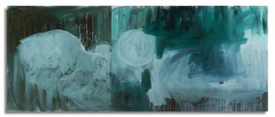 Marcia Freedman, On the Piano, oil on canvas, 48 x 108 in. (artwork © Marcia Freedman)
Marcia Freedman. Robinson Gallery, Bloomfield Art Center, Birmingham, Michigan, April 10–June 5, 2015. Memory & Observation. Painting.

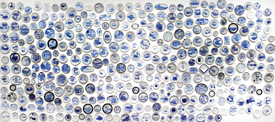 Julie Green, The Last Supper, 2000–2015, ongoing, 600 plates completed to date, dimensions variable (artwork © Julie Green)
Julie Green. Block Museum of Art, Northwestern University, Evanston, Illinois, May 9–August 9, 2015. The Last Supper: 600 Plates Illustrating Final Meals of U.S. Death Row Inmates. Painted ceramics.
Northeast
Serena Bocchino. Art Mora, New York, April 30–May 27, 2015. Serena Bocchino: Paintings.
South

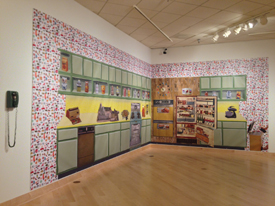 Sue Johnson, installation view of Early Sunday Morning in the Kitchen, Ready-Made Dream from American Dreamscape, print on vinyl with found object, 9½ x 32 ft. (artwork © Sue Johnson)
Sue Johnson. Walton Arts Center, Fayetteville, Arkansas, April 9–June 1, 2015, Ready-Made Dream from American Dreamscape. Installation.
Trigger Warning Presentation AAUP
posted Jun 22, 2015
DeWitt Godfrey, professor of art and art history at Colgate University and president of the CAA Board of Directors, delivered the following presentation during a panel on trigger warnings at the one hundredth anniversary conference of the American Association of University Professors in Washington, DC, on Friday, June 12, 2015. In addition, Linda Downs, CAA executive director, has written a response to the panel.
Trigger Warning Presentation AAUP
First I would like to thank Joan Bertin and Shaden Tageldin for the invitation to the College Art Association to participate in this panel. I would also like to thank CAA’s executive director Linda Downs, Nia Page, Director of Memebership and Michael Goodman, Director of IT for their support. Special thanks to Angela Gibson, Associate Managing Editor of Book Publications at MLA who created and analyzed the survey results.
I feel it’s just safer, teaching in the state of Texas, to put a clear statement on my syllabus at the beginning of the term. That way, I can point to it and say that the individual had been warned.
This is all new to me, but it’s made me think twice about each and every assignment that contains material that might make one student uncomfortable, but that is necessary for me to deliver the course as I believe it should be taught.
Self censorship is the worst form of censorship.
My concern is for the insidious ways that things like trigger warnings induce doubt, fear and intimidation.
During CAA’s Mellon Foundation supported Fair Use project, we learned shocking fact that 50% of scholars and 30% of artists had abandoned projects due to fear and misunderstanding of copyright. The chilling effects of this restrictive culture of permissions on cultural production and production of knowledge cannot be overstated; how many articles, books, exhibitions and dissertations have been lost to a culture that overemphasizes ownership and unfairly removes works from study and distribution?
I would like to place trigger warnings in the context of other ideological assaults on intellectual freedom, the ways that this brings well meaning persons from the left—often feminist left—into an uneasy (and I hope unintended) alliance with an anti-intellectual conservative right; each marshal oppressive forces of fear to stifle debate.
We are in a moment that requires academics, in my opinion, to reenage with the world, and regrettably the debates around education are currently on terms that are no longer our own. There sounds a steady drumbeat of demands that we justify the value and place of the arts and humanities in our institutions and culture; there are moves to shift already eroding funding and support towards alledgedly more practical, more instrumental areas of education and study with more quantitative deliverables of jobs and careers. And the old arguments that the humanities and arts are “good” for you or even the overwhelming evidence that arts and creative communities deliver measuable economic benefits are no longer adequate. These arguments are reactive and reduce what we do to the adjunctive and peripheral, where we cede the terms of the debate.
So what do we do in a context that can only relate to cultural production in terms of the liberal economic model? What are the counter narratives that lead us away from the place of hand wringing and learned helplessness passively awaiting our eventual destruction?
We must reassert the humanities as the space of speculation and imagination that is at the center of human experience and the creation of culture. Art is where cultures and communities work things out, where we come to terms with the unfamiliar and rexamine the familiar; we are the canary in coal mine and we hold our own string, we help define, create and then transgress the boundaries of the normative. We propose frameworks for discernment, we cultivate the value of small and subtle differences, we consider from more than a single perspective, we look closely, we see through ideologies of stark difference. We explore shifting criteria, ideally we teach our students how to construct their own, we help create the capacity for sound judgement, to understand the contingent nature of such judgements, to be comfortable with uncertainty.
A neuroscience colleague at my University put it this way: during a conversation with a group of faculty, one remarked on recent work in his field that seemed to promise, one day, that all of our feelings, emotions and sensations could be reduced to series of well understood electrochemical interactions, the merely mechanical. He replied that in the unlikely event that ever came to pass, we would still have to figure what to do about it, we would still have to decide what it would mean.
Ideological Attempts to proscibe what can and can’t be taught, even those based in good intentions like trigger warnings, put that process in jeopardy.
Very few of us, I suspect, want to deliberately or inadvertantly hurt our students but, as the survey response show, most of us want to challenge them, to provide spaces in which they confront the unfamiliar.
The idea of “safe” space has been transformed so far that the educational mission itself becomes framed as “unsafe.” I write this as a woman who works on difficult material by marginalized groups. I understand discursive inequality and the ways that texts can be experienced as deeply personal. But the “safe” idea has itself become quite dangerous, I think. A student this fall put it best: “I don’t want a safe space to protect me from the world; I want to develop tools to change the world.”
Conceptual art example.
Derived from the context shifting ready-mades of Duchamp, conceptual artists assert that the un-embodied idea alone can be a work of art. As a consequence, anything or nothing can be a work of art. Such realizations can require a wrenching shift in ones entire worldview. One day the cup and saucer on your breakfast table have clear and certain utility and meaning, the next you cannot be so sure, things slide back and forth losing and gaining defining qualities. Imagine your world-view as a completed puzzle, where the many variegated pieces fit neatly into a coherent bounded image. Changing the shape or orientation of one piece, your definition and understanding of what is and isn’t art for example, means that many—maybe even all—the other pieces must be rethought, reshaped and replaced to restore coherence, to reestablish a consistent, workable world-view.
One can understand then where the resistance and rejection of conceptual art’s challenge originates. I do not expect students to necessarily share my reading of art, I do not proselytize, but I do expect that their rejection or acceptance of this mode of art practice be based on an engagement with it, not merely because it doesn’t “fit” their current understanding.
Art often provokes emotional responses ahead of intellectual ones, students—and fellow faulty—are often offended by the challenges presented by the avant-garde, morally outraged.
Conceptual art happened, it cannot be unhappened.
How can we teach such things as war, homophobia, racism, misogyny, homophobia, and violence if we cannot expect students to read such texts or material? How can we educate students about such violence (and thus hope to end such violence) if students refuse to engage with it in the classroom? And what about students who might refuse material that is contrary to other belief systems? For example, might fundamentalist students (of any religion or political philosophy) refuse to read books on sexuality, feminism, or women? In a word, trigger warnings feel like a reasonable issue in terms of supporting student survivors of sexual violence. But what about other kinds of censorship? And painfully, it is the very students who ask for trigger warnings (often open-minded, progressive, well-meaning, feminist students) who dont understand that their feminist request sounds like a conservative one for many progressive teachers.
The appealing dangers of certainty, fanning the conflagration of fear and anxiety.
I have had my share of trauma, but I am not sure if the best way of coping is to have yet another paternalistic/maternalistic authority figure interfering with what may be a trigger or not. Let me be the judge.
I would be very wary of any policy that required instructors to provide trigger warnings, because essentially that would mean the University was regulating certain kinds of speech/imagery and denoting it as deviant or disturbing.
I have colleagues whose experience with students sensitized by such warnings, prepped for PTSD I would say, serves as appalling evidence of the manipulation of young women into self-conscious victim positions and the closing down of discourse. As a life-long feminist and survivor of kidnap and gang-rape myself, who has helped many others cope with the aftermath, I have no evidence that trigger warnings lead to anything but the cultivation of a posture of fear. And the damage to freedom of speech–and simply to education, particularly feminist education—is incalculable.
The shift from Political Correct to Individual Correctness, any one persons trauma is by definition, the greatest of traumas. The right to never be offended.
The “trigger warning”, which forces teachers to change their teaching plans based on calculations about what topics might hurt students’ feelings or make them feel “unsafe”, forces teachers into the work of affirming the narcissism of many privileged students. It also buys into the notion that learning, study and education is a consumer experience, and that the consumers (the students) get to decide whether they like the goods on offer.
How can one predict what experiences students bring so that one can provide the correct warnings? What may seem totally innocent to the faculty member may trigger a reaction from a student. It’s almost as if faculty now have to adapt each course to the number of students enrolled: independent studies would be a more accurate description of a course if accommodations have to be made for everyone.
As someone who teaches predominantly non-white literature that often times critiques white privilege, comments by white students regarding this course material seems to miss the actual point regarding trigger warnings—it refuses to acknowledge (and actually desires to protect) the very privilege that many of the texts critique.
Ideology, like theory, bends and twists all available material into the pursuit of its own agenda, and casts out the rest. Its uses are by definition limited.
We seem to be in a golden age of passive aggression, whereby the speech of others can be controlled or stopped if one feels ‘uncomfortable.’
PTSD is real, accomodations can be made as they already are for other conditions that impact a students participation, performance and evaluation.
I feel that students should assume agency and talk to their professors about any personal needs. To offer blanket trigger warnings sends the message that some triggers are more important than others. I don’t believe it is pedagogically useful to sanitize spaces of learning of anything that could cause discomfort. The “real” world does not come with trigger warnings.
Trigger Warnings
posted Jun 22, 2015
Trigger warnings was the topic addressed on a panel—organized by the National Coalition Against Censorship (NCAC), the Modern Language Association (MLA), and CAA—that took place at the one hundredth anniversary conference of the American Association of University Professors (AAUP) in Washington, DC, on Friday, June 12, 2015. Joan Bertin, executive director of NCAC, led a group of speakers that included Shaden Tageldin, professor of cultural studies at the University of Minnesota and chair of the MLA’s Women’s Committee, Anita Levy of AAUP, and DeWitt Godfrey, professor of art and art history at Colgate University and CAA president.
Faculty at several universities, including Wellesley College and the University of California, Santa Barbara, have adopted procedures to warn students, on syllabi, of disturbing topics that could trigger posttraumatic stress disorder or other strong reactions to subjects that will be presented in class. Students who may be affected are allowed to miss the class in which the identified work is discussed.
CAA and MLA prepared an informal survey in preparation for this panel and sent it to all members. Bertin summarized the results in her introduction. The survey found that less than 1 percent of the respondents’ institutions have adopted a policy on trigger warnings. However, 23 percent of faculty report that they have voluntarily provided warnings several times or regularly. Student-initiated efforts have instituted trigger warnings represent 7.5 percent. Fifteen percent of faculty indicated that students in their classes have requested warnings in the course they teach. Roughly 12 percent of respondents report that students have complained, either to the instructor or to administrators, about the failure to provide warnings. And 45 percent of respondents who have had first-hand experience with trigger warnings see it as a real threat to academic freedom. Many respondents added comments to the survey regarding their approaches, policies, concerns, and questions about trigger warnings. The panel will be reviewing them and preparing a document that summarizes them to assist other faculty in approaching this issue with their students and administrators.
Godfrey believes that trigger warnings are a form of self-censorship that induces doubt, fear, and intimidation in students as well as faculty. He called on faculty to reassert the humanities as a space of speculation and imagination at the center of human experience and to help students confront the unfamiliar in order to change it. “Art is where cultures and communities work things out,” Godfrey said, “where we come to terms with the unfamiliar and reexamine the familiar.” He sees a shift from the “politically correct” to “individual correctness,” where any one person’s trauma is, by definition, the greatest trauma. The individual now is asserting a right never to be offended or challenged intellectually. This shuts the door on exploration and discussion. There is also a chilling effect on faculty who are increasingly subject to administrative, student, and parental criticism and evaluation. Trigger warnings grew out of the feminist concern for the status of women on campus, but the result is that they find themselves in a place that can be identified as that of the political right. (CAA has published the text of Godfrey’s presentation.)
Tagilden indicated that trigger warnings grew out of the feminist concern for the status of women related to the trauma of rape, and that there should be a clear differentiation between mediated reality and reality in the classroom, so that students can move beyond their own limitations and find outlets and language to deal with traumas instead of normalizing victim appropriation. If students opt out of classes with difficult material, it automatically places the personal on a political plane.
What is the cause of this interest in protecting students from topics that may be difficult or traumatizing to address? Some in the audience saw it as coddling students for fear of criticism being levied on faculty. Some saw it as a question of race and class privilege. Students who have lived protected lives determine the need for treatment of all students. Others see it as a new generation of students isolated and unable to handle personal interaction as described in Sherry Turkle’s Alone Together.
The panel will be reviewing all the comments from respondents to the CAA/MLA survey to cull the most useful approaches that were recommended from the field to address the issue of trigger warnings. These recommendations will be posted by NCAC, CAA, and MLA in the near future.
2015 Fellowships for MFA and PhD Students
posted Jun 19, 2015
CAA has begun accepting applications from MFA and PhD students for its Professional-Development Fellowships in the Visual Arts and Art History. For the current cycle, CAA will award grants of $10,000 each to outstanding students who will receive their terminal degrees in the calendar year 2016. One award will be presented to a practitioner—an artist, designer, and/or craftsperson—and one award will be presented to an art, architecture, and/or design historian, curator, or critic.
Fellows also receive a free one-year CAA membership and complimentary registration to the 104th Annual Conference in Washington, DC, taking place February 3–6, 2016. Honorable mentions, given at the discretion of the jury, earn a free one-year CAA membership and complimentary conference registration.
CAA’s fellowship program supports promising artists, designers, craftspersons, historians, curators, and critics who are enrolled in MFA, PhD, and other terminal degree programs nationwide.. Awards are intended to help the students with various aspects of their work, whether it be for job-search expenses or purchasing materials for art/design practice. CAA believes a grant of this kind, without contingencies, can best facilitate the transition between graduate studies and professional careers.
Please visit collegeartassociation.slideroom.com to submit applications to the Professional-Development Fellowship programs. The deadline for applications for the PhD fellowships is Friday, October 2, 2015, and Monday, November 16, 2015, for the MFA fellowships. Awardees will be announced in January 2016.