
CAA News Today
Affiliated Society News for January 2014
posted Jan 09, 2014
American Institute for Conservation of Historic and Artistic Works
The American Institute for Conservation of Historic and Artistic Works (AIC) has recently published Ethics and Critical Thinking in Conservation, a collection of essays that brings into focus a moment in the evolution of the complex decision-making processes required when conservators consider the treatment of cultural-heritage materials. The papers presented are drawn from two consecutive years of presentations during general sessions at the AIC annual meeting. These were “Ethos Logos Pathos: Ethical Principles and Critical Thinking in Conservation” (2011) and “The Conservation Continuum: Examining the Past, Envisioning the Future” (2010). The book is available in two formats: a full-color hardcover for $30 and a black-and-white paperback for $15. The hardcover features nearly fifty full-color figures and illustrations throughout the text. Copies can be ordered at www.conservation-us.org/shop.
Art Historians of Southern California
The Art Historians of Southern California (AHSC) will host a roundtable on “The Coalition of the Art Association: California Public Education and the Promise of the Humanities,” chaired by Jane Chin Davidson of California State University, San Bernardino, at CAA’s Annual Conference in Chicago. The event will take place on Thursday, February 13, 2014, 12:30–2:00 PM in Boulevard C, 2nd Floor, Hilton Chicago. The discussion will include professors of art history, visual studies, and the humanities who have represented the California system—California Community Colleges, the California State Universities (CSUs), and the Universities of California (UCs)—such as Amelia Jones, Catherine Cole, Jennifer Doyle, Jennifer Gonzalez, and Sandra Esslinger. This roundtable will address issues of legislation, labor, and class within the academy while finding ways to acknowledge the value of the humanities in university education. Through their membership in CAA, visual art and humanities professors have long been the organizing principle of our potential solidarity. The perpetual decline of art history and visual studies has recently led to public scrutiny of CAA’s centralized leadership (see “An Open Letter to Victoria H. F. Scott Regarding the CAA,” February 8, 2013). In light of the continuing need for political advocacy, the leadership of CAA could provide a means for organizing coalition and for affecting the status of the humanities by bringing greater representation and awareness to both academic and public spheres.
Art Libraries Society of North America
The Art Libraries Society of North America (ARLIS/NA) is pleased to announce the election of new executive board members: Kristen Regina of the Hillwood Estate, Museum, and Gardens is vice president and president elect; Mark Pompelia of the Rhode Island School of Design is treasurer; Sylvia Roberts of Simon Fraser University in Canadian member-at-large; and Holly Hatheway of Yale University is communications and publications liaison.
ARLIS/NA recently created the post of Multimedia and Technology Reviews. The first reviews will be posted on the ARLIS website in early 2014.
Save the date for the ARLIS/NA 2014 annual conference, which will be held May 1–5, 2014, in Washington, DC. For more information, please visit the conference website.
Community College Professors of Arts and Art History
The Community College Professors of Arts and Art History (CCPAAH) will hold two events at this year’s CAA Annual Conference: a business meeting on Friday, February 14, from 7:30 to 9:00 AM in the Williford C Room on the 3rd Floor of the Hilton Chicago; and the session “Starting the Conversation: Engaging Students in the Studio and Art History” at 12:30 PM in the same space. Interested in participating or any questions? Contact Susan Altman.
Historians of Islamic Art Association
The Historians of Islamic Art Association (HIAA) is pleased to announce the election of two new members to its executive board. Sussan Babaie has been elected president-elect, and Abigail Balbale is secretary. Each will serve a three-year term beginning in January 2014; both will be officially welcomed to the board at its 2014 members and business meeting on February 14, 2014, in conjunction with the CAA Annual Conference in Chicago. At that time, Sheila Canby will succeed Marianna Shreve Simpson as president. Preparations also continue for HIAA’s fourth biennial symposium, which will be hosted by the new Aga Khan Museum in Toronto, Ontario, in October 2014.
Historians of Netherlandish Art
The Historians of Netherlandish Art (HNA) will hold its quadrennial conference in Boston, Massachusetts, from June 5 to 7, 2014, in cooperation with the American Association for Netherlandic Studies. Please refer to the HNA website for further information. Additionally, HNA is pleased to announce the publication of the Summer 2013 issue of the open-access, refereed ejournal Journal of Historians of Netherlandish Art (JHNA). This special issue of the journal is dedicated to Egbert Haverkamp-Begemann. In addition to excerpts from an interview with Begemann discussing his life as a scholar, curator, and teacher, the issue includes essays by his former students. The next formal deadline for submissions to JHNA is March 1, 2014; please send correspondence to the editor in chief, Alison Kettering.
International Sculpture Center
Each year the International Sculpture Center (ISC) presents an award competition to its member colleges and universities as a means of supporting, encouraging, and recognizing the work of young sculptors and their supporting schools’ faculty and art program. The Student Award winners participate in an exhibition at Grounds for Sculpture, as well as a traveling exhibition hosted by arts organizations across the country. Winners’ work is also featured in Sculpture magazine. Each winner receives a one-year ISC membership; all winners are eligible to apply for a fully sponsored residency to study in Switzerland. To nominate students for this competition, the nominees’ university must first be an ISC university-level member. University membership costs $200 for universities in the United States, Canada, and Mexico ($220 for international universities) and includes a number of benefits. Students who are interested should talk to their professors about getting involved. To find out more about the program, please visit www.sculpture.org/StudentAwards/2014 or email studentawards@sculpture.org. Nominations open: January 1, 2014; University membership registration: March 17, 2014; online student nomination form: March 24, 2014; online student submission form: April 14, 2014.
Italian Art Society
The Italian Art Society (IAS) invites members attending the CAA Annual Conference in Chicago to its first session “Periodization Anxiety in Italian Art: Renaissance, Baroque, or Early Modern” at 9:30 AM on February 13, 2014; IAS’s business meeting at 7:30 AM on February 14; and its second session “‘Futuro Anteriore’: Cultural Self-Appropriation as Catalyst in the Art of Italy” at 12:30 PM on February 14.
The society’s website details the five IAS sessions at the Renaissance Society of America meeting (New York, March 27–29, 2014) and includes a call for submissions to IAS-sponsored sessions at the Sixteenth Century Society and Conference (New Orleans, October 2014; deadline to IAS: March 1, 2014).
Launched in July 2013, the IAS-initiated IASblog offers news and notes on Italian art and architecture as a complement to its main website. IASblog, edited by the IAS webmaster, Anne Leader, now has over nine hundred followers and two thousand unique visitors. IASblog welcomes submissions from members via the Submit button or by email.
National Art Education Association
Register now for the national convention of the National Art Education Association (NAEA), taking place March 29–31, 2014, in San Diego, California. We are visual arts educators. We are artists. We are creative leaders. Lead your professional learning experience at the 2014 NAEA national convention. Choose from more than one thousand sessions, workshops, tours, and events. Fuse creative thinking with art knowledge, skills, emerging technology, and new research to create powerful opportunities for your classroom, career, and beyond. Connect with thousands of colleagues from around the globe for the largest gathering of visual arts education in the world. Join a professional learning community and spend four art-filled days in Washington, DC, exploring permanent collections, current exhibitions, and the museum itself as a work of art.
NAEA SummerVision DC, now in its fifth year, is an annual NAEA event that partners with Washington, DC–area art museums to showcase best practices in critical response to art while enhancing creativity through visual journaling and by using a balanced, interdisciplinary “Form + Theme + Context (FTC) Palette for Museums and Works of Art” to enhance visual learning. Participating museums include the National Gallery of Art and Sculpture Garden, the Freer Gallery of Art and Arthur M. Sackler Gallery, the National Museum of African Art, the National Museum of Women in the Arts, the Phillips Collection, the National Building Museum, the Corcoran Gallery of Art, the Smithsonian American Art Museum, and the National Portrait Gallery. Registration is limited to twenty-five participants per session. Choose from two sessions: July 8–11 or July 22–25, 2014.
New NAEA publications include Michelle Kraft and Karen Keifer-Boyd’s Including Difference: A Communitarian Approach to Art Education in the Least Restrictive Environment(no. 322); and The Learner-Directed Classroom: Developing Creative Thinking Skills through Art (no. 326), edited by Diane B. Jaquith and Nan E. Hathaway.
National Council of Arts Administrators
The National Council of Arts Administrators (NCAA), a community of current and future arts administrators in higher education, announces two events for CAA’s 2014 Annual Conference in Chicago: NCAA MIXER—You’re all invited, administrators or not, grab a friend and bring ‘em along; Thursday, February 13, 5:00–8:00 PM, Hilton Chicago (room TBA); and the session “Hot Problems/Cool Solutions in Arts Leadership,” which is a fast-paced series of five-minute presentations on leadership occurring on Friday, February 14, 5:30–7:00 PM in Williford C, 3rd Floor, Hilton Chicago. NCAA members hope to see you at both events in which attendees will share conviviality and ideas.
Public Art Dialogue
Jack Becker, the 2014 recipient of Public Art Dialogue’s annual award, will make a presentation at the CAA Annual Conference in Chicago on Friday, February 14, 5:30–7:00 PM. A conference on “Monument/Anti-Monument” will be held in St. Louis in April. Stay tuned for details. There have been several changes in PAD personnel. Sarah Schrank has stepped down as cochair, and Kelly Pajek will complete her term. Sierra Rooney is now both PAD secretary and treasurer. The Fall 2013 issue of Public Art Dialogue, edited by Eli Robb, considers “Perspectives on Relational Art.” Six articles explore practices based on human interactions: Caroline Peters and Ben Bloch, “To the Quick with Paul Crik: The World’s First E-Motivator Kills It with Public Art Dialogue; Cara Jordan, “The Evolution of Social Sculpture in the United States: Joseph Beuys and the Work of Suzanne Lacy and Rick Lowe”; John Tain, “Peace Tower as Commonplace: Relational Aesthetics’ Lieux de mémoire”; Lauren Rotenberg, “The Prospects of “Freed” Time: Pierre Huyghe and L’Association des Temps Libérés”; Gediminas Gasparavičius, “How the East Saw East in 1992: NSK Embassy Moscow and Relationality in Eastern Europe”; and Dee Hibbert-Jones, “A New Band-Aid for Social Ailments? Raising Questions on Social Practice and Social Responsibilities.”
Society for Photographic Education
Registration is open for the fifty-first annual national conference of the Society for Photographic Education (SPE), titled “Collaborative Exchanges: Photography in Dialogue.” In an age of interconnectedness, photographers are no longer solitary practitioners peering at the world through the singular eye of the viewfinder. Rather, photography is positioned at the heart of the discourse on contemporary art, establishing relationships with a broad array of ideas and media. This conference illuminates this new paradigm and celebrates the spirit of cooperation and social linkages. Join 1,600 artists, educators, and photographic professionals from March 6 to 9, 2014, for programming and dialogue in Baltimore, Maryland, that will fuel your creativity. The event will be a celebration of the power of community and social exchange to propel new thinking in photographic practice. Explore SPE’s exhibits fair showing the latest equipment, processes, publications, and schools with photo-related programs. Participate in one-on-one portfolio critiques and informal portfolio sharing and take advantage of student volunteer opportunities for reduced admission. Other conference highlights include a print raffle, silent auction, photo scavenger hunt, film screenings, exhibitions, tours, receptions, a dance party and more! Keynote Speakers: Joan Fontcuberta, Nicholas Kahn and Richard Selesnick, Taryn Simon, and Catherine Lord. Preview the conference schedule and register online.
Society of Historians of East European, Eurasian, and Russian Art and Architecture
The Society of Historians of East European, Eurasian, and Russian Art and Architecture (SHERA) will sponsor a session at the 2014 CAA annual conference in Chicago titled “Decentering Art of the Former East,” chaired by Kristen Romberg and Masha Chlenova. SHERA will also hold a business meeting that is open to both current and prospective members. In addition, the organization is pleased to welcome CAA International Travel Grant recipients from Eastern Europe and Russia to its events at the conference. Please visit the News section of the SHERA website for details as the conference approaches.
The annual conference of the Association of Slavic, East European, and Eurasian Studies (ASEEES), held in Boston, Massachusetts, in November 2013, showed a surge in activity from SHERA members, who presented their work on fourteen panels and in roundtable discussions ranging from the imperial era to the present day. The SHERA business meeting attracted over forty people, including many new members. Ballot proposals for electronic voting in January 2014 would amend SHERA’s bylaws to include the listserv administrator on the list of officers and would also replace the position of webmaster with a web news editor. Balloting will also elect a new slate of members-at-large. SHERA members will receive voting information by email in early January.
Career Services Guide for the 2014 Annual Conference
posted Jan 09, 2014
The January 21 and 28 issues of CAA News gave the incorrect URL for the Career Services Guide for the 2015 Annual Conference in New York. Please click here to download and read that document.
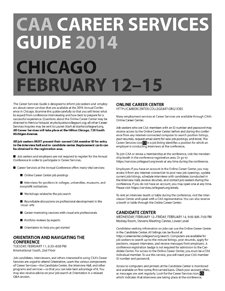 CAA has designed the Career Services Guide to inform job seekers and employers about placement activities at the 2014 Annual Conference in Chicago. The publication, available as a PDF, will help you navigate Career Services events and provides answers to frequently asked questions. Study this guide carefully so that you will know what to expect from conference interviewing and how best to prepare for a successful experience.
Job candidates can review the basics of the conference employment search. Read about the Candidate Center, your home base at the conference, as well as Orientation, an introduction to Career Services where you can ask questions. In addition, learn more about the Online Career Center, where you can search for position listings, post application materials, and arrange interviews. The publication includes tips for improving your CV, portfolio, and supplemental application materials.
Employers will find details in the guide for renting interview booths and tables as well as recommendations for posting jobs and conducting interviews at the conference. You can begin preparations now for Career Services through the Online Career Center or onsite at the Interviewer Center.
Printed copies of the Career Services Guide will be distributed onsite at Orientation and in the Candidate Center. All conference Career Services will take place at the Hilton Chicago. For more information about job searching, professional-development workshops, and more, visit the Career Services section of the conference website.
Art History Teaching Resources Seeks Lesson Plans
posted Jan 08, 2014
Do you have a great lesson plan you want to take some time to codify and share? Following a recently awarded Kress grant for digital resources, Art History Teaching Resources (AHTR), a peer-populated platform for instructors that is home to a constantly evolving, collectively authored online repository of art-history teaching content, seeks contributors for specific subject areas in the art-history survey.
AHTR is particularly interested the following sections in art and architecture for publication in early spring 2014:
- Ancient Egyptian
- Ancient Aegean
- Ancient Greek
- Ancient Etruscan and Roman
- Proto-Renaissance and Fourteenth Century Italian Renaissance
- Fifteenth-Century Italian Renaissance
- Fifteenth-Century Northern Renaissance
For each content area, AHTR seeks lecture and lesson plans similar to those developed for its sections on Prehistory and Prehistoric Art in Europe and Art of the Ancient Near East. These plans, which will be posted to the AHTR website in early 2014, are supported by $250 writing grants made possible by the Kress award.
All parts in the art-history survey, however, will eventually need to be populated. If your area of interest is not listed above, AHTR is still interested in hearing from you. Let us know which area(s) you’d like to cover: a full list can be found under Survey 1: Prehistory to Gothic and Survey 2: Renaissance to Modern and Contemporary. In addition, we welcome suggestions on how to fill the gaps in these chronologies.
AHTR is looking for contributors who:
- Have strong experience teaching the art-history survey and strong interest in developing thoughtful, clear, and detailed lesson plans in particular subject areas
- Are committed to delivering lecture content (plan, PowerPoint, resources, activities) for one to two (a maximum of two) content areas in a timely manner. Each content area will be supported by a $250 Kress writing grant
- Want to engage with a community of peers in conversations about issues in teaching the art-history survey
AHTR’s intention is to offer monetary support for the often-unrewarded task of developing thoughtful lesson plans, to make this work freely accessible (and thus scalable), and to encourage feedback on them so that the website’s content can constantly evolve in tandem with the innovations and best practices in the field. In this way, AHTR wants to encourage new collaborators to the site—both emerging and experienced instructors in art history—who will enhance and expand teaching content. It also wishes to honor the production of pedagogical content at the university level by offering modest fellowships to support digital means of collaboration among art historians.
Please submit a short, teaching-centered CV and a brief statement of interest that describes which subject area(s) you wish to tackle to teachingarthistorysurvey@gmail.com. These initial texts should be delivered to AHTR in February 2014. Collaboration on content for further subject areas will be solicited throughout 2014.
News from the Art and Academic Worlds
posted Jan 08, 2014
Each week CAA News publishes summaries of eight articles, published around the web, that CAA members may find interesting and useful in their professional and creative lives.
Conventional Wisdom
Thousands of literature scholars will emerge from their research cocoons, don their finest black duds, and descend upon Chicago for this year’s convention of the Modern Language Association. They’ll all be there: muckety-mucks whose rings ache for kissing; frazzled early-career professors angling for tenure; and, of course, hordes of desperate graduate students and barely employed PhDs, hoping to break into what everyone actually calls “the profession.” (Read more from Slate.)
How the Humanities Compute in the Classroom
Computer-assisted scholarship in the humanities dates back decades. In the past five years, though, the kinds of work collectively known as the digital humanities have taken on fresh luster. Observers have called this technology-inflected research “the next big thing.” Beyond the headlines and hoopla, digital scholarship has begun to work its way into the academic ecosystem. In the following collection of articles, read more about how the digital humanities play now in the undergraduate classroom, whether they pay off in tenure and promotion, and what it takes to create a work of digital scholarship that will last. (Read more from the Chronicle of Higher Education.)
Garage Sale Renoir Painting Sparks Legal Battle with Museum
A one-of-a-kind Renoir painting the size of a napkin is at the center of an intense legal battle between a museum that claims it was stolen and a Virginia woman who claims she bought it for $7. The tiny work of art is an 1879 landscape by the Impressionist painter titled Paysage Bords de Seine. In court papers filed this week, the Baltimore Museum of Art claims the painting was stolen in 1951. As evidence, the museum provided a sixty-year-old police report, old museum catalogues, and a receipt showing that a patron bequeathed the painting to the museum. (Read more from ABC News.)
Conserving Priceless Chinese Paintings Is an Art All Its Own
Outside China and Taiwan, American museums hold the world’s best collection of Chinese paintings. It’s worth billions of dollars, but it’s also fragile: over time, these paintings fall apart. In the US, only four master conservators know how to take care of them, and they’re all approaching retirement. The Freer and Sackler Galleries—one of the huge, stone Smithsonian buildings on the National Mall in Washington, DC—employ one of those masters. (Read more from National Public Radio.)
Technology in Museums: Less Is More!
The experience of going to a museum often feels a little engineered. A heavy curatorial hand leads you through an exhibition, making it hard to resist reading the panels of information contextualizing and explaining the art or artifacts on display rather than come to your own appreciation of them. Audio guides offer to fill in gaps in your knowledge and give you expert insights. Sometimes glistening screens nearby beckon you to see more. (Read more from Spiked.)
Let’s Change the World for Art Students in 2014
Funding cuts and a move to banish art lessons from schools made 2013 a sad year for creative education. But art students and their staff are regrouping for a fight they believe is there to be won. The number of students applying to study creative arts in British universities is on the decline. According to the latest available data from UCAS, the number of applications fell 17 percent from 2011 to 2012. (Read more from the Guardian.)
Mock, Phone, Video Interviews
Participating in a mock interview my first time on the job market was the most embarrassing moment of my academic career. I dressed in as close to a suit as I owned at the time and walked into the large classroom we had scheduled, where the seven faculty members sat in a semicircle. They were all specialists in their fields, so their questions probed my ability to be conversant in each field, whereas my specialty was about combining the fields. Yet I wasn’t able to articulate how or why I did that. Realizing that I really couldn’t answer their questions was incredibly humbling. (Read more from Inside Higher Ed.)
Ten Tips for Tweeting at Conferences
Tweeting at conferences is a great way to share what you’re learning in a session with your followers and the wider world. It’s also a great way to be in two places at once, as you can read tweets from other sessions that you weren’t able to attend. You can read those tweets as they come in or—if you’d rather not fracture your attention—read them after the fact using a Twitter search. (Read more from ProfHacker.)
Wix.com Webinar on Creating a Strong Online Presence
posted Jan 07, 2014
Creating a strong online presence is the key to a successful career. During this special workshop for CAA, to be held on Wednesday, February 5, 2014, 3:00–4:00 PM EST, representatives from Wix.com will go over the fundamentals for creating a personal online brand. They will also explain how to choose the best social channels, visual branding, and website creation with Wix.com, a no-code, visual drag-and-drop editor that uses the latest HTML5 technology to help you build the best website possible. With Wix you can have a beautiful, free website in just a few hours.
Call for Testimonials for “Academic Porn”
posted Jan 07, 2014
In academia, it is well known that politics among colleagues, institutions, and committees are rarely, if ever, spoken about publicly. Instead, an artist-educator and/or art historian is left alone to navigate what sometimes may be murky, dangerous waters in order to avoid getting eaten by the lurking academic sharks.
At the 2014 Annual Conference in Chicago, ARTspace will host an interactive, American Idol–like event titled “Academic Porn: Revealing the Politics in Academia” on Thursday, February 13, 2:30–5:00 PM. Focusing on difficult and uncomfortable circumstances that commonly arise in institutional environments, the four panelists will address dilemmas in academic politics, acting as “judges” adjudicating—and hopefully resolving—these issues.
In advance of this event, the organizers of “Academic Porn” need your testimonials. Feel free to anonymously (or not!) share situations that you or your colleagues have experienced. The panel’s moderator, Sharon Louden, will be reading these testimonials out loud, with a live Twitter feed and audience participation enthusiastically welcomed. Please send your testimonials directly to her at sharon.louden@gmail.com.
Meiss Grant Winners for Fall 2013
posted Jan 06, 2014
This fall, CAA awarded grants to the publishers of eight books in art history and visual culture through the Millard Meiss Publication Fund. Thanks to the generous bequest of the late Prof. Millard Meiss, CAA gives these grants to support the publication of scholarly books in art history and related fields.
The grantees for fall 2013 are:
- Claudia Brittenham, The Cacaxtla Paintings, University of Texas Press
- Georges Didi-Huberman and Harvey Mendelsohn, trans., The Surviving Image: Phantoms of Time and Time of Phantoms: Aby Warburg’s History of Art, Pennsylvania State University Press
- Cécile Fromont, The Art of Conversion: Christian Visual Culture in the Kingdom of Kongo, University of North Carolina Press
- Kristina Kleutghen, Imperial Illusions: Crossing Pictorial Boundaries in Eighteenth-Century China, University of Washington Press
- Wei-Cheng Lin, Building a Sacred Mountain: The Buddhist Architecture of China’s Mount Wutai, University of Washington Press
- Maria Loh, Still Lives: Death, Desire, and the Portraits of the Old Masters, Princeton University Press
- T’ai Smith, Writing on Weaving: A Bauhaus Craft, a Bauhaus Medium, University of Minnesota Press
- Laura Weigert, Late Medieval Visual Culture and the Making of Theater in France, Cambridge University Press
Books eligible for Meiss grants must already be under contract with a publisher and on a subject in the visual arts or art history. Authors must be current CAA members. Please review the application guidelines for more information.
Recent Deaths in the Arts
posted Dec 27, 2013
In its regular roundup of obituaries, CAA recognizes the lives and achievements of the following artists, historians, curators, dealers, collectors, and others whose work has significantly influenced the visual arts. Notable deaths in fall 2013 include the artist Anthony Caro, the photographer Saul Leiter, the philosopher and critic Arthur C. Danto, and the scholar and curator Karin Higa.
- Kirk Alexander, an art historian, civil engineer, and educational-technology expert who worked at Princeton University and the University of California, Berkeley, died on October 1, 2013. He was 63
- Charles Cajori, an artist who was part of the second generation of Abstract Expressionists in New York, passed away on December 1, 2013, at the age of 92
- Anthony Caro, a British modernist artist who created colorful, welded steel sculptures, died on October 23, 2013. He was 89 years old
- Arthur C. Danto, a philosopher and art critic who taught at Columbia University and wrote for the Nation, died on October 25, 2013, at age 89
- Wanda Ewing, an artist, printmaker, and associate professor of art at the University of Nebraska, died on December 8, 2013. CAA has published a special obituary for Ewing, who was a member of CAA’s Committee on Women in the Arts, written by Maria Elena Buszek
- Günther Förg, a German artist who worked in painting, sculpture, and photography commented on modernism, died on December 5, 2013. He was 61
- Michael Harvey, a pioneer in the craft of lettering and the development of typefaces, died on October 18, 2013, at the age of 81
- Karin Higa, a scholar of Asian American art and a curator for the Japanese American National Museum in Los Angeles, passed away on October 29, 2013. She was 47. Higa had been a member of the editorial board for Art Journal, which has published a series of remembrances
- Jenny Hoon, a lecturer on textile design at the Derby School of Art (now the University of Derby) for many years, died on October 15, 2013, at age 79. She also served as an administrator and examiner for numerous schools
- Saul Leiter, a pioneering photographer of images using color film, died on November 26, 2013. He was 89 years old
- Georgina Livingston, an English landscape architect whose projects included the visitor’s center at Stonehenge and the Cambridge University Centre for Mathematical Sciences, died in October 2013. She was 72
- Brian MacDermot, a London stockbroker who became a dealer of nineteenth-century Orientalist painting, died on September 12, 2013, age 82
- Gridley McKim-Smith, an art historian who specialized in seventeenth-century Spanish art and a longtime professor at Bryn Mawr College, passed away on October 19, 2013. She was 70 years old
- Samuel Clifford Miller, director of the Newark Museum from 1968 to 1993, died on November 7, 2013, at the age of 83
- José Esteban Muñoz, a queer theorist and a professor in the Tisch School of the Arts at New York University, died on December 4, 2013. He was 46 years old
- Hajime Nakatani, a professor of East Asian art history who worked in Canada and Japan, died in June 2013. He was 46
- George Ortiz, a French collector of antiquities from Sumer, Babylon, Egypt, and Greece, passed away on October 8, 2013. He was 86
- George Rodrigue, a New Orleans–based artist beloved for his paintings of the Blue Dog, died on December 14, 2013. He was 69
- Leslie Sacks, a Californian art dealer with galleries at Bergamot Station in Santa Monica and in Brentwood, died in October 2013. She was 61 years old
- Àngeles Santos, a Catalan artist who was often called the Spanish Rimbaud, died on October 3, 2013. She was 101 years old
- Martin Sharp, a psychedelic artist who designed album covers in the late 1960s and who founded Oz magazine, died on December 1, 2013, age 71
- Michael Sullivan, a historian of Chinese art who taught at Stanford University from 1966 to 1984, died on September 28, 2013. He was 96
- Deborah Turbeville, a fashion photographer and a contemporary of Helmut Newton and Guy Bourdin whose images appeared in Vogue and Harper’s Bazaar, died on October 24, 2013. She was 81 years old
- David Vestal, a photographer and professor at Parsons School of Design, the School of Visual Arts, and Pratt Institute, died on December 4, 2013. Born in 1924, he received two John Simon Guggenheim Fellowships in photography in 1966 and 1973
- Ian White, an artist, curator, and writer who performed his works at Tate Britain, Tate Modern, and the Institute for Contemporary Arts in London, died on October 26, 2013, at the age of 41
- Victor Zamudio-Taylor, a Mexican curator, art advisor, and promoter of contemporary art, has died. Born in 1956, he was once a Rockefeller Foundation senior associate researcher at the National Museum of American Art and the Archives of American Art
Read all past obituaries in the arts in CAA News, which include special texts written for CAA. Please send links to published obituaries, or your completed texts, to Christopher Howard, CAA managing editor, for the next list.
News from the Art and Academic Worlds
posted Dec 25, 2013
Each week CAA News publishes summaries of eight articles, published around the web, that CAA members may find interesting and useful in their professional and creative lives.
The World’s Most Famous Missing Painting
Vincenzo Peruggia was not the kind of criminal mastermind that makes up the majority of art thieves in Hollywood films. He was not a genius cat burglar. He managed to walk into the Louvre in Paris and walk out with the Leonardo painting after minimal preparation. But his theft created a sensation. (Read more from BBC News.)
Understanding Wood Supports for Art: A Brief History
Historically, wood panels were used for paintings long before the adoption of flexible fabric supports. Most of the earliest icons still intact from the second and third century as well as a large portion of the Renaissance paintings were created on solid wood panels. Many of Raphael’s paintings, for example, are painted on primed wood panels. The method for preparing the panels was laborious as the solid wood was first dried well and sanded very smooth. It was then covered with layers of ground made by mixing gypsum (pounded into powder) with hide glue made from animal skins. The panel was then sanded and burnished until it was smooth and ready for painting. (Read more from Just Paint.)
Academic Freedom and Electronic Communications
This report brings up to date and expands upon the association’s 2004 report, Academic Freedom and Electronic Communications. It reaffirms that report’s overriding principle: “Academic freedom, free inquiry, and freedom of expression within the academic community may be limited to no greater extent in electronic format than they are in print, save for the most unusual situation where the very nature of the medium itself might warrant unusual restrictions.” (Read more from the American Association of University Professors.)
The British Library Puts One Million Images into the Public Domain, Making Them Free to Reuse and Remix
Earlier this week, Oxford’s Bodleian Library announced that it had digitized a 550-year old copy of the Gutenberg Bible along with a number of other ancient bibles, some of them quite beautiful. Not to be outdone, the British Library came out with its own announcement on Thursday: “We have released over a million images onto Flickr Commons for anyone to use, remix and repurpose. These images were taken from the pages of 17th, 18th and 19th century books digitised by Microsoft who then generously gifted the scanned images to us, allowing us to release them back into the Public Domain.” (Read more from Open Culture.)
Fakers, Fakes, and Fake Fakers
Many years ago, I interviewed a forger named David Stein. He had been arrested for faking hundreds of drawings, gouaches, and watercolors by Matisse, Chagall, Picasso, Cézanne, Degas, Miró, and many others. One day, while he was out on bail, I asked him how an art forger creates works by well-known artists whose styles are so different. “The first thing you have to do is know intimately the artist you are imitating, not only to know him but also to like him, to love his art,” Stein said. (Read more from ARTnews.)
Job Placement Confusion
With tuition prices continuing to rise and greater numbers of graduates struggling in the job market, families, students and policy makers—most visibly President Obama—are increasingly questioning the “value” that colleges are providing. In response to that mounting pressure, more colleges and universities are turning to alumni outcome surveys. (Read more from Inside Higher Ed.)
How to Score That Elusive Spousal Hire
The spousal/couple/dual-career search is, hands down, the most stressful kind of academic job search there is. And I know this viscerally, because I had an ex-husband with a PhD—in a different humanities field, but still—and can still remember the sick feeling in my stomach, the cold sweats late at night, the gut-wrenching anxiety as I contemplated just how in god’s name we were going to get both of us gainfully employed on the tenure track. (Read more from Vitae.)
Need for Leaders at DC Arts Institutions Could Be a Golden Opportunity or a Squandered One
The Kennedy Center recently announced that Deborah Rutter of the Chicago Symphony Orchestra Association will become its new president, but many high-profile Washington cultural and arts institutions are still searching for new leaders to fill their top posts. The Smithsonian Institution announced in October that its secretary, Wayne Clough, would be stepping down next year, and Richard Koshalek, the former director of the Hirshhorn Museum and Sculpture Garden, resigned in May after the demise of his seasonal inflatable structure project. (Read more from the Washington Post.)
LACMA Resurrects Art and Technology Program, Teams with Google
More than forty-five years ago, the Los Angeles County Museum of Art created an experimental program to bring artists and technology companies together in the hopes of inspiring innovative thinking in the visual arts. Earlier this month museum announced that it is resurrecting the program in the form of a laboratory and has partnered with companies including Google and SpaceX. (Read more from the Los Angeles Times.)
Solo Exhibitions by Artist Members
posted Dec 22, 2013
See when and where CAA members are exhibiting their art, and view images of their work.
Solo Exhibitions by Artist Members is published every two months: in February, April, June, August, October, and December. To learn more about submitting a listing, please follow the instructions on the main Member News page.
December 2013
Abroad

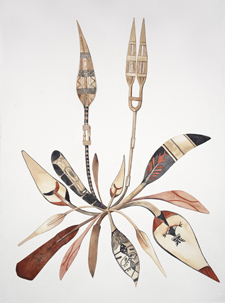 Sue Johnson, Paddling Brush, 2011, gouache, watercolor, and pencil on paper (artwork © Sue Johnson; photograph by Malcolm Osman/PRM)
Sue Johnson. Salisbury and South Wiltshire Museum, Salisbury, England, February 1–May 10, 2014. Pitt Rivers: Collecting Patterns. Painting and printmaking.
Mid-Atlantic

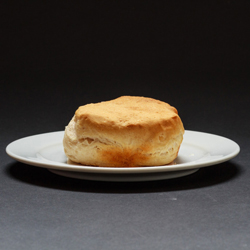 Peter Dueker, Untitled (#9), digital c-print, 10 x 10 in. (artwork © Peter Dueker)
Peter Dueker. Outer Space, Washington, DC, October 5–26, 2013. 19 Hot Biscuits. Photography.
Midwest

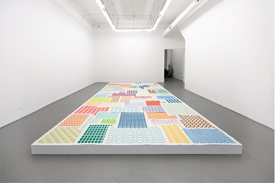 Michelle Grabner, Untitled, 2013 (artwork © Michelle Grabner; photograph provided by the artist and Shane Campbell Gallery, Chicago)
Michelle Grabner. Museum of Contemporary Art, Cleveland, Ohio, November 1, 2013–February 16, 2014. I Work from Home. Painting, printmaking, video, and sculpture.

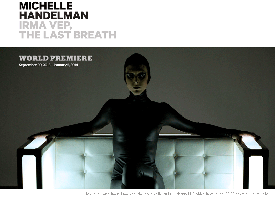 Michelle Handelman, Irma Vep, the last breath, 2013, 4-channel HD video installation, 33:00 min. (artwork © Michelle Handelman; photograph by Laure Leber)
Michelle Handelman. Eli and Edythe Broad Art Museum, Michigan State University, East Lansing, Michigan, September 20, 2013–March 30, 2014. Irma Vep, the last breath. Multichannel video installation.

Amy Reidel. Meramec Contemporary Art Gallery, Saint Louis Community College, Saint Louis, Missouri, October 3–25, 2013. Relic-quarry: New Work by Amy Reidel. Painting, installation, collage, and video.
Northeast

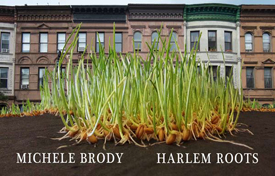 Invitation card for Michele Brody’s Harlem Roots
Michele Brody. Casa Frela, New York, November 9–December 9, 2013. Harlem Roots. Environmental installation.

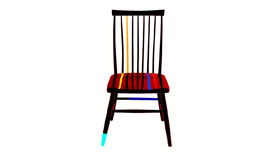 Sharon Louden, still from Community, 2013, digital animation, 2:35 min. (artwork © Sharon Louden)
Sharon Louden. Morgan Lehman Gallery, New York, October 24–December 7, 2014. Community. Sculpture and video.
Josette Urso. Anthony Giordano Gallery, Dowling College, Oakdale, New York, September 4–October 12, 2013. Multiple Choice.

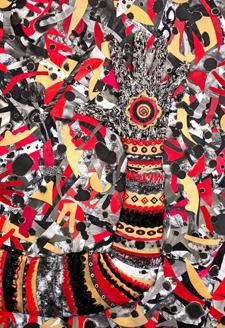 Michael Velliquette, Working Arm, 2013, paper, ink, acrylic, foam, and glue, 52 x 36 in. (artwork © Michael Velliquette)
Michael Velliquette. DCKT, New York, October 25–December 8, 2013. Their Arising and Passing Away. Sculptural cut-paper construction.
South

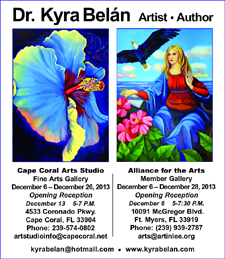 Invitation card for Kyra Bélan’s exhibitions
Kyra Bélan. Fine Arts Gallery, Cape Coral Arts Studio, Cape Coral, Florida, December 6–26, 2013. Painting and text.
Kyra Bélan. Member Gallery, Alliance for the Arts, Fort Meyers, Florida, December 6–28, 2013. Painting, drawing, digital media, and mixed media.

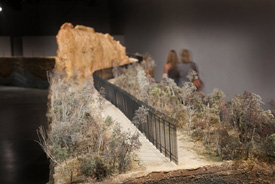 Blane De St. Croix, Broken Landscapes III, 2013 (artwork © Blane De St. Croix)
Blane De St. Croix. Blue Star Contemporary Art Museum, San Antonio, Texas, December 5, 2013–February 16, 2014. Broken Landscapes III. Sculpture.

 Sue Johnson, Mod-style Hearth (left) and Picture Window Looking West, from the series Ready-Made Dream, 2013 (artworks © Sue Johnson)
Sue Johnson. Eleanor D. Wilson Museum, Hollins University, Roanoke, Virginia. October 3–December 7, 2013. Sue Johnson: American Dreamscape. Installation.

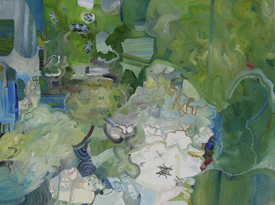 Josette Urso, Cloud Lily, 2013, oil on canvas, 24 x 30 in. (artwork © Josette Urso)
Josette Urso. Maitland Art Center Galleries, Art and History Museum Maitland, Maitland, Florida, October 11–December 29, 2013. Artist-in-Residence ONE: Josette Urso. Painting.
West

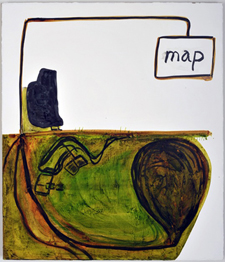 Mira Schor, Reversible Painting: Map, 2013, ink and oil on gesso on linen, 28 x 24 in. (artwork © Mira Schor)
Mira Schor. CB1 Gallery, Los Angeles, California, October 19–December 8, 2013. Mira Schor: Chthonic Garden. Painting.