
CAA News Today
New NHA Memo to Members
posted Oct 28, 2013
The executive director of the National Humanities Alliance (NHA) sent the following email on October 25, 2013.
New NHA Memo to Members
Dear NHA Member Representatives,
I am writing with the first edition of NHA’s new Memo to Members. Please click here for:
- a legislative update that includes a discussion of Senator Sessions’ recent letter to Acting NEH Chair Carole Watson;
- follow-up to the Commission on the Humanities and Social Science’s The Heart of the Matter;
- resources for advocates;
- studies, reports, and initiatives pertaining to the humanities;
- a compendium of humanities news articles and essays;
- federal grant opportunities; and
- upcoming humanities policy and advocacy events.
We hope that this monthly memo will provide you with tools to aid your advocacy efforts and help you and your organization stay abreast of policy and advocacy news. If you have information to to suggest for a future edition, please contact Erin Mosley at emosley@nhalliance.org.
Click here to download the briefing in pdf.
2013 Editions of CAA’s Directories of Graduate Programs in the Arts
posted Oct 24, 2013
 New editions of CAA’s comprehensive directories of graduate programs in the arts are now available for purchase, featuring updated information about 630 schools in the United States, Canada, the United Kingdom, Europe, and beyond.
Entries from the following eight program types are available: History of Art and Architecture; Studio Art and Design; Curatorial and Museum Studies; Arts Administration; Art Education; Library Science; Film Production; and Conservation and Historic Preservation.
The directories are currently available for purchase as customized PDFs, created on demand based on the customer’s preferred search criteria. Anyone can search the directories online by program type, faculty specialization, degrees awarded, country, region, state, availability of health insurance, and whether or not part-time students are admitted; you may also browse by institution. Search results include the program type, its location, and the program name and description, while the purchased PDF gives an in-depth profile of each program (see sample entries). Printed volumes and ebooks will be available for purchase in early November.
CAA’s directories provide prospective graduate students with the information they need for the application process and beyond. The publications are also key professional references for career-services representatives, department chairs, graduate and undergraduate advisors, librarians, professional-practices educators, and professors interested in helping emerging generations of artists and scholars find success.
For questions about purchasing, please contact Roberta Lawson at rlawson@collegeart.org or 212-392-4404.
News from the Art and Academic Worlds
posted Oct 23, 2013
Each week CAA News publishes summaries of eight articles, published around the web, that CAA members may find interesting and useful in their professional and creative lives.
Information Literacy Competency Standards for Higher Education
While the Information Literacy Competency Standards for Higher Education are currently in force, an Association of College and Research Libraries (ACRL) task force is extensively revising them in 2013–14. The existing standards, reviewed by the ACRL standards committee and approved by the organization’s board on January 18, 2000, were also endorsed by the American Association for Higher Education and the Council of Independent Colleges. (Read more from Association of College and Research Libraries.)
5,400 Images from the Getty Research Institute’s Special Collections Now Available as Open Content
Imagine being able to pore over a sketchbook by Jacques-Louis David in minute detail, to investigate Maya, Aztec, and Zapotec ruins in Mexico, or to study the costumes and social mores at Versailles. All of these things are possible with a major addition to the Open Content Program, which includes 5,400 artwork images from the collections of the Getty Research Institute—bringing the total number of available images to over 10,000. (Read more from the Getty Iris.)
The Correlation between Free and Digital Open Access
The most important thing art museums do is make their collections, exhibitions, programs, and scholarship available to the broadest possible public. When it comes to measuring success and mission fulfillment by that last part—accessibility—Los Angeles–area museums are on a roll. (Read more from Modern Art Notes.)
The New Players: How Artist Foundations Influence the Art World
The Robert Rauschenberg Foundation represents a rarely discussed dividend of the high-flying postwar and contemporary art market: the growing number of nonprofit artist foundations that burnish the legacies of their creators and provide an invaluable benefit to artists and arts organizations as grant- and gift-giving entities. (Read more from Blouin Artinfo.)
Is Art to Blame for Gentrification?
Bold Tendencies is the art space and cocktail bar standing imperiously on top of a Peckham multistory car park. It is charged with so much architectural symbolism it’s almost funny: a sky-high contemporary gallery in one of London’s poorest districts, packed each evening with painfully well-dressed young white people supping Campari bitters, who gaze down upon the streets of pound shops, mobile phone stalls, and cheap clothes stores below. (Read more from the Guardian.)
Are Artists to Blame for Gentrification?
The current narrative—in newsrooms, in think tanks, in studios and galleries—has art at the bleeding edge of urban transformation. But this narrative is wrong—or at least it keeps getting told in the wrong way. In the 1960s, shortly after the term “gentrification” was coined by the British sociologist Ruth Glass, the experimental art guru George Maciunus converted the large spaces in deindustrialized SoHo into artist cooperatives and live/work spaces, touching off its ultimate conversion into the gleaming nexus of air-brushed boutiques and tony restaurants that it is today. City leaders were so impressed that they wanted to do it again, and ever since the magical power of art to make over cities has been a key talking point. (Read more from Slate.)
Making It Past the First Round
For a high school basketball coach, the hardest part of the job is making the cuts—especially when there are more deserving kids than uniform jerseys, and the differences between the fifteenth player and the sixteenth are minuscule. But when you walk into the gym on the first day of tryouts and see the dozens of hopefuls, most of whom have no chance of making the team, all you want to do is eliminate as many as possible, as quickly as possible, so you can get down to the hard work of making a final roster. I’ve experienced similar feelings as a search-committee member, looking at 150 or more applications for three or four full-time positions. (Read more from the Chronicle of Higher Education.)
Digital Takeover: Not If but When
We are so accustomed to the big, glossy, full-color art book that it seems that this tool of art history, not to mention the art trade, has been with us forever. But books of this kind only really took off following the revolution in color printing that happened soon after the First World War. Now, thanks to the inexorable march of technology, things are changing again. Digital art books are becoming inevitable, for pretty much the same reasons that the printed book replaced the medieval illuminated manuscript. (Read more from the Art Newspaper.)
2014 Lifetime Achievement Awards from the Women’s Caucus for Art
posted Oct 22, 2013
The Women’s Caucus for Art (WCA) has announced the recipients of its 2014 Lifetime Achievement Awards: Phyllis Bramson, Harmony Hammond, Adrian Piper, and Faith Wilding. The winners of the 2014 President’s Art and Activism Award are Janice Nesser-Chu and Hye-Seong Tak Lee.
Please join WCA for an awards celebration on Saturday, February 15, 2014, in Chicago, Illinois. The event will be held during the annual WCA and CAA conferences. The awards ceremony, open free of charge to the public, will take place from 6:00 to 7:30 PM, followed by a ticketed gala from 8:00 to 10:00 PM at the Museum of Contemporary Art, Chicago. The ticketed gala will include a walk-around gourmet dinner, open bar, and the opportunity to congratulate the awardees. Individual tickets may be purchased online for $150 prior to January 7 and for $165 thereafter.
2014 Lifetime Achievement Awardees
Phyllis Bramson is an artist and educator whose recent works use folly and innuendo as narrative tactics to embody exaggerated fictions about love. Infused with amusing anecdotes about life’s imperfections, her sensuous paintings are miniaturized schemes meandering through love, desire, pleasure, tragedy, and cosmic disorder. Bramson received her MFA from the School of the Art Institute of Chicago and taught for twenty-two years at the University of Illinois, Chicago, where she is now professor emerita. Since 2007, she has advised MFA students at the School of the Art Institute of Chicago. Bramson has shown her work in over thirty solo and innumerable group exhibitions across the United States. In 2013, she will have one-person shows at Zolla/Lieberman Gallery in Chicago and at Littlejohn Contemporary in New York. Bramson was selected for the Annual Artists’ Interviews at CAA’s 2010 Annual Conference in Chicago, and in 2012 she received the Distinguished Artist of the Year/Chicago from the Union League Club of Chicago.
Harmony Hammond is an artist, writer, and educator who was a leading figure in the feminist art movement in New York in the early 1970s, cofounding A.I.R., the first women’s cooperative art gallery in New York, and the journal Heresies: A Feminist Publication on Art and Politics. Her earliest feminist work combined gender politics with Postminimal concerns of materials and process, frequently occupying a space between painting and sculpture. Since 1984, Hammond has lived and worked in northern New Mexico. She taught at the University of Arizona in Tucson from 1998 to 2006. Hammond’s Wrappings: Essays on Feminism, Art, and the Martial Arts (1984) is a seminal publication on 1970s feminist art, and her book Lesbian Art in America: A Contemporary History (2000) received a Lambda Literary Award. Her artwork has been exhibited internationally and was featured in High Times, Hard Times: New York Painting 1967–1975 (2006–8) and WACK! Art and the Feminist Revolution (2007–8) In 2013, Hammond was honored with CAA’s Distinguished Feminist Award.
Adrian Piper is a conceptual artist and analytic philosopher. She received a BA in philosophy with a minor in medieval and renaissance musicology from the City College of New York and a PhD in philosophy from Harvard University. Piper became the first tenured African American woman professor in the field of philosophy. For her refusal to return to the United States while listed as a suspicious traveler on the Transportation Security Administration’s watch list, Wellesley College forcibly terminated her tenured full professorship in 2008. In 2011, the American Philosophical Association awarded her the title of professor emeritus. Piper’s two-volume, open-access study in Kantian metaethics, Rationality and the Structure of the Self, Volume I: The Humean Conception and Rationality and the Structure of the Self, Volume II: A Kantian Conception, was accepted for publication by Cambridge University Press in 2008 and praised as “groundbreaking,” “brilliant,” “indispensable,” and “original and important.” Piper introduced issues of race and gender into the vocabulary of Conceptual art as well as explicit political content into Minimalism. In 2000, she further expanded the vocabulary of Conceptual art to include Vedic philosophical imagery and concepts. Her artwork has enjoyed numerous national and international traveling retrospectives. She received CAA’s Artist Award for Distinguished Body of Work in 2012. Piper lives and works in Berlin, where she runs the Adrian Piper Research Archive Foundation Berlin.
Faith Wilding is an intermedia artist, writer, and educator. She is professor emerita of performance art at the School of the Art Institute of Chicago, a graduate faculty member at Vermont College of Fine Arts, and currently a visiting scholar at Brown University’s Pembroke Center for Teaching and Research on Women. Born in Paraguay, Wilding received a BA from the University of Iowa and an MFA from California Institute of Arts (CalArts). Wilding was a co-initiator of the Feminist Art Programs at Fresno State College and at CalArts and key contributor to the Womanhouse exhibition in 1970–71 with her Crocheted Environment installation and her Waiting performance. Her work with the feminist art movement in Southern California was chronicled in her book By Our Own Hands (1977) and later in The Power of Feminist Art (1994), edited by Norma Broude and Mary Garrard. Wilding’s art, which addresses the recombinant and distributed biotech body in two-dimensional and digital media, audio and video, and installations and performances, has been featured in major feminist exhibitions, including WACK! Art and the Feminist Revolution (2007–8), Sexual Politics (1995), Division of Labor: Women’s Work in Contemporary Art (1995), and re.act.feminism (2009). Wilding cofounded and collaborates with subRosa, a cyberfeminist cell of cultural producers using bioart and tactical performance in the public sphere to explore and critique the intersections of information and biotechnologies in women’s bodies, lives, and work. She is also the coeditor of Domain Errors! Cyberfeminist Practices! (2002).
2014 President’s Awardees for Art and Activism
Janice Nesser-Chu is an educator, mixed-media artist, and activist in the arts community. Her life’s work has centered on social activism, education, mentorship, and promotion of women in the arts. Nesser-Chu serves as the Legacy Campaign Director on the national board of WCA, on the WCA Saint Louis chapter board, and on the board of directors for ArtTable. Nesser-Chu was president of WCA from 2010 to 2012 and has served on the organization’s board for over eight years. She coordinated the 2011 Art and Social Justice Conference and sat on the advisory board and steering committee for the 2012 Cross-Cultural Engagement: Building a Diverse and Dynamic Community Conference, both held in Saint Louis. She recently served on the Forums Committee for Art Saint Louis and is a founder and past board member of the Northern Arts Council. Nesser-Chu is chair of the Arts and Humanities Department and a professor of art at Saint Louis Community College, Florissant Valley. Previously she served as the director of the school’s galleries and permanent collection and coordinator of the photography program. Nesser-Chu established the Women’s History Month (WHM) and World AIDS Day/Quilt display programs on her campus and continues to serve as the coordinator for WHM. She has a master’s degree in art from Webster University and a BA in journalism with a minor in political science from Saint Mary-of-the-Woods College. Nesser-Chu has exhibited internationally for over twenty years.
Hye-Seong Tak Lee is an artist, curator, and lecturer from Gwangju, South Korea. While residing in various cities in North America over a ten-year period, she was active in immigrant communities, helping emerging artists enrich their environment through multicultural exhibitions. Since returning to South Korea, she has worked with expatriate artists to broaden her country’s cultural tolerance and expand the society of artists through events such as art classes, workshops, mural projects, and exhibitions. Lee is particularly determined to expand the visibility of women artists in Korea, whose accomplishments have been all but ignored because of the country’s focus on other significant democratic issues. In partnership with WCA’s International Caucus, Lee mounted the 2012 exhibition Woman + Body in Seoul and Gwangju. A survey of contemporary sexual personae—female, transgender, and male—Women + Body raised questions about stereotypes and prejudice, presented diverse points of view, and showcased significant Korean activist women artists spanning several generations, together with WCA activist women artists from the United States. Lee also participated in panel discussions related to gender policies and lectured on the contributions of women in the arts. Woman + Body opened the door for strengthening and widening women artists’ networks for both Koreans and Americans. Lee looks forward to curating more exhibitions with talented women artists from all over the world.
Background
WCA’s Lifetime Achievement Awards were first awarded in 1979 in President Jimmy Carter’s Oval Office to Isabel Bishop, Selma Burke, Alice Neel, Louise Nevelson, and Georgia O’Keeffe. Past honorees have represented the full range of distinguished achievement in the arts professions. This year’s awardees are no exception. The President’s Art and Activism Award is awarded each year to emerging or midcareer women whose life and work exemplifies WCA’s mission of creating community through art, education, and social activism.
Founded in 1972 in connection with CAA, WCA is a national member organization unique in its multidisciplinary, multicultural membership of artists, art historians, students, educators, and museum professionals. WCA is committed to recognizing the contribution of women in the arts; providing women with leadership opportunities and professional development; expanding networking and exhibition opportunities for women; supporting local, national, and global art activism; and advocating equity in the arts for all.
Solo Exhibitions by Artist Members
posted Oct 22, 2013
See when and where CAA members are exhibiting their art, and view images of their work.
Solo Exhibitions by Artist Members is published every two months: in February, April, June, August, October, and December. To learn more about submitting a listing, please follow the instructions on the main Member News page.
October 2013
Abroad

Patricia Cronin. Musei Capitolini, Centrale Montemartini Museo, Rome, Italy, October 9–November 20, 2013. Le Macchine, Gli Dei e I Fantasmi (Machines, Gods and Ghosts).

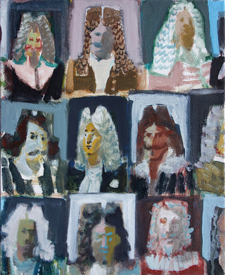 David Holt, Wigs, 2013, acrylic on canvas, 16 x 14 in. (artwork © David Holt)
David Holt. Loop Gallery, Toronto, Ontario, Canada, September 14–October 6, 2013. Illustrated History. Painting.

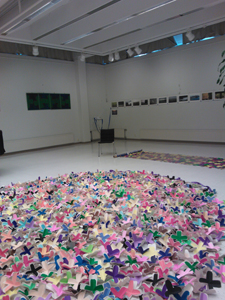 Hee Sook Lee-Niinioja, installation view of Goethe in Me (artwork © Hee Sook Lee-Niinioja)
Hee Sook Lee-Niinioja. Fallesmanni Exhibition Hall, Loppi, Finland, July 8–31, 2013. Goethe in Me. Installation and painting.
Firoz Mahmud. Goethe Institute Art Space, Dhaka, Bangladesh, October 1–21, 2013. Soaked Dream. Photography, objects, and performance.
Firoz Mahmud. Dhaka Art Center, Dhaka, Bangladesh, September 3–12, 2013. Loss of the Toss Is Blessing of Their Disguise. Photography and drawing.

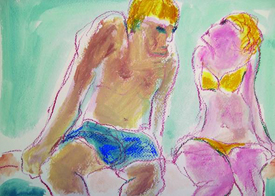 Jan Wurm, At the Pool, 2013, mixed media on paper, 11 x 14 in. (artwork © Jan Wurm)
Jan Wurm. Dorfgalerie, Neumarkt an der Raab, Austria, August 8–September 29, 2013. Magic Moments.
Mid-Atlantic
Les Barta. Edward Williams Gallery, Fairleigh Dickinson University, Hackensack, New Jersey, December 3, 2013–January 18, 2014. Works by Les Barta. Digital prints of photoconstructions.

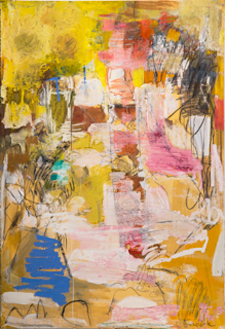 Cianne Fragione (artwork © Cianne Fragione)
Cianne Fragione. Brentwood Arts Exchange, Gateway Arts Center, Brentwood, Maryland, November 4–December 28, 2013. My Haiku. Work on paper and painting.

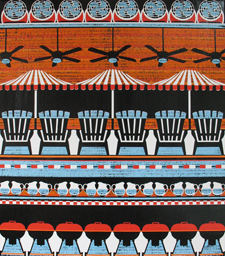 Margi Weir, Heat Wave, 2013, acrylic, vinyl, and resin on panel, 46 x 40 in. (artwork © Margi Weir)
Margi Weir. Sheetz Gallery, Misciagna Family Center for the Arts, Pennsylvania State University, Altoona, Pennsylvania, September 5–October 13, 2013. An Ivyside Exhibition by Margi Weir. Painting and vinyl installation.
Midwest

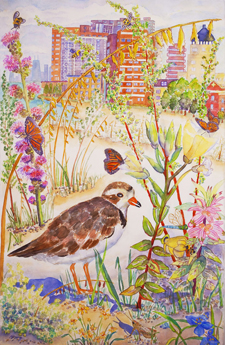 Michelle Kogan, Rogers Park Dunes Restoration with Piping plover, endangered species, 2013, watercolor and watercolor pencil on paper, 40 x 26 in. (artwork © Michelle Kogan)
Michelle Kogan. Peggy Notebaert Nature Museum, Chicago, Illinois, July 13–October 13, 2013. Narratives of Nature Watercolors by Michelle Kogan. Watercolor.

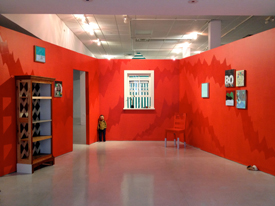 R. C. Sayler, installation view of HOME ALONE, 2013, mixed media, dimensions variable (artwork © R. C. Sayler; photograph by the artist)
R. C. Sayler. Peoria Art Guild, Peoria, Illinois, June 29–August 7, 2013. HOME ALONE. Mixed-media installation, sculpture, and painting.

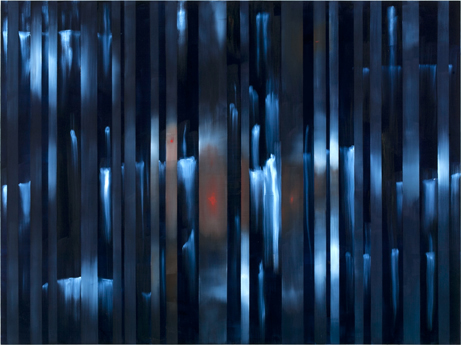 Betsy Stirratt, Cascade, 2013, oil on panel, 30 x 40 in. (artwork © Betsy Stirratt; photograph by Kevin Mooney)
Betsy Stirratt. Packer Schopf Gallery, Chicago, Illinois, September 6–October 19, 2013. Half-Light. Painting.
Anne Wilson. Rhona Hoffman Gallery, Chicago, Illinois, October 18–December 7, 2013. Dispersions.
Northeast
Phyllis Bramson. Littlejohn Contemporary, New York, September 3–28, 2013. Small Personal Dilemmas. Painting.

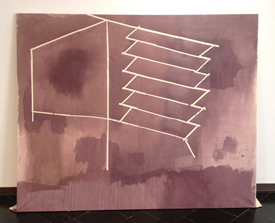 Sharon L. Butler, Turbine House (Purple), 2013, pigment and binder on canvas, loosely stretched and propped against the wall, 66 x 78 in. (artwork © Sharon L. Butler)
Sharon L. Butler. Fine Arts Gallery, Westchester Community College, State University of New York, Valhalla, New York, September 3–November 24, 2013. Dense Surveillance. Painting and drawing.
Steve Locke. Institute of Contemprary Art, Boston, Massachussets, July 31–October 27, 2013. Steve Locke: there is no one left to blame. Painting and sculpture.
Allison Smith. Aldrich Contemporary Art Museum, Ridgefield, Connecticut, May 27–September 2, 2013. Rudiments of Fife and Drum. Mixed media.

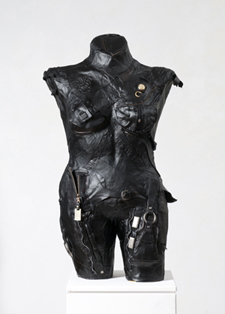 Linda Stein, Defender 696, 2010, leather, metal, and mixed media, 38 x 22 x 14 in. (artwork © Linda Stein)
Linda Stein. Perrella Gallery, Fulton-Montgomery Community College, State University of New York, Johnstown, New York, October 17–December 13, 2013. The Fluidity of Gender: Sculpture by Linda Stein. Sculpture.

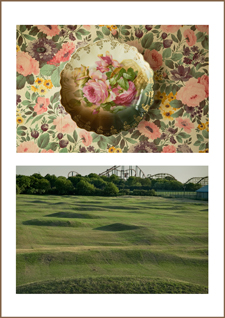 Blaise Tobia, Slight Perturbations of the Surface: double green, 2009, archival inkjet print, 22 x 17 in. (artwork © Blaise Tobia)
Blaise Tobia. O. K. Harris Works of Art, New York, September 21–October 26, 2013. Blaise Tobia: Binary Codes. Paired photographic images.
Josette Urso. Kathryn Markel Fine Arts, Bridgehampton, New York, July 10–24, 2013. Josette Urso: Recalibration. Painting.
South

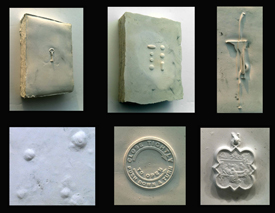 Jill Bedgood, Book of Hours: Intervention, 2013, installation of 25 unique cast booklike forms, Hydrocal, marble dust, and graphite, 7 x 5 x 1½ in. each (artworks © Jill Bedgood)
Jill Bedgood. Blue Star Contemporary Art Museum, San Antonio, Texas, June 6–August 24, 2013. Book of Hours: Intervention. Installation of twenty-five cast booklike objects.

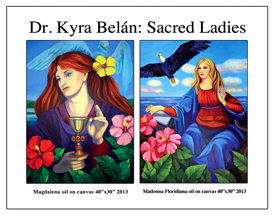 Invitation card for Dr. Kyra Bélan: Sacred Ladies (artworks © Kyra Bélan)
Kyra Bélan. Arts for ACT Gallery, Fort Meyers, Florida, September 6–29, 2013. Dr. Kyra Bélan: Sacred Ladies. Painting.

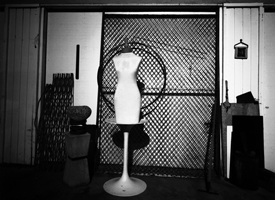 Lee Ann Paynter (artwork © Lee Ann Paynter)
Lee Ann Paynter. Kaviar Forge & Gallery, Louisville, Kentucky, September 27–November 2, 2013. SHE. Photography and sculpture.

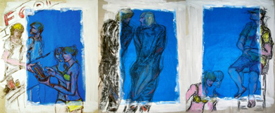 Jan Wurm, Beach Triptych, 2013, mixed media on vinyl, 40 x 108 in. (artwork © Jan Wurm)
Jan Wurm. Peacock Gallery, Middle Georgia State College, Cochran, Georgia, August 26–September 27, 2013. Jan Wurm: Drawings. Drawing.
West
Steven Bleicher. Branigan Cultural Center, Las Cruces, New Mexico, October 4–26, 2013. Route 66: The Mother Road. Drawing, digital media, and mixed media.

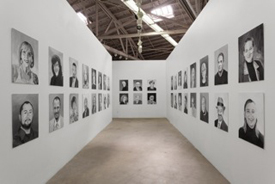 Katie Herzog, installation view of Transtextuality (SB 48), 2013, 48 oil on linen panels, 22 x 28 in. each (artworks © Katie Herzog)
Katie Herzog. Night Gallery, Los Angeles, California, June 29–August 3, 2013. Transtextuality (SB 48). Painting.
caa.reviews Celebrates Fifteenth Anniversary with New Series
posted Oct 21, 2013
On the occasion of its fifteenth anniversary, caa.reviews launched a new series: Re-Views: Field Editors’ Reflections. Authored by members of the journal’s Council of Field Editors, the series provides a locus for editors to reflect upon their respective fields as seen through the lens of the reviews they have commissioned.
The first essay in the series, titled “Reflections on Photography,” is by the field editor for photography and editorial-board member Tanya Sheehan, an associate professor in the Department of Art at Colby College in Waterville, Maine. In this essay Sheehan assesses the topics, methodologies, and debates current in publications about photography over the past several years. Themes she addresses include the global reach and significance of photography, political considerations, the play between “art” and “vernacular” in photography studies, and future directions for the field.
Reception at the Art Institute of Chicago
posted Oct 21, 2013

The Opening Reception for the 2014 Annual Conference will take place in the Art Institute of Chicago’s recently inaugurated Modern Wing on Wednesday evening, February 12, from 7:00 to 9:30 PM. Designed by the Pritzker Prize–winning architect Renzo Piano, this stunning addition to the venerable institution provides a new home for the museum’s renowned collection of twentieth- and twenty-first-century art.
Tickets are required for admission and cost $35 for members and $45 for nonmembers. Availability is limited; please purchase your ticket online by January 10, 2014. Tickets will not be sold at the door at the Art Institute of Chicago.
Image Caption
The Modern Wing of the Art Institute of Chicago during the reception for the CAA Annual Conference in 2010 (photograph by Bradley Marks).
THATCamp CAA 2014
posted Oct 17, 2013
 Registration is now open for THATCamp CAA, a free “unconference” on digital art history that is taking place during the week of the 2014 Annual Conference in Chicago. THATCamp CAA is open to scholars, artists, and graduate students with an active interest in digital art history, defined as scholarship and education in art history, architectural history, and archaeology that is supported by digital technology. The 2014 event will build on the great work done at CAA’s THATCamp in New York in 2013. Full details of the upcoming event, including information on how to register online, can be found in the About section of THATCamp’s website.
THATCamp CAA will be held at Columbia College Chicago on the days immediately preceding the main conference: Monday, February 10 (11:45 AM–5:15 PM); and Tuesday, February 11 (9:30 AM–5:00 PM). A follow-up session intended to reflect on the discussion is scheduled for Thursday, February 13 (9:30 AM–NOON) in the Marquette Room of the Hilton Chicago. Participants should be able to attend all sessions.
Registration is now open! The organizers also ask that you begin proposing session ideas. Approximately sixty participants will be accepted on a first-come, first-served basis. Space is limited. Only those who can commit to attending all days should register.
People in the News
posted Oct 17, 2013
People in the News lists new hires, positions, and promotions in three sections: Academe, Museums and Galleries, and Organizations and Publications.
The section is published every two months: in February, April, June, August, October, and December. To learn more about submitting a listing, please follow the instructions on the main Member News page.
October 2013
Academe

 Nicole Archer (photograph by John Lee)
Nicole Archer, a visiting faculty member at the San Francisco Art Institute in California since 2009, has been appointed assistant professor in history and theory of contemporary art at her school. The position is tenure track.

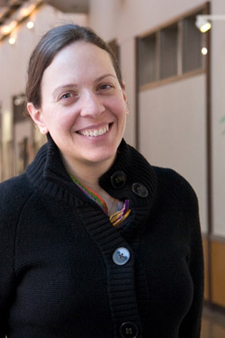 Emily Engel (photograph by Paul Miller)
Emily Engel has joined the College of Mount Saint Vincent in Riverdale, New York, as a tenure-track professor of art history and chair of the Fine Arts Department. In addition to her teaching and research responsibilities in the history of Latin American art, Engel will develop majors in studio art and art history for the college.
Ruthann Godollei has been named a DeWitt Wallace Professor of Art in the Department of Art and Art History at Macalester College in Saint Paul, Minnesota. Her courses include printmaking, the senior seminar, and topics such as dissent.
Janet Kraynak has been appointed associate dean for the School of Art and Design History and Theory at Parsons the New School for Design in New York.

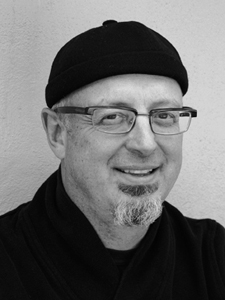 Beauvais Lyons
Beauvais Lyons, Chancellor’s Professor at the University of Tennessee in Knoxville, has been awarded an Ellen McClung Berry professorship for 2013–15.
J. P. Park has joined the History of Art Department at the University of California, Riverside, as an assistant professor of East Asian art. Park was formerly an assistant professor at the University of Colorado in Boulder.
Howard Singerman has joined Hunter College, City University of New York, as Caroff Chair of the Department of Art and Art History. Previously he was chair of the McIntire Department of Art at the University of Virginia in Charlottesville.
Museums and Galleries

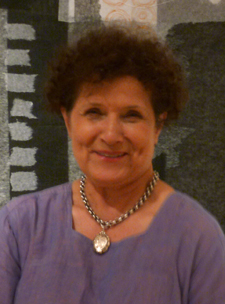 Renata Holod
Renata Holod, curator of the Near East section at the University of Pennsylvania Museum in Philadelphia, has been elected president of the board of trustees of the Ukranian Museum in New York.
Kimberly L. Jones has joined the Dallas Museum of Art in Texas as Ellen and Harry S. Parker III Assistant Curator of the Arts of America. She previously worked as a curator and lecturer at the University of Texas at Austin.

 Danielle Rice
Danielle Rice, formerly executive director of the Delaware Art Museum in Wilmington, has been appointed director of the new graduate degree program in museum leadership in the Westphal College of Media Arts and Design at Drexel University in Philadelphia, Pennsylvania.
Marika Sardar has accepted the post of associate curator of Southern Asian and Islamic art at the San Diego Museum of Art in California.
Organizations and Publications
Sylvie Fortin has been tapped to lead the next Biennale de Montréal as executive and artistic director. The multisite exhibition in the province of Quebec will take place in 2014–15.

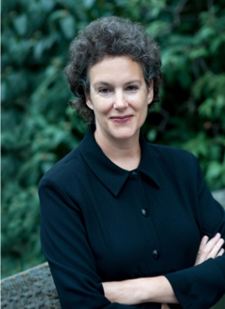 Brooke Kamin Rappaport (photograph by Ellen Dubin Photography)
Brooke Kamin Rappaport, most recently an independent curator and specialist in modern and contemporary sculpture, has been appointed senior curator of the Madison Square Park Conservancy in New York.
Institutional News
posted Oct 17, 2013
Read about the latest news from institutional members.
Institutional News is published every two months: in February, April, June, August, October, and December. To learn more about submitting a listing, please follow the instructions on the main Member News page.
October 2013
The Archives of American Art, a branch of the Smithsonian Institution based in New York and Washington, DC, has received a $37,500 grant from the Terra Foundation for American Art to support its first symposium on digital humanities and American art, scheduled for November 2013.
The Art Institute of Chicago in Illinois has received a $125,000 grant from the Terra Foundation for American Art to support an exhibition called Art and Appetite: American Painting, Culture, and Cuisine, which will open in November 2013.
The Art Institute of Chicago in Illinois has received a $100,000 grant from the Terra Foundation for American Art to support the development and implementation of “American Sources: Using Visual Art in the Humanities Curriculum,” a yearlong professional-development program that will explore the use of American artworks as primary documents and guide participants in the development of related curriculum for middle and high school students in the region.
Artspace, a nonprofit art organization in New Haven, Connecticut, has received a 2013 grant from the Foundation for Contemporary Arts.
The Association of Research Institutes in Art History, an organization based in Miami Beach, Florida, has accepted a $75,000 grant from the Terra Foundation for American Art to support three research fellowships in American art.
The Bard Graduate Center in New York has recieved a 2013 grant from the Graham Foundation for Advanced Studies in the Fine Arts. The school will use the funds for the exhibition Artek: Design, Domesticity, and the Public Sphere.
The Canadian Center for Architecture in Montreal, Quebec, has received a 2013 grant from the Graham Foundation for Advanced Studies in the Fine Arts. The institution will use the funds for a publication, Chandigarh and Casablanca: Modern Urbanism, New Geographies.
Columbia College Chicago in Illinois has applied a $40,000 grant from the Terra Foundation for American Art toward a professional-development program for teachers in twenty-five public schools in Chicago for the 2012–13 academic year.
DePaul University in Chicago, Illinois, has received a $12,560 grant from the Terra Foundation for American Art to support an exhibition called For and against Modernity: The Armory Show + 100, which took place at the DePaul Art Museum earlier this year.
Elmhurst College in Elmhurst, Illinois, has spent a $18,870 grant from the Terra Foundation for American Art on a public symposium that explored the role of humor in American art of the 1960s through the 1980s. The event took place on April 27, 2013, in partnership with the DePaul Art Museum.
The Getty Research Institute in Los Angeles, California, has acquired the archive of the photographer Lewis Baltz, which includes his negatives, prints and proofs, ephemera, photographs, and publications.
The Solomon R. Guggenheim Foundation in New York has accepted a $200,000 grant from the Terra Foundation for American Art to support its forthcoming exhibition, Robert Motherwell: The Early Collages.
The Herron Art Library at Indiana University–Purdue University Indianapolis has become the only American library housing a permanent art collection honoring the literary history of Iraq. The library signed an agreement with an international coalition of artists and writers to preserve and showcase a collection of more than three hundred printed materials remembering the destruction of al-Mutanabbi Street, the centuries-old literary center of Baghdad.
The Los Angeles County Museum of Art in California, the Art Gallery of New South Wales in Sydney, Australia, and the National Museum of Korea in Seoul have collaborated on an exhibition project called America: Painting a Nation, which received $849,968 in funds from the Terra Foundation of American Art.
The Metropolitan Museum of Art in New York has accepted a $300,000 grant from the Terra Foundation for American Art to support American West in Bronze, 1850–1925, an exhibition that will open in December 2013 and later travel to Denver, Colorado, and to China.
Montana State University in Bozeman has accepted a $30,140 grant from the Terra Foundation for American Art to support an international scholarly conference, “Dialect[ic]s of Diplomacy: American and French Political Portraits during the Revolutionary and Federal Areas, circa 1776–1815.” The event will take place at the Smithsonian Institution’s National Portrait Gallery in Washington, DC, in September 2014.
The Moore College of Art and Design in Philadelphia, Pennsylvania, has created a new website. The school invites students, faculty, alumni, and others to visit the site and return often for updates.
New York University has received a $20,000 grant from the Terra Foundation for American Art to support an international graduate-student symposium, “Mapping the Landscape: Geography, Power, and the Imagination in the Art of the Americas,” which was held March 7–8, 2013.
Northeastern Illinois University in Chicago has accepted a $40,000 grant from the Terra Foundation for American Art on behalf of the Chicago Teachers’ Center. The funds support the second year of a three-year initiative for public-school teachers called “Studio Thinking and American Art.”
The Pennsylvania Academy of the Fine Arts in Philadelphia has established a new endowment for the purchase of contemporary works of art. The school’s goal is to greatly increase an aspect of the acquisitions program that has long been critical to building the renowned collection of the academy’s museum.
San Francisco State University in California has received a $95,165 grant from the Terra Foundation for American Art to support an exhibition in its Fine Arts Gallery called The Moment for Ink, which took place earlier in 2013.
The School of the Art Institute of Chicago in Illinois has applied a 2013 grant from the Graham Foundation for Advanced Studies in the Fine Arts for a public lecture “Toyo Ito: Architecture after 3.11,” taking place on October 15, 2013.
The Smithsonian American Art Museum in Washington, DC, has acquired one hundred photographs from the Irving Penn Foundation. The gift includes rare street photographs from the late 1930s and 1940s, many of which are unpublished; images of postwar Europe; iconic portraits of figures such as Agnes de Mille, Langston Hughes, and Truman Capote; color photographs made for magazine editorials and commercial advertising; self-portraits; and some of Penn’s most recognizable fashion and still-life photographs. An exhibition is planned for 2015.
The Smithsonian American Art Museum and its Renwick Gallery, both in Washington, DC, have received a $25,000 grant from the Terra Foundation for American Art to support travel by a to-be-appointed international member of the American Art editorial board to strengthen the journal’s global ties and networks.
Tate, a family of four museums in England, has accepted a $435,546 grant from the Terra Foundation for American Art to support the appointment of a three-year Terra Research Fellow in American Art (2014–17) as part of the “American Art Initiative.”
The Terra Foundation for American Art in Chicago, Illinois, has awarded itself a $733,210 grant to support a three-year initiative, “American Art at the Core of Learning,” which helps cultural organizations in Chicago to address the new Common Core State Standards in English Language Arts.
The Terra Foundation for American Art in Chicago, Illinois, has applied a $117,000 grant toward supporting its international publication initiative, “Perspectives in American Art,” which explores fundamental ideas shaping American art and culture.
The Terra Foundation for American Art in Chicago, Illinois, has earmarked a $79,000 grant to support the 2014 Terra Research Travel Grants, which have been awarded annually since 2003.
The Terra Foundation for American Art in Chicago, Illinois, has awarded itself a $150,000 grant to support a scholarly peer-reviewed anthology to accompany the single-painting exhibition, Samuel F. B. Morse’s “Gallery of the Louvre” and the Art of Invention, during its upcoming tour of American museums.
The Terra Foundation for American Art in Chicago, Illinois, has used a $39,000 grant to support planning for programming focused on Chicago’s art and design legacy. The funds support an advisory committee to assess program and content ideas for the initiative and to develop an initiative plan, including various kinds of public and K–12 programs, archival projects, publications, and more.
The University of Glasgow in Scotland has won a $100,000 grant from the Terra Foundation for American Art to support an inventory of historical American art in public collections in the United Kingdom.
The University of Kentucky in Lexington has taken a $61,443 grant from the Terra Foundaiton for American Art to support an academic conference called “American Art in Exhibition: Presentations of American Art at Home and Abroad from the Nineteenth Century to the Present,” that will take place November 15–16, 2013, at Tsinghua University in China.
The University of Nottingham in Nottingham, England, has used a $17,450 grant from the Terra Foundation for American Art to support a two-day symposium, “Art across the Black Diaspora: Visualizing Slavery in America,” which took place in May 2013 at the Rothermere American Institute at the University of Oxford.
The University of Wisconsin, Milwaukee, has received a 2013 grant from the Graham Foundation for Advanced Studies in the Fine Arts to help produce an exhibition called The Uncertainty of Enclosure: Leo Saul Berk and Bruce Goff, to be held in summer 2014.
The Wolfsonian at Florida International University in Miami Beach, Florida, has received a 2013 grant from the Graham Foundation for Advanced Studies in the Fine Arts. The museum will use the funds to publish a special issue of the Journal of Decorative and Propaganda Arts on Turkey.