
CAA News Today
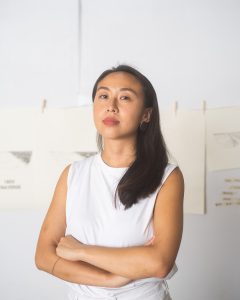
Tiffany Lin
posted Dec 03, 2021
 Statement
My name is Tiffany Lin, and I am honored to be nominated to join the CAA Board of Directors. I currently teach at the University of Nevada, Las Vegas as a Visiting Assistant Professor in the Department of Art. Prior to my career in higher education, I worked as a social worker and arts educator at various public schools in the San Francisco Bay Area. These professional experiences have dramatically influenced my pedagogical approach, and I have entered the realm of higher education through a synthesis of these experiences. As a member of the UNLV Art Department’s Diversity, Equity, Accessibility, and Inclusion Committee, I collaborate with colleagues to envision and implement policies for a more equitable landscape, one in which access to visual arts education is not stratified by any visible or invisible difference.
My teaching philosophy is grounded by the concept of “meeting the student halfway”, incorporating a compassionate, holistic lens that acknowledges the intersectional underpinnings of the individual. The majority of my student body identify as young people of color, most of whom are first-generation college attendees or immigrants, as my parents once were. If nominated to the Board, I would strive to address the cultural chasm that first-generation and non-traditional art students and faculty face in attempting to navigate academia and the professional visual arts world. Fostering a truly diverse CAA constituency would require explicit efforts to recruit and retain this demographic, traditionally underrepresented in higher education.
For the past two years, I have served as a member of UNLV’s MFA Application Review Board and the Graphic Design Curriculum Working Group. Although my artistic practice is multidisciplinary and largely analog, based in drawing and social practice, I primarily teach undergraduate graphic design courses. I have noted the increasing divide between fine arts and design, as institutions face external pressures to supplant fine arts programs with exclusively design based education. I stand firmly behind the transformative power of a broad humanities and arts-based education, and would advocate for maintaining an interdisciplinary focus that unifies both art and design curricula.
It would be an absolute honor to serve on the CAA Board of Directors and work toward creating a boldly inclusive visual arts community on an international scale.
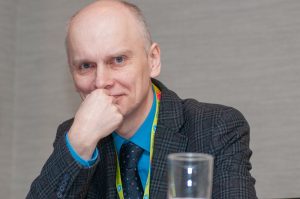
Nazar Kozak
posted Dec 03, 2021
Statement
A key reason I am interested in serving on CAA’s Board of Directors is to support CAA’s efforts to expand its international membership and outreach. This is crucial to further develop art history as a truly global, inclusive, and impactful discipline, one that flourishes worldwide and amplifies diverse voices that have been ignored in the past. As a Ukrainian art historian based in Lviv I have direct knowledge of the external and internal obstacles that stand in the way of scholars from so-called “underrepresented countries” who try to become part of the CAA community across the world’s political and economic divides. My own entry into this community was made possible by the CAA-Getty International Program, which selected me together with fourteen other international scholars to attend CAA’s Annual Conference in 2015. Since then, I haven’t missed a conference, presenting papers or organizing sessions at each one. I have further increased my involvement by serving on CAA’s International Committee (since 2019), where I have worked to build connections between American and international scholars. My aim now is to further advance my support for CAA at the level of our organization’s board by initiating a conversation on how to better serve art historians and artists around the world: how to improve their professional communications and networking; how to implement a more flexible membership structure that would allow individuals with lower income to participate in the organization and its events; and how to find and allocate resources to support equity initiatives.
As a board member, I also would like to address the need for integrative projects that would bring together and mutually enrich scholars working on disconnected geographical areas and divergent chronologies from multiple theoretical perspectives. This commitment originates from the trajectory of my own scholarly interests. Initially, I focused exclusively on Byzantine and post- Byzantine art; yet the 2013-14 pro-democratic Maidan revolution in Kyiv, and Russia’s subsequent invasion of Ukraine, motivated me to reinvent myself as a scholar. I began researching the agency of contemporary art in addressing crises, be they social, political, or ecological in origin. Currently, I work in these two fields–medieval and contemporary–simultaneously, exploring how a dialogue of time periods and methods can be beneficial for discovering new ways of understanding art. Because of this dual specialization, I am eager to expand the role of CAA’s annual conferences and publications as platforms for mixing and connecting art histories across cultures and decades with special attention to the reverberations between art of the past and the present.
Finally, I want to contribute to CAA’s efforts of advocacy for social justice and ecology that resonate with my activist experience in Ukraine and my research. I see this as a crucial element of a more general process that leads art history beyond its past as a “coy science,” to borrow Donald Preziosi’s phrase, and shapes it as a discipline of the future, one that takes responsibility for contributing to global thinking and decisions regarding existential issues. With your support, I am committed to help reinforce the organization’s course towards this fundamental renewal of our discipline.
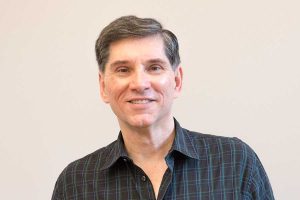
Gregory Gilbert
posted Dec 03, 2021
Statement
I am currently Professor of Art History and the Director of the Art History and Art Museum Studies programs at Knox College. While my area of scholarship is 20th century American art, I teach the entire Art History major at my institution and have greatly valued the support of CAA as my primary professional sphere for engaging with other art historians. My diverse background encompasses studio art, academic art history and museum curating. I feel this gives me insights into the different professional constituencies making up the membership of CAA and how these fields relate and intersect. If selected for the Board of Directors, I would like to advocate for greater dialogue and cooperative programming within our organization as a means to advance our many shared agendas.
I have spent most of my career teaching at an undergraduate liberal arts college that is devoted to experiential learning and social equity. Many of us are grappling with the nationwide decline in the Humanities and the shrinking academic job market. Those teaching in undergraduate institutions are at the frontlines dealing with such major demographic shifts as larger numbers of first-generation college students and greater racial diversity. Building on the abolitionist history of my college, I am currently part of a faculty initiative in the arts and humanities to diversify and decolonize our curriculum and am working to restructure courses towards greater forms of critical service learning and civic engagement. I also recently created an Art Museum Studies minor in order to provide needed career preparation for our current generation of students. I feel strongly that the future growth and vitality of art history will depend on more innovative and inclusive forms of teaching and pre-professional mentoring at the undergraduate level. This will require more strategic efforts to rethink and reposition the educational role of the visual arts and their ability to inspire students to engage with social and political questions beyond the academy. In running for the Board, I aim to use my experience to promote policies and programming to support the development of alternative, transformative and socially relevant pedagogies in our fields.
My academic and museum careers have provided me with leadership experience to effectively serve on the CAA Board. I did longtime service on the board of my regional civic arts center, and as senior curator at the Figge Art Museum, I was the chief staff liaison to the Board of Trustees. I have also chaired three academic committees at my college and am currently the Chair of Academic Assessment. We are conducting studies on Diversity, Equity and Inclusion, Civic Engagement and Professional Outcomes, all highly relevant and pressing academic issues for our membership. I will also bring a strong fundraising background having worked closely with my Advancement Office to obtain NEH and Mellon Foundation grants as well as donor funding to acquire a new art gallery facility. I look forward to the possibility of helping CAA progress towards future goals and appreciate being considered for this important service.
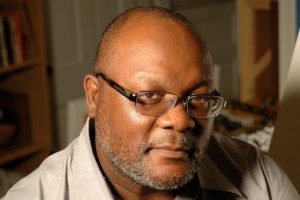
Alexander Bostic
posted Dec 03, 2021
 Statement
I believe the future direction of the College Arts Association should have more diversity. We should look into new and ever-changing field of art by exploring every available technology. I hope to bring new ways of teaching and educating students to think more globally in this industrial and complex world of ours. We must not only think outside of the box, but we can “be” the box. We should find new pathways for our young artists to follow and to explore limitless ways on how all art is made or produced. We need to look into the profession as well as the business of art and how we can connect how art is made and sold and marketed. I think we should bring the business side of creativity to our students. This must be a part of our agenda, namely, to look at many ways to educate our students on how to get work.
CAA 2021: A look back on the past year’s programming, publications, and opportunities
posted Nov 30, 2021
CAA has produced this reel with a compilation of events, scholarship, programs, and initiatives CAA from the last year. See below for a full list of each item (in order of appearance in the video) with links to learn more.
Programming:
CAA’s first virtual Annual Conference
Mariam Ghani in conversation with Laura Anderson Barbata
In Conversation with Dr. Nancy Odegaard
Theresa Avila, Annual Conference Program Chair in conversation with Meme Omogbai
An Inaugural Evening with CAA Distinguished Awardees and Artists
CAA Then & Now: Reflections on the Centennial Book and the Next Century
Karen Leader, author of Chapter 12: Advocacy
Opportunities:
Publication, travel, and support grants
Publications and Publications Programming:
Artist Project, Elana Mann for Art Journal Open
Roundtable discussion for Art Journal Open, Holding Space…
Art Journal and The Art Bulletin
caa.reviews book and exhibition reviews
caa.reviews’s dissertation roster, 2020
Global Programs
CAA-Getty International Program
CAA-Getty 10-Year International Program online publication
Podcasts
CAA Conversations by CAA’s Education Committee
CAA’s 110th Annual Conference will take place in Chicago from February 17-19, followed by virtual live sessions to be held in Zoom from March 3-5. For more information and to register go to this link.
Ellen Levy, Author of Chapter 8: Art in an Academic Setting
posted Nov 29, 2021
As part of CAA’s 10-year anniversary celebration of its publication The Eye, the Hand, the Mind: 100 Years of the College Art Association, chapter authors reflect on their contributions and how their impressions of the field have changed. Our second video in the series features Ellen Levy, who wrote Chapter 8, “Art in an Academic Setting: Contemporary CAA Exhibitions.”
Ellen K. Levy, PhD, is a multimedia artist and writer known for exploring art, science and technology interrelationships since the mid-1980s. Levy highlights their importance through exhibitions, educational programs, publications and curatorial opportunities. Her graduate studies were at the School of the Museum of Fine Arts, Boston following a B.A. from Mount Holyoke College in Zoology. She was President of the College Art Association (2004-2006) before earning her doctorate (2012) from the University of Plymouth (UK) on the art and neuroscience of attention. She then was Special Advisor on the Arts and Sciences at the Institute for Doctoral Studies in the Visual Arts. She was a Distinguished Visiting Fellow in Arts and Sciences at Skidmore College (1999) and taught many transdisciplinary classes and workshops (e.g., the New School, Cooper Union, Brooklyn College, Banff). She was recipient of an AICA award and an arts commission from NASA following a solo exhibition at the National Academy of Sciences (NAS) (1985).
She has exhibited her art internationally and in such landmark exhibitions as Weather Report (Boulder Museum, cur Lucy Lippard) and Gregor Mendel: Planting the Seeds of Genetics (Field Museum, Chicago, adv. Martin Kemp). Levy has published widely on art and complex systems. With Berta Sichel, she guest edited and contributed to CAA’s special issue of Art Journal (spring 1996), likely the first widely distributed academic publication on contemporary art and the genetic code. With Charissa Terranova, she is co-editor of D’Arcy Wentworth Thompson’s Generative Influences in Art, Design: From Forces to Forms (2021, Bloomsbury Press). Levy has also curated a related exhibition for Pratt Manhattan’s gallery. Levy and Barbara Larson co-edit the “art and science since 1750” book series of Routledge Press. Levy and Patricia Olynyk co-direct the NY LASER program, a central initiative of Leonardo/ISAST. She was twice an invited participant in Watermill’s Art and Consciousness Workshop, led by stage director and playwright, Robert Wilson.
Committee on Women in the Arts (CWA) Picks: November
posted Nov 29, 2021
The November “Picks” from the Committee on Women in the Arts explore spaces between the human figure and its psychic figurations. Each artist featured in the exhibitions traces the vacillations between interior perceptions and the objective contours of an external world eroded by alienation and violence. Whether they draw from traditional genres or experiment with new media, these artists destabilize the grammar of recognizable forms to reveal the vulnerability of human subjectivity and test the possibilities for repair.
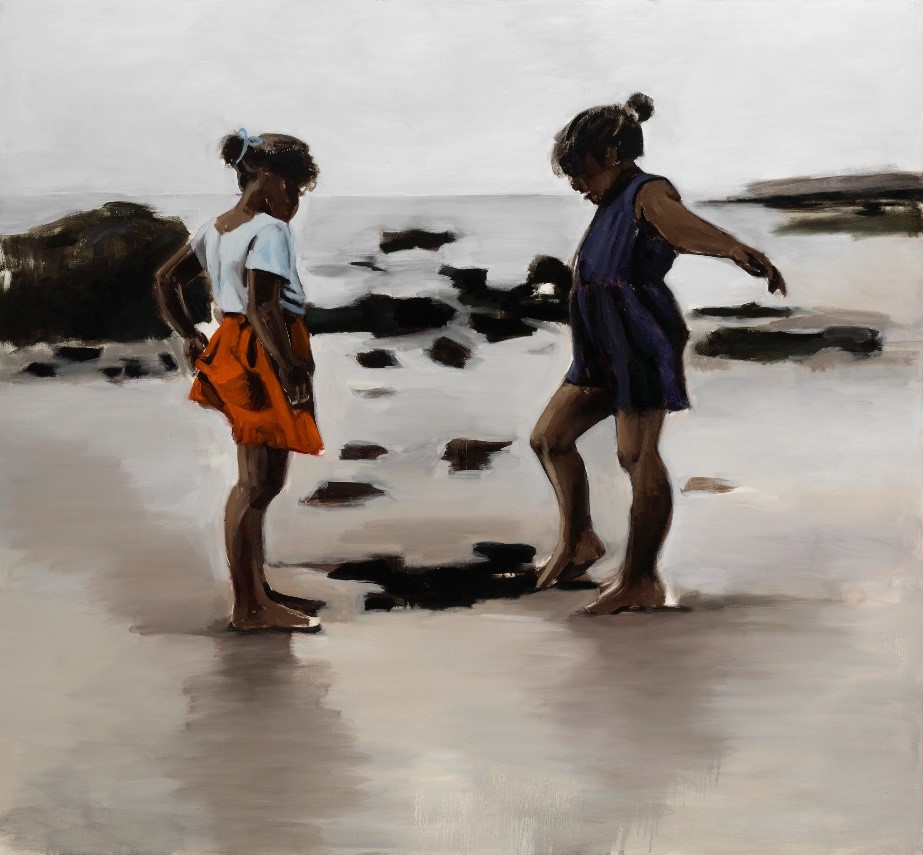
Lynette Yiadom-Boakye, Condor and the Mole, 2011, Arts Council Collection, Southbank Centre, London © Courtesy of Lynette Yiadom-Boakye.
Lynette Yiadom-Boakye: Fly in the League with the Night
October 16, 2021-February 13, 2022
Kunstammlung Nordheim Westfalen, Düsseldorf, Germany
Lynette Yiadom-Boakye paints portraits to evoke the psychic depths of Black subjects while gently keeping them from the demand for full exposure. The fields of rich colors and soft, slightly loose brush strokes in which Yiadom-Boakye holds her sitters allow her paintings to pulsate with an elegance that is tangible but difficult to pinpoint, though it seems to emerge from the value the artist attributes to seeing as a private act. One painting featured in this exhibition, Condor and Mole (2011), seems to illustrate the mysterious camaraderie indicated by the title of the exhibition and links it to the veils of privacy Yiadom-Boakye brings to the painted image . Condor and Mole portrays two Black girls on a beach punctuated with dark rocks; the tide pulls their shadows into tan and blue-grey sheens that continue into the horizon line. The girls are turned to each other as they look down into a dark crevice in the sand. Viewers do not see what they are looking at, and Yiadom-Boakye portrays the playful attunement of their collaboration, expressed through the correspondence of their body language, without providing full access to their shared vision.
Ana Torfs, Dark Spaces Where Things Cannot Be Put
January 10, 2021-February 27, 2022
Museo Universitario Arte Contemporáneo
México City, México
Ana Torfs is an artist based in Belgium and Dark Spaces Where Things Cannot Be Put is her first solo exhibition in the Americas. Working with an idiosyncratic array of materials and sources, Tors makes her subject the contingency of visual perception and the unstable connections among images, words, and knowledge. How do words determine what becomes visible to us? For Tors, this is an aesthetic, historical, ethical question that takes her work into contexts of great consequence. The installation The Parrot and the Nightingale, a Phantasmagoria (2014) exemplifies her interest in language, translation, and power. In it, Tors draws from Christopher Columbus’ travel diaries to provoke reflections on linguistic alienation, curiosity, order, and repression. In dialogue with 81 black-and-white images of tropical nature, Tors presents a female interpreter translating an English version of Columbus’ diary into American Sign Language and then three male interpreters bring the text back to a spoken English fractured with error. The “original” diary and its exploratory record recedes further from vision and the connection to the photographs becomes even more unstable, but Tors suggests that the damage imperial encounters remain. The female translator in The Parrot and the Nightingale, a Phantasmagoria points to the stealth feminism running through Tors’ artwork and her attention to the long histories of depriving women access to the voice of authority. The installation Echo’s Bones/Were Turned to Stone (2020), a carpet overlaid with a recording of a woman speaking in an endless chain of associations, suggests that this gendered displacement into irrationality forces women to carry the deaths embedded in and covered over by sensible, rational language.
November 25, 2021-July 3, 2022
Tate Britain, London
The winner of the 2017 Turner Prize, Lubaina Himid is well-known for her impact on the Black British art movement and her innovative depictions of everyday life in the Black diaspora. This Tate exhibition features Himid’s recent work as well as selected highlights from her influential oeuvre, focusing in particular on her interest and training in the theatre. With vivid colors that appear within slightly unsettling arrangements of geometric forms, Himid stages mise-en-scènes that reflect on diasporic imagining, building, and making. These qualities are evident in Six Tailors (2019), a painting in which Himid has arranged six men of African descent around a table covered in bright turquoise blue. The fabric, scissors, and spools thread with which they work materialize the colored and textured worlds they are in the process of making, which sharply contrasts the painting behind them that depicts the sky and sea as flat gray horizontal lines. Himid’s work as a painter is figured into this meditation on making and registers the losses that compose it.
Pipilotti Rist: Big Heartedness, Be My Neighbor
September 12, 2021-June 6, 2022
Geffen Contemporary, Museum of Contemporary Art, Los Angeles
The first West Coast survey of Pipilotti Rist’s work reveals how much her Pop-friendliness fits with Los Angeles. The playful eroticism, love of sparkle and shine, and hyper femininity that are the Swiss artist’s stylistic signatures all resonate with the city’s central place in the fantasy of making dreams come true. Of course, a dark cruelty lurks within this fantasy, and it therefore makes sense that despite the generosity alluded to in the exhibition’s title, Big Heartedness, Be My Neighbor also reveals the artist’s affinity with figures such as Lynn Hershman Leeson and David Lynch. Surveying more than thirty years of her work, this exhibition highlights Rist’s talent for stretching video to its extremes with scale, color, and sound. For her, video is a threshold into a rich and elastic imaginary that lets interiors and exteriors flow into each other and announces the desire for big-hearted connections.
October 1, 2021-July 10, 2022
Brooklyn Museum of Art, Elizabeth Sackler Center for Feminist Art
Baseera Khan recently received the UOVO Prize for an emerging Brooklyn artist, and with an aesthetics of distortion pushed to theatrical extremes, they make their body a site for realizing spaces of disjuncture between Muslim and American identities. All of Khan’s artworks collage together a struggle with the archive of commodified objects, images, and materials through which Muslim Americans are perceived. Khan’s I Arrive in a Place with a High Level of Psychic Distress (Blue) (2021) encapsulates this struggle and crystallizes the meaning of the kaleidoscopic layers that are a predominant feature of their work. In this photograph, brown hands and legs adorned with silver chains, bracelets, and rings emerge from behind the broken fragments of painted floor tiles. It is a beautiful and violent fight to “arrive in a place,” but also a challenge to the conditions of raced and gendered visibility that materialize on the terrain of the image.
Yoko Ono: Mend Piece for London
August 25, 2021-January 2, 2022
Whitechapel Gallery, London
Yoko Ono’s Mend Piece for London consists of two plain white tables upon which she has placed broken cups and saucers as well as instruments of repair: scissors, glue, twine, and tape. In her instructions she states, “Mend carefully/ think of mending the world/ at the same time.” A gentle reassertion of her central place in the Fluxus tradition and its continued pertinence, Ono also draws from the Japanese tradition of Kintsugi, in which broken pottery is repaired with lacquer mixed with precious metals and silver. Mend Piece for London also exemplifies Ono’s irrepressible commitment to reaching people with her aesthetics of repair and inspiring them to create and hold an image of a peaceful world in their minds so as to thoughtfully cohere all its broken pieces.
Jennifer Packer: The Eye is Not Satisfied with Seeing
October 30, 2021-April 17, 2022
Whitney Museum of Art, New York
The Eye is Not Satisfied with Seeing features 30 artworks Jennifer Packer has produced over the last decade. Emerging from a historical period in which visual media testifies to the state-sanctioned murder of Black people, Packer explores the psychic states and experiences that exceed visual evidence with a lyrical and melancholic vision. Layered with swaths of bright color, discordant fragments, blank spaces, and the weeping lines of vertical drips, Packer’s paintings and drawings are both heavy and light, private and revelatory, understandable and illegible. It seems that for Packer, traditional genres are tools for containing chaotic feelings, giving them form, but also evoking what has yet to be expressed. The still life Say Her Name (2017) is Packer’s response to the 2015 murder of Sandra Bland. The flowers, leaves, and stems of this painted funerary bouquet, loosely suspended before an unstable background of yellow and black, becomes a scrim that evokes the intimacy of identification and the reality of death’s irrevocable distance.
CAA signs AHA statement on Censorship and Prosecution by Chinese Authorities
posted Nov 29, 2021
CAA has signed onto a statement released by the AHA that expresses alarm in response to the escalation of censorship and prosecution by Chinese authorities on Chinese citizens who deviate from the Communist Party line of hero worship. It asserts, “Such efforts strike at the very heart of historical scholarship, which depends on open-ended inquiry and a free exchange of ideas, wherever that inquiry leads, and whether or not those ideas cast aspersions on historical actors…. The AHA stands firmly against national laws and policies that in effect criminalize the historical enterprise.” Read the entire statement here.
Meet the 2021 Wyeth Award Winners!
posted Nov 18, 2021
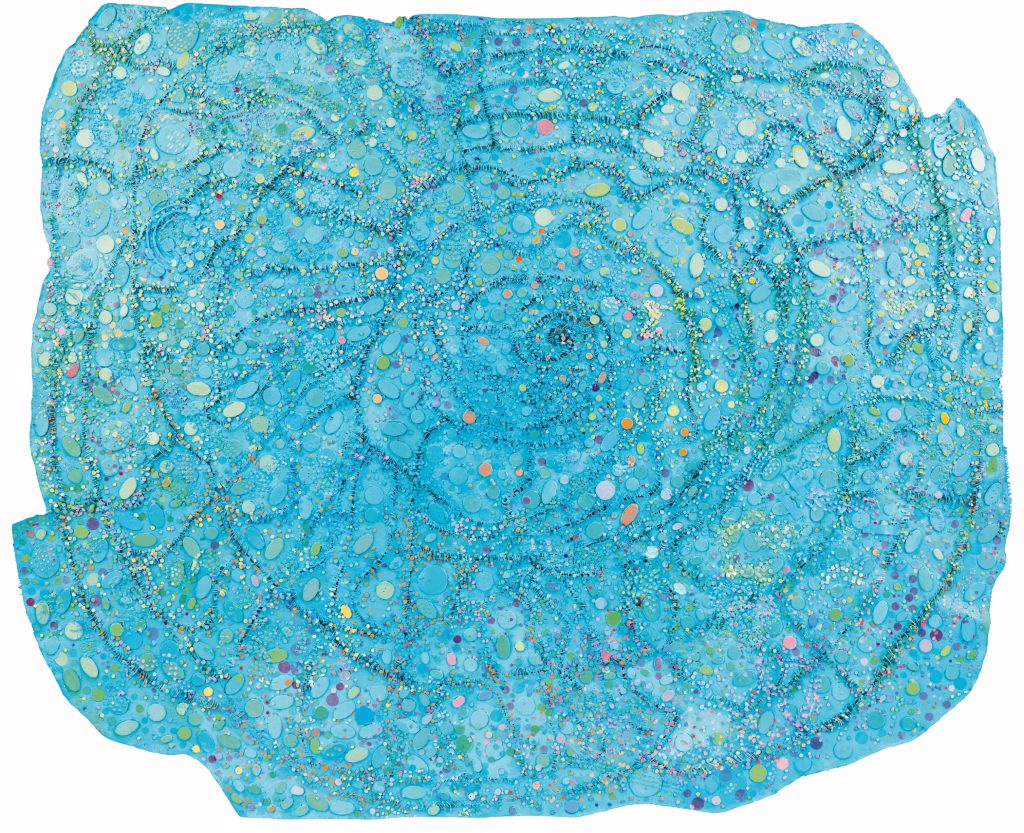
Howardena Pindell, Night Flight, 2015-16, mixed media on canvas, 75 X 63 in. (190.5 X 160 cm) (artwork © Howardena Pindell; photograph provided by Garth Freenan Gallery, New York)
MEET THE GRANTEES
Since 2005, the Wyeth Foundation for American Art has supported the publication of books on American art through the Wyeth Foundation for American Art Publication Grant, administered by CAA. The 2021 grantees are:
- Emilie Boone, A Nimble Arc: James Van Der Zee and Photography, Duke University Press
- Sarah Cowan, Howardena Pindell: Reclaiming Abstraction, Yale University Press
- Elizabeth Hamilton, Charting the Afrofuturist Imaginary in African American Art: The Black Female Fantastic, Taylor & Francis
- Jacqueline Taylor, Amaza Lee Meredith Imagines Herself Modern: Architecture and the Black American Middle Class, The MIT Press
Read a list of all recipients of the Wyeth Foundation for American Art Publication Grant from 2005 to the present.
BACKGROUND
For the Wyeth Foundation for American Art Publication Grant, “American art” is defined as art created in the United States, Canada, and Mexico. Eligible for the grant are book-length scholarly manuscripts in the history of American art, visual studies, and related subjects that have been accepted by a publisher on their merits but cannot be published in the most desirable form without a subsidy. The deadline for the receipt of applications is September 15 of each year.
Guidelines
Process, Materials, and Checklist
CONTACT
Questions? Please contact Cali Buckley, Content Manager, Education and Intellectual Property, at cbuckley@collegeart.org.
Karen Leader, Author of Chapter 12: Advocacy
posted Nov 15, 2021
As part of CAA’s 10-year anniversary celebration of its publication The Eye, the Hand, the Mind: 100 Years of the College Art Association, chapter authors reflect on their contributions and how their impressions of the field have changed. Our first video in the series features Karen J. Leader, who wrote Chapter 12, “CAA Advocacy: The Nexus of Art and Politics.”
Karen J. Leader is Associate Professor of Art History and Faculty Associate in the Center for Women, Gender and Sexuality Studies at Florida Atlantic University. She received her BA from the University of California, Berkeley and her MA and Ph.D. at the Institute of Fine Arts, New York University. Her areas of interest include art and popular culture in the 19th-21st centuries, feminist theory and practice, and the history and future of the discipline of art history, the humanities, and higher education. She has published on the artist Gustave Courbet, representations of women in popular culture, and 21st-century tattoo culture. She directs the Barb Schmidt Fellowship: Cultivating Community Involvement, Activism and Social Change, and currently chairs the Services to Historians of Visual Arts Committee (SHVAC) at CAA.You can follow her on Instagram and Twitter @proftinkerbell.