CAA News Today
May Obituaries in the Arts
posted May 13, 2009
CAA recognizes the lives and achievements of the following artists, art historians, and theorists. Of special note are two obituaries written especially for CAA: Richard R. Ranta on Carol Purtle, and Clark V. Poling on John Howett.
- Ernie Barnes, an artist who was also a professional football player, died on April 27, 2009, at the age of 70
- John Howett, a professor emeritus of art history at Emory University, died on April 8, 2009, at the age of 82
- Jack Prip, a silversmith who taught for many years at the Rhode Island School of Design, died on April 8, 2009. He was 86
- Carol Purtle, a professor of art history at the University of Memphis, died on December 12, 2008, at the age of 69
- David W. Scott, an artist, art historian, and founding director of the National Museum of American Art, died on March 30, 2009. He was 92
- Eve Kosofsky Sedgwick, a literary theorist and pioneer of queer studies, died on April 12, 2009, at the age of 58
- Honoré Sharrer, a figurative American artist who rose to prominence in the 1940s, died on April 17, 2009. She was 88
Read all past obituaries in the arts on the CAA website.
John Howett: In Memoriam
posted May 13, 2009
Clark V. Poling is professor emeritus of art history at Emory University in Atlanta, Georgia.

John Howett
John Howett, professor of art history at Emory University for thirty years, died on April 8, 2009, at the age of 82. A founding member of the Art History Department and active with numerous arts organizations in Atlanta, he nurtured the careers of many artists and undergraduate and graduate students both in art history and in the interdisciplinary Graduate Institute of the Liberal Arts.
After serving with the US infantry in the Philippines and Japan during World War II, Howett began his career in art as a student at the John Herron Art Institute in Indianapolis, Indiana, earning a BFA. He received an MA and PhD from the University of Chicago in Illinois, specializing in early Italian Renaissance art; during this time he was curator of the University of Notre Dame Art Gallery as well as associate professor at that university.
Arriving at Emory in 1966, Howett helped develop the Art History Department and its graduate program, summer-abroad program in Europe, and collection of works of art on paper, which subsequently became part of Emory’s Michael C. Carlos Museum. He was revered as a teacher and mentor, having received the Emory Williams Distinguished Teaching Award, the Award for Outstanding Teaching and Service to Undergraduate Students, and the Arts and Sciences Award of Distinction. Recently, a former student established the John Howett Travel Fund for Advanced Undergraduate Seminars in Art History in his honor.
Howett was instrumental in the decision to select Michael Graves as the architect of the Carlos Museum. In recognition of his contributions there, including serving as curator for a number of exhibitions of works on paper, a gallery in the museum is named in his honor, as is the newly established John Howett Works on Paper Fund. Howett has also been awarded the Woolford B. Baker Award for service to the museum and the arts at Emory.
When Howett arrived in Atlanta in the sixties, the civil rights movement was at its height, and he became active in antiwar and social-justice efforts. He was an ardent supporter of the arts community in the city, serving on the boards of the Atlanta College of Art, Art Papers, the Arts Festival of Atlanta, Nexus Contemporary Art Center, and the Museum of Contemporary Art in Georgia. A board member of the High Museum of Art for two decades, he helped in the choice of Richard Meier as architect of its new building completed in 1983. The many exhibitions for which he served as curator—at the High, the Carlos, and galleries in Atlanta—included contemporary art as well as Renaissance and Baroque illuminations, prints, and drawings. His championing of Atlanta artists in exhibitions and publications aided many careers and contributed to the burgeoning arts community.
Howett was a model of the publicly engaged academic: kind, humorous, wise, and spirited in navigating the shoals of university politics and bureaucracy and bridging the gap between academia and the broader community.
CAA 2009–10 Operating Budget Reductions
posted May 11, 2009
Updated May 14, 2009.
Like most universities, art museums, and learned societies, CAA has been significantly affected by the global economic downturn. The Board of Directors made difficult decisions at its May 2009 meeting that nevertheless will allow CAA to maintain the high quality of member services and programming. Strategic reductions and other measures have been instituted throughout the association to balance the budget and keep core programs, publications, and services in operation. With this careful financial planning, CAA remains dedicated to supporting members and the visual-arts community at large through our advocacy, career services, publications, and conference.
Annual Conference
The 2010 Annual Conference in Chicago will commence on Wednesday evening, February 10, with Convocation and the Gala Reception. All 120 planned sessions will be presented over the following three days, Thursday, February 11 to Saturday, February 13, with the addition of extended evening hours. No sessions will take place on Wednesday.
Publications
Newsletter: Beginning July 2009, CAA News will only be distributed online in a new reader-friendly design. This allows us to save printing and mailing costs and help to preserve coverage of core programs and publications. CAA’s website, www.collegeart.org, will become the primary hub of up-to-date information on the organization.
Journals: CAA’s longtime support of the journals is absolutely central to the mission, and the association is fully committed to maintaining them now and in the future. The Art Bulletin and Art Journal will continue to be published. Illustrations, however, will be limited to black and white for 2009–10, except where editorial and budget decisions may allow the insertion of color. caa.reviews will be unchanged, with new book reviews, exhibition reviews, and conference and symposia reports published regularly. While the CAA Board of Directors has determined the budget restrictions necessary for this part of the association, the editors-in-chief will work closely with staff and editorial boards to make sure that any further reductions are implemented with a strict attention to quality consistent with the identity and mission of the journals.
Grants and Fellowships
Two programs in CAA’s grant-making arm will be suspended for 2009–10: the Professional Development Fellowship Program for graduate students and the Millard Meiss Publication Fund. However, the Annual Conference Travel Grants and the Wyeth Foundation for American Art Publication Grant will both continue, and the CAA Annual Exhibitions, also funded by a grant, will take place at the Chicago and New York conferences.
Obama Requests NEA and Arts-Education Budget Increases
posted May 08, 2009
President Barrack Obama has released his budget recommendations for fiscal year 2010, which includes $161.3 million in funding for the National Endowment for the Arts—$6.3 million over the previous year’s budget and the largest increase in fifteen years (about 4 percent). Obama’s administration also requested $38.16 million for the Arts in Education program at the US Department of Education.
CAA encourages you to contact your legislators to voice your support for these increases in arts and cultural funding through the Arts Action Center, sponsored by Americans for the Arts. You can use or modify existing letter templates to tell Congress to support Arts in Education and the National Endowment for the Arts.
Advocacy Days in Washington, DC
posted May 08, 2009
 Andrea Kirsh, an independent art historian based in Philadelphia, Pennsylvania, and a member of the CAA Board of Directors, was one of several CAA delegates who attended Humanities Advocacy Day and Arts Advocacy Day, both of which took place in March 2009 in Washington, DC.
In an article for the forthcoming May issue of CAA News that is also posted online, she writes about her experiences advocating for increased funding for the National Endowment for the Arts and National Endowment for the Humanities, among other government programs and legislation.
Photo: The Grammy-nominated singer-songwriter Josh Groban (center) advocates for the arts with CAA board member Judith Thorpe (left) and Jean Miller at the Congressional Breakfast during Arts Advocacy Day
May CAA News Published
posted May 08, 2009
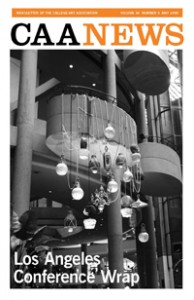 The May issue of CAA News has just been published. All individual and institutional members will receive it in the mail; you can also download a PDF of the issue now, reformatted to better fit your screen.
In the issue, CAA President Paul Jaskot and Director of Programs Emmanuel Lemakis sum up highlights from the 2009 Annual Conference in Los Angeles, and CAA Board Member Andrea Kirsh writes about her experiences at this year’s Arts Advocacy Day and Humanities Advocacy Day.
The May newsletter also includes instructions for proposing a session for the 2011 Annual Conference in New York—CAA’s centennial year. Please read the guidelines carefully before the submission process begins on June 16, 2009. Deadline: September 1, 2009.
Also published are calls for texts on “the contemporary” for Art Journal and for participation on CAA’s Professional Interests, Practices, and Standards Committees—plus the latest news from CAA’s affiliated societies and listings of solo exhibitions, books published, and exhibitions curated by CAA members.
Advocacy Days in Washington, DC
posted May 07, 2009
Andrea Kirsh, an independent art historian based in Philadelphia, Pennsylvania, and a member of the CAA Board of Directors, was one of several CAA delegates who attended Humanities Advocacy Day and Arts Advocacy Day, both of which took place in March 2009 in Washington, DC.
In an article for the forthcoming May issue of CAA News that is also posted online, she writes about her experiences advocating for increased funding for the National Endowment for the Arts and National Endowment for the Humanities, among other government programs and legislation.
Photo: The Grammy-nominated singer-songwriter Josh Groban (center) advocates for the arts with CAA board member Judith Thorpe (left) and Jean Miller at the Congressional Breakfast during Arts Advocacy Day
Obama Requests NEA and Arts-Education Budget Increases
posted May 07, 2009
President Barrack Obama has released his budget recommendations for fiscal year 2010, which includes $161 million in funding for the National Endowment for the Arts—$11 million over the previous year’s budget and the largest increase in fifteen years. Obama’s administration also requested $38.16 million for the Arts in Education program at the US Department of Education.
CAA encourages you to contact your legislators to voice your support for these increases in arts and cultural funding through the Arts Action Center, sponsored by Americans for the Arts. You can use or modify existing letter templates to tell Congress to support Arts in Education and the National Endowment for the Arts.
Call for Art Journal Texts on “the Contemporary”
posted May 05, 2009
Katy Siegel is incoming editor-in-chief of Art Journal and associate professor of art history at Hunter College, City University of New York.
During my tenure as editor-in-chief of Art Journal, I would like to publish a wide-ranging series that assesses contemporary art—its making, exhibition, criticism, history, and social uses. This series could include the kind of state-of-the-field essays that have traditionally been written about historical areas of study for The Art Bulletin. It could also mean more focused historiographic subjects, such as the evolution of “the contemporary” or the rise and fall of postmodernism. Or theoretical discussions of, for example, the relationships between the modern and the contemporary (questions of periodization being of special interest), or more speculative considerations of the changing role of contemporary art in current economic, technological, and social conditions.
I welcome approaches that are ambitious and generalizing, but since “the contemporary” is not really a single unified disciplinary object, I am also seeking writing that is partisan and partial, local and medium-specific. While one person might approach postmodernism from a historical perspective, as an object in the past, another might argue for its continuing validity under current conditions. Different authors might investigate the social meaning of “the contemporary” as opposed to the modern in particular countries at particular moments (the US at midcentury, China today), or for particular institutions, such as the museum, biennial exhibition, or university/college course.
I would like to hear from curators, teachers, critics, and artists about their own concrete experiences in relation to these large, abstract questions. I am interested not only in a wide range of topics, but also a diversity of approaches to those topics: art criticism, discussions, shorter polemical essays, and artists’ projects are all possibilities in addition to the scholarly article.
For more information, please write to katy.siegel@gmail.com.
Spring Art Journal Published
posted May 04, 2009
 In her introductory editor’s letter to the recently published Spring 2009 Art Journal, Judith Rodenbeck underlines the notion of retooling in the issue. The authors and contributors, she notes, confront three areas in particular: how the expansive global art world thrives in non-Western countries; how art education is undergoing progressive change outside traditional art academia; and how a history of early computer art can inform contemporary practice.
Gail Gelburd’s essay, “Cuba and the Art of ‘Trading with the Enemy,’ ” looks at Cuban-American relations over the past fifty years and their effect on cultural exchange. In her essay “Urban Claims and Visual Sources in the Making of Dakar’s Art World City,” Joanna Grabski discusses the Dak’Art Biennale in relation to Senghorian Négritude, the city’s School of Fine Arts, and Dakar’s urban fabric.
During the past several years, Art Journal has investigated retoolings in pedagogical issues. “The Currency of Practice: Reclaiming Autonomy for the MFA,” developed from a roundtable discussion that took place at the CAA Annual Conference in 2007, explores alternatives to traditional graduate degrees such as often-nomadic, nonaccredited schools, organizations led and run by artists, and programs for PhDs for artists.
Moving forward by looking back, three essays explore the history and practice of digital art. The artist Paul Hertz presents an overview that draws on his recent cocurated exhibition, Imaging by Numbers: A Historical View of the Computer Print. A computer scientist and pioneering artist, Frieder Nake, examines early European computer artists and their work, which he calls “algorithmic images accepted as art.” Patric D. Prince, a scholar, artist, and collector of computer art, provides a short history of computer-generated imagery and digital printmaking in America before the era of the home computer.
Reviews include texts on recent projects by Boris Groys (a collection of essays and an exhibition) and a book on Marcel Duchamp and artists’ labor. Letters to the editor include two replies to an Art Journal article, “Steps to an Ecology of Communication: Radical Software, Dan Graham, and the Legacy of Gregory Bateson,” from the Fall 2008 issue.