CAA News Today
CAA Protests Rose Art Museum Closing and Art Collection Sale
posted Jan 29, 2009
The College Art Association (CAA) was shocked and dismayed to learn of the decision by Brandeis University to close the Rose Art Museum and sell its entire art collection for operating revenue.
CAA supports the Codes of Ethics of the American Association of Museums and the Association of Art Museum Directors, which clearly state that works of art in museum collections are held as a public trust and that any proceeds of sales must only support the acquisition of new works. However, perceiving an entire art collection as a disposable financial asset and then dismantling that collection wholesale to cover other university expenses is deeply troubling for all college and university collections.
The closing of the museum at Brandeis will be devastating to the academic community, not only affecting our colleagues at the museum and students and faculty in the Department of Fine Arts, which offers programs in both studio art and art history, but also depriving the entire arts-loving public in New England and around the world. The teaching of art and art history in higher education is untenable without the direct study of physical works of art, and it appears the Brandeis Board of Trustees has disregarded the kind of scholarship and creativity that have been the hallmark of CAA members for nearly one hundred years.
According to news reports, neither Brandeis University nor the Rose Art Museum is on the brink of economic collapse, nor are they unable to maintain the collections. Given that no clear explanation has been offered on the school’s financial exigencies, the closure of the Rose Art Museum and the sale of its collection appear to be in violation of professional museum standards and of academic transparency and due process; the decision also demonstrates a lack of academic responsibility and fiduciary foresight. We appeal to the Trustees of Brandeis to revisit and reverse their decision.
Paul B. Jaskot
President, College Art Association
Professor of Art History
Department of the History of Art and Architecture
DePaul University
Linda Downs
Executive Director, College Art Association
Download a PDF of this letter from the CAA website.
Brandeis University to Close Rose Art Museum and Sell Collection
posted Jan 27, 2009
Geoff Edgers and Peter Schworm of the Boston Globe reported yesterday that Brandeis University, a private research university in Waltham, Massachussets, plans to close the Rose Art Museum and sell its collection of modern and contemporary masterworks. The measure to shutter the museum, which was founded in 1961, in late summer 2009 is one of several drastic decisions the school is making as it faces a budget deficit of several million over the next couple years.
The school’s website boasts that the museum “houses what is widely recognized as the finest collection of modern and contemporary art in New England. With more than 6,000 objects—paintings, sculptures, works on paper and new media—the Rose collection has particular strengths in American Modernism, American Social Realism, post-War American, Abstract Expressionism, Minimalism, Surrealism and Photorealism.”
“The decision to shut the museum,” writes Scott Jaschik of Inside Higher Ed, “runs directly counter to the ethics codes of art and museum associations, which permit the sale of art donated for a museum only for the purchase of additional art, not to be shifted to other purposes.” The Association of College and University Museums and Galleries, a CAA affilated society, has already spoken out opposing the closure.
Relatedly, Inside Higher Ed also reports on shrinking college and university endowments.
Winter Obituaries in the Arts
posted Jan 26, 2009
CAA recognizes the lives and achievements of the following artists, scholars, designers, architects, philanthropists, and collectors.
- Joan Abelló, a Spanish painter who lived in Barcelona, died on December 25, 2008, one day before he would have turned 86
- Leonard E. B. Andrews, a collector of Andrew Wyeth’s “Helga Pictures” and an arts philanthropist, died on January 2, 2009, in Malvern, Pennsylvania. He was 83
- Manjit Bawa, an Indian figurative painter of mythological and Sufi spiritual themes, died on December 29, 2008, in New Delhi. He was 67
- Aldo Crommelynck, an artist and master printer who worked with artists ranging from Matisse, Picasso, and Miró to Jim Dine, Chuck Close, and Terry Winters, died on December 22, 2008, in Paris, France. He was 77
- Hannah Frank, a Scottish artist and sculptor, died on December 18, 2008. She was 100
- Betty Freeman, an art collector and supporter of twentieth-century music, died on January 3, 2009, at the age of 97
- Shigeo Fukuda, a graphic designer and poster artist, died on January 11, 2009, in Tokyo, Japan. He was 76
- Betty Goodwin, a highly acclaimed Canadian artist, died on December 1, 2008, at the age of 85
- Robert Graham, a Los Angeles–based artist who focused on monumental public bronze sculpture, including those depicting Franklin Delano Roosevelt, Joe Louis, and Charlie Parker, died on December 27, 2008. He was 70
- Robert Gumbiner, a physician, healthcare innovator, and founder of the Museum of Latin American Art in Long Beach, California, died on January 20, 2009. He was 85
- Jan Kaplický, a Czech architect whose radical, organic building forms can be seen across Europe and the UK, died on January 14, 2009, at the age of 71
- Michael Levy, an art historian and director of the National Gallery in London from 1973 to 1987, died on December 28, 2008, at the age of 81
- Pierre Mendell, a graphic designer and poster artist who worked on the visual identity of the International Design Museum in Munich, Germany, died on December 19, 2008. He was 79
- Govinder Nazran, an illustrator and designer turned fine artist, died on December 30, 2008, at the age of 44
- Ann Sperry, a New York–based sculptor and feminist whose work was collected by art institutions nationwide, died on November 27, 2008
- Coosje van Bruggen, an art historian, critic, and artist who collaborated with her husband Claes Oldenburg, died on January 10, 2009, in Los Angeles. She was 66
- Andrew Wyeth, a respected and reviled American realist painter, died on January 16, 2009, at his home in Chadds Ford, Pennsylvania. He was 91
- Ray Yoshida, a painter and collage artist who taught at the School of the Art Institute of Chicago for many years, died on January 10, 2009, in Kauai, Hawai‘i. He was 78
Read all past obituaries in the arts on the CAA website.
CAA Publishes Its Directories of Graduate Programs in the Arts
posted Jan 26, 2009
 New editions of CAA’s two Directories of Graduate Programs in the Arts are now available for purchase. Listing more than six hundred programs in the United States, Canada, the United Kingdom, Australia, New Zealand, and elsewhere worldwide, the guides are the most comprehensive resources available for prospective graduate students in the visual arts. Colleges, universities, and independent art schools are all included.
The first volume, Graduate Programs in Art History: The CAA Directory, includes over 260 programs that offer a master’s, doctoral, or related degrees in art and architectural history, visual studies, museum and curatorial studies, arts administration, library science, and more.
The second book, Graduate Programs in the Visual Arts: The CAA Directory, describes 350-plus programs that offer a master’s or other advanced degree in in studio art, graphic and web design, art education, film production, conservation, heritage preservation, and more.
Compiled in 2008 and conveniently divided into two separate volumes, these easy-to-use directories present detailed information on: descriptions of special courses; numbers, names, and specializations of faculty; facilities such as libraries, studios, and labs; student opportunities for research and work; information on financial aid, fellowships, and assistantships; and details on housing, health insurance, and other practical matters.
 An index lists schools alphabetically and by state and country for quick reference. An introductory essay presents a detailed description of the elements of a program entry, including explanations of the various kinds of programs and degrees offered, placing the search and selection process in context.
Although these invaluable books are designed primarily for students who are considering graduate study in the arts, they also provide a wealth of data for academic departments and programs, researchers, publishers, and funders.
Each directory is available for $39.95 for members and $49.95 for nonmembers, plus shipping and handling. Please visit CAA’s online store to get your copies of the directories today!
Please note: If you are ordering on behalf of an institution of department within a university, please use this special order form (or request one from Anitra Haendel, CAA office services and purchasing coordinator) and submit it via fax or post. At this time, online purchases can only be processed for individuals.
Editorial-Board Member and Field Editors Needed for caa.reviews
posted Jan 23, 2009
caa.reviews is an online journal devoted to the peer review of new books, museum exhibitions, and projects relevant to the fields of art history, visual studies, and the arts.
caa.reviews Seeks Editorial-Board Member
CAA invites nominations and self-nominations for one individual to serve on the caa.reviews Editorial Board for a four-year term, July 1, 2009–June 30, 2013.
Candidates may be artists, art historians, art critics, art educators, curators, or other art professionals with stature in the field, a strong record of scholarship, and experience in writing or editing book and/or exhibition reviews; institutional affiliation is not required.
The editorial board advises the editor-in-chief and field editors and helps them to identify books and exhibitions for review and to solicit reviewers, articles, and other content for the journal; guides its editorial program and may propose new initiatives for it; and may support fundraising efforts on the journal’s behalf. Members also assist the editor-in-chief to keep abreast of trends and issues in the field by attending and reporting on sessions at the CAA Annual Conference and other academic conferences, symposia, and events in their fields.
Each year the editorial board meets twice in New York and once at the CAA Annual Conference. CAA reimburses members for travel and lodging expenses for the spring and fall New York meetings in accordance with its travel policy, but members pay these expenses to attend the conference.
Candidates must be current CAA members and should not be serving on the editorial board of a competitive journal or on another CAA editorial board or committee. Nominators should ascertain their nominee’s willingness to serve before submitting a name. Please send a letter describing your interest in and qualifications for appointment, CV, and contact information to: Chair, caa.reviews Editorial Board, CAA, 275 Seventh Ave., 18th Floor, New York, NY 10001. Deadline: April 15, 2009.
caa.reviews Seeks Field Editors for Books on Photography and South Asian Art
CAA invites nominations and self-nominations for field-editor positions for book reviews in caa.reviews for three-year terms, July 1, 2009–June 30, 2012.
Candidates may be artists, art historians, art critics, art educators, curators, or other art professionals; institutional affiliation is not required. Candidates with expertise in photography and in South Asian art are needed now.
Each field editor commissions reviews of books in their subject area or exhibitions in their geographic area, determines the appropriate character of the reviews, and works with reviewers to develop manuscripts for publication. These field editors work with the caa.reviews Editorial Board as well as the caa.reviews editor-in-chief and CAA’s staff editor.
The Council of Field Editors meets with the caa.reviews Editorial Board once a year at the CAA Annual Conference. Editors must pay travel and lodging expenses to attend the conference.
Candidates must be current CAA members and should not be serving on the editorial board of a competitive journal or on another CAA editorial board or committee. Nominators should ascertain their nominee’s willingness to serve before submitting a name. Please send a letter describing your interest in and qualifications for appointment, CV, and contact information to: Chair, caa.reviews Editorial Board, CAA, 275 Seventh Ave., 18th Floor, New York, NY 10001. Deadline: April 15, 2009.
Art Journal Seeks Reviews Editor and Editorial-Board Members
posted Jan 22, 2009
Art Journal, published quarterly by CAA, is devoted to twentieth- and twenty-first-century art and visual culture.
Art Journal Seeks Reviews Editor
The Art Journal Editorial Board invites nominations and self-nominations for the position of reviews editor of Art Journal, for a three-year term, July 1, 2010–June 30, 2013 (preceded by half a year as reviews editor designate, from January 1 to June 30, 2010).
Working with the editorial board, the reviews editor is responsible for the commissioning of all book and exhibition reviews in Art Journal. He or she selects books and exhibitions to be reviewed, commissions reviewers, and determines the appropriate length and character of reviews. The reviews editor also works with authors and CAA’s manuscript editor in the development and preparation of review manuscripts for publication and is expected to keep abreast of newly published and/or important books and recent exhibitions in the fields of twentieth-century and contemporary art, criticism, theory, and visual culture. This is a three-year term, which includes membership on the Art Journal Editorial Board.
The reviews editor attends the three annual meetings of the Art Journal Editorial Board—held in the spring and fall in New York and once at the CAA Annual Conference—and submits an annual report to CAA’s Publications Committee. CAA reimburses the reviews editor for travel and lodging expenses for the spring and fall meetings in accordance with its travel policy, but the reviews editor pays these expenses to attend the Annual Conference.
Candidates must be current CAA members and should not be serving on the editorial board of a competitive journal or on another CAA editorial board or committee. Members may not publish their own work in the journal during the term of service. Nominators should ascertain their nominee’s willingness to serve before submitting a name. Please send a letter describing your interest in and qualifications for appointment, CV, and contact information to: Chair, Art Journal Editorial Board, CAA, 275 Seventh Ave., 18th Floor, New York, NY 10001. Deadline: April 15, 2009.
Art Journal Seeks Editorial-Board Members
CAA invites nominations and self-nominations for two individuals to serve on the Art Journal Editorial Board for a four-year term, July 1, 2009–June 30, 2013.
Candidates are individuals with a broad knowledge of modern and contemporary art; institutional affiliation is not required. Applicants who are artists, museum-based scholars, or scholars interested in pedagogical issues are especially invited to apply.
The editorial board advises the editor-in-chief and assists him or her to seek authors, articles, artist’s projects, and other content for the journal; guides its editorial program and may propose new initiatives for it; performs peer reviews and recommends peer reviewers; and may support fundraising efforts on the journal’s behalf. Members also assist the editor-in-chief to keep abreast of trends and issues in the field by attending and reporting on sessions at the CAA Annual Conference and other academic conferences, symposia, and events in their fields.
Each year the editorial board meets twice in New York and once at the CAA Annual Conference. CAA reimburses members for travel and lodging expenses for the spring and fall New York meetings in accordance with its travel policy, but members pay these expenses to attend the conference.
Candidates must be current CAA members and should not be serving on the editorial board of a competitive journal or on another CAA editorial board or committee. Members may not publish their own work in the journal during the term of service. Nominators should ascertain their nominee’s willingness to serve before submitting a name. Please send a letter describing your interest in and qualifications for appointment, CV, and contact information to: Chair, Art Journal Editorial Board, CAA, 275 Seventh Ave., 18th Floor, New York, NY 10001. Deadline: April 15, 2009.
The Art Bulletin Seeks Editor-in-Chief and Editorial-Board Members
posted Jan 21, 2009
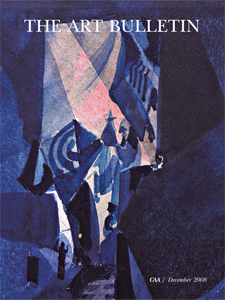 The Art Bulletin publishes leading scholarship in the English language in all aspects of art history as practiced in the academy, museums, and other institutions. From its founding in 1913, the quarterly journal has published, through rigorous peer review, scholarly articles and critical reviews of the highest quality in all areas and periods of the history of art.
The Art Bulletin Seeks Editor-in-Chief
The Art Bulletin Editorial Board invites nominations and self-nominations for the position of editor-in-chief of The Art Bulletin, for a three-year term, July 1, 2010–June 30, 2013 (preceded by a year as editor designate, from July 1, 2009 to June 30, 2010).
The Art Bulletin comprises scholarly essays and documentation on the history of visual art of all periods and places. The editor-in-chief is responsible for the content and character of the journal. Each issue has approximately 150 editorial pages (135,000 words), not including book and exhibition reviews, which are the responsibility of the reviews editor. The editor-in-chief reads all submitted manuscripts, refers them to appropriate expert referees for scholarly review, provides guidance to authors concerning the form and content of submissions, and makes final decisions regarding acceptance or rejection of articles for publication.
In addition to working with authors, the editor-in-chief attends the three annual meetings of the Art Bulletin Editorial Board—held in the spring and fall in New York and once at the CAA Annual Conference—and submits an annual report to the CAA Board of Directors and editorial board. CAA reimburses the editor-in-chief for travel and lodging expenses for the spring and fall meetings in accordance with its travel policy, but the editor-in-chief pays these expenses to attend the Annual Conference. The editor-in-chief also works closely with the CAA staff in New York, where production for the publication is organized. This is a half-time position. CAA provides financial compensation to the editor’s institution, usually in the form of course release or the equivalent, for three years. The editor is not usually compensated directly.
Candidates must be current CAA members and should not be serving on the editorial board of a competitive journal or on another CAA editorial board or committee. Members may not publish their own work in the journal during the term of service. Nominators should ascertain their nominee’s willingness to serve before submitting a name. Please send a letter describing your interest in and qualifications for appointment, CV, and contact information to: Chair, Art Bulletin Editorial Board, CAA, 275 Seventh Ave., 18th Floor, New York, NY 10001. Deadline: April 15, 2009.
The Art Bulletin Seeks Editorial-Board Members
CAA invites nominations and self-nominations for two individuals to serve on the Art Bulletin Editorial Board for a four-year term, July 1, 2009–June 30, 2013.
The ideal candidate has published substantially in the field and may be an academic, museum-based, or independent scholar; institutional affiliation is not required. Applicants who have specializations in East or South Asian, Renaissance, or early modern European art are especially invited to apply.
The editorial board advises the editor-in-chief and assists him or her to seek authors, articles, and other content for the journal; guides its editorial program and may propose new initiatives for it; performs peer reviews and recommends peer reviewers; and may support fundraising efforts on the journal’s behalf. Members also assist the editor-in-chief to keep abreast of trends and issues in the field by attending and reporting on sessions at the CAA Annual Conference and other academic conferences, symposia, and events in their fields.
Each year the editorial board meets twice in New York and once at the CAA Annual Conference. CAA reimburses members for travel and lodging expenses for the spring and fall New York meetings in accordance with its travel policy, but members pay these expenses to attend the conference.
Candidates must be current CAA members and should not be serving on the editorial board of a competitive journal or on another CAA editorial board or committee. Members may not publish their own work in the journal during the term of service. Nominators should ascertain their nominee’s willingness to serve before submitting a name. Please send a letter describing your interest in and qualifications for appointment, CV, and contact information to: Chair, Art Bulletin Editorial Board, CAA, 275 Seventh Ave., 18th Floor, New York, NY 10001. Deadline: April 15, 2009.
Meiss Grant Seeks Jury Member
posted Jan 20, 2009
CAA seeks nominations and self-nominations for an individual to serve on the Millard Meiss Publication Fund Jury for a four-year term, July 1, 2009–June 30, 2013. Applicants with expertise in East Asian art, African, or twentieth-century art, or in the history of photography, are especially invited to apply.
The jury awards grants that subsidize the publication of book-length scholarly manuscripts in the history of art and related subjects. It reviews manuscripts and grant applications twice a year and meets in New York in the spring and fall to select awardees. CAA reimburses committee members for travel and lodging expenses in accordance with its travel policy. For more information about the Meiss grant, please see www.collegeart.org/meiss.
Candidates must be current CAA members and should not be serving on another CAA editorial board or committee. Jury members may not themselves apply for a grant in this program during their term of service. Nominators should ascertain their nominee’s willingness to serve before submitting a name. Please send a letter describing your interest in and qualifications for appointment, CV, and contact information to: Millard Meiss Publication Fund Jury, CAA, 275 Seventh Ave., 18th Floor, New York, NY 10001. Deadline: April 15, 2009.
Katy Siegel Named Art Journal Editor
posted Jan 16, 2009
 Katy Siegel, associate professor of art history at Hunter College in New York, is the new editor-in-chief of Art Journal. She will begin her three-year term on July 1, 2009, and her first issue will appear in spring 2010. Siegel succeeds Judith Rodenbeck of Sarah Lawrence College, who has led the journal since July 2006.
In addition to her work in the City University of New York system, teaching at both Hunter and the Graduate Center, Siegel has also been a senior critic in the Yale University School of Art and was a visiting associate professor at Princeton University from 2007 to 2009. She earned her PhD at the University of Texas at Austin in 1995.
Siegel has published widely on modern and contemporary art, with essays in books and catalogues for Richard Tuttle, Dana Schutz, Takashi Murakami, Lisa Yuskavage, Bernard Frize, and more. Among her own books are Abstract Expressionism (forthcoming from Phaidon, 2010) and Art Works: Money (with Paul Mattick; New York: Thames and Hudson, 2004). She wrote the primary essay for Jeff Koons (Berlin: Taschen, 2008), and Reaktion Books will publish her latest project, ‘Since ’45’: Contemporary Art in the Age of Extremes.
A contributing editor to Artforum, she has written criticism, essays, and reviews for the magazine since 1998. Siegel also maintains a public face, participating in panels and delivering lectures and papers nationwide. At the 2009 CAA Annual Conference in Los Angeles, she is chairing a session entitled “The Age of Extremes.”
Her recent guest-curated exhibition, High Times, Hard Times: New York Painting, 1967–75, with the artist David Reed as advisor, traveled internationally from 2006 to 2008 to great critical acclaim.
CAA Letter to Barack Obama
posted Jan 15, 2009
On January 14, 2009, CAA President Paul Jaskot and CAA Executive Director Linda Downs sent a letter to Bill Ivey of President-elect Barack Obama’s transition team, discussing the needs of artists and scholars in the coming years.
CAA has signed onto letters with many other nonprofit organizations urging full funding for the National Endowment for the Arts (NEA), the National Endowment for the Humanities (NEH), and the Institute for Library and Museum Services (IMLS). However, CAA felt that it was necessary to have a separate voice on issues of importance to its members.
CAA will have a presence in Washington, DC, in March 2009 at the Humanities Advocacy Day and Arts Advocacy Day. Jaskot and Downs will be making separate appointments to visit the new chairs of the NEA, NEH and IMLS once they have been appointed.
CAA Letter to President-elect Barack Obama
January 14, 2009
President-elect Barack Obama
President-elect Transition Team
Dear President-elect Barack Obama:
College Art Association, representing over 16,000 artists, art historians, scholars, curators, collectors, art publishers, universities, and libraries, looks forward to working with you and your administration to ensure the revitalization of support for professional artists and art historians in America.
College Art Association:
- Promotes excellence in scholarship and teaching in the history and criticism of the visual arts and in creativity and technical skill in the teaching and practices of art;
- Facilitates the exchange of ideas and information among all people interested in art and the history of art;
- Advocates comprehensive and inclusive education in the visual arts;
- Speaks for its membership on issues affecting the visual arts and humanities;
- Publishes scholarly journals, art criticism, and artists’ writings;
- Fosters career development and professional advancement;
- Identifies and develops sources of funding for the practice of art and for scholarship in the arts and humanities;
- Supports and honors the accomplishments of artists, art historians, and critics; and
- Articulates and affirms the highest ethical standards in the conduct of the profession.
As the leading association in the world that represents professional visual-arts practitioners, CAA endorses your campaign platform’s support of the arts. We strongly agree that in order to remain competitive in the global economy America must reinvigorate the creativity and innovation that has made this country great.
CAA would like your Administration to include not only community arts organizations in its arts program of support but, also, to give greater focus to professional artists and art historians in academia, art museums, and independent professional visual-arts practitioners. Visual art must be reinstated as a respected and esteemed profession in America.
CAA advocates that professionally educated artists and art historians teach K–16 students. To meet this end we must offer all students, K–16, equal access to visual-arts education taught by professionally trained instructors in studio art and art history.
We also believe that public/private partnerships should expand not only between schools and communities but also among the academic community within colleges, universities, and art schools.
We endorse the creation of an art corps comprised of professionally educated artists and art historians who will work with students in urban schools on community-based projects that raise the awareness of the importance of creativity and professional artists. CAA would also like to see an emphasis on visual arts in government-sponsored projects such as AmeriCorps, in both urban and rural areas that address job preparation as well as environmental issues. Professional artists are eager to work on environmental programs that involve community-organized design projects.
CAA would like to emphasize that, in order to publicly champion the importance of arts education, America needs to support the proper preparation and training of artists and art historians who teach at the primary, secondary, and college/university levels. Visual arts need to become part of the core curriculum in each grade and at every stage of education.
CAA fully supports increased funding for the National Endowment for the Arts, the National Endowment for the Humanities, and the Institute for Library and Museum Services. Specifically, professional artists need to be supported on an individual basis, and we strongly recommend reinstatement of the Individual Artist Fellowship program to enable our best artists to pursue and develop their work. We have found that grants to other areas of the arts and humanities far exceed federal and private foundation grants to professional visual artists. It would be an outstanding legacy of this administration to again make federal support of the arts a priority in defending the promotion of our nation’s cultural heritage.
CAA supports legislation that will allow scholars to publish so-called orphan works, which are copyrighted works—such as books, pictures, music, recordings, or films—whose copyright owners cannot be identified or located. This legislation has been introduced in prior Congresses, and we hope it will be passed during the new Congress. Due to the risks of publishing copyrighted material without obtaining permission, many art historians and scholars are unable to publish orphan works, thereby causing great detriment to scholarly publishing, research and public access to these works. At the same time, orphan works legislation must be carefully crafted in respect to the legitimate interests and concerns of visual artists, including photographers.
CAA supports your platform for cultural diplomacy by enhancing international opportunities offered through agencies, such as the United States Information Agency, for exhibitions, teaching, research, and lecture tours by professional visual artists and art historians. CAA’s international membership testifies to the promotion of cultural understanding that occurs through international cultural exchange. Every year CAA seeks funding to support travel of international artists and art historians to its Annual Conference. Current Homeland Security laws and a lack of government funding make it difficult for foreign artists and scholars to present their work and research at conferences of their peers. CAA endorses streamlining the visa process and providing government support for international exchanges of graduate students and professional artists and art historians.
CAA supports providing health care to professional artists and art historians. This is a major concern for professional artists and art historians who are not associated with a college, university, or art museum and attempt to work independently to support themselves. As you are aware, each state has its own laws on insurance. Professional organizations such as CAA would like to offer national healthcare coverage for artists but are prohibited from offering insurance to its members due to differences in state laws. CAA endorses the creation of a National Health Insurance Exchange as one step in the direction of coverage for artists. In the meantime, we encourage you to press for government reforms of insurance laws so that professional organizations such as CAA will be in a position to assist its members to obtain universal coverage.
CAA endorses tax fairness for artists. We have worked hard—and will continue to work hard—to support the Artist-Museum Partnership Act, which was introduced in the prior Congress by Senator Patrick Leahy (D-VT). The Act amends the Internal Revenue Code to allow artists to deduct the fair market value of their work, rather than just the costs of the materials, when they make charitable contributions of that work. Not only has the current tax law been harmful to artists, the creative legacy of a whole generation of professional visual artists has not been donated to our great public institutions because of disincentives to donate created by the current tax laws.
CAA realizes that change takes the support and involvement of every member of society. CAA is committed to promoting the support of professional visual artists and art historians in all areas of American society. We stand ready to help provide information on visual arts professionals, suggestions for specific programs, or any other aid that you may find helpful in promoting a better world for artists and art historians in America.
With your leadership and the groundswell of support for activism, we can reestablish the professional visual-arts practitioner as a contributor to positive cultural change in America.
Sincerely yours,
Paul Jaskot, President, CAA, and Professor of Art and Art History, DePaul University; and Linda Downs, Executive Director, CAA