CAA News Today
CAA Letter to Barack Obama
posted Jan 15, 2009
On January 14, 2009, CAA President Paul Jaskot and CAA Executive Director Linda Downs sent a letter to Bill Ivey of President-elect Barack Obama’s transition team, discussing the needs of artists and scholars in the coming years.
CAA has signed onto letters with many other nonprofit organizations urging full funding for the National Endowment for the Arts (NEA), the National Endowment for the Humanities (NEH), and the Institute for Library and Museum Services (IMLS). However, CAA felt that it was necessary to have a separate voice on issues of importance to its members.
CAA will have a presence in Washington, DC, in March 2009 at the Humanities Advocacy Day and Arts Advocacy Day. Jaskot and Downs will be making separate appointments to visit the new chairs of the NEA, NEH and IMLS once they have been appointed.
CAA Letter to President-Elect Barack Obama
January 14, 2009
President-elect Barack Obama
President-elect Transition Team
Dear President-elect Barack Obama:
College Art Association, representing over 16,000 artists, art historians, scholars, curators, collectors, art publishers, universities, and libraries, looks forward to working with you and your administration to ensure the revitalization of support for professional artists and art historians in America.
College Art Association:
- Promotes excellence in scholarship and teaching in the history and criticism of the visual arts and in creativity and technical skill in the teaching and practices of art;
- Facilitates the exchange of ideas and information among all people interested in art and the history of art;
- Advocates comprehensive and inclusive education in the visual arts;
- Speaks for its membership on issues affecting the visual arts and humanities;
- Publishes scholarly journals, art criticism, and artists’ writings;
- Fosters career development and professional advancement;
- Identifies and develops sources of funding for the practice of art and for scholarship in the arts and humanities;
- Supports and honors the accomplishments of artists, art historians, and critics; and
- Articulates and affirms the highest ethical standards in the conduct of the profession.
As the leading association in the world that represents professional visual-arts practitioners, CAA endorses your campaign platform’s support of the arts. We strongly agree that in order to remain competitive in the global economy America must reinvigorate the creativity and innovation that has made this country great.
CAA would like your Administration to include not only community arts organizations in its arts program of support but, also, to give greater focus to professional artists and art historians in academia, art museums, and independent professional visual-arts practitioners. Visual art must be reinstated as a respected and esteemed profession in America.
CAA advocates that professionally educated artists and art historians teach K–16 students. To meet this end we must offer all students, K–16, equal access to visual-arts education taught by professionally trained instructors in studio art and art history.
We also believe that public/private partnerships should expand not only between schools and communities but also among the academic community within colleges, universities, and art schools.
We endorse the creation of an art corps comprised of professionally educated artists and art historians who will work with students in urban schools on community-based projects that raise the awareness of the importance of creativity and professional artists. CAA would also like to see an emphasis on visual arts in government-sponsored projects such as AmeriCorps, in both urban and rural areas that address job preparation as well as environmental issues. Professional artists are eager to work on environmental programs that involve community-organized design projects.
CAA would like to emphasize that, in order to publicly champion the importance of arts education, America needs to support the proper preparation and training of artists and art historians who teach at the primary, secondary, and college/university levels. Visual arts need to become part of the core curriculum in each grade and at every stage of education.
CAA fully supports increased funding for the National Endowment for the Arts, the National Endowment for the Humanities, and the Institute for Library and Museum Services. Specifically, professional artists need to be supported on an individual basis, and we strongly recommend reinstatement of the Individual Artist Fellowship program to enable our best artists to pursue and develop their work. We have found that grants to other areas of the arts and humanities far exceed federal and private foundation grants to professional visual artists. It would be an outstanding legacy of this administration to again make federal support of the arts a priority in defending the promotion of our nation’s cultural heritage.
CAA supports legislation that will allow scholars to publish so-called orphan works, which are copyrighted works—such as books, pictures, music, recordings, or films—whose copyright owners cannot be identified or located. This legislation has been introduced in prior Congresses, and we hope it will be passed during the new Congress. Due to the risks of publishing copyrighted material without obtaining permission, many art historians and scholars are unable to publish orphan works, thereby causing great detriment to scholarly publishing, research and public access to these works. At the same time, orphan works legislation must be carefully crafted in respect to the legitimate interests and concerns of visual artists, including photographers.
CAA supports your platform for cultural diplomacy by enhancing international opportunities offered through agencies, such as the United States Information Agency, for exhibitions, teaching, research, and lecture tours by professional visual artists and art historians. CAA’s international membership testifies to the promotion of cultural understanding that occurs through international cultural exchange. Every year CAA seeks funding to support travel of international artists and art historians to its Annual Conference. Current Homeland Security laws and a lack of government funding make it difficult for foreign artists and scholars to present their work and research at conferences of their peers. CAA endorses streamlining the visa process and providing government support for international exchanges of graduate students and professional artists and art historians.
CAA supports providing health care to professional artists and art historians. This is a major concern for professional artists and art historians who are not associated with a college, university, or art museum and attempt to work independently to support themselves. As you are aware, each state has its own laws on insurance. Professional organizations such as CAA would like to offer national healthcare coverage for artists but are prohibited from offering insurance to its members due to differences in state laws. CAA endorses the creation of a National Health Insurance Exchange as one step in the direction of coverage for artists. In the meantime, we encourage you to press for government reforms of insurance laws so that professional organizations such as CAA will be in a position to assist its members to obtain universal coverage.
CAA endorses tax fairness for artists. We have worked hard—and will continue to work hard—to support the Artist-Museum Partnership Act, which was introduced in the prior Congress by Senator Patrick Leahy (D-VT). The Act amends the Internal Revenue Code to allow artists to deduct the fair market value of their work, rather than just the costs of the materials, when they make charitable contributions of that work. Not only has the current tax law been harmful to artists, the creative legacy of a whole generation of professional visual artists has not been donated to our great public institutions because of disincentives to donate created by the current tax laws.
CAA realizes that change takes the support and involvement of every member of society. CAA is committed to promoting the support of professional visual artists and art historians in all areas of American society. We stand ready to help provide information on visual arts professionals, suggestions for specific programs, or any other aid that you may find helpful in promoting a better world for artists and art historians in America.
With your leadership and the groundswell of support for activism, we can reestablish the professional visual-arts practitioner as a contributor to positive cultural change in America.
Sincerely yours,
Paul Jaskot, President, CAA, and Professor of Art and Art History, DePaul University; and Linda Downs, Executive Director, CAA
2009 Awards for Distinction
posted Jan 13, 2009
CAA announced today the recipients of its 2009 Awards for Distinction. These annual awards honor outstanding member achievements and reaffirm CAA’s mission to encourage the highest standards of scholarship, practice, and teaching in the visual arts.
CAA President Paul Jaskot will formally recognize the honorees and present the awards at Convocation, to be held during CAA’s 97th Annual Conference on Wednesday, February 25, 2009, at the Los Angeles Convention Center in California. The Annual Conference—hosting scholarly sessions, panel discussions, career-development workshops, art exhibitions, and more—is the largest gathering of artists, art historians, students, and arts professionals in the United States.
With these awards, CAA honors the accomplishments of individual artists, art historians, authors, conservators, curators, and critics whose efforts transcend their individual disciplines and contribute to the profession as a whole and to the world at large. The 2009 winners are:
Artist Award for Distinguished Body of Work
Mary Heilmann
Mary Heilmann’s contribution to contemporary art has been long and generous, as seen in her recent retrospective exhibition, Mary Heilmann: To Be Someone, curated by Liz Armstrong, that opened at the Orange County Museum of Art in California in the spring of 2007. Traveling for nearly two years to the Contemporary Arts Museum in Houston, Texas; the Wexner Center for Arts in Columbus, Ohio; and the New Museum of Contemporary Art in New York, the exhibition showcased the work of an audacious yet respected artist who, after moving to New York from California (where she had grown up and gone to school) in 1968, gave up a more object-based practice in favor of painting—mostly because, to hear her tell it, painting was what you “shouldn’t” do.
Distinguished Artist Award for Lifetime Achievement
Chris Burden
One of the most recognized and respected artists of his generation, Chris Burden has for more than thirty years engaged the most intellectually challenging and provocative ideas of our time. Beginning with his now-legendary performance pieces of the early 1970s that tested the limits and endurance of the body, Burden helped to reshape the possibilities for body and performance art, and his work has had a major influence on artists throughout the world. Much of his work has been about experience and the concept of trust, and how society depends on interpersonal responsibility. Throughout his practice he has maintained his aesthetic and social purpose, principles based in deeply abiding personal ethics and grounded in his immense integrity.
Distinguished Feminist Award
The Guerrilla Girls
In many ways the Guerrilla Girls, recipients of CAA’s inaugural Distinguished Feminist Award, embody the very spirit of the feminist art world: collaborative, proactive, and persistent. Since 1985, members of the group have harassed, entertained, shamed, and moved the art world with their direct campaigns that provide statistical information on the inequities of the art world. Their masked appearances and performances, as well as their public posters, have precisely and pertinently “called out” the art world on its practices and habitual behaviors, using humor and satire to expose gender bias, gender erasure, and gender-centric concepts of creativity and genius. The Guerrilla Girls also won CAA’s Frank Jewett Mather Award in 2004.
Charles Rufus Morey Book Award
Anthony J. Barbieri-Low, Artisans in Early Imperial China, University of Washington Press
In this book, a magisterial study of the myriad and mostly anonymous artisans of early imperial China, Anthony J. Barbieri-Low examines the lives of artisans—from the men and women working in the royal court to the indentured workers in prison and slave camps—who crafted objects as diverse as lacquer bowls, stone funerary monuments, bronze lamps, ceramic sculpture, and wall paintings. Artisans in Early Imperial China goes far beyond the materialist analysis of works, adding an often-overlooked human dimension to an already brilliant synthesis of social history, archaeology, anthropology, and aesthetics.
Alfred H. Barr, Jr., Award
Tim Barringer, Gillian Forrester, and Barbaro Martinez-Ruiz, eds., Art and Emancipation in Jamaica: Isaac Mendes Belisario and His Worlds, Yale Center for British Art, in association with Yale University Press
Remaining attentive to the material objects, the editors and authors of Art and Emancipation in Jamaica advance bold arguments to elucidate a complex network of colonial interchange, and in the process address subjects as seemingly disparate as English slavery, Jamaican Jewry, and hybrid traditions of performance. The exhibition catalogue for a show at the Yale Center for British Art offers a striking, new perspective on a remarkable set of objects and a pivotal venue at a volatile moment in history and in the history of art.
Alfred H. Barr, Jr., Award for Smaller Museums, Libraries, and Collections
Phillip Earenfight, ed., A Kiowa’s Odyssey: A Sketchbook from Fort Marion, University of Washington Press, in association with the Trout Gallery, Dickinson College
In what has become a substantial body of art-historical study and literature on Plains Indian ledger book art, and on the drawings of the Fort Marion prisoners in particular, A Kiowa Odyssey stands out because of its more comprehensive evocation of historical and ethnographic context and its astute visual analysis. Although the broad story has been told in print many times before, this book ventures far deeper into the “mirror dance” of colonialist visual expression as told through the poignant experiences and powerful artistic expressions of the artist/prisoner.
Arthur Kingsley Porter Prize
Marnin Young, “Heroic Indolence: Realism and the Politics of Time in Raffaëlli’s Absinthe Drinkers”
In his nuanced and elegant article from the June 2008 issue of The Art Bulletin, Marnin Young offers an insightful and original interpretation of the work of an artist who has been virtually ignored since the early twentieth century. Firmly grounding his reading in social and historical context, the author closely analyzes contemporary critical responses to Absinthe Drinkers when it was exhibited at the Sixth Impressionist Exhibition in 1881 and charts the ways in which the painting engages with the politics of both absinthe and the banliue. Young’s well-crafted and subtle argument is beautifully paced, a kind of enactment of the very subject of his study that reminds us that when we look closely and proceed slowly, depth of meaning reveals itself in ever-more eloquent ways.
Art Journal Award
Richard Meyer, “ ‘Artists sometimes have feelings,’ ”
The Art Journal Award is presented to Richard Meyer for his insightful, rich, and personal essay, “ ‘Artists sometimes have feelings,’ ” published in the Winter 2008 issue as part of a larger forum focused on working with living artists. Grounding his exegesis in the Fogg Art Museum director Edward Forbes’s 1911 account of the beauties and pitfalls of working with living artists, Meyer gives an unusual measure of historical depth to his work and the issue’s topic, making clear that the “problem of the living artist” is indeed not new. Using the interview as a subject—he writes about his experiences talking with Paul McCarthy and Anita Steckel—Meyer explores how personal feelings structure work on contemporary art, and how those feelings, even in their capacity to hinder and thwart communication, construct useful boundaries and limitations.
Frank Jewett Mather Award
Boris Groys
The work of Boris Groys maintains and extends the tradition of art criticism as provocation. His essays in Art Power (Cambridge, MA: MIT Press, 2008) posit his arguments as stylish paradoxes that dismantle contemporary art and modernism, their presentation in public venues such as museums, and the role of curatorship and criticism within this framework. Groys consistently questions established and fashionable art-world notions but acknowledges and even honors the continued significance of utopian ideals in our construction of modernity.
Distinguished Lifetime Achievement Award for Writing on Art
Georges Didi-Huberman
One of the most distinctive and influential voices in the field of art history, Georges Didi-Huberman has written a cascade of publications that address works of art created in a variety of geographical locations and widely differing historical moments. His work constitutes a call for the recognition of the poetry of images and their continuing appeal to interpretation, while nevertheless perpetually escaping its grasp. Among his important books are the pioneering The Invention of Hysteria: Charcot and the Photographic Iconography of the Salpêtrière (1982, translated to English in 2003); Confronting Images (a 2005 translation of Devant l’image of 1990), Fra Angelico: Dissemblance and Figuration (1995; from a French edition of 1990); L’Image survivante (2002); and Images Malgré Tout (2003), translated as Images in Spite of All (2008).
Distinguished Teaching of Art Award
Roland Reiss, Claremont Graduate University
Roland Reiss, professor emeritus of the art program at Claremont Graduate University in California, stands out through his legendary energy, passion, and intellectual commitment—and above all for his transformative connection with the individual student. During the course of thirty-five years, he helped shape his school’s reputation as a cutting-edge art program. An exceptional teacher can connect with the current generation of students and lead them into the future, and it is a rare educator who can do this generation after generation, deeply penetrating the pulse of the times.
Distinguished Teaching of Art History Award
Charles W. Haxthausen, Williams College
Charles W. Haxthausen has provided long, transformative, and inspiring leadership to one of the most important master’s degree programs in art history in the United States. As Robert Sterling Clark Professor of Art History at Williams College in Massachusetts and director of the Graduate Program there from 1993 to 2007, he has served as an enthusiastic and energetic intellectual model, with his love of scholarship and carefully crafted and innovative pedagogy creating a degree program that in turn has produced numerous leading scholars, teachers, and curators in art history.
CAA/Heritage Preservation Award for Distinction in Scholarship and Conservation
Carol Stringari, Solomon R. Guggenheim Museum, and Chris McGlinchey, Museum of Modern Art
For Imageless: The Scientific Study and Experimental Treatment of an Ad Reinhardt Black Painting, Carol Stringari and Chris McGlinchey presented the work of the AXA Conservation Research Project in conjunction with their respective museums. The results of this effort were several: a major advance in the understanding of Ad Reinhardt’s materials and techniques; the improvement of a relatively new conservation technique, laser ablation, which now holds much greater promise for the treatment of intractable problems like those posed by Reinhardt’s damaged and overpainted black paintings; and the presentation of these findings in a modest but remarkable exhibition and catalogue that presented the damaged work together with pristine examples by the artist and a lucid explanation of the treatment and findings, assisted by a video produced for an exhibition at the Solomon R. Guggenheim Museum.
Contact
For more information on CAA’s Awards for Distinction, please download the full press release or contact Emmanuel Lemakis, CAA director of programs.
Mildred Constantine: In Memoriam
posted Jan 13, 2009
Linda Downs is CAA executive director.
Until her death on December 10, 2008, at age 95, Mildred “Connie” Cohen Constantine Bettelheim was the oldest College Art Association member and the oldest CAA employee. At the age of sixteen, she was hired by Audrey McMahon, corresponding secretary at CAA, in 1929 as a stenographer when the CAA offices were located at 220 West Fifty-eighth Street. She kept up the list of New York exhibitions for Parnassus (the precursor of Art Journal), eventually editing articles, assisting at Annual Conferences, and attending to correspondence.
I interviewed Connie last May in her art-filled home in Nyack, New York. She talked about the seminal experience that CAA’s employment and subsequent membership meant to her in her professional life. It opened up the creative and intellectual world to her at a time when CAA was in its formative years, and she was able to contribute to its development. Through her position at CAA she came in contact with artists like David Smith (when he applied for Works Progress Administration status through CAA; they immediately became life-long friends) and with art historians and future museum directors such as Francis Henry Taylor.
CAA also taught her the realities of the art world, from organizing demonstrations in support of artists’ rights to being requested to change her name. A prominent CAA member lobbied the Board of Directors to protest the appearance of a Jewish name on CAA correspondence. So Connie, as she was known by her friends, found a new name that she liked and permanently changed her last name from Cohen to Constantine.
She worked at CAA until 1937, when she returned to college to earn her BA and MA at New York University and attend graduate school at the National Autonomous University of Mexico. In 1940 Constantine worked at the Office of Inter-American Affairs at the Library of Congress, and in 1948 was hired by the Museum of Modern Art’s Architecture and Design Department. She became an associate curator and curatorial consultant at MoMA through 1970, where she pioneered an interest in art outside the mainstream, from posters to graphic design. Constantine wrote over a dozen books and exhibition catalogues, including Tina Modotti: A Fragile Life (1975), Revolutionary Soviet Film Posters (1974) with Alan Fern, and Whole Cloth (1997) with Laurel Reuter. She also became an expert on fiber arts, coauthoring Beyond Craft: The Art Fabric (1973) with the fiber artist Jack Lenor Larson. At her death, she was researching for a major international study of thread.
Constantine was both a great supporter and a great critic of CAA. She was a lifetime member and enjoyed the articles in The Art Bulletin, but believed that Art Journal was too limited in scope and did not fully address contemporary international art, as it once did. She also wanted to see a greater focus on international artists at Annual Conferences.
I first met Connie in 1980 when we were organizing a Diego Rivera retrospective at the Detroit Institute of Arts. Because of her familiarity with Mexican collections and because of her research and book on Tina Modotti, she was recommended to me by Alan Fern, who was then director of the National Portrait Gallery, for the photography section of the larger exhibition. Over several years we worked together as she curated one of the most important collections of photographs that captured the life of Diego Rivera and Frida Kahlo by artists such as Manuel Álvarez Bravo, Edward Weston, and Tina Modotti. She was an intrepid curator with a wonderful eye for quality and for the quirky.
Connie’s pioneering work and gregarious personality touched the lives of so many artists, art historians, curators, and collectors. She helped to shape the College Art Association in its first few decades and forged a path that has been followed by many subsequent students of art and art history.
Participate in Conference Mentoring
posted Jan 08, 2009
You can enroll in either the Artists’ Portfolio Review or Career Development Mentoring at the 2009 Annual Conference in Los Angeles. These sessions are offered free of charge.
Artists’ Portfolio Review
The Artists’ Portfolio Review offers artist members the opportunity to have slides, VHS videos, digital images, or DVDs of their work reviewed by curators and critics in personal twenty-minute consultations at the 2009 Annual Conference. You may bring battery-powered laptops; wireless internet is not available in the room. Sessions are filled by appointment only and are scheduled for Thursday, February 26, and Friday, February 27, 8:00 AM–NOON and 1:00–5:00 PM each day.
All applicants must be current CAA members. Participants are chosen by a lottery of applications received by the deadline; all applicants are notified by email. To apply, download the Career Development Enrollment Form or use the form in the Conference Information and Registration booklet. Please send the completed form to: Artists’ Portfolio Review, CAA, 275 Seventh Ave., 18th Floor, New York, NY 10001. Deadline: January 16, 2009.
Career Development Mentoring
Artists, art historians, art educators, and museum professionals at all stages of their careers may apply for one-on-one consultations with veterans in their fields at the 2009 Annual Conference. Career Development Mentoring offers a unique opportunity for participants to receive candid advice on how to conduct a thorough job search, present work, and prepare for interviews. Sessions are filled by appointment only and are scheduled for Thursday, February 26, and Friday, February 27, 8:00 AM–NOON and 1:00–5:00 PM each day.
All applicants must be current CAA members. Participants are chosen by a lottery of applications received by the deadline; all applicants are notified by email. To apply, please download the Career Development Enrollment Form or use the form in the Conference Information and Registration booklet. Please send the completed form to: Career Development Mentoring, CAA, 275 Seventh Ave., 18th Floor, New York, NY 10001. Deadline: January 16, 2009.
Academy of Arts and Sciences Launches Humanities Indicators Prototype
posted Jan 07, 2009
The American Academy of Arts and Sciences, an independent policy research center that conducts multidisciplinary studies of complex and emerging problems, has unveiled the Humanities Indicators, a prototype set of statistical data about the humanities in the United States that is organized in collaboration with a consortium of national humanities organizations.
“Until now the nation has lacked a broad-based, quantitative analysis of the status of the humanities in the United States,” said Leslie Berlowitz, chief executive officer of the American Academy and project codirector. “We need more reliable empirical data about what is being taught in the humanities, how they are funded, the size of the workforce, and public attitudes toward the field. The Humanities Indicators are an important step in closing that fundamental knowledge gap. They will help researchers and policymakers, universities, foundations, museums, libraries, humanities councils, and others answer basic questions about the humanities, track trends, diagnose problems, and formulate appropriate interventions.”
CAA worked closely on the Humanities Indicators project since its inception and eagerly looks forward to the essays that will interpret the first set of statistical information. CAA provided information on hundreds of art-history departments at colleges, universities, and art schools that were then contacted to participate in filling out questionnaires to add to the statistics. For the first time, statistical information on academic art history and art museums will be represented in separate categories instead of being summarized (as in the US Department of Education and US Department of Labor statistics) in the general arts category.
Visual art in higher education and elsewhere, however, was not considered. Linda Downs, CAA executive director, notes that “the visual arts are only represented by art history in the indicators because the American Academy chose to follow the current definition of the humanities used by the National Endowment of the Humanities. I have argued for the inclusion of statistical information on artists, and the academy has promised that they will include visual artists in next year’s collection of statistics. Visual-arts statistics are not kept separate from performing-arts statistics by the Education or Labor Departments. So, any step in this direction will be useful for CAA.”
The Humanities Indicators reveal that:
- The picture of adult literacy in the US is one of polarization. Among Western industrialized nations, we rank near the top in the percentage of highly literate adults (21 percent) but also near the top in the proportion who are functionally illiterate (also 21 percent)
- Public debate about teacher qualifications has focused mainly on math and science, but data reveal that the humanities fields suffer an even more glaring dearth of well-prepared teachers. In 2000, the percentage of middle (29 percent) and high school (37.5 percent) students taught by a highly qualified history teacher was lower than for any other major subject area. The definition of “highly qualified” is a teacher who has certification and a postsecondary degree in the subject they teach
- Humanities faculty are the most poorly paid. They also have a higher proportion of part-time, nontenured positions compared to their counterparts in the sciences and engineering. But almost half of humanities faculty indicate that they are “very satisfied” with their jobs overall
- Since the early 1970s, the number of Americans who support the banning of books from the public library because they espouse atheism, extreme militarism, communism, or homosexuality decreased by at least 11 percentage points, although from 26 percent to 34 percent of the public would support banning some type of book. In the case of books advocating homosexuality, the decline was a particularly significant 20 percentage points
- Recent federal legislation identifies certain languages as “critical need languages” (Arabic, Persian, Hindi, Bengali, Turkish, and Uzbek, among others), but the data show these languages are rarely studied in colleges and universities. At the same time, there has been a substantial increase in the number of students studying Chinese
- Charitable giving to arts and cultural organizations grew between the mid-1990s and the early 2000s before leveling off. But little public- or private-sector funding for the humanities goes to academic research. This trend undermines both academia and the public since public institutions rely on humanities scholars to provide much of the knowledge on which these activities are based
- The number of American adults who read at least one book in the previous twelve months decreased from 61 percent to 57 percent in the decade between the early 1990s and the early 2000s. The greatest rate of decline (approximately 15 percent) occurred among 18-to-24-year-olds
The project collected and analyzed data from existing sources to compile a prototype set of seventy-four indicators and more than two hundred tables and charts, accompanied by interpretive essays covering five broad subject areas. The indicators will be updated as new information becomes available, including data from a survey administered last year to approximately 1,500 college and university humanities departments. The academy views the indicators as a prototype for a much-needed national system of humanities data collection.
Among the organizations collaborating with the academy on the effort are the the College Art Association, American Council of Learned Societies, the American Academy of Religion, the American Historical Association, the American Political Science Association, the Association of American Universities, the Federation of State Humanities Councils, the Linguistic Society of America, the Modern Language Association, and the National Humanities Alliance.
Update: Scott Jaschik of Inside Higher Ed has the first review of the Humanities Indicators, with comments from readers.
Art Journal Conference Roundtable: Art and Transnationalism
posted Jan 07, 2009
The editorial board of Art Journal seeks interested CAA members to join us at the 2009 Annual Conference in Los Angeles for a roundtable discussion on art and transnationalism.
Art in the twentieth century has been deeply shaped by exile, travel, and diaspora. Since about 1990, “globalization” has been driven by the trajectory of global finance and transnational capitalism, which in turn have intensified transnational circulation and art practice. Seen through this lens, the contemporary artist is a producer of commodified sameness, and even an unwitting vector for capitalist penetration into the peripheries. But transnational practice and exchange may also foster new imaginaries and solidarities at variance with capitalism. Can such practices transform the local by enabling a more direct social address? Postcolonial theory and globalization studies are enabling new ways of writing histories of modernisms as crossnational cultural forms. Thinking through transnationalism may productively reconfigure the disjunctive relationship between a local or national art history and a “global” art history of the modern and contemporary era.
Led by Art Journal editorial-board member Iftikhar Dadi, the roundtable discussion will be recorded and may provide material for publication in a future issue. The discussion will take place on Thursday, February 26, 2:00–4:00 PM, at a conference location to be announced.
Participation is by invitation. Please send a brief email describing your interest in the topic and how you foresee contributing to the discussion to mid1@cornell.edu. Invitations to participate will be sent around February 1. Deadline: January 20, 2009.
CAA Board of Directors Election Begins
posted Jan 07, 2009
 CAA members may now cast their e-ballots for the CAA Board of Directors Election, as well as submit their proxies for the Annual Members’ Business Meeting. The four recipients receiving the most votes will serve on the board from 2009 to 2013.
If you have previously indicated that you want to cast your vote and submit your proxy online, an email sent yesterday will contain your PIN; your ID is your CAA member number. Please go to www.electionadmin.com/caa.htm to begin the process.
The board candidates are:
- Carol Crown, University of Memphis
- Jacqueline Francis, California College of the Arts and San Francisco State University
- DeWitt Godfrey, Colgate University
- Patricia Mathews, Hobart and William Smith Colleges
- Patricia McDonnell, Ulrich Museum of Art, Wichita State University
- Perri Lee Roberts, University of Miami
Please read each candidate’s statement and biography—and watch their special video introductions—by clicking on his or her name above before casting your vote. Voting began on January 5, 2009, and ends on Friday, February 27, at 5:00 PM (PST).
Results of the election will be announced during the CAA Annual Conference at the Annual Members’ Business Meeting, which takes place on February 27, 5:00–6:00 PM, in West Hall Meeting Room 502A, Level 2, of the Los Angeles Convention Center, 1201 S. Figueroa Street.
If you are unable to attend the Annual Members’ Business Meeting, you may submit your proxy online. By doing so, you appoint the individuals named on the proxy to:
- Vote as indicated on your proxy
- Vote, in their discretion, on such other matters as may properly come before such a meeting; and
- Vote in any and all adjournments thereof
As CAA’s governing body, the Board of Directors is charged with CAA’s long-term financial stability and strategic direction. It sets policy regarding all aspects of the organization’s activities, including publications, the Annual Conference, awards and fellowships, advocacy work, and committee procedures.
Questions? Contact Vanessa Jalet, CAA executive assistant, at 212-691-1051, ext. 261.
Academy of Arts and Sciences Launches Humanities Indicators Prototype
posted Jan 07, 2009
The American Academy of Arts and Sciences, an independent policy research center that conducts multidisciplinary studies of complex and emerging problems, has unveiled the Humanities Indicators, a prototype set of statistical data about the humanities in the United States that is organized in collaboration with a consortium of national humanities organizations.
“Until now the nation has lacked a broad-based, quantitative analysis of the status of the humanities in the United States,” said Leslie Berlowitz, chief executive officer of the American Academy and project codirector. “We need more reliable empirical data about what is being taught in the humanities, how they are funded, the size of the workforce, and public attitudes toward the field. The Humanities Indicators are an important step in closing that fundamental knowledge gap. They will help researchers and policymakers, universities, foundations, museums, libraries, humanities councils, and others answer basic questions about the humanities, track trends, diagnose problems, and formulate appropriate interventions.”
CAA worked closely on the Humanities Indicators project since its inception and eagerly looks forward to the essays that will interpret the first set of statistical information. CAA provided information on hundreds of art-history departments at colleges, universities, and art schools that were then contacted to participate in filling out questionnaires to add to the statistics. For the first time, statistical information on academic art history and art museums will be represented in separate categories instead of being summarized (as in the US Department of Education and US Department of Labor statistics) in the general arts category.
Visual art in higher education and elsewhere, however, was not considered. Linda Downs, CAA executive director, notes that “the visual arts are only represented by art history in the indicators because the American Academy chose to follow the current definition of the humanities used by the National Endowment of the Humanities. I have argued for the inclusion of statistical information on artists, and the academy has promised that they will include visual artists in next year’s collection of statistics. Visual-arts statistics are not kept separate from performing-arts statistics by the Education or Labor Departments. So, any step in this direction will be useful for CAA.”
The Humanities Indicators reveal that:
- The picture of adult literacy in the US is one of polarization. Among Western industrialized nations, we rank near the top in the percentage of highly literate adults (21 percent) but also near the top in the proportion who are functionally illiterate (also 21 percent)
- Public debate about teacher qualifications has focused mainly on math and science, but data reveal that the humanities fields suffer an even more glaring dearth of well-prepared teachers. In 2000, the percentage of middle (29 percent) and high school (37.5 percent) students taught by a highly qualified history teacher was lower than for any other major subject area. The definition of “highly qualified” is a teacher who has certification and a postsecondary degree in the subject they teach
- Humanities faculty are the most poorly paid. They also have a higher proportion of part-time, nontenured positions compared to their counterparts in the sciences and engineering. But almost half of humanities faculty indicate that they are “very satisfied” with their jobs overall
- Since the early 1970s, the number of Americans who support the banning of books from the public library because they espouse atheism, extreme militarism, communism, or homosexuality decreased by at least 11 percentage points, although from 26 percent to 34 percent of the public would support banning some type of book. In the case of books advocating homosexuality, the decline was a particularly significant 20 percentage points
- Recent federal legislation identifies certain languages as “critical need languages” (Arabic, Persian, Hindi, Bengali, Turkish, and Uzbek, among others), but the data show these languages are rarely studied in colleges and universities. At the same time, there has been a substantial increase in the number of students studying Chinese
- Charitable giving to arts and cultural organizations grew between the mid-1990s and the early 2000s before leveling off. But little public- or private-sector funding for the humanities goes to academic research. This trend undermines both academia and the public since public institutions rely on humanities scholars to provide much of the knowledge on which these activities are based
- The number of American adults who read at least one book in the previous twelve months decreased from 61 percent to 57 percent in the decade between the early 1990s and the early 2000s. The greatest rate of decline (approximately 15 percent) occurred among 18-to-24-year-olds
The project collected and analyzed data from existing sources to compile a prototype set of seventy-four indicators and more than two hundred tables and charts, accompanied by interpretive essays covering five broad subject areas. The indicators will be updated as new information becomes available, including data from a survey administered last year to approximately 1,500 college and university humanities departments. The academy views the indicators as a prototype for a much-needed national system of humanities data collection.
Among the organizations collaborating with the academy on the effort are the the College Art Association, American Council of Learned Societies, the American Academy of Religion, the American Historical Association, the American Political Science Association, the Association of American Universities, the Federation of State Humanities Councils, the Linguistic Society of America, the Modern Language Association, and the National Humanities Alliance.
Update: Scott Jaschik of Inside Higher Ed has the first review of the Humanities Indicators, with comments from readers.
January CAA News Published
posted Jan 06, 2009
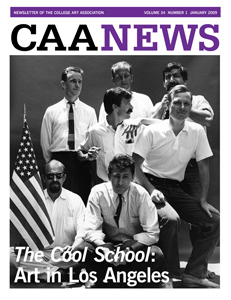 The first issue of CAA News for 2009 has just been posted to the CAA website. Click on the cover to download a PDF of the issue right away. Printed copies for individual and institutional members will be mailed soon, to begin arriving in mid-January.
The January issue includes statements and biographies of the six candidates for the CAA Board of Directors for 2009–13. Please read these texts, as well as view their short video statements online, before casting your vote.
Also featured are details on the upcoming Regional MFA Exhibition at the 97th Annual Conference in Los Angeles, which features the work of student artists from twelve graduate programs in southern California.
The deadline for submissions to, and advertisements for the March 2009 issue is January 10. Please see the newsletter submission guidelines for instructions or write to Christopher Howard, CAA managing editor.
CAA Joins Museum Associations in Letter to Obama Transition Team
posted Jan 05, 2009
CAA has joined a list of twenty-six national organizations, six regional museum associations, and thirty-nine state associations in sending a letter to President-elect Barack Obama’s transition team. The letter, drafted by the American Association of Museums and sent on December 22, 2008, states the case for the importance of US museums of all kinds and recommends $50 million in funding for the Office of Museum Services at the Institute of Museum and Library Services (IMLS) in fiscal year 2010—an increase of $19 million over this year’s budget.