
CAA News Today
Stuart Cary Welch Jr.: In Memoriam
posted Sep 08, 2008
Stuart Cary Welch Jr., curator emeritus of Islamic and later Indian art at the Harvard Art Museum and former special consultant in charge in the Department of Islamic Art at the Metropolitan Museum of Art, died on August 13, 2008, while traveling in Hokkaido, Japan. He was 80 and a resident of New Hampshire.
Welch, a legendary scholar, collector, and connoisseur, studied and taught at Harvard University, where he was instrumental in transforming the Department of Islamic Art, establishing a curriculum of study of the arts of the Middle East and South Asia, and developing one of the finest collections of Islamic and later Indian art in this country. His lifelong association with Harvard culminated in his role over the past two decades as one of the most generous donors to the Harvard Art Museum.
Welch developed an appreciation of art early in his childhood. Aside from being a collector of drawings at a very young age, Welch himself was an accomplished draftsman, a skill that carried through to his enrollment at Harvard and beyond. He was a graduate of the St. Paul’s School in Concord, New Hampshire, in 1946. That same year he began his undergraduate studies in fine arts at Harvard, where he continued his graduate work in Classical art from 1952 to 1954. During that time, Welch intensified his study and collecting of Islamic and Indian art. He also published some of his more entertaining and lighthearted drawings in Harvard’s literary and humor magazines, including his series of Popular Professions Illustrated that appeared in the Harvard Lampoon and the Harvard Advocate.
While Welch concentrated in the study of fine arts at Harvard, at the time there were no classes or formal instruction available in the subject of Islamic or Indian art. Ever resourceful, Welch took the initiative to devise his own “course of study” by traveling extensively throughout the Middle East and South Asia to absorb regional traditions and culture and to witness firsthand the lands that captivated him, his interest driven by the drawings that he had already begun to acquire. At the same time, Eric Schroeder, then honorary keeper of Islamic Art at the Fogg Museum, became his mentor at Harvard.
In 1956, Schroeder invited Welch to become honorary assistant keeper of Islamic Art at the Fogg, and thus began an era that saw Welch use his infinite enthusiasm to transform the fledgling Department of Islamic Art. At the same time, as part of the vanguard of Islamic art scholars at Harvard, he spearheaded the effort to establish one of the first American university curriculums in the study of the arts of the Islamic world. In 1960, he taught the first class at Harvard in Near Eastern Art. An instructor for twenty-five years at Harvard, Welch arranged for works of art to be made available for study by students and scholars. Welch was a teacher and mentor to many distinguished museum leaders and scholars, including Lentz; Glenn Lowry, director of the Museum of Modern Art; and Michael Brand, director of the J. Paul Getty Museum. Over four decades at Harvard, Welch served as honorary keeper, curator (retiring in 1995), and finally curator emeritus. He worked brilliantly with such esteemed donors as John Goelet, Edwin Binney III, and John Kenneth Galbraith, and during his tenure he vastly enriched Harvard’s holdings of Islamic and Indian art.
Concurrent with his work at Harvard, Welch served as special consultant in charge in the Department of Islamic Art at the Metropolitan Museum of Art from 1979 to 1987. He was instrumental in making many important acquisitions that greatly enhanced the Metropolitan Museum’s collection and, in 1985, organized the groundbreaking exhibition India: Art and Culture, 1300–1900, a comprehensive presentation of over three hundred works including masterpieces of the sacred and court traditions that ranks among his greatest achievements as a curator.
Welch’s scholarship, particularly in the fields of Persian and Indian painting and drawing, served as the foundation for many important exhibitions and accompanying publications, including The Art of Mughal India, Paintings and Precious Objects (1964), the first important American exhibition devoted to Mughal art; Gods, Thrones, and Peacocks: Northern Indian Painting from Two Traditions, Fifteenth to Nineteenth Centuries (1965); Room for Wonder: Indian Painting during the British Period, 1760–1880 (1978); Wonders of the Age: Masterpieces of Early Safavid Painting, 1501–1576 (1979); Gods, Kings, and Tigers: The Art of Kotah (1997); and From Mind, Heart, and Hand: Persian, Turkish, and Indian Drawings from the Stuart Cary Welch Collection (2004), an exhibition of drawings from Welch’s landmark gift to Harvard in 1999 of over three hundred works.
Welch produced countless exhibitions over the forty years that he spent at Harvard, many of which may have been small in size, but which always tended toward the visual and poetic. His last exhibition is the first in a series entitled Perspectives that is part of the long-term exhibition Re-View at the Harvard Art Museum/Arthur M. Sackler Museum. The small installation, titled Tree of Life: Five Indian Variations on a Theme, includes just five works of art but is characteristic of Welch’s vision and approach. It opened in April 2008, just a few days after Welch’s eightieth birthday.
Considered his greatest scholarly achievement was the immense, two-volume study of The Houghton Shahnameh, coauthored with Martin B. Dickson of Princeton University, which focused on the great early Safavid dynasty copy of the Persian national epic executed for the Safavid ruler and patron of the arts Shah Tahmasp (r. 1524–1576). Welch’s insights fundamentally changed the way scholars thought about the development of early Safavid painting, demonstrating that it was, in fact, a brilliant synthesis of the earlier Timurid and Turkman styles of painting.
Welch’s numerous exhibitions, publications, public lectures, and years of teaching propelled the study and appreciation of Islamic and Indian art to new heights, educating and enlightening generations of students, scholars, and museum visitors.
Mentors Needed for CAA Conference
posted Sep 05, 2008
Participating as a mentor in CAA’s two Career Services mentoring programs—the Artists’ Portfolio Review and Career Development Mentoring—is an excellent way to serve the field while assisting the professional growth of the next generation of artists and scholars.
Artists’ Portfolio Review
CAA seeks curators and critics to participate in the Artists’ Portfolio Review during the 2009 Annual Conference in Los Angeles. This program provides an opportunity for artists to have slides, VHS videos, digital images, or DVDs of their work critiqued by professionals; member artists are paired with a critic, curator, or educator for twenty-minute appointments. Whenever possible, artists are matched with mentors based on medium or discipline. Volunteer mentors provide an important service to artists, enabling them to receive professional criticism of their work. Art historians and studio artists must be tenured; critics, museum educators, and curators must have five years’ experience. Curators and educators must have current employment with a museum or university gallery.
Interested candidates must be current CAA members, register for the conference, and be willing to provide at least five successive twenty-minute critiques in a two-hour period on one of the two days of the review: Thursday, February 26, and Friday, February 27, 8:00 AM–NOON and 1:00–5:00 PM each day.
Send your CV and a brief letter of interest to: Lauren Stark, Artists’ Portfolio Review, CAA, 275 Seventh Ave., 18th Floor, New York, NY 10001; or email them to lstark@collegeart.org. Deadline: December 12, 2008.
Career Development Mentoring
CAA seeks mentors from all areas of art history, studio art, art education, film and video, graphic design, the museum professions, and other related fields to serve in CAA’s Career Development Mentoring. Mentors give valuable advice to emerging and midcareer professionals, reviewing cover letters, CVs, slides, and other pertinent job-search materials in twenty-minute sessions.
Interested candidates must be current CAA members, register for the conference, and be prepared to give five successive twenty-minute critiques in a two-hour period on one of the two days of the session: Thursday, February 26, and Friday, February 27, 8:00 AM–NOON and 1:00–5:00 PM each day. Art historians and studio artists must be tenured; critics, museum educators, and curators must have five years’ experience. Curators and educators must have current employment with a museum or university gallery.
This mentoring session is not intended as a screening process by institutions seeking new hires. Applications are not accepted from individuals whose departments are conducting a faculty search in the field in which they are mentoring. Mentors should not attend as candidates for positions in the same field in which workshop candidates may be applying.
Please send your CV and a brief letter of interest to: Lauren Stark, Career Development Mentoring, CAA, 275 Seventh Ave., 18th Floor, New York, NY 10001; or email them to lstark@collegeart.org. Deadline: December 12, 2008.
New AAM Standards on Cultural Property
posted Sep 04, 2008
The American Association of Museums (AAM) has established new standards for the museum acquisition of archaeological material and ancient art that emphasize proper provenance of such objects and complete transparency on the part of the acquiring institutions. The product of two years of concerted research and vetting from the museum field, the Standards Regarding Archaeological Material and Ancient Art provide clear ethical guidance on collecting such material to discourage illicit excavation of archaeological sites and monuments. The standards also require museums to create a publicly available collections policy that sets institutional standards for provenance when acquiring archaeological material and ancient art.
CAA has also established Standards and Guidelines on similar topics, including the Resolution Concerning the Acquisition of Cultural Properties Originating in Foreign Countries (1973) and the Statement on the Importance of Documenting the Historical Context of Objects and Sites (2004).
Survey on Library and Museum Digitization Published
posted Sep 04, 2008
Research and Markets, a publisher of international marketing and research data based in Dublin, Ireland, has just produced The International Survey of Library and Museum Digitization Projects. The study presents and summarizes data on digitization programs at academic, public, and government libraries and museums in the United States, Canada, Australia, Germany, the United Kingdom, and more. Discussed are issues related to staffing, training, funding, outsourcing, permissions and copyright clearance, cataloguing, software and applications selection, and marketing. The International Survey is available for sale on the Research and Markets website.
UK Debates on the Future of Art Education
posted Sep 03, 2008
This year, the British contemporary-art magazine Art Monthly has been addressing issues in art education in the United Kingdom. Articles and editorials appearing in their pages have taken on the corporatization of the art school, the rise of the creative industries, educational Taylorism, levels of satisfaction in and radical improvements for UK educational institutions, and more.
In advance of two panel debates taking place September 27 at the Institute for Contemporary Arts in London and October 6 at Ikon Gallery in Birmingham, Art Monthly has made their essays and letters on art education available online. Please visit the magazine’s website for more information about the debates, to read the articles, and to join the debate.
Ann Temkin Named Chief Curator at MoMA
posted Sep 03, 2008

The Museum of Modern Art in New York has announced that Ann Temkin will succeed John Elderfield as chief curator of painting and sculpture. Temkin, who served for thirteen years at the Philadephia Museum of Art in Pennsylvania, has been a curator at MoMA for five years. Among her exhibitions there are Color Chart: Reinventing Color, 1950 to Today (2008) and Against the Grain: Contemporary Art from the Edward R. Broida Collection (2006).
The New York Times has the story. Photograph by Robin Holland and provided by the Museum of Modern Art.
September CAA News Published
posted Aug 28, 2008
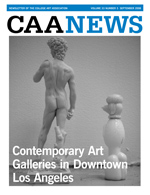 The September CAA News has just been published. With the newsletter back in print, individual and institutional members will receive a copy in the mail next month; the newsletter is also available immediately as a PDF download.
The September issue celebrates the tenth anniversary of caa.reviews, the online journal that launched in fall 1998. Also, in preparation for the 2009 Annual Conference, the issue contains an article on the hottest contemporary art galleries downtown in Los Angeles, including those in Chinatown.
A number of important deadlines for participation in CAA activities also appear: calls for nominations for editor-in-chief of Art Journal and reviews editor of The Art Bulletin (September 15); for conference travel grants (September 26); for applications for graduate-student fellowships (October 1); and more.
The deadline for submissions to the November issue is September 10; please send them to Christopher Howard, CAA managing editor. If you wish to receive CAA News in electronic format only, please contact CAA Member Services.
Women’s Caucus for Art Lifetime Achievement Awards
posted Aug 27, 2008
The Women’s Caucus for Art (WCA) has selected five recipients for its 2009 Lifetime Achievement Awards:
- Maren Hassinger, director of the Rinehart School of Graduate Sculpture at the Maryland Institute College of Art
- Ester Hernandez, a San Francisco–based artist who was a pioneer in the Chicana/Chicano civil rights art movement
- Joyce Kozloff, a political and feminist artist who was a founding member of the Pattern and Decoration movement of the 1970s
- Margo Machida, a renowned authority on contemporary Asian American art and visual culture and associate professor at the University of Connecticut
- Ruth Weisberg, an artist and dean of fine arts at the University of Southern California
The awards ceremony will be held at the Wilshire Grand Hotel in Los Angeles on Saturday, February 28, 2009, in conjunction with the CAA Annual Conference. This ceremony, which is free and open to the public, will be the thirtieth anniversary of the awards. As in past years, the awards ceremony will include an accompanying catalogue, outlining the awardees’ accomplishments in greater detail. Please check the WCA website for more details about the ceremony (free), the awards dinner (tickets are $90 before December 1, 2008, and $105 after), and other planned events.
CAA Award Recipients Featured in Art in America
posted Aug 25, 2008
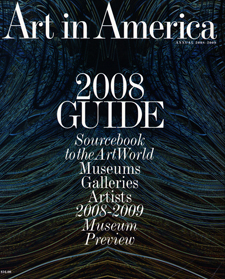 Art in America’s 2008 Annual Guide to Galleries, Museums, and Artists hit newsstands earlier this month, with museum previews for the 2008–9 season as well as a look back at notable events and people of the past year. The “People in Review” section features Yoko Ono, Robert L. Herbert, Chris Kraus, and Sylvia Sleigh as honored recipients of CAA Awards for Distinction. The awards were presented in February 2008 at the CAA Annual Conference in Dallas–Fort Worth.
Download the Art in America feature; also, see the full list of 2008 award recipients.
caa.reviews Needs Field Editors for Art Exhibitions
posted Aug 21, 2008
CAA invites nominations and self-nominations for two field-editor positions for exhibition reviews in caa.reviews for a four-year term, through June 30, 2012. Each field editor covers a geographic region of the United States; needed now are editors covering art exhibitions in the Northwest and Southeast United States.
caa.reviews is an online journal devoted to the peer review of new books, museum exhibitions, and projects relevant to the fields of art history, visual studies, and the arts. Candidates may be artists, art historians, art critics, art educators, curators, or other art professionals; institutional affiliation is not required. Field editors should live in the region covered.
Each field editor commissions reviews of important museum and gallery exhibitions for caa.reviews. He or she selects shows to be reviewed, commissions reviewers, determines the appropriate character of the reviews, and works with reviewers to develop manuscripts for publication. These field editors work with the caa.reviews Editorial Board as well as the caa.reviews editor-in-chief and CAA’s staff editor. Each field editor is expected to keep abreast of current and upcoming exhibitions (and other related projects) in his or her geographic region.
The Council of Field Editors meets annually at the CAA Annual Conference. Field editors must pay travel and lodging expenses to attend the conference.
Candidates must be current CAA members and should not be serving on the editorial board of a competitive journal or on another CAA editorial board or committee. Nominators should ascertain their nominee’s willingness to serve before submitting a name; self-nominations are also welcome. Send a statement describing your interest in and qualifications for appointment, CV, and contact information to: Chair, caa.reviews Editorial Board, CAA, 275 Seventh Ave., 18th Floor, New York, NY 10001. Deadline extended: September 15, 2008.