
CAA News Today
Free Speech Protection Act Introduced in House
posted Mar 10, 2009
Representative Peter King, a Republican from the State of New York, reintroduced the Free Speech Protection Act (HR 1304) to protect the First Amendment rights of Americans who are sued for defamation in foreign courts. With the rise of libel tourism, the fear of a lawsuit has become a deterrent for American authors, journalists, and publishers seeking to publish works on topics such as terrorism. The bill provides protections that will deter foreigners from suing Americans.
Recently there has been a rise in “libel tourism,” where foreigners take advantage of plaintiff-friendly foreign court systems, such as in the United Kingdom, in order to sue Americans for defamation. When sued in foreign courts, it has been difficult for Americans to countersue, as they could not establish standing in US courts. Without the ability to retaliate, there is nothing to discourage the practice of libel tourism.
The Free Speech Protection Act does the following to protect Americans and deter foreign libel lawsuits:
- Allows US persons to bring a federal cause of action against any person bringing a foreign libel suit if the writing does not constitute defamation under US law
- Bars enforcement of foreign libel judgments and provides other appropriate injunctive relief by US courts if a cause of action is established
- Awards damages to the US person who brought the action in the amount of the foreign judgment, the costs related to the foreign lawsuit, and the harm caused due to the decreased opportunities to publish, conduct research, or generate funding
- Awards treble damages if the person bringing the foreign lawsuit intentionally engaged in a scheme to suppress First Amendment rights
- Allows for expedited discovery if the court determines that the speech at issue in the foreign defamation action is protected by the First Amendment.
While the goal of the bill is to protect Americans from the exploitation of libel tourism, it does not intend to limit legitimate cases of defamation. Nothing in the bill limits the rights of foreign litigants who bring forward good-faith defamation actions against journalists and others who have purposely and maliciously published false information.
In 2008, New York State passed a similar bill entitled Rachel’s Law. King’s bill raises the issue on the federal level so that all American’s rights can be protected. Senators Specter, Lieberman, and Schumer have introduced companion legislation in the Senate.
NEA Report on Unemployment Rates for Artists
posted Mar 09, 2009
Unemployment rates are up among working artists and the artist workforce has contracted, according to new research from the National Endowment for the Arts (NEA). Artists in a Year of Recession: Impact on Jobs in 2008 examines how the economic slowdown has affected the nation’s working artists. The study looks at artist employment patterns during two spikes in the current recession—the fourth quarters of 2007 and 2008. Not unexpectedly, this downturn reflects larger economic declines across the nation: a Commerce Department report from late February noted a 6.2 percent decrease in the gross domestic product in the last quarter of 2008. The ten-page publication can be downloaded as a PDF.
Among the findings:
- Artists are unemployed at twice the rate of professional workers, a category in which artists are grouped because of their high levels of education. The artist unemployment rate grew to 6 percent in the fourth quarter of 2008, compared with 3 percent for all professionals. A total of 129,000 artists were unemployed in the fourth quarter of 2008, an increase of 50,000 (63 percent) from one year earlier. The unemployment rate for artists is comparable to that for the overall workforce (6.1 percent)
- Unemployment rates for artists have risen more rapidly than for US workers as a whole. The unemployment rate for artists climbed 2.4 percentage points between the fourth quarters of 2007 and 2008, compared to a one-point increase for professional workers as a whole, and a 1.9 point increase for the overall workforce
- Artist unemployment rates would be even higher if not for the large number of artists leaving the workforce. The US labor force grew by 800,000 people from the fourth quarter of 2007 to the fourth quarter of 2008. In contrast, the artist workforce shrank by 74,000 workers. Some of this decline may be attributed to artists’ discouragement over job prospects
- Unemployment rose for most types of artist occupations. Artist jobs with higher unemployment rates are performing artists (8.4 percent), fine artists, art directors, and animators (7.1 percent), writers and authors (6.6 percent), and photographers (6.0 percent)
- The job market for artists is unlikely to improve until long after the US economy starts to recover. Unemployment is generally a lagging economic indicator, or a measure of how an economy has performed in the past few months. During the prior recession (2001), artist unemployment did not reach its peak of 6.1 percent until 2003—two years after economic recovery began nationwide.
As an example of how arts jobs intersect with the larger economy, consider the construction industry. Industry-wide declines, which began in 2006, have contributed to the shrinking job market for architects. While this group usually has the lowest unemployment rates among all artist occupations and all professionals, architect unemployment rates doubled, from 1.8 percent in fourth quarter 2007, to 3.8 percent in the fourth quarter of 2008. Unemployment in the designer category also doubled, from 2.3 percent to 4.7 percent. This broad category includes interior, commercial, and industrial designers whose work is closely associated with the construction industry. Eighty-three thousand designers left the artist labor market during that time period.
The contraction of the arts workforce has implications for the overall economy. A May 2008 NEA study revealed there are two million full-time artists representing 1.4 percent of the US labor force, only slightly smaller than the number of active-duty and reserve personnel in the military (2.2 million). More recently, a National Governors Association report recognized that the arts directly benefit states and communities through job creation, tax revenues, attracting investments, invigorating local economies, and enhancing quality of life. There are 100,000 nonprofit arts organizations that support 5.7 million jobs and return nearly $30 billion in government revenue every year, according to a study by Americans for the Arts.
The NEA Office of Research and Analysis produced Artists in a Year of Recession: Impact on Jobs in 2008 using published and unpublished data from the Department of Labor’s Bureau of Labor Statistics. The research note measures unemployment rates among workers who self-reported an artist job as occupying their greatest number of working hours per week, whether the employment was full-time or part-time.
Recent Deaths in the Arts
posted Mar 09, 2009
Below is a list of recent deaths in the arts, with a link to each person’s published obituary:
- Lucille Virginia Burton, a curator of Egyptian art at the Metropolitan Museum of Art, died on February 22, 2009, at the age of 90
- Schuyler Chapin, a cultural affairs commissioner for New York City and a dean of the School of the Arts at Columbia University, died on March 7, 2009. He was 86
- William de Looper, an artist associated with the Washington Color School and a curator for the Phillips Collection, died on January 30, 2009, at age 76
- Louisa Edwards, an art dealer at McIntosh Gallery in Atlanta who promoted black artists, died on February 23, 2009. She was 83
- Sverre Fehn, a Norwegian architect who won the Pritzker Architecture Prize, died on February 23, 2009, at age 84
- Virgil Grotfeldt, a painter and sculptor based in Houston, Texas, died on February 23, 2009. He was 60
- Mary Hambleton, an artist and a professor of art at Parsons the New School Design, died January 9, 2009, at the age of 56
- Judith Hoffberg, an art librarian, curator, and editor of the journal Umbrella who championed artist’s books, died on January 16, 2009. She was 74
- Howard Kanovitz, a Photo Realist painter who emerged in the 1960s, died on February 2, 2009, at the age of 79
- Max Neuhaus, a percussionist and a pioneer of sound art, died on February 3, 2009, at the age of 69
- Olga Raggio, a scholar who taught at the Institute of Fine Arts at New York University and a curator for the Metropolitan Museum of Art, died on January 24, 2009. She was 82
- George Schneeman, a poet and painter based in New York, died January 22, 2009, at age 74
- Franz-Joachim Verspohl, an art historian who taught at the Friedrich-Schiller-Universität Jena in Germany, died in February 2009
- Dina Vierny, an artist’s model who inspired the sculptor Aristide Maillol, died on January 20, 2009. She was 89
Read all past obituaries in the arts on the CAA website.
NEA REPORT ON UNEMPLOYMENT RATES FOR ARTISTS
posted Mar 09, 2009
Unemployment rates are up among working artists and the artist workforce has contracted, according to new research from the National Endowment for the Arts (NEA). Artists in a Year of Recession: Impact on Jobs in 2008 examines how the economic slowdown has affected the nation’s working artists. The study looks at artist employment patterns during two spikes in the current recession—the fourth quarters of 2007 and 2008. Not unexpectedly, this downturn reflects larger economic declines across the nation: a Commerce Department report from late February noted a 6.2 percent decrease in the gross domestic product in the last quarter of 2008. The ten-page publication can be downloaded as a PDF.
Among the findings:
- Artists are unemployed at twice the rate of professional workers, a category in which artists are grouped because of their high levels of education. The artist unemployment rate grew to 6 percent in the fourth quarter of 2008, compared with 3 percent for all professionals. A total of 129,000 artists were unemployed in the fourth quarter of 2008, an increase of 50,000 (63 percent) from one year earlier. The unemployment rate for artists is comparable to that for the overall workforce (6.1 percent)
- Unemployment rates for artists have risen more rapidly than for US workers as a whole. The unemployment rate for artists climbed 2.4 percentage points between the fourth quarters of 2007 and 2008, compared to a one-point increase for professional workers as a whole, and a 1.9 point increase for the overall workforce
- Artist unemployment rates would be even higher if not for the large number of artists leaving the workforce. The US labor force grew by 800,000 people from the fourth quarter of 2007 to the fourth quarter of 2008. In contrast, the artist workforce shrank by 74,000 workers. Some of this decline may be attributed to artists’ discouragement over job prospects
- Unemployment rose for most types of artist occupations. Artist jobs with higher unemployment rates are performing artists (8.4 percent), fine artists, art directors, and animators (7.1 percent), writers and authors (6.6 percent), and photographers (6.0 percent)
- The job market for artists is unlikely to improve until long after the US economy starts to recover. Unemployment is generally a lagging economic indicator, or a measure of how an economy has performed in the past few months. During the prior recession (2001), artist unemployment did not reach its peak of 6.1 percent until 2003—two years after economic recovery began nationwide.
As an example of how arts jobs intersect with the larger economy, consider the construction industry. Industry-wide declines, which began in 2006, have contributed to the shrinking job market for architects. While this group usually has the lowest unemployment rates among all artist occupations and all professionals, architect unemployment rates doubled, from 1.8 percent in fourth quarter 2007, to 3.8 percent in the fourth quarter of 2008. Unemployment in the designer category also doubled, from 2.3 percent to 4.7 percent. This broad category includes interior, commercial, and industrial designers whose work is closely associated with the construction industry. Eighty-three thousand designers left the artist labor market during that time period.
The contraction of the arts workforce has implications for the overall economy. A May 2008 NEA study revealed there are two million full-time artists representing 1.4 percent of the US labor force, only slightly smaller than the number of active-duty and reserve personnel in the military (2.2 million). More recently, a National Governors Association report recognized that the arts directly benefit states and communities through job creation, tax revenues, attracting investments, invigorating local economies, and enhancing quality of life. There are 100,000 nonprofit arts organizations that support 5.7 million jobs and return nearly $30 billion in government revenue every year, according to a study by Americans for the Arts.
The NEA Office of Research and Analysis produced Artists in a Year of Recession: Impact on Jobs in 2008 using published and unpublished data from the Department of Labor’s Bureau of Labor Statistics. The research note measures unemployment rates among workers who self-reported an artist job as occupying their greatest number of working hours per week, whether the employment was full-time or part-time.
2010 Call for Participation Published
posted Feb 23, 2009
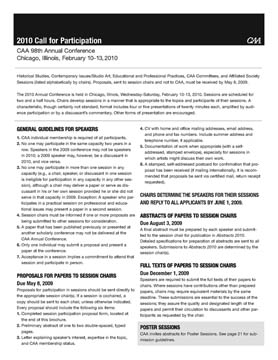 The 98th Annual Conference will take place February 10–13, 2010, in Chicago, Illinois, the first time since 2001. Listing more than 120 sessions, the 2010 Call for Participation, which you can download now as a PDF, will arrive in the mailboxes of all individual and institutional CAA members in March 2009.
This twenty-four-page publication describes many of next year’s panels and presentations. CAA and session chairs invite your participation: please follow the instructions in the booklet to submit a proposal for a paper or presentation. This publication also includes a call for Poster Session proposals and describes the Open Forms sessions.
In addition to attending and participating in the wide-ranging panels on art history, studio art, contemporary issues, and professional and educational practices, CAA expects participation from many area schools, museums, galleries, and other art institutions. The Hyatt Regency Chicago is the conference hotel, holding most sessions and panels, Career Services and the Book and Trade Fair, receptions and special events, and more. Deadline: May 8, 2009.
Read the 2009 Annual Conference Blog
posted Feb 23, 2009
Once again, CAA is publishing an official Annual Conference blog in order to chronicle the event’s diverse experiences, points of view, and opinions. Six bloggers, selected from among the CAA membership, will be writing daily—even hourly—on Los Angeles conference events. Christopher Howard, CAA managing editor, will moderate and post images.
The 2009 bloggers are: Katie Anania, a graduate student in art history at the University of Texas at Austin; Beth Harris, director of digital learning at the Museum of Modern Art in New York; Micol Hebron, a California-based video and performance artist and an assistant professor of art at Chapman University; Benjamin Lima, a doctoral student at Yale University; Ed Schad, a Los Angeles–based writer and a curatorial associate for the Broad Art Foundation; and Steven Zucker, dean of the School of Graduate Studies at the Fashion Institute of Technology, State University of New York. Read their full biographies on the blog.
Regular sessions and ARTspace happenings, Career Services and the Book and Trade Fair, exhibition openings and special events—anything and everything is game for the CAA conference blog!
March CAA News Published
posted Feb 20, 2009
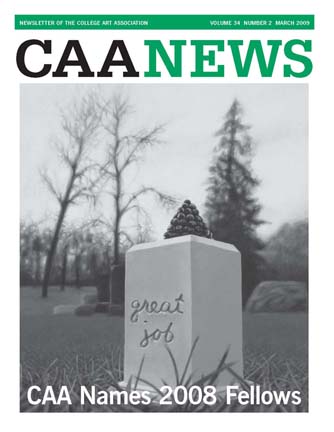 The March 2009 CAA News has been posted to the CAA website as a PDF download. Printed copies for individual and institutional members will be mailed next week, with your copy arriving in early March.
Highlighted in the issue are the four 2008 recipients of CAA’s Professional Development Fellowship Program for graduate students: Mary Reid Kelley, Yale University; Justin Shull, Rutgers University; Nichole N. Bridges, University of Wisconsin, Madison; and Wendy Ikemoto, Harvard University. Six honorable mentions are also named.
In the Publications section, CAA announces the appointment of Katy Siegel as the next Art Journal editor-in-chief. In addition, the editorial boards of our three journals—The Art Bulletin, Art Journal, and caa.reviews—and the Millard Meiss Publication Fund Jury all seek new members. Read the calls for nominations and self-nominations inside.
The deadline for submissions to the May 2009 CAA News is March 10. Please read the newsletter submission guidelines or write to Christopher Howard, CAA managing editor.
NEA and Smithsonian Benefit from Economic-Recovery Bill
posted Feb 19, 2009
On Tuesday, President Barack Obama signed the American Recovery and Reinvestment Act, passed by Congress late last week. The $787 billion stimulus bill includes considerable appropriations for the National Endowment for the Arts ($50 million for a federal agency with a $245 million budget for the current fiscal year) and Smithsonian Institution ($25 million, but cut from the House’s original request of $150 million). Language that, in the Senate version of the act, would have excluded museums, theaters, and arts centers from receiving federal funds was removed from the final legislation.
Casey Selix and Cynthia Dizikes of MinnPost.com report:
According to the bill, the NEA money is “to be distributed in direct grants to fund arts projects and activities which preserve jobs in the non-profit arts sector threatened by declines in philanthropic and other support during the current economic downturn.” Forty percent of the money is to be distributed to state arts agencies and regional arts councils . . . and 60 percent for “competitively selected projects.”
Helen Stoilas from the Art Newspaper and Robin Pogrebin at the New York Times have also reported on the arts portion of the stimulus bill.
In a press release from last week, Americans for the Arts argued that 100,000 nonprofit arts organizations and their audiences generate $166.2 billion annually in US economic activity, supporting 5.7 million jobs and providing nearly $30 billion in government revenue. While politicians debated the merits of including the arts in the economic-recovery package, some stood firm. On the House floor last Friday, Congressman David Obey (D-WI) stated: “There are five million people who work in the arts industry. And right now they have 12.5 percent unemployment—or are you suggesting that somehow if you work in that field, it isn’t real when you lose your job, your mortgage, or your health insurance? We’re trying to treat people who work in the arts the same way as anybody else.”
The New York Times has published a full breakdown of the $787 billion, although arts and education funding don’t appear in standalone categories. However, Doug Lederman at Inside Higher Ed once again lists higher-education allotments in the House and Senate bills, as well as amounts in the final compromise that was approved by President Obama.
While groups like Americans for the Arts and CAA applaud the provisions for art and education in the American Recovery and Reinvestment Act, others point out larger issues. In the Wall Street Journal, Greg Sandow writes that “Fifty million dollars . . . is just a bubble on a wave” and feels that arguments about the economic value of the arts need closer examination. Tyler Green of Modern Art Notes also casts a skeptical eye on the NEA funding, suggesting that people in the arts should “join Washington’s think-tank culture . . . to develop new ideas about how government should be involved in the arts (and not just in one little agency, but across the federal apparatus).”
NEA AND SMITHSONIAN BENEFIT FROM ECONOMIC-RECOVERY BILL
posted Feb 19, 2009
On Tuesday, President Barack Obama signed the American Recovery and Reinvestment Act, passed by Congress late last week. The $787 billion stimulus bill includes considerable appropriations for the National Endowment for the Arts ($50 million for a federal agency with a $245 million budget for the current fiscal year) and Smithsonian Institution ($25 million, but cut from the House’s original request of $150 million). Language that, in the Senate version of the act, would have excluded museums, theaters, and arts centers from receiving federal funds was removed from the final legislation.
Casey Selix and Cynthia Dizikes of MinnPost.com report:
According to the bill, the NEA money is “to be distributed in direct grants to fund arts projects and activities which preserve jobs in the non-profit arts sector threatened by declines in philanthropic and other support during the current economic downturn.” Forty percent of the money is to be distributed to state arts agencies and regional arts councils . . . and 60 percent for “competitively selected projects.”
Helen Stoilas from the Art Newspaper and Robin Pogrebin at the New York Times have also reported on the arts portion of the stimulus bill.
In a press release from last week, Americans for the Arts argued that 100,000 nonprofit arts organizations and their audiences generate $166.2 billion annually in US economic activity, supporting 5.7 million jobs and providing nearly $30 billion in government revenue. While politicians debated the merits of including the arts in the economic-recovery package, some stood firm. On the House floor last Friday, Congressman David Obey (D-WI) stated: “There are five million people who work in the arts industry. And right now they have 12.5 percent unemployment—or are you suggesting that somehow if you work in that field, it isn’t real when you lose your job, your mortgage, or your health insurance? We’re trying to treat people who work in the arts the same way as anybody else.”
The New York Times has published a full breakdown of the $787 billion, although arts and education funding don’t appear in standalone categories. However, Doug Lederman at Inside Higher Ed once again lists higher-education allotments in the House and Senate bills, as well as amounts in the final compromise that was approved by President Obama.
While groups like Americans for the Arts and CAA applaud the provisions for art and education in the American Recovery and Reinvestment Act, others point out larger issues. In the Wall Street Journal, Greg Sandow writes that “Fifty million dollars . . . is just a bubble on a wave” and feels that arguments about the economic value of the arts need closer examination. Tyler Green of Modern Art Notes also casts a skeptical eye on the NEA funding, suggesting that people in the arts should “join Washington’s think-tank culture . . . to develop new ideas about how government should be involved in the arts (and not just in one little agency, but across the federal apparatus).”
Conference Book and Trade Fair Exhibitors
posted Feb 17, 2009
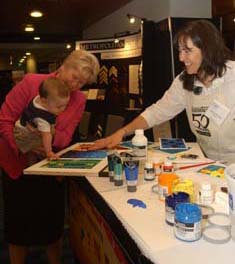 CAA has announced the list of exhibitors who will be present in Los Angeles for this year’s Book and Trade Fair. Taking place at the Los Angeles Convention Center during the 97th Annual Conference, the Book and Trade Fair hosts more than one hundred major college and university publishers, leading trade publishers, and trend-setting independent presses.
The largest national and international art-materials manufacturers and distributors, as well as highly specialized companies with unique products for studio artists, will show their products and wares. Also on hand are a handful of contemporary art journals.
The fair continues to attract a wide array of diverse organizations providing professional services to the visual arts, including programs of advanced study, specialized associations, advanced-degree programs, and independent exhibition services.
At the CAA booth, you can purchase copies of the highly anticipated directories of graduate programs in the arts: Graduate Programs in Art History and Graduate Programs in the Visual Arts. Stop by to browse these publications, talk with CAA staff members, and learn more about CAA’s programs and services.
The Book and Trade Fair in Los Angeles is open for three days: Thursday, February 26, and Friday, February 27, 9:00 AM–6:00 PM, and Saturday, February 28, 9:00 AM–2:30 PM. The 2009 sponsors are ARTstor, Blick Artist Materials, Prestel Publishing, Saskia Ltd./Scholars Resource, the School of Visual Arts, and SlideRoom.