
CAA News Today
Submit a Proposal for Idea Exchange at CAA 2020
posted Sep 16, 2019
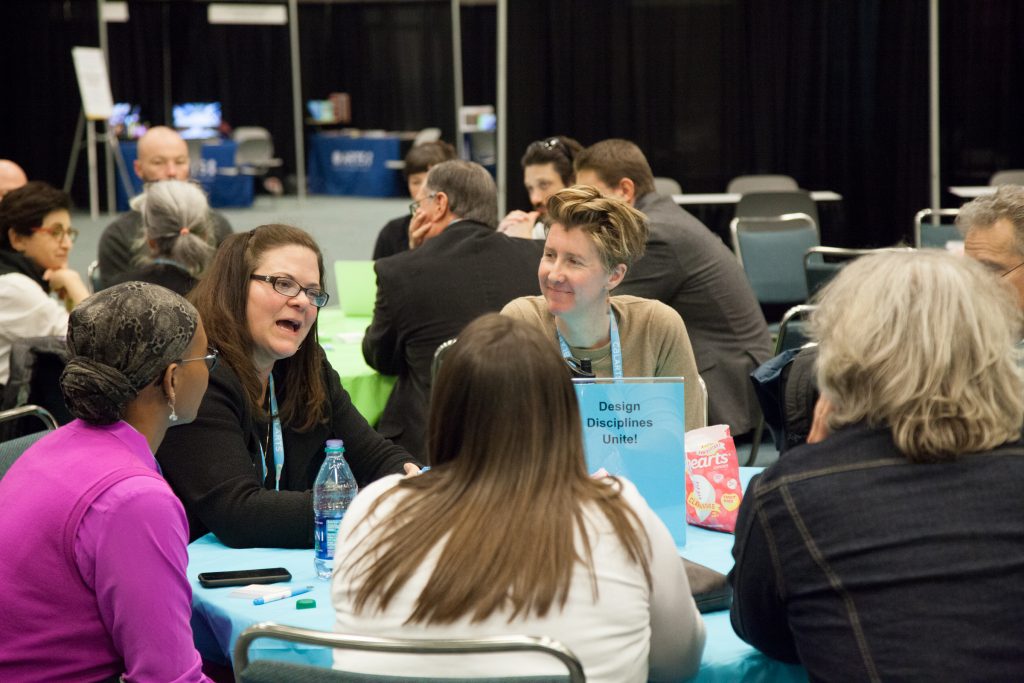
Idea Exchange at the 2018 CAA Annual Conference. Photo: Rafael Cardenas
We launched Idea Exchange at the 2018 Annual Conference in Los Angeles in response to members who expressed an interest in holding informal roundtable discussions on topics ranging from fellowship applications and gallery representation to student engagement in the classroom and preserving women artists’ legacies. See a list of previous discussion topics here.
We’re offering Idea Exchange again in 2020 and we’re looking for CAA members to serve as discussion leaders.
Propose a topic that you would like to discuss with your colleagues for a sixty-minute roundtable at the conference. It can relate to professional development, teaching, or current events, such as the debate surrounding Confederate monuments or the #MeToo movement in the arts. Be creative. The conversations are meant to be lively and engaging. Please submit your Idea Exchange proposals by November 1, 2019.
In order to submit an Idea Exchange topic, you will need to have your member ID and password ready. If you do not have an individual ID number and password or you do not know it, please contact member services by email at membership@collegeart.org or by phone at 212-691-1051, ext. 1.
Idea Exchange will be held in the Hilton Chicago, Lower Level, Salon B, during the following times:
Wednesday, February 12: 10:30 AM; 12:30 PM; 2:00 PM; 4:00 PM
Thursday, February 13: 10:30 AM; 12:30 PM; 2:00 PM; 4:00 PM
Friday, February 14: 10:30 AM; 12:30 PM; 2:00 PM; 4:00 PM
Saturday, February 15: 10:30 AM; 12:30 PM
For more information on Idea Exchange, contact Mira Friedlaender, manager of the Annual Conference, at mfriedlaender@collegeart.org or by phone at (212) 392-4405.
Lyz Wendland and Ann E. Lawton
posted Sep 16, 2019
The weekly CAA Conversations Podcast continues the vibrant discussions initiated at our Annual Conference. Listen in each week as educators explore arts and pedagogy, tackling everything from the day-to-day grind to the big, universal questions of the field.
CAA podcasts are on iTunes. Click here to subscribe.
This week, Lyz Wendland and Ann E. Lawton discuss work-life balance.
Lyz Wendland is an assistant professor of Art at Augsburg University in Minneapolis, Minnesota. Her mixed-media work explores the relationship between architecture and nature.
Ann E. Lawton is a mixed media artist, registered art therapist, and an art educator at the University of Wisconsin-River Falls.
New in caa.reviews
posted Sep 13, 2019
Didier Aubert commemorates the life and work of François Brunet, and reviews Brunet’s book La photographie: Histoire et contre-histoire. Read the full review at caa.reviews.
Matthew Bent discusses the exhibition Past Disquiet: Artists, International Solidarity and Museums in Exile, curated by Kristine Khouri and Rasha Salti. Read the full review at caa.reviews.
Kimberly Cleveland considers Henry Glassie and Pravina Shukla’s Sacred Art: Catholic Saints and Candomblé Gods in Modern Brazil. Read the full review at caa.reviews.
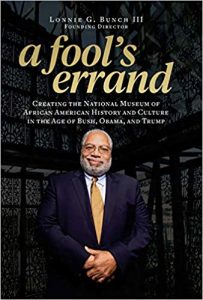
Deborah Ziska writes about Lonnie G. Bunch III’s forthcoming book, A Fool’s Errand: Creating the National Museum of African American History and Culture in the Age of Bush, Obama, and Trump. Read the full review at caa.reviews.
CAA Internship Program
posted Sep 12, 2019
Starting in September 2018, CAA introduced a new internship program in its New York office for undergraduate and graduate students and recent graduates. Specifically, the program is designed for those who wish to gain experience and develop skills in the following areas:
- Events and Conference Programming
- Publications and Digital Publications
- Marketing & Communications
- Membership Development
Each intern will be assigned a discrete, clearly defined project (or projects) to be completed during the internship period.
The number of hours will depend on the preference of the CAA department, but will generally expected to work 20-30 hours per week in CAA’s New York office sometime between the hours of 9:00 AM to 6:00 PM, Monday to Friday. All internships require a commitment of eight consecutive weeks. Interns are expected to be commit three days per week
Eligibility
- Candidates must have successfully completed their junior year at an undergraduate college in any field of study.
- Candidates must have secure housing in the New York area which will allow them to complete the entire internship period.
- Candidates should have had some office experience and should be generally familiar with Microsoft Office, especially Word and Excel. Familiarity with Microsoft Office 365 preferable.
Internship sessions
- Fall 2019 – 8 weeks (September 15 through December 15)
- Spring 2020 – 8 weeks (January 15 through May 15)
- Summer 2020 – 8 weeks (June 1 through August 15)
There will be two interns per session.
Compensation
Each intern will receive a stipend of $500 per month paid bimonthly along with CAA’s regular payroll. Interns will be viewed as independent contractors and no deductions will be made, however a 1099 will be issued and interns are expected to pay all taxes as required under law.
Course credit
CAA will make every effort to assist successful candidates to obtain college credit, if applicable. Please coordinate with your institution’s administrator for semester credit. CAA can provide letters of confirmation and/or complete necessary forms.
To apply
Please submit a cover letter indicating your departmental interests (please rank two preferred departments), and CV to Daniel Tsai, CAA Programs and Publications Administrator: dtsai@collegeart.org. Please also list two professional references and the means to contact them via telephone or email. No phone calls please.
Applications will be accepted until positions are filled.
Events and Conference Programming Internship Tasks:
Assists with Annual Conference Special Events/Special Projects
- pre-conference workshops
- Key Conversation Panels
- events for students and emerging professionals
- Museum visits and tours
Assists with the research and facilitation of the Network Hall programming.
Assists with the research and development and implementation of workshops and programs throughout the year.
Publications and Digital Publications Internship Tasks:
- Assisting with checking layouts and copyediting
- Proofreading the reviewsadmin site to ensure uniformity of titles, format
- Checking all the links on Art Journal Opensite to make sure they work
Marketing & Communications Internship Tasks:
- Editing and proofreading
- Visual design and layout assistance
- Social media
- Assembling press files
- Website review and content review
- Assembling press hits files
- Assembling digital metrics files
- General communications and strategy research
Membership Development Internship Tasks:
- Database cleanup
- Assist with membership growth strategy
- Renewal address file clean up
- Membership card file address clean up, folding cards, post office delivery
- Updating IP addresses indiv/org claims for missing issues
- Returned publications for indiv/orgs
- Adding/updating primary contacts for organizations
- Possible outreach to lapsed organizational members
The CAA is an equal opportunity employer and considers all candidates for employment regardless of race, color, sex, age, national origin, creed, disability, marital status, sexual orientation, gender expression, or political affiliation.
CWA Picks for September 2019
posted Sep 12, 2019
CAA’s Committee on Women in the Arts selects the best in feminist art and scholarship to share with CAA members on a monthly basis. See the picks for September below.
FAST FASHION/SLOW ART
Luther W. Brady Art Gallery, The George Washington University, Washington, DC
August 9 – December 15, 2019
Beyond the glitz and glamour of the fashion industry are serious timely questions around waste and consumerism in the garment industry, which is what the contemporary artists and filmmakers explore in Fast Fashion/Slow Art. The diverse group of emerging and established contemporary artists and filmmakers from China, Denmark, Germany, Norway, and the United States includes Julia Brown, Carole Frances Lung (Frau Fiber), Cat Mazza, Senga Nengudi, Martha Rosler, Hito Steyerl, Martin de Thurah, Rosemarie Trockel, and Wang Bing, who collectively encourage scrutiny of today’s garment industry. For example, Bing’s documentary installation, 15 hours, was shot in a factory in China, capturing the labor of some of its 300,000 workers, emitting a meditation on the contemporary meaning of work in present-day China. Also available during the exhibition are two web programs, ”Planet Money Makes a T-Shirt” and “Sweatshop—Deadly Fashion.”
Her Own Way
Female Artists and the Moving Image in Art in Poland: From 1970s to the Present
Tokyo Photographic Art Museum
August 14 – October 14, 2019
The exhibition of artworks by Polish women artists features moving image, which has a rich history in Polish art scene. Women artists have used video and photography even though during the Cold War those working “behind” the Iron Curtain had little access to equipment and training. Despite hardships, women experimented with video expression. Following democratization of the country after the fall of the Berlin Wall and the introduction of the free market economy, Poland welcomed economic growth and material affluence. This contributed to deepening income gaps and rapid changes in value. Polish critical art of the 1990s addressed those contradictions in society. Those who were born under the Communist regime and brought up after democratization started looked back with a critical distance to explore new perspectives and question complex social and political conditions. This has driven a rich and diverse landscape for moving image, including the use of more accessible media. The exhibition features works from 1970s onwards questioning contradictions of the global economic system. It includes some of the key figures in Polish art scene including Bogna Burska, Izabella Gustowska, Zuzanna Janin, Katarzyna Kozyra, Anna Kutera, Natalia LL, Ewa Partum, Agnieszka Polska, Joanna Rajkowska, and Alicja Rogalska, among others.
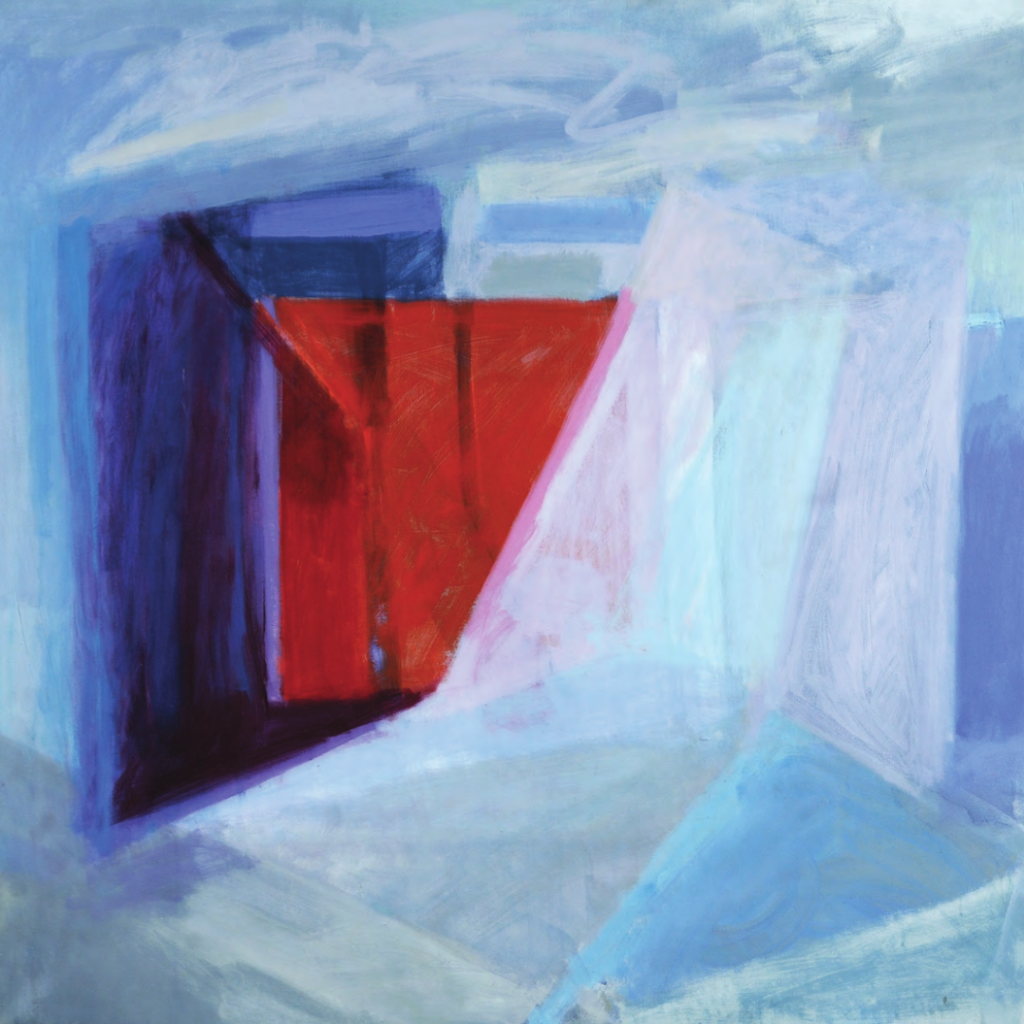
Helene Herzbrun, Entrances (detail), 1977. Acrylic on canvas, framed: 52 5/8 × 52 3/4 × 1 5/8 in., image: 52 × 52 in. American University Museum, X1639.
Grace Hartigan & Helene Herzbrun: Reframing Abstract Expressionism
American University Museum at the Katzen Arts Center, Washington, DC
September 3 – October 20, 2019
The past few years has witnessed an urgent reappraisal of the Abstract Expressionist canon in the United States. Recent game-changers, such as the Women of Abstract Expressionism exhibition and catalogue (2016), and steady growth in the art market, have turned a sharp eye on the women whose careers received little critical and financial support during and after the heyday of heroic gesturalism and figurative abstraction in the 1950s. Norma Broude, the distinguished feminist art historian and professor emerita at The American University, has organized an exhibition that argues for a reframing of the geographic center of New York, and presents a two-person show on Grace Hartigan (1922-2008) and Helene Herzbrun (1922-1984). Both artists, who had a cordial friendship, had lived and exhibited for many decades around the Baltimore and Washington, DC region, and many of the paintings on view are drawn from local private collections and museums. Hartigan, the more celebrated of the two, has received considerable scholarly attention. Her early career in New York was shaped by social relationships with the first generation of Abstract Expressionists, including Jackson Pollock and Willem de Kooning (a seminal influence), and the seductive riffraff of modern life in the fifties around her studio on the Lower East Side. Hartigan often incorporated the popular and material subjects—the “vulgar and vital”—from her surroundings, and Baltimore eventually proved to have much to offer. Her early artistic development was also largely influenced by her own study of paintings at the Metropolitan Museum of Art and transformative friendships with poets Frank O’Hara and Barbara Guest. By 1953, she had the attention of Alfred Barr, Jr. and curator Dorothy C. Miller, who accessioned her Baroque-inspired masterpiece, Persian Jacket (1952), into the permanent collection of the Museum of Modern Art; this was followed by her participation as the only woman artist in MoMA’s groundbreaking exhibitions, 12 Americans (1956) and The New American Painting (1958-1959). Broude’s catalogue essays purposefully consider the negative impact on Hartigan’s career after leaving New York City for Baltimore, and the artist’s serious disappointment in the regional artistic scene. This shifted to some degree when she found support in her new intellectual community as a revered professor and mentor at the Maryland Institute of Art (MICA), Hoffberger School. Comparably, Broude develops a fascinating biographical sketch of Helene Herzbrun, whose archives are held at American University. Herzbrun experienced similar challenges in her desire to establish critical recognition outside the parameters of New York and beyond the stylistic popularity of Color Field painting practiced by her male contemporaries in Washington. Herzbrun maintained an important correspondence with Ab-Ex artist Jack Tworkov, with whom she worked as a MFA student at AU. She was a faculty member in the University’s art department until her death in 1984. Addressing the limited opportunities for artists in the area, Herzbrun co-founded an important cooperative space called Jefferson Place Gallery in DC. Hartigan and Herzbrun make exciting visual partners in Reframing Abstract Expressionism. Their painterly dialogues on nature and the landscape interrogate the creative process and explore the persistent motivations to paint abstractly while negotiating representation, structure, and spontaneity, all essential components of the living language of Abstract Expressionism. This exhibition expands our understanding of the networks of production and distribution of ideas and resources on Abstract Expressionism to the regional centers of the country.
Affiliated Society News for September 2019
posted Sep 11, 2019
Affiliated Society News shares the new and exciting things CAA’s affiliated organizations are working on including activities, awards, publications, conferences, and exhibitions.
Interested in becoming an Affiliated Society? Learn more here.
SECAC
The 75th Annual SECAC Conference, hosted by the University of Tennessee at Chattanooga, will be held October 16 through 19, 2019. More than 540 papers—on studio art, art history, art education, and graphic design—will be presented in 142 sessions. All sessions will take place at the Chattanoogan Hotel. Offsite events include the annual SECAC Artist’s Fellowship and Juried Exhibitions and a keynote address by artist, educator, and advocate for artists, Sharon M. Louden, who serves as editor of the Living and Sustaining a Creative Life series of books and Artistic Director of the Visual Arts at Chautauqua Institution. More information and conference registration are available at https://secacart.org/page/Chattanooga.
Society for the Study of Early Modern Women and Gender (SSEMWG)
Foundation for Advancement in Conservation
Material Immaterial: Photographs in the 21st Century Symposium and Seminars
September 23-25, 2019, Yale University, New Haven, CT
Organized by Paul Messier and Monica Bravo
We are witnessing the historic transformation of photography from tangible objects—prints, plates, and negatives—to code: intangible bits, bytes, and pixels. As the tether between visual culture and the material world is recalibrated every day, a new form of literacy is required to draw meaning from physical media and its obsolescence. At the very moment when characterization and interpretation of the printed photograph is rapidly gaining ground, the momentum toward dematerialization raises the issue of the long-term relevance and sustainability of photography as a material fact. Does the physical photograph still matter today—as a source for teaching, learning, and scholarship—and will it matter into the future?
This symposium and elective seminars will provide insight into new tools for researching photographs with an emphasis on both the material and immaterial aspects of the medium. Conservation professionals will gain practical knowledge on new and existing techniques for characterizing prints and collections and how this information can be structured and visualized. Curators and art historians will benefit from exposure to the methods and techniques that underlie the contemporary approaches to material history. Together, the presentations and discussions are meant to demystify techniques adapted from seemingly exotic fields of artificial intelligence and data science and to cover some basic techniques for understanding and interpreting the physical and chemical makeup of a photographic print.
View the program for detailed a schedule and speaker list or visit the event website to register.
Support for this program comes from The Andrew W. Mellon Foundation Fund for Collaborative Workshops in Photograph Conservation, a grant from the National Endowment for the Humanities, and the Foundation for Advancement in Conservation Endowment for Professional Development.
Association for Modern and Contemporary Art of the Arab World, Iran, and Turkey (AMCA)
“AMCA Interview with the Winner of the 2019 Rhonda A. Saad Prize for Best Paper in Modern and Contemporary Arab Art”
The 2019 Rhonda A. Saad Prize for Best Paper in Modern and Contemporary Arab Art was awarded to Lara Ayad for her paper “Homegrown Heroes: Peasant Masculinity and Nation-Building in the Paintings of Aly Kamel al-Deeb.” Dr. Ayad is an Assistant Professor of Art History at Skidmore College. She received her PhD in the History of Art and Architecture at Boston University. An interview with Dr. Ayad about her research may be found on AMCA’s website: http://amcainternational.org/interview-with-lara-ayad/
The Rhonda A. Saad Prize review committee acknowledges that Dr. Ayad’s paper is highly original. The Committee found that her paper was a scrupulously researched examination of the 1930s visual cultural context in which the artist worked in Egypt, when ethnography, social sciences, and fine arts intersected on the body of the muscular, model peasant.
Established in 2010 in honor of our dear and respected colleague and friend, The Rhonda A. Saad Prize aims to recognize and promote excellence in the field of modern and contemporary Arab art. The award is offered to a graduate student or recent post-doctoral scholar working in any discipline whose paper is judged to provide the most significant contribution to the disciplines of Art History and Middle East Studies. For more information and submission guidelines, please visit www.amcainternational.org.
Visual Resources Association
The Visual Resources Association Foundation (VRAF) strives to strengthen the visual resources field by increasing public and professional awareness of visual information management while advocating for the value of images in the teaching and learning environment. The VRAF supports a range of educational activities in multiple formats and venues, for example, instructional tools, regional workshops, online learning, and advocacy materials, to build bridges across the information management and educational communities. The Foundation’s research interests advance scholarship in the field, improve outreach to the larger community on significant issues. These include intellectual property rights, the development of best practices protocols for the dissemination of digital images, and furthering public access to visual resources information. Significant areas of focus include: image collections, technology, metadata, cataloging, visual literacy, and copyright. The VRAF’s educational and research agenda advances scholarship in the field and improves outreach to the larger community.
The VRA Foundation currently offers two types of grant opportunities:
1) Project grants, which provide up to $3,000, awarded to organizations or institutions for programs and projects in the VRAF Grant Areas of Interest. The funds may be used for small, stand-alone projects, pilots or start-up financing for larger projects, or for a component of a larger project. This year’s project grant was awarded to Arden Kirkland, Adjunct Professor at the School of Information Studies at Syracuse University in New York to develop the CostumeCore Toolkit for streamlining the process of developing standards-based, interoperable metadata for collections related to the study of historic clothing.
2) Professional development grants, two awards of a $1,000, are provided to an individual for professional development in the field of visual resources and image management. These grants support attendance at an educational event of the grantee’s choosing (such as, an association conference, symposium or workshop), or enrollment in relevant research activities in the VRAF Grant Areas of Interest.
This Fall, the VRAF is accepting applications for the VRAF Professional Development Grant program (see number 2 above). For consideration, please submit your application by Friday, September 20, 2019, 11:59PM Pacific Time using this online application: https://forms.gle/LHeYeRJFnEniJHJP9. If you have any questions about the VRAF Professional Development Grant or the application process, please contact the VRAF Board of Directors at vrafoundation@gmail.com. The recipient of the Fall 2019 VRAF Professional Development grant will be announced by Friday, October 4, 2019, and must be used before October 4, 2020.
This news is being provided by Maureen Burns, VRA CAA Affiliate Representative, on behalf of the VRAF Board of Directors and Visual Resources Association. For more information, please use the following contacts or social media and view the online links:
maburns@uci.edu
vrafoundation@gmail.com
https://vrafoundation.com
https://twitter.com/vrafoundation
https://www.facebook.com/visrafoundation/
Pacific Arts Association
The annual PAA Europe Conference 2019 entitled “Challenging Times – Provenances in Museums” will take place at the Museum der Kulturen Basel, from 19th to 21st September 2019. The meeting coincides with the exhibition “Thirst for Knowledge meets Collecting Mania.” Papers and reports will respond to the exhibition’s theme, “Museums face challenging times: what seemed a must for an ethnographic museum in the past – such as a collection of skulls – is now a sensitive issue. In collecting, objects were removed from their original contexts, items made of rare and precious materials such as ivory or gold aroused desires, and exotic weapons were acquired by the score. The exhibition explores the motives for this former collecting mania and poses questions as to the appropriate handling of sensitive objects today.” For further information visit https://pacificarts.org
QUEER CAUCUS
National Committee for the History of Art (NCHA)
5th CIHA World congress in São Paulo – CALL FOR PAPERS
The CIHA Brazil Committee invites proposals for participation in nine Sessions, six Emerging Scholars Seminars, and a Special Session that will constitute the 35th CIHA World Congress – Motion: Migrations.
The Sessions, Emerging Scholars Seminars, and Special Session are detailed here: https://drive.google.com/file/d/1Qxyun9-gUje83bhCOGtt_d6p8EEMPmFF/view
New Media Caucus (NMC)
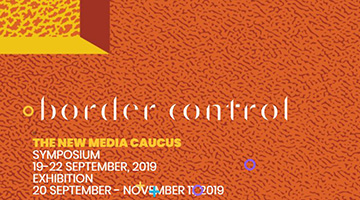 Border Control Symposium and Exhibition
The New Media Caucus (NMC) is proud to present the 2019 Symposium and Exhibition, Border Control at the University of Michigan, Penny W. Stamps School of Art and Design and the Stamps Gallery. The symposium will take place on 19th – 22nd September, 2019, and the exhibition is from 20th September – 11th November, 2019. Keynote Speaker, Vinay Gupta will present a lecture, “Cities that will Walk Away” on 19th September at 5:10pm For more information about the events please visit our website: http://bordercontrol.newmediacaucus.org/
Design Incubation
Colloquium 6.1: Quinnipiac University
Design Incubation Colloquium 6.1 (#DI2019oct) will be held at the School of Communications at Quinnipiac University on Saturday, October 5, 2019.
https://designincubation.com/publications/colloquium/colloquium-6-1-quinnipiac-university/
Practicing Type in the Age of Screens
Saturday, November 9, 2019. 2-5pm. Type Directors Club, NYC
Typeface design and the implementation of typography has never been more exciting. In many cases, type is presented on monitors, tiny and huge electronic visual displays, i.e., screens. In collaboration with the Type Directors Club, Design Incubation will moderate a panel discussion among design innovators about their design and use of type in today’s changing environment. Panelists include Jason Pamental, Javier Mavromantes, Nancy Campbell.
CFP: The Fellowship Program at Design Incubation 2020
Call for Participation: 3-day academic design research and writing workshop in New York City. June 4-6, 2020. Application deadline, October 15, 2019.
Target Audience: Design academics in one or more of the following areas: graphic design, information design, branding, marketing, advertising, typography, web, interaction, film and video, animation, illustration, game design. Full-time tenure track or tenured faculty are given preference but any academic may apply.
https://designincubation.com/call-for-submissions/cfp-the-fellowship-program-at-design-incubation-2020/
CFP: The Design Incubation Residency at Haddon Avenue Writing Institute 2019
Rolling acceptances until Sept 30, 2019. Only 14 seats are available for this event. This 3-day residency allows researchers and scholars time to work on existing writing projects or to start a new writing project. The residency is open to design faculty and to those working in related fields.
https://designincubation.com/design-events/the-design-incubation-residency-at-haddon-avenue-writing-institute-2019/
CFP: A Day of Writing
Come spend an uninterrupted day working on a writing project.
Quinnipiac University School of Communications, October 6th 2019.
https://designincubation.com/design-events/a-day-of-writing/
CFP: Colloquium 6.3: Fordham University
Call for design research abstracts. Deadline: Saturday, December 28, 2019.
https://designincubation.com/call-for-submissions/colloquium-6-3-fordham-university-call-for-submissions/
Association of Art Museum Curators (AAMC)
Apply for AAMC Foundation’s 2020 Engagement Program for International Curators
The AAMC Foundation Engagement Program for International Curators is seeking eligible international and US-based curators interested in pursuing a year-long partnership dedicated to professional development and exchange.
At the core of this Program is a 12-month partnership between a non-US based curator (International Awardee) and a US-based curator (US Liaison) dedicated to reflecting on and developing self-identified areas of advancement with each other. Made possible by major support from the Terra Foundation for American Art, the Program includes travel funding for International Awardees, a participant stipend for US Liaisons, networking, and more, which are outlined in greater detail in the online application, available here: bit.ly/AAMCApply. Two pairings will be awarded.
Eligible applicants must be art curators working on or having worked within exhibitions and projects that explore historical art of the United States (c. 1500-1980), including painting; sculpture; works on paper, such as prints, drawing and photography; decorative arts; performance; and design (except industrial). Architecture and commercial film are excluded. Native American art is eligible for consideration. Additional requirements include a minimum of 50% of the time for/with non-profit organizations will be considered. Please note that curators working in four-wall collecting and non-collecting, community based, and non-four wall organizations, at any location in the globe are eligible.
Through fostering international relationships between curators, AAMC Foundation aims to not only provide opportunities for professional development and exchange, but also strengthen the international curatorial community and increase awareness of the concerns and needs of curators working outside the US. Visit our website to learn more: www.artcurators.org/page/GrantsTerra.
The online application for International Awardees and US Liaisons opens on Wednesday, September 11, 2019, and are due by 12pm ET on Thursday, October 24, 2019.
—
AAMC Foundation Webinar on Utilizing Community Advisory Groups
Join us on Tuesday, September 24, 2019 from 2:00 – 3:15PM ET to learn about the formation, implementation, and utilization of community partners and advisory groups from a dynamic speaker lineup.
From grassroots organizations to large, landmark institutions, museum teams are increasingly engaging with community members to bring history to bear on the narratives told and to bring forward the value of local knowledge. These consultations help develop and shape exhibition themes and checklists, open conversations on collecting practices and directions, and ensure that museum-generated programs accurately and genuinely reflect and engage their communities. From local focus groups to international convenings, the collaborative aspect welcomes perspectives outside the curatorial department.
This webinar explores a diverse range of current approaches, case studies, and lessons learned—from emerging grassroots efforts to established museum outreach. Speakers will address the value in engaging communities, best practices in developing partnerships and advisory groups, and ways to create meaningful and ongoing valued relationships.
Speakers include René Paul Barilleaux, McNay Art Museum; Adrian Locke, Royal Academy of Arts; Regan Pro, Seattle Art Museum; David Serkoak, Key Collaborator with the Canadian Museum for Human Rights; and Ben Tremillo, San Anto Cultural Arts.
There are only a limited amount of spots available. Registration is required: www.artcurators.org/event/communityadvisory
SHERA
The SHERA Board is pleased to announce that the SHERA Graduate Student / Independent Scholar Travel Grant for the 2019 ASEEES meeting has been awarded to Dr. Yulia Karpova (Central European University). Her paper, “Late Soviet studio ceramics as a site of institutional critique” will be presented during the SHERA-sponsored panel “Culture as Matter.”
News from the Art and Academic Worlds
posted Sep 11, 2019
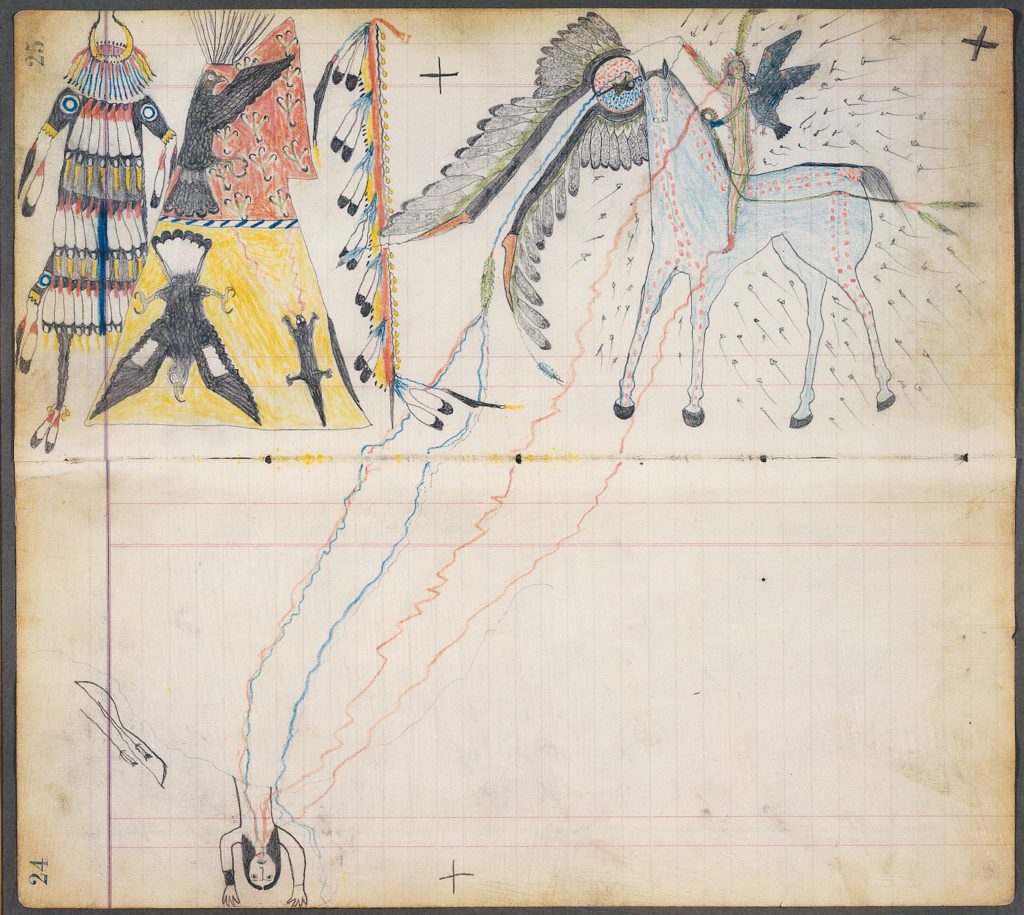
Unrecorded Arapaho artist, attributed to “Henderson Ledger Artist A,” also known as Horseback, “A Medicine Vision” (Arapaho, Oklahoma, 1880). Photo by Dirk Bakker, courtesy of the Metropolitan Museum of Art, via artnet News
The Met Is Expanding Its Definition of American Culture by Hiring a Curator of Indigenous Art for Its Famed American Wing
The museum is looking for its first full-time curator of Native North American art to spearhead a new arts program. (artnet News)
Jenny Holzer Hits Her Mark in a Major, Largely Unnoticed Retrospective
“How does it happen that a major artist like Jenny Holzer gets a major retrospective—the largest survey of her work to date—at a major museum like the Museo Guggenheim Bilbao but no catalogue is produced, and there is almost no press coverage?” (Hyperallergic)
A New Spreadsheet Shares Salary and Employment Information for Adjunct Professors
In addition to recent salary spreadsheets for art workers and interns circulated by Art + Museum Transparency, have you seen this spreadsheet for adjunct professors? (Twitter)
Towards the Ethical Practice of Art History
Addressing the relationship between white supremacy and medieval studies remains an urgent issue, especially as students head back to school. A reflection from 2018, via Material Collective. (Material Collective)
Want articles like these in your inbox? Sign up:
What Do You Think? On the Victor Arnautoff Murals and Controversial Artworks
posted Sep 09, 2019
Please share your comments using the form at the end of this post.
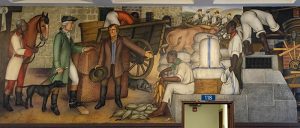
One of thirteen The Life of Washington murals by Victor Arnautoff, George Washington High School, San Francisco. Image courtesy George Washington High School Alumni Association.
CAA invites comments from our members regarding our position on the San Francisco Unified School District and its Board of Education’s decision to destroy, and later its reversal and decision to cover up, WPA-era murals by Victor Arnautoff at George Washington High School.
We spoke out against the initial vote, in opposition to the destruction of works of art and from the hope that creating a contextual reading of the murals might be of some value to the school and its students and an alternative to destroying them.
We also acknowledge that many, including CAA board members, find the murals offensive and damaging to the students’ learning environment, and supported the Board of Education’s decision.
Last month, during a reportedly contentious meeting, the School Board voted to cover up the murals rather than destroy them.
What do you think? Should the murals by Victor Arnautoff be covered up? Should they be destroyed? What are other alternatives?
More broadly, what place do controversial works of art hold in our society? What role do you feel CAA should play in these situations?
We want to know what you think and why. Let us know using the form, below.
Anthony Faris and Nick Nelson
posted Sep 09, 2019
The weekly CAA Conversations Podcast continues the vibrant discussions initiated at our Annual Conference. Listen in each week as educators explore arts and pedagogy, tackling everything from the day-to-day grind to the big, universal questions of the field.
CAA podcasts are on iTunes. Click here to subscribe.
This week, Anthony Faris and Nick Nelson discuss utilizing technology to connect with audiences in galleries and museums.
Anthony Faris is an artist, curator, and instructor at North Dakota State University in Fargo.
Nick Nelson is the director of the Springfield Art Museum in Springfield, Missouri.
New in caa.reviews
posted Sep 06, 2019
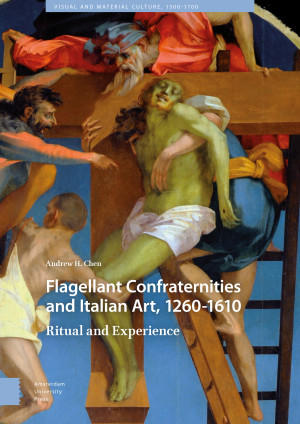
Barbara Wisch reviews Flagellant Confraternities and Italian Art, 1260–1610: Ritual and Experience by Andrew H. Chen. Read the full review at caa.reviews.
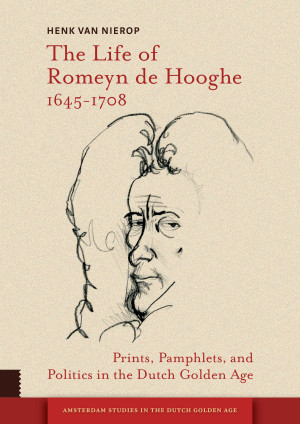
Christine Kooi discusses Henk van Nierop’s The Life of Romeyn de Hooghe 1645–1708: Prints, Pamphlets, and Politics in the Dutch Golden Age. Read the full review at caa.reviews.