
CAA News Today
Exhibitions Curated by CAA Members
posted by CAA — April 15, 2011
Check out details on recent shows organized by CAA members who are also curators.
Exhibitions Curated by CAA Members is published every two months: in February, April, June, August, October, and December. To learn more about submitting a listing, please follow the instructions on the main Member News page.
April 2011

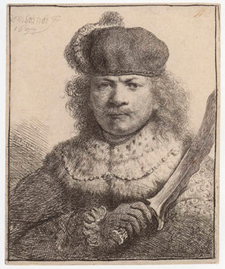 Rembrandt van Rijn, Self-Portrait with Raised Saber, 1634, etching, with touches of burin (state II of II), retouched by a later hand with brush and gray ink, image: 4 13/16 x 4 in., sheet: 4⅞ x 4 in. Fondation Custodia, Collection Frits Lugt, Paris (artwork in the public domain)
Colin B. Bailey, Margaret Iacono, and Joanna Sheers. Rembrandt and His School: Masterworks from the Frick and Lugt Collections. Frick Collection, New York, February 15–May 15, 2011.

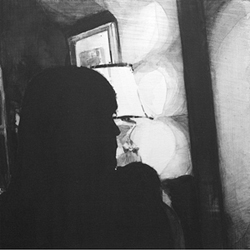 Brian Bishop, Untitled (Passage: Seventeen), 2010, casein on paper, 5 x 5 in. (artwork © Brian Bishop)
Robert Bunkin and Colleen Randall. Charged Brushes: Ten Artists from the Registry. Painting Center, New York, March 1–26, 2011.

 Unknown Russian artist, The Virgin of the Sign, late 16th–early 17th century, tempera on wood with gilt, 28 x 34½ in. Chazen Museum of Art. Gift of Joseph E. Davies, 37.1.3 (artwork in the public domain; photograph by Eric Tadsen)
Thomas E. A. Dale. Holy Image, Sacred Presence: Russian Icons, 1500–1900. Chazen Museum of Art, University of Wisconsin, Madison, Wisconsin, March 12–June 5, 2011.

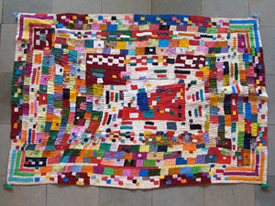 Baby quilt by Katumbi Muzavar from Karnataka-India, 2005 (photograph by Henry John Drewal)
Henry John Drewal. Soulful Stitching: Patchwork Quilts by Africans (Siddis) in India. Latimer/Edison Gallery, Schomburg Center for Research in Black Culture, New York Public Library, New York, February 1–June 30, 2011.

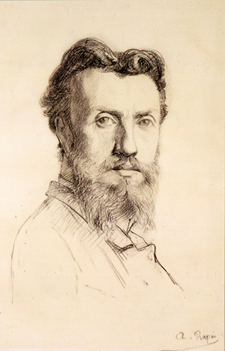 Alexandre Rapin, Self-Portrait, 19th century, graphite on paper. Dahesh Museum of Art. Gift of DeCourcy E. McIntosh. 2002.63 (artwork in the public domain)
J. David Farmer and Alia Nour. The Essential Line: Drawings from the Dahesh Museum of Art. Palitz Gallery, Lubin House, Syracuse University, New York, February 9–March 24, 2011.

 Rachel Hines, Lollygagging, November 8, 2010, performance at Oregon State University (artwork © Rachel Hines; photograph by Maggie Hudson)
Julie Green. Three Rache(a)ls: Rachel Hines, Rachael Huffman, and Rachel Warkentin. Fairbanks Gallery, Oregon State University, Corvallis, Oregon, November 8–29, 2010.

Michelle Y. Hyun. Dear Pratella, what do you hear?. Center for Curatorial Studies, Bard College, Annandale-on-Hudson, New York, May 1–22, 2011.
Ellen G. Landau. Mercedes Matter: The Hofmann Years. Wiegand Gallery, Notre Dame de Namur University, Belmont, California, January 26–February 26, 2011.

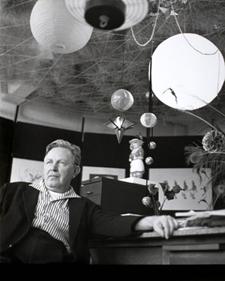 Bruce Goff at his University of Oklahoma School of Architecture office, ca. 1954. Bruce A. Goff Archives, Ryerson and Burnham Archives, Art Institute of Chicago (photograph by Philip B. Welch and provided by Scott W. Perkins)
Scott W. Perkins and Ghislain d’Humieres. Bruce Goff: A Creative Mind. Price Tower Arts Center, Bartlesville, Oklahoma, January 9–May 1, 2011.

 Bruce Goff, animation still of an unrealized design, John Garvey House project, Urbana, Illinois, 1952 (animation by Skyline Ink Animation Studios, Oklahoma City; photograph provided by Scott W. Perkins)
Scott W. Perkins and Ghislain d’Humieres. Bruce Goff: A Creative Mind. Fred Jones Jr. Museum of Art, University of Oklahoma, Norman, Oklahoma, October 9, 2010–January 2, 2011.
Mary Salvante and Ellie Brown. Body, Mind, and Hair. Rowan University Art Gallery, Glassboro, New Jersey, October 11–November 13, 2010.

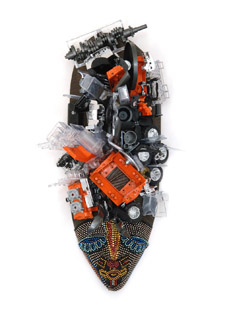 Torkwase Dyson, Untitled (West African mask, V-8 Model engine, and bling t-shirt), 2008, mixed media, plastic, wood, bullet heads, and cotton, 24 x 8 x 13 in. (artwork © Torkwase Dyson; photograph provided by Flanders Art Gallery)
Michelle Joan Wilkinson. Material Girls: Contemporary Black Women Artists. Reginald F. Lewis Museum of Maryland African American History and Culture, Baltimore, Maryland, February 12–October 16, 2011.

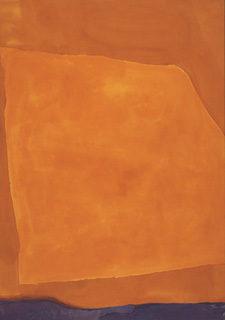 Helen Frankenthaler Adriatic, 1968, acrylic on canvas, 132⅛ x 93 in. Norton Simon Museum, Gift of the Artist. P.1969.138 (artwork © 2011 Helen Frankenthaler; photograph © 2011 Artists Rights Society [ARS], New York)
Gloria Williams. Surface Truths: Abstract Painting in the Sixties. Norton Simon Museum, Pasadena, California, March 25–August 15, 2011.
Books Published by CAA Members
posted by CAA — April 15, 2011
Publishing a book is a major milestone for artists and scholars—browse a list of recent titles below.
Books Published by CAA Members appears every two months: in February, April, June, August, October, and December. To learn more about submitting a listing, please follow the instructions on the main Member News page.
April 2011

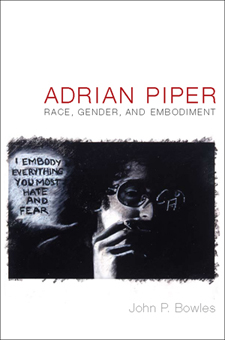
John P. Bowles. Adrian Piper: Race, Gender, and Embodiment (Durham, NC: Duke University Press, 2011).

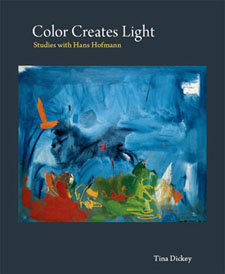
Tina Dickey. Color Creates Light: Studies with Hans Hofmann (Victoria, BC: Trillistar Books, 2011).

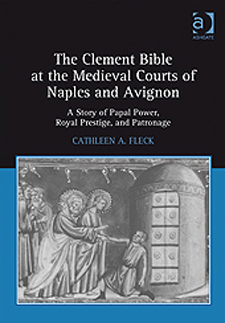
Cathleen A. Fleck. The Clement Bible at the Medieval Courts of Naples and Avignon: A Story of Papal Power, Royal Prestige, and Patronage (Burlington, VT: Ashgate, 2010).

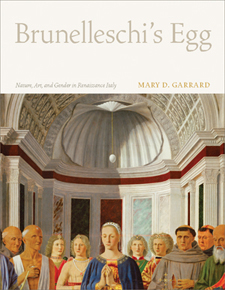
Mary D. Garrard. Brunelleschi’s Egg: Nature, Art, and Gender in Renaissance Italy (Berkeley: University of California Press, 2010).

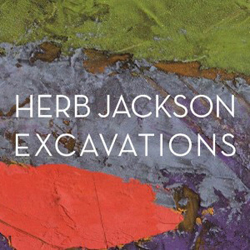
Herb Jackson. Herb Jackson: Excavations (Davidson, NC: Van Every/Smith Galleries, Davidson College, 2011).

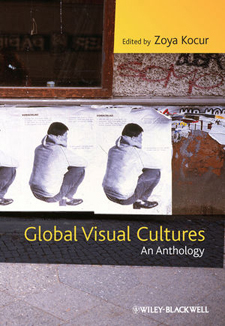
Zoya Kocur, ed. Global Visual Cultures: An Anthology (Malden, MA: Wiley-Blackwell, 2011).

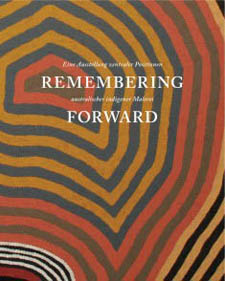
Kasper König, Emily Joyce Evans, and Falk Wolf, eds. Remembering Forward: Australian Aboriginal Painting since 1960 (London: Paul Holbertson, 2010).


Andreas Marks. Publishers of Japanese Woodblock Prints: A Compendium (Leiden, the Netherlands: Hotei, 2011).

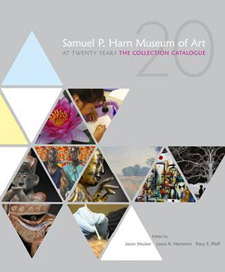
Jason Steuber, Laura K. Nemmers, and Tracy E. Pfaff, eds. Samuel P. Harn Museum of Art at Twenty Years: The Collection Catalogue (Gainesville: University Press of Florida, 2010).


Philip Ursprung. Die Kunst der Gegenwart: 1960 bis heute (Munich: C. H. Beck, 2010).

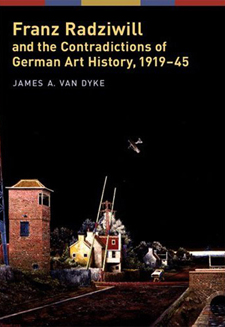
James A. van Dyke. Franz Radziwill and the Contradictions of German Art History, 1919–45 (Ann Arbor: University of Michigan Press, 2010).

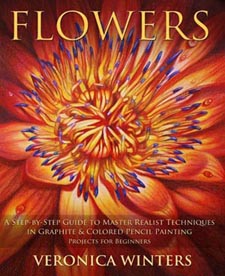
Veronica Winters. Flowers: A Step-By-Step Guide to Master Realist Techniques in Graphite and Colored Pencil Painting (State College, PA: UltraMax Publishing, 2010).
Humanities Action Alert: Update on House and Senate Dear Colleague Letters
posted by CAA — April 15, 2011
Jessica Jones Irons, executive director of the National Humanities Alliance (NHA), emailed the following Humanities Action Alert on April 15, 2011. Founded in 1981, NHA is a nonprofit organization that works to advance national humanities policy in the areas of research, education, preservation, and public programs.
House and Senate Dear Colleague Letters
As you know, Congress just passed a final, compromise bill on funding for the current fiscal year (FY 2011). Along with cuts to most federal agencies and accounts, there are significant reductions in spending for critical humanities programs. NEH funding was cut by approximately $12.5 million (7.5%), with a final level for FY 2011 of $154.69 million (including a .2% across-the-board rescission). Far more drastic cuts were made to two critical Department of Education accounts: Title VI/Fulbright Hays International Education Programs (cut by $50 million—about 40%), and Teaching American History grants (cut by $73 million—about 61%). We will continue to post updates to the NHA website on efforts to restore funding to these and other programs.
In the meantime, ongoing advocacy efforts for FY 2012 humanities funding continue. Last Friday we let you know about two Dear Colleague letters circulating in the House and Senate in support of the humanities. If you have not done so already, please take a few minutes to contact your Members of Congress and ask them to sign the NEH dear colleague.
The deadline for Representatives to indicate their interest in signing the House letter, sponsored by Rep. David Price (D-NC), is today (April 15). The deadline for Senators to sign the Senate letter, sponsored by Senator Tom Udall (D-NM), is April 25.
The Alliance has set up template messages for you to customize. Click here to send a message to your Representative. Click here to send a message to your Senators. If you would prefer to call the offices directly, you can do so through the Capitol Switchboard at (202) 224-3121.
Updated lists of signers are available here.
Sincerely,
Jessica Irons
Executive Director
National Humanities Alliance
caa.reviews Seeks Field Editors for Books and Exhibitions
posted by Betty Leigh Hutcheson — April 14, 2011

An online journal, caa.reviews is devoted to the peer review of new books, museum exhibitions, and projects relevant to the fields of art history, visual studies, and the arts.
caa.reviews Council of Field Editors
caa.reviews invites nominations and self-nominations for five individuals to join its Council of Field Editors, which commissions reviews of books, exhibitions, and related media within an area of expertise or geographic region, for a three-year term: July 1, 2011–June 30, 2014. Candidates may be art historians, critics, curators, or other professionals in the visual arts; institutional affiliation is not required.
The journal seeks field editors for books in three areas: Chinese and Korean art, early modern and southern European art, and nineteenth-century art. Field editors for exhibitions are needed in two regions: New York and the Northeastern United States covering art prior to 1800, and the Southwestern US covering art of all periods.
Working with the caa.reviews editor-in-chief, the caa.reviews Editorial Board, and CAA’s staff editor, each field editor selects content to be reviewed, commissions reviewers, and reviews manuscripts for publication. Field editors for books are expected to keep abreast of newly published and important books and related media in his or her field of expertise, and those for exhibitions should be aware of current and upcoming exhibitions (and other related projects) in their geographic regions. The Council of Field Editors meets annually at the CAA Annual Conference. Field editors must pay travel and lodging expenses to attend the conference.
Candidates must be current CAA members and should not be serving on the editorial board of a competitive journal or on another CAA editorial board or committee. Nominators should ascertain their nominee’s willingness to serve before submitting a name; self-nominations are also welcome. Please send a letter describing your interest in and qualifications for appointment, a CV, and your contact information to: Chair, caa.reviews Editorial Board, College Art Association, 275 Seventh Avenue, 18th Floor, New York, NY 10001; or email the documents to Alex Gershuny, CAA editorial associate. Deadline: May 18, 2011.
Françoise “Francesca” Weinmann: In Memoriam
posted by CAA — April 13, 2011
George A. Wanklyn is associate professor of art history and European and Mediterranean cultures at the American University of Paris in France.

Françoise “Francesca” Weinmann
It is with a real sense of great personal loss that I write about the death of Francesca Weinmann, who passed away at the Institut Curie in Paris in the early morning of March 4, 2011. Francesca—who much preferred the Italian form of her name to the Françoise she was given at birth—was being treated for a few years for a particularly vicious form of breast cancer.
Weinmann taught at the American College in Paris, which subsequently became the American University of Paris, from 1972 to 1999. More than just a professor, she founded the Art History Department after Dean Carol Maddison Kidwell asked her to create the major in art history. In 1982 Weinmann was awarded the first Board of Directors Distinguished Teaching Award. Upon retirement, she became associate professor of art history emerita.
Shortly after I met Francesca, who was department chair when I was hired to teach my first course there in 1982, I asked her about her nationality. “European!” she immediately replied. Born in Switzerland in 1932 to a Swiss Protestant mother and a father who was a British subject of German Jewish origin, Weinmann grew up in the north of Italy, in the village of Loveno on Lake Como. She received her early education in Loveno and Como and then studied in Paris, receiving a licence from the Institut d’art et d’archéologie of the Sorbonne before attending the Institute of Fine Arts at New York University for her graduate studies. English was Francesca’s fourth language, in fact, after French, German, and Italian.
Weinmann developed many courses during her ACP/AUP years, exploring the origins of art and the art of antiquity through the Middle Ages to the Italian and Northern Renaissance. During most of her time as a faculty member, she taught eight courses a year, in addition to her duties as chair. She also developed a course on aesthetics, and her sustained reflection on the nature of beauty in art produced a book, on which she was working in her retirement—right to the very last days of her life. Aperion Books has scheduled The Path towards Beauty for publication in June.
Weinmann had a powerfully strong personality: many of her students, who were also mine, have told me how scared they were, initially, in her presence. But this most demanding teacher developed bonds of the greatest affection and loyalty with a large number of them, who stayed in regular contact with her. After retiring from AUP, she spent more and more time in her beautiful house and garden on Lake Como. When in Paris, she continued to teach a number of young people, relatives of former colleagues and students, who were interested in the history of art. This was something Weinmann assumed as a passionately engaged volunteer, but she put as much energy and conviction into the work as she had invested for decades of semesters in her art-history courses.
During the last phase of her illness, a team of devoted friends—almost without exception former students and faculty colleagues—regularly visited and helped her. While being treated these past few years by her doctors in Paris and Italy, Francesca maintained great optimism and unbounded confidence in their capacity to care for her. She had asked to be buried in Loveno, next to her mother, in the small cemetery she showed me the first time I stayed at her house—something like a quarter of a century ago.
Among the last people to visit Francesca, when she was hospitalized, were Waddick Doyle, who lived near her apartment at Les Gobelins, and me. Doyle has said, “She will be remembered with affection, respect, and love. She made a great contribution to our institution. She will live on in her students and colleagues.” And, I would add, in the forthcoming book that is the fruit of many years of deep reflection and hard work.
Anne L. Schroder: In Memoriam
posted by CAA — April 13, 2011
ulie-Anne Plax is professor of art history in the School of Art at the University of Arizona in Tucson.

Anne L. Schroder (photograph by Chris Hildreth, Duke Photography, 2006)
Anne L. Schroder, curator and academic program coordinator at Duke University’s Nasher Museum of Art died on December 23, 2010, in Chapel Hill, North Carolina, after a brief, unexpected illness. She will be fondly remembered as a remarkable scholar and curatorial “sleuth” of eighteenth-century French art; a vibrant, generous member of the scholarly community; and a warm, kind, and cheerful friend. In the words of one colleague: “For a serious scholar, Anne Schroder certainly laughed a lot.”
Schroder published widely on Jean-Honoré Fragonard, the subject of her dissertation, and on gender issues, prints and the print market of the eighteenth century, and the debate over theories of copying, originality, and artistic property following the French Revolution. Her astute intellect, fertile imagination, and sheer love of her work are perceptible in all her writings.
Schroder’s keen curatorial eye led to the Nasher’s purchase of a late-eighteenth-century history painting, Clytemnestra Hearing the News of Iphigenia’s Impending Sacrifice (1787), attributed to the studio of Jacques-Louis David. Her painstaking scholarly detective work led to its attribution as an early work by François Gérard. She also curated and oversaw many installations from the permanent collection, including the inaugural exhibition Nature, Gender, Ritual (2005). With a $500,000 grant from the Andrew W. Mellon Foundation in 2009, she increased Duke faculty and student involvement with the museum’s collection.
Schroder received her BA at Smith College and her MA and PhD degrees in art history from the University of North Carolina, Chapel Hill, under the direction of Mary Sheriff. Before taking on her position at the Nasher, Schroder was curator of exhibitions at the Samuel P. Harn Museum of Art in Gainesville, Florida, and assistant curator at the Michele and Donald D’AmourMuseum of Fine Arts in Springfield, Massachusetts. An adjunct faculty member at Duke, she had also taught art history at the University of Florida and the University of Minnesota.
Known for her professionalism and a willingness to serve, Schroder was the president of the Historians of Eighteenth-Century Art and Architecture, a CAA affiliate, from 2005 to 2009, and a member of the American Society of Eighteenth-Century Studies. Her warm connection with everyone endowed the organization with a sense of community and camaraderie.
Schroder is survived by her beloved husband Eric and her son Spaulding. We shall all miss her optimism, intelligence, and that great smile.
Spring Deaths in the Arts
posted by Christopher Howard — April 13, 2011
CAA recognizes the lives and achievements of the following artists, scholars, teachers, filmmakers, curators, museum directors, and other men and women whose work has had a significant impact on the visual arts. Of special note are two obituaries—on the curator Anne L. Schroder and the art historian Francesca Weinmann—that are published by CAA.
- Meredith Allen, a photographer based in New York best known for her series of Melting Ice Pops, died on March 17, 2011. Born in 1964, Allen showed her work at Edward Thorp Gallery and Sarah Bowen Gallery
- Jihmye Collins, an activist, poet, and painter who helped found two nonprofit organizations in southern California—African American Writers and Artists and San Diego Writers, Ink—died on March 15, 2011. He was 71
- Donny George, an archaeologist, professor at Stony Brook University, and former director of the Iraqi National Museum in Baghdad who fought against its looting in 2003, died on March 11, 2011, at age 60. CAA News published an interview with George in 2007 and the text of his 2008 Convocation address about the looting
- Gabriel Laderman, a New Realist painter based in New York whose 1971 article in Artforum highlighted the like-minded figurative work of Sidney Tillim, Jack Beal, and Philip Pearlstein, died on March 10, 2011. He was 81 years old
- Sidney Lumet, the celebrated director of such films as Dog Day Afternoon, Network, Serpico, 12 Angry Men, and The Wiz, died on April 9, 2011, at the age of 86
- John McCracken, a sculptor and painter who emerged in the 1960s making a West Coast brand of Minimalism often called “finish fetish” or “light and space,” died on April 8, 2011. He was 76 years old
- Anne L. Schroder, curator and academic program coordinator at Duke University’s Nasher Museum of Art, died on December 23, 2010, at the age of 56. Julie-Anne Plax has contributed a special text on her
- Leo Steinberg, an eloquent, erudite art historian whose articles and books on Renaissance, Baroque, and modern art—among them Other Criteria and The Sexuality of Christ in Renaissance Art and in Modern Oblivion—have influenced innumerable students and scholars, died on March 13, 2011, at age 90. Steinberg was honored as CAA’s Distinguished Scholar in 2002
- Hedda Sterne, an artist associated with the original Surrealists and the first-generation New York School but whose paintings often resisted such styles and categorizations, died on April 8, 2011, at age 100. She also appeared in the famous “Irascibles” photograph in Life magazine in 1951
- Toshiko Takaezu, an award-winning ceramic artist based in Honolulu who had taught for many years at Princeton University and the Cleveland Institute of Art, died on March 9, 2011. She was 88
- Peter Thursby, an English artist who created sculpture in bronze, aluminum, and stainless steel, often placed in public locations, died on January 6, 2011. He was 80 years old
- George Tooker, a Magic Realist artist known for mysterious, haunting work, including The Subway (1950), in the collection of the Whitney Museum of American Art, died on March 27, 2011. He was 90
- Françoise “Francesca” Weinmann, founder of the Art History Department at the American University in Paris who taught there for three decades, died on March 4, 2011. George A. Wanklyn has written a remembrance on Weinmann, who was born in 1932
Read all past obituaries in the arts in CAA News, which include special texts written for CAA.
Support CAA with a Donation to the Centennial Campaign
posted by Nia Page — April 12, 2011
The year 2011 marks the College Art Association’s one-hundredth anniversary, a celebratory occasion for any organization but particularly so given CAA’s dynamic influence in shaping the study and practice of the visual arts over the past century. Without dedicated members like you, CAA would not be where it is today. Show your support with a donation to the 2011 Centennial Campaign.
The Centennial Campaign is an opportunity for you to help CAA support the field and give back to its members. Your contributions allow us to provide fellowships to MFA students, keep conference rates affordable, and subsidize the memberships of student, retired, and low-income members. Donations also help publish an information-packed website, which features calls for entries and papers and listings for grants and fellowships in the Opportunities section, as well as job classifieds in the Online Career Center. Additionally, your donations support advocacy at a time when art is, once again, under political attack.
Contributions at every level are appreciated and will be acknowledged publicly; they are also 100 percent tax deductible. Your generous gift will both sustain the organization now and guarantee its leadership role over the next one hundred years.
Ask Your Congressional Representatives to Sign a Dear Colleague Letter Supporting the NEH
posted by CAA — April 11, 2011
Jessica Jones Irons, executive director of the National Humanities Alliance (NHA), emailed the following Humanities Action Alert on April 8, 2011. Founded in 1981, NHA is a nonprofit organization that works to advance national humanities policy in the areas of research, education, preservation, and public programs.
House and Senate Dear Colleague Letters
Please help support the humanities by taking a few minutes to write your Members of Congress and ask them to sign a Dear Colleague letter regarding FY 2012 funding for the National Endowment for the Humanities. As you may know, President Obama’s FY 2012 Budget proposes $146.3 million in funding for NEH—more than $21 million in cuts to the agency. Although funding for FY 2011 (the current fiscal year) still remains uncertain today, the FY 2012 appropriations process is in full swing, and we must continue our advocacy efforts for the next fiscal year.
House Dear Colleague Letter
Representative David Price (D-NC) is currently circulating a Dear Colleague letter in support of the National Endowment for the Humanities (NEH). The letter, addressed to the Chair and Ranking Member of the House Appropriations Subcommittee, requests $167.5 million in FY 2012 funding for the NEH. This is the same level of funding the agency received in FY 2010. A copy of the letter is available here. Please ask your Representative to sign on to this letter. Click here to send an email today. The Alliance has set up a template message for you to customize for your Representative.
Senate Dear Colleague Letter
Senator Tom Udall (D-NM) is currently circulating a Dear Colleague letter in support of the National Endowment for the Humanities (NEH) and the National Endowment for the Arts (NEA). The letter, addressed to leaders on the Senate Appropriations Committee and Subcommittee, requests $167.5 million in FY 2012 funding for the NEH and the NEA. This is the same level of funding both agencies received in FY 2010. A copy of the letter is available here. Please ask your Senators to sign on to this letter. Click here to send an email today. The Alliance has set up a template message for you to customize for your Senators.
Thank you for your assistance on this important issue. The signatures on these letters will provide an important record of support for federal humanities funding in both the House and the Senate.
Sincerely,
Jessica Jones Irons
Executive Director
National Humanities Alliance
Millard Meiss Jury Seeks Specialist in Non-Western Art
posted by CAA — April 11, 2011
CAA seeks nominations and self-nominations for scholars with a specialization in non-Western subject matter to serve on the jury for the Millard Meiss Publication Fund for a four-year term, July 1, 2011–June 30, 2015. Candidates must be actively publishing scholars with demonstrated seniority and achievement; institutional affiliation is not required.
The Meiss jury awards grants that subsidize the publication of book-length scholarly manuscripts in the history of art and related subjects. Members review manuscripts and grant applications twice a year and meet in New York in the spring and fall to select the awardees. CAA reimburses jury members for travel and lodging expenses in accordance with its travel policy.
Candidates must be current CAA members and should not be serving on another CAA editorial board or committee. Jury members may not themselves apply for a grant in this program during their term of service. Nominators should ascertain their nominee’s willingness to serve before submitting a name; self-nominations are also welcome. Please send a letter describing your interest in and qualifications for appointment, a CV, and contact information to: Millard Meiss Publication Fund Jury, College Art Association, 275 Seventh Avenue, 18th Floor, New York, NY 10001; or send all materials as email attachments to Alex Gershuny, CAA editorial associate. Deadline: April 22, 2011.