CAA News Today
CAA Members Receive Discounts with Zipcar
posted by Nia Page — August 06, 2012
 CAA has partnered with Zipcar to bring car sharing to members at a greatly reduced rate. CAA members can join for a $25 annual fee—as opposed to the regular rate of $60 per year. In addition, if you join through CAA, Zipcar will waive the one-time $25 application fee and also give you $25 in free driving credit.
Zipcar is an easy, economical, and environmentally friendly alternative to traditional car-rental programs. With Zipcar you can reserve a vehicle by the hour or the day and select from a wide range of cars, vans, and trucks. Gas, insurance, and 180 miles are included in each reservation. A membership with Zipcar is universal: pick up a car in over fifteen participating cities in the United States, Canada, and the United Kingdom, including New York, Boston, Chicago, San Francisco, Washington, DC, Toronto, and London. Faculty and students also have the added benefit of being able to access Zipcars right on campus, with more than 250 colleges and universities participating in the car-sharing program.
Join today; don’t forget to use the promotional code member25 to earn $25 in free driving credit to your account.
EDITORS OF THE ART BULLETIN
posted by Christopher Howard — August 06, 2012
Nora Griffin is an artist and CAA assistant editor.
Kirk Ambrose (2013–16)
Kirk Ambrose
Kirk Ambrose, associate professor of medieval art history and chair of the Department of Art and Art History at the University of Colorado in Boulder, will become editor-in-chief of The Art Bulletin. His three-year term begins on July 1, 2013, after he concludes a year as editor designate. Ambrose will succeed Karen Lang of the University of Warwick in England, who has led the journal since 2010.
As incoming editor, Ambrose plans to build on the legacies of two previous Art Bulletin editors, Karen Lang and Nancy Troy, and to develop alternative forums for debate within the journal, such as the recently inaugurated special features “Regarding Art and Art History” and “Notes from the Field.” Like Lang, he is also inspired by the journal’s approaching centennial, in 2013, and sees The Art Bulletin’s current moment as intellectually parallel to the “speculative and creative” art history that was being practiced in its pages in the early twentieth century. The recent decision of the German government to fund “clusters of excellence” has resulted in new structures at universities and has spurred Ambrose into dialogue with a group of international scholars from Brazil, France, India, and Turkey, to better understand the nuances of how “art-historical research and pedagogy is now conceived.” This international perspective on art history will be thoroughly addressed in a new series of short essays for The Art Bulletin, tentatively titled “Whither History?” in which invited scholars will “reflect upon how trends toward globalization in the humanities have had an impact on the ways we conceive art history.”
In 1999, Ambrose earned his PhD in the history of art from the University of Michigan in Ann Arbor with a dissertation on “Romanesque Vézelay: the Art of Monastic Contemplation,” completed under the guidance of Ilene Forsyth and Elizabeth Sears. Ambrose’s education also includes a BA from Oberlin College in Oberlin, Ohio, in 1990 and additional study at the Goethe Institut in Düsseldorf, Germany, and McGill University in Montreal, Canada.
A faculty member at the University of Colorado since 1999, Ambrose has taught a range of courses on topics of medieval art history and methodology at the undergraduate and graduate level and has served as an MA and PhD thesis advisor for many students. A specialist in Romanesque sculpture, Ambrose is dedicated to the idea of art history as a global discipline and to this end has worked to diversify his department at Colorado. He recently worked with the administration to create a tenure-track position for an art historian specializing in colonial Latin America.
Within Ambrose’s own field of interest, he has consistently chosen topics and methodologies of inquiry that enlarge the scope of medieval studies. His book Monsters in Twelfth-Century European Sculpture, is forthcoming from Boydell and Brewer, and he received a Samuel H. Kress Foundation grant for the volume The Nave Sculpture of Vézelay: The Art of Monastic Viewing (Toronto: Pontifical Institute of Mediaeval Studies, 2006). Recent book chapters include “Male Nudes and Embodied Spirituality in Romanesque Sculpture,” published in Meanings of Nudity in Medieval Art (Burlington, VT: Ashgate, 2012), edited by Sherry Lindquist. A 2011 essay, “Viollet-le-Duc’s Judith at Vézelay: Romanesque Sculpture Restoration as (National) Art,” published in Nineteenth-Century Art Worldwide, discusses the restoration of a medieval monument in nineteenth-century France as it relates to the country’s republican politics. He recently contributed to The Art Bulletin a review of Friedrich Kittler’s Optical Media: Berlin Lectures 1999, translated by Anthony Enns, that was published in the March 2011 issue, and a short piece on appropriation and medieval art in the multiauthored section “Notes from the Field” in June 2012.
Ambrose’s practice of a socially and culturally mindful art history has led to opportunities beyond the classroom. With colleagues Davide Stimilli and Lisa Tamiris-Becker, he is currently planning a 2014 exhibition at the University of Colorado Art Museum, tentatively titled Aby Warburg and the Beginning of Cultural Studies in the American Southwest. Ambrose states, “Warburg’s 1895–86 expedition to the Southwest is well known, but this journey looks very different when viewed from an American, rather than European, perspective. Much of Warburg’s vision appears indebted to a network of mostly Jewish merchants across the Southwest, who sold photographs of Indian rituals as well as ceramics and other objects that Warburg collected.” For Ambrose the exhibition is a means to explore the multifariousness of art-historical vision, and how “art practices can serve as vehicles of knowledge” for scholars at the turn of both the twentieth and twenty-first centuries.
Travel Grants to Attend the 2013 Annual Conference in New York
posted by Lauren Stark — August 02, 2012
 CAA offers Annual Conference Travel Grants to graduate students in art history and studio art and to international artists and scholars. In addition, the Getty Foundation has funded the second year of a program that enables twenty applicants from outside the United States to attend the 2013 Annual Conference in New York. Applicants may apply for more than one grant but can only receive a single award.
CAA Graduate Student Conference Travel Grant
CAA will award a limited number of $250 Graduate Student Conference Travel Grants to advanced PhD and MFA graduate students as partial reimbursement of travel expenses to attend the 101st Annual Conference, taking place February 13–16, 2013, in New York. To qualify for the grant, students must be current CAA members. Successful applicants will also receive a complimentary conference registration. Deadline: September 14, 2012.
CAA International Member Conference Travel Grant
CAA will award a limited number of $500 International Member Conference Travel Grants to artists and scholars from outside the United States as partial reimbursement of travel expenses to attend the 101st Annual Conference, taking place February 13–16, 2013, in New York. To qualify for the grant, applicants must be current CAA members. Successful applicants will also receive a complimentary conference registration. Deadline: September 14, 2012.
CAA International Travel Grant Program
The CAA International Travel Grant Program, generously supported by the Getty Foundation, provides funding to twenty art historians, museum curators, and artists who teach art history to attend the 101st Annual Conference, taking place February 13–16, 2013, in New York. The grant covers travel expenses, hotel accommodations, per diems, conference registrations, and one-year CAA memberships. For 2013, CAA will offer preconference meetings on February 11 and 12 for grant recipients to present and discuss their common professional interests and issues. Applicants do not need to be CAA members. Deadline extended: August 24, 2012.
Donate to the Annual Conference Travel Grants
CAA’s Annual Conference Travel Grants are funded solely by donations from CAA members—please contribute today. Charitable contributions are 100 percent tax deductible. CAA extends a warm thanks to those members who made voluntary contributions to this fund during the past twelve months.
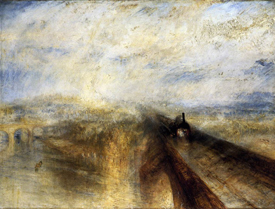
Image: Joseph Mallord William Turner, Rain, Steam and Speed—The Great Western Railway, 1844, oil on canvas, 35⅞ x 49 in. National Gallery, London (artwork in the public domain)
August 2012 Picks from CAA’s Committee on Women in the Arts
posted by Christopher Howard — August 01, 2012
 Each month, CAA’s Committee on Women in the Arts produces a curated list, called CWA Picks, of recommended exhibitions and events related to feminist art and scholarship in North Americn and around the world.
The CWA Picks for August 2012 include several important exhibitions in New York and a handful on view this month in Europe. The Solomon R. Guggenheim Museum is hosting a survey of work by the Dutch photographer and video artist Rineke Dijkstra; the Whitney Museum of American Art has given over its third floor to Sharon Hayes, who is incorporating performance into her exhibition of photography and video; and the Brooklyn Museum is presenting a collaborative project led by Ulrike Müller in its Raw/Cooked series, which features artists who live and work in the borough.
Across the Atlantic, MUSAC in León, Spain, has staged Feminist Genealogies in Spanish Art: 1960–2010, organized by Juan Vicente Aliaga and Patricia Mayayo, which investigates the underrecognized role that feminist activism and theory has played in Spanish art since the 1960s. Elsewhere, the Portuguese artist Joana Vasconcelos has created an installation of large-scale sculptures in the Palace of Versailles, and Goldsmiths in London has spread work by Su Richardson across two venues in London.
Check the archive of CWA Picks at the bottom of the page, as several museum and gallery shows listed in previous months may still be on view or touring.
Image: Rineke Dijkstra, The Krazyhouse (Megan, Simon, Nicky, Philip, Dee), Liverpool, UK, 2009, four-channel HD video projection with sound, 32 min., looped (artwork © Rineke Dijkstra; photograph provided by the artist, Marian Goodman Gallery, New York and Paris, and the Solomon R. Guggenheim Museum)
Jens T. Wollesen: In Memoriam
posted by CAA — July 23, 2012
The following obituary was submitted by Jill Caskey, associate professor in the Department of Art at the University of Toronto in Ontario, Canada, and PhD coordinator for the school’s Centre for Medieval Studies.
Jens T. Wollesen, a professor and a specialist in the art of medieval Italy and Cyprus, died in Toronto on April 22, 2013. He received his BA from the University of Hamburg, his PhD from the University of Heidelberg, and his Habilitation from the University of Munich before traversing the Atlantic to join the Department of Art at the University of Toronto in 1985. For the rest of his life Wollesen remained firmly anchored to Toronto, where his contributions to the pedagogical and scholarly missions of the university took many forms. At various times he directed the undergraduate and graduate programs in art and also served on the Art Committee of the University of Toronto’s Victoria University, where he was a fellow.
Wollesen’s work probed several salient issues in medieval art, from the devotional function of panel paintings to images of everyday life. Among his many articles and books are the influential Die Fresken von San Piero a Grado bei Pisa (Bad Oeynhausen, Germany: Theine, 1977), Pictures and Reality: Monumental Frescoes and Mosaics in Rome around 1300 (New York: Peter Lang, 1998), and Patrons and Painters on Cyprus: The Frescoes in the Royal Chapel at Pyrga (Toronto: Pontifical Institute of Mediaeval Studies, 2010). He had recently completed a second book on Cyprus, entitled Acre or Cyprus: A New Approach to Crusader Painting around 1300.
Wollesen could discourse equally on Asian painting, contemporary art, and the medieval artists and patrons who commanded most of his scholarly attention. His intellectual range and curiosity served him well in the classroom. Literally thousands of undergraduates first encountered the discipline of art history in his legendary Intro lectures at Toronto. He garnered legions of fans in such adventurous courses as “The Body: An Exercise,” “The Practice of Art History,” and “Is There Crusader Art?” Wollesen flourished outside the classroom and study as well as within: he was an accomplished painter and photographer, and a passionate sailor who commanded the waves of Lake Ontario at the first sign of spring.
He is survived by his wife, Elena Lemeneva, and his children, Leon Wollesen, Hanna Wollesen, Christina Wollesen, Victor Wollesen, and Kate Wollesen.
Art Journal Publishes Special Issue on Pacific Standard Time
posted by Christopher Howard — July 18, 2012
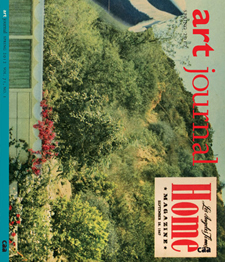 Pacific Standard Time, the massive project on art in southern California that concluded in June, is the topic of a special issue of Art Journal that has just been published. An unprecedented collaboration of some sixty southern Californian cultural institutions brought together by the Getty, the Pacific Standard Time exhibitions and events offered a near-encyclopedic view of the work artists created in the region from 1945 to 1980.
At the center of the journal’s coverage is a conversation with Andrew Perchuk, deputy director of the Getty Research Institute (GRI), and Thomas Crow, former director of the GRI and now a professor at the Institute of Fine Arts of New York University; they speak with the art historian Howard Singerman, reviews editor of Art Journal.
The issue features a commissioned artist’s project by Allen Ruppersberg, PST: Before and After, which appears on the covers of the issue and every interior page. In her introduction to the issue, the editor-in-chief Katy Siegel notes that Ruppersberg “is often seen as the classic Los Angeles artist.” His project draws on press treatment of art in southern California during the years covered by Pacific Standard Time.
In addition, many of the Pacific Standard Time exhibitions are reviewed or discussed in extended essays by historians, curators, and artists: Connie Butler, Jan Tumlir, Lucia Sanromán, Malik Gaines, Michael Ned Holte, and Ken Gonzales-Day. An essay by Lucy Bradnock considers the Angeleno curator Walter Hopps, and Maria Elena Buszek interviews the artists Suzanne Lacy and Andrea Bowers about their joint projects.
This special issue of Art Journal is the leading edge of the flood of scholarship on postwar art in southern California that Pacific Standard Time is expected to engender.
Revised Directory of Affiliated Societies
posted by Lauren Stark — July 17, 2012
The Directory of Affiliated Societies, a comprehensive list of all seventy-four groups that have joined CAA as affiliate members, has just been updated. Please visit the directory to view a single webpage that includes the following information for each group: name, date of founding, size of membership, and annual dues; a brief statement on the society’s nature or purpose; and the names of officers and/or contacts for you to get more details about the groups or to join them. In addition, CAA links directly to each affiliated society’s homepage.
New Leaders for CAA’s Publications
posted by Christopher Howard — July 10, 2012
The president of the CAA Board of Directors, Anne Collins Goodyear, has confirmed new appointments to the editorial boards of CAA’s three scholarly journals and to the Publications Committee, in consultation with the vice president for publications, Randall C. Griffin. The appointments took effect on July 1, 2012.
The Art Bulletin
The Art Bulletin has announced its next editor-in-chief: Kirk Ambrose, associate professor and chair of the Department of Art and Art History at the University of Colorado in Boulder. In addition to numerous essays and book chapters, he is the author of The Nave Sculpture of Vézelay: The Art of Monastic Viewing (Toronto: Pontifical Institute of Mediaeval Studies, 2006) and the coeditor, with Robert A. Maxwell, of Current Directions in Eleventh- and Twelfth-Century Romanesque Sculpture Studies (Turnhout, Belgium: Brepols, 2010). His book Monsters in Twelfth-Century European Sculpture is forthcoming from Boydell and Brewer. Other future projects include a volume on Portuguese Romanesque sculpture and an exhibition at the University of Colorado Art Museum, tentatively entitled Aby Warburg and the Beginning of Cultural Studies in the American Southwest and scheduled for 2014. Ambrose will succeed Karen Lang of the University of Warwick in England, beginning his three-year term as editor-in-chief on July 1, 2013, with the preceding year as editor designate.
David J. Getsy, the Goldabelle McComb Finn Distinguished Professor of Art History, Theory, and Criticism at the School of the Art Institute of Chicago, has joined the Art Bulletin Editorial Board for a four-year term. His work focuses on modern and contemporary art in Europe and America from the 1870s to the present day. Among his books are Body Doubles: Sculpture in Britain, 1877–1905 (New Haven: Paul Mellon Centre for Studies in British Art and Yale University Press, 2004) and Rodin: Sex and the Making of Modern Sculpture (New Haven: Yale University Press, 2010). Getsy is currently editing the critical writings of the American postminimalist artist Scott Burton, for publication later this year by Soberscove Press.
Rachael DeLue, associate professor of art history at Princeton University in Princeton, New Jersey, has begun a three-year term as the reviews editor of The Art Bulletin, succeeding Michael Cole of Columbia University in New York. Her first section will appear in the March 2013 issue. Thelma K. Thomas, associate professor of fine arts at the Institute of Fine Arts, New York University, has now entered the second year of her two-year service as the chair of the editorial board of the journal.
Art Journal
Michael Corris, professor of art and chair of the Division of Art in the Meadows School of the Arts at Southern Methodist University in Dallas, Texas, was appointed Art Journal reviews editor. He will serve one year as reviews editor designate, taking over from Howard Singerman of the University of Virginia in July 2013. Corris is both an artist and an author of many works on postwar and contemporary art and theory. The Peacock Gallery in London and the Reading Room in Dallas hosted his most recent solo shows; he has also exhibited widely as a member of the collaborative group Art & Language. Among Corris’s many publications are monographs on Ad Reinhardt (London: Reaktion Books, 2008) and David Diao (Beijing: Timezone 8, 2005). Two books forthcoming in 2013 are The Artist Out of Work: Selected Writings on Art (Les Presses du réel and JRP | Ringier) and What Do Artists Know? The Response to Deskilling in Art (Reaktion Books). Corris is a cofounder and editor of Transmission Annual, a collaborative project of Sheffield Hallam University in England and the Meadows School of the Arts.
Joining the Art Journal Editorial Board for four-year terms are Catherine Lord and Hilary Robinson. Lord is a writer, artist, and curator whose work addresses issues of feminism, cultural politics, and colonialism. She is a professor of studio art and women’s studies at the University of California, Irvine. Recent solo exhibitions were held at ONE National Gay and Lesbian Archives and Jancar Gallery, both in Los Angeles. Lord is the author of the text-image experimental narrative The Summer of Her Baldness: A Cancer Improvisation (Austin: University of Texas Press, 2004), and her forthcoming book project coedited with Richard Meyer, to be published by Phaidon, is called Art and Queer Culture, 1885–2005. Robinson is a professor of art theory and criticism in the College of Fine Arts at Carnegie Mellon University in Pittsburgh, Pennsylvania. The focus of her scholarship is the history and theory of feminist art. Her books include Reading Art, Reading Irigaray: The Politics of Art by Women (London: I. B. Tauris, 2006) and Feminism-Art-Theory: A History, forthcoming from Blackwell. She is the editor of Visibly Female: Feminism and Art: An Anthology (London: Camden, 1987) and Feminism-Art-Theory: An Anthology 1968–2000 (Malden, MA: Blackwell, 2001).
Lane Relyea, an art critic and associate professor in the Department of Art Theory and Practice at Northwestern University in Evanston, Illinois, has finished his year as editor designate of Art Journal and now assumes the position of editor-in-chief, succeeding Katy Siegel of Hunter College, City University of New York. His first edited issue will appear in spring 2013. Rachel Weiss, a professor at the School of the Art Institute of Chicago whose work focuses on the art of Cuba, is the new chair of the journal’s editorial board. Weiss recently published To and from Utopia in the New Cuban Art (Minneapolis: University of Minnesota Press, 2011).
caa.reviews
The caa.reviews Editorial Board welcomes a new member, Tanya Sheehan, assistant professor in the Department of Art History at Rutgers University in New Brunswick, New Jersey, who will serve for four years. Currently the journal’s field editor for books on photography, she is the author of Doctored: The Medicine of Photography in Nineteenth-Century America, published by Pennsylvania State University Press in 2011.
Six new field editors for books and exhibitions have recently been chosen by the editorial board to serve three-year terms. Gloria Williams will commission reviews of exhibitions of pre-1800 art on the West Coast; Eve Straussman-Pflanzer will oversee reviews of exhibitions in the Midwest; and Jennifer Kingsley will commission reviews of exhibitions in the Southeast. Kirsten Swenson will assign books on contemporary art for review, and Megan O’Neil will commission reviews of books and related media on Precolumbian art. Michael Schreffler will handle reviews of books on early modern Iberian and colonial Latin American art.
Publications Committee
S. Hollis Clayson, Bergen Evans Professor in the Humanities and professor of art history at Northwestern University in Evanston, Illinois, was appointed to the Publications Committee as member-at-large. Clayson specializes in nineteenth-century modern European art, particularly French art; her most recent book is Paris in Despair: Art and Everyday Life under Siege (1870–71) (Chicago: University of Chicago Press, 2002). She is the recipient of numerous research and teaching awards and, as director of the Alice Kaplan Institute for the Humanities at Northwestern, promotes discussion and projects focusing on humanities in the digital era. A former chair and member of the Art Bulletin Editorial Board, Clayson has served on CAA’s Annual Conference Committee and on the juries for three CAA awards: the Distinguished Lifetime Achievement Award for Writing on Art, the Arthur Kingsley Porter Prize, and the Distinguished Teaching of Art History Award.
Recent Deaths in the Arts
posted by Christopher Howard — July 09, 2012
In its monthly roundup of obituaries, CAA recognizes the lives and achievements of the following artists, curators, designers, photographers, filmmakers, and other men and women whose work has had a significant impact on the visual arts. This month was marked by the loss of the Pop art dealer Ivan Karp, the film scholar Andrew Sarris, and the feminist art historian Paula Hays Harper.
- Carl F. Barnes Jr., a former president of the International Center of Medieval Art, died on May 25, 2012, at the age of 77. Barnes was a professor emeritus of art history at Oakland University in Rochester, Michigan, where he had taught from 1971 to 2001. A specialist in European medieval art, he wrote extensively on the thirteenth-century French artist Villard de Honnecourt
- Barton Lidice Benes, a sculptor and collector, died on May 30, 2012, at the age of 69. Benes made art from the raw materials of everyday life, drawing support and controversy for using medical equipment associated with AIDS/HIV treatment and the cremated remains of friends who perished from the disease. His object and art-filled apartment is now being meticulously re-created as an installation at the North Dakota Museum of Art in Grand Forks
- Willard Bond, an artist known for his vibrant paintings of yachts and seascapes, died on May 19, 2012. He was 85 years old. Bond was a versatile artist, influenced in equal parts by the teaching of Buckminster Fuller and by his own experience as a pier master at New York’s South Street Seaport. Admirers claim that his paintings embody the ineffable experience of being on a boat at sea
- Frederick J. Brown, a figurative painter deeply inspired by jazz music and the legacy of Abstract Expressionism, passed away on May 5, 2012. He was 67 years old. Brown created colorful, highly expressionistic portraits of people whom he admired, such as the avant-garde composer Anthony Braxton and the painter Willem de Kooning. His artworks were exhibited at the Studio Museum in Harlem, the Smithsonian Institution’s National Portrait Gallery, and the New Orleans Museum of Art
- Paula Hays Harper, an art historian who challenged the discipline with her feminist perspective, died on June 3, 2012, at the age of 81. In the 1970s, Harper was instrumental in establishing the feminist art program at California Institute of the Arts and for three decades was a professor at the University of Miami in Florida. She also coauthored a biography of the Impressionist painter Camille Pissarro
- Paul Jenkins, an American abstract painter known for his poured-paint technique, died on June 9, 2012, at the age of 88. In the 1950s Jenkins spent extensive time working and showing in Europe, a factor that made him less visible in the New York art scene than his aesthetic peers, Jackson Pollock, Helen Frankenthaler, and Morris Louis. Jenkins’s art, though, was wildly popular, and the artist had many prominent patrons and museum exhibitions throughout the United States, France, and Great Britain. On a side note to his career arc, Jenkins’s paintings were featured in the 1978 film, An Unmarried Woman
- Gerhard Kallmann, an architect known for his controversial modernist design for Boston City Hall, died on June 19, 2012, at the age of 97. Built in 1968, the Brutalist building was criticized and praised, sometimes at the same time. Ada Louise Huxtable, architecture critic for the New York Times, wrote that Boston now had “one of the handsomest buildings around, and thus far, one of the least understood”
- Ivan Karp, an art dealer and gallery owner who championed Pop art in its early days, passed away on June 28, 2012. He was 86 years old. Karp served as codirector of the Leo Castelli Gallery and in 1969 opened his own space, OK Harris, in SoHo, which established the fledgling artist neighborhood as the new gallery mecca in Manhattan. Artists whom Karp promoted include Andy Warhol, John Chamberlain, Roy Lichtenstein, and Claes Oldenburg
- Jeff Keen, a British experimental filmmaker, visual artist, and poet, passed away on June 21, 2012. He was 88 years old. In his late 30s Keen hit his stride as an artist with a series of short, surrealistic films that combined collage techniques and innovative sound tracks. Keen was a founding member of the London Film-Makers Co-op in 1966 and actively participated in the counterculture movement
- Mary Katharine MacGregor, a former curator of prints and drawings at the Joslyn Art Museum in Omaha, Nebraska, died on May 16, 2012, at the age of 89. MacGregor was affiliated with several New York art museums, including the Museum of Modern Art, before she returned to her native Iowa to pursue a curatorial position at the Print and Drawing Study Room at the University of Iowa’s Museum of Art
- Georges Mathieu, a French abstract painter, passed away on June 10, 2012. He was 91 years old. In the 1940s and 1950s Mathieu worked in the mode of Lyrical Abstraction, a French counterpart to Abstract Expressionism in the United States. He often performed his paintings in front of a live audience as a demonstration of his dramatic, freeform technique
- LeRoy Neiman, an artist and illustrator of the good life, died on June 20, 2012, at the age of 91. Like a contemporary Norman Rockwell, Neiman worked in a space between the fine-art and magazine worlds. He painted illustrations of sporting events for Playboy in the 1950s and taught for many years at the School of the Art Institute of Chicago
- Justine Price, a professor of art history at Canisius College in Buffalo, New York, died on October 24, 2011, at the age of 42. A faculty member of Canisius College since 2005, she had recently received tenure and been named the director of the college’s art-history program. Her scholarly interests extended from American Pop art to contemporary Polish photography
- Michael Rabe, a scholar of South Asian art and a professor at Xavier University in Chicago, died in late March 2012. Rabe’s colleague Andrew Cohen has written a special obituary for CAA
- Andrew Sarris, a film critic and scholar who wrote for the Village Voice for many years, passed away on June 20, 2012, at the age of 83. A champion of auteur theory, Sarris wrote a seminal book on the subject, The American Cinema: Directors and Directions 1929–1968 (1968). He had taught at Columbia University’s School of the Arts and was an inspirational figure to several generations of film critics and historians
- A. Richard Turner, an expert on Italian Renaissance art, particularly the legacy of Leonardo da Vinci, died on September 9, 2011. He was 79 years old. Turner was the author of Inventing Leonardo (1993), a book that analyzed five centuries of critical dialogue on the artist. Turner had a long teaching career that included stints at the University of Michigan, Princeton University, and Middlebury College before he became the director of the Institute of Fine Arts at New York University in 1979
- Jeff West, a champion of the arts in Dallas, Texas, died on May 22, 2012, at the age of 54. The executive director of the Shakespeare Festival of Dallas, West had helped bring film culture to the city with the AFI Dallas International Film Festival. He also worked for eleven years as executive director of the Sixth Floor Museum at Dealey Plaza, an institution that preserves the memory of President John F. Kennedy’s assassination
Read all past obituaries in the arts in CAA News, which include special texts written for CAA. Please send links to published obituaries to Christopher Howard, CAA managing editor, for the August list.
Affiliated Society News for July 2012
posted by CAA — July 09, 2012
American Council for Southern Asian Art
The Bulletin of the American Council for Southern Asian Art (ACSAA) will be available to all ACSAA members this summer. As printed versions of the bulletin were discontinued in 2011, members should visit the ACSAA website to download the latest edition in PDF format, as well as all past Bulletins and Newsletters that have now been digitized.
American Society of Hispanic Art Historical Studies

The American Society of Hispanic Art Historical Studies (ASHAHS) announced its awards winners at the 2012 CAA Annual Conference. Jessica Weiss of the University of Texas at Austin is the recipient of the Photographs Grant, given to support the acquisition of photographs by graduate students who are preparing their doctoral dissertation or MA thesis on the topic of Spanish or Portuguese art history. Weiss’s dissertation is entitled “Juan de Flandes and the Commoditization of Aesthetics in Isabelline Spain.”
The Eleanor Tufts Award, which recognizes an outstanding English-language publication in the area of Spanish or Portuguese art history, went to Contested Visions in the Spanish Colonial World (Los Angeles: Los Angeles County Museum of Art, 2011), edited by Ilona Katzew. In addition, the jurors selected two books for honorable mention: Book of Honors for Empress Maria of Austria: Composed by the College of the Society of Jesus of Madrid on the Occasion of Her Death (1603) (Philadelphia: Saint Joseph’s University Press, 2011), edited by Antonio Bernat Vistarini, John T. Cull, and Tamás Sajó; and Maruja Mallo and the Spanish Avant-Garde (Burlington, VT: Ashgate, 2010), by Shirley Mangini.
Art, Literature, and Music in Symbolism and Decadence
Art, Literature, and Music in Symbolism and Decadence (ALMSD) thanks everyone who helped make its recent conference, “The Symbolist Movement: Its Origins and Its Consequences,” a success. The event took place April 25–28, 2012, at Allerton Park in Monticello, Illinois. Visit the conference website for complete program information and to watch a video of the opening. ALMSD has signed a contract with a publisher to publish an annual journal, to be called Art, Literature, and Music in Symbolism, Its Origins, and Its Consequences, beginning in 2013. The organization invites interested scholars working on aspects of the Symbolist movement to learn more about membership in the organization. Please contact Rosina Neginsky to contribute to the annual newsletter.
Association for Textual Scholarship in Art History
The Association for Textual Scholarship in Art History (ATSAH) seeks papers for a special session during CAA’s 101st Annual Conference in New York, taking place February 13–16, 2013. The session will examine how stained glass evolved as an art form between the years 1400 and 1900. Papers may also address how images are derived from the Bible, mythology, history, and literature. Please send abstracts to Liana Cheney, ATSAH president.
Association of Historians of American Art
The Association of Historians of American Art (AHAA) will sponsor two sessions at CAA’s 2013 Annual Conference in New York. Elizabeth Lee of Dickinson College and Robin Vedder of Pennsylvania State University will chair the scholarly session, “The Body of the Artist and the Artist as Body in American Artistic Practice.” Jaleen Grove and Douglas Dowd, both of Washington University in Saint Louis, will chair the professional session, “The Art History of American Periodical Illustration.” See the AHAA website for more information on the two panels.
The second AHAA symposium, “American Art: the Academy, Museums, and the Market,” will feature Holland Cotter, art critic for the New York Times, as the keynote speaker. The event will take place at the Boston Athenaeum in Massachusetts on October 11–13, 2012. The full schedule of speakers and registration information can be found online. Registration opened on June 1, 2012.
Association of Research Institutes in Art History
The Association of Research Institutes in Art History (ARIAH) invites nominations and self-nominations for the newly established ARIAH Prize for Online Publishing. This award, which carries a $1,000 cash prize, seeks to encourage and promote scholarly standards in online publishing in all fields of art history. The prize will be awarded annually to the author(s) of a distinguished article or essay published online in the past three years in the form of an ejournal or a short-form epublication that advances the study of art history and visual culture. The article should either appear exclusively online, or should be substantially distinct from any print version, creatively capitalizing on the potential of digital publishing.
Community College Professors of Art and Art History
Community College Professors of Art and Art History (CCPAAH) is reaching out to new members: please visit the new blog and watch for a Facebook page that is being developed. The organization seeks papers for a symposium, “Teaching All of Our Students: Few Majors, Fewer Transfers, Many Others,” to be held at the next CAA Annual Conference, taking place February 13–16, 2013, in New York. The symposium will explore the diverse make-up of the community-college student body and consider how best to teach art and art history to students who may have no interest in pursuing a major in the field. Panelists will be asked to share an example of a “best practice” that they feel addresses this concern. For more information about the upcoming symposium and for general inquiries about CCPAAH, please write to communitycollegeart@gmail.com.
CCPAAH invites its members to submit proposals for papers for Foundations in Art: Theory and Education’s next conference, “postHaus,” taking place April 3–6, 2013, in Savannah, Georgia. The session topic, “The Value of Writing in the Foundation Year: Exploring New Approaches,” will examine the importance of writing in both studio and art-history courses in the foundation year. Paper topics might include: how writing is integrated into your studio course; writing assignments beyond the standard art-history research paper; and using technology to get students writing. Please address all questions regarding FATE proposals to communitycollegeart@gmail.com.
Historians of Eighteenth-Century Art and Architecture
Michael Yonan, associate professor at the University of Missouri in Columbia, has been elected the new president of the Historians of Eighteenth-Century Art and Architecture (HECAA).
HECAA will be represented at the next American Society for Eighteenth Century Studies conference, taking place April 4–7, 2013, in Cleveland, Ohio, with two panels, chaired by Christopher Johns and Heather McPherson. Proposals for papers are due by September 15, 2012, and should be sent directly to the seminar chairs. HECAA will also host its annual luncheon and its business meeting at the conference.
Historians of Islamic Art Association

Registration is open for “Looking Widely, Looking Closely,” the third biennial symposium of the Historians of Islamic Art Association (HIAA), hosted by the Metropolitan Museum of Art in New York, October 18–20, 2012. Early registration ends on August 1. For more information about registration, travel tips, and hotels, please visit the website.
HIAA welcomes Jennifer Pruitt to the organization’s executive board as interim webmaster, succeeding Lara Tohme, who served for two years, from 2011 to 2012.
International Sculpture Center

Registration is now open for the twenty-third International Sculpture Conference of the International Sculpture Center (ISC), taking place October 4–6, 2012, in Chicago, Illinois. The conference will bring together people from around the world and across the field of contemporary sculpture to Chicago for ARTSlams, mentoring sessions, and an invigorating roster of presenters, including two keynote speakers: the artists Sophie Ryder and Sanford Biggers. This is an event you don’t want to miss!
ISConnects is hosting three upcoming summer and fall events in 2012. On July 21 in Omaha, Nebraska, ISC, KANEKO, and Bemis Center for Contemporary Arts will present a full day of discussions and artist-led tours with Nathalie Miebach and Michael Jones McKean, coinciding with McKean’s Bemis exhibition, The Rainbow: Certain Principles of Light and Shapes between Forms. On August 25, ISC and Grounds for Sculpture will host tours and an exciting panel discussion exploring the evolution and transformation of sculpture, followed by a reception in the Grounds for Sculpture Museum in Hamilton, New Jersey. Funded in part by the Johnson Art and Education Foundation, ISConnects explores the unique perspectives on sculpture in the contemporary art world. With partner organizations, ISC offers intimate programming that addresses cutting-edge, timely trends in sculpture through lively and insightful discourse.
Italian Art Society
The Italian Art Society (IAS) seeks nominations and self-nominations for various committee positions; please review the list of vacancies for more information on how to apply for a position. The deadline for nominations is November 1, 2012. Those interested in submitting proposals for papers for four linked sessions at the forty-eighth International Congress on Medieval Studies in Kalamazoo, Michigan, taking place May 9–12, 2013, should review the online call for additional information.
Leonardo Education and Art Forum
Patricia Olynyk, an artist and chair of the Leonardo Education and Art Forum (LEAF), will moderate a panel, “Eco-Art + the Evolving Landscape of Social and Situated Practices,” at the eighteenth International Symposium on Electronic Art, to be held September 19–24, 2012, in Albuquerque, New Mexico. The panelists include Linda Weintraub, Sam Bower, and Saul Ostrow, and the focus will be on education and the complex triad of ecoart, situated practices, and project-based public work that embraces various democratic processes and inspires progressive social, cultural, and environmental change. Jill Scott and Ellen K. Levy are cochairs of another ISEA panel, “Synaptic Scenarios for Ecological Environments,” which addresses cognitive issues in relation to ecology with the goal of gaining a greater embodied sense of place within the ecological environment. The panelists include Patricia Olynyk, Nicole Ottiger, Angelika Hilbeck, and Alison Hawthorne Deming.
LEAF seeks panelists for its session at CAA’s 2013 Annual Conference in New York. Entitled “Re/Search: Art, Science, and Information Technology (ASIT): What Would Leonardo da Vinci Have Thought?” and moderated by Joe Lewis of the University of California, Irvine, the session takes a close look at art projects that involve the intersection of science and technology. When Leonardo da Vinci introduced himself to the Duke of Milan, he did not reveal himself as an artist but instead presented a proposal to create military weapons to protect the duke’s city in times of siege. What entrepreneurial ideas have contemporary artists developed to provide funding for their projects? Please submit proposals to Joe Lewis by July 31, 2012.
Mid-America College Art Association

The Mid-America College Art Association (MACAA) will hold its biannual conference from October 3 to 6, 2012, in Detroit, Michigan. The James Pearson Duffy Department of Art and Art History at Wayne State University will host the conference. Programming will include three featured speakers; panels on art, design, art history, and visual resources; and studio workshops, member exhibitions, and museum visits. The conference will have two content areas, “Meaning and Making” and “Community and Collaboration.” Visit the Detroit conference website to learn more about the event, travel and hotel information, and how to become an MACAA member.
National Alliance of Artists from Historically Black Colleges and Universities
Lee Ransaw, chairman and founder of the National Alliance of Artists from Historically Black Colleges and Universities (NAAHBCU), was a panelist on the 2012 James A. Porter Colloquium at Howard University in Washington, DC. He presented on “The Growth and Development of the National Alliance of Artists from Historically Black Colleges and Universities.” The James A. Porter Colloquium is the leading forum for scholars, artists, curators, and individuals in the field of African American Art and Visual Culture. Established at Howard University in 1990, the colloquium is named in honor of James A. Porter, the pioneering art historian and professor, whose 1943 publication Modern Negro Art laid the foundation for the field.
The annual NAAHBCU meeting was held June 29–30, 2012, in Atlanta, Georgia. Coinciding with the meeting was an exhibition, Influence and Legacy: Shaping the Future while Preserving the Past, featuring NAAHBCU artists and held at the Stewart McClain Gallery in Atlanta.
National Council of Arts Administrators
The National Council of Arts Administrators (NCAA) board seeks proposals for the presentation of case studies for its annual conference, “Granting Permission,” taking place November 7–10, 2012, and hosted by Ohio State University and Columbus College of Art and Design. Topics might include but are not limited to: leadership and management; interpersonal communication; succeeding with external constituencies; budget management; personnel evaluation; issues related to promotion and tenure; personal growth; career paths; and any topical area related to arts administration and leadership. Please outline your proposal, or send an actual case study, in 350 words or less to Lydia Thompson or Amy Hauft. Proposals are due by Friday, July 31, 2012. Selected entries will be notified by September 1, 2012. Confirmation of presenters will be posted at NCAA’s website and formally acknowledged by the NCAA board.
New Media Caucus
The New Media Caucus (NMC) extends a warm welcome to its new board members: Elizabeth Demaray, Rutgers University; Margaret Dolinsky, Indiana University Bloomington; Conrad Gleber, La Salle University; Claudia Hart, School of the Art Institute of Chicago; Krista Hoefle, Saint Mary’s College; Meredith Hoy, University of Massachusetts, Boston; Patrick Lichty, Columbia College Chicago; Gail Rubini, Florida State University; and Joyce Rudinsky, University of North Carolina, Chapel Hill. These outstanding artist practitioners, educators, and academics will join continuing board members and officers.
Public Art Dialogue

Public Art Dialogue (PAD) has published the latest issue of its eponymous journal, which features a theme of “Audience Response.” Public art today is often commissioned with community input, but very little is known about how such art is received initially and over time. Although “the public” is often invoked, the actual audience is rarely consulted after a work is in place. In this issue, Public Art Dialogue aims to document this elusive but critical aspect of public art and suggest a methodology for its study.
The fourth annual PAD award for achievement in the field of public art was presented to the media artist Ben Rubin at the 2012 CAA Annual Conference in Los Angeles. Rubin treated all in attendance to a unique glimpse into the behind-the-scenes happenings of his new public project, Shakespeare Machine. Commissioned by New York City’s Percent for Art program, the site-specific sculpture will be installed in the lobby of the Public Theater in New York. After the presentation, Rubin shared some of the joys and obstacles of the public art process in an intimate question-and-answer session.
Society for Photographic Education

This fall the Society for Photographic Education (SPE) will host regional conferences in Rochester, New York; Jersey City, New Jersey; Daytona Beach, Florida; Starkville, Mississippi; Cincinnati, Ohio; Fort Collins, Colorado; and Eugene, Oregon. Photographic artists, educators, students, and professionals will gather on an intimate scale for discussions on programming, photography critiques, exhibitions, tours, receptions, and more. Regional conferences are great opportunities to meet other members of the organization. If you are not an SPE member, you can still attend the conferences at a nonmember rate. Visit the SPE website to find out more about the regional conferences, including registration and proposal deadlines.
Society for the Study of Early Modern Women
The Society for the Study of Early Modern Women (SSEMW) has elected the following officers for the current year: Allyson M. Poska, professor of history, University of Mary Washington, president; Jane Couchman, professor emeritus, York University, vice president; Deborah Uman, professor of English, Saint John Fisher College, treasurer; Abby Zanger, independent scholar, secretary; and Karen Nelson, Center for Literary and Comparative Studies, University of Maryland, webmaster.
Society of Architectural Historians
At its sixty-fifth annual conference in Detroit in April 2012, members of the Society of Architectural Historians (SAH) warmly welcomed a new slate of officers: Abigail A. Van Slyck, Connecticut College, president; Kenneth Breisch University of Southern California, first vice president; Ken Tadashi Oshima, University of Washington, second vice president; Gail Fenske, Roger Williams University, secretary; and Jan M. Grayson, treasurer. SAH also welcomes the following incoming board members, who will serve three years: Michael J. Gibson, Greenberg, Whitcombe & Takeuchi; Duanfang Lu, University of Sydney; Robert Nauman, University of Colorado, Boulder; Donna Robertson, Illinois Institute of Technology; and Gary Van Zante, MIT Museum.
Visual Resources Association

The Visual Resources Association (VRA) presented the winners of its highest honors at an awards luncheon on April 19, 2012, which took place during the organization’s thirtieth annual conference, held in Albuquerque, New Mexico. Kathe Hicks Albrecht of American University received the Distinguished Service Award for her contributions to visual resources and image management. The ceremony featured comments from Albrecht’s nominators and a discussion of her engagement with visual resources advocacy, service to the profession, and long term involvement with VRA and the VRA Foundation over her twenty-one year career. In addition, VRA presented two Nancy DeLaurier Awards for distinguished achievement to Sheila M. Hannah of the University of New Mexico and Patti McRae Baley of the University of Nevada in Las Vegas. Hannah was honored for her early, innovative development of image automation: the Visual Information Checklist, the development of Visual Resources Catalog of Native American Artists, and the implementation of a thriving internship program. Baley was honored for her long and successful role as the “Empress” of the VRA conference; inaugurating the “VRAffle,” which provides income for the Tansey Travel Awards; and immediate involvement in the association for new and veteran conference attendees. You can find images and information about the awards presentation and a selection of multimedia illustrated conference presentations on the VRA website.