
CAA News Today
News from the Art and Academic Worlds
posted by Christopher Howard — August 28, 2013
Each week CAA News publishes summaries of eight articles, published around the web, that CAA members may find interesting and useful in their professional and creative lives.
Nineteen Lessons about Teaching
1. Teaching is a learning experience. Every time I teach a lesson, I learn the material in new and deeper way. I also always learn so much from my students. I learn from their own life experiences. I learn from their insights and reactions. They see aspects all the time in the sources we use that I wouldn’t have seen otherwise—and these are awesome teaching moments. (Read more from Inside Higher Ed.)
New Infographic: Good News in Fair Use for Libraries
A new infographic from the Association of Research Libraries tells the story of library fair use and the Code of Best Practices in a clear and compelling way. There’s an embeddable PNG for your own blogs, and there’s also a print-ready 8½ x 11 inch version in case you need hardcopies to hand out at events. (Read more in ARL Policy Notes.)
Building Digital Humanities Projects for Everyone
Earlier this summer, the American Historical Association profiled a few recipients of National Endowment for the Humanities start-up grants to see what kinds of projects were emerging from the world of digital humanities with particular applications for historians. This month the organization caught up with a new cohort of implementation grantees, recently announced by the NEH Office of Digital Humanities. (Read more from the American Historical Association.)
Van Gogh in 3D? A Replica Could Be Yours for £22,000
A poster of one of Van Gogh’s sunflowers is one of the traditional adornments to a student bedroom. The rest of us hang our reproductions with the knowledge that even the good ones are far from faithful to the originals—for which the going rate is £24 million. But not anymore. The Van Gogh museum in Amsterdam has developed high-quality 3D reproductions of some of its finest paintings, with what it describes as the most advanced copying technique ever seen. (Read more in the Guardian.)
The Real Neuroscience of Creativity
You know how the left brain is realistic, analytical, practical, organized, and logical, and the right brain is creative, passionate, sensual, tasteful, colorful, vivid, and poetic? Thoughtful cognitive neuroscientists such as Rex Jung, Darya Zabelina, Andreas Fink, and others are on the forefront of investigating what actually happens in the brain during the creative process. And their findings are overturning conventional notions surrounding the neuroscience of creativity. (Read more in Scientific America.)
The Benefits of Flipping Your Classroom
A small but growing number of faculty at major universities are experimenting with the inverted or flipped classroom. It’s an instructional model popularized by, among other influences, a Ted Talk by the Khan Academy founder Salman Khan, which has received more than 2.5 million views. Institutions as varied as Duke University’s School of Medicine, Boston University’s College of Engineering, and the University of Washington School of Business are experimenting with changing from in-class lectures to video lectures and using class time to explore the challenging and more difficult aspects of course content. (Read more from Faculty Focus.)
Another Digital Divide
More students are being disciplined for sharing incendiary remarks through social media, drawing outraged responses from peers who say online interactions don’t dictate offline behavior. Despite the conflicting ideas of how students should behave on the internet, social-media etiquette is almost never discussed during first-year orientation. (Read more from Inside Higher Ed.)
Do Critics Paint Women Artists Out of the Picture?
Is there a glass ceiling for women in the arts? A glance by a visiting alien would see twenty-first-century Britain as one of the best places and times ever for women working as artists. I went to Rome for my holidays and gorged on paintings, frescoes, and statues, from ancient Roman mosaics to Canova nudes. None of these great works of art of ages gone by is credited to a woman—which doesn’t mean there were no women artists at all before modern times. (Read more in the Guardian.)
Extended Deadline for 2015 Annual Conference Session Proposals
posted by Emmanuel Lemakis — August 27, 2013
 CAA invites individual members to propose a session for the 103rd Annual Conference, taking place February 11–14, 2015, in New York. Proposals should cover the breadth of current thought and research in visual art, art and architectural history, theory and criticism, pedagogical issues, museum and curatorial practice, conservation, and developments in technology. For full details on the submission process for the conference, please review the information published on the Chair a 2015 Annual Conference Session webpage.
The Annual Conference Committee welcomes session proposals from established artists and scholars, along with those from younger scholars, emerging and midcareer artists, and graduate students. Particularly welcome are proposals that highlight interdisciplinary work. Artists are especially encouraged to propose sessions appropriate to dialogue and information exchange relevant to artists.
The submission process for the 2015 conference is now open. In order to submit a proposal, you must be a current CAA member. Deadline extended to Tuesday, September 10, 2013.
Image Caption
A. Major, Bird’s-Eye View of the Great New York and Brooklyn Bridge, and Grand Display of Fireworks on Opening Night … May 24, 1883, 1883, color lithograph, 18⅞ x 26¼ in. Metropolitan Museum of Art, New York (artwork in the public domain).
John Greyson Arrest in Egypt
posted by Linda Downs — August 27, 2013
The College Art Association joins colleagues around the world in expressing its hope for the swift release of John Greyson, Associate Professor at York University and Director of York’s graduate program in film, who was recently detained in Egypt, together with Tarek Loubani, a physician, while working on a film project. More information about John Greyson’s arrest has been provided by his home institution, York University: http://news.yorku.ca/2013/08/19/statement-from-york-university-president-and-vice-chancellor-mamdouh-shoukri-on-professor-john-greyson/.
Further information regarding the campaign to free John Greyson, can be found here:
http://www.podur.org/node/1019
Messages of support seeking his release can be directed to the following authorities:
Canadian Embassy in Egypt: cairo@dfait-maeci.gc.ca
Egyptian Embassy, Ottawa, Canada
Phone:
+1-613-234-4931
+1-613-234-4935
Email:
egyptemb@sympatico.ca
Egyptian Consulate General, Montreal, Canada
Phone:
+1-514-8668455
+1-514-8668456
+1-514-8668457
Email:
egypt.consulate@videotron.ca
John Baird – Minister of Foreign Affairs Canada
Phone
613-990-7720
Email
bairdj@parl.gc.ca
Twitter: John Baird @honjohnbaird
Twitter: Department of Foreign Affairs Canada: @DFATDCanada
Stephen Harper – Prime Minister of Canada
Phone [Ottawa office]
613-992-4211
Email
stephen.harper@parl.gc.ca
For the US:
Egyptian Embassy in the US: embassy@egyptembassy.net
Petition to Prevent the Sale of Works from the Detroit Institute of Arts
posted by CAA — August 26, 2013
The Executive Committee of the CAA Board of Directors has agreed to promote this petition, initiated by Jeffrey Hamburger of Harvard University, regarding the potential sale of the collection of the Detroit Institute of Arts.
On May 28, 2013, CAA published an open letter to Kevyn Orr, emergency manager of the city of Detroit, to express concern over the future of the museum’s excellent collection of visual art.
Solo Exhibitions by Artist Members
posted by CAA — August 22, 2013
See when and where CAA members are exhibiting their art, and view images of their work.
Solo Exhibitions by Artist Members is published every two months: in February, April, June, August, October, and December. To learn more about submitting a listing, please follow the instructions on the main Member News page.
August 2013
Abroad

 Grimanesa Amorós, The Mirror Connection, 2013, light-emitting diodes, diffusion material, reflective material, custom lighting sequence, and electrical hardware, 30 x 20 x 33 ft. (artwork © Grimanesa Amorós)
Grimanesa Amorós. Museum of China Central Academy of Fine Arts, Beijing, China, June 2–22, 2013. The Mirror Connection. Light sculptural installation.

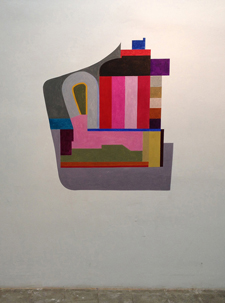 Julie Langsam, Sert Floorplan: Spanish Pavilion, Color Determined by Chance, 2013, acrylic on wall, 7 x 8 ft. (artwork © Julie Langsam)
Julie Langsam. Espai-8, Barcelona, Spain, March 20–April 17, 2013. Buildings and Blueprints. Acrylic on wall.

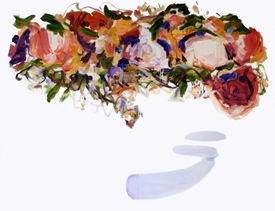 Stephen McClymont, Bouquet, 2013, oil on two linen panels, 77 x 102 in. (artwork © Stephen McClymont)
Stephen McClymont. Galry, Paris, France. September 15–October 15 2013. Bouquet. Painting.
Mid-Atlantic

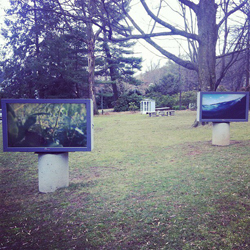 Lee Arnold, The Wanderer, 2013, digital color video, 3 min.; and The Swim, 2013, digital color video, 3:32 min. (artworks © Lee Arnold)
Lee Arnold. Montclair Art Museum, Montclair, New Jersey, April 3–September 15, 2013. Works by Lee Arnold. Digital video.

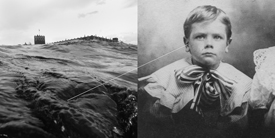 Anne Massoni, My Castle Striped Misery, 2010, archival digital print and hand-drawn painted line, 13 x 26 in. (artwork © Anne Massoni))
Anne Massoni. Print Center, Philadelphia, Pennsylvania, January 11–March 16, 2013. Anne Massoni: Holding. Photography.

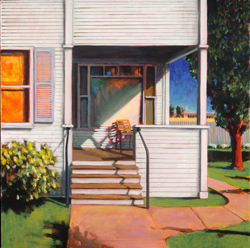 Sharon Wolpoff, Going Home, 2012, oil on linen, 34 x 34 in. (artwork © Sharon Wolpoff)
Sharon Wolpoff. Woman’s National Democratic Club, Washington, DC, May 29–September 3, 2013. In the Early Bright. Oil painting.
Northeast

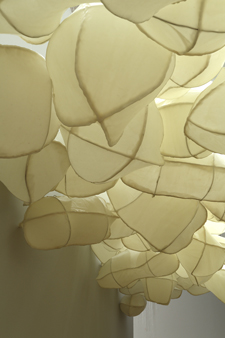 Lorrie Fredette, detail of Implementation of Adaptation, 2013, beeswax, tree resin, muslin, brass, nylon line, and wood, 288 sq. ft. (artwork © Lorrie Fredette)
Lorrie Fredette. Garrison Art Center, Garrison, New York, August 10–September 8, 2013. Implementation of Adaptation. Installation.

Kate Gilmore. Institute of Contemporary Art, Maine College of Art, Portland, Maine, July 3–August 4, 2013. Kate Gilmore. Video and performance.

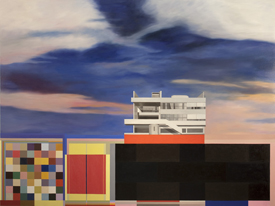 Julie Langsam, Le Corbusier Landscape (Villa Stein), 2013, oil on canvas, 72 x 96 in. (artwork © Julie Langsam)
Julie Langsam. 532 Gallery Thomas Jaeckel, New York, April 11–May 25, 2013. Now(here). Oil painting.

 Jerry Meyer, Ordinary Unhappiness, 2011, mixed media, 20¼ x 17¾ x 12 in. (artwork © Jerry Meyer)
Jerry Meyer. Denise Bibro Fine Art, New York, May 16–July 6, 2013. Ordinary Unhappiness. Multimedia light boxes and installation.

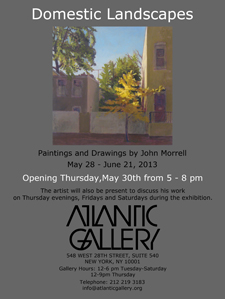 Invitation card for John Morrell’s Domestic Landscapes
John Morrell. Atlantic Gallery, New York, May 28–June 21. Domestic Landscapes. Painting and drawing.
Linda Stein. Romany Kramoris Gallery, Sag Harbor, New York, June 27–September 2, 2013. Power and Protection: Bully Proof Vests by Linda Stein. Sculpture.
Jayoung Yoon. Here Arts Center, New York, July 18–August 17, 2013. Mind Out of Time. Sculpture, video, and performance.
South

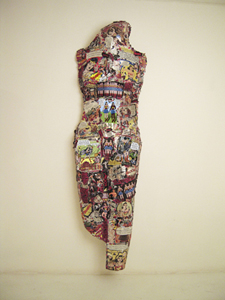 Linda Stein, Justice for All 698, 2010, acrylicized metallic paper, archival inks, and mixed media, 79 x 40 x 9 in. (artwork © Linda Stein)
Linda Stein. Fine Arts Gallery, St. Edward’s University, Austin, Texas, September 5–27, 2013. The Fluidity of Gender: Sculpture by Linda Stein. Sculpture.
West
Mara De Luca. Quint Contemporary Art, La Jolla, California, June 8–July 27, 2013. Even If the Lights Go Out. Painting.

 Carol Ladewig, Year in Color: Lunar Phases, (52 Weeks and a Day), 2012, acrylic and gouache on 365 five-inch-square wood panels, 70 x 135 in. (artwork © Carol Ladewig; photograph by Phil Cohen)
Carol Ladewig, Slate Contemporary, Oakland, California, February 28–March 23, 2013. Year in Color/Lunar Cycles: New Work by Carol Ladewig. Acrylic and gouache on panels and on canvas and digital prints.
Recent Deaths in the Arts
posted by Christopher Howard — August 22, 2013
In its regular roundup of obituaries, CAA recognizes the lives and achievements of the following artists, historians, educators, and others whose work has significantly influenced the visual arts. Notable deaths this summer include four major internationally known artists: Ruth Asawa, Walter De Maria, León Ferrari, and Allan Sekula. In addition, CAA has published special obituaries on the Asian American art historian Sadayoshi “Sada” Omoto and the eminent Russian scholar Dmitrii V. Sarabianov.
- Ruth Asawa, an artist based in San Francisco who created abstract sculpture, including intricate hanging wire pieces and several public fountains, passed away on August 6, 2013. She was 87 years old
- Ronnie Cutrone, an artist and an assistant to Andy Warhol in the Factory from 1972 into the early 1980s, died on July 21, 2013. He was 65
- Walter De Maria, a sculptor best known for his large-scale outdoor work The Lightning Field and indoor pieces such as The New York Earth Room and The Broken Kilometer, died on July 25, 2013. He was 77 years old
- León Ferrari, an Argentine artist known for provocative work that addressed war, religion, power, and sex, died on July 25, 2013. He was 92 years old
- Betty Jones, a conservator of paintings at Harvard University’s Fogg Museum and for the Museum of Fine Arts, Boston, died on May 20, 2013, at age 94. She was instrumental in recovery efforts in Venice after the city was flooded in 1966
- Ben Lifson, a writer, curator, and photographer, passed away on July 3, 2013, at the age of 72. Lifson served as photography critic for the Village Voice from 1977 to 1982
- Larry Nowlan, a realist sculptor based in New Hampshire known for his bronze statue of the actor Jackie Gleason as Ralph Kramden, sited outside New York’s Port Authority, died on July 30, 2013. He was 48 years old
- Sadayoshi “Sada” Omoto, a historian of American and Asian art who taught at Michigan State University for thirty-three years, died on March 4, 2013, at the age of 90. A special obituary on the scholar has been published by CAA
- John Reilly, the founder of a New York theater for underground video called the Global Village, died on July 28, 2013, age 74. Reilly financed documentary films and created his own, including Waiting for Beckett (1993), while also teaching workshops on video production
- Alejandro Santiago, a Mexican artist who worked on a series of small statues called 2501 Migrantes from 2002 to 2008, passed away on July 22, 2013. He was 49 years old
- Dmitrii V. Sarabianov, a Russian scholar who specialized in art of the nineteenth and twentieth centuries, passed away on July 19, 2013, age 89. CAA has published a special obituary on the eminent art historian
- Allan Sekula, an artist, photographer, writer, and longtime professor at California Institute of the Arts, died on August 10, 2013. He was 62 years old. Last year CAA honored Sekula with its Distinguished Lifetime Achievement Award for Writing on Art
- Jud Yalkut, a film and video artist based in Dayton, Ohio, died on July 23, 2013, at the age of 75. He founded the film and video program at Wright State University in 1973 and also taught at Sinclair Community College and Xavier University
Read all past obituaries in the arts in CAA News, which include special texts written for CAA. Please send links to published obituaries, or your completed texts, to Christopher Howard, CAA managing editor, for the next list.
Sadayoshi “Sada” Omoto: In Memoriam
posted by CAA — August 21, 2013
adayoshi “Sada” Omoto: In Memoriam
The following obituary was prepared by the deceased’s wife, Kathryn B. Omoto, and his son, Loren Omoto.

Sadayoshi Omoto
Sadayoshi “Sada” Omoto, an artist and art historian, died on March 4, 2013, after a lifetime of inspiring students, artists, and friends. He was 90 years old. Omoto’s path through life brought him challenges, opportunities, and triumphs. He was a beloved husband, father, grandfather, college professor, elected official, activist and, in later years, an artist. His indomitable spirit and easygoing personality made him a friend to and role model for many. His individuality and dogged determination emerged early and were defining characteristics throughout his life.
Omoto was born at Wing Point on Bainbridge Island, Washington. The island—a short ferry ride from Seattle—was an idyllic spot to grow up. As a young man he began classes at the University of Washington, but his life was changed forever on the day Japanese forces attacked Pearl Harbor. Soon after, President Franklin Delano Roosevelt signed Executive Order 9066 authorizing the United States military to relocate American citizens of Japanese ancestry from the West Coast. The first people subject to the evacuation order were Japanese Americans living on Bainbridge Island.
Omoto’s family and more than two hundred other island residents were given just six days to collect what possessions they could carry and make arrangements for their property. On March 30, 1942, US soldiers carrying rifles with bayonets rounded them up and put them on a ferry to Seattle. Ultimately the family became some of the first residents at Manzanar War Relocation Center, an internment camp located in a remote area of the Southern Californian desert. At Manzanar, Omoto lived in communal barracks with his brother and widowed mother, surrounded by barbed wire, dogs, and guard towers, while his two older brothers served in the US military. The experience instilled a keen awareness of social injustice. He later made his forced relocation a “teachable moment” for his children and for hundreds of others who heard him speak or who viewed his highly personal art on the subject.
Omoto left the camp to join the US Army, training as a linguist at the Military Intelligence Service Language School in Minnesota. He made his first journey to Asia while in the military. After the war, Omoto resumed his quest for a higher education—but this time in the Midwest. Omoto enrolled at Oberlin College in Ohio and earned a bachelor’s degree. He also earned a master’s degree from Michigan State University and his PhD in art history from Ohio State University.
For the next forty years, Omoto taught American and Asian art history—first at Bradley College in Illinois, then at Wayne State University in Detroit, and finally at Michigan State, where he worked for thirty-three years. During his career, he served as department chair and as advisor to a minority student organization. His concern and attention to principles of justice were remembered by students long after their college careers.
Omoto was the author of numerous articles in professional journals, including “Thackeray and Architectural Taste” (1967) and “The Queen Anne Style and Architectural Criticism” (1964) in the Journal of the Society of Architectural Historians; “The Sketchbooks of Worthington Whittredge” in Art Journal (1965); and “Berkley and Whittredge at Newport” in Art Quarterly (1964). He also wrote book reviews and contributed articles to the Kresge Art Center Bulletin.

Under the auspices of the Bicentennial Inventory of American Paintings Executed before 1914, a program of the National Collection of Fine Arts (later renamed the Smithsonian American Art Museum), Omoto directed the inventory of early Michigan paintings. The collection of over one thousand works served as the basis for the Michigan Experience exhibition at Kresge Art Center Gallery at Michigan State in 1986, which traveled to venues throughout the state. He authored exhibition catalogues for The Michigan Experience (1986, with Eldon Van Liere) and Early Michigan Paintings (1976–77).
After retiring from Michigan State, Omoto returned to the northern Michigan community he had first visited as an art student during the 1950s. In Leland, he cultivated a new life focused on creativity and community service. He attended painting classes and helped to form a collective of local artists who drew inspiration from the local landscape and from each other. Omoto also helped to organize exercise classes for seniors and exhibitions of art from the past and present. With his wife Kathryn, he supported the work of the Leelanau Conservancy and other local historic-preservation efforts. Although slowed in recent years, Omoto remained a familiar sight at Leland community events, galleries, and coffee shops. His gentle humor and easy smile made him a beacon of friendliness during any season.
Omoto is survived by his wife, Kathryn Bishop Omoto; his children Allen Omoto (David Robinson) of Claremont, California, Katherine (Neal) Fortin of Okemos, Michigan, Loren (Susan) Omoto of Maitland, Florida; his granddaughter Helen Fortin of Okemos; and numerous nieces and nephews. Omoto was preceded in death by his parents Daikichi and Masa Omoto; his son Roger Omoto; his brothers Masakatsu, Setsuo, and Taketo Omoto; and his sister Kanee Omoto.
Dmitrii V. Sarabianov: In Memoriam
posted by CAA — August 21, 2013
Alison Hilton is Wright Family Professor of Art History at Georgetown University in Washington, DC.
Dmitrii V. Sarabianov, a Russian art historian and a specialist on nineteenth- and twentieth-century art, died in Moscow on July 19, 2013. He was 89 years old. Sarabianov was one of the great art historians of his generation, those who began their scholarly careers during and following World War II.
Born on October 10, 1923, into the family of a Marxist philosopher, Sarabianov showed an early interest in the arts, especially poetry and music, as well as camping and athletics. Soon after he began his undergraduate studies in 1941, Germany invaded the Soviet Union. He joined the army to serve as a translator, was wounded twice, and received several medals for military merit. After the war Sarabianov completed his undergraduate work at Moscow State University and was admitted into the school’s graduate program in art history, earning his candidate’s degree in 1952.
In 1954 he began work at Moscow’s prestigious Institute of Art History, first as a senior researcher and later as deputy director. From 1966 to 1996 Sarabianov taught and served as the head of the Art History Department at Moscow State University. He earned his doctorate in 1971. (In Russia this signifies substantial scholarly achievement beyond the candidate’s degree; it is roughly equivalent to full professorship.) Sarabianov became a corresponding member of the Russian Academy of Sciences in 1987 and was elected to the rank of academician five years later.
Sarabianov was an inspiring teacher and mentor whose influence guided the careers of many Russian academics and museum scholars for several generations. Even for those who did not encounter him directly, Sarabianov’s publications—numbering more than 360 books and articles—set a standard for scholarship recognized both in Russia and abroad. Subjects of his monographs, many of them translated, include important nineteenth-century artists, among them Pavel Fedotov, Orest Kiprenskii, Aleksei Venetsianov, Ilya Repin, and Valentin Serov, as well as key figures in early-twentieth-century art such as Vasilii Kandinsky, Pavel Kuznetsov, Robert Falk, Liubov Popova, and Kazimir Malevich. What distinguishes Sarabianov’s work is the scope and originality of his interpretations of Russian art movements. He was among the first to write about Russian nineteenth-century painting in relation to European art, and he published a path-breaking study of international Art Nouveau in 1989. His book Russian Art: From Neoclassicism to the Avant Garde 1800–1917 (1990) is considered the fundamental text on the subject.
Sarabianov always took his civic responsibility as an academic very seriously. He spoke up at meetings, defended intellectual freedom, and voted on policy questions. In 2005, he and colleagues in Moscow’s major museums and other art institutions created the National Organization of Art Experts (NOEXI) to monitor and cope with the unprecedented demands of the chaotic art market in Russia and to establish means of ensuring professional credibility and trust.
Regarded by his peers, his former students, and his readers as a scholar of absolute integrity, Dmitrii Sarabianov will be missed most for his immense charm and kindness. He is survived by his wife, Elena Borisovna Murina, and his sons, Andrei and Vladimir Sarabianov.
News from the Art and Academic Worlds
posted by Christopher Howard — August 21, 2013
Each week CAA News publishes summaries of eight articles, published around the web, that CAA members may find interesting and useful in their professional and creative lives.
Almanac of Higher Education 2013
The Chronicle of Higher Education takes the measure of higher education in its 2013–14 almanac, an annual compendium of data on colleges regarding the profession, students, diversity, finance, technology, and international issues. This year’s almanac features many new tables and charts along with the familiar ones. (Read more in the Chronicle of Higher Education.)
A Guide to the Web’s Growing Set of Free Image Collections
The J. Paul Getty Trust has launched its Open Content Program, making more than 4,600 high-quality images of artwork available for free online. Though works by van Gogh, Rembrandt, and Dürer had already fallen into the public domain, the Getty’s program makes their digital reproductions much easier to use. The Getty is not the first museum to put so many images online this year. The Atlantic has listed the museums and research institutions that have large, high-quality, free-to-use collections of historically or aesthetically notable images online. (Read more in the Atlantic).
Help Desk: Pressure to Review
I’m a new arts administrator and live in a midsized city. I started writing art reviews last year and now feel pressure to write about my artist friends’ work. It’s not like they are asking me directly, but hints have been dropped. I have no problem reviewing work that I think is good; the problem is that I like some people very much but don’t think their work is that great. How do I avoid reviewing work I don’t like without losing my friends? (Read more in Daily Serving.)
Christie’s Appraisal Will Reveal Value of Detroit Institute of Arts’ Collection
Art museums treat estimated values of their art like state secrets. In fact, major museums such as the Detroit Institute of Arts don’t even know precisely what all of their multi-million-dollar treasures are worth. When officials from the New York–based auction house Christie’s finish formally appraising city-owned works in Detroit this fall, the results will open an unprecedented public window into the market value of thousands of artworks at a top American museum. (Read more in the Detroit Free Press.)
Feminist Anti-MOOC
At first glance, “Feminism and Technology” sounds like another massive open online open course (MOOC) that would involve video components and be available online to anyone, with no charge. But don’t look for this course in any MOOC catalogue. “Feminism and Technology” is taking a few MOOC elements but then changing them in ways consistent with feminist pedagogy to create a distributed open collaborative course (DOCC). (Read more from Inside Higher Ed.)
More Smiles? More Money
Last November, the artist Martha Rosler had her first solo exhibition at the Museum of Modern Art, an installation and performance piece called Meta-Monumental Garage Sale. It was, in fact, an enormous garage sale, with heaps of toys, furniture, clothes, and crockery arranged on a tidy maze of racks and tables winding through the museum’s main atrium. The show continued a project Rosler began in 1973 with Monumental Garage Sale, a performance she staged as a graduate student at UC San Diego and later re-created in museums all over the world. Like its predecessors, Meta-Monumental Garage Sale was a meditation on value. (Read more from N+1.)
Jasper Johns’s Assistant Charged with Stealing the Artist’s Work
In the twenty-seven years that James Meyer worked for Jasper Johns, the assistant answered the artist’s phone, stretched his canvases, bought his paintbrushes, and even drew lines on his canvases. Meyer was recently arrested for stealing at least twenty-two works from his employer and selling them through an unnamed New York gallery for $6.5 million, falsely telling the dealer and buyers that Johns had given them to him as presents and that they would be in the official catalogue raisonné. (Read more in New York Times.)
Pre-Raphaelite Mural Discovered in William Morris’s Red House
It began as an attempt to restore one blurry image that had been hidden for a century behind a large built-in wardrobe on William Morris’s bedroom wall. Months later, the painstaking removal of layers of paint and wallpaper revealed that an entire wall at the artist and craftsman’s first married home was painted by his young friends who would become world-famous Pre-Raphaelite artists. (Read more in the Guardian.)
Institutional News
posted by CAA — August 17, 2013
Read about the latest news from institutional members.
Institutional News is published every two months: in February, April, June, August, October, and December. To learn more about submitting a listing, please follow the instructions on the main Member News page.
August 2013
California Institute of the Arts in Valencia, along with the Roy and Edna Disney/CalArts Theater (REDCAT) in Los Angeles, has received a $244,000 grant from ArtPlace America for the September 2013 edition of “Radar L.A., an International Festival of Contemporary Theater” and a related series of performing artist residencies.
California State University, Stanislaus, has received a $20,000 Art Works Research Grant from the National Endowment for the Arts to support a study of the differential impacts of arts participation on California’s Central San Joaquin Valley, in particular Stanislaus County.
Christopher Newport University in Newport News, Virginia, has won a $20,000 Art Works Research Grant from the National Endowment for the Arts to support a study using the federal agency’s Survey of Public Participation in the Arts data to develop a multivariate framework for measuring arts participation.
The Fleet Library at the Rhode Island School of Design in Providence has received a $50,000 National Forum Grant from the Institute of Museum and Library Services to hold a symposium titled “Materials Education and Research in Art and Design: A New Role for Libraries,” which took place June 6–8, 2013, at the school’s museum.
The Galleries at Moore College of Art and Design in Philadelphia, Pennsylvania, has accepted a $20,000 grant from the Pew Center for Arts and Heritage for an upcoming exhibition called Strange Currencies.
The Institute of Contemporary Art at the University of Pennsylvania in Philadelphia has received a $25,000 grant from the Pew Center for Arts and Heritage for its upcoming exhibition, Barbara Kasten.
The Maine College of Art in Portland has unveiled a new institutional logo, created through a collaboration between Eddie Opara of the design company Pentagram and a group of design faculty and students.
The Museum of Modern Art in New York has combined its Department of Prints with the Department of Drawings, creating a new Department of Prints and Drawings. The change took effect on July 1, 2013.
The National Gallery in London, England, has partnered with the Getty Research Institute in Los Angeles, California, to add nearly 100,000 records of art sales from more than 1,200 British auction catalogues that were published between 1780 and 1800. The records will join the Getty Provenance Index, a free online art-historical database.
Northeastern University in Boston, Massachusetts, has received a $25,000 Art Works Research Grant from the National Endowment for the Arts to support an analysis of American Community Survey data to determine relationships among selections of arts majors, occupational choices, and labor-market outcomes of American college graduates, including artist job holders.
The Philadelphia Museum of Art in Pennsylvania has earned a $30,000 planning grant from the Pew Center for Arts and Heritage for a project called “The Contemporary Caucus,” which will engage staff from education, technology, marketing, communications, and exhibitions to identify and implement optimal strategies for connecting with twenty-first-century audiences.
The Philadelphia Museum of Art in Pennsylvania has received a Curatorial Travel/Internationally Collaborative Pre-exhibition Convening Grant from the Terra Foundation for American Art for an upcoming exhibition, Paul Strand: Photography and Film for the Twentieth Century.
The Rhode Island School of Design in Providence, in partnership with the design firm Project Projects, has completed a new visual identity and website for the school’s museum. Part of the initiative involved the renaming of the exhibiting institution as RISD Museum.
Saint Louis University in Missouri has accepted a $20,000 Art Works Research Grant from the National Endowment for the Arts to support a study that will examine how the growth and stability of local arts businesses have contributed to the redevelopment of downtown Saint Louis at the street and block level.
The School of the Art Institute of Chicago in Illinois has won a $20,000 grant from the National Endowment of the Arts to support a study of the characteristics, needs, and support systems of ethnically and culturally specific organizations in the United States and Canada.
The Toledo Museum of Art in Toledo, Ohio, has achieved a milestone in a twenty-year effort to reduce energy consumption. On May 21, 2013, the museum’s main building, a 101-year-old Beaux Arts structure, stopped drawing power from the electrical grid and even began returning power to the system.
The University of Iowa Museum of Art in Iowa City has received permission from its board of regents to construct a new building that will house a collection of 12,000 works. The school’s old exhibition space was destroyed by flooding in 2008.
The University of Maryland, College Park, has won a $25,000 Art Works Research Grant from the National Endowment for the Arts to support an analysis of two longitudinal data sets for information about the impact of high school arts education on college attainment, after controlling for certain preexisting differences between arts and nonarts students.
The University of Oregon in Eugene has received a $15,000 Art Works Research Grant from the National Endowment for the Arts to support the development of an online, annotated resource that identifies American prison arts programs and their histories, related research, and outcomes analyzed on a rubric to be created for this project.
The University of Southern California in Los Angeles has earned a $15,000 Art Works Research Grant from the National Endowment for the Arts to support an analysis of survey data from the National Alliance of Media Arts and Culture to map the spatial relationships of media arts organizations to local community characteristics and target audiences.
West Chester University in West Chester, Pennsylvania, has received a $25,000 Art Works Research Grant from the National Endowment for the Arts to support a study examining the physiological impacts of participation in music, dance, and the visual arts on economically disadvantaged children.
The Whitney Museum of American Art in New York has approved a new graphic identity and logo—which it calls the “responsive W”—in consultation with the design studio Experimental Jetset.
Warren Wilson College in Swannanoa, North Carolina, has received a $2.1 million grant from the Windgate Charitable Foundation to enhance its Art Department with the addition of studio craft and material arts and to foster a close partnership between it and the Center for Craft, Creativity, and Design.
The Wolfsonian–FIU at Florida International University in Miami Beach, Florida, has accepted a $5 million donation from the Knight Foundation to fund a project to make the museum’s collection digitally accessible within five years.