
CAA News Today
Affiliated Society News for May 2014
posted by CAA — May 09, 2014
American Council for Southern Asian Art
The American Council for Southern Asian Art (ACSAA) invites you to visit its newly updated website, where you can browse calls for papers, job and fellowship listings, and, for members, recent and past issues of the ACSAA Bulletin. Please send news and postings for the website to ACSAA’s webmaster, Cathleen Cummings.
Please also watch the ACSAA website and listserv for news about upcoming elections. ACSAA will be voting on new board members, changes to membership fees, and several other initiatives. You must be a member in good standing to be eligible to cast your vote. Help shape the future of ACSAA.
Association of Art Historians

The Association of Art Historians (AAH) has announced that Christine Riding is the new AAH chair, serving a three-year post. She takes over from Alison Yarrington. Riding is senior curator and head of art at the Royal Museums Greenwich in London. Previously she was curator of eighteenth- and nineteenth-century British art at Tate Britain and held curatorial positions at the Palace of Westminster, Museum of London, and the Wallace Collection. Riding has lectured and published widely on the history of eighteenth- and nineteenth-century British art and has organized a number of international exhibitions at Tate Britain and Tate Modern. Her current projects include curating Turner and the Sea, a major exhibition that opened at Greenwich in November 2013. She also served as an AAH trustee between 2004 and 2007 and was deputy editor of Art History between 2007 and 2012. Riding has participated on the Clore Leadership Programme and was recently appointed as an impact assessor for REF2014.
Community College Professors of Art and Art History
The Community College Professors of Art and Art History (CCPAAH) had a successful session at this year’s CAA Annual Conference in Chicago. “Starting the Conversation: Engaging Students in the Studio and Art History,”chaired by Susan Altman of Middlesex County College, featured: Tyrus Clutter, College of Central Florida, “Flipping the Classroom with Digital Demonstrations”; Monica Anke Hahn, Community College of Philadelphia, “Virtual Engagement: Conversations in Online and Hybrid Classes”; and Julianne Parse Sandlin, Portland Community College, “Low-Tech Engagement: Art History and the Class Discussion.” The prospectus for next year’s conference session will be posted later this spring on CCPAAH’s Facebook page. To become more involved in the organization, please email ccpaah@gmail.com.
Foundations in Art: Theory and Education

The next biennial conference of Foundations in Art: Theory and Education (FATE), called “Tectonic Shifts” and hosted by the Herron School of Art and Design at Indiana University–Purdue University Indianapolis, will be held March 25–28, 2015. The event will take place in the heart of downtown Indianapolis at the Westin Hotel Indianapolis, which just completed a $14 million renovation. You can access hotel registration information via the FATE website.
FATE’s Programming Committee is now reviewing the call for session proposals. While the call for sessions is now closed, a call for papers was sent in April 2014. Approximately one hundred sessions will run during the three-day conference. Papers will be accepted from all who contribute to the foundation experience. The “Tectonic Shifts” FATE members exhibition will take place in one of Indianapolis’s most respected exhibition venues, the Herron School Art and Design Galleries. A call for exhibition entries will go out in mid-May. The conference keynote speaker is Wayne White, an American artist, art director, illustrator, puppeteer, and much, much more.White has traveled the country delivering an incredibly entertaining hour-long talk in which he discusses his life and work, while making time for banjo and harmonica playing.
Historians of German and Central European Art and Architecture
The Historians of German and Central European Art and Architecture (HGCEA) has elected a new board of directors for a three-year term, 2014–17. They are: Marsha Morton, president; Jay Clarke, secretary; Jim Van Dyke, treasurer; Elizabeth Cronin, web manager; and Keith Holz, Karla Huebner, Juliet Koss, and Elizabeth Otto, at-large members.
Historians of Netherlandish Art
The Historians of Netherlandish Art (HNA) will hold its next conference June 5–7, 2014, in Boston, Massachusetts. The event will be held in cooperation with the American Association for Netherlandic Studies and involve sessions and workshops with focus on Netherlandish art from 1350 to 1750. Please see the HNA website for more information.
The next formal deadline for submitting manuscripts to the Journal of Historians of Netherlandish Art, HNA’s peer-reviewed, open-access ejournal, is August 1, 2014. In addition to longer articles, the journal welcomes shorter notes on archival discoveries, iconographical issues, technical studies, and rediscovered works. For submission guidelines, see the journal’s website or contact Alison Kettering, senior editor, at aketteri@carleton.edu or aketteri@jhna.org for more information.
International Association of Art Critics
The United States chapter of the International Association of Art Critics (AICA-USA) will hold its awards ceremony and dinner to honor the best exhibitions that opened between January and December 2013 at the studio of Izhar Patkin in New York on Monday, May 12, 2014, 6:00–9:00 PM.
Italian Art Society
The Italian Art Society (IAS) invites scholars in Italy this spring to attend the fifth annual IAS/Kress Lecture in Italy by Jean K. Cadogan, professor of fine arts at Trinity College in Hartford, Connecticut, whose paper is titled “‘Maravigliose istorie’: The Mural Decoration of the Camposanto in Pisa.” Cadogan will share her intriguing work on the multiphase, comprehensive program of painting on the walls of the Camposanto in a presentation on May 27, 2014, at the Gipsoteca of the Università di Pisa. See the IAS website for details.
In addition, the IAS website publishes information about the organization’s activities at the upcoming forty-ninth International Congress of Medieval Studies in Kalamazoo, Michigan, taking place May 8–11, 2014. IAS will hold a business meeting at 5:30 PM on Thursday, May 8 (in Valley II, Garneau Lounge), plus three IAS-sponsored sessions (all in Bernhard 209) and an IAS reception (in the second floor lobby of Bernhard) at 5:30 PM on Friday, May 9. All members and prospective members are welcome!
National Art Education Association

The National Art Education Association (NAEA) is accepting proposals for presentations for the 2015 NAEA national convention, to be held March 26–28 in New Orleans, Louisiana. You must be an NAEA member to submit a proposal. The deadline is May 15, 2014.
NAEA also announces two new publications: Practice Theory: Seeing the Power of Art Teacher Researchers and Purposes, Principles, and Standards for School Art Programs.
Studies in Art Education, the NAEA’s professional refereed journal, is a quarterly publication that reports quantitative, qualitative, historical, and philosophical research in art education. View a sample digital issue. The cost for a one-year subscription is $20 for NAEA members, $30 for nonmembers, and $45 for Canadian/foreign subscriptions.
NAEA announces SummerVision DC: Hands-On Learning in Art Museums. Choose from two sessions: July 8–11, 2014, or July 22–25, 2014. Now in its fifth year, NAEA SummerVision DC is an annual event offered by NAEA in partnership with Washington, DC–area art museums. Upon completion of the program, participants will receive a certificate of participation with thirty clock hours of professional development. The cost is $495 (NAEA members) and $549 (nonmembers). Each session is limited to twenty-five participants.
New Media Caucus
The New Media Caucus (NMC) has announced the results of its recent board and officer elections. The NMC board of directors voted to add two new officer positions to its Executive Committee: chair of the Communications Committee and chair of the Events and Exhibitions Committee. A. Bill Miller, assistant professor at the University of Wisconsin in Whitewater, joins the board and begins a one-year term as the chair of the Communications Committee. Joyce Rudinsky, associate professor at the University of North Carolina in Chapel Hill, was voted as the chair of Exhibitions and Events Committee. NMC also welcomes new and reelected board members: Barbara Rauch, Kevin Hamilton, Joshua Selman, A. Bill Miller, Rachel Clarke, and Mat Rappaport. Rappaport was reelected as secretary, and Vagner Whitehead, associate professor at Oakland University in Rochester, Michigan, begins his term as the fourth NMC president.
The NMC board would like to thank its former president, Paul Catanese, for his leadership over the past six years. Under his tenure NMC has grown into an organization of over nine hundred members and developed annual programming that highlights the practice and scholarship of new-media art and theory. He now sits on the Executive Committee as immediate past president. NMC also wants to thank board members whose terms have ended for all the work they have done in the past years: Mike Salmond, Dima Strakovsky, Leslie Raymond, and Gwyan Rhabyt (president emeritus). Finally, NMC thanks the members of the Nominations Committee who oversaw the election: Mina Cheon, Meredith Hoy, and Mat Rappaport.
Pacific Arts Association
The conference of the European chapter of Pacific Arts Association (PAA) was held April 24–26, 2014, at the Rautenstrauch-Joest-Museum-Cultures of the World in Cologne, Germany. The conference coincided with the exhibition Made in Oceania: Tapa – Art and Social Landscapes. Learn more about conference registration, programs, accommodations, and special events on the PAA website.
Public Art Dialogue

At CAA’s 2014 Annual Conference in Chicago, Jack Becker received the 2014 Public Art Dialogue Award for Achievement in the Field of Public Art. In honoring his thirty-five years of service to the profession, Harriet F. Senie, cochair of Public Art Dialogue (PAD), observed, “I don’t think there is anyone in the field who has done more to legitimize the field of public art than Jack Becker. I can’t begin to imagine where we would all be without the Public Art Review and its ongoing response to and expansion of our enterprise.”
A CAA session on “Public Art and Its Role in Placemaking from an International Perspective” featured the speakers Marisa D. Lerer, Norie Sato, and Jack Becker. Chaired by Erika Doss, another session, “Vandalism, Removal, Relocation, Destruction: The Dilemma of Public Art’s Permanence,” featured the following presentations: “Yankees, Automobiles, and Other Hazards: Shattered Monuments and the Problem of Confederate Memory,” by Sarah Beetham; “Marking Memory: Ambiguity and Amnesia in the Monument to Soviet Tank Crews in Prague,” by Jenelle Davis; “Maintaining Problematic Public Art,” by Christine Young-Kyung Hahn; “Distant Stars, Black Holes, and Burned Out Sculptures: Media Obsolescence and the Trouble with Public Art,” by Julia E. Marsh; and “The Sordid Pasts of Public Art and How We Go About Protecting Them,” by Michele Bogart.
Society for Photographic Education

The Society for Photographic Education (SPE) is accepting proposals for its 2015 conference, “Atmospheres: Climate, Equity, and Community in Photography.” Topics may include but are not limited to: image-making, history, contemporary theory and criticism, new technologies, effects of media and culture, educational issues, and funding. SPE membership is required to submit; proposals are peer reviewed. Proposals are due by June 1, 2014. Visit the SPE website for full proposal guidelines.
SPE is pleased to announce these award opportunities:
- Future Focus Project Support Grant: Established to recognize exceptional photographic work, this $5,000 grant is partially funded by the SPE Future Focus Campaign. The recipient also receives a complimentary one-year SPE membership and two years of conference registration
- Honored Educator Award: Bestowed upon a career educator recognizing significant contribution to the field of photographic education. The recipient receives a lifetime SPE membership and a $1,000 honorarium
- Insight Award: Given to up to five members annually who demonstrate excellence in innovative teaching, sustained mentoring of colleagues or students, broad contribution to technical, critical, pedagogical, or visual aspects of the field, breadth or depth of exhibition or publication, and/or sustained presence in the field
Applications and nominations are due by July 1, 2014. Visit the SPE website for more information about these awards.
Society of Architectural Historians
The Society of Architectural Historians (SAH) is accepting applications for its 2014 SAH/Mellon Author Awards, designed to support emerging authors publishing monographs on the history of the built environment who are responsible for paying for rights and permissions for images in their publications. The deadline is June 1, 2014.
SAH is also accepting abstracts for papers for its sixty-eighth annual conference, taking place April 15–19, 2015, in Chicago, Illinois. Abstracts may be submitted for one of the thirty-two thematic sessions or for an open session. The deadline to submit is June 6, 2014. Visit the SAH website for details.
Carolyn Garrett has been named SAH development director. She has over twelve years of experience in resource development and previously held positions at Changing Worlds and Chicago Foundation for Women.
Society of Historians of Eastern European, Eurasian, and Russian Art and Architecture
The Society of Historians of Eastern European, Eurasian and Russian Art and Architecture (SHERA) seeks proposals of papers for its sponsored session, “Reconsidering Art and Politics: Toward New Narratives of Russian and Eastern European Art” at CAA’s 2015 Annual Conference in New York. The session aims to move beyond conventional binary narratives of art and power by inviting papers that challenge these interpretations and highlight the complexity of artistic responses produced at the nexus of aesthetics and politics. The chairs seek historically grounded case studies of Russian, Eastern European, and Eurasian art from the Byzantine era to modern times that productively explore these issues. Interested contributors should see CAA’s 2015 Call for Participation and send proposals with other required materials to the session’s cochairs, Galina Mardilovich and Maria Taroutina. The deadline for proposals is May 9, 2014.
SHERA is delighted to welcome two new institutional members: the Russian American Cultural Center, an organization that sponsors exhibitions, arts events, and scholarly symposia in the greater New York area; and Centro Studi sulle Arti della Russia in Venice, Italy, a center for the research and study of Russia’s rich cultural heritage.
Southeastern College Art Conference

The Southeastern College Art Conference (SECAC) has announced the newly elected members of its board of directors: Sandra Reed, Savannah College of Art and Design; Reni Gower, Virginia Commonwealth University; and Ria O’Foghludha, Whittier College were reelected to a three-year term. In addition, Heather Stark of Marshall University and Ute Wachsmann-Linnan of Columbia College were elected to a three-year term.
The new issue of the Southeastern College Art Conference Review has been published. It is volume 17, number 3, 2013.
Visual Resources Association
The 2014 Summer Educational Institute for Visual Resources and Image Management (SEI) will be held June 10–13 at the University of Illinois in Urbana-Champaign. This intensive workshop features a curriculum addressing the latest requirements of today’s visual-resources and image-management professionals. Expert instructors will cover: intellectual-property rights; digital imaging and digital preservation; metadata and cataloging; project management; and professional development. SEI is open to all individuals interested in visual resources and image management. Past participants have included: current graduate students and recent graduates; visual-resources professionals; information, library, and museum professionals; art historians; and digital-collection managers.
Founded over ten years ago, SEI is a joint project of the Art Libraries Society of North America (ARLIS/NA) and the Visual Resources Association Foundation (VRAF). SEI provides information professionals with the information and experience needed to stay current in a rapidly changing field, and significant networking opportunities. Registration for members of VRA or ARLIS/NA and University of Illinois staff and students is $595; registration for nonmembers is $675. For more information or to register, visit the SEI website.
News from the Art and Academic Worlds
posted by Christopher Howard — May 07, 2014
Each week CAA News publishes summaries of eight articles, published around the web, that CAA members may find interesting and useful in their professional and creative lives.
Michelangelo’s David Sculpture at Risk of Collapse
Michelangelo’s famous statue of the biblical figure David is at risk of collapse due to the weakening of the artwork’s legs and ankles, according to a report recently published by art experts. The findings, which were made public by Italy’s National Research Council, show microfractures in the ankle and leg areas. (Read more from the Los Angeles Times).
The False Promise of the Digital Humanities
The humanities are in crisis again, or still. But there is one big exception: digital humanities. In 2009, the nascent field was the talk of the Modern Language Association convention: “among all the contending subfields,” a reporter wrote about that year’s gathering, “the digital humanities seem like the first ‘next big thing’ in a long time.” Even earlier, the National Endowment for the Humanities created its Office of Digital Humanities to help fund projects. And digital humanities continues to go from strength to strength, thanks in part to the Mellon Foundation, which has seeded programs at a number of universities with large grants. (Read more from the New Republic).
The Adjunct Revolt: How Poor Professors Are Fighting Back
Mary-Faith Cerasoli has been reduced to “sleeping in her car, showering at college athletic centers and applying for food stamps,” the New York Times recently reported. Is she unemployed? No, in fact, she is a college professor—but an adjunct one, meaning she is hired on a short-term contract with no possibility of tenure. (Read more from the Atlantic).
Art and the Internet of Things: A Turning Point in Creative Education
In the art world’s internal sense of time, the degree show is in many ways the equivalent of New Year’s Eve: a point at which to collectively celebrate the birth of the future, while taking stock of the events of the past year. Reflecting on the 2013–14 academic year, it is clear that one of the most pressing issues is that of value, and the need continually to defend the arts in this respect. It is interesting to note the difference between making art for yourself—which holds value for you as an individual—and pursuing a career as an artist by studying for a degree in fine art or a related field. By doing the latter, you are implicitly deciding that your creativity also holds value for others. (Read more from the Guardian).
To Bind and to Liberate: Printing Out the Internet
“Printing the internet is not creative nor art. It is a waste of time and resources. Please, find something more creative to do.” So reads a comment on a petition on change.org. Directed at Kenneth Goldsmith, the petition was published in 2013 in response to a project the poet organized at LABOR gallery in Mexico City, where Goldsmith invited people from all over the world to print out the internet and send the pages to the gallery. (Read more from Rhizome).
Five Tips for Grant Research
It’s easy to get excited about the prospect of funding via grants, which carry a certain amount of prestige and the assurance that your work is (at least somewhat) funded, not to mention the fact that, if a funder is willing to give you a grant, they respect your work. But as the saying goes, only fools rush in. (Read more from Fractured Atlas).
Pat Badani at CAA: In Conversation with the Editor of Media-N Journal
At CAA’s 2014 Annual Conference in Chicago, Joshua Selmanand Pat Badanilaunched a discussion that examined what was happening at CAA this year as it applied to the New Media Caucus, to Media-N Journal, and to CAA members. (Read more from Artist Organized Art).
CAA Publishes the March 2014 Issue of The Art Bulletin
posted by Christopher Howard — May 07, 2014
 The March 2014 issue of The Art Bulletin, the leading publication of international art-historical scholarship, is the first in the editorship of Kirk Ambrose and the first copublished with Taylor & Francis. The issue opens with a new recurring feature, “Whither Art History?” The inaugural essay by Griselda Pollock critically engages interpretive and institutional trends within the discipline.
In the long-form essays that follow, Mary D. Garrard explores the effect of love on Michelangelo’s creativity by analyzing the Renaissance artist’s cryptic drawing Children’s Bacchanal (1532–33) in her essay, “Michelangelo in Love.” For his contribution, titled “Map as Tapestry,” Jesús Escobar argues that Pedro Teixera’s monumental 1656 map of Madrid is not only a remarkable scientific achievement but also a sophisticated art object. Next, in “The Fragrance of the Divine,” Nina Ergin considers the olfactory traditions underlying Ottoman incense burners and discusses their complex meanings. Finally, Edith Wolfe demonstrates in her essay, called “Paris as Periphery,” how the art of Vicente do Rego Monteiro reflects a specifically Brazilian cosmopolitanism at the core of a counternarrative of modernity in the 1920s.
In the Reviews section, an Art Bulletin Centennial review essay by Mariët Westermann assesses the two volumes of De Hollandsche schilderkunst in de zeventiende eeuw, which examine the work of Frans Hals and Rembrandt van Rijn. Tanya Sheehan reviews two books on interdisciplinary subjects: Knowing Nature: Art and Science in Philadelphia, 1740–1840, edited by Amy R. W. Myer, and The Premise of Fidelity: Science, Visuality, and Representing the Real in Nineteenth-Century Japan, written by Maki Fukuoka. Three recent books on Mexican art—Mary K. Coffey’s How a Revolutionary Art Became Official Culture, Adriana Zavala’s Becoming Modern, Becoming Tradition, and Shelley E. Garrigan’s Collecting Mexico—are assessed by Rick López. Josh Ellenbogen ruminates on two books on art and technology, Illusions in Motion: Media Archaeology of the Moving Panorama and Related Spectacle by Erkki Huhtamo and Enfoldment and Infinity: An Islamic Genealogy of New Media Art by Laura U. Marks.
CAA sends The Art Bulletin to all institutional members and to those individuals who choose to receive the print journal as a benefit of their membership. In addition, online versions of the articles in each issue are available to CAA members who log into the CAA members’ portal. The next issue of the quarterly publication, to appear in June 2014, will feature the next “Whither Art History?” essay, by Parul Dave Mukherji, and essays on Greek domestic mosaics, death masks produced in eighteenth- and nineteenth-century Europe, the architecture of the Jaipur Economic and Industrial Museum, and Frank Lloyd Wright’s Kalita Humphreys Theater.
Propose a Poster Session by May 9
posted by Emmanuel Lemakis — May 05, 2014
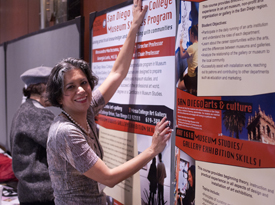 CAA invites individual members to submit abstracts for Poster Sessions at the 103rd Annual Conference in New York, taking place February 11–14, 2015. Poster Sessions—presentations displayed on bulletin boards by an individual for small groups—usually include a brief narrative paper mixed with illustrations, tables, graphs, and similar presentation formats. The poster display can intelligently and concisely communicate the essence of the presenter’s research, synthesizing its main ideas and directions. Colorado State University has published useful general information on Poster Sessions.
Poster Sessions offer excellent opportunities for extended informal discussion and conversation focused on topics of scholarly or pedagogical research. Posters are displayed for the duration of the conference, so that interested persons can view the work even when the presenters are not physically present. Poster Sessions take place in a high-traffic area, in close proximity to the Book and Trade Fair and conference rooms.
Proposals for Poster Sessions must include the following:
- Title of Poster Session
- Summary of project, not to exceed 250 words
- Name of presenter(s), affiliation(s), and CAA member number(s)
- A two-page CV
- Complete mailing address and telephone number
- Email address
Proposals are due on Friday, May 9, 2014—the same deadline as the regular call for papers for the 2014 conference. Send all materials to Lauren Stark, CAA manager of programs. A working group of the Annual Conference Committee selects Poster Sessions based on individual merit and space availability at the conference. Accepted presenters must maintain their memberships through the conference.
Displays must be assembled by 10:00 AM on Thursday, February 12, and cleared by 2:00 PM on Saturday, February 14. Live presentations last ninety minutes and are scheduled during the lunch breaks on Thursday and Friday, 12:30–2:00 PM. During this time, presenters stand by their poster displays while others view the presentation and interact with the presenters.
CAA assigns presenters one freestanding bulletin board (about 4 x 8 feet of display space) onto which they can affix their poster display and other materials, as well as a table to place materials such as handouts or a sign-up sheet to record the names and addresses of attendees who want to receive more information. CAA also provides pushpins or thumbtacks to attach components to the bulletin board on the day of installation.
Printed materials must be easily read at a distance of four feet. Each display should include the title of the presentation (104-point size) and the name of the presenter(s) and his or her affiliation(s) (72-point size). CAA recommends a point size of 16–18 or larger for body text. No electrical support is available in the Poster Session area; you must have your own source of power (e.g., a battery).
Contact
For more information about proposals of Poster Sessions for the 2015 Annual Conference, please contact Lauren Stark, CAA manager of programs, at 212-392-4405.
Image Caption
Alessandra Moctezuma of San Diego Mesa College preps a bulletin board for “San Diego Mesa College Museum Studies Program: Gaining Practical Knowledge and Connecting with Communities,” a poster session organized with her colleague Georgia Laris for the 2013 Annual Conference in New York (photograph by Bradley Marks).
May 9 Deadline for Proposals of Papers for the 2015 Annual Conference
posted by Emmanuel Lemakis — May 02, 2014
 The 2015 Call for Participation for the 103rd Annual Conference, taking place February 11–14, 2015, in New York, describes many of next year’s programs sessions. CAA and the session chairs invite your participation: please follow the instructions in the booklet to submit a proposal for a paper or presentation. This publication also includes a call for Poster Session proposals and describes the seven Open Forms sessions.
Listing more than one hundred panels, the 2015 Call for Participation is only available as a PDF download; CAA will not mail hard copies of this twenty-eight-page document.
The deadline for proposals of papers and presentations for the New York conference is Friday, May 9, 2014.
In addition to dozens of wide-ranging panels on art history, studio art, contemporary issues, and professional and educational practices, CAA conference attendees can expect participation from many area schools, museums, galleries, and other institutions. The Hilton New York is the conference headquarters, holding most sessions, Career Services, the Book and Trade Fair, ARTspace, special events, and more. Deadline: May 9, 2014.
Contact
For more information about proposals of papers and presentations for the 2015 Annual Conference, please contact Lauren Stark, CAA manager of programs, at 212-392-4405.
News from the Art and Academic Worlds
posted by Christopher Howard — April 30, 2014
Each week CAA News publishes summaries of eight articles, published around the web, that CAA members may find interesting and useful in their professional and creative lives.
77,000 Images of Tapestries and Italian Monuments Join the Open Content Program
The Getty Research Institute has just added more than 77,000 high-resolution images to the Open Content Program from two of its most often-used collections. The largest part of the new open-content release—more than 72,000 photographs—comes from the collection Foto Arte Minore: Max Hutzel photographs of art and architecture in Italy. (Read more from the Getty Iris.)
NGA Online Editions
Available for the first time on the National Gallery of Art’s website, NGA Online Editions presents the most current, in-depth information on the museum’s collections by the world’s leading art historians along with rich capabilities for exploring that information. A customized reading environment and toolkit for managing text and images are intended both to provide scholars with a useful workspace for research and to encourage the study and appreciation of art. (Read more from the National Gallery of Art.)
As Researchers Turn to Google, Libraries Navigate the Messy World of Discovery Tools
Many professors and students gravitate to Google as a gateway to research. Libraries want to offer them a comparably simple and broad experience for searching academic content. As a result, a major change is under way in how libraries organize information. Instead of bewildering users with a bevy of specialized databases—books here, articles there—many libraries are bulldozing their digital silos. They now offer one-stop search boxes that comb entire collections, Google style. (Read more from the Chronicle of Higher Education.)
Previously Unknown Warhol Works Discovered on Floppy Disks from 1985
A multi-institutional team of new-media artists, computer experts, and museum professionals has discovered a dozen previously unknown experiments by Andy Warhol on aging floppy disks from 1985. The purely digital images, “trapped” for nearly thirty years on Amiga floppy disks stored in the archives collection of the Andy Warhol Museum, were discovered and extracted by members of the Carnegie Mellon University Computer Club, with assistance from the museum’s staff, the Frank-Ratchye STUDIO for Creative Inquiry, the Hillman Photography Initiative at the Carnegie Museum of Art, and the artist Cory Arcangel. (Read more from the Frank-Ratchye STUDIO for Creative Inquiry.)
The Happy Hour Test
Getting a job, as we all know, can prove mysterious. Just what determines if one gets the job or not? And what, for departments and committees, proves the deciding factor? If things are relatively equal by the finalist stage, and they usually are, then what? I’d contend that many, maybe most searches come down to the intangibles. And the biggest and most indefinable of them all is simply fitting in. (Read more from Inside Higher Ed.)
Why This Movie Perfectly Re-Created a Picasso, Destroyed It, and Mailed the Evidence to Picasso’s Estate
Imagine this: You’ve just spent three weeks painstakingly replicating a Picasso painting from scratch—you’ve scrutinized documentation about the artist’s creative process; you’ve practiced his brushstrokes, so your work will look convincing; you’ve even painted in noted preliminary images, then covered them up, because that’s what he did. You’ve toiled over this, all for mere seconds of screen time in a film. And then you have to destroy it. (Read more from Vanity Fair.)
Ten Steps to Becoming an Adjunct Ally
There have been plenty of word battles recently between tenure-track faculty and adjuncts as the crisis within higher education has become more publicized, and it is more important than ever that tenured and full-time allies take action in support their colleagues and students as we struggle to take back our colleges from corporate mismanagement. Here are some direct steps tenure-track and other full-time faculty can take to support adjunct faculty. (Read more from Fugitive Faculty.)
Warming Up to the Culture of Wikipedia
If ever there was the antithesis of the crowd-sourced Wikipedia, it would be a museum, where an expert picks what is seen and not seen, then carefully prepares captions explaining what each piece of art means. But while there used to be innate suspicion toward Wikipedia among museum staffs, even hostility, in recent years there has increasingly been cooperation. Wikipedia’s volunteer editors are frequently invited to spend the day at museums and archives to create and improve articles related to the works housed there. (Read more from the New York Times.)
New Study on the Changing Research Practices of Art Historians
posted by Christopher Howard — April 30, 2014
 The following announcement was originally published by Ithaka S+R on April 30, 2014.
Supporting the Changing Research Practices of Art Historians
A study funded by the Getty Foundation and the Samuel H. Kress Foundation, called Supporting the Changing Research Practices of Art Historians, looks at how art historians’ research practices are evolving in the digital age. Intended primarily for the museums, libraries, academic departments, and visual-resources centers that support research in art history within the United States, this project focused on five key areas:
1. The emergence of “digital art history,” and how it is diverging from the broader understanding of the digital humanities.
2. The interconnected scholarly communities that support art history, including museums, libraries, and visual-resources centers, both within and beyond an art historian’s home institution.
3. The changes that digitization and online search portals have brought to the process of searching for primary sources and the limitations of the current discovery environment.
4. The practices art historians employ for managing their large personal collections of digital images.
5. The state of graduate students’ professional training.
Within these five areas, the report makes clear that the needs of art historians can be successfully met only through the collaborative work of many support organizations. Our findings suggest several opportunities for these organizations to develop new funding, services, tools, and initiatives that will have far-reaching impact on the discipline.
This is the third project to be completed as part of Ithaka S+R’s Research Support Services Program. A report for the project in history was released in December 2012, and a report for the project in chemistry was released in February 2013.
NEA Awards Sixth Consecutive Grant for ARTspace
posted by Nia Page — April 29, 2014
 CAA has been awarded a $20,000 grant from the National Endowment for the Arts (NEA) to support the next installment of ARTspace at the 2015 Annual Conference in New York. Spearheaded by CAA’s Services to Artists Committee, ARTspace is a forum for programming designed by artists for artists that is free and open to the public. Held at each Annual Conference since 2001, ARTspace is intended to reflect the current state of the visual arts and arts education and is among the most vital and exciting aspects of the conference.
Designed to engage CAA’s artist members as well as the general public, ARTspace offers free program sessions and includes diverse activities such as the Annual Distinguished Artists’ Interviews (most recently with Kay Rosen); screenings of film, video, and multimedia works; live performances; and papers and presentations that facilitate a conversational yet professional exchange of ideas and practices.
The grant, which is the NEA’s sixth consecutive award to CAA for ARTspace, will help fund programs such as ARTexchange, the popular open-portfolio exhibition for artists, as well as [Meta] Mentors, a professional-development forum that has addressed such topics as making a living as an artist with and without a dealer, self publishing, social media, and alternative funding. ARTspace programming at the 2014 conference in Chicago included panels that explored the shifting landscape of the field, from the growing role of audience participation and collaboration to new models for artists’ workspaces. You can explore all of the 2014 ARTspace programming at conference.collegeart.org/artspace.
Image Caption
The artist Kay Rosen was interviewed in ARTspace at the 2014 Annual Conference in Chicago (photograph by Bradley Marks).
NEH and NEA Nominees Await Confirmation
posted by CAA — April 29, 2014
The American Alliance of Museums sent the following email on April 28, 2014.
Urge Congress to Confirm Nominees to Lead NEH and NEA
On April 10, President Obama announced Dr. William “Bro” Adams, president of Colby College, as his choice to serve as Chairman of the National Endowment for the Humanities. Two months earlier, on February 12, Obama announced Dr. Jane Chu, president and CEO of the Kauffman Center for the Performing Arts in Kansas City, as his choice to serve as the next Chairman of the National Endowment for the Arts.
These two nominees must now be confirmed by the U.S. Senate.
Take two minutes to ask the U.S. Senate to confirm Dr. Adams and Dr. Chu today!
“Dr. Adams will bring a vast array of experiences to the National Endowment for the Humanities, including as a First Lieutenant in the U.S. Army during the Vietnam War and as president of Colby College, home of the AAM-accredited Colby College Museum of Art,” said Alliance President Ford W. Bell.
“Dr. Chu has dedicated her life to the arts, from her early days as a pianist and music educator to her leadership at one of the nation’s finest performing arts centers,” said Bell. “It will be a great asset to have an NEA Chairman who instinctively understands the economic impact of the arts in our communities, recognizes the value of arts education and aspires to bring great art to all Americans.”
Please urge the U.S. Senate to confirm these nominees swiftly so these talented leaders can get right to work supporting our nation’s cultural and educational treasures.
“These two accomplished leaders will be terrific additions to the cultural landscape in Washington, DC and I urge the U.S. Senate to confirm them without delay,” said Bell.
Read Ford Bell’s complete statement on President Obama’s nominees to lead NEA and NEH.
Since the December 2012 departure of Chairman Rocco Landesman, NEA has been led by Acting Chairman Joan Shigekawa. Since the May 2013 departure of Chairman Jim Leach, NEH has been led by Acting Chairman Carole Watson. Read the American Alliance of Museums’ issues briefs on NEH and NEA.
News from the Art and Academic Worlds
posted by Christopher Howard — April 23, 2014
Each week CAA News publishes summaries of eight articles, published around the web, that CAA members may find interesting and useful in their professional and creative lives.
Summer Survival Strategies for Adjuncts
I’ve lived through enough adjunct summers to know that things get pretty difficult financially around late July. What little money you managed to scrape together during the school year is long gone, and you’re at least two rent cycles away from the next paycheck. For adjuncts who aren’t lucky enough to score classes, the end of the summer can become a deeply stressful period of doing whatever it takes—borrowing, penny-pinching, and scouring Craigslist for odd jobs. (Read more from Vitae.)
Personal Finance in Grad School
Living on a grad student stipend is tough, but we often make it harder on ourselves if we don’t know where the money is going. By tracking our spending habits, we can get a better sense of what we value, our motivations for spending, and areas where we can save a few dollars or even a few hundred dollars. (Read more from GradHacker.)
Can an Economist’s Theory Apply to Art?
Thomas Piketty is a name on a lot of people’s lips at the moment. The French economist’s new book, Capital in the Twenty-First Century, is a historic survey of wealth concentration that has quickly become a go-to text for the gathering debate on income inequality. In his book, published in English last month, Piketty argues that the rich are only going to get richer as a result of free-market capitalism. The reason, he says, is simple: returns on invested capital are greater than rates of economic growth, and this has become a “fundamental force for divergence” in society. (Read more from the New York Times.)
Detroit Pension Deals Make Sale of DIA Art Less Likely—but Still Possible
Some bankruptcy experts said that it now appears increasingly unlikely that creditors will be able to get their hands on the city-owned art collection at the Detroit Institute of Arts. But experts also said that even in the wake of tentative agreements between the city and Detroit retirees and pensioners, the bondholders, and others pushing hard for a sale of art still have viable legal arguments. (Read more from the Detroit Free Press.)
The Importance of Being a Director-Curator
For those occupying the highest positions in art institutions, spending time with the works that fill their galleries is inevitably more limited than in their earlier curatorial roles. The chance to do the job that made their name—organizing groundbreaking exhibitions or displaying exemplary scholarship—become fewer as bureaucratic demands become greater. Two directors have arguably the most demanding administrative roles in European museums—Udo Kittelmann and Nicholas Serota—both of who continue to take on lead curator roles in major shows. (Read more from the Art Newspaper.)
The Lost, Surprisingly Soulful Art of Corporate Identity
Before corporations, entertainment companies, sports franchises, and political parties acquired “brand narratives,” the notion of branding was a subset of a practice called “corporate identity.” CI, as it was known, required companies and design firms to develop, refine, and maintain an integrated identity system defined by laws set down in a bible known as the graphic standards manual. (Read more from the Atlantic.)
How to Earn Tenure II
So now your clock is running out. In some cases, you’ll be asked to write up a personal statement to be included in your dossier. This can be a tricky thing to write. On the one hand, it will be read by experts in your field. On the other hand, it will also be read by some people who don’t know the first thing about your field. How can you possibly write one document to serve such disparate audiences? (Read more from Inside Higher Ed.)
Confronting the Myth of the “Digital Native”
When Kaitlin Jennrich first walked into her communications seminar last fall, she had no idea that the professor already knew of her affinity for pink cars and Olive Garden breadsticks—and that she planned to share that knowledge with the class. It hadn’t taken much sleuthing on the professor’s part to uncover those inane nuggets. The eighteen-year-old freshman at Northwestern University had herself lobbed them into the public sphere, via Twitter. Her reaction, she recalls, was, “Oh, no.” (Read more from the Chronicle of Higher Education.)