CAA News Today
News from the Art and Academic Worlds
posted by Christopher Howard — September 07, 2016
Each week CAA News summarizes eight articles, published around the web, that CAA members may find interesting and useful in their professional and creative lives.
Know Your Rights: A Tool for Artists
Creative Capital spoke with Joy Garnett from the Arts Advocacy Project at the National Coalition against Censorship about a new educational tool, Artist Rights, which was created to address questions that artists may have about their rights under the First Amendment. (Read more from Creative Capital.)
Is Getting an MFA Worth the Price?
In the 2000s, the MFA was pitched as a Golden Ticket, with an ever more youth-oriented art market generating rumors of dealers snapping up artists right out of school. A degree that was originally designed to allow you to teach became seen as the pathway to a gallery career. In more recent years, angst about art school has become entangled with the political debate about student debt’s crushing toll. (Read more from Artnet News.)
Notes for a New Faculty Member
When I first started teaching more than twenty years ago, I was a TA, nervous, excited, and preoccupied by technical details that suddenly seemed important. There were assignments to draft, grading techniques to practice, readings to master, departmental policies to incorporate into syllabi, and training sessions to attend. It was easy, in those overwhelming days, to forget why I wanted to be in the classroom to begin with. (Read more from the Chronicle of Higher Education.)
How Men Benefit from Family-Friendly Tenure Policies
Academics are well aware that gender gaps continue to exist on American campuses. It is true that female students now outnumber male students, and also that more women earn professional degrees compared to men. But it is also true that only 28 percent of tenured faculty are women. (Read more from the Conversation.)
Fair Use and the Future of Art
Twenty-five years ago, in a seminal article in the Harvard Law Review, Judge Pierre Leval changed the course of copyright jurisprudence by introducing the concept of “transformativeness” into fair-use law. Soon thereafter, the Supreme Court embraced Leval’s new creation, calling the transformative inquiry the “heart of the fair use” doctrine. Yet the transformative test has failed art, and this article shows why and what to do about it. (Read more from the New York University Law Review.)
Organizations with Staying Power
As we strive to ensure that our arts organizations have a sustainable future, management teams across the UK are focusing on income and diversifying business models as key drivers for resilience. Resilience is the buzzword at the moment and was the subject of a session at the Arts Fundraising Summer School at the University of Leeds. (Read more from Art Professional.)
A Brief Guide to the Battle over Trigger Warnings
The University of Chicago’s dean of students recently sent a strongly worded letter to incoming freshmen declaring that the institution didn’t endorse “trigger warnings” or “intellectual safe spaces.” The message touched off a debate both inside and outside academe about the use of such terms on college campuses. Here’s a look at how professors view the warnings—and at how widespread they really are. (Read more from the Chronicle of Higher Education.)
How Trigger Warnings Silence Religious Students
Last week, the University of Chicago’s dean of students sent a welcome letter to freshmen decrying trigger warnings and safe spaces—ways for students to be warned about and opt out of exposure to potentially challenging material. While some supported the school’s actions, arguing that these practices threaten free speech and the purpose of higher education, the note also led to widespread outrage. (Read more from the Atlantic.)
New in caa.reviews
posted by CAA — September 02, 2016
Mickey Abel and Karlyn Griffith discuss The Crusader Bible: A Gothic Masterpiece at the Blanton Museum of Art. Devoted to a single manuscript, the exhibition “represents an extraordinary opportunity to see a significant treasure of the Middle Ages.” Through “historical didactics, innovative technology, and the spatial layout,” the curator demonstrates the “contemporary relevancy of cross-cultural exchange.” Read the full review at caa.reviews.
David B. Brownlee reviews Michael Hall’s George Frederick Bodley and the Later Gothic Revival in Britain and America, an “enormous and enormously rich biography of one of the greatest High Victorians.” Although the immense volume “slightly exasperates even an avid reader,” “it is worth persisting” to read this “compelling account of his multifaceted and path-breaking creativity.” Read the full review at caa.reviews.
Robert E. Harrist Jr. reviews The Efficacious Landscape: On the Authorities of Painting at the Northern Song Court by Foong Ping. “Brimming with new findings,” the book provides “original interpretations of the role ink landscape painting played at the Northern Song imperial court” and “the most extensive account in a Western language” of the artist Guo Xi’s career. Read the full review at caa.reviews.
Caa.reviews publishes over 150 reviews each year. Founded in 1998, the site publishes timely scholarly and critical reviews of studies and projects in all areas and periods of art history, visual studies, and the fine arts, providing peer review for the disciplines served by the College Art Association. Publications and projects reviewed include books, articles, exhibitions, conferences, digital scholarship, and other works as appropriate. Read more reviews at caa.reviews.
News from the Art and Academic Worlds
posted by Christopher Howard — August 31, 2016
Each week CAA News summarizes eight articles, published around the web, that CAA members may find interesting and useful in their professional and creative lives.
Academic Work Is Labor, Not Romance
The National Labor Relations Board delivered a win for labor this month, ruling that graduate students at private colleges are also employees. The action overturned a 2004 decision involving Brown University that until now allowed administrations to insist that collective bargaining would imperil students’ academic pursuits. (Read more from the Chronicle of Higher Education.)
You Can Be a Mother and Still Be a Successful Artist
“There’s an old-fashioned myth that having a baby is going to make it impossible to work,” says the painter Nikki Maloof. “I had just started gaining a lot of momentum in my career when I found out I was pregnant, so it was scary.” Maloof’s fear could apply to any number of career-oriented women across numerous industries. (Read more from Artsy.)
Does Advertising Make Sense for Artists?
Investing in one’s career is often touted as a sound business move, an act of confidence in the future, the cost of doing business, and taking responsibility. But which career investments actually give you a return? Many artists would agree that school tuition was a vital expense, as are art supplies, a studio rental, and the cost of creating a website. Other forms of investment are more debatable. (Read more from the Huffington Post.)
University of Chicago Strikes Back against Campus Political Correctness
The anodyne welcome letter to incoming freshmen is a college staple, but the University of Chicago took a different approach: it sent new students a blunt statement opposing some hallmarks of campus political correctness, drawing thousands of impassioned responses, for and against, as it caromed around cyberspace. (Read more from the New York Times.)
Computers and Robots Don’t Count
Copyright has a weird relationship with computers. Sometimes it completely freaks out about them; sometimes it pretends it can’t see them at all. The contrast tells us a lot about copyright—and even more about how we relate to new technologies. (Read more from Slate.)
Finding Your Footing in a New Position
Particularly for faculty moving into administration—or for administrators moving into a new position—it really pays to “start smart” and to be as strategic as possible in your first days and weeks on the job. Although it is tempting to put the stresses of the search entirely behind you, I urge people to extend that heightened inner zeitgeist as long as possible. (Read more from Vitae.)
Judge Rules Famous Artist Did Not Paint Landscape at Center of Lawsuit
Stamping an emphatic end to a legal case that drew the attention of the international art world, a federal judge ruled that a painting owned by a Canadian man was not made by Peter Doig, whose works sell for millions of dollars. Doig “absolutely did not paint the disputed work,” said a US district judge, adding that the testimony and documents presented at a seven-day trial “conclusively” show the artist did not create the desert scene in 1976. (Read more from the Chicago Tribune.)
Five Ways Artists and Creatives Can Get Over Their Fear of Selling
If I had the opportunity to meet you face to face and ask you how selling makes you feel, what would your response be? Would you want to run and hide from the conversation, or would you gladly jump in? If you are like most artists I know, selling is not your forte. (Read more from the Huffington Post.)
Deadline Approaching to Nominate for 2017 Awards for Distinction
posted by CAA — August 26, 2016
The window to submit nominees for the Awards for Distinction for the 2017 Annual Conference is quickly closing!
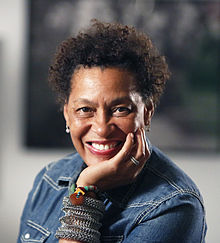
Last year, we honored pathbreaking contemporary artist Carrie Mae Weems with the Distinguished Feminist Award. We honored Sabina Ott, professor of Art and Art History at Columbia College Chicago, with the Distinguished Teaching of Art Award. We honored artist Carmen Herrera with the Distinguished Artist Award for Lifetime Achievement. The list of other awardees is equally impressive for their impact on the field of visual arts. There is still time to honor deserving colleagues for their contributions to our field in 2017. Who would you like to see recognized for their work?
Submit your nominees for the Awards for Distinction before August 31, 2016!
Nomination Guidelines for the 2017 Annual Conference.
Recipients of the 2016 Awards for Distinction.
For more information about the nomination process, contact Katie Apsey, CAA manager of programs, 212-392-4405.
New in caa.reviews
posted by CAA — August 26, 2016
Claudia Hucke reads Timed Out: Art and the Transnational Caribbean by Leon Wainwright, a “demanding read” and rare piece of theoretical literature on Caribbean art. Focusing on the Anglophone Caribbean, especially Trinidad and Guyana, the book “provides a good balance between theory and insightful analyses of artworks and artists’ biographies.” Read the full review at caa.reviews.
Beatriz E. Balanta reviews Kristine Juncker’s Afro-Cuban Religious Arts: Popular Expressions of Cultural Inheritance in Espiritismo and Santería. The volume “combines the study of material culture with the methodological tools of anthropology to trace the history of Afro-Cuban religious arts,” with a concentration on the artworks of four prominent female religious leaders. Read the full review at caa.reviews.
Shawn Digney-Peer examines Historical Perspectives on Preventive Conservation, the sixth installment in the Getty Conservation Institute’s Reading in Conservation series. Comprised of sixty-six entries divided into nine themes, “the intent of the volume is to provide a context for what is meant by ‘preventive conservation’ and to illustrate how thinking and practices have evolved.” Read the full review at caa.reviews.
Patricia Johnston takes a look at Wendy Bellion’s Citizen Spectator: Art, Illusion, and Visual Perception in Early National America. The author, focused on “Federal-period American visual culture,” demonstrates “how active looking reflected political ideologies and encouraged the emergence of community and national identities in the decades following the Revolution.” Read the full review at caa.reviews.
Caa.reviews publishes over 150 reviews each year. Founded in 1998, the site publishes timely scholarly and critical reviews of studies and projects in all areas and periods of art history, visual studies, and the fine arts, providing peer review for the disciplines served by the College Art Association. Publications and projects reviewed include books, articles, exhibitions, conferences, digital scholarship, and other works as appropriate. Read more reviews at caa.reviews.
News from the Art and Academic Worlds
posted by Christopher Howard — August 24, 2016
Each week CAA News summarizes eight articles, published around the web, that CAA members may find interesting and useful in their professional and creative lives.
Defining the Relationship
Dear Students: I think it’s time we had the talk. You know, the one couples who have been together for a while sometimes have to review boundaries and expectations? Your generation calls this DTR—short for “defining the relationship.” (Read more from the Chronicle of Higher Education.)
What Went Wrong with the Macon Social Practice Residency?
It should have been a dream-come-true artist residency and a template for responsible and holistic community redevelopment. But an apparent breakdown in communication and trust between the Macon Arts Alliance and the artists Ed Woodham and Samantha Hill led to the artists being terminated from their contracts on July 26, just a few weeks into their three- and four-month residencies. (Read more from Burnaway.)
Art World Wants US to Better Protect Artifacts in Iraq and Syria
Art-market experts want the Defense Department to get more involved in preventing the destruction and looting of cultural artifacts in Iraq and Syria, according to a Government Accountability Office report. The recommendation was one of seven suggestions experts gave for ways the United States can better protect artifacts from the Islamic State and other groups. (Read more from the Hill.)
Understanding the Techniques of Pouring Acrylics
While the practice of pouring is certainly not a new way to apply paint, achieving consistent results can be frustrating and costly. Therefore it is vital to the process to conduct experiments to gain the knowledge of what are the most critical controlling factors that preside over paint pours. (Read more from Just Paint.)
In Search of the Lost Empire of the Maya
The ancient city of Holmul isn’t much to look at. To the casual observer it’s just a series of steep, forested hills in the middle of the jungle in northern Guatemala, near the Mexican border. The jungle here in the Petén Basin is thick and warm but drier than you might expect. And silent, except for the drum of cicadas and the occasional calls of howler monkeys. (Read more from National Geographic.)
Seven Vanishing Technologies Making a Comeback through Art
The scope of digital technology has made many things obsolete, from traditional black-and-white film to the homemade cassette mixtape, but it also prevents them from ever disappearing completely. Enthusiasts can congregate online, exploring, preserving, and sharing information on dwindling technologies before they’re ever truly lost. (Read more from Artsy.)
Are Replicas Changing the Way We Experience Art?
Digital reproductions do not have to be copies of existing works. Recently, the Next Rembrandt project saw scientists develop a brand-new painting, complete with an original subject and composition, digitally designed and printed to look like a lost work by Rembrandt. Aesthetically, when viewed on a computer or television screen, it convinces. (Read more from Zócalo Public Square.)
Toward an Art History for Video Games
If video games possess an “official history,” it is predicated primarily on the advancement of technology, the shifting of markets, and the consolidation of multinational corporations. This history prioritizes technological advancement, from computer gaming’s rise as the product of quiet dissent among the engineers of military computers at MIT to the clinking of arcade machines and the ensuing success of the home console. (Read more from Rhizome.)
Exhibitor and Advertiser Prospectus for 2017
posted by CAA — August 22, 2016
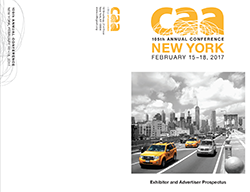 The Exhibitor and Advertiser Prospectus for the 2017 Annual Conference in New York is now available for download. Featuring essential details for participation in the Book and Trade Fair, the booklet also contains options for sponsorship opportunities and advertisements in the Conference Program and on the conference website. Printed copies of the prospectus will be available at the end of August.
The Exhibitor and Advertiser Prospectus will help you to reach a core audience of artists, art historians, educators, students, and administrators, who will converge in New York for CAA’s 105th Annual Conference, taking place February 15–18, 2017. With three days of exhibit time, the Book and Trade Fair will be centrally located in the New York Hilton Midtown. CAA offers several options for booths and tables that can help you to connect with conference attendees in person. The priority deadline for Book and Trade Fair applications is Monday, October 31, 2016; the final deadline for all applications and full payments is Friday, December 9, 2016.
In addition, sponsorship packages will allow you to maintain a high profile throughout the conference. Companies, organizations, and publishers may choose one of four visibility packages, sponsor specific areas and events, or work with CAA staff to design a custom package. Advertising possibilities include the Conference Program, distributed to over four thousand registrants and press contacts in the conference tote bag, and the conference website, seen by tens of thousands more. The deadline for sponsorships and advertisements in the Conference Program is Monday, December 5, 2016; web ads are taken on a rolling basis.
Questions about the 2017 Book and Trade Fair? Please contact Paul Skiff, CAA assistant director for Annual Conference, at 212-392-4412. For sponsorship and advertising queries, speak to Anna Cline, CAA development and marketing assistant, at 212-392-4426.
New in caa.reviews
posted by CAA — August 19, 2016
Francesco Ceccarelli visits Jefferson e Palladio: Come construire un mondo nuovo at the Palladio Museum in Vicenza, Italy. The exhibition is dedicated to Thomas Jefferson, one of Andrea Palladio’s “greatest American disciples,” and demonstrates “how both men prefigured a new world through their novel conceptions of the built environment and its symbols.” Read the full review at caa.reviews.
Jo Farb Hernández reviews Horace Pippin: The Way I See It, the catalogue published “in conjunction with the first exhibition project in over twenty years to provide an in-depth examination of the work of the painter Horace Pippin” at the Brandywine River Museum of Art. The six contributing authors “focus their texts to contrast with the platitudes that have defined Pippin’s work” since the late 1930s. Read the full review at caa.reviews.
Linda Rodriguez reads Urban Space as Heritage in Late Colonial Cuba: Classicism and Dissonance on the Plaza de Armas of Havana, 1754–1828 by Paul Barrett Niell. Featuring a “heritage approach,” it is “one of the few books that analyzes the art and architectural history of the Cuban colonial period in depth, while placing it in useful dialogue with works produced in other areas of the Spanish viceroyalties.” Read the full review at caa.reviews.
Caa.reviews publishes over 150 reviews each year. Founded in 1998, the site publishes timely scholarly and critical reviews of studies and projects in all areas and periods of art history, visual studies, and the fine arts, providing peer review for the disciplines served by the College Art Association. Publications and projects reviewed include books, articles, exhibitions, conferences, digital scholarship, and other works as appropriate. Read more reviews at caa.reviews.
CAA Seeks Membership Specialist
posted by CAA — August 18, 2016
CAA seeks a Membership Specialist to support membership growth at the organization.
Approximately 10 to 20 hours per week – flexible hours with some nights and weekend hours available. $16 per hour – September through December 2016
Founded in 1911, the College Art Association (CAA) is the preeminent international leadership organization in the visual arts, promoting the field through intellectual engagement, advocacy, and a commitment to the diversity of practices and practitioners. Each year, CAA offers an Annual Conference, publishes three scholarly journals, and offers a variety of other programs. Visit www.collegeart.org for a complete description of programs and offerings.
CAA has more than 9,000 members worldwide. The majority of members are curators, art historians, scholars, visual artists, and designers. Each year, members renew their membership to CAA. The Membership Specialist will reach out to CAA members whose membership has lapsed and seek to renew that individual’s membership. Selected applicant(s) will receive a one-year complimentary CAA student membership.
Responsibilities include:
- Understanding the core mission, purpose, and programs offered by CAA
- Understanding the various membership levels offered by CAA
- Understanding the benefits assigned to membership levels offered by CAA
- Telephoning members and requesting they renew their annual memberships
- Recording meaningful feedback (both positive and negative) about CAA
- Imparting current information about CAA and its Annual Conference to the individuals called
- Updating objective information (i.e., address, phone, email, etc.) in CAA’s database about the individual
- Processing the payment for renewal of the individual’s membership
- Transmitting information to supervisors with feedback from Members about CAA
Required Qualifications:
- Minimum of two years of college, preferably in the visual arts, art history, or related fields
- Ability to speak in a pleasant professional manner over the phone
- Ability to type with speed and accuracy
- Sufficient computer knowledge (PC) to allow for the successful processing of membership renewals
- Ability to work independently and in collaboration with others
- Ability to convey to the individuals the value of renewing Membership with CAA
- Flexibility, creativity, and initiative
The College Art Association is an equal opportunity employer and considers all candidates for employment regardless of race, color, sex, age, national origin, creed, disability, marital status, sexual orientation, gender expression, or political affiliation.
Application Instructions / Public Contact Information
Interested individuals should submit a cover letter and resume to Denise Williams via email at jobs@collegeart.org. Applications will be accepted until all positions are filled. Please include the names and contact information for three references who can speak to your ability to perform the tasks requested.
News from the Art and Academic Worlds
posted by Christopher Howard — August 17, 2016
Each week CAA News summarizes eight articles, published around the web, that CAA members may find interesting and useful in their professional and creative lives.
Rhizome Releases First Public Version of Webrecorder
Current digital preservation solutions involve complex, automated processes that were designed for a web made from relatively static documents. Webrecorder, in contrast, can capture social media and other dynamic content, such as embedded video and complex JavaScript, while putting the user at the center of the archiving process. (Read more from Rhizome.)
Does Technological Analysis Destroy the Romance of Art History?
In 2012, a linguist at the University of Southern California decoded a famous medieval manuscript written in a cypher with software designed to translate remote languages and based on algorithms that matched the frequency of unknown sounds with the frequency of word-use in known tongues. Meanwhile, archaeologists use satellite photographs to identify unexcavated sites in Egypt and map terrorist looting in the Middle East. (Read more from Aeon.)
Black Art Incubator Aims to Invert Art-World Normal
The Black Art Incubator takes blackness—and everything this racial identifier suggests about what a person might know or feel—as a given. The project isn’t so much oppositional as an inversion of what we tend to expect. “Most art institutions are rooted in whiteness, but it’s implied, it’s this normalized thing,” Kim Drew says. With the project, “we’re normalizing being rooted in blackness without beating people over the head with it.” (Read more from the Village Voice.)
What Artists Need to Understand about Privacy
Artists regularly include identifiable figures in their work, and calling this work “art” won’t always suffice to keep them out of trouble. Artists aren’t being hauled into court every time they include a recognizable face in their work, but the growing sense that one’s likeness is a “property” that can be commercially exploited has led many artists to feel less secure in pursuing realistic figurative images. (Read more from the Huffington Post.)
Five Strategies Successful Artists Follow to Thrive in Their Careers
As a gallery owner, I’ve been particularly interested in watching the careers of artists who have built strong sales of their work. These artists are able to generate sales that allow them to devote all of their time to their art. They have found ways to make a successful living while at the same time pursuing their passion. (Read more from Red Dot Blog.)
The Unintended Consequences of Seeking Tenure
Originally established to protect scholars from reprisals for advancing new ideas in research or in the classroom, tenure now comes under regular fire for limiting how quickly institutions can respond to change in the short term and for tying up budgets in the long term. Another important yet unintended consequence receives comparatively little discussion: the limitations that the pursuit of tenure has on the contributions assistant professors can make to their own institutions. (Read more from Vitae.)
Stress and Student Success
I’ve spent a decade teaching college success strategies to mostly nontraditional first-year students. At times I would stare at my course roster, hoping that an answer to the success riddle would appear. “Why do you leave?” I’d ask. “What else can I do to help you?” While I use countless teaching strategies in my courses, I’ve been tracking something more fundamental: a unified field theory for student success in higher education. (Read more from Inside Higher Ed.)
Hands Off My Smiley Face: Emoji Become Corporate Tools
Apple’s new emoji feature seems more likely to impede a different kind of skill: creating surprising, figurative, and subversive forms of individual expression from the digital ephemera that populate our devices. In a rush to harness the power of the web’s most evocative cultural units—emoji and their hyperactive cousins, GIFs—tech companies, corporate brands, and social-media stars could inadvertently risk flattening the creative world that’s sprung up around them. (Read more from the New York Times.)