
CAA News Today
2024 Art History Travel Fund Grantees Announced!
posted by CAA — April 29, 2024
The Art History Fund for Travel to Special Exhibitions is designed to grant instructors of qualifying art history classes the resources to attend special museum exhibitions both in the US and abroad. These grants cover travel, accommodation, and admission fees for selected classes up to $10,000. Congratulations to the 2024 grantees!
University of Mississippi
Instructor: Kris K. Belden-Adams
Course: Art Now (Art of the 21st Century)
Exhibition: Whitney Biennial 2024
Location: The Whitney Museum, New York City
Penn State University
Instructor: Lindsay S. Cook
Course: Theories and Practices of Conservation
Exhibition: Rediscovering the Sculptures from Notre-Dame and The Medieval Library of Notre Dame of Paris
Location: Musée de Cluny, Paris
Applications for the next round of grants will be accepted by CAA beginning in fall 2024. Questions about the program can be sent to Cali Buckley, Manager of Grants and Awards and Director of the CAA-Getty International Program.
CAA Advocacy Policy and Procedures
posted by CAA — April 22, 2024
As the preeminent international leadership organization in the visual arts, CAA has an important role to play in public discourse on matters related to visual arts scholarship and practice. The CAA Board of Directors, Executive Director, members, and staff contribute to public understanding of visual arts advocacy through our newsletter, ED letters, social media platforms, special events, and sessions/workshops at our Annual Conference.
When the Executive Director or the Advocacy Committee perceives good reason to publish a statement on behalf of CAA (which may involve requesting endorsements from affiliated member societies/organizations or signing on to advocacy statements drafted by those affiliates), the Advocacy Committee convenes to interrogate the issue. If this issue is deemed in service to CAA’s mission and a majority of Advocacy Committee members agree to act, a member of the committee or staff will draft an original statement depending on capacity. The Advocacy Committee may approve the statement, reject it, or request changes; responses are needed from all members as soon as possible and no later than two days after receipt. The Advocacy Committee and Executive Director will agree on any action to be taken in response to expressed concerns. Once the entire committee reviews and approves the final draft, the statement will go live on the CAA website and will be distributed across social media channels when appropriate. In the case of a sign on to another organization’s advocacy statement, the Executive Director will share the sign on opportunity with the Advocacy Committee, and they will discuss and vote to determine whether to proceed.
The Executive Director is authorized to issue statements on behalf of the organization without review by the Advocacy Committee on time-sensitive matters (see example). At these times, the ED will specify this an ED response, so as not to speak on behalf of the Advocacy Committee, Executive Committee, or Board of Directors without consent.
CAA cannot respond to every advocacy request brought forth by our members. Our goal remains maximum impact when advocating for the field. There are times when calls to advocacy from one constituency directly conflict with another. It is for this reason that it is imperative our Board of Directors, and by extension, our Advocacy Committee remain diverse in background, field, and perspective, to ensure decisions are made as objectively as possible on behalf of membership and the field; advocacy action must also be in direct alignment with our mission, and in accordance with our 501(c)(3) status.
CAA must concentrate its energy and prestige on matters related to the advancement and protection of visual arts and scholarship, including academic infrastructure and professional practice.
Because CAA is the umbrella organization for a diverse membership with varying needs and viewpoints, we cannot engage in party politics and cannot take a stand on issues that are not in direct alignment with our mission.
CAA SOCIAL MEDIA POLICY
The CAA Board, Executive Director, and staff agree that due to the limitations of the mode, comments made on social media about visual arts practice or scholarship by CAA staff are most effective when they are constructive and celebratory of the achievements of CAA and members of the CAA community. CAA staff and Board members may wish and indeed are encouraged to share information about CAA and its programs, including on social media.
CONTACT US
If you have an advocacy request, please contact info@collegeart.org with the subject line “Constituent Advocacy Request” and your concern will be escalated to the Advocacy Committee for immediate discussion.
Policy adopted by the CAA Board of Directors on February 18, 2024.
Call for Nominations: Jury Members for CAA Grants and Awards (2024–2027)
posted by CAA — April 03, 2024
CAA invites nominations and self-nominations for individuals with relevant expertise to serve on our juries for Awards for Distinction, Publication Grants, Travel Grants, and Fellowships. Jury service is one of the most impactful volunteer positions at CAA; help select our next awardees and grantees!
To apply, send an e-mail to Cali Buckley, CAA Manager of Grants and Awards & Director of CAA-Getty International Program, with the following:
- Statement of interest outlining qualifications and experience of nominee (150 words maximum)
- CV (two pages maximum)
Three-year terms begin in July. Current CAA Committee and Editorial Board members are not eligible to apply.
Deadline: June 1, 2024
CURRENT JURY OPENINGS
- Art Journal Award
- Charles Rufus Morey Book Award for Non-catalogue Books in the History of Art
- Arthur Kingsley Porter Prize for Art Bulletin articles
- The CAA/American Institute for Conservation Award for Distinction in Scholarship and Conservation
- Jury for the Artist Award for Distinguished Body of Work, Distinguished Artist Award for Lifetime Achievement, and Distinguished Teaching of Art Award
- Distinguished Feminist Awards for Scholars and Artists
- Millard Meiss Publication Fund for Books in Art History
- Wyeth Foundation for American Art Publication Grant
- Art History Fund for Travel to Special Exhibitions
- Professional Development Fellowship in Visual Art
- Michael Aurbach Fellowship for Excellence in Visual Art
Art Journal / AJO Editorial Board seeks new members!
posted by CAA — March 15, 2024
CAA invites nominations and self-nominations to fill two seats on the Art Journal / AJO Editorial Board for a four-year term: July 1, 2024–June 30, 2028. Candidates may be artists, art historians, art critics, art educators, curators, or other art professionals; institutional affiliation is not required. Art Journal, published quarterly by CAA, is devoted to twentieth- and twenty-first-century art and visual culture. AJO is an online forum for the visual arts that presents artists’ projects, conversations and interviews, scholarly essays, and other forms of original content. Committed to fostering new intellectual exchanges in the fields of modern and contemporary art, AJO prioritizes material that makes meaningful use of the web and publishes on a rolling basis.
The editorial board advises the Art Journal and AJO editors-in-chief and assists them in identifying authors, articles, artists’ projects, and other content for the journal; performs peer review and recommends peer reviewers; guides the journals’ editorial programs and may propose new initiatives for them; promotes and advocates for both journals; and may support fundraising efforts on their behalf. Members also assist the editors-in-chief to keep abreast of trends and issues in the field by attending and reporting on sessions at the CAA Annual Conference and other academic conferences, symposia, exhibitions, and events.
The Art Journal / AJO Editorial Board meets three times a year, with meetings in the spring and fall plus one at the CAA Annual Conference in February. The fall and spring meetings are currently held remotely. Members are expected to pay travel and lodging expenses to attend the conference in February. Members of all editorial boards volunteer their services to CAA without compensation.
Candidates must be current CAA members in good standing and should not be serving on the editorial board of a competitive journal or on another CAA editorial board or committee. Members may not publish their own work in the journals during the term of service. CAA encourages applications from colleagues who will contribute to the diversity of perspectives on the Art Journal / AJO Editorial Board and who will engage actively with conversations about the discipline’s engagements with differences of culture, religion, nationality, race, gender, sexuality, and access. Nominators should ascertain their nominee’s willingness to serve before submitting a name; self-nominations are also welcome. Please email a letter of interest and a CV as a single PDF to Eugenia Bell, Editorial Director.
Deadline: May 6
CWA Picks: Spring 2024
posted by CAA — March 13, 2024
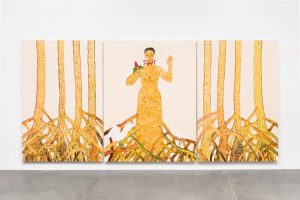
Rosana Paulino, Garça Branca from the Mangrove-Women series, 2023
The exhibitions, screenings, projects, and talks selected for CWA’s Spring Picks hint at the fleeting, ephemeral nature of memory and intimacy. The creatives highlighted here have left their mark, interpreting and imbuing their materials with meaning, often leaving behind evidence of their process.
UNITED STATES
Christina Fernandez: Multiple Exposures
Through April 28
Art on Hulfish Gallery, Princeton, NJ
Princeton University Art Museum’s Art on Hulfish presents a survey of work by Christina Fernandez, a Los Angeles–based artist who has spent more than thirty years conducting a rich exploration of migration, labor, gender, and her Mexican American identity through photography. Whether staged or candid, Fernandez’s photographs record touch and mark making, engaging the medium’s distinct ability to convey surfaces—the surfaces of bodies, architecture, and the images themselves. Multiple Exposures traces the development of the artist’s work from the late 1980s to now.
April 4–August 4
MIT List Visual Arts Center, Cambridge, MA
Since 2015, the Zagreb-born Miletić has worked almost exclusively with hand-produced textiles across several ongoing series.
Her Materials series is comprised of works hand woven on a 1970s loom. As an extension of her formal training as a photographer, their idiosyncratic shapes and color-schemes are based on Miletić’s snapshots of temporary repairs to buildings and objects in urban public spaces. Though never exhibited, her photographs of responsive, ad-hoc constructions become templates for seemingly abstract textile pieces. Her meticulous and time-consuming use of hand work to document the ephemeral repairs reproduces this ethos of care and provides a slowness and material intimacy that Miletić found lacking in photography. Across her various series, Miletić also calls attention to the gendered associations of textile craft, subtly relating forms of historically undervalued labor, like the “women’s work” of weaving, to other narratives of social and economic struggle and the larger political forces that give shape to them.
Through June 15
Nora Eccles Harrison Museum of Art, Utah State University, Logan
Jane Catlin’s career as an artist and teacher has lasted more than forty years. During that time she has produced figural paintings to semi-abstract images of biological forms and processes. Throughout her career, Catlin’s style and content have shifted due to the profound influence of her travels through Japan, Korea, Africa, and Canada. This overview reveals her fascination with biology, ecology, and the environment. The mysterious imagery that results from her visual meditations evokes our mutating world and serves as a reminder of both the beauty and fragility of nature. This exhibition offers a unique opportunity to see some of her most significant works presented together for the first time.
Joan Jonas: Good Night, Good Morning
March 17–July 6
Museum of Modern Art, New York
Joan Jonas creates meditations on bodies, space, time, and nature. As she has explained, “The performer sees herself as a medium: information passes through.” The most comprehensive retrospective of Jonas’s work in the United States, this exhibition provides new insights into the artist’s process, unprecedented access to archival materials, and fresh historical perspectives on Jonas’s work. Drawings, photographs, notebooks, oral histories, film screenings, performances, and a selection of the artist’s installations, drawn from MoMA’s collection and institutions around the world, will trace the development of Jonas’s career, from works made in the 1960s and 1970s exploring the confluence of technology and ritual to more recent ones dealing with ecology and the landscape.
Joyce J. Scott: Walk a Mile in My Dreams
March 24–July 14
Baltimore Museum of Art
This fifty-year career retrospective celebrates one of the most significant artists of our time. Best known for her virtuosic use of beads and glass, Scott’s work across varying media beguiles viewers with beauty and humor while confronting racism, sexism, ecological devastation, and complex family dynamics. The exhibition includes more than 120 objects ranging from woven tapestries and soft sculpture from the 1970s and audacious performances and wearable art in the 1980s to sculptures of astonishing formal ingenuity and social force from the late 1970s to the present moment.
On April 11, 6:30–8:30 p.m. Joyce J. Scott will appear with longtime collaborator Kay Lawal-Muhammad, in a conversation moderated by Tracey Beale, BMA Director of Public Programs.
May 3–August 11
The Power Plant, Toronto
June Clark: Witness is the first survey in Canada of the Toronto-based artist June Clark, who, since the late 1960s, has developed a unique and groundbreaking practice spanning photo-based work, text, collage, installation, and sculptural assemblages. In this deeply personal exhibition, she explores how history, memory, and identity—both individual and collective—have established the familial and artistic lineages that shape her work.
Witness brings together four significant bodies of work that stretch from the 1990s to the present, many of them seen here for the first time. These include her iconic installations Family Secrets (1992) and Harlem Quilt (1997); a series of photo-based works from 2004 titled 42 Thursdays in Paris; Perseverance Suite (a new project); and Homage, a collection of sculptural assemblages that, in Clark’s words, “gave me permission to be the artist I am today.”
June Clark: Witness will be presented in tandem with another solo exhibition of the artist’s work at the Art Gallery of Ontario titled June Clark: Unrequited Love.
Thorugh July 21
Harvard University Art Museums, Cambridge, MA
LaToya M. Hobbs: It’s Time presents the series Carving Out Time (2020–21), a life-size suite of woodcuts by the Arkansas-born, Baltimore-based artist. Unfolding over five scenes, the work depicts a day in Hobbs’s life with her husband and children. Hobbs shares the labor and intimacy of her private life in these prints, centering the negotiations she brokers daily to balance her manifold responsibilities—as a wife, mother, educator, and artist. The series is also a powerful statement about her influences and self-fashioning as an artist: references to paintings, sculptures, and prints by prominent artists such as Elizabeth Catlett, Alma Thomas, Valerie Maynard, and Kerry James Marshall appear throughout. Carving Out Time is a part of Hobbs’s ongoing Salt of the Earth project, which she characterizes as “the personification of Black women as salt in relation to their role as preservers of family, culture and community.”
Lauren Lee McCarthy: Bodily Autonomy
Through May 25
Mandeville Art Gallery, University of California San Diego, La Jolla
Bodily Autonomy is Lauren Lee McCarthy’s largest US solo exhibition to date. For the past fifteen years, McCarthy has worked in performance, video, installation, software, artificial intelligence, and other media to address how an algorithmically determined world impacts human relationships and social life. The show brings together two major series of works—Surrogate and Saliva—to examine the current state of bio-surveillance in times of rapid technological development and increased corporate and government surveillance.
Loie Hollowell: Dilation Stage
Through April 20
Pace Gallery, New York
Hollowell will present ten new pastel drawings that document the dilation stage of labor. Displayed sequentially on a rounded wall, these drawings feature depictions of Hollowell’s own pregnant abdomen, rendered to scale. Below each belly is a circle the exact size of the effaced cervix as it expands. The cervical “circles” at the bottom of each drawing seem to pulse as the series progresses, culminating in a blazing cadmium red.
In addition to these drawings, the exhibition will include a unique birthing bench that Hollowell created collaboratively with her husband, sculptor Brian Caverly. The birthing chair has been used by women in labor throughout millennia and the rendition here, which visitors are invited to sit on, is created not just for the birther, but also for the partner, midwife, doula, doctor, or any other witness to the transcendent journey of birth.
Dilation Stage will coincide with Hollowell’s first museum survey, on view at the Aldrich Contemporary Art Museum in Ridgefield, CT, through August 11.
Modern Art for an Old Tale: Fuku Akino’s Illustrations for “The Dwarf Pine Tree”
Through July 31
Zimmerli Art Museum, Rutgers University, New Brunswick, NJ
This exhibition presents more than twenty illustrations for The Dwarf Pine Tree by Fuku Akino (1908–2001), a Kyoto-based painter and teacher who was one of Japan’s most prominent woman artists during her lifetime. Published in 1963, The Dwarf Pine Tree is a modern retelling of a Japanese folk tale whose main character is a pine tree, an important symbol in Japanese culture representing love and endurance. The book is one of several collaborations between Akino, the author Betty Jean Lifton, and the editor Jean Karl, who promoted her vision to publish complex and culturally diverse stories for young American readers such as those written by Lifton, an American resident of Japan, and illustrated by Akino.
Through July 7
Brooklyn Museum, New York
“What does a Black person look like today in those places where Africans were once sold, a century and a half ago?” asks artist Nona Faustine (b. 1977). Using her own body, she interrogates this question in her photographic series White Shoes. Forty-two self-portraits show Faustine standing in sites across New York City, from Harlem to Wall Street to Prospect Park and beyond, that are built upon legacies of enslavement in New York—one of the last Northern states to abolish slavery. On her feet are a pair of sensible white pumps, which speak to the oppressions of colonialism and assimilation imposed on Black and Indigenous peoples locally, nationally, and globally. Otherwise nude, partially covered, or holding props, Faustine is at once vulnerable and commanding, standing in solidarity with ancestors whose bodies and memory form an archive in the land beneath her shoes. White Shoes is the artist’s first solo museum exhibition and the first complete installation of this consequential series.
April 11–September 22
Madison Square Park and Inwood Hill Park, New York
Seed explores the personal and collective experiences that have influenced artist Rose B. Simpson’s life and work with a series of new large-scale sculptures appearing in two major public parks in Manhattan. In Madison Square Park, Simpson assembles seven monumental androgynous sentinel figures fabricated in steel with bronze adornments around a central sculpture of a young female figure emerging from the earth. In addition, two life-size bronze sentinels stand watch in Inwood Hill Park, a contested space in Native American history as the site where Dutch colonial governor Peter Minuit “purchased” Manhattan Island from the Lenape in 1626. This marks Madison Square Park Conservancy’s first collaboration with another New York City public park.
Sarah Maldour: Tricontinental Cinema
Through April 28
Wexner Center for the Arts, Ohio State University, Columbus
Tricontinental Cinema explores Maldoror’s five-decade career as a maker of revolutionary cinema, tracing her involvement with Black liberation movements in France, Africa, and the Caribbean. Through an immersive, multisensory landscape of films, photographs, poetry, and letters, the exhibition invites you to experience the full scope of Maldoror’s radical practice.
A legendary filmmaker, Maldoror completed more than forty-five shorts, documentaries, and feature films before her death in 2020. Many of these works rewrite the rules of films focusing on resistance and rebellion, casting women as protagonists in movements dominated by men.
The exhibition includes several large-scale works by contemporary artists, including a monumental fiber sculpture by renowned Canadian artist Kapwani Kiwanga. It also features a newly commissioned mural, painted on-site, from Paris-based artist Maya Mihindou. Framing Maldoror’s films and archives, these works form a constellation of Black and Afro-Surrealist practices while amplifying the continued resonance of her work today.
Through August 18
Nasher Sculpture Center, Dallas
Always attuned to the built environment, Sze’s new site-specific installations across three gallery spaces integrate painting, sculpture, images, sound, and video with the surrounding architecture to create intimate systems that reference the rapidly changing world. This extraordinary new exhibition will blur the boundaries between making and showing, process and product, digital and material ultimately to question how objects acquire their meaning.
Northern California Women’s Caucus for Art: The 6000 Circle Project
Through April 6
Arc Project Gallery, San Francisco
In collaboration with The Calling (artists Yasmin Lambie-Simpson, Chantelle Goldthwaite, and Sheila Metcalf-Tobin) and the Northern California Women’s Caucus for Art (NCWCA) chapter of the Women’s Caucus for Art (WCA), anyone interested in participating in this international art initiative is welcome! The 6000 Circle Project focuses on the circle as a symbol of balance and unity, a never-ending container of feminine energy and light. The Calling envisions 6000 circles created by a multitude of artists from around the globe. The 6000 Circle Project opens with more than 300 circles on the walls at Arc. Through the course of the exhibition, the public will be invited to make circles to add to the walls.
March 15, 6 –9 p.m.
MIT Bartos Theater, Cambridge, MA
Renowned Inuit lawyer Aaju Peter has led a lifelong fight for the rights of her people. But while launching an effort to establish an Indigenous forum at the European Union, Aaju finds herself facing a difficult, personal journey to mend her own wounds after the unexpected passing of her son. In this “powerful exploration of cultural trauma” (The Film Stage), director Lin Alluna follows alongside Aaju Peter as she strives to reclaim her language and identity after a lifetime of whitewashing and forced assimilation.
The screening will be followed by a Q&A discussion. Free and open to the public. Doors open at 5:30 p.m.
Panel: Vision is a Battlefield: Histories of Race and Media
March 26, 6:30 p.m.
Segal Theatre Center, CUNY Graduate Center, New York
How is our basic perception of the world influenced by concepts of racial identity? Join moderator Claire Bishop, professor of art history at the CUNY Graduate Center, for an illuminating discussion with the authors of four recent books exploring the intertwined histories of photography, media, and race. The panel features Brooke Belisle, associate professor of art at Stony Brook University, speaking on computational imagery and AI; Emilie Boone, assistant professor of art history at New York University, on Harlem Renaissance photographer James Van Der Zee; Monica Huerta, assistant professor of English and American studies at Princeton University, on the aesthetics of racial capitalism; and Nicholas Mirzoeff, professor of media, culture, and communication at New York University, on the visual politics of whiteness.
April 18, 6:30 p.m.
Segal Theatre Center, CUNY Graduate Center, New York
Natalie Dykstra’s Chasing Beauty is the vivid and masterful biography of Isabella Stewart Gardner—creator of one of America’s most stunning museums and a true American original. A wealthy Boston socialite at the turn of the twentieth century, Gardner was misunderstood for her eccentric lifestyle, but found her niche as a patron and friend to artists, including John Singer Sargent, who painted her portrait. Dykstra illuminates how the museum and its holdings can be seen as a kind of memoir created with objects, displayed per Gardner’s wishes, including not only masterwork paintings but tapestries, rare books, prints, porcelains, and fine furniture. Dykstra speaks about the new book with Rachel Cohen, author of A Chance Meeting: Intertwined Lives of American Writers and Artists.
MEXICO
War and Peace: A Poetics of Gesture
Through June 30
Museo Universitario de Arte Contemporáneo, Mexico City
Beatriz González is one of the most renowned living Latin American painters and one of the key references of her country’s culture. War and Peace: A Poetics of Gesture is a new review of Beatriz González’s work. This is the first monographic exhibition of the painter’s work to be held in Mexico: it will offer both an overview of her work and an original investigation of her approach to the figure and gestures as a vehicle for emotional communication.
CANADA
un/tangling, un/covering, un/doing
Through March 17
Surrey Art Gallery, British Columbia
From the moment of birth, hair takes on multifaceted meanings. Rooted within storytelling by families and communities, the politics of hair have been both intimately personal and profoundly social.
Artists from across Canada—including Audie Murray, Becky Bair, Wally Dion, Clare Yow, Sharon Norwood, Sarindar Dhaliwal, Karin Jones, Baljit Singh, Kiranjot Kaur, and Natasha Kianipour—offer reflections on how hair embodies the importance of culture. In this exhibition, artists employ compelling storytelling that express connections intertwined with familial teachings and their own informed experiences.
SOUTH AMERICA
March 22–June 10
Fundación Malba Museo de Arte Latinoamericano de Buenos Aires
This is the first comprehensive exhibition to be held outside Brazil of the work of Rosana Paulino (b. 1967). It includes works made between 1994 and 2024, and approaches her oeuvre from the concept of “Amefricana” as proposed by the Brazilian philosopher Lélia Gonzáles.
Paulino’s poetic interventions reinscribe the archives of the African diaspora in South America. They do so through constant dialogue between personal and historical archives, reconceptualizations of Brazilian art, interrogations of the matrixes of Western science, and through an approach to the circumstances of black women in Brazilian and Latin American societies. The exhibition includes five large installations, displayed together with drawings, engravings, and video organized into four conceptual hubs that are not separate zones, but rather axes of meaning that run through almost all of Paulino’s works.
ASIA
Jorinde Voigt and Xiyadie: 2.0
Through May 4
Gallery P21, Seoul
In 2.0 paper transcends its two-dimensional origins to become a silent narrator telling tales of delicacy, rebellion, and existence. The title of the show is tri-fold: the exhibition is the first in the gallery’s new “2.0” space; the show comprises the work of two artists; and the binary symbolism behind the numbers: 2, which represents existence and material, and 0, which represents absence or the subconscious. The overlap of these artists’ practices is predominantly material, but presenting them alongside one another brings out conceptual overlap, allowing alternate readings of each artist’s works. For both artists the fragility of each cut or fold becomes a poetic marker of time, capturing moments in the evolution of the artwork. Both artists, through their engagement with paper, participate in a form of archiving, be it of cultural narratives or conceptual explorations.
EUROPE & UK
May 17–August 11
Kunsthalle Basel
For her first institutional exhibition in Switzerland, the Swedish artist Ghislaine Leung (b. 1980) presents a new, site-specific project. Leung’s artistic practice is characterized by a rigorous, conceptual approach that often traces physical and economic circuits as much as institutional and societal mechanisms. The result are artworks—which she considers “events”—that emerge from her interest in the various structures underlying commodities, sites, and human relations.
Leung’s work is also on view in the Turner Prize 2023 Shortlist Exhibition at Towner Eastbourne, UK, and in a solo show at the Renaissance Society, Chicago, both through April 14.
March 20–June 9
Städel Museum, Frankfurt
Käthe Kollwitz (1867–1945) chose prints and drawings as her essential media, finding in them an independent visual language of great immediacy. This exhibition presents more than 110 works on paper, sculptures, and early paintings by the artist from the collection as well as from leading museums and Kollwitz collections. Surprising, unconventional works and selected sculptures will be presented together with loans from around Germany to highlight her independent pictorial language that was distinguished by an incisive immediacy to respond to the essential questions of humanity and address troubling topics.
A major Kollwitz retrospective exhibition will be on view at the Museum of Modern Art, March 31 – July 20.
Shahzia Sikander: Collective Behavior
April 20–October 20
Venice Biennale
Shahzia Sikander: Collective Behavior is the most comprehensive presentation of the artist’s work to date, bringing together more than thirty works made over the past thirty-five years, including new site-specific drawings and glasswork created for this exhibition.
Collective Behavior traces Sikander’s ever-evolving explorations of gender, race, and colonial histories. The exhibition includes her breakthrough work The Scroll (1989–90), which established her position at the vanguard of the neo-miniature movement. Collective Behavior also debuts new works by Sikander that respond to the architecture and history of the Palazzo Soranzo Van Axel, the city of Venice, and global histories of trade and artistic exchange.
Vanessa Bell: A Pioneer of Modern Art
May 15–October 6
The Courtauld Project Space, London
Vanessa Bell (1879–1961) was one of the leading artists associated with the Bloomsbury Group, the avant-garde assembly of artists, writers, and philosophers who pioneered literary and artistic modernism in Britain at the beginning of the twentieth century. This focused display will be the first devoted to the Courtauld’s significant collection of Bell’s work. It will include paintings such as her masterpiece A Conversation, as well as the bold, abstract textile designs she produced for the Omega Workshops, led by influential artist and critic Roger Fry in London, which aimed to abolish the boundaries between the fine and decorative arts and bring the arts into everyday life. The exhibition will highlight one of the most cutting-edge artists working in Britain in the early twentieth century.
MIDDLE EAST & NORTH AFRICA
Ana Mzzei: How to Disappear
Through April 20
Green Art Gallery, Dubai
How to Disappear marks the conclusion of Ana Mazzei’s ongoing project Love Scene Crime Scene, a three-part exhibition series centered around the fictional disappearance of a ballerina. In this latest installment presented by Green Art Gallery in Dubai, the Brazilian artist deepens the enigma by introducing a collection of bronze sculptures and oil paintings that leave the spectator wanting to play the role of investigator. Her sculptures, featuring half human, half animal creatures placed on raw concrete plinths, take center stage against an entire wall displaying approximately fifty paintings. The selection of paintings is divided into six themes: stage, vases, landscape, cages, beings, and the joker. Together, they form a vocabulary or alphabet of symbols put together in an attempt to illustrate how to disappear, if we ever wanted to.
Through December 6
Gulf Photo Plus Gallery, Dubai
Lara Chahine and Reem Falaknaz subvert a common documentary landscape in Swallow This! with works in photography and digital media. The exhibition explores the rampant pathologization of women’s bodies, where the politically absurd, visually surreal, and humorous converge. Drawing on the uncanny collective experience of womanhood, Chahine and Falaknaz veer into a kind of performance art, becoming the subjects of their own work at times.
Swallow This! weaves narratives where the clinical or scientific, the grotesque or bodily, the divine or occult coexist as contemporary reflections on a post-internet, Arab feminism. Both photographers seek to unpack “erotic capital,” where the strange is made familiar, and the familiar, strange.
OCEANIA
Through April 20
Michael Lett Gallery, Auckland
Material, action, trace. In myriad ways and with a diverse body of tools, Judy Millar applies and removes paint in order to explore embodied acts of making and how these enact particular forms of consciousness. With a palette made up of unexpected combinations of color, Millar often plays with the tension between background and foreground. Millar’s works are often large-scale, dwarfing those who encounter them, acting as a reminder that people belong to gestures and that painting can be a shift away from the self.
Call for Editor-in-Chief, The Art Bulletin
posted by CAA — March 11, 2024
The Art Bulletin Editorial Board invites nominations and self-nominations for the position of editor-in-chief for a three-year term—July 1, 2025–June 30, 2028—with service as incoming editor designate from July 1, 2024–June 30, 2025, and as past editor from July 1, 2028–June 30, 2029.
The candidate should have published substantially in the field and may be an academic, museum-based, or independent scholar; institutional affiliation is not required. The Art Bulletin features leading scholarship in the English language in all aspects of art history as practiced in the academy, museums, and other institutions. From its founding in 1913, the quarterly journal has published, through rigorous peer review, scholarly articles and critical reviews of the highest quality in all areas and periods of the history of art.
Working with the editorial board, the editor-in-chief is responsible for the content and character of the journal. Each issue has approximately 150 editorial pages, not including book and exhibition reviews, which are the responsibility of a reviews editor. The editor-in-chief reads all submitted manuscripts, refers them to appropriate expert referees for peer review, provides guidance to authors concerning the form and content of submissions, and makes final decisions regarding acceptance or rejection of articles for publication. The editor-in-chief also works closely with the CAA staff in New York, where production for The Art Bulletin is organized. This is a half-time position. CAA provides financial compensation to the editor’s institution, usually in the form of course release or the equivalent, for three years. The editor is not compensated directly. The term includes membership on the Art Bulletin Editorial Board.
The editor-in-chief attends the Art Bulletin Editorial Board’s three meetings each year and submits an annual report to the CAA Board of Directors.
Candidates must be current CAA members and should not be serving on the editorial board of a competitive journal or on another CAA editorial board or committee. The Art Bulletin also encourages nominations from two-person editorial teams representing divergent and/or complementary fields and approaches. Editors may not publish their own work in the journal during the term of service. Candidates should have a willingness to explore webinars and podcasts, and conduct other outreach activities.
Nominators should ascertain their nominee’s willingness to serve before submitting a name; self-nominations are also welcome. Interested applicants—both self-nominated or nominated by someone else—should submit a CV and a cover letter in one PDF document to Eugenia Bell, Editorial Director.
Deadline: Monday, May 6.
The Art Bulletin Seeks An Editorial Board Member
posted by CAA — March 11, 2024
CAA invites nominations and self-nominations for one (1) individual to serve on The Art Bulletin Editorial Board for a four-year term, July 1, 2024–June 30, 2028. The ideal candidate has published substantially in the field and may be an academic, museum-based, or independent scholar; institutional affiliation is not required. The Art Bulletin features leading scholarship in the English language in all aspects of art history as practiced in the academy, museums, and other institutions.
The editorial board advises The Art Bulletin Editor-in-Chief and assists by seeking authors, articles, and other content for the journal; performs peer review and recommends peer reviewers; may propose new initiatives for the journal; and may support fundraising efforts on the journal’s behalf. Members also assist the editor-in-chief to keep abreast of trends and issues in the field by attending and reporting on sessions at the CAA Annual Conference and other academic conferences, symposia, and events in their fields.
The Art Bulletin Editorial Board meets three times a year, with meetings in the spring and fall (remote) plus one at the CAA Annual Conference in February (board members pay travel and lodging expenses to attend the conference in February. Members of all editorial boards volunteer their services to CAA.)
Candidates must be current CAA members in good standing and should not be serving on the editorial board of a competitive journal. Members may not publish their own work in the journal during the term of service. CAA encourages applications from colleagues who will contribute to the diversity of perspectives on The Art Bulletin Editorial Board and who will engage actively with conversations about the discipline’s engagements with differences of culture, religion, nationality, race, gender, sexuality, and access. Nominators should ascertain their nominee’s willingness to serve before submitting a name; self-nominations are also welcome. Interested applicants—both self-nominated or nominated by someone else—should submit a CV and a cover letter as a single PDF document by Monday, May 6 to Eugenia Bell, Editorial Director.
Congratulations to the 2024 Distinguished Awardees!
posted by CAA — March 04, 2024
Each year at the Annual Conference CAA honors outstanding achievements in visual arts and art scholarship during Convocation by announcing the annual Awards for Distinction recipients. Congratulations to this year’s awardees!
Distinguished Award for Lifetime Achievement in Writing on Art
Distinguished Artist Award for Lifetime Achievement
Carrie Mae Weems and Suzy Lake
Art Journal Award
Ken Gonzales-Day, “Race, Whiteness, and Absence in Studio Practice,” Art Journal, Fall 2023
Alfred H. Barr Jr. Award
Oswaldo Chinchilla Mazariegos, James A. Doyle, and Joanne Pillsbury, eds., Lives of the Gods: Divinity in Maya Art, Metropolitan Museum of Art, 2022
Alfred H. Barr Jr. Award for Smaller Museums, Libraries, Collections, and Exhibitions
Perrin Lathrop, ed., African Modernism in America, Yale University Press and the American Federation of Arts, 2022
Frank Jewitt Mather Award
Kobena Mercer, Alain Locke and the Visual Arts, Yale University Press, 2022
Frank Jewitt Mather Honorable Mention
Andrea Giunta, The Political Body: Stories on Art, Feminism, and Emancipation in Latin America, trans. Jane Brodie, University of California Press, 2023
Charles Rufus Morey Book Award
Matthew Francis Rarey, Insignificant Things: Amulets and the Art of Survival in the Early Black Atlantic, Duke University Press, 2023
Arthur Kingsley Porter Prize
Daniel M. Zolli, “Making Up Materials: Donatello and the Cosmetic Act” The Art Bulletin, 105.4, 2023: 36–63.
CAA/AIC Award for Distinction in Scholarship and Conservation
Han Neevel and Birgit Reissland
Artist Award for a Distinguished Body of Work
Distinguished Teaching Award (Art)
Distinguished Teaching Award (Art History)
Monica Juneja
Distinguished Feminist Award (Art)
Distinguished Feminist Award (Art History)
Excellence in Diversity Award
Isabella Stewart Gardner Museum
Michael Aurbach Fellow Announced!
posted by CAA — March 04, 2024
Congratulations to this year’s recipient of the Michael Aurbach Fellowship for Excellence in Visual Art, Sara Torgison!
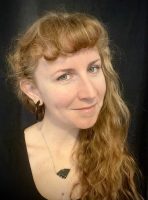
Sara Torgison is an interdisciplinary artist working in ceramic, fiber, and found materials. Her work builds into and extends finite and fragile surfaces to emphasize and inhabit marginal spaces. Strange alliances formed in passages between hard and soft substances are resonant of the shifts inherent in navigating public and private life and the distance between self and other. The action of configuring bridges in transitional zones draws upon traditions of mending and maintenance as a continuous collaborative process.
Sara received an MFA from the University of Cincinnati Department of Design, Architecture, Art and Planning, and a BFA from the California Polytechnic University, Humboldt. Sara is currently Visiting Ceramics Faculty at Miami University of Ohio, and works as a preparator at the Contemporary Arts Center in Cincinnati. She has participated in various artist residencies and workshops, including Penland School of Craft’s winter residency for which she was awarded a distinguished fellowship in 2024. Sara was a 2023 Ohio Arts Council Creative Excellence Grant recipient. Her work is widely exhibited and collected throughout the United States.
HONORABLE MENTIONS
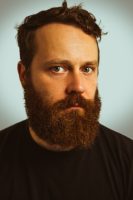
Alex Lukas was born in Boston, MA. With a wide range of influences, Lukas’s practice is focused on the intersections of place and human activity, narrative, history, and invention. His fieldwork, research, and production reframes the monumental and the incidental through intricate publication series, sculptures, drawings, prints, videos, and audio collages. Lukas’s work has been exhibited nationally and internationally, and is included in the collections of the Pennsylvania Academy of the Fine Arts, the Kadist Foundation, the Philadelphia Museum of Art, the San Francisco Museum of Art library, the New York Public Library, and the library of the Museum of Modern Art, New York. Lukas has been awarded residencies at the Bemis Center for the Arts, the Ucross Foundation, the Center for Land Use Interpretation, the Fountainhead, and the John Michael Kohler Arts Center’s Arts/Industry program, among others. He graduated with a BFA from the Rhode Island School of Design in 2003, and received an MFA from Carnegie Mellon University in 2018. Lukas is currently an Assistant Professor of Print and Publication in the Department of Art at the University of California, Santa Barbara, and organizer of CA53776V2.gallery, an experimental exhibition platform on the dashboard of a 2007 Ford Ranger.
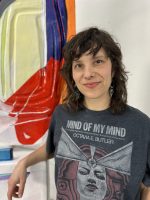
Kristy Hughes is a sculptor, painter, and educator. She received her MFA from Indiana University and her MA and BA from Eastern Illinois University. Hughes was awarded a 2022–23 Visual Arts Fellowship at the Fine Arts Work Center in Provincetown, MA, and has held residencies at the ChaNorth Artist Residency, Hambidge Center for Creative Arts and Sciences, Liquitex Residency at Residency Unlimited, the Studios at MASS MoCA, and a full fellowship at the Vermont Studio Center. Recent solo and group exhibitions include: the Sculpture Center in Cleveland, OH; Provincetown Art Association and Museum, Provincetown, MA; ChaShaMa, New York; Hudson D. Walker Gallery, Provincetown, MA; Soft Times Gallery, San Francisco, CA; Wassaic Project, Wassaic, NY, in addition to exhibitions at universities in North Carolina and South Carolina. Her work has been featured most recently in Maake magazine, New American Paintings, Friend of the Artist, Create magazine, and Vast magazine. Hughes is a full-time lecturer at the University of Vermont in Burlington, VT, where she teaches sculpture, painting, and drawing.
CAA Board President’s Open Letter to North American College and University Presidents
posted by CAA — February 09, 2024
On behalf of the College Art Association (CAA) and its Advocacy Committee, I write in support of an open letter from the Middle East Studies Association (MESA) written on December 18, 2023. As a partner learned society under the American Council of Learned Societies (ACLS), we urge you to uphold and protect academic and creative freedom on your campuses.
Since October 2023, we have seen a surge in threats to faculty, students, and college staff. The current Gaza-Israel conflict has generated widespread academic and scholastic debate; we call upon you during this difficult time to protect free speech and to defend academic freedom for all campus community members. We also urge you to refrain from censoring artist exhibitions in your campus galleries and museums.
CAA honors diversity and reflects an extraordinary range of cultures, perspectives, education, and experiences that make the advancement of art and design integral to our global constituencies and to culture at large.
CAA is committed to ensuring academic freedom and freedom of artistic expression and exhibition. We agree with MESA that “free speech is essential for any democratic polity, and this country’s institutions of higher education should be places in which even the most controversial and unpopular views can be expressed, debated and criticized. At the same time, all students deserve equal access to education, free from harassment and discrimination. Unfortunately, we are witnessing a dramatic increase in antisemitic, anti-Palestinian, anti-Arab and anti-Muslim harassment and discrimination on our campuses.”
As university leaders, you bear responsibility during charged political times to safeguard academic freedom, freedom of expression and artistic practice, as well as the physical welfare of all members of your community. We urge you to protect students, faculty, and staff and honor their right to freedom of speech without fear of intimidation, harassment, or retaliation.
Sincerely,
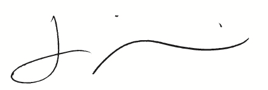
Jennifer Rissler, PhD
President, Board of Directors
CAA | Advancing Art and Design