CAA News Today
Robert Kaupelis: In Memoriam
posted by CAA — December 14, 2009
John Carey, an artist and art teacher, is the editorial cartoonist for Greater Media Newspapers in central New Jersey.
First there was Kimon Nicolaïdes’s Natural Way to Draw (1941), then there was Robert Beverly Hale’s Drawing Lessons from the Great Masters (1964). Then in 1966 came Robert Kaupelis’s Learning to Draw. It was a book smart enough and egalitarian enough to employ old and modern masters’ examples along with students’ work; the point was the dynamics of application, not only the procedures of attempting realism. I discovered that book in 1972 in my high school library in Richmond, Kentucky. The book offered me and my generation what we knew but didn’t quite trust yet—the processes of mark-making, be it gentle, violent, nuanced, or bold. We had seen those applications in artworks we admired—old and new—but we hadn’t had it broken down in a philosophy with lessons before. When I saw that the author of Learning to Draw taught at New York Univeristy I knew where I wanted to go to college. Three years later I was in Kaupelis’s classroom.
Describing a great teacher is a bit like explaining a great performance. There is context, delivery, insight, and presence; there is also something else: the mark left. That mark is often as elusive as an actor’s impact, but as in theater, there are now and then a few mentors that remain definitive for us in their transformative and indelible effects. In this regard Kaupelis was a star. His energy and intelligence demanded attention, and in turn one realized that a reciprocity of that demand was expected in the presentation of one’s artwork and in the articulation of one’s efforts. It was also understood that respect came only from very hard, serious work. And it was great fun. “Change!” was something often heard in the art studio (along with Frank Sinatra, Ray Charles, and Beethoven LPs); Kaupelis would shout “Change!” to models he kept busy, finding one quick pose after another as our young tentative arms began to loosen up with quick contour and gesture drawings in our search for some beauty with our own mark-making. After a few of these energized classes a Kaupelis student never looked at art in the same way again. The lessons of Learning to Draw had met the energy of the man behind it. Change had happened.
Kaupelis, who died on June 12, 2009, began teaching at NYU in 1956. He was born in Amsterdam, New York, in 1928 and educated in Buffalo and at Columbia University. In 1975 he was the subject of a chapter in a Herbert Livesey book surveying higher education called The Professors, where he was cited as one of the nation’s outstanding art educators. In 1980 Kaupelis wrote his second Watson-Guptill drawing book, Experimental Drawing, which reinforced his exuberant amalgam of stressing the fundamentals of art along with encouraging innovative and, at times, refreshingly quirky approaches: fifty nonstop drawings in three hours, drawing from out-of-focus slides, drawing the model with eyes shut. This newer book was almost as significant as Learning to Draw because at the time it was published drawing had become a very undervalued curriculum in university programs; it was a time when drawing was considered by many as old-fashioned and nearly irrelevant.
As an artist Kaupelis emerged as the New York School rose to prominence, and when nonobjective American art found its place on the world stage. His own work reflected that influence in its vibrancy and spontaneity. He was, as the critic John Canaday wrote, a seductive colorist. Eventually geometry and sharp, taped edges also merged and interacted with the wetter, looser applications. While the paintings of Kaupelis represented some of his philosophies about aesthetics, I never felt they fully matched his ability to illuminate and celebrate the art of others—the art in galleries and museums and the work of his students. He wrote and spoke of art the way Martin Scorsese speaks of movies—with a compulsive, obsessive, comprehensive insight. He thought and taught art like a man intoxicated with the anticipation of romance—that ineffable state of mind where joy and passion merge with love.
Kaupelis asked a lot from his readers and students. His main demand was: “LOOK!”—look at this: at this sepia wash Constable landscape; this Sheeler charcoal still life; this De Kooning gouache; this pen-and-ink Manet portrait; this Rauschenberg collage; this Pontormo red-chalk figure dancing off the page with a gesture line of astonishing confidence, speed, and grace! Look at this form, this line, this shade, this figure, this edge, this space! Look at your assimilation of them all! How many future artists, curators, art historians, cartoonists, animators, illustrators and teachers were asked to LOOK by Kaupelis during his thirty years at NYU and in his two important drawing books, Learning to Draw and Experimental Drawing? Thousands.
Kaupelis said drawing was anything intended as art which left a mark. He left his.
Michael Kabotie: In Memoriam
posted by CAA — November 23, 2009
Zena Pearlstone is emeritus professor of art history at California State University, Fullerton.

Michael Kabotie with his work at the Del Rio Gallery in Flagstaff, Arizona
Michael Kabotie (Lomawywesa), a Hopi painter, jeweler, poet, and printmaker, died in Flagstaff, Arizona, on October 23, 2009, of complications from H1N1 influenza. He was 67.
Kabotie is known among Hopi artists as one who commanded several media and constantly pushed his iconographic and technical skills. His work was always powerful and often mystical. Kabotie worked with the mythology and sentiments of his people, but he described his art as pushing back in time in an attempt to arrive at the roots or basics of Hopi teachings that would promote a common understanding. His intelligence was far reaching. Some people think outside the box, but for him there never was a box.
Kabotie was born in 1942 at Songoopovi, Second Mesa, Hopi, a member of the Snow-Water clan and the son of the artist Fred Kabotie and Alice Kabotie. He attended Hopi High School, where he studied art with his father, and in 1961 graduated from the Haskell Institute in Lawrence, Kansas. He began studies in engineering but did not complete the program, preferring to devote his full attention to his art. He lived at Hopi and also, for many years, in Flagstaff and New Mexico.
During the sixties and into the seventies Kabotie’s work was influenced by ancestral Pueblo art and European modernism. In the 1960 and 1961 Southwest Indian Art Project summer program at the University of Arizona, he studied with the Cochiti artist Joe Herrera, who introduced him to the kiva murals at the Hopi site of Awotovi. Herrera, Kabotie said, opened his eyes to the art of his people. The murals and the related Sikyatki pottery images remained a reference for Kabotie throughout his career. At his 1967 initiation into the Wuwtsim (a priesthood society) Kabotie received the name Lomawywesa, “Walking in Harmony.” The ceremony led him to consider the art of his ancestors as more central than modern art.
Still it was important to Kabotie to work with other artists in a modernist style that extracted elements from ancient sources. In 1973 he was a founding member of Artist Hopid, a group of five contemporary Hopi artists who felt the need to communicate their cultural and artistic experiences. Speaking for the group Kabotie said, “We hoped that from the presentation of our traditions and from the interpretations of the Hopi way in our art and paintings a new direction would come for American spirituality.” In 1996, he continued his search for basic truths when he began sharing canvases with Jack Dauben, who is of Celtic ancestry.

Michael Kabotie, silver pendant, 2004
Kabotie began silversmithing seriously in the late 1970s. His unique work modified Hopi overlay into three-dimensional pieces, a process most Hopi jewelers would never attempt. One stunning 2001 bracelet with Awotovi designs is built like a box, squared and hollow, an astounding construction feat.
Kabotie’s painting and jewelry were incorporated into large public works, including murals at Sunset Crater Visitors Center in Arizona; a large mural, Journey of the Human Spirit, made with Delbridge Honanie and now in the Kiva Gallery at the Museum of Northern Arizona in Flagstaff; and a gate at the Heard Museum in Phoenix designed to look like a piece of overlay jewelry.
Kabotie was a Southwestern force and in all his endeavors an ambassador for Hopi while absorbing the ideas of other cultures. In a career of almost fifty years, he was involved, as either participant or consultant, in myriad projects concerning Southwest and Californian art and culture. He worked with indigenous artists in New Zealand, Brazil and Mexico; had exhibitions in fourteen US states, South America, Europe, and New Zealand; and served as an advisor to the Heard Museum, the Southwest Museum in Los Angeles, and the Idyllwild California Summer Arts program at the Idyllwild Arts Foundation. At the latter Kabotie taught Hopi overlay jewelry techniques for almost twenty years. His work is held by museums in the United States and Europe. In 2003 he received the Arizona Indian Living Treasure Award.
He was a warm and caring person and a wonderful friend. His thoughtfulness and his humor went hand in hand. He was a quick wit and always the trickster. “Come have Thanksgiving with us,” he asked one year. “We have too many Indians and not enough Pilgrims.”
Kabotie leaves a monumental body of work that will be admired and influential for many years. He leaves a large family and a multitude of friends, all of whom adored and respected him.
Bernard Hanson: In Memoriam
posted by CAA — September 22, 2009
Jay Garfield is Doris Silbert Professor in the Humanities, professor of philosophy, and director of the Logic Program and of the Five College Tibetan Studies in India Program at Smith College in Northampton, Massachusetts. He is also professor in the graduate faculty of philosophy at the University of Massachusetts, professor of philosophy at Melbourne University, and adjunct professor of philosophy at the Central Institute of Higher Tibetan Studies.
Bernard Allen Hanson, an art historian, critic, professor, and administrator, died on June 21, 2009, after a short illness. He was 86. For years he was recognized around New Haven, Connecticut, by his blue pickup truck with its elegantly lettered moniker, “Bernard Hanson. Art Critic.”
The youngest of five children, Hanson was born to Stephen Bernard (Bert) Hanson and Stella Cook Hanson on October 11, 1922, in Williamsburg, Iowa. He graduated from the University of Iowa in 1944 with a degree in English. While at the university he was a two-time Big Ten gymnastics champion, performing on the side horse, and was a member of the Scottish Highlanders. He earned his MA in art history at the same school and pursued doctoral research at New York University and the University of Pennsylvania.
Hanson enjoyed a distinguished career in art history. His research, teaching, and public lectures addressed the history of Indian art, the nature of public art, the history of architecture, and film theory. Hanson was not only a noted scholar, but also an eminent academic leader and a public intellectual. His teaching career spanned four decades, and included appointments at Northwestern University, the Philadelphia College of Art, and the Hartford Art School at the University of Hartford. Hanson served as director of the Humanities Division at the Philadelphia College of Art and as dean at the Hartford School of Art from 1970 to 1979 before returning to the teaching faculty until his retirement in 1987.
Hanson said once in an interview, “Before people are anything, they are human beings, and education in an art school should be basically humanistic,” and his approach to teaching, to academic leadership, and to public comment on the arts reflected this sentiment. His tenure as dean at Hartford was notable for the steady stream of distinguished artists he invited to visit the school, for the installations and happenings he initiated, for the vibrancy of the community under his leadership, and for his curricular innovations, encouraging broader academic study by art students. The Hartford Art School recently recognized his contributions by endowing the Bernard Hanson Scholarship for promising artists with financial need.
Hanson was a noted New England art critic, contributing for over two decades to the West Hartford News, the Hartford Courant (where he received an honorable mention in a national art criticism competition sponsored by Art/World Magazine), and the Middletown Press. His columns were noteworthy for their ability to bring serious erudition to bear in commentary accessible to ordinary readers.
After retiring from the University of Hartford, Hanson volunteered in Literacy Volunteers of America and as a teacher’s aide in Miss DeNuzzo’s second-grade class at the East Rock School in New Haven. He derived as much joy from contributing in these contexts as he did from his academic career.
Hanson was preceded in death by his wife and fellow art historian, Anne Coffin Hanson. He is survived by his daughter, Bridget, his stepchildren Robert, James, and Blaine Garson, his nephew Stephen, and their families, as well as his beloved dog, Sheldon.
Memorial contributions can be made to the Bernard Hanson Endowed Scholarship at the University of Hartford or the SPCA of Connecticut.
Deadline for the Wyeth Book Grant Extended
posted by CAA — September 08, 2009
 The deadline for the Wyeth Foundation for American Art Publication Grant, established in 2005 with funding from the Wyeth Foundation for American Art, has been extended to Friday, October 9, 2009.
The Wyeth grant supports book-length scholarly manuscripts in the history of American art, visual studies, and related subjects that have been accepted by a publisher on their merits but cannot be published in the most desirable form without a subsidy. For purposes of the program, “American art” is defined as art created in the United States, Canada, and Mexico prior to 1970.
For more information, please contact Alex Gershuny, CAA editorial associate, at 212-691-1051, ext. 254.
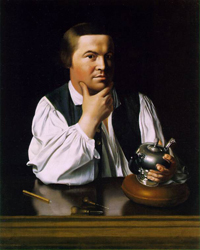
Image: John Singleton Copley, Paul Revere, 1768, oil on canvas, 35 1/8 x 28 1/2 in. Gift of Joseph W. Revere, William B. Revere and Edward H. R. Revere, 1930. 30.781 (artwork in the public domain)
Petition to Support University Galleries and Museums
posted by CAA — July 14, 2009
Several university art museums or their school administrations have recently sold, or have attempted to sell, artworks and objects in their collections to offset operating costs. In response to this, CAA has joined a task force supporting the educational importance of preserving collections at university museums and galleries. The task force—which includes representatives from the American Association of Museums, the Association of Art Museum Directors, the Association of College and University Museums and Galleries, and the Samuel H. Kress Foundation—has established a two-pronged effort: 1) to recognize museums as integral educational resources in the university accreditation process; and 2) to heighten public awareness of the educational value of art museum collections.
Members of the task force are meeting with accreditation organizations throughout the country to enlist their support for the recognition of art museums as integral educational resources.
A petition has been prepared that reaffirms the integrity and value of university and college museums.
Please show support for our efforts by adding your name and affiliation to this petition, which will be published in the Chronicle of Higher Education this fall. Please encourage your university, college, or museum to sign it as well.
Thank you for your support on this critical issue.
Paul B. Jaskot, President, and Linda Downs, Executive Director
Petition Letter to Support University Galleries and Museums
posted by CAA — July 14, 2009
Several university art museums or their school administrations have recently sold, or have attempted to sell, artworks and objects in their collections to offset operating costs. In response to this, CAA has joined a task force supporting the educational importance of preserving collections at university museums and galleries. The task force—which includes representatives from the American Association of Museums, the Association of Art Museum Directors, the Association of College and University Museums and Galleries, and the Samuel H. Kress Foundation—has established a two-pronged effort: 1) to recognize museums as integral educational resources in the university accreditation process; and 2) to heighten public awareness of the educational value of art museum collections.
Members of the task force are meeting with accreditation organizations throughout the country to enlist their support for the recognition of art museums as integral educational resources.
A petition has been prepared that reaffirms the integrity and value of university and college museums.
Please show support for our efforts by adding your name and affiliation to this petition, which will be published in the Chronicle of Higher Education this fall. Please encourage your university, college, or museum to sign it as well.
Thank you for your support on this critical issue.
Paul B. Jaskot, President, and Linda Downs, Executive Director
John Howett: In Memoriam
posted by CAA — May 13, 2009
Clark V. Poling is professor emeritus of art history at Emory University in Atlanta, Georgia.

John Howett
John Howett, professor of art history at Emory University for thirty years, died on April 8, 2009, at the age of 82. A founding member of the Art History Department and active with numerous arts organizations in Atlanta, he nurtured the careers of many artists and undergraduate and graduate students both in art history and in the interdisciplinary Graduate Institute of the Liberal Arts.
After serving with the US infantry in the Philippines and Japan during World War II, Howett began his career in art as a student at the John Herron Art Institute in Indianapolis, Indiana, earning a BFA. He received an MA and PhD from the University of Chicago in Illinois, specializing in early Italian Renaissance art; during this time he was curator of the University of Notre Dame Art Gallery as well as associate professor at that university.
Arriving at Emory in 1966, Howett helped develop the Art History Department and its graduate program, summer-abroad program in Europe, and collection of works of art on paper, which subsequently became part of Emory’s Michael C. Carlos Museum. He was revered as a teacher and mentor, having received the Emory Williams Distinguished Teaching Award, the Award for Outstanding Teaching and Service to Undergraduate Students, and the Arts and Sciences Award of Distinction. Recently, a former student established the John Howett Travel Fund for Advanced Undergraduate Seminars in Art History in his honor.
Howett was instrumental in the decision to select Michael Graves as the architect of the Carlos Museum. In recognition of his contributions there, including serving as curator for a number of exhibitions of works on paper, a gallery in the museum is named in his honor, as is the newly established John Howett Works on Paper Fund. Howett has also been awarded the Woolford B. Baker Award for service to the museum and the arts at Emory.
When Howett arrived in Atlanta in the sixties, the civil rights movement was at its height, and he became active in antiwar and social-justice efforts. He was an ardent supporter of the arts community in the city, serving on the boards of the Atlanta College of Art, Art Papers, the Arts Festival of Atlanta, Nexus Contemporary Art Center, and the Museum of Contemporary Art in Georgia. A board member of the High Museum of Art for two decades, he helped in the choice of Richard Meier as architect of its new building completed in 1983. The many exhibitions for which he served as curator—at the High, the Carlos, and galleries in Atlanta—included contemporary art as well as Renaissance and Baroque illuminations, prints, and drawings. His championing of Atlanta artists in exhibitions and publications aided many careers and contributed to the burgeoning arts community.
Howett was a model of the publicly engaged academic: kind, humorous, wise, and spirited in navigating the shoals of university politics and bureaucracy and bridging the gap between academia and the broader community.
Hans A. Lüthy: In Memoriam
posted by CAA — April 09, 2009
Petra ten-Doesschate Chu works in the Department of Art, Music, and Design at Seton Hall University in South Orange, New Jersey, and June Hargrove teaches nineteenth-century European painting and sculpture at the University of Maryland, College Park.

Hans A. Lüthy
With the death of Hans A. Lüthy, on March 8, 2009, art history has lost a scholar and a leader, a catalyst whose vision and philanthropy contributed to the growth of the discipline in Europe and America.
Born in 1932, Lüthy studied art history in Zurich, where he wrote a dissertation on the nineteenth-century Swiss landscape painter Johann Jakob Ulrich II (1965). In 1963, he was appointed director of the Schweizerisches Institut für Kunstwissenschaft (SIK), or Swiss Institute for Art Research in Zürich, a position that he would hold for more than thirty years. Founded in 1951, the SIK became a major research institute under his directorship, the influence of which was felt both at home and abroad. Lüthy, indeed, pursued a two-pronged agenda: one, to research Switzerland’s artistic patrimony and to disseminate that research through exhibitions and publications; and, two, to promote Swiss art abroad, particularly in the United States. He was responsible for the organization of several exhibitions of Swiss art in the US, including From Liotard to Le Corbusier: 200 Years of Swiss Painting, 1730–1930 in the High Museum of Art in Atlanta and monographic exhibitions of the works of Ferdinand Hodler. His energy and commitment brought a new dimension to the awareness of Swiss art here.
Lüthy’s scholarly pursuits were focused on nineteenth-century French art, and he maintained an active publishing career, which included numerous articles for the press, notably the Neue Zürcher Zeitung.
Since his retirement in 1994, Lüthy remained actively involved in art history. Through a private foundation, he and his wife, Marianne (Mascha), funded several research and writing projects. One of these was Nineteenth-Century Art Worldwide, which would not have come into being if not for his generous start-up grant. For this, the Association of Historians of Nineteenth-Century Art owes him a debt of gratitude. The couple also contributed a scholarship to the Centre allemande d’histoire de l’art (Deutsche Forum für Kunstgeschichte) in Paris.
At the same time, he began to collect art. As a collector his taste tended to French neoclassical and Romantic drawings, a predilection that was no doubt related to his life-long interest in the work of Théodore Géricault. He also assembled a small but significant collection of sculpture of the same period. A selection of drawings and sculpture from his collection was exhibited in 2002 in the Kunstmuseum in Bern, on the occasion of his seventieth birthday.
During the past few years, Lüthy’s ill health prevented him from staying in touch with many former friends and acquaintances. Those who knew him, and I am sure there are many of us in the US, remember him fondly for his genuine kindness, his enthusiasm, and his generosity of spirit. He was a raconteur and bon vivant whose presence enlivened many an occasion, scholarly and otherwise. He will be much missed.
The Art Bulletin Seeks Editor-in-Chief and Editorial-Board Members
posted by CAA — January 21, 2009
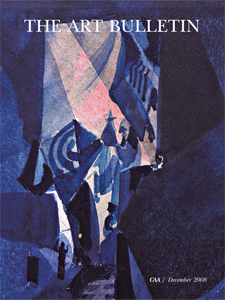 The Art Bulletin publishes leading scholarship in the English language in all aspects of art history as practiced in the academy, museums, and other institutions. From its founding in 1913, the quarterly journal has published, through rigorous peer review, scholarly articles and critical reviews of the highest quality in all areas and periods of the history of art.
The Art Bulletin Seeks Editor-in-Chief
The Art Bulletin Editorial Board invites nominations and self-nominations for the position of editor-in-chief of The Art Bulletin, for a three-year term, July 1, 2010–June 30, 2013 (preceded by a year as editor designate, from July 1, 2009 to June 30, 2010).
The Art Bulletin comprises scholarly essays and documentation on the history of visual art of all periods and places. The editor-in-chief is responsible for the content and character of the journal. Each issue has approximately 150 editorial pages (135,000 words), not including book and exhibition reviews, which are the responsibility of the reviews editor. The editor-in-chief reads all submitted manuscripts, refers them to appropriate expert referees for scholarly review, provides guidance to authors concerning the form and content of submissions, and makes final decisions regarding acceptance or rejection of articles for publication.
In addition to working with authors, the editor-in-chief attends the three annual meetings of the Art Bulletin Editorial Board—held in the spring and fall in New York and once at the CAA Annual Conference—and submits an annual report to the CAA Board of Directors and editorial board. CAA reimburses the editor-in-chief for travel and lodging expenses for the spring and fall meetings in accordance with its travel policy, but the editor-in-chief pays these expenses to attend the Annual Conference. The editor-in-chief also works closely with the CAA staff in New York, where production for the publication is organized. This is a half-time position. CAA provides financial compensation to the editor’s institution, usually in the form of course release or the equivalent, for three years. The editor is not usually compensated directly.
Candidates must be current CAA members and should not be serving on the editorial board of a competitive journal or on another CAA editorial board or committee. Members may not publish their own work in the journal during the term of service. Nominators should ascertain their nominee’s willingness to serve before submitting a name. Please send a letter describing your interest in and qualifications for appointment, CV, and contact information to: Chair, Art Bulletin Editorial Board, CAA, 275 Seventh Ave., 18th Floor, New York, NY 10001. Deadline: April 15, 2009.
The Art Bulletin Seeks Editorial-Board Members
CAA invites nominations and self-nominations for two individuals to serve on the Art Bulletin Editorial Board for a four-year term, July 1, 2009–June 30, 2013.
The ideal candidate has published substantially in the field and may be an academic, museum-based, or independent scholar; institutional affiliation is not required. Applicants who have specializations in East or South Asian, Renaissance, or early modern European art are especially invited to apply.
The editorial board advises the editor-in-chief and assists him or her to seek authors, articles, and other content for the journal; guides its editorial program and may propose new initiatives for it; performs peer reviews and recommends peer reviewers; and may support fundraising efforts on the journal’s behalf. Members also assist the editor-in-chief to keep abreast of trends and issues in the field by attending and reporting on sessions at the CAA Annual Conference and other academic conferences, symposia, and events in their fields.
Each year the editorial board meets twice in New York and once at the CAA Annual Conference. CAA reimburses members for travel and lodging expenses for the spring and fall New York meetings in accordance with its travel policy, but members pay these expenses to attend the conference.
Candidates must be current CAA members and should not be serving on the editorial board of a competitive journal or on another CAA editorial board or committee. Members may not publish their own work in the journal during the term of service. Nominators should ascertain their nominee’s willingness to serve before submitting a name. Please send a letter describing your interest in and qualifications for appointment, CV, and contact information to: Chair, Art Bulletin Editorial Board, CAA, 275 Seventh Ave., 18th Floor, New York, NY 10001. Deadline: April 15, 2009.
Meiss Grant Seeks Jury Member
posted by CAA — January 20, 2009
CAA seeks nominations and self-nominations for an individual to serve on the Millard Meiss Publication Fund Jury for a four-year term, July 1, 2009–June 30, 2013. Applicants with expertise in East Asian art, African, or twentieth-century art, or in the history of photography, are especially invited to apply.
The jury awards grants that subsidize the publication of book-length scholarly manuscripts in the history of art and related subjects. It reviews manuscripts and grant applications twice a year and meets in New York in the spring and fall to select awardees. CAA reimburses committee members for travel and lodging expenses in accordance with its travel policy. For more information about the Meiss grant, please see www.collegeart.org/meiss.
Candidates must be current CAA members and should not be serving on another CAA editorial board or committee. Jury members may not themselves apply for a grant in this program during their term of service. Nominators should ascertain their nominee’s willingness to serve before submitting a name. Please send a letter describing your interest in and qualifications for appointment, CV, and contact information to: Millard Meiss Publication Fund Jury, CAA, 275 Seventh Ave., 18th Floor, New York, NY 10001. Deadline: April 15, 2009.