
CAA News Today
Mildred Constantine: In Memoriam
posted by CAA — January 13, 2009
Linda Downs is CAA executive director.
Until her death on December 10, 2008, at age 95, Mildred “Connie” Cohen Constantine Bettelheim was the oldest College Art Association member and the oldest CAA employee. At the age of sixteen, she was hired by Audrey McMahon, corresponding secretary at CAA, in 1929 as a stenographer when the CAA offices were located at 220 West Fifty-eighth Street. She kept up the list of New York exhibitions for Parnassus (the precursor of Art Journal), eventually editing articles, assisting at Annual Conferences, and attending to correspondence.
I interviewed Connie last May in her art-filled home in Nyack, New York. She talked about the seminal experience that CAA’s employment and subsequent membership meant to her in her professional life. It opened up the creative and intellectual world to her at a time when CAA was in its formative years, and she was able to contribute to its development. Through her position at CAA she came in contact with artists like David Smith (when he applied for Works Progress Administration status through CAA; they immediately became life-long friends) and with art historians and future museum directors such as Francis Henry Taylor.
CAA also taught her the realities of the art world, from organizing demonstrations in support of artists’ rights to being requested to change her name. A prominent CAA member lobbied the Board of Directors to protest the appearance of a Jewish name on CAA correspondence. So Connie, as she was known by her friends, found a new name that she liked and permanently changed her last name from Cohen to Constantine.
She worked at CAA until 1937, when she returned to college to earn her BA and MA at New York University and attend graduate school at the National Autonomous University of Mexico. In 1940 Constantine worked at the Office of Inter-American Affairs at the Library of Congress, and in 1948 was hired by the Museum of Modern Art’s Architecture and Design Department. She became an associate curator and curatorial consultant at MoMA through 1970, where she pioneered an interest in art outside the mainstream, from posters to graphic design. Constantine wrote over a dozen books and exhibition catalogues, including Tina Modotti: A Fragile Life (1975), Revolutionary Soviet Film Posters (1974) with Alan Fern, and Whole Cloth (1997) with Laurel Reuter. She also became an expert on fiber arts, coauthoring Beyond Craft: The Art Fabric (1973) with the fiber artist Jack Lenor Larson. At her death, she was researching for a major international study of thread.
Constantine was both a great supporter and a great critic of CAA. She was a lifetime member and enjoyed the articles in The Art Bulletin, but believed that Art Journal was too limited in scope and did not fully address contemporary international art, as it once did. She also wanted to see a greater focus on international artists at Annual Conferences.
I first met Connie in 1980 when we were organizing a Diego Rivera retrospective at the Detroit Institute of Arts. Because of her familiarity with Mexican collections and because of her research and book on Tina Modotti, she was recommended to me by Alan Fern, who was then director of the National Portrait Gallery, for the photography section of the larger exhibition. Over several years we worked together as she curated one of the most important collections of photographs that captured the life of Diego Rivera and Frida Kahlo by artists such as Manuel Álvarez Bravo, Edward Weston, and Tina Modotti. She was an intrepid curator with a wonderful eye for quality and for the quirky.
Connie’s pioneering work and gregarious personality touched the lives of so many artists, art historians, curators, and collectors. She helped to shape the College Art Association in its first few decades and forged a path that has been followed by many subsequent students of art and art history.
Meet the Editors of CAA’s Journals
posted by CAA — December 30, 2008
Attendees of the CAA Annual Conference in Los Angeles are invited to meet the editors-in-chief of The Art Bulletin, Art Journal, and caa.reviews at the CAA booth in the Book and Trade Fair. Discuss the journals, present your ideas, learn how to submit material for consideration, and ask questions. Richard Powell of The Art Bulletin, Judith Rodenbeck of Art Journal, and Lucy Oakley of caa.reviews will be at the booth on Friday, February 27, 2008, 10:30–11:30 AM.
Strategic Planning for 2010–15
posted by CAA — December 19, 2008
Strategic planning may sound bureaucratic, but it’s an essential step in making CAA the organization that meets your needs in the future. There is no more appropriate time to take stock and set goals for our future than the present, with a dramatically changing economy, a new presidential administration, and the prospect of the next hundred years of CAA beginning in 2011.
On October 25, 2008, the Board of Directors, the Strategic Planning Steering Committee, and senior CAA staff held a Strategic Planning Retreat to set goals for 2010–15. Members of the Planning Steering Committee are: Michael Ann Holly, Sterling and Francine Clark Art Institute; Paul Jaskot, DePaul University and CAA President and CEO; Ken Gonzales-Day, Scripps College and CAA board; Jay Coogan, Rhode Island School of Design and CAA board; Anne Collins Goodyear, National Portrait Gallery and CAA Vice President for External Affairs; Mary-Ann Milford-Lutzker, Mills College and CAA Vice President for Committees; Barbara Nesin, Spelman College and CAA Secretary; and Linda Downs, CAA Executive Director.
James McNamara and Paul Melton, planning consultants from LaPlaca Cohen, a cultural arts marketing firm, have assisted CAA through the planning process, which will be completed with a final document at year-end 2009. Before the retreat, McNamara and Melton conducted interviews with board members, senior staff, and a selection of academic and association leaders outside the CAA membership to determine the key issues and implications that we must address in preparing for our future. Questions addressed the components of a mission, vision, and values statement, the future of CAA’s service to its members, and the visual-arts field.
In September 2008, over eight hundred members responded to an email survey on their most pressing professional concerns. The results also helped inform the planning process.
The planning retreat began with a presentation on digital publishing by Raym Crow, managing partner at the Chain Bridge Group. He presented the essential points of investigation needed to plan for digital publications. CAA staff presented current statistical information on programs and publications and presented comparative information for other national academic member associations. McNamara and Melton then presented the results of the interviews and members’ survey as a basis for the discussion of identifying goals for the future of CAA.
All CAA committees, including the Professional Interests, Practices and Standards Committees, the Publications Committee, the three journals’ editorial boards, and our affiliated societies, were requested to present their interests and concerns for CAA’s future. Their responses will be incorporated into the planning process.
I encourage you to attend an open forum for all members to discuss planning issues during the Annual Members’ Business Meeting at the Annual Conference in Los Angeles on Friday, February 27, 2009, at 5:00 PM in the West Hall Meeting Room, 502A Level 2, Los Angeles Convention Center. We would like to have your thoughts and ideas in order to make CAA responsive to all members’ needs. If you cannot attend the forum, please send your comments to nyoffice@collegeart.org. I look forward to hearing from you.
—Linda Downs, CAA executive director
Preorder Graduate Programs in Art History
posted by CAA — December 05, 2008
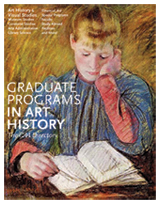 CAA is now taking preorders of Graduate Programs in Art History: The CAA Directory. This easy-to-use directory includes over 260 schools and English-language academic programs in the United States, Canada, Great Britain, and elsewhere worldwide. An index lists schools alphabetically and by state and country for quick reference.
Member Rate: $39.95 + shipping and handling
Nonmember Rate: $49.95 + shipping and handling
Please visit our online store to reserve your copy of the directory today. If you are ordering on behalf of an institution or department within a university, please use this form and submit via fax or post. At this time, online purchases can only be processed for individuals.
The directory is your indispensable, comprehensive guide to schools offering master’s, doctoral, and related degrees in art studies, including:
- History of Art and Architecture
- Visual Studies
- Museum Studies
- Curatorial Studies
- Arts Administration
- Library Science
Listings provide:
- Descriptions of specialized courses
- Number, names, and specializations of faculty
- Facilities such as libraries, image libraries, and labs
- Student opportunities for research and work
- Information on financial aid, fellowships, and assistantships
- Details on housing, health insurance, and other practical matters
Graduate Programs in the Visual Arts: The CAA Directory, which includes studio art, graphic design, applied arts and design, film production, art education, and conservation, will be available in early 2009.
CAA Offers Publications Grants
posted by CAA — September 10, 2008
CAA awards grants to publishers to support the publications of books in art history, visual studies, and related subjects. Millard Meiss Publications Grants are given twice annually, and Wyeth Foundation for American Art Publication Grants are awarded in the fall.
Millard Meiss Publication Grants
CAA awards Millard Meiss Publication Grants to support book-length scholarly manuscripts in the history of art and related subjects that have been accepted by a publisher on their merits but cannot be published in the most desirable form without a subsidy. For complete guidelines, application forms, and grant description, please visit www.collegeart.org/meiss or write to nyoffice@collegeart.org. Deadline: October 1, 2008.
Wyeth Foundation for American Art Publication Grant
Thanks to a second generous three-year grant from the Wyeth Foundation for American Art, CAA awards a publication grant to support book-length scholarly manuscripts in the history of American art and related subjects. Books eligible for the Wyeth Grant have been accepted by a publisher on their merits but cannot be published in the most desirable form without a subsidy. For complete guidelines, application forms, and grant description, please visit www.collegeart.org/wyeth or write to nyoffice@collegeart.org. Deadline: October 1, 2008.
Stuart Cary Welch Jr.: In Memoriam
posted by CAA — September 08, 2008
Stuart Cary Welch Jr., curator emeritus of Islamic and later Indian art at the Harvard Art Museum and former special consultant in charge in the Department of Islamic Art at the Metropolitan Museum of Art, died on August 13, 2008, while traveling in Hokkaido, Japan. He was 80 and a resident of New Hampshire.
Welch, a legendary scholar, collector, and connoisseur, studied and taught at Harvard University, where he was instrumental in transforming the Department of Islamic Art, establishing a curriculum of study of the arts of the Middle East and South Asia, and developing one of the finest collections of Islamic and later Indian art in this country. His lifelong association with Harvard culminated in his role over the past two decades as one of the most generous donors to the Harvard Art Museum.
Welch developed an appreciation of art early in his childhood. Aside from being a collector of drawings at a very young age, Welch himself was an accomplished draftsman, a skill that carried through to his enrollment at Harvard and beyond. He was a graduate of the St. Paul’s School in Concord, New Hampshire, in 1946. That same year he began his undergraduate studies in fine arts at Harvard, where he continued his graduate work in Classical art from 1952 to 1954. During that time, Welch intensified his study and collecting of Islamic and Indian art. He also published some of his more entertaining and lighthearted drawings in Harvard’s literary and humor magazines, including his series of Popular Professions Illustrated that appeared in the Harvard Lampoon and the Harvard Advocate.
While Welch concentrated in the study of fine arts at Harvard, at the time there were no classes or formal instruction available in the subject of Islamic or Indian art. Ever resourceful, Welch took the initiative to devise his own “course of study” by traveling extensively throughout the Middle East and South Asia to absorb regional traditions and culture and to witness firsthand the lands that captivated him, his interest driven by the drawings that he had already begun to acquire. At the same time, Eric Schroeder, then honorary keeper of Islamic Art at the Fogg Museum, became his mentor at Harvard.
In 1956, Schroeder invited Welch to become honorary assistant keeper of Islamic Art at the Fogg, and thus began an era that saw Welch use his infinite enthusiasm to transform the fledgling Department of Islamic Art. At the same time, as part of the vanguard of Islamic art scholars at Harvard, he spearheaded the effort to establish one of the first American university curriculums in the study of the arts of the Islamic world. In 1960, he taught the first class at Harvard in Near Eastern Art. An instructor for twenty-five years at Harvard, Welch arranged for works of art to be made available for study by students and scholars. Welch was a teacher and mentor to many distinguished museum leaders and scholars, including Lentz; Glenn Lowry, director of the Museum of Modern Art; and Michael Brand, director of the J. Paul Getty Museum. Over four decades at Harvard, Welch served as honorary keeper, curator (retiring in 1995), and finally curator emeritus. He worked brilliantly with such esteemed donors as John Goelet, Edwin Binney III, and John Kenneth Galbraith, and during his tenure he vastly enriched Harvard’s holdings of Islamic and Indian art.
Concurrent with his work at Harvard, Welch served as special consultant in charge in the Department of Islamic Art at the Metropolitan Museum of Art from 1979 to 1987. He was instrumental in making many important acquisitions that greatly enhanced the Metropolitan Museum’s collection and, in 1985, organized the groundbreaking exhibition India: Art and Culture, 1300–1900, a comprehensive presentation of over three hundred works including masterpieces of the sacred and court traditions that ranks among his greatest achievements as a curator.
Welch’s scholarship, particularly in the fields of Persian and Indian painting and drawing, served as the foundation for many important exhibitions and accompanying publications, including The Art of Mughal India, Paintings and Precious Objects (1964), the first important American exhibition devoted to Mughal art; Gods, Thrones, and Peacocks: Northern Indian Painting from Two Traditions, Fifteenth to Nineteenth Centuries (1965); Room for Wonder: Indian Painting during the British Period, 1760–1880 (1978); Wonders of the Age: Masterpieces of Early Safavid Painting, 1501–1576 (1979); Gods, Kings, and Tigers: The Art of Kotah (1997); and From Mind, Heart, and Hand: Persian, Turkish, and Indian Drawings from the Stuart Cary Welch Collection (2004), an exhibition of drawings from Welch’s landmark gift to Harvard in 1999 of over three hundred works.
Welch produced countless exhibitions over the forty years that he spent at Harvard, many of which may have been small in size, but which always tended toward the visual and poetic. His last exhibition is the first in a series entitled Perspectives that is part of the long-term exhibition Re-View at the Harvard Art Museum/Arthur M. Sackler Museum. The small installation, titled Tree of Life: Five Indian Variations on a Theme, includes just five works of art but is characteristic of Welch’s vision and approach. It opened in April 2008, just a few days after Welch’s eightieth birthday.
Considered his greatest scholarly achievement was the immense, two-volume study of The Houghton Shahnameh, coauthored with Martin B. Dickson of Princeton University, which focused on the great early Safavid dynasty copy of the Persian national epic executed for the Safavid ruler and patron of the arts Shah Tahmasp (r. 1524–1576). Welch’s insights fundamentally changed the way scholars thought about the development of early Safavid painting, demonstrating that it was, in fact, a brilliant synthesis of the earlier Timurid and Turkman styles of painting.
Welch’s numerous exhibitions, publications, public lectures, and years of teaching propelled the study and appreciation of Islamic and Indian art to new heights, educating and enlightening generations of students, scholars, and museum visitors.
The Art Bulletin Seeks Reviews Editor
posted by CAA — August 19, 2008
 As the current term of the Art Bulletin reviews editor is coming to its conclusion, CAA invites applicants for the next term, July 1, 2009–June 30, 2012 (with service as incoming reviews editor designate from February to June 2009). The Art Bulletin, published quarterly by CAA, is the leading publication of art history in English.
Candidates should be art scholars with stature in the field and experience in editing book and/or exhibition reviews; institutional affiliation is not required. Candidates should be published authors of at least one book.
The reviews editor is responsible for commissioning all book and exhibition reviews in The Art Bulletin. He or she selects books and exhibitions for review, commissions reviewers, and determines the appropriate length and character of reviews. The reviews editor also works with authors and CAA’s director of publications in the development and preparation of review manuscripts for publication. He or she is expected to keep abreast of newly published and important books and recent exhibitions in the fields of art history, criticism, theory, visual studies, and museum publishing. This is a three-year term, which includes membership on the Art Bulletin Editorial Board.
The reviews editor attends the three annual meetings of the Art Bulletin Editorial Board—held in the spring and fall in New York and in February at the CAA Annual Conference—and submits an annual report to CAA’s Publications Committee. CAA reimburses the reviews editor for travel and lodging expenses for the spring and fall New York meetings in accordance with its travel policy, but he or she pays these expenses to attend the conference.
Candidates must be current CAA members and should not be serving on the editorial board of a competitive journal or on another CAA editorial board or committee. Nominators should ascertain their nominee’s willingness to serve before submitting a name; self-nominations are also welcome. Please send a statement describing your interest in and qualifications for appointment, CV, and at least one letter of recommendation to: Director of Publications, Art Bulletin Reviews Editor Search, CAA, 275 Seventh Ave., 18th Floor, New York, NY 10001. Deadline: September 15, 2008; finalists will be interviewed on October 24, 2008, in New York.
CAA Seeks Award Nominations
posted by CAA — August 12, 2008
Recognize someone who has made extraordinary contributions to the fields of art and art history by nominating him or her for one of twelve CAA Awards for Distinction. Award juries consider your personal letters of recommendation when making their selections. In the letter, state who you are; how you know (of) the nominee; how the nominee and/or his or her work or publication has affected your practice or studies and the pursuit of your career; and why you think this person (or, in a collaboration, these people) deserves to be recognized. We also urge you to contact five to ten colleagues, students, peers, collaborators, and/or coworkers of the nominee to write letters. The different perspectives and anecdotes from multiple letters of nomination provide juries with a clearer picture of the qualities and attributes of the candidates.
The twelve Awards for Distinction are:
- The Distinguished Feminist Award honors a person who, through his or her art, scholarship, or advocacy, has advanced the cause of equality for women in the arts
- The Charles Rufus Morey Book Award honors an especially distinguished book in the history of art, published in the English language. (To give the jury the full opportunity to evaluate each submission fairly, please send your nomination by July 31, 2008)
- The Alfred H. Barr, Jr., Award for museum scholarship is presented to the author or authors of an especially distinguished catalogue in the history of art, published in the English language under the auspices of a museum, library, or collection. (To give the jury the full opportunity to evaluate each submission fairly, please send your nomination by July 31, 2008)
- The Arthur Kingsley Porter Prize is awarded for a distinguished article published in The Art Bulletin by a scholar of any nationality who is under the age of thirty-five or who has received the doctorate no more than ten years before the acceptance of the article for publication
- The Art Journal Award is presented to the author of the most distinguished contribution (article, interview, conversation, portfolio, review, or any other text or visual project) published in Art Journal
- The Frank Jewett Mather Award is awarded to an author of art journalism that has appeared in whole or in part in North American publications
- The Distinguished Teaching of Art Award is presented to an individual who has been actively engaged in teaching art for most of his or her career
- The Distinguished Teaching of Art History Award is presented to an individual who has been actively engaged in teaching art history for most of his or her career
- The Artist Award for a Distinguished Body of Work is given to a living artist of national or international stature for exceptional work through exhibitions, presentations, or performances
- The Distinguished Artist Award for Lifetime Achievement celebrates the career of an artist who has demonstrated particular commitment to his or her work throughout a long career and has had an impact nationally and internationally on the field
- The CAA/Heritage Preservation Award for Distinction in Scholarship and Conservation honors outstanding contributions by one or more persons who, individual or jointly, have enhanced understanding of art through the application of knowledge and experience in conservation, art history, and art
- The Distinguished Lifetime Achievement Award for Writing on Art celebrates the career of an author of note and includes the publication of art criticism, art history, art biography, and/or art theory
All nomination campaigns should include one copy of the nominee’s CV (limit: two pages). Nominations for book and exhibition awards should be for authors of books published or works exhibited or staged between September 1, 2007, and August 31, 2008. No more than ten letters per candidate are considered. For more information, please write to Claire Vancik, CAA programs assistant. Deadline: July 31, 2008, for the Morey and Barr awards; August 31, 2008, for all others.
Art Journal Seeks Editor-in-Chief
posted by CAA — July 26, 2008
As the current term of the Art Journal editor-in-chief is coming to its conclusion, CAA invites applicants for the next term, July 1, 2009–June 30, 2012 (preceded by a term as editor designate from November 2008 to June 2009). Art Journal, published quarterly by CAA, promotes informed discussion about issues across disciplines in twentieth- and twenty-first-century art, nationally and internationally.
Candidates may be artists, art historians, art critics, art educators, curators, or other art professionals; institutional affiliation is not required.
Advised by the Art Journal Editorial Board, the editor-in-chief is responsible for the content and character of the journal. He or she reads all submitted manuscripts and reviews all submitted artist projects, sends them to peer reviewers, provides guidance to authors and artists concerning the form and content of submissions, and makes final decisions regarding the acceptability of all submissions for publication. The editor-in-chief is not responsible for commissioning reviews. The editor-in-chief works closely with CAA staff in New York, where the publication is produced. This is a half-time position. CAA may negotiate course release or other compensation for the editor.
The editor-in-chief attends the three annual meetings of the Art Journal Editorial Board—held in the spring and fall in New York and in February at the Annual Conference—and submits an annual report to CAA’s Publications Committee. CAA reimburses the editor-in-chief for travel and lodging expenses for the spring and fall New York meetings in accordance with its travel policy, but he or she pays these expenses to attend the conference.
Candidates must be current CAA members and should not be serving on the editorial board of a competitive journal or on another CAA editorial board or committee. Nominators should ascertain their nominee’s willingness to serve before submitting a name; self-nominations are also welcome. Please send a statement describing your interest in and qualifications for appointment, CV, and at least one letter of recommendation to: Director of Publications, Art Journal Editor-in-Chief Search, CAA, 275 Seventh Ave., 18th Floor, New York, NY 10001. Deadline: September 15, 2008; finalists will be interviewed October 23, 2008, in New York.
NEH and IMLS Advancing Knowledge Grants
posted by CAA — March 15, 2007
Applications for the Institute of Museum and Library Services and the National Endowment for the Humanities grant program, “Advancing Knowledge: The IMLS/NEH Digital Partnership” are now available on www.neh.gov. This program “seeks applications for innovative, collaborative humanities projects using the latest digital technologies for the benefit of the American public, humanities scholarship, and the nation’s cultural community.”