CAA News Today
Welcome to the 2019 Annual Conference
posted by CAA — February 13, 2019
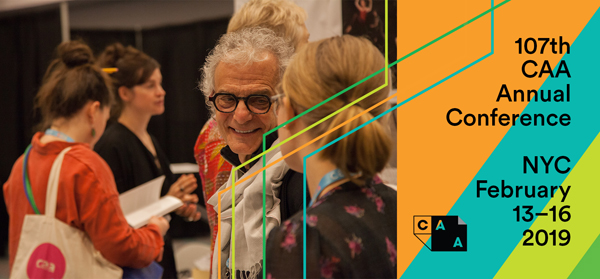
As of yesterday evening, the 107th CAA Annual Conference is in full swing in New York City. Welcome to the thousands of CAA members, colleagues, and friends attending! If you’re attending, make sure you have downloaded the 2019 CAA app, which is your go-to resource for personalizing your schedule and connecting with others at the conference.
Would like to attend but haven’t registered? Onsite registration is available, and for the third year in a row we’re happy to offer a Pay-as-you-Wish Day Pass.
Not at the conference? See what’s happening on Twitter, Instagram, and Facebook, and join in the discussion online using using #CAA2019 and #CAANYC. Select events are being recorded and will be shared afterwards, too.
CAA staff is on-the-ground at the New York Hilton Midtown, so website updates and email replies may be delayed. Thanks for your understanding!
Pay-as-you-Wish Is Back for CAA 2019
posted by CAA — February 05, 2019
The Pay-as-you-Wish Day Pass is back for the CAA 2019 Annual Conference in New York City, February 13-16! For the third year in a row we are happy to offer the pass as a way for students, adjunct faculty, or anyone not able to afford a full conference registration to attend any part of the conference for a full day.
Pay-as-you-Wish is available onsite only at the New York Hilton Midtown. It is open to everyone, CAA members and non-members alike, with no advance registration needed. Pay-as-you-Wish purchases can be made with any registration staff or the Pay-as-you-Wish helpers in the registration area.
Suggested Pay-as-you-Wish Day Pass price: $25
The Pay-as-you-Wish Day Pass allows for full, one-day access to the conference, and if you want to return the next day, a full day pass must be purchased.
The Annual Conference will feature over 300 sessions, a bustling Book and Trade Fair, and the free and open to the public Academic and Cultural Network Hall with professional development workshops, Idea Exchange, and booths of leading cultural non-profits and educational institutions.
Browse the Full Conference Schedule
The Keynote Speaker for 2019 will be Joyce J. Scott, sculptor, craftsperson, and 2016 MacArthur Fellow. The Distinguished Artist Interviews will feature Julie Mehretu interviewed by Julia Bryan-Wilson and Guadalupe Maravilla interviewed by Sheila Maldonado. The Distinguished Scholar for the 107th CAA Annual Conference is Dr. Elizabeth Boone, the Martha and Donald Robertson Chair in Latin American Studies at Tulane University.
Meet the 2018 Professional Development Fellows
posted by CAA — January 28, 2019
CAA has awarded two 2018 Professional Development Fellowships—one in art history and one in visual art—to graduate students in MFA and PhD programs. In addition, CAA has named one honorable mention in art history and two in visual art. The fellows and honorable mentions both receive a complimentary one-year CAA membership and registration for the 2019 Annual Conference in New York City.
The recipient of the $10,000 fellowship in art history is C.C. McKee, a dual PhD candidate in the Department of Art History at Northwestern University and the École des hautes études en sciences sociales in Paris. Accepting the $10,000 fellowship in visual art is Camila Labarca Linaweaver, a MFA candidate in Printmaking at the University of Oklahoma.
The honorable mention for art history goes to Julia Vázquez, a PhD candidate in the Department of Art History & Archaeology at Columbia University. The honorable mentions in visual art are awarded to Kira Dominguez Hultgren, who is earning a MFA/MA in Fine Arts and Visual and Critical Studies at California College of the Arts, and Rowan Renee, who is currently pursuing their MFA at the University of Michigan.
The two fellows and three honorable mentions will be formally recognized at the 107th Annual Conference during Convocation on Wednesday, February 13, 2019.
CAA’s fellowship program supports promising artists and art historians who are enrolled in MFA and PhD programs nationwide. Awards are intended to help them with various aspects of their work, whether for job-search expenses or purchasing materials for the studio. CAA believes a grant of this kind, without contingencies, can best facilitate the transition between graduate studies and professional careers. The program is open to all eligible graduate students in the visual arts and art history. Applications for the 2019 fellowship cycle will open in the late spring.
FELLOW IN ART HISTORY
 C.C. McKee
C.C. McKee is a dual doctoral candidate in the Department of Art History at Northwestern University (advised by Huey Copeland) and the École des hautes études en sciences sociales in Paris (advised by Anne Lafont). McKee received his BA from the University of California, Berkeley as a double major with honors in the history of art and highest honors in history.
McKee’s current dissertation project takes up art and visual culture from the francophone Caribbean during the long nineteenth century, arguing that, on the one hand, painting could bolster imperial authority by eliding the coeval inhumane violence and ecological brutality of colonialism. On the other, these artworks are inadvertent repositories for parallel ecologies opening onto embodied African diasporic knowledge of the Caribbean landscape.
This project represents one facet of McKee’s broader investment in the transhistorical relationship between colonialism (particularly during the seventeenth through nineteenth centuries) and its continued effects in the present. These interests include, art of the Atlantic World, contemporary African and African diasporic art, and queer aesthetic practices; all of which are indebted to black feminist, ecocritical, postcolonial, and psychoanalytic theories. McKee has developed these perspectives in various pieces of art criticism; with exhibitions at the Block Museum, Iceberg Projects (Chicago, IL), and the Ghetto Biennale (Port-au-Prince, Haiti); as well as in a forthcoming article for Art Journal. Moving forward, McKee will pursue a scholarly and curatorial practice that challenges the boundaries between the university classroom and the museum, between academic publication and exposing a broad public to the rich artistic traditions of the Caribbean.
FELLOW IN VISUAL ART
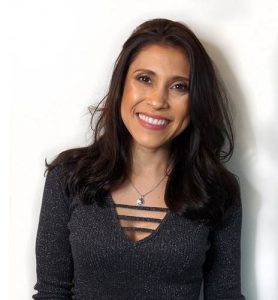 Camila Labarca Linaweaver
Camila Labarca Linaweaver was born in Santiago, Chile and immigrated to the United States at the age of 7. She lived and studied in Texas and holds a BFA from The University of Houston Clear Lake. She is a first-generation college graduate and is currently an MFA Printmaking candidate at The University of Oklahoma. While pursuing her graduate studies she has taught undergraduate courses in Printmaking and Drawing. Linaweavers focus within the printmaking medium is almost exclusively on singular and experimental prints. Using the landscape as a metaphor, she crafts narratives of immigrant displacement, loss, and alienation. Recently she has delved into time-based work, subjecting monotypes to various stop motion processes. Her unique approach to confronting her personal history as an immigrant results in highly nuanced imagery that aims to bridge opposing sides and create positive discourse within the context of global immigration issues.
As an emerging artist, Linaweaver has exhibited extensively throughout the US and has chosen to pursue a career in academia. In the future she aspires to participate in residencies and exhibitions that focus on community engagement and the intersection of landscape, identity, and culture.
HONORABLE MENTION IN ART HISTORY
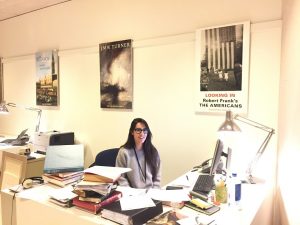 Julia Vázquez
Julia Vázquez is a PhD candidate in the Department of Art History & Archaeology at Columbia University, where she is currently completing a dissertation titled “The Artist as Curator: Diego Velázquez, 1623-1660.” Her dissertation reconsiders the curatorial career of Diego Velázquez at the court of King Philip IV of Spain. It examines the major redecoration projects that Velázquez executed for galleries in the Spanish royal palace, considering the ways that his ambitions and interests as a painter found a new expression in this medium. It also analyzes significant paintings that Velázquez made in response to the royal art collection, considering the impact on his painting practice not only of its contents, but also of its display. Her research therefore proposes the career of Diego Velázquez at the Hapsburg court as a major episode in the history of the artist-curator, ultimately arguing that Velázquez’s simultaneous creative identities as painter to the king and curator of his art collection were mutually transformative.
Previously, Julia has held internships and fellowships at the Musée du Louvre, the Whitney Museum of American Art, the Meadows Museum, the Museo Nacional del Prado, and the National Gallery of Art. While at the Meadows, she curated two exhibitions: “Picasso’s Dream and Lie of Franco: The Spanish Civil War in Print” (summer 2017) and “Murillo at the Meadows: A 400th-Anniversary Celebration” (2017-2018). She is currently the Hilla Rebay International Fellow at the Solomon R. Guggenheim Museum, the Museo Guggenheim Bilbao, and the Collezione Peggy Guggenheim.
HONORABLE MENTIONS IN VISUAL ART
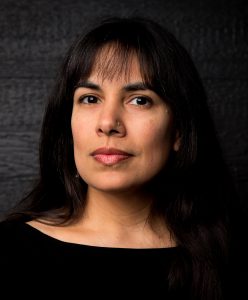 Kira Dominguez Hultgren
Kira Dominguez Hultgren (b. 1980) is a California-, Utah-, and Minnesota-based textile artist. She studied French postcolonial theory and literature at Princeton University (BA Comparative Literature, 2003), and performance and fine arts in Río Negro, Argentina from 2010-2012. While in Patagonia, she apprenticed with master weaver Mary Coronado, where Dominguez Hultgren studied the process and history of indigenous warp-faced weaving of Mallín Ahogado on a Mapuche vertical post loom.
Today, Dominguez Hultgren combines her interests in postcolonial theory and weaving in both her art and writing-research practice. In her third year at California College of the Arts, Dominguez Hultgren is earning a dual-degree MFA/MA in Fine Arts and Visual and Critical Studies. Her research interests include material and embodied rhetorics, loom technologies, decolonizing material culture, and analyzing textiles as a performative critique against the visual. She has won numerous awards including California College of the Art’s All College Honors Graduate Fine Art Award, the Edwin Anthony and Adalaine Boudreaux Cadogan Scholarship, and the Lenore Tawney Fiber and Material Studies Scholarship. Dominguez Hultgren is represented by Eleanor Harwood Gallery in San Francisco, where she had her first solo show, Wingspan, in 2018.
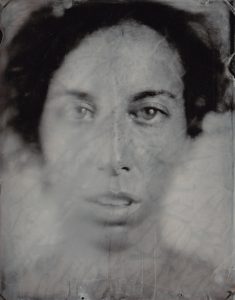 Rowan Renee
Rowan Renee is a genderqueer artist who uses photography to interrogate how sexual bodies are gendered, victimized, policed and punished. Through photographic, printmaking and sculptural techniques, they produce and appropriate images that intervene on issues of authorship, the representation of queer and feminine bodies within the art-historical canon, and the intersection of homophobia and misogyny in sex law and copyright law. The disjunctures of pleasure and abjection, felt through jouissance, informs their manipulation of images. Through artistic labor, they see a means to construct transformative meaning from experiences of violence, persecution and erasure that threaten queer and feminine subjects.
Currently pursuing their MFA at the University of Michigan, Renee works between Ann Arbor, Michigan and Brooklyn, NY. Their career began in 2006, when they joined The Miss Rockaway Armada, a collaborative flotilla of thirty people who floated down the Mississippi river on junk rafts built from NYC construction waste. Recently, they have received awards from the Aaron Siskind Foundation, the Rema Hort Mann Foundation and the Anchorage Museum of Art, as well as fellowships from the Jerome Foundation and the McColl Center for Visual Art. In 2018 they were named an Elsie Choy Lee Scholar by the University of Michigan. Their solo exhibitions include Z at Pioneer Works (2015), Bodies of Wood at The Aperture Foundation (2017), and No Honor No Heart at the Center for Visual Arts Toledo (2019). Their work has been profiled on NPR, in The New York Times, VICE, Hyperallergic, Huffington Post, American Photo Magazine and Guernica, among many other publications.
Meet the 2019 Student Scholarship Winners
posted by CAA — January 25, 2019
with support from

For the third year in a row, CAA is proud to partner with our sponsors, multinational publisher, Routledge, Taylor & Francis, and art materials specialist, Blick Art Materials, on student scholarships to assist CAA student members with conference costs.
Routledge, Taylor & Francis Student Scholarship
CAA Annual Conference Premier Sponsor, Routledge, Taylor & Francis supports four CAA student members with a $250 scholarship. The 2019 winners are:
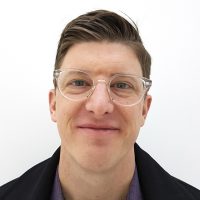
Jonathan Anderson
Jonathan Anderson is an artist and art critic, and is currently working on a PhD at King’s College London. His research focuses on modern and contemporary art, with a particular emphasis on its relations to religion and theology. He is the coauthor of the book Modern Art and the Life of a Culture: The Religious Impulses of Modernism (2016), and he has contributed to various books and journals, including essays on John Cage, Francis Alÿs, Kris Martin, Rachel Whiteread, and others.
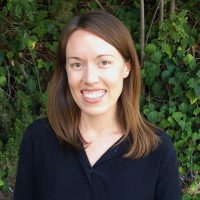
Noni Brynjolson
Noni Brynjolson is a PhD Candidate in Art History, Theory & Criticism at the University of California, San Diego. Her research analyzes socially engaged art projects in US cities. She is interested in looking at how artists address the politics of housing and gentrification through their work, as well as the informal communities that emerge within these projects. Noni is a member of the editorial collective of FIELD: A Journal of Socially Engaged Art Criticism, and her writing has been published in FIELD as well as in Hyperallergic, Akimbo, Geist and Craft Journal. She has also published chapters in two edited books: “From Mentorship to Collaboration: Art, Feminism and Community in Winnipeg” (in Desire Change: Contemporary Feminist Art in Canada, McGill Queen’s University Press, 2017), and “The Making of Many Hands: Artisanal Production and Neighbourhood Redevelopment in Contemporary Socially Engaged Art” (in Craft on Demand: The New Politics of the Handmade, I.B. Tauris, forthcoming 2019). Noni’s dissertation research was supported by a SSHRC doctoral fellowship, and she is currently a graduate fellow at UC San Diego’s International Institute as part of the 2018-19 Sawyer Seminar focused on the theme of ‘Reclaiming the City.’
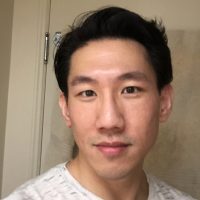
Anton Lee
Anton Lee teaches in the Department of Art History, Visual Art and Theory at the University of British Columbia, Vancouver BC, where he completed his doctorate in November 2018. A specialist in the history and theory of photography, his work focuses on the contested understandings of the medium’s identities in European and Anglo-American countries from the early 20th century to the present. His current research prioritizes transforming his doctoral dissertation into a book, provisionally titled Nouvelle Photographie Amériaine: The Rise of Photographic Sequence in the United States and France, 1968–1989. Lee was the Kenneth J. Botto Research Fellow at the Center for Creative Photography in Tucson in 2016 and a Visiting Researcher at the Université Paris-Sorbonne in 2015.

Candace Smith
Candace Smith currently studies Art History at the University of North Texas where she is working towards an MA under Dr. Nada Shabout in the field of Modern and Contemporary Art of the Middle East. Her current research explores issues of power, identity politics, and built space in the context of postwar Lebanese Art institutions and reconstruction (1990-present). Smith has presented and lectured on politics, power, and space, both as a university level and at the Texas Sculpture Symposium with NY-based artist Wafaa Bilal. She has also spent time abroad meeting and working directly with some of Beirut’s most prominent art collectors and foundations as well as emerging Beirut-based artists such as Hiba Kalache. Smith received a BA from Texas Tech University after completing undergraduate thesis work on 21st-Century street art created during times of conflict in central Cairo and the West Bank. Working directly with published photojournalists and prominent, local artists, Smith addressed local agency and perceptions of space in direct contrast with American and European activity in the area. Smith was the director of social media for AMCA and collaborated with Selections Magazine on their Winter 2018 Art Pages.
Blick Art Materials Student Scholarship
CAA Annual Conference Supporter Sponsor, Blick Art Materials supports four CAA student members with a $250 scholarship. The 2019 winners are:
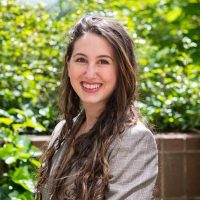
Margot Bernstein
Margot Bernstein is an advanced PhD candidate at Columbia University with a specialization in eighteenth-century art and material culture. Her dissertation, “Carmontelle’s Profile Pictures and the Things that Made Them Modern,” examines hundreds of portraits on paper by Louis Carrogis called Carmontelle (1717-1806), a French amateur draftsman. Margot holds a BA (2010) in art history and history from Williams College and an MA (2012) in the History of Art from the Courtauld Institute of Art. She also holds an MA (2014) and an MPhil (2015) in art history from Columbia University. In recent years, she has worked at the Metropolitan Museum of Art, the Frick Collection, the Morgan Library & Museum, the New-York Historical Society, the Calder Foundation, and the Williams College Museum of Art. Currently, Margot is a Chester Dale Fellow in the Department of Drawings and Prints at the Metropolitan Museum of Art.
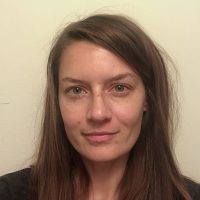
Jessica Crocker
Jessica Rae Crocker lives and works in Prescott, AZ. She is currently pursuing her PhD in Philosophy, Aesthetics, and Art Theory through IDSVA (Institute for Doctoral Studies in the Visual Arts). She is a ceramic artist focusing on the role of craft as a means to develop intimacy. Her recent work explores relationships and limerence through the use of imbedded interactive technologies. She works in both figurative and functional paradigms embracing the historical symbolism of the clay material in its many forms. This generous gift is allowing her to attend the CAA conference for the first time.
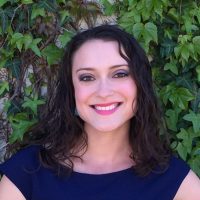
Kimberly Minor
Kimberly Minor is a doctoral candidate in Art History at the University of Oklahoma. Her research broadly focuses on American art, with interests in material culture, art of the early American West, and Northern Plains Indian drawings. Her dissertation “Pictographic Motifs: Memory and Masculinity on the Upper Missouri” engages the visual, material, and experiential sources of military imagery produced by the Mandan and Hidatsa during the early nineteenth-century. She studies how indigenous male identity was negotiated through constant confrontation (both physical and spiritual) with war and warriors, adding to a growing body of scholarship that emphasizes and affirms the importance of indigenous histories. Her research has been supported by the Smithsonian Institute of Museum Anthropology and the ACLS/Luce Dissertation Fellowship in American Art.
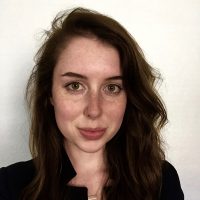
Laura Stowell
Laura Stowell is a third-year PhD Student in Art History at the University of Washington, Seattle. She received her MA in Contemporary Art from Sotheby’s Institute of Art, New York. Her research explores intersections of performance, affect, aesthetics, and trauma in art from 1945 to the present, with specific emphasis on feminist approaches to the body. In 2018 she presented a paper titled “Listening to the Body in Pain: Regina José Galindo’s (279) Golpes” at UC San Diego’s Graduate Visual Arts Symposium, and a paper titled “Pathography and the work of Alina Szapocznikow” at the Legacies of the Enlightenment Workshop at Michigan State University. She worked as the Curatorial Assistant at the Henry Art Gallery, Seattle, and plans on continuing to work in the curatorial field.
Criteria for the Scholarship
Awardees were chosen at random and fulfilled the following criteria:
- Individuals were registered for the Annual Conference by the Early Registration deadline
- Individuals are current CAA members with proof of student status
- Individuals did not receive conference registration or travel reimbursement from their institution or employer
We look forward to seeing you in New York City next month! The 107th Annual Conference is February 13-16, 2019. Click here to explore the conference program.
Submit Your Work to ARTexchange at CAA 2019
posted by CAA — January 23, 2019
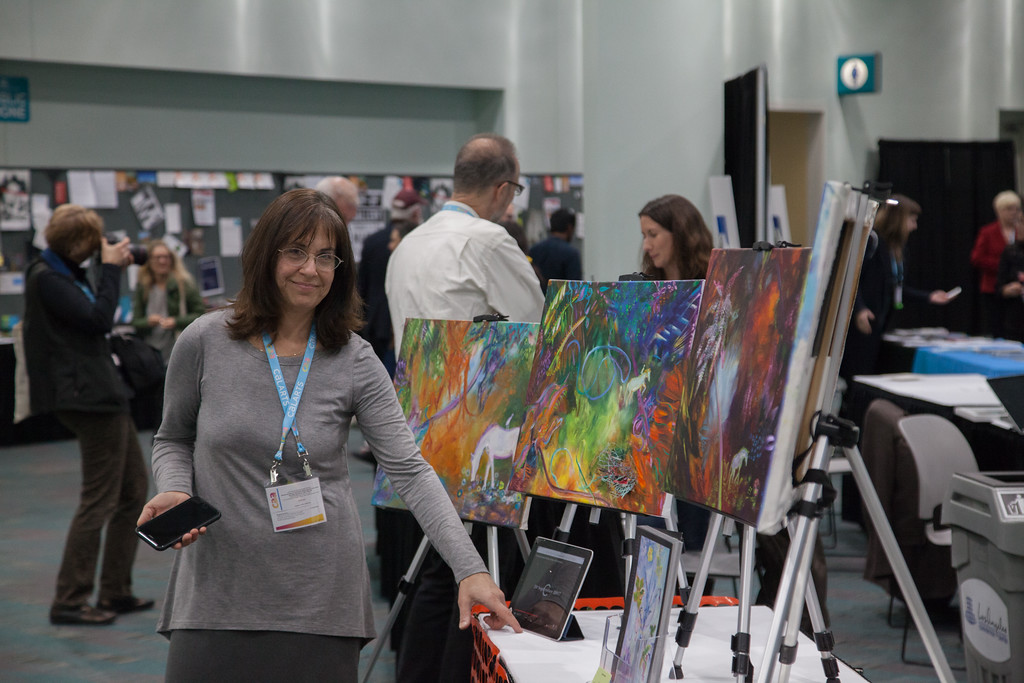
Artist Joanne Tarlin presents her work at ARTexchange at the 2018 CAA Annual Conference in Los Angeles. Photo: Rafael Cardenas
The Services to Artists Committee invites artist members to submit work to ARTexchange, CAA’s pop-up exhibition and annual social event for artists and curators. This event provides an opportunity for artists to share their work and build affinities with other artists, historians, curators, and cultural producers. ARTexchange will take place Friday evening, February 15, 2019, from 5:30–7:30 PM, and is free and open to the public.
Participating CAA members will be given space to share their work on, above and beneath a six-foot table. Artwork cannot be hung on walls, and it is not possible to run power cords devices. Participants are responsible for their own work. Sales of work are not permitted. Performance, process-based, interactive, and participatory works are especially encouraged.
Please be sure to provide all of the following information in order to complete your submission:
- A short biography or artist statement. (150 words max)
- A description of what you will exhibit and how you will use the space. Please include any details regarding performance, sound, spoken word, or technology-based work, laptop/tablet digital or media presentations. (250 words max)
- Your CAA member number (memberships must be valid).
- A link to a website of your work or 5-10 images of your recent work, including: title, year, medium and dimensions. (Maximum image size 5 mb of 1500pixels largest size and sent as JPG)
Submissions to ARTexchange can be and sent by email to Julie Hughes (artexchangeCAA@gmail.com) with “ARTexchange” and your last name in the subject line.
Deadline to submit: February 1, 2019
Announcing the 2019 Awards for Distinction Recipients
posted by CAA — January 17, 2019
Honorees this year include Howardena Pindell, Ursula von Rydingsvard, Anna C. Chave, Senga Nengudi, Nancy S. Steinhardt, Edward Sullivan, Molly Nesbit, and many other scholars, artists, authors, and teachers
CAA Annual Conference, New York City, February 13-16, 2019
CAA is pleased to announce the recipients and finalists of the 2019 Awards for Distinction. Awardees this year were chosen from a pool of scholars, artists, teachers, and authors who are constantly pushing our understanding of the visual arts. The CAA Awards for Distinction are presented during Convocation at the CAA Annual Conference on Wednesday, February 13 at 6:00 PM at the New York Hilton Midtown. The CAA Annual Conference runs from February 13-16, 2019.
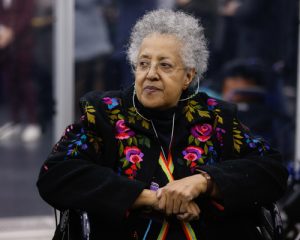
Howardena Pindell. Courtesy the artist and Garth Greenan Gallery.
Among the winners this year is Howardena Pindell, recipient of the 2019 Distinguished Artist Award for Lifetime Achievement. Pindell studied painting at Boston University and received her MFA from Yale University. Since 1979, she has been a professor of painting and conceptual drawing at SUNY Stony Brook University. Pindell is the recipient of a Guggenheim Fellowship, two National Endowment for the Arts grants, a Joan Mitchell Foundation grant, and a Studio Museum in Harlem Artist Award. In 1990, CAA awarded her the Most Distinguished Body of Work or Performance Award. Pindell’s work is in the permanent collection of the Metropolitan Museum of Art, the Museum of Modern Art, the Whitney Museum of American Art, the Yale University Art Gallery, the Fogg Museum at Harvard University, and the Rhode Island School of Design Museum, among many others.
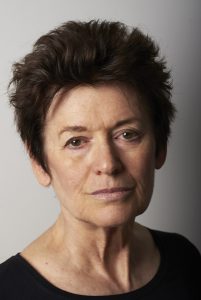
Ursula von Rydingsvard. Photo: Zack Garlitos
Ursula von Rydingsvard is the winner of the 2019 Artist Award for Distinguished Body of Work. Von Rydingsvard is best known for her unmistakable towering sculptures with mountainous topographic surfaces created from carved cedar wood. She has also explored other mediums in her work, such as bronze, paper, and resin. Over an artistic career spanning more than forty years, Von Rydingsvard’s work has been in solo exhibitions at Galerie Lelong, SCAD Museum of Art, the Philadelphia Museum of Art, and Dieu Donné. Her work has been included in numerous group exhibitions and is in the permanent collections of more than thirty museums. She is the recipient of a Lifetime Achievement Award from the International Sculpture Center, the Skowhegan Medal for Sculpture, a Joan Mitchell Foundation grant, and an Academy Award in Art from the American Academy of Arts and Letters, among other awards and recognitions. A major exhibition of her work, Ursula von Rydingsvard: The Contour of Feeling, was presented at the Fabric Workshop and Museum in Philadelphia (April 27 – August 26, 2018) and will travel to the National Museum of Women in the Arts in March 2019.
The Award for Excellence in Diversity recognizes the work of an individual or organization in the visual arts whose commitment to inclusion in scholarship or practice stands out as groundbreaking and unifying. The winner of the Award for Excellence in Diversity for 2019 is the Chicano Studies Research Center at UCLA. The work of the center entails five distinct areas: a library, an academic press, collaborative research projects, public programs and community partnerships, and a grant and fellowship program.
Each year, CAA awards two Distinguished Feminist Awards, one to a visual artist and one to a scholar. The two winners for 2019 are Senga Nengudi for visual artist, and Anna C. Chave for scholar.
The full list of 2019 CAA Awards for Distinction Recipients
Artist Award for Distinguished Body of Work
Ursula von Rydingsvard
Distinguished Artist Award for Lifetime Achievement
Howardena Pindell
Distinguished Teaching of Art Award
Susanne Slavick
Distinguished Feminist Award—Visual Artist
Senga Nengudi
Distinguished Feminist Award—Scholar
Anna C. Chave
Distinguished Teaching of Art History Award
Nancy S. Steinhardt
Edward Sullivan
Distinguished Lifetime Achievement Award for Writing on Art
Molly Nesbit
Award for Excellence in Diversity
Chicano Studies Research Center (CSRC)
Charles Rufus Morey Book Award
Zeynep Çelik Alexander
Kinaesthetic Knowing: Aesthetics, Epistemology, Modern Design
University of Chicago Press, 2017
Finalists
Olga Bush
Reframing the Alhambra: Architecture, Poetry, Textiles and Court Ceremonial
Edinburgh University Press, 2018
Linda Kim
Race Experts: Sculpture, Anthropology, and the American Public in Malvina Hoffman’s Races of Mankind
University of Nebraska Press, 2018
Carolyn Yerkes
Drawing after Architecture
Princeton University Press, 2017
Alfred H. Barr Jr. Award
Wendy Kaplan
Design in California and Mexico 1915–1985: Found in Translation
Los Angeles County Museum of Art, 2017
Finalists
Jeffrey Spier and Timothy Potts
Beyond the Nile: Egypt and the Classical World
J. Paul Getty Trust, 2018
Christophe Cherix
Adrian Piper: A Synthesis of Intuitions 1965–2016
Museum of Modern Art, 2018
Naoko Takahatake and Jonathan Bober
The Chiaroscuro Woodcut in Renaissance Italy
Los Angeles County Museum of Art, 2018
Cecilia Fajardo-Hill, Andrea Giunta, and Rodrigo Alonso
Radical Women: Latin American Art, 1960–1985
Hammer Museum, University of California, 2017
Alfred H. Barr Jr. Award for Smaller Museums, Libraries, Collections, and Exhibitions
Andrew C. Weislogel and Andaleeb Badiee Banta
Lines of Inquiry: Learning from Rembrandt’s Etchings
Herbert F. Johnson Museum of Art, Cornell University, 2017
Finalists
Patrick A. Polk, Roberto Conduru, Sabrina Gledhill, and Randal Johnson
Axé Bahia: The Power of Art in an Afro-Brazilian Metropolis
Fowler Museum at UCLA, 2018
Antonio Sergio Bessa and Jessamyn Fiore
Gordon Matta-Clark: Anarchitect
Bronx Museum of Art, 2017
Mark Sloan
Fahamu Pecou: Visible Man
Halsey Institute of Contemporary Art, 2016
Frank Jewett Mather Award for Art Criticism
Julia Bryan-Wilson
Fray: Art + Textile Politics
University of Chicago Press, 2017
Rebecca M. Schreiber
The Undocumented Everyday: Migrant Lives and the Politics of Visibility
University of Minnesota Press, 2018
Art Journal Award
Mara Polgovsky Ezcurra
“Beyond Evil: Politics, Ethics, and Religion in Léon Ferrari’s Illustrated Nunca más”
Art Journal, Fall 2018
Arthur Kingsley Porter Prize
Nathan T. Arrington
“Touch and Remembrance in Greek Funerary Art”
The Art Bulletin, September 2018
CAA/AIC Award for Distinction in Scholarship and Conservation
Karl D. Buchberg
Jodi Hauptman
Learn about the juries that select the recipients of the CAA Awards for Distinction.
Contacts
Nick Obourn, Director of Communications, Marketing, and Membership
nobourn@collegeart.org, 212-392-4401
Joelle Te Paske, Media and Content Manager
jtepaske@collegeart.org, 212-392-4426
IMAGES AVAILABLE UPON REQUEST
Hashtags: #CAA2019 #CAANYC
CAA Announces Notable Speakers for 2019 Annual Conference in New York
posted by CAA — December 03, 2018
Artist Joyce J. Scott leads as Keynote; Distinguished Scholar Elizabeth Hill Boone; Artist Interviews with Julie Mehretu and Julia Bryan-Wilson and Guadalupe Maravilla and Sheila Maldonado; Designer Stephen Burks, and Douglas Dreishpoon and Randy Kennedy with Mary Helimann, Bob Stewart, and John Giorno, among many other notable speakers and presenters
The Getty Foundation to receive the Outstanding Leadership in Philanthropy Award
We’re delighted to announce the following special guests will be presenting at the 107th CAA Annual Conference, taking place February 13-16, 2019, at the New York Hilton Midtown.
Keynote Speaker
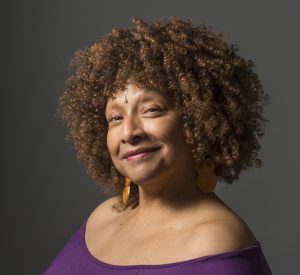
Joyce J. Scott. Photo: John Dean
The Keynote Speaker for the 107th CAA Annual Conference will be Joyce J. Scott, sculptor and craftsperson and 2016 MacArthur Fellow. Scott is best known for her figurative sculpture and jewelry using free-form off-loom bead weaving techniques similar to a peyote stitch, as well as blown glass, and found objects. Over the past 50 years, Scott has established herself as an innovative fiber artist, print maker, installation, and performing artist. She explores challenging subjects, powerfully revealing the equality between materials and practices often associated with “craft” and “fine art.”
Scott is the recipient of myriad commissions, grants, awards, residencies, and prestigious honors from the National Endowment for the Arts, the Louis Comfort Tiffany Foundation, Anonymous Was a Woman, American Craft Council, National Living Treasure Award, and has received a Lifetime Achievement Award from the Women’s Caucus for the Arts, a Mary Sawyers Imboden Baker Award, among others.
CAA Convocation featuring Joyce J. Scott’s Keynote will take place Wednesday, February 13, 2019, from 6-7:30 PM. Free and open to the public.
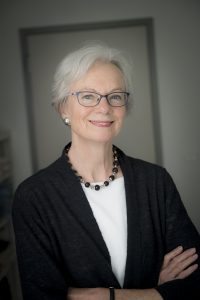
Elizabeth Hill Boone. Photo: Paula Burch
Distinguished Scholar
The Distinguished Scholar for the 107th CAA Annual Conference will be Elizabeth Hill Boone, Professor of History of Art and Martha and Donald Robertson Chair in Latin American Art at Tulane University. An expert in the Pre-Columbian and early colonial art of Latin America with an emphasis on Mexico, Professor Boone is the former Director of Pre-Columbian Studies at Dumbarton Oaks and recipient of numerous honors and fellowships, including the Order of the Aztec Eagle, awarded by the Mexican government in 1990. Read our interview with Elizabeth Hill Boone.
The Distinguished Scholar Session will take place Thursday, February 14, 2019, from 4-5:30 PM.
Distinguished Artist Interviews
The Annual Artist Interviews will feature two artist interviews: Julie Mehretu interviewed by Julia Bryan-Wilson and Guadalupe Maravilla interviewed by Sheila Maldonado.
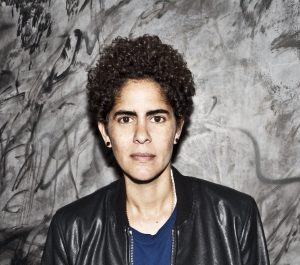
Julie Mehretu. Photo: Anastasia Muna
Julie Mehretu is a world-renowned painter, born in Addis Ababa, Ethiopia in 1970, who lives and works in New York City and Berlin. She received a Master’s of Fine Art with honors from The Rhode Island School of Design in 1997. Mehretu is a recipient of many awards, including the The MacArthur Fellowship (2005) and the US Department of State Medal of Arts Award (2015). She is best known for her large-scale paintings that take the abstract energy, topography, and sensibility of global urban landscapes and political unrest as a source of inspiration. She has shown her work extensively in international and national solo and group exhibitions and is represented in public and private collections around the world. Julia Bryan-Wilson is Doris and Clarence Malo Chair and Professor of Modern and Contemporary Art at University of California, Berkeley.
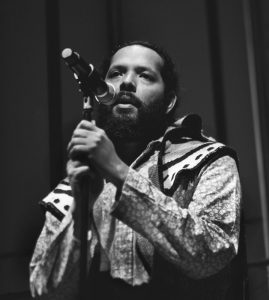
Guadalupe Maravilla. Photo: Raul Rodarte Torres
Guadalupe Maravilla (formally Irvin Morazan) was part of the first wave of undocumented children to arrive at the United States border in the 1980s from Central America. In 2016, as a gesture of solidarity with his undocumented father (who uses Maravilla as his last name in his fake identity) Irvin Morazan changed his name to Guadalupe Maravilla. Maravilla has performed and presented his work extensively in venues such as the Whitney Museum of American Art, New Museum, The Metropolitan Museum of Art, The Bronx Museum, El Museo Del Barrio, Jersey City Museum, Caribbean Museum (Colombia), and MARTE Museum (El Salvador). His work has been recognized by numerous awards and fellowships including, Franklin Furnace, Creative Capital Grant, Joan Mitchell Emerging Artist Grant, Art Matters Grant & Fellowship, Virginia Museum of Fine Arts Fellowship, Dedalus Foundation Fellowship and the Robert Mapplethorpe Foundation. Sheila Maldonado is a New York-based writer and poet, whose family hails from Honduras.
The Distinguished Artist Interviews will take place Friday, February 15, 2019, 3:30-5:30 PM. Free and open to the public.
CAA Committee on Design Featured Speaker
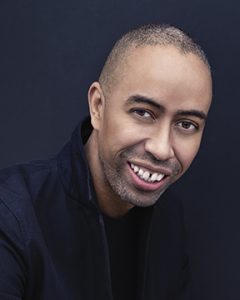
Stephen Burks. Photo: Photography Emin
CAA is also pleased to announce that designer Stephen Burks will speak at the Annual Conference in a special event of the CAA Committee on Design. Burks will lead a talk titled, “Objects of African Descent: Tracing the lineage and influence of everyday African objects and culture throughout the diaspora and beyond.” Burks believes in a pluralistic vision of design inclusive of all cultural perspectives. For his efforts with artisan groups around the world, he has been called a design activist. His ongoing Man Made project bridges the gap between authentic developing world production, industrial manufacturing, and contemporary design. Independently and through association with the nonprofits Aid To Artisans, Artesanias de Colombia, the Clinton Global Initiative, Design Network Africa, and the Nature Conservancy, Burks has consulted on product development with artisan communities throughout the world. In addition, leading, manufacturers have commissioned his studio, Stephen Burks Man Made, to develop lifestyle collections that engage hand production as a strategy for innovation. In 2015, Burks was awarded the National Design Award in product design and in 2018, the Harvard Loeb Fellowship.
UPDATE, January 28, 2019: Unfortunately due to scheduling conflicts this event is canceled. Explore other presentations on design here.
Outstanding Leadership in Philanthropy Award

For the second year, CAA will present the Outstanding Leadership in Philanthropy Award to a foundation or philanthropic organization that has established a record of exceptional generosity and civic and charitable responsibility. This year’s award will be given to the Getty Foundation.
Childcare Available at 2019 CAA Annual Conference
posted by CAA — November 28, 2018

In 1971, CAA first began the discussion to offer childcare at the Annual Conference. In 1976, after five years of discussion, CAA decided the risks of offering child care were too high and did not move forward. Over 40 years later, CAA will provide childcare at the Annual Conference for the first time. For the 107th CAA Annual Conference, CAA partnered with Kiddie Corp to offer onsite childcare for ages 6 months to 12 years of age at a price of $12 an hour. Kiddie Corp programs feature arts and crafts, group games, music and movement, board games, story time, dramatic play, and many more engaging activities. Kiddie Corp is in its 33rd year of providing childcare services at conferences and trade shows and has a longstanding partnership with the American Academy of Pediatrics.
Learn more about Childcare at the 2019 CAA Annual Conference.
The deadline to sign up is January 14, 2019.
Meet the 2019 Travel Grant Recipients
posted by CAA — November 26, 2018
CAA offers Annual Conference Travel Grants to graduate students in art history and studio art and to international artists and scholars. Meet this year’s recipients below.
CAA TRAVEL GRANT IN MEMORY OF ARCHIBALD CASON EDWARDS, SENIOR, AND SARAH STANLEY GORDON EDWARDS
Established by Mary D. Edwards with the help of others, the CAA Travel Grant in Memory of Archibald Cason Edwards, Senior, and Sarah Stanley Gordon Edwards supports women who are emerging scholars at either an advanced stage of pursuing a doctoral degree or who have received their PhD within the two years prior to the submission of the application.
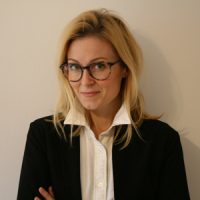
Hollyamber Kennedy, Columbia University
Session: Migration and Colonial Modernities
Paper: Infrastructures of “Legitimate Violence”: Notes on The Prussian Settlement Commission’s Border Villages
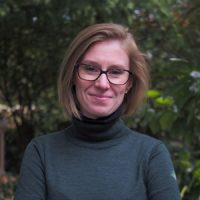
Kaja Tally-Schumacher, Cornell University
Session: Perimeter, Periphery, Partition: Exploring Boundaries in Gardens and Landscapes
Paper: A Spectrum of Life: Exploring Blurred Boundaries in Human and Plant Bodies in Roman Gardens
CAA GRADUATE STUDENT CONFERENCE TRAVEL GRANTS
CAA awards Graduate Student Conference Travel Grants to advanced PhD and MFA graduate students as partial reimbursement of travel expenses to the Annual Conference.
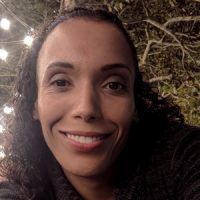
J’han Brady
American University
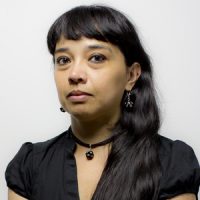
Gabriela Germana
Florida State University
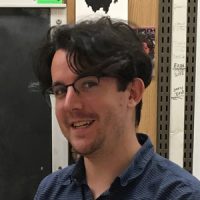
Anthony Hamilton
Illinois State University

Donato Loia
University of Texas at Austin
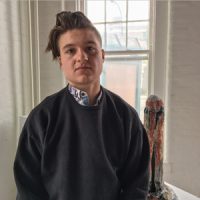
Marval Rechsteiner
Queer Art Network
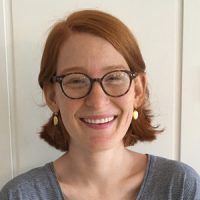
Anna Van Voorhis
University of Minnesota-Twin Cities
CAA INTERNATIONAL MEMBER CONFERENCE TRAVEL GRANTS
CAA awards the International Member Conference Travel Grant to artists and scholars from outside the United States as partial reimbursement of travel expenses to the Annual Conference.
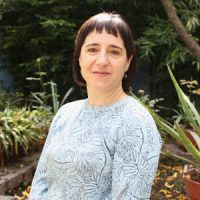
Élodie Dupey
Universidad Nacional Autónoma de México, Mexico
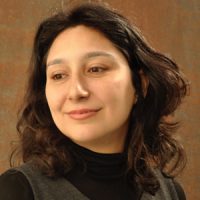
Ana Mannarino
Federal University of Rio De Janeiro, Brazil
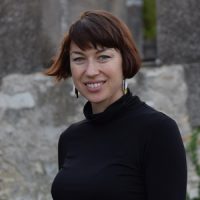
Chalice Mitchell
Independent Artist, United Kingdom
SAMUEL H. KRESS FOUNDATION CAA CONFERENCE TRAVEL FELLOWSHIP FOR INTERNATIONAL SCHOLARS
Recognizing the value of first-hand exchanges of ideas and experience among art historians, the Kress Foundation is offering support for international scholars participating as speakers at the 2018 CAA Annual Conference. The scholarly focus of the papers must be European art before 1830. Kress recipients will be announced in January 2019.
CAA-GETTY INTERNATIONAL PROGRAM
Every year since 2012, the CAA-Getty International Program has brought between fifteen and twenty art historians, museum curators, and artists who teach art history to attend CAA’s Annual Conference. This program is funded on an annual basis by the Getty Foundation. Click here to meet the CAA-Getty International Program participants.
An Interview with Elizabeth Hill Boone, 2019 CAA Distinguished Scholar
posted by CAA — November 20, 2018
We are pleased to welcome Elizabeth Hill Boone, Professor of History of Art and Martha and Donald Robertson Chair in Latin American Art at Tulane University, as the 2019 CAA Distinguished Scholar.
An expert in the Precolumbian and early colonial art of Latin America with an emphasis on Mexico, Professor Boone is the former Director of Pre-Columbian Studies at Dumbarton Oaks and recipient of numerous honors and fellowships, including the Order of the Aztec Eagle, awarded by the Mexican government in 1990.
CAA media and content manager Joelle Te Paske corresponded with her recently to learn her thoughts on art history, scholarship, and challenges in the field. Read their interview below.
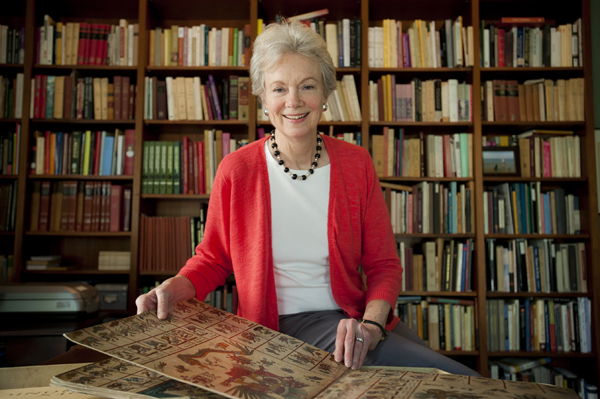
Photo: Paula Burch, Tulane University
Joelle Te Paske: Thanks for taking the time to speak with CAA. So, where are you from originally?
Elizabeth Hill Boone: Coming from a military family rooted in Virginia, I moved from coast to coast often as a child and then attended the College of William and Mary in Virginia for my BA.
JTP: What pathways led you to the work you do now?
EHB: It was at William and Mary, where I was a Fine Arts major. The sculpture professor Carl Roseberg offered a course, Ancient Art, that included a three-week section on the Pre-Columbian Americas. He showed us and presented the then-canonical explanation of the monumental “Coatlicue” sculpture from Aztec Mexico, and I was immensely intrigued. I wondered what kind of mind would conceptualize and carve a work like that as its creator or mother goddess. That question led me into Aztec studies, which took me to the University of Texas at Austin for my PhD, and to Aztec painted books, where similar images were to be found. I became a manuscript specialist because I needed to understand what the manuscript paintings meant, how they related to the Coatlicue, why they came to fill those particular pages. Since the field of Mexican manuscript painting was in its infancy, I left the Coatlicue behind to focus on the other manuscript genres and Mexican pictography as a system. My study of Mexican pictography naturally led me to the issue of how the concept of Writing should be broadened.
JTP: What are you working on currently?
EHB: I am now finishing up a book analyzing the corpus of pictorial manuscripts created in the early colonial period to document the ideologies and practices of Aztec culture. United by their decendency from Mexican pictography, these painted reflections of the Aztec past were re-purposed to inform Europeans principally about Aztec religion, as weapons of conversion and aids for colonial administrators.
JTP: What is your favorite part of the work you do?
EHB: I think most art historians love solving mysteries: discovering connections and uncovering histories and contexts. I want to understand what an object meant to its different audiences at the time of its creation, and also what it can tell us now about our own perspectives. Depending on the object, it can also be rewarding and telling to track its reception and reconceptualization through time.
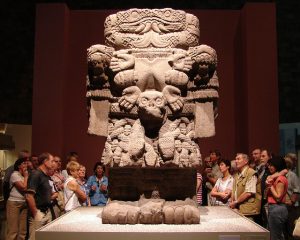
Coatlicue Statue in National Museum of Anthropology, Mexico City. Photo: Antony Stanley
JTP: If you could boil your teaching philosophy down to a central idea, what would it be?
EHB: My goal is to excite students about the potentials of visual expression. This means giving them knowledge of the material such that they can understand its cultural context and power, but also showing the students how the objects speak today as works of art.
JTP: What’s exciting to you right now in the field?
EHB: Globalism. The discipline has broken the confines that once centered it in Western Europe and is now focusing on connections between peoples. Centers of discourse are now shifting toward the larger Atlantic world, the Pacific world, the Silk Road, and the trans-Mediterranean/African network, to name just a few. It is opening up new ways of understanding the meaning and agency of art.
JTP: What do you see as the greatest challenges in the field right now?
EHB: I see two challenges. The first and most important is relevance. Art history must articulate why it matters in these times. As graphic communication (communication that is not oral or gestural) becomes even more the principal form of communication between people, the discipline needs to assert its place as a source of theoretical knowledge and of models for investigative practice.
The second challenge is linked to the increasing study of trans-cultural connections. Scholars who seek to follow the movement of objects and ideas across spaces and between cultures need to develop strong local knowledge of all participants, so that these global connections are grounded in area expertise. In order to avoid facile comparisons and connections, researchers now have to master multiple areas.
JTP: Have you attended CAA conferences? Do you have a favorite memory?
EHB: I have attended many. Perhaps my favorite memories are of cross-cultural sessions that focus on issues relevant to many cultures, for example, civic identity, and in which the presenters push their material to address the large question in a serious way.
JTP: Thank you, Professor Boone. We’re looking forward to seeing you at the 2019 conference.
Elizabeth Hill Boone is Professor of History of Art and Martha and Donald Robertson Chair in Latin American Art at Tulane University. An expert in the Precolumbian and early colonial art of Latin America with an emphasis on Mexico, she is the former Director of Pre-Columbian Studies at Dumbarton Oaks. Professor Boone has earned numerous honors and fellowships, including the Order of the Aztec Eagle, awarded by the Mexican government in 1990. She is a Fellow of the American Academy of Arts and Sciences and a Corresponding Member of the Academia Mexicana de la Historia. Her research interests range from the history of collecting to systems of writing and notation, and are grounded geographically in Aztec Mexico, but extend temporally for at least a century after the Spanish invasion. She is the author of Cycles of Time and Meaning in the Mexican Books of Fate (Texas, 2007) and Stories in Red and Black: Pictorial Histories of the Aztecs and Mixtecs (Texas, 2000), which was awarded the Arvey Prize by the Association for Latin American Art.