
CAA News Today
Member Spotlight: Arnold J. Kemp
posted by CAA — September 18, 2019
We are delighted to welcome Arnold J. Kemp, in conversation with Huey Copeland, as one of our Distinguished Artist Interviews at the 2020 CAA Annual Conference. Learn more.
Up next in our Member Spotlight series, we are highlighting the work of Arnold J. Kemp, professor of Painting and Drawing and Dean of Graduate Studies at the School of the Art Institute of Chicago (SAIC). Joelle Te Paske, CAA’s media and content manager, corresponded recently with Professor Kemp to learn more about his work. Read the interview below:
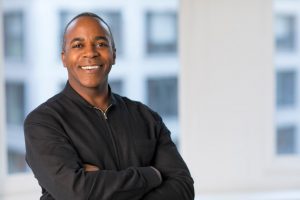
Arnold J. Kemp. Photo: Todd Rosenberg for the School of the Art Institute of Chicago
Where are you from originally?
I am from the 6 square miles of a Boston neighborhood called Dorchester. The back of my high school, which was located in the Fenway, faced the Isabella Stewart Gardener Museum and was just a few blocks away from the Museum of Fine Arts. I took classes at the MFA through an after school program supported by the Boston Public School system, and I was lucky to be asked to take classes at the School of the Museum of Fine Arts, Boston during the summers of my sophomore and junior years of high school.
During my senior year in high school I went to New York City to visit my older sister, and while she was at work I spent the day at the Metropolitan Museum of Art. I was entranced with the African and Oceanic collections there and I learned all that could. This was a transformative experience that has much to do with the way I have surrounded myself in an immersive life in the arts, culture, and literature.
What pathways led you to the work you do now?
After graduating high school I took part an internship working for the Smithsonian’s National Air and Space Museum. I learned a lot there about how museums functioned. Then, in college at Tufts University, I worked for the Boston Center for the Arts while my roommates and I ran a small organization that showed our peers—other young artists and writers—and invited guests such as Tim Rollins, Emett Gowin, and Marie Howe. I was aware that not far away, the Dark Room Collective—which included Ellen Gallagher, Kevin Young, Tisa Bryant, Thomas Sayers Ellis, and Sharan Strange—was doing similar things. In fact, Ellen Gallagher and I worked together on the night shift at the Museum School’s library.
In 1991, when the art world was still struggling to distill the pain and loss of the AIDS epidemic, I moved to San Francisco and marched with ACT UP. Around that time I also started working at the not-for-profit experimental space called New Langton Arts, and I participated in the later days of conferences organized by the National Association of Artist’s Organizations (NAAO).
At Langton I met role models such as Renny Pritikin, Judy Moran, Jon Winet, Holly Block, Ann Philbin, and James Elaine who believed in spaces started by artists to support artists. I also met many great artists and writers who were central to the literary movement called New Narrative and places such as Small Press Traffic, The Lab and The Luggage Store gallery. Kevin Killian, Dodie Bellamy, Kathy Acker, Bob Glück, Barret Watten, Leslie Scalpino, Quincy Troupe, Harryette Mullen had a big influence on me. These people are important to me because they encouraged me to be an artist, a poet, and a curator. They showed me how to curate and showed me values of good organizations that supported communities struggling for relevance.
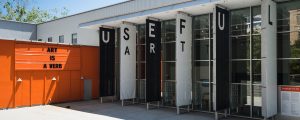
Courtesy Yerba Buena Center for the Arts.
At that time I had no idea that I would end up teaching. I was supporting myself by working for arts non-profits. I kept doing more and more in this arena and eventually became an assistant curator and then associate curator at Yerba Buena Center for the Arts (YBCA). I worked there for ten years and curated solo and group exhibitions and worked with artists such as David Hammons, Patty Chang, Carrie Mae Weems, Fred Wilson, Ellen Gallagher, Laylah Ali, Bruce Conner, John Baldessari, Michael Joo, and so many others. I even met Bill T. Jones, Meredith Monk, Philip Glass, and Conlon Nancarrow while working at YBCA. I worked there from its start in 1993 until 2003 when I left to attend graduate school at Stanford.
Teaching came somewhat naturally while I was pursuing an MFA at Stanford. After grad school and after struggling for a few years as a New York artist, an opportunity arose for me to direct the MFA in Visual Studies Department and to teach at the Pacific Northwest College of Art in Portland, Oregon. Prior to teaching in Portland I had an exhibition there and curated and organized a public program around my exhibition as part of Portland Institute for Contemporary Art’s TBA Festival. So much seemed possible in Portland, and I developed a true art family there.
The desire to experience working with larger schools and more diverse populations led me to positions as Chair of the Department of Painting and Printmaking at Virginia Commonwealth University (VCU) and also to my current position as Dean of Graduate Studies at the School of the Art Institute of Chicago (SAIC).
What are you working on currently?
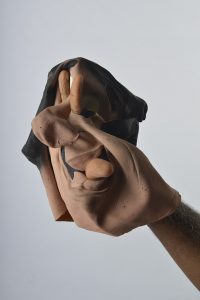
Arnold J. Kemp, Untitled, 2018, archival pigment print, 61 x 41 inches. Courtesy the artist.
I am always busy in the studio. I just completed delivering 23 works to the set of a remake of a Hollywood film that is currently being shot in Chicago. It turns out the producer of Jordan Peele’s films has been looking at my work for a long time, and I am glad that this opportunity has come my way.
I am also preparing for a solo show opening at the Los Angeles-based nonprofit JOAN in September 2020, followed by a solo show at Fourteen30 Contemporary, my gallery in Portland. For both these shows I will exhibit paintings and sculptures. Perhaps there will be a performance of one of my plays that have been staged in art galleries and artists’ spaces such as Biquini Wax EPS in Mexico City.
I also just joined the board of Threewalls, a Chicago-based nonprofit with an itinerant exhibition program that supports and encourages art practices that respond to lived experience, encouraging connections beyond art. As part of Threewalls’ board I will be involved again in expanding the discourse around the presentation and exhibition of contemporary art—from Threewalls, to the fourth wall, to breaking down walls. This is where itinerancy comes into play as the presentation model for Threewalls.
Having lived and practiced as an artist, writer, curator and educator in Boston, San Francisco, New York, Portland, Chicago and Richmond, I have had a life that is productively itinerant!
How would you say poetry weaves itself through your work?
For many years theses were separate activities, but in 2012 I began writing theatrical works with spoken lines that are meant to be performed in galleries by non-actors chosen from the community in which the piece is performed. Often the pieces concern that community so I might sometimes have a local artist or curator play themselves. This happened most recently at the venue in Mexico I mentioned, Biquini Wax EPS, in a farce that I wrote based on my experiences in the art and academic worlds. The piece was translated into Spanish and performed by local artists, writers, curators, and activists. I think of the pieces as time based-sculpture. The performance was just one part of a big show titled “When the Sick Rule the World” after Dodie Bellamy’s essay of the same name.
What is a favorite exhibition you’ve worked on over the years?
When I was at Pacific Northwest College of Art I curated a two-person show of B. Wurtz and Xylor Jane. There was a catalog and public program, and it was great to bring my San Francisco, New York, and Portland communities together. Xylor Jane is painter I have known from way back in my San Francisco days. Her work is formally beautiful and inspired by numbers, the Fibonacci sequence and the color sequences of ROYGBIV. She accomplishes a lot in visually intense abstractions that are based on logical forms. B. Wurtz is older than Xylor and is more of a conceptualist, having gone to school at CalArts in its heyday. Some of his classmates were Mike Kelly and Tony Oursler. He took classes with [Michael] Asher. The show was rigorous and unexpected—it did a lot to get students to think out of the box.
Do you have a favorite artist or exhibition in general?
I am not sure, at this point, if I have favorite artists anymore, but I recall The Museum as Muse which was curated by Kynaston McShine for MoMA as being a terrifically aesthetic, intellectual, and poetic exhibition that sought to give voice to the complicated relationship between museums and artists in light of history and institutional critique. I am fortunate enough to have seen it and to also have the terrific catalog. I feel that McShine as an art world personage needs to be studied and written about. He was important not just for being the curator of Primary Structures and Information but also for being of black Caribbean descent (he was born in Trinidad) and for being a one-time the lover of Frank O’Hara. Paradoxically, his work at MoMA also caused the Guerrilla Girls to organize and fight for greater inclusion of women and people of color in New York museums. No one has dealt with McShine’s legacy or his biography in the way they should. McShine was complicated and private, and so brilliant and influential.
When did you first become a CAA member?
I joined CAA in 2013 because as a department chair at VCU’s School of the Arts I wanted to stay in touch with artists, historians, and theorists from around the country. There are certain people who I aim to see at every conference just so that we can catch up and talk about the field and find ways to organize and help each other. In some ways the CAA reminds me of NAAO conferences that I used to attend in the 1990s.
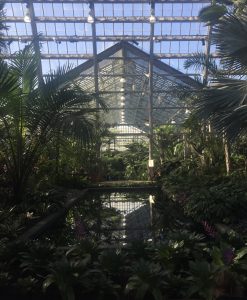
Garfield Park Conservatory. Photo: Joelle Te Paske
What should people make sure not to miss while they’re in Chicago for the 2020 conference?
In Chicago there is no such thing as bad weather, only bad clothing, so I suggest bringing a warm coat! Also, go to Garfield Park Conservatory—one of the largest and most stunning botanical conservatories in the nation with thousands of plant species from around the world throughout eight indoor display gardens.
What is your must-read book at the moment?
I would have to say Housing Shaped by Labour: The Architecture of Scarcity in Informal Settlements by Ana Rosa Chagas Cavalcanti.
How do you balance your artistic and professional roles?
Surround yourself with the things and people that you love. That is the only way I have been able to find balance. I find balance because it is a necessity and loving what I do makes it worth the time and effort.
ARNOLD J. KEMP BIOGRAPHY
Arnold J. Kemp is an interdisciplinary artist living in Chicago. The recurrent theme in his drawings, photographs, sculptures and writing is the permeability of the border between self and the materials of one’s reality. Kemp’s works are in the collections of the Metropolitan Museum of Art, The Studio Museum in Harlem, The Berkeley Art Museum and Pacific Film Archive, The Portland Art Museum, The Schneider Museum of Art, and the Tacoma Art Museum. He has received awards from the John Simon Guggenheim Memorial Foundation, the Joan Mitchell Foundation, The Pollock-Krasner Foundation, and Portland Institute for Contemporary Art. His work has been exhibited recently in Chicago, Mexico City, New York, San Francisco and Portland. His work was also shown in Tag: Proposals On Queer Play and the Ways Forward at the ICA Philadelphia. Kemp was a founding curator at Yerba Buena Center for the Arts from 1993-2003 and is currently the Dean of Graduate Studies at the School of the Art Institute of Chicago.
Submit a Proposal for Idea Exchange at CAA 2020
posted by CAA — September 16, 2019
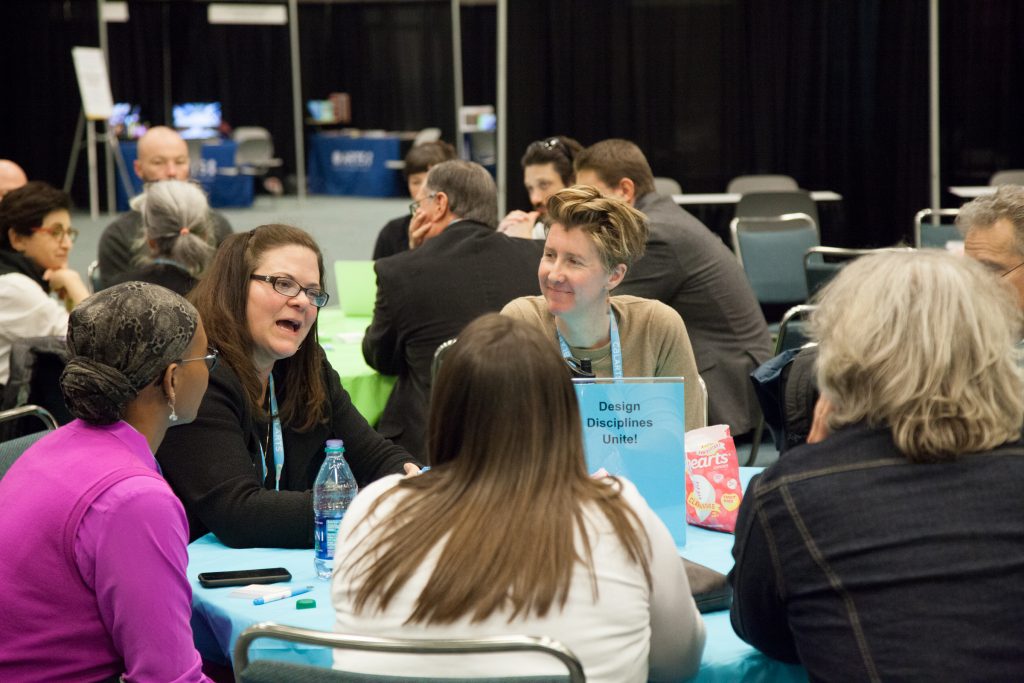
Idea Exchange at the 2018 CAA Annual Conference. Photo: Rafael Cardenas
We launched Idea Exchange at the 2018 Annual Conference in Los Angeles in response to members who expressed an interest in holding informal roundtable discussions on topics ranging from fellowship applications and gallery representation to student engagement in the classroom and preserving women artists’ legacies. See a list of previous discussion topics here.
We’re offering Idea Exchange again in 2020 and we’re looking for CAA members to serve as discussion leaders.
Propose a topic that you would like to discuss with your colleagues for a sixty-minute roundtable at the conference. It can relate to professional development, teaching, or current events, such as the debate surrounding Confederate monuments or the #MeToo movement in the arts. Be creative. The conversations are meant to be lively and engaging. Please submit your Idea Exchange proposals by November 1, 2019.
In order to submit an Idea Exchange topic, you will need to have your member ID and password ready. If you do not have an individual ID number and password or you do not know it, please contact member services by email at membership@collegeart.org or by phone at 212-691-1051, ext. 1.
Idea Exchange will be held in the Hilton Chicago, Lower Level, Salon B, during the following times:
Wednesday, February 12: 10:30 AM; 12:30 PM; 2:00 PM; 4:00 PM
Thursday, February 13: 10:30 AM; 12:30 PM; 2:00 PM; 4:00 PM
Friday, February 14: 10:30 AM; 12:30 PM; 2:00 PM; 4:00 PM
Saturday, February 15: 10:30 AM; 12:30 PM
For more information on Idea Exchange, contact Mira Friedlaender, manager of the Annual Conference, at mfriedlaender@collegeart.org or by phone at (212) 392-4405.
Call for Participation: CAA 2020 Poster Session Highlighting Undergraduate Research in Art and Art History
posted by CAA — September 05, 2019
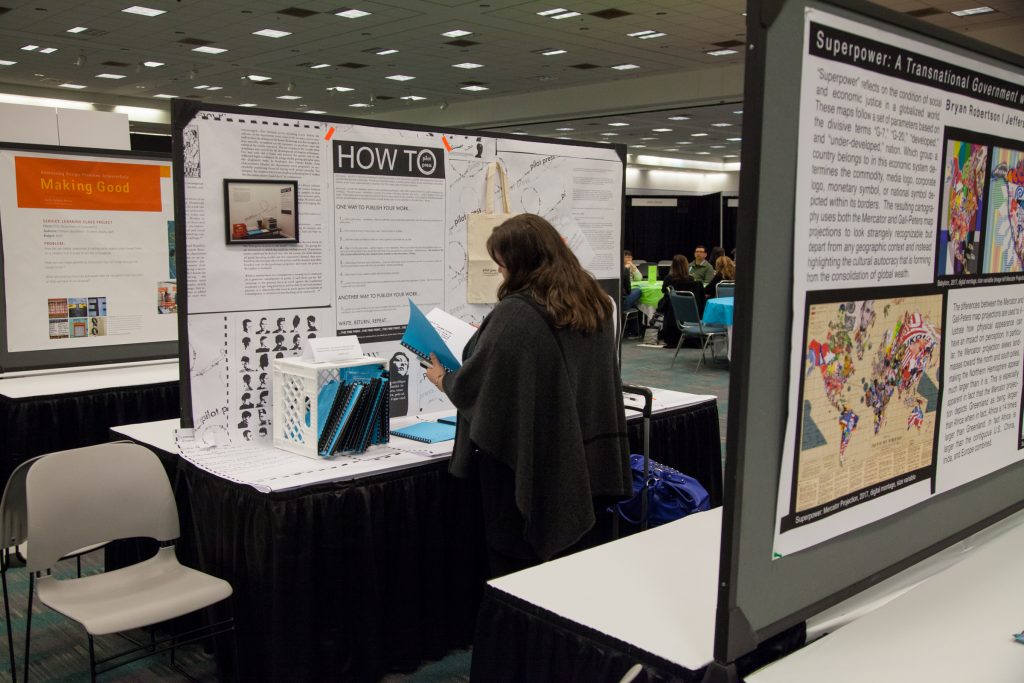
Poster sessions at the 2018 CAA Annual Conference in Los Angeles. Photo: Rafael Cardenas
We’re excited to announce a Call for Participation for a special poster session dedicated to undergraduate research for the 2020 Annual Conference in Chicago, February 12-15.
Organized by Alexa Sand, Chair of the Division of Arts and Humanities for the Council on Undergraduate Research, and Professor of Art History and Director of Undergraduate Research at Utah State University, this session is one of several events planned for CAA 2020 to provide more opportunities for undergraduate participation.
Submissions should be sent via this google form by October 31, 2019.
Selected presenters will be notified by December 1 and will need to join CAA at the student membership rate prior to participation in the conference. Participants will also be required to register for the conference.
Undergraduate research—whether part of a faculty-directed project, class-based, or an individual pursuit on the part of a student—is an ideal example of active and engaged learning. Students in art history identify questions, evaluate source material, test ideas and theories, and produce reports in some form, usually including a significant written component. In the studio art and design fields, research can take a different form, with creative practice being one way outcomes of a project can be delivered.
This poster session will be dedicated to presenting outstanding examples of undergraduate research. Submissions are invited from students conducting research such as object and/or medium studies, text-based analysis, experimental archaeology, thesis research, and/or creative inquiry. Students may choose to present findings from ongoing research or from recently completed projects.
We also encourage submissions from faculty and museum professionals who have experience with mentoring undergraduate research in Art History, Studio Art, Graphic Design, Visual Communication, and other creative fields. Faculty posters may address specific projects or case studies of student research projects, assessment of undergraduate research, characteristics of successful programs, or other approaches that addresses the challenges and benefits to students of undergraduate research.
This project proposal is part of CAA’s Undergraduate Outreach Initiative organized collaboratively by CAA’s Education Committee, Committee on Diversity Practices, Students and Emerging Professionals Committee, and the Division of Arts and Humanities, Council on Undergraduate Research.
Please contact Alexa Sand directly at alexa.sand@usu.edu with any questions.
Call for Participation for CAA 2020 Sessions Soliciting Contributors
posted by CAA — June 26, 2019
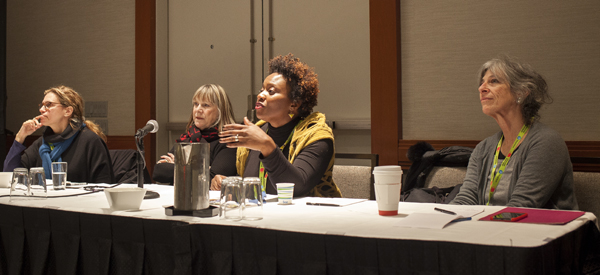
Shervone Neckles-Ortiz presents as part of “The Artist’s Vision—The Lasting Legacy” with Sharon Louden, Squeak Carnwath, and Jan Wurm at the 2019 CAA Annual Conference. Photo: Ben Fractenberg
The 2020 Call for Participation for accepted sessions soliciting contributors for the CAA Annual Conference, February 12-15 in Chicago, is now open.
From medieval art to the legacies of contemporary figures like Okwui Enwezor and Carolee Schneemann, the 2020 Annual Conference offers an enormous range of topics to explore.
A word to the wise! Submissions for this CFP are to be emailed directly to the session chair(s), listed under each session description along with their email(s). If there is more than one session chair, send materials to both chairs.
Deadline: July 23, 2019
The Getty Foundation to Fund the CAA-Getty International Program for a Ninth Year
posted by CAA — June 12, 2019
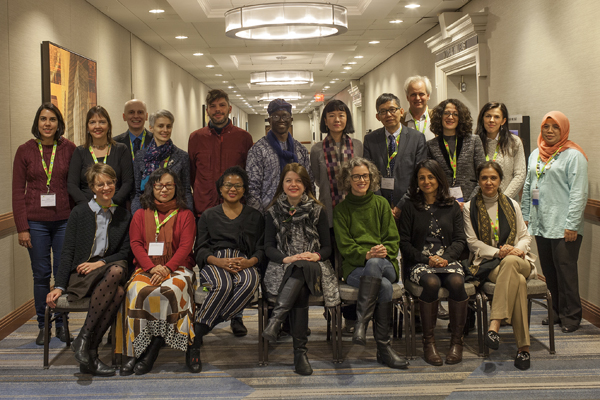
CAA-Getty Scholars at the 2019 Annual Conference in New York. Photo: Ben Fractenberg
The Getty Foundation has awarded CAA a grant to fund the CAA-Getty International Program for a ninth consecutive year. The Foundation’s support will enable CAA to bring twenty international visual-arts professionals to the 108th Annual Conference, taking place February 12-15, 2020 in Chicago. Fifteen individuals will be first-time participants in the program and five will be alumni, returning to present papers during the conference. The CAA-Getty International Program provides funds for travel expenses, hotel accommodations, per diems, conference registrations, and one-year CAA memberships to art historians, artists who teach art history, and museum curators.
The application portal is now open. Grant guidelines and the 2020 application can be found here.
“The Getty Foundation is proud to continue its commitment to the CAA-Getty International Program and offer support that brings together diverse scholars from around the world,” says Joan Weinstein, acting director of the Getty Foundation. “CAA’s dedication to this joint program strengthens the annual conference and builds the field of art history as a global discipline.”
Since the CAA-Getty International Program’s inception in 2012, it has brought over 120 first-time attendees from 46 countries to CAA’s Annual Conference. Historically, the majority of international registrants at the conference have come from North America, the United Kingdom, and Western European countries. The CAA-Getty International Program has greatly diversified attendance, adding scholars from Central and Eastern Europe, Russia, Africa, Asia, Southeast Asia, the Caribbean, and South America. The majority of the participants teach art history, visual studies, art theory, or architectural history at the university level; others are museum curators or researchers.
One measure of the program’s success is the remarkable number of international collaborations that have ensued, including an ongoing study of similarities and differences in the history of art among Eastern European countries and South Africa, attendance at other international conferences, publications in international journals, and participation in panels and sessions at subsequent CAA Annual Conferences. Former grant recipients have become ambassadors of CAA in their countries, sharing knowledge gained at the Annual Conference with their colleagues at home. The value of attending a CAA Annual Conference as a participant in the CAA-Getty International Program was succinctly summarized by alumnus Nazar Kozak, Senior Researcher, Department of Art Studies, National Academy of Sciences of Ukraine “To put it simply, I understood that I can become part of a global scholarly community. I felt like I belong here.”
Read our Member Spotlight with Nazar Kozak.
About the Getty Foundation
The Getty Foundation fulfills the philanthropic mission of the Getty Trust by supporting individuals and institutions committed to advancing the greater understanding and preservation of the visual arts in Los Angeles and throughout the world. Through strategic grant initiatives, it strengthens art history as a global discipline, promotes the interdisciplinary practice of conservation, increases access to museum and archival collections, and develops current and future leaders in the visual arts. It carries out its work in collaboration with the other Getty Programs to ensure that they individually and collectively achieve maximum effect.
CAA Assembles Working Group Against Harassment and Assault
posted by CAA — May 23, 2019
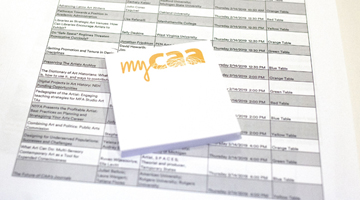 Motivated by an Idea Exchange roundtable held at the 2019 Annual Conference in New York, CAA announces the formation of a Working Group Against Harassment and Assault, aimed at addressing issues related to sexual harassment and power dynamics at the Annual Conference.
The working group is made up of CAA members from around the country, many of whom have experience effecting change at their own institutions in this arena. The working group members are:
Sonia De Laforcade, Princeton University
Claire Kovacs, Binghamton University Art Museum
Karen Leader, Florida Atlantic University
Daniel Quiles, School of the Art Institute of Chicago
Leanne Zalewski, Central Connecticut State University
The working group will meet several times over the summer of 2019 to formulate suggestions to the Board of Directors. These recommendations are intended to aid CAA in addressing the systemic and structural dynamic of power and privilege that makes space for predatory behavior at the Annual Conference.
CAA Recognizes Anniversary of Women’s Suffrage at 2020 Annual Conference
posted by CAA — April 17, 2019

Women’s suffragists parade in New York City in 1917, carrying placards with the signatures of more than a million women. (New York Times Photo Archives)
In collaboration with the Committee on Women in the Arts, CAA seeks to offer a selection of sessions, papers, speakers, and related programming for the 2020 Conference in celebration of the Centennial of Women’s Suffrage in the US, while also acknowledging the discriminatory practices that limited voting rights for Indigenous women and women of color, even after the passage of the 19th amendment in 1920.
We hope 50% of the conference’s content will be focused on women-centered research, artistic presentations, and discourse, and addresses the intersectional and transnational complexity of race, ethnicity, class, age, body size, disability, gender and sexual orientation in the arts. Reinforcing inclusivity beyond binary understandings of gender, this initiative seeks to advance a forum for increased dialogue within the context of this historical moment.
The submissions portal for the 2020 CAA Annual Conference is now open with a deadline of April 30.
See the Results of the 2019 CAA Annual Conference Survey
posted by CAA — April 02, 2019
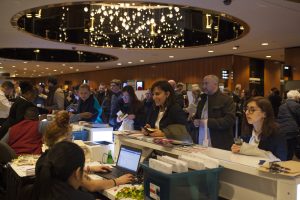
Registration at the 2019 CAA Annual Conference in New York. Photo: Ben Fractenberg
Thank you to everyone who participated in our 2019 Annual Conference survey! Each year we work to make the Annual Conference better than the year before. It’s a large effort that takes the time of many people. We only do it once year but we need to have it perfect from that first hour registration is open, and your direct feedback helps us make that happen.
Here is what you told us about your experience this year:
- Up from last year, 79% of you were satisfied with the Annual Conference
- 75% liked the content of the sessions but only half of you thought the sessions represented a balance of time periods
- 75% liked your online experience with CAA
- 74% liked the Book and Trade Fair
- 67% thought that the conference was welcoming and inclusive
Here’s what you liked about the conference:
- Professional development offerings and workshops
- Networking opportunities
- Diverse sessions, good variety, good from a scholarly point
- Staff—easy to find someone to help
- Very smooth check-in process
- Pay-as-you-Wish Day Pass
- Conference in one building (as opposed to LA)
- New York is a good destination – museums and galleries
- Length of the sessions, committees’ lunch, opportunity to participate on a panel
- Mentoring
- Welcoming and stimulating, not the “high-brow” style of years’ past; friendly, collegial spirit
- More inclusion of design
- Many people got to participate
- Planning features on website
- Childcare
- Book and Trade Fair
- Convocation
- Open sessions on diversity and other topics
- Tables where people could sit and talk
Here is what you want to think about for next year’s conference:
- Conference was too long, and conference fatigue was inevitable
- Need more offerings for mentoring and interviewing
- Bring back the free paper schedule program
- 90-minute sessions are too short for 5 presenters; 8:30 is too early for some sessions
- Too many things are scheduled at the same time
- Too much for art historians rather than artists
- Not enough for art historians
- New York is always a problem with weather and too expensive ($13 for a glass of wine?)
- Could never find the soul to the conference —leaves me feeling sad about our field
- Very few senior scholars or mid-career attended, making it feel like a graduate student mentoring event
- Too many sessions on the same topics and at the same time
- Needs more transparency on how sessions are selected and put together
- There was a lack of diverse topics
- Way too large and overwhelming—no one had a chance to network—conference is no longer an academic one
- Abstracts should be available online
- The website is very confusing
- Too many presenters read from their papers, looking down
- Nothing to attract scholars or historians
- Why are there almost no artists outside of academia at CAA
Here is what you told us about you:
- About 67% of you are art historians; 24% are practicing artists
- 77% of you are associated with a college or university and nearly half of you are either full-time faculty or department chairs
- 75% of you pay for your membership fees yourself; about half of you are fortunate to have your employer to pay for it
Planning to submit a proposal for CAA 2020? The submissions portal for next year’s Annual Conference in Chicago closes April 30. We invite proposals for sessions, lightning rounds, poster sessions, and workshops from visual arts professionals working across the field in all disciplines.
Rejoin CAA in April and Get 25% Off Your Membership
posted by CAA — April 01, 2019
There is strength in numbers. Every day, CAA is working on behalf of professionals in the visual arts to create resources, build networks, and encourage scholarship at the highest levels. The louder our voice, the more we can do.
Rejoin CAA during the month of April and get 25% off any Tiered membership level.
Plan on participating in the 2020 Annual Conference in Chicago, February 12-15, 2020? Submissions are due April 30, 2019.
Join your colleagues and fellow professionals in creating the programming for the largest gathering of art historians, artists, designers, curators, arts administrators, museum professionals, and others in the visual arts.
Now is the perfect time to rejoin and save.
Offer valid from April 1–April 30, 2019, 11:59 PM EST, to individual lapsed members for a one-year membership. Discount applies only to those whose membership has lapsed between January 1, 2012 and January 1, 2018. Log in to your CAA account to view the discount code.
Questions? Contact Member Services at 212-691-1051, ext. 1.
Serve on a CAA Award Jury
posted by CAA — March 28, 2019
CAA invites nominations and self-nominations for individuals to serve on ten of the fourteen juries for the annual Awards for Distinction for three years (2019–22). Terms begin in May 2019; award years are 2020–22.
CAA’s fourteen awards honor artists, art historians, authors, curators, critics, and teachers whose accomplishments transcend their individual disciplines and contribute to the profession as a whole and to the world at large.
Candidates must possess expertise appropriate to the jury’s work and be current CAA members. They should not hold a position on a CAA committee or editorial board beyond May 31, 2019. CAA’s president and vice president for committees appoint jury members for service.
Jury vacancies for spring 2019:
- The Art Journal Award: two members
- Alfred H. Barr Jr. Award: three members
- Frank Jewett Mather Award for Art Criticism: one member
- Charles Rufus Morey Book Award: two members
- Arthur Kingsley Porter Prize: two members
- CAA/AIC Award for Distinction in Scholarship and Conservation: one member
- Distinguished Artist Award for Lifetime Achievement: one member
- Distinguished Lifetime Achievement Award for Writing on Art: two members
- Distinguished Feminist Award: one member
- Distinguished Teaching of Art Award: one member
Nominations and self-nominations should include a brief statement (no more than 150 words) outlining the individual’s qualifications and experience and a CV (an abbreviated CV no more than two pages may be submitted). Please send all materials by email to Cali Buckley, CAA grants and special programs manager; submissions must be sent as Microsoft Word or Adobe PDF attachments. For questions about jury service and responsibilities, contact Tiffany Dugan, CAA director of programs and publications.
Deadline: May 13, 2019