
CAA News Today
Receive Career Advice or Feedback on Your Art
posted by CAA — September 20, 2016
 An interview at the 2016 Annual Conference in Washington, DC (photograph by Bradley Marks)
CAA is committed to supporting and advancing the careers of professionals in the visual arts. As a CAA member, you have free access to a diverse range of mentors at Career Services during the 105th Annual Conference, taking place February 15–18, 2017, in New York.
All emerging, midcareer, and even advanced art professionals can benefit from one-on-one discussions with dedicated mentors about artists’ portfolios, career-management skills, and professional strategies. You may enroll in either the Artists’ Portfolio Review or Career Development Mentoring. Participants are chosen by a lottery of applications received by the deadline; all applicants are notified of their scheduled date and time slot via email in January 2017. Conference registration, while encouraged, is not necessary to participate; appointments are offered free of charge. Deadline: December 16, 2016.
Artists’ Portfolio Review
The Artists’ Portfolio Review offers CAA members the opportunity to have images of their work reviewed by artists, critics, curators, and educators in personal twenty-minute consultations. Whenever possible, CAA matches artists and mentors based on medium or discipline. You must bring a charged battery-powered laptop or hard copy of your portfolio to review your work. Sessions are filled by appointment only and scheduled for 8:30 AM–noon and 1:30–5:00 PM each day.
To apply, complete and submit the Artists’ Portfolio Review Enrollment Form. Contact Katie Apsey, CAA manager of programs, if you have any questions. Deadline: December 16, 2016.
Career Development Mentoring
Artists, art historians, art educators, and museum professionals at all stages of their careers may apply for one-on-one consultations with veterans in their fields. Through personal twenty-minute consultations, Career Development Mentoring offers a unique opportunity for participants to receive candid advice on how to conduct a thorough job search; present cover letters, CVs, and digital images; and prepare for interviews. Whenever possible, CAA matches participants and mentors based on their career area or discipline. You must bring your résumé or CV, your other job-search materials, and your specific career goals to discuss during these appointments. Sessions are filled by appointment only and scheduled for 8:30 AM–noon and 1:30–5:00 PM each day.
To apply, complete and submit the Career Development Mentoring Enrollment Form. Contact Katie Apsey, CAA manager of programs, if you have any questions. Deadline: December 16, 2016.
Work at the 2017 Conference
posted by CAA — September 15, 2016
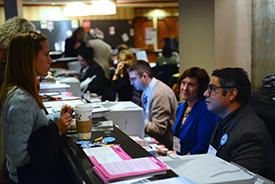 CAA members work with CAA staff in the registration booths at the 2016 Annual Conference in Washington, DC (photograph by Bradley Marks)
Working as a room monitor at CAA’s 105th Annual Conference, taking place February 15–18, 2017, in New York, is a great way to save on conference expenses. CAA encourages students, emerging professionals, and any interested members—especially those in the New York City area—to apply for service.
Session Room Monitors
CAA seeks members to work as room monitors for all session rooms, Career Services rooms, and various conference events between Wednesday, February 15, 2017, and Saturday, February 18, 2017. Room monitors are responsible for monitoring conference badge and ticket adherence at the doors of session rooms, recording session attendance and collecting tickets, monitoring the capacity of session rooms, aiding the communication between session chairs and the onsite audiovisual specialists, checking in conference attendees with mentoring or portfolio-review appointments, and/or facilitating the work of the career-development mentors.
Successful applicants will be friendly, familiar with digital projectors and both Mac and PC laptops, communicative, and able to problem-solve quickly in the hectic conference environment. To apply, please send the following three items to Katie Apsey, CAA manager of programs, by December 16, 2016[DEADLINE EXTENDED!] JANUARY 9, 2017:
- One-page résumé
- Brief letter of interest including your CAA Member ID# and preferred days for scheduling
- An application form
Chosen applicants will be paid $12 per hour and receive full complimentary registration to the conference. Selected room monitors will be required to work a minimum of twenty hours over the four days of the conference, but may work up to thirty-two hours. All people hired for the conference must also attend a one-hour (paid) training meeting on Tuesday night, February 14, 2017.
All candidates must be US citizens or permanent US residents and able to fill out a W-9 employment form.
CAA membership is encouraged but not required. Students should check to see if their schools and universities are CAA institutional members, because institutional membership now includes the benefit of specially discounted student memberships for individuals.
Please contact Katie Apsey, CAA manager of programs, at kapsey@collegeart.org or 212-392-4405 with any questions.
Become a Mentor or Reviewer for the 2017 Conference
posted by CAA — September 13, 2016
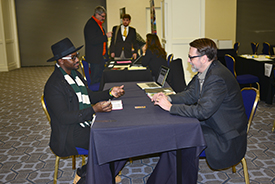 An interview at the 2016 Annual Conference in Washington, DC (photograph by Bradley Marks)
For the 2017 Annual Conference in New York, CAA seeks established professionals in the visual arts to volunteer as mentors for two Career Services programs: Artists’ Portfolio Review and Career Development Mentoring. Participating as a mentor is an excellent way to serve the field and to assist the professional growth of the next generation of artists and scholars. Art historians, studio artists, critics, museum educators, and curators are especially requested by mentees. All mentors and reviewers must demonstrate significant experience in their fields.
Artists’ Portfolio Reviewers
CAA seeks artists, critics, curators, and educators to serve as reviewers for the Artists’ Portfolio Review. In this program, mentors review and provide feedback on digital images of work by artist members in personal twenty-minute consultations. Whenever possible, CAA matches artists and mentors based on medium or discipline. Mentors provide an important service to artists, enabling them to receive professional criticism of their work.
Interested candidates must be current CAA members with experience mentoring or advising and be prepared to give between four and nine successive twenty-minute critiques in a three-hour period. Reviewing shifts may occur between Wednesday, February 15, and Saturday, February 18, 2017, from 8:30 AM to noon and from 1:30 to 5:00 PM each day. Conference registration, while encouraged, is not required to be a reviewer. Preference will be given to reviewers who can serve multiple shifts or multiple days
Please send your CV and a brief letter of interest (outlining your specialty or field and your scheduling availability during the conference) to Katie Apsey, CAA manager of programs. Deadline: December 2, 2016.
Career Development Mentors
CAA seeks mentors from all areas of studio art, art history, art education, film and video, graphic design, the museum professions, and other related fields to serve as mentors for Career Development Mentoring. In this program, mentors give valuable advice to emerging and midcareer professionals, reviewing cover letters, CVs, digital images, and other pertinent job-search materials in personal twenty-minute consultations. Whenever possible, CAA matches participants and mentors based on medium or discipline.
Interested candidates must be current CAA members with experience mentoring or advising and be prepared to give between four and nine successive twenty-minute critiques in a three-hour period. Reviewing shifts may occur between Wednesday, February 15, and Saturday, February 18, 2017, from 8:30 AM to noon and from 1:30 to 5:00 PM each day. Conference registration, while encouraged, is not required to be a mentor. Preference will be given to mentors able to serve multiple shifts or multiple days.
Please send your CV and a brief letter of interest (outlining your specialty or field and your scheduling availability during the conference) to Katie Apsey, CAA manager of programs. Deadline: December 2, 2016.
Career Development Mentoring is not intended as a screening process by institutions seeking new hires. CAA does not accept applications from individuals whose departments are conducting a faculty search in the field in which they are mentoring. Mentors should not be attending the conference as candidates for positions in the same field in which mentees may be applying.
Participate in ARTexchange at the 2017 Annual Conference
posted by CAA — September 08, 2016
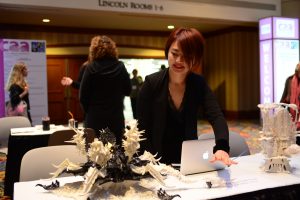 The artist Young Suk Lee participates in ARTexchange at the 2016 Annual Conference in Washington, DC (photograph by Bradley Marks)
The Services to Artists Committee invites artist members to participate in ARTexchange, CAA’s unique pop-up exhibition and annual meet-up for artists and curators. This social event provides an opportunity for artists to share their work and build affinities with other artists, historians, curators, and cultural producers. ARTexchange will take place at the 105th Annual Conference in New York on Friday evening, February 17, 2017, from 5:30 to 7:30 PM.
Each artist is given the space on, above, and beneath a six-foot table to exhibit their work: prints, paintings, drawings, photographs, sculptures, and small installations; performance, process-based, interactive, and participatory works are especially encouraged. Previous ARTexchange participants have found that this parameter sparked many creative display options. Please note that artwork cannot be hung on walls, and it is not possible to run power cords from laptops or other electronic devices to outlets.
To participate as an exhibiting artist in 2017, contact Katie Apsey, CAA manager of programs, by December 2, 2016, with the following information: (1) a short description of what you will exhibit and how you will use the six-foot table space (provide details regarding performance, sound, spoken word, or technology-based work, including laptop presentations); (2) your CAA member number (memberships must be active through February 18, 2017); and (3) your website or a link to a digital portfolio.
Because ARTexchange is a popular venue and participation is based on available space, early applicants are given preference. Participants are responsible for their work; CAA is not liable for losses or damages. Sales of work are not permitted. Deadline extended: January 6, 2017.
Exhibitor and Advertiser Prospectus for 2017
posted by CAA — August 22, 2016
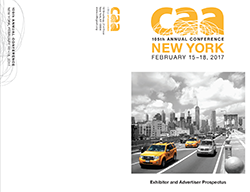 The Exhibitor and Advertiser Prospectus for the 2017 Annual Conference in New York is now available for download. Featuring essential details for participation in the Book and Trade Fair, the booklet also contains options for sponsorship opportunities and advertisements in the Conference Program and on the conference website. Printed copies of the prospectus will be available at the end of August.
The Exhibitor and Advertiser Prospectus will help you to reach a core audience of artists, art historians, educators, students, and administrators, who will converge in New York for CAA’s 105th Annual Conference, taking place February 15–18, 2017. With three days of exhibit time, the Book and Trade Fair will be centrally located in the New York Hilton Midtown. CAA offers several options for booths and tables that can help you to connect with conference attendees in person. The priority deadline for Book and Trade Fair applications is Monday, October 31, 2016; the final deadline for all applications and full payments is Friday, December 9, 2016.
In addition, sponsorship packages will allow you to maintain a high profile throughout the conference. Companies, organizations, and publishers may choose one of four visibility packages, sponsor specific areas and events, or work with CAA staff to design a custom package. Advertising possibilities include the Conference Program, distributed to over four thousand registrants and press contacts in the conference tote bag, and the conference website, seen by tens of thousands more. The deadline for sponsorships and advertisements in the Conference Program is Monday, December 5, 2016; web ads are taken on a rolling basis.
Questions about the 2017 Book and Trade Fair? Please contact Paul Skiff, CAA assistant director for Annual Conference, at 212-392-4412. For sponsorship and advertising queries, speak to Anna Cline, CAA development and marketing assistant, at 212-392-4426.
Propose a Paper or Presentation for the 2017 Annual Conference
posted by CAA — August 08, 2016
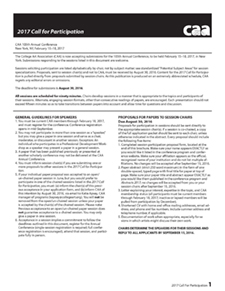 The 2017 Call for Participation for CAA’s 105th Annual Conference, taking place February 15–18, 2017, in New York, describes many of next year’s programs sessions. The chairs of these sessions invite your participation: please follow the instructions in the booklet to submit a proposal for a paper or presentation. This publication also includes a call for Poster Session proposals.
Listing 127 panels, the 2017 Call for Participation is only available as a PDF download; CAA will not mail hard copies of this thirty-seven-page document.
The deadline for proposals of papers and presentations for the New York conference is Tuesday, August 30, 2016. The deadline for Poster Sessions proposals is Thursday, September 15, 2016.
In addition to dozens of wide-ranging panels on art history, studio art, contemporary issues, and professional and educational practices, CAA conference attendees can expect participation from many area schools, museums, galleries, and other institutions. The Hilton New York Midtown is the conference headquarters, holding most sessions, Career Services, the Book and Trade Fair, ARTspace, special events, and more.
Contact
For more information about proposals of papers and presentations for the 2017 Annual Conference, please contact Katie Apsey, CAA manager of programs, or Tiffany Dugan, CAA director of programs.
2017 Call for Participation Now Open
posted by CAA — July 05, 2016
The 2017 Call for Participation for the 105th Annual Conference, taking place February 15–18, 2017, in New York, NY, is now open.
The 2017 Call for Participation describes approved sessions for next year’s conference which are seeking contributions. CAA and the session chairs invite your participation: please follow the instructions in the link to submit a proposal for a paper or presentation directly to the appropriate session chair(s). A call for Poster Session Proposals is also included in this CFP.
The 2017 Call for Participation is only available as a PDF download; CAA will not mail hard copies of this document.
The deadline for proposals of papers and presentations is August 30, 2016. The deadline for Poster Session Proposals is September 15, 2016.
Contact
For questions about the CAA Annual Conference’s 2017 Call for Participation, please contact Katie Apsey, CAA manager of programs, at kapsey@collegeart.org or Tiffany Dugan, CAA director of programs at tdugan@collegeart.org.
The Getty Foundation to Fund a Reunion for the College Art Association-Getty International Program
posted by CAA — June 28, 2016
The Getty Foundation has awarded the College Art Association (CAA) a major grant to fund the CAA-Getty International Program for the sixth consecutive year. Having completed five successful years of programming, CAA will use the grant to underwrite the cost of bringing twenty alumni to the 2017 Annual Conference for a reunion program. The Foundation’s support will enable CAA to bring these international visual arts professionals to the conference, taking place February 15-18, 2017, in New York City. Funds will support all travel expenses, hotel accommodations, per diems, conference registrations, and one-year CAA memberships.
The reunion will focus on common themes and interests in global art history, its greatest challenges, and what can be done to overcome them. Relying on the geographic and scholarly diversity of the twenty alumni, the reunion program will explore multiple points of view related to the state of the field, including interdisciplinary and transnational approaches to art history, the nature of cross-cultural collaborations, and future directions of the discipline. The 2017 attendees, together with leading art historians from the United States, will participate in several sessions devoted to these topics throughout the conference.
Since the CAA-Getty International Program began in 2012, ninety scholars have participated in CAA’s Annual Conference. Historically, the majority of international registrants at the Annual Conference have come from North America, the United Kingdom, and Western European countries. The CAA-Getty International Program has diversified the Annual Conference, adding scholars from Central and Eastern Europe, Russia, Africa, Asia, Southeast Asia, Caribbean countries, and South America. The majority of the alumni teach art history (or visual studies, art theory, or architectural history) at the university level; others are museum curators or researchers. Prior to participating in this program, none of the alumni had attended a CAA Annual Conference.
A remarkable number of international collaborations have ensued, including an ongoing study of similarities and differences in the history of art among Eastern European countries and South Africa, attendance at other international conferences, publications in international journals, and participation in panels and sessions at subsequent CAA Annual Conferences. Former grant recipients have become ambassadors of CAA in their countries, sharing knowledge gained at the Annual Conference with their colleagues at home.
Building on the evident success of the program, alumni at the 2017 reunion will provide input on how to further strengthen the program. How can CAA better serve international members? How can it cultivate future collaborations among CAA-Getty participants and CAA members? Are there ways to broaden the reach of the program to include artists, designers, and other types of arts professionals? The views and suggestions gathered at this convening will provide valuable insights as CAA works to enlarge its international activities.
For more information on the CAA-Getty International Program and other CAA travel opportunities, visit CAA Travel Grants.
Lead a Professional Development Workshop at CAA 2017
posted by CAA — June 14, 2016
Do you have a knack for sharing your knowledge with others and are enthusiastic about doing so? CAA seeks active members who are well established in their fields to serve as leaders for 90-minute Professional Development Workshop offerings at the 2017 Annual Conference at the New York Hilton Midtown from February 15-18.
The Annual Conference Committee and Programs Department aims to provide CAA members with re-vamped, affordable, and relevant professional development opportunities for 2017. But we need your help to do it! We encourage your collaboration and we welcome your proposals! Sample titles and/or subjects could run from, “Creating Online Exhibitions” to “Thinking Outside the Tenure Track.”
For more details, requirements, and submissions please visit the submissions page.
Workshop leaders will receive complimentary conference registration, a complimentary ticket to the 2017 Opening Reception, and one year of Premium Level Membership (renewal or upgrade to commence upon current membership’s expiration date) in exchange for their work as a leader.
Deadline for submissions: Monday, July 18, 2016.
For questions and more information please contact Katie Apsey at kapsey@collegeart.org
NEA to Support ARTspace for 2017!
posted by CAA — May 10, 2016
 National Endowment for the Arts Chairman Jane Chu has approved more than $82 million to fund local arts projects and partnerships in the NEA’s second major funding announcement for fiscal year 2016. Included in this announcement is an Art Works award of $15,000 to the College Art Association (CAA) for ARTspace, part of the CAA Annual Conference. This is the eighth consecutive year the NEA has supported ARTspace. The Art Works category supports the creation of work and presentation of both new and existing work, lifelong learning in the arts, and public engagement with the arts through 13 arts disciplines or fields.
“The arts are all around us, enhancing our lives in ways both subtle and obvious, expected and unexpected,” said NEA Chairman Jane Chu. “Supporting projects like the one from CAA offers more opportunities to engage in the arts every day.”
ARTspace is a conference within the conference tailored to the interests and needs of artists and open to all attendees. Organized by CAA’s Services to Artists Committee, it includes a large-audience session space and a media lounge. ARTspace is the site of the Annual Artists’ Interviews held on Friday afternoon. Each morning begins with coffee and tea. The 2016 Annual Conference Artists’ Interviews featured conversations between Rick Lowe and LaToya Ruby Frazier and Joyce Scott with George Ciscle.
Save the date for the 2017 Annual Conference, February 15-18 in New York City.
To join the Twitter conversation about this announcement, please use #NEASpring16. For more information on projects included in the NEA grant announcement, go to arts.gov