
CAA News Today
Participate in ARTexchange at the 2016 Annual Conference
posted by Katie Apsey — September 24, 2015
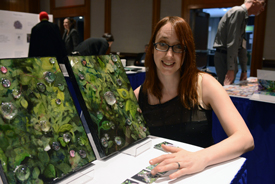 The Services to Artists Committee invites artist members to participate in ARTexchange, the annual meet-up for artists and curators at CAA’s unique pop-up exhibition. This social event provides an opportunity for artists to share their work and build affinities with other artists, historians, curators, and cultural producers. ARTexchange will take place at the 104th Annual Conference in Washington, DC, on Friday evening, February 5, 2016, from 5:30 to 7:30 PM.
Each artist is given the space on, above, and beneath a six-foot table to exhibit their works: prints, paintings, drawings, photographs, sculptures, and small installations; performance, process-based, interactive and participatory works are especially encouraged. Previous ARTexchange participants have found that this parameter sparked many creative display options. Depending on the number and type of submissions CAA receives, a schedule of performances may be created. Please note that artwork cannot be hung on walls, and it is not possible to run power cords from laptops or other electronic devices to outlets—bring fully charged batteries.
To participate, send an email to Katie Apsey, CAA manager of programs. Include your CAA member number and a brief description of what you plan to present. Please provide details regarding performance, sound, spoken word, or technology-based work, including laptop presentations. You will receive an email confirmation. Because ARTexchange is a popular venue and participation is based on available space, early applicants are given preference. Participants are responsible for their work; CAA is not liable for losses or damages. Sales of work are not permitted. Deadline: December 14, 2015.
Image: A participant in ARTexchange at the 2015 Annual Conference in New York (photograph by Bradley Marks)
Exhibitor and Advertiser Prospectus for the 2016 Annual Conference
posted by CAA — August 27, 2015
 The Exhibitor and Advertiser Prospectus for the 2016 Annual Conference in Washington, DC, is now available for download. Featuring essential details for participation in the Book and Trade Fair, the booklet also contains options for sponsorship opportunities and advertisements in the Conference Program and on the conference website.
The Exhibitor and Advertiser Prospectus will help you reach a core audience of artists, art historians, educators, students, and administrators, who will converge in our nation’s capital for CAA’s 104th Annual Conference, taking place February 3–6, 2016. With three days of exhibit time, the Book and Trade Fair will be centrally located in the Washington Marriott Wardman Park Hotel. CAA offers several options for booths and tables that can help you to connect with conference attendees in person. The priority deadline for Book and Trade Fair applications is Friday, October 30, 2015; the final deadline for all applications and full payments is Monday, December 7, 2015.
In addition, sponsorship packages will allow you to maintain a high profile throughout the conference. Companies, organizations, and publishers may choose one of four visibility packages, sponsor specific areas, events, and objects (such as the Student and Emerging Professionals Lounge and hotel room keys), or work with CAA staff to design a custom package. Advertising possibilities include the Conference Program, distributed to over four thousand registrants and press contacts in the conference tote bag, and the conference website, seen by tens of thousands more. The deadline for sponsorships and advertisements in the Conference Program is Friday, December 4, 2015; web ads are taken on a rolling basis.
Questions about the 2016 Book and Trade Fair? Please contact Paul Skiff, CAA assistant director for Annual Conference, at 212-392-4412. For sponsorship and advertising queries, speak to Anna Cline, CAA development and marketing assistant, at 212-392-4426.
Travel Grants to Attend the 2016 Annual Conference in Washington, DC
posted by Emmanuel Lemakis — July 17, 2015
CAA offers Annual Conference Travel Grants to graduate students in art history and studio art and to international artists and scholars. In addition, the Getty Foundation has funded the fifth year of a program that enables applicants from outside the United States to attend the 104th Annual Conference in Washington, DC, which takes place February 3–6, 2016. Applicants may apply for more than one grant but can only receive a single award.
CAA-Getty International Program
The CAA-Getty International Program, generously supported by the Getty Foundation, provides funding to fifteen art historians, museum curators, and artists who teach art history to attend the 2016 Annual Conference. The grant covers travel expenses, hotel accommodations for eight nights, per diems, conference registrations, and one-year CAA memberships. Extended deadline: August 26, 2015.
CAA Graduate Student Conference Travel Grant
CAA will award a limited number of $250 Graduate Student Conference Travel Grants to advanced PhD and MFA graduate students as partial reimbursement of travel expenses to attend the 2016 Annual Conference. To qualify for the grant, students must be current CAA members. Successful applicants will also receive a complimentary conference registration. Deadline: September 18, 2015.
CAA International Member Conference Travel Grant
CAA will award a limited number of $500 International Member Conference Travel Grants to artists and scholars from outside the United States as partial reimbursement of travel expenses to attend the 2016 Annual Conference. To qualify for the grant, applicants must be current CAA members. Successful applicants will also receive a complimentary conference registration. Deadline: September 18, 2015.
Donate to the Annual Conference Travel Grants
CAA’s Annual Conference Travel Grants are funded solely by donations from CAA members—please contribute today. Charitable contributions are 100 percent tax deductible. CAA extends a warm thanks to those members who made voluntary contributions to this fund during the past twelve months.
Improvements to CAA’s Annual Conference
posted by Linda Downs — July 16, 2015
CAA’s Annual Conference provides an important platform for the dissemination of new research and creative work. It also provides opportunities for networking, hosts workshops on crucial career topics, tackles pressing issues in the field, and provides an opportunity for institutions to interview candidates for open positions. In an effort to serve its members more effectively, CAA has established a Task Force on the Annual Conference to address ways of providing more occasions for members to exchange work and scholarship. The task force will also investigate greater uses of technology to extend the conference beyond its physical location and increased networking opportunities for professionals in the visual arts. The changes announced below are only the first round of a more thorough redesign of the conference, a very much renewed and improved version of which will be introduced in the coming years.
In preparation for the next Annual Conference, to be held February 3–6, 2016, in Washington, DC, and in an effort to strengthen the Annual Conference while providing an even greater value to the membership and our profession, members of the CAA Board of Directors and the Task Force on the Annual Conference have recommended and approved the following changes:
- Allowing members to present papers and chair sessions in consecutive years at the Annual Conference
- Extending the Annual Conference through low-cost webinars to accommodate those affected by reductions in funds for professional travel. CAA will offer webinars on a regular basis that will highlight the content generated by members
- Conference registration, opening in early October 2015, will have only one advance registration period that will end on December 21, 2015
- A new discounted registration fee for CAA members who are part-time faculty or are independent artists and scholars
- Institutional members may purchase specially discounted student memberships and register their students for the conference at deeper discounts during the advance registration period. These discounts will not be available onsite
- CAA members will be hired to be room monitors and to work at CAA’s registration area for a stipend and free conference registration rather than hiring temporary staff to fill these roles
- Providing a conference that serves members. Everyone who participates (i.e., presenter, speaker, chair) must be a current CAA member at the time of the conference
- All participants will need to either register for the entire conference or purchase a single-time-slot ticket for the session in which they are participating. This change applies to sessions led by all CAA affiliated societies and special-interest groups
CAA must proactively respond to the escalating costs of producing the Annual Conference. Ever-increasing expenses include staffing the conference, union rates at hotels, guaranteeing minimum numbers of attendees, and providing audiovisual equipment and WiFi. In the past, many sessions were offered without requiring CAA membership or conference registration. CAA can no longer subsidize the attendance and participation of nonmembers and nonregistrants. In order for CAA to maintain the high quality of the conference and to meet the needs of its members, we ask for your support as we introduce these changes to improve the conference experience.
The 2016 Annual Conference in Washington, DC, will be outstanding. The keynote speaker will be David Adjaye, architect of the Smithsonian Institution’s new National Museum of African American History and Culture on the National Mall and newly designated architect of the Studio Museum in Harlem. Richard J. Powell is CAA’s Distinguished Scholar, and Joyce Scott is the Distinguished Artist who will be interviewed. CAA will sponsor an MFA exhibition with student artists from around the region and host a reception for all CAA members at the Katzen Art Center at American University. In addition, the Annual Conference Committee for the DC meeting is preparing special tours to artists’ studios and museums and organizing special events.
Washington is home to a host of outstanding museums and other cultural institutions, and CAA has not held a conference there since 1991. We are very pleased to bring the conference to Washington, DC, and grateful for the support of our membership and institutions in that region. You will not want to miss this exciting event! Please refer to http://conference.collegeart.org for ongoing updates and news about the 2016 Annual Conference.
The Getty Foundation to Fund a Fifth Year of the College Art Association-Getty International Program
posted by Christopher Howard — June 09, 2015
The Getty Foundation has awarded the College Art Association a grant to fund the CAA-Getty International Program for the fifth consecutive year. The Foundation’s support will enable CAA to bring fifteen international visual-arts professionals to the 104th Annual Conference, taking place February 3–6, 2016, in Washington DC. The CAA-Getty International Program provides funds for travel expenses, hotel accommodations, per diems, conference registrations, and one-year CAA memberships to art historians, artists who teach art history, and museum curators. The program will include a one-day preconference colloquium on international issues in art history on February 2, at which participants will present and discuss their common professional interests and issues.
The goals of the International Program are to increase international participation in CAA, to diversify the organization’s membership, and to foster collaborations between American art historians, artists, and curators and their international colleagues. CAA also strives to familiarize international participants with the submission process for conference sessions to encourage ongoing involvement with the association. CAA will provide hosts from its membership to welcome the international participants and introduce them to colleagues in their fields.
Historically, the majority of international registrants to CAA’s Annual Conferences have come from North America, the United Kingdom, and Western European countries. In the first four years of the CAA-Getty International Program, CAA has added seventy-five attendees from Central and Eastern Europe, Russia, Africa, Asia, Southeast Asia, Caribbean countries, and South America. As this alumni group grows, so too does international participation in CAA. Former grant recipients have become ambassadors of CAA in their countries, sharing knowledge gained at the Annual Conference with their colleagues and encouraging them to submit applications to the International Program. A number of scholarly collaborations have also ensued among grant recipients and CAA members. The value of attending a CAA Annual Conference as a participant in the CAA-Getty International Program was succinctly summarized by Nazar Kozak, a 2015 participant from Ukraine: “To put it simply, I understood that I can become part of a global scholarly community. I felt like I belong here.”
The deadline for applications has been extended to August 26, 2015. Grant guidelines and the 2016 application can be found here.
CAA Seeks Nominations for the 2016 Awards for Distinction
posted by Emmanuel Lemakis — June 04, 2015
CAA has begun accepting nominations for the 2016 awards. Please review the guidelines below to familiarize yourself with the nomination process and to download, complete, and submit the requested materials. Deadline: July 31, 2015, for the Charles Rufus Morey Book Award, the Alfred H. Barr Jr. Awards, and the Frank Jewett Mather Award; August 31, 2015, for all others.
General Guidelines
In your letter, state who you are; how you know (of) the nominee; how the nominee and/or his or her work or publication has affected your practice or studies and the pursuit of your career; and why you think this person (or, in a collaboration, these people) deserves to be recognized. We also urge you to contact up to five colleagues, students, peers, collaborators, and/or coworkers of the nominee to write letters; no more than five letters are considered. Letters of support are important for reference, but the awards decisions are the responsibilities of the juries based on their expert assessment of the qualifications of the nominees.
Nominations for book and exhibition awards should be for authors of books published or works exhibited or staged between September 1, 2014, and August 31, 2015. Books published posthumously are not eligible. Letters of support are not required for the Mather, Morey, and Barr awards. All submissions must include a completed 2016 nomination form and one copy of the nominee’s CV (limit: two pages); book-award nominations do not require a CV (see below for the appropriate forms for the Mather, Morey, and Barr awards and the Porter prize).
Charles Rufus Morey Book Award
To give the jury full opportunity to evaluate each submission fairly, submit materials well before the July 31 deadline. Please review the following nomination guidelines:
- A publisher may submit no more than three titles. In addition, CAA accepts nominations from its membership, jury members, reviews editors for The Art Bulletin and Art Journal, and field editors from caa.reviews
- Publishers may not submit the same title for the Morey and Barr awards. The Morey jury does not accept exhibition catalogues
- Eligible books must have been published between September 1, 2014, and August 31, 2015
- Books published posthumously are not eligible
- CAA and each jury member must receive a copy of the nominated book. A total of six copies of the book must be sent. To receive the mailing addresses for the jury, please contact Emmanuel Lemakis, CAA director of programs
- Complete and submit the Morey nominaton form
- Letters of support are not required
Alfred H. Barr Jr. Award
To give the jury full opportunity to evaluate each submission fairly, submit materials well before the July 31 deadline. Please review the following nomination guidelines:
- A publisher may submit no more than three titles. In addition, CAA accepts nominations from its membership, jury members, reviews editors for The Art Bulletin and Art Journal, and field editors from caa.reviews
- Publishers may not submit the same title for the Morey and Barr awards. The Morey jury does not accept exhibition catalogues
- Eligible books must have been published between September 1, 2014, and August 31, 2015
- Books published posthumously are not eligible
- CAA and each jury member must receive a copy of the nominated book. A total of six copies of the book must be sent. To receive the mailing addresses for the jury, please contact Emmanuel Lemakis, CAA director of programs
- Complete and submit the Barr nomination form
- Letters of support are not required
Frank Jewett Mather Award
Please submit copies of critical writings, which may be website links and printouts, photocopies or scanned pages of newspapers or magazines, and more. If the writing is contained in a single volume (such as a book), please provide the publication information. In addition, complete and submit the Mather nomination form. To give the jury full opportunity to evaluate each submission fairly, submit materials well before the July 31 deadline.
Distinguished Teaching of Art and Art History Awards
Letters for these two awards are particularly important for the juries because of the personal contact involved in successful teaching.
Arthur Kingsley Porter Prize
To determine eligibility, authors of articles in The Art Bulletin must complete the Porter nomination form.
Contact
Please write to Emmanuel Lemakis, CAA director of programs, for more information about the nomination process.
Changes Coming to the Annual Meeting!
posted by Linda Downs — June 02, 2015
Suzanne Preston Blier, Vice President for the Annual Conference, is heading the CAA Task Force on the Annual Conference and, along with other members of this group, she is seeking suggestions from CAA members on the kinds of changes that you would like to see.
Among the suggestions that have already been initiated is the following:
CAA has decided to return to its earlier policy of allowing members to annually submit proposals, present a paper, or chair a panel. This is a change from the every-other-year format that had been followed in recent years. Our goal is to keep members engaged and participating in CAA’s Annual Conference on a yearly basis.
Please send your suggestions to nyoffice@collegeart.org.
NEA Awards Seventh Consecutive Grant for ARTspace
posted by Nia Page — May 08, 2015

CAA has been awarded a $15,000 grant from the National Endowment for the Arts (NEA) to support the next installment of ARTspace, taking place during the 2016 Annual Conference in Washington, DC. Spearheaded by CAA’s Services to Artists Committee, ARTspace is a forum for programming designed by artists for artists that is among the most vital and exciting aspects of the conference. Held at each Annual Conference since 2001, ARTspace is intended to reflect the current state of the visual arts and arts education.
ARTspace offers free program sessions and includes diverse activities such as the Annual Distinguished Artists’ Interviews (most recently with William Pope.L and Ursula von Rydingsvard in New York in February 2015); screenings of film, video, and multimedia works; live performances; and papers and presentations that facilitate a conversational yet professional exchange of ideas and practices designed to engage CAA’s artist members as well as the general public.
The grant, which is the NEA’s seventh consecutive award to CAA for ARTspace, will help fund programs such as ARTexchange, the popular open-portfolio exhibition for artists; the Distinguished Artists’ Interviews; and the Media Lounge, a space dedicated to curated programs of film, video, and multimedia work. ARTspace programming at the 2015 conference in New York included panels that explored the shifting landscape of the field, from “Surveillance as Art Practice” and “Art Collectives and the Contemporary World” to “Balancing Act: Art, Family, and Other Distractions” and “Imagining an Alternative School of Art.” You can explore all of the 2015 ARTspace programming on the conference website.
CAA’s 104th Annual Conference will take place February 3–6, 2016, in Washington, DC. Through grants to thousands of nonprofits each year, the NEA promotes opportunities for people in communities across America to experience the arts and exercise their creativity.
Image Caption
Jenny Schlenzka of MoMA PS 1 interviews the artist William Pope.L during ARTspace at the 2015 Annual Conference in New York (photograph by Bradley Marks)
2015 CAA-Getty International Program Participants Attend Annual Conference in New York
posted by Janet Landay, Program Manager, Fair Use Initiative — March 17, 2015

This year, fifteen scholars from around the world attended CAA’s Annual Conference in New York as participants in the CAA-Getty International Program. The temperature in town when everyone arrived on February 8 was a frigid 10 degrees; nonetheless, the international travelers were intrepid, and their warmth and excitement did much to allay the cold weather outside.
Now in its fourth year, the program brings together art historians, artists who teach art history, and museum curators to meet with CAA members in their fields of study, attend conference sessions, and participate in a one-day preconference colloquium on international issues in art history. Funded by a generous grant from the Getty Foundation, this year’s scholars came from Argentina (Georgina Gluzman), Bangladesh (Mokammal H. Bhuiyan), Brazil (Ana Mannarino), Burkina Faso (Boureima Diamitani), China (Shao Yiyang), Croatia (Ljerka Dulibić), Hungary (Márton Orosz and Nóra Veszprémi), India (Savita Kumari), Mexico (Dafne Cruz Porchini), Russia (Andrey Shabanov), South Africa (Nomusa Makhubu and Lize van Robbroeck), Uganda (Angelo Kakande), and Ukraine (Nazar Kozak). For some, it was their first visit to the United States; for all, it was their first time at a CAA Annual Conference.

A highlight of the program was a full-day preconference colloquium about international issues in art history. Each of the fifteen participants gave presentations about their work, relating their specific research interests to one of five broader topics: Questioning the Discourse, Beyond Borders/Beyond Context, Activism and the Political, Cross-Cultural Encounters/Reception, and Exhibiting Cultures in a Global Society. The talks featured a wide range of art and varied approaches to the field. They were followed throughout the day by Q&A sessions and open discussions moderated by Rosemary O’Neill, chair of CAA’s International Committee, and Marc Gotlieb, president of the National Committee for the History of Art. As Nóra Veszprémi, a scholar from Hungary wrote, “The topics were as diverse as the participants themselves, but the questions that lay at the heart of the papers were closely related. Everyone was interested in the ‘internationalization’ of art history, and it was a wonderful experience to be able to discuss these issues with colleagues from all over the world.”
The colloquium included a number of CAA members serving as hosts to the international scholars. This year, many hosts came from select CAA affiliated societies, thereby sharing scholarly interests and providing networking opportunities for the participants. For example, Deepali Dewan, president of the American Council for Southern Asian Art (ACSAA), was paired with Savita Kumari, an Indian art historian specializing in medieval and premodern Indian art, and Elisa Mandell, president of the Association for Latin American Art (ALAA), served as host to Georgina Guzman from Argentina and Dafne Cruz Porchini from Mexico. Other hosts came from the Society of Historians of East European, Eurasian, and Russian Art and Architecture (SHERA), the Arts Council of the African Studies Association (ACASA), the Renaissance Society of America (RSA), and the Society of Contemporary Art Historians (SCAH). CAA’s International Committee also supplied hosts, rounding out an excellent group of art historians to welcome and assist the international scholars. CAA is grateful to the National Committee for the History of Art for its financial support of the hosting activities of these CAA members.

The CAA-Getty scholars were busy throughout the conference week, attending sessions, meeting colleagues, and visiting New York museums and galleries. On Thursday the group attended two sessions, sponsored by CAA’s International Committee, that examined the legacy of the landmark exhibition Magiciens de la Terre, curated by Jean-Hubert Martin in 1989 at the Centre Georges Pompidou and the Grande Halle at the Parc de la Villette in Paris. Martin, who participated in the sessions and attended Tuesday’s preconference as well, discussed the rationale behind the exhibition, which challenged Western preconceptions about non-Western art by displaying an unprecedented mix of objects—half of the works were by Western artists and the other half by artists from the rest of the world. Martin’s presentation was followed by other talks and, later in the afternoon, a roundtable discussion. In all, the events of this day provided an excellent platform for continuing Tuesday’s discussion about international issues in art history.
As in past years, CAA’s International Committee was centrally involved in planning this year’s international program. We are particularly grateful to Rosemary O’Neill, chair of the committee, for her enthusiastic support. In addition to organizing the sessions on Magiciens de la Terre (with her fellow committee member Gwen Farrelly), O’Neill helped to coordinate the preconference colloquium and even raised outside funds to bring Martin to the conference.
At the close of the week’s activities, program participants met again to learn about publishing art history in the United States and opportunities for residencies at research institutes. Susan Bielstein from the University of Chicago Press, Kirk Ambrose, editor of The Art Bulletin, and Gail Feigenbaum of the Getty Research Institute provided enormously helpful information on these subjects.

The CAA-Getty scholars then had a weekend on their own to explore New York before heading to the Sterling and Francine Clark Art Institute in Williamstown, Massachusetts, to meet with scholars there and learn about the research opportunities offered by that institution’s Research and Academic Program. The trip was a wonderful opportunity to see a great museum and experience a totally different part of the United States (where it was even colder than New York).
The purpose of the CAA-Getty International Program is to bring a more diverse and global perspective to the study of art history by generating international scholarly exchange. This year’s visitors brought with them a great deal of knowledge, enthusiasm, and curiosity about the field, which they shared with the CAA members they met, as well as with each other. In return, conference attendees offered their expertise and friendship, beginning relationships that will hopefully bear fruit in future projects and collaborations.
Nazar Kozak, an art historian from Ukraine, summarized the experiences of many when he wrote, “To put it simply, I understood that I can become a part of a global scholarly community. I felt like I belong here.”
Images
2015 CAA-Getty International Program participants. Front row, left to right: Savita Kumari, Andrey Shabanov, Nóra Veszprémi, Shao Yiyang, Janet Landay (from CAA), Ana Mannarino, Nomusa Makhubu, and Dafne Cruz Porchini. Back row, left to right: Nazar Kozak, Márton Orosz, Angelo Kakande, Boureima Diamitani, Ljerka Dulibić, Lize van Robbroeck, and Georgina Gluzman. Not pictured: Mokammal H. Bhuiyan (photograph by Bradley Marks)
Nazar Kozak with his host, Margaret Samu (photograph by Bradley Marks)
Ana Mannarino, Dafne Cruz Porchini, and Namusa Makhubu (photograph by Bradley Marks)
CAA President DeWitt Godfrey and Ljerka Dulibic (photograph by Bradley Marks)
Propose a Poster Session for the 2016 Annual Conference
posted by Emmanuel Lemakis — March 13, 2015
The deadline to propose a Poster Session passed on Friday, May 8, 2015.
CAA invites individual members to submit abstracts for Poster Sessions at the 104th Annual Conference, taking place February 3–6, 2016, in Washington, DC. Poster Sessions—presentations displayed on bulletin boards by an individual for small groups—usually include a brief narrative paper mixed with illustrations, tables, graphs, and similar presentation formats. The poster display can intelligently and concisely communicate the essence of the presenter’s research, synthesizing its main ideas and directions. Colorado State University has published useful general information on Poster Sessions.
Poster Sessions offer excellent opportunities for extended informal discussion and conversation focused on topics of scholarly or pedagogical research. Posters are displayed for the duration of the conference, so that interested persons can view the work even when the presenters are not physically present. Poster Sessions take place in a high-traffic area, in close proximity to the Book and Trade Fair and conference rooms.
Proposals for Poster Sessions must include the following:
- Title of Poster Session
- Summary of project, not to exceed 250 words
- Name of presenter(s), affiliation(s), and CAA member number(s)
- A two-page CV
- Complete mailing address and telephone number
- Email address
Proposals are due by Friday, May 8, 2015—the same deadline as the regular call for papers for the 2016 conference. Send all materials to Lauren Stark, CAA manager of programs. A working group of the Annual Conference Committee selects Poster Sessions based on individual merit and space availability at the conference. Accepted presenters must maintain their memberships through the conference.
Displays must be assembled by 10:00 AM on Thursday, February 4, and cleared by 2:00 PM on Saturday, February 6. Live presentations last ninety minutes and are scheduled during the lunch breaks on Thursday and Friday, 12:30–2:00 PM. During this time, presenters stand by their poster displays while others view the presentation and interact with the presenters.
CAA assigns presenters one freestanding bulletin board (about 4 x 8 feet of display space) onto which they can affix their poster display and other materials, as well as a table to place materials such as handouts or a sign-up sheet to record the names and addresses of attendees who want to receive more information. CAA also provides pushpins or thumbtacks to attach components to the bulletin board on the day of installation.
Printed materials must be easily read at a distance of four feet. Each display should include the title of the presentation (104-point size) and the name of the presenter(s) and his or her affiliation(s) (72-point size). CAA recommends a point size of 16–18 or larger for body text. No electrical support is available in the Poster Session area; you must have your own source of power (e.g., a battery).
Contact
For more information about proposals of Poster Sessions for the 2016 Annual Conference, please contact Lauren Stark, CAA manager of programs, at 212-392-4405.