CAA News Today
US Patents and Trademarks Office Issues “Green Paper” on Copyright in the Digital Age
posted by CAA — August 30, 2013
The following text is from a blog post by Shira Perlmutter, director of the United States Patents and Trademarks Office (USPTO).
We Want to Hear from You on Copyright Policies in the Digital Economy
The Department of Commerce’s Internet Policy Task Force (IPTF) last week issued a green paper on copyright, and I’d like to take a moment to highlight the paper’s core content and goals. The paper, titled Copyright Policy, Creativity, and Innovation in the Digital Economy (Green Paper), represents the most thorough and comprehensive analysis of digital copyright policy issued by any administration since 1995. Along with the National Telecommunications and Information Administration (NTIA), the USPTO played a key role in its production, from gathering public comments starting in 2010 through the paper’s drafting and release.
The Green Paper calls for new public input on critical policy issues that are central to our nation’s economic growth, cultural development, and job creation. It is intended to serve as a reference for stakeholders, a blueprint for further action, and a contribution to global copyright debates. As promised in the paper, we will soon be reaching out to the public for views on a variety of topics. Please stay tuned for announcements about how to share your thoughts, insights, and recommendations.
caa.reviews Publishes Multimedia Project on Bernini Exhibition
posted by Christopher Howard — August 13, 2013
Celebrating its fifteenth anniversary as a born-digital journal this fall, caa.reviews continues its exploration of the scholarly review medium through “Exhibitions Close Up—Bernini: Sculpting in Clay.” This multimedia, open-access project focuses on the recent exhibition that assembles over forty small terra-cotta models made by the Baroque sculptor Gian Lorenzo Bernini to visualize large sculptures. The project was made possible through a grant to CAA from the Alliance for Networking Visual Culture.
Conceived by Sheryl Reiss, editor-in-chief of caa.reviews, and broadened through discussion with the journal’s editorial board, the project explores the Bernini exhibition in several ways. It provides a traditional scholarly review of the presentation at both its venues—the Metropolitan Museum of Art in New York and the Kimbell Art Museum in Fort Worth, Texas—and a review by the sculptor Denise Pelletier. Central to the project is a video walk-through at the Kimbell that juxtaposes close views of Bernini’s terra-cotta models with physical movement within the gallery spaces and around the objects on display, giving the viewer a close approximation of visiting the exhibition in person. The project—which also includes a bibliography, previously published essays on and reviews of Bernini’s work and methods from The Art Bulletin and caa.reviews, additional educational videos about the artist’s work, the Kimbell floor plan of the exhibition, comparative illustrations showing completed pieces, and an interview with C. D. Dickerson, curator of European art at the Kimbell—provides a comprehensive resource for Bernini’s oeuvre and influence as well as an in-depth look at an important monographic exhibition.
The Alliance for Networking Visual Culture (ANVC) developed the Scalar digital authoring platform with support from the Andrew W. Mellon Foundation and the National Endowment for the Humanities. The Art Bulletin also used this platform for an anniversary project launched in February 2013, called “Publishing The Art Bulletin: Past, Present, and Future,” that was developed by Thelma Thomas, (then) chair of the Art Bulletin Editorial Board and associate professor at the Institute of Fine Arts, New York University. Additional projects using the Scalar platform can be viewed on the ANVC website.
The minimum browser requirements for “Exhibitions Close Up—Bernini: Sculpting in Clay” are Internet Explorer 9.0, Firefox 4.0, Chrome 7.0, and Safari 5.0.
New Faces for CAA’s Journals
posted by Christopher Howard — August 02, 2013
The president of the CAA Board of Directors, Anne Collins Goodyear, has confirmed new appointments to the editorial boards of CAA’s three scholarly journals and to the Publications Committee, in consultation with the vice president for publications, Suzanne Preston Blier. The appointments took effect on July 1, 2013.
The Art Bulletin
The three new members of the Art Bulletin Editorial Board are: Sarah Betzer, assistant professor of eighteenth- and nineteenth-century art and director of the undergraduate program in art history at the University of Virginia in Charlottesville; Rita Freed, a historian of Egyptian art and chair of the Department of Art of the Ancient World at the Museum of Fine Arts, Boston, in Massachusetts; and Glenn Peers, a professor of medieval art at the University of Texas at Austin. They will serve four-year terms, through June 30, 2017. In addition, Goodyear appointed David Getsy of the School of the Art Institute of Chicago in Illinois to a two-year term as editorial-board chair.
Art Journal
The new member-at-large for the Art Journal Editorial Board is Juan Vicente Aliaga, a curator and a professor of modern and contemporary art and theory at Universitat Politècnica de València in Spain.
caa.reviews
The caa.reviews Editorial Board welcomes David Raskin as editor designate through June 30, 2014. Raskin is professor of contemporary art history in the Department of Art History, Theory, and Criticism and chair of the Department of Sculpture at the School of the Art Institute of Chicago in Illinois. Juliet Bellows, assistant professor of nineteenth- and twentieth-century art in the Department of Art at American University in Washington, DC, joins the editorial board for a three-year term.
New field editors for the journal are: Suzanne Hudson, a historian of modern and contemporary art at the University of Southern California in Los Angeles and an active critic, as field editor for reviews of exhibitions of modern and contemporary art on the West Coast; Kevin Murphy, chair of the History of Art Department at Vanderbilt University in Nashville, Tennessee, as field editor for books on architecture and urbanism from 1800 to the present; Kristoffer Neville, assistant professor in the Department of the History of Art at the University of California, Riverside, as field editor for books on architecture and urbanism, pre-1800; Andrei Pop, assistant professor of art history at Universität Basel in Switzerland, as field editor for books on theory and historiography; and Jason Weems, assistant professor in the Department of the History of Art at the University of California, Riverside, as field editor for books on American art.
Publications Committee
Susan Higman Larsen joins CAA’s Publications Committee. Larsen is director of publications at the Detroit Institute of Arts in Michigan and an adjunct professor in the graduate program in museum studies at Johns Hopkins University in Baltimore, Maryland.
First Issue of Art Journal under New Editor-in-Chief
posted by Christopher Howard — July 31, 2013
 The new issue of Art Journal, which features Burn the Diaries, an artist’s project by Moyra Davey, is the first in the editorship of Lane Relyea.
Essays consider topics such as role of the art critic in the emerging art market of China ca. 1990, the 1970s Tee Pee Video Space Troupe of the artist Shirley Clarke, obscurity and stillness in current film-based installations, and ethnicity in Marcel’s Duchamp’s gender-bending alter ego, Rrose Sélavy.
An essay by Michael Jay McClure on the work of Trisha Donnelly, titled “If It Need Be Termed Surrender,” has been published as free content on the Art Journal website, along with Maymanah Farat’s review of the exhibition and publication The Fertile Crescent.
Advertise in CAA’s Directories of Graduate Programs
posted by CAA — July 19, 2013
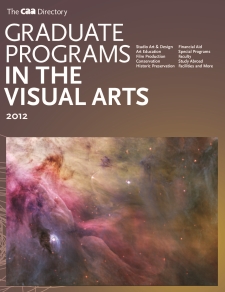 For the first time, CAA is offering advertising space in its annual directories of graduate programs in the arts. Promote your institution, program, product, or service in the go-to resource for prospective graduate students in the arts.
CAA’s directories are the most comprehensive resources available for new and incoming graduate students in fine art and design, art and architectural history, curatorial and museum studies, arts administration, art education, film production, conservation, and more in the United States, Canada, the United Kingdom, Australia, and New Zealand.
The directories provide prospective graduate students with the critical information they need to complete the application process and navigate the academic landscape, from availability of financial aid and fellowships to faculty and deadlines.
CAA Publishes Annual Report 2012–2013
posted by CAA — July 16, 2013
 CAA has just published the Annual Report 2012–2013, which describes the organization’s accomplishments over the past year as well as other notable efforts as they relate to the Strategic Plan 2010–2015. You may download a PDF of the nineteen-page document.
Abundantly illustrated by photographs from the 2013 Annual Conference in New York, the report describes recent developments in several important areas, such as the Task Force on Fair Use, several publications initiatives (including an analysis of the financial structure and distribution of CAA’s three journals), a grant from the Alliance for Networking Visual Culture for two scholarly projects using the Scalar platform, and the CAA International Travel Grant Program, generously funded by the Getty Foundation. Also covered is an overview of the Task Force on the Strategic Plan for 2015–2020 as well as highlights from the current plan that CAA has accomplished so far, such as free wireless internet at the Annual Conference and the publication of CAA’s directories of graduate programs in the arts.
In addition, the annual report includes a membership report, a selected list of grants received during the fiscal year, and statistics related to CAA News, www.collegeart.org, Twitter, and Facebook. An update on professional-development activities and a financial statement on the 2012 fiscal year close the report.
We hope you will enjoy reading about CAA’s accomplishments.
Download the 2013 Abstracts and Directory of Attendees
posted by Christopher Howard — July 01, 2013
 Registrants for the 2013 Annual Conference in New York may download the Abstracts and Directory of Attendees. These publications, available as PDFs, summarize the contents of hundreds of papers and talks that were presented in program sessions and list the names and contact information for those attendees who registered by both the early and advance deadlines.
Program sessions are alphabetized by the chair’s last name and appear in the contents pages (4–10). An index in the back of the publication names all the speakers. Alternatively, use your Adobe Reader to conduct a keyword search for terms relevant to your interests. Similarly, the Directory of Attendees helps with networking and communication after the conference.
To download the two publications, registrants can log into their CAA account, click the “Conference Registrant Information” image, and then click the Abstracts and/or Directory of Attendees icon to download a PDF. The Abstracts and Directory of Attendees are part of the registration package; there is no added cost to paid or complimentary registrants for access to these publications.
Conference attendees who purchased single-time slot tickets, or those who want the Abstracts but did not go to New York, may attain the document for a charge: $30 for CAA members and $35 for nonmembers. The Abstracts and Directory of Attendees will remain on the CAA website for download or sale through July 31, 2013.
Beginning with the 2010 conference in Chicago, CAA offers its Abstracts exclusively as a PDF download. Past issues of the printed publication from 1999 to 2009 are also available. The cost per copy is $30 for CAA members and $35 for nonmembers. For more information and to order, please contact Roberta Lawson, CAA office coordinator.
Contribute to the Art Bulletin Publication Fund
posted by Christopher Howard — June 25, 2013
 As you may already know, 2013 marks the one hundredth anniversary of The Art Bulletin, CAA’s first print publication and a preeminent scholarly journal for the history of art and visual studies. The Art Bulletin covers the full range of art history in essays by some of the world’s most acclaimed scholars of art. Essays from The Art Bulletin have been staples in art-history courses at colleges and universities for decades, and the journal continues to support exemplary scholarship in all areas of art history.
In honor of this important anniversary, CAA invites you to make a contribution to the Art Bulletin Publication Fund. Contributions of $50 or more made before July 1, 2013, will be acknowledged with a special thank you in the September issue, and contributions of $250 or more will be acknowledged in four consecutive issues and on the CAA website for twelve months.
Please join CAA in celebrating The Art Bulletin’s longstanding excellence as a leader in art-historical scholarship. We look forward to many years to come.
Call to Action by the Commission on the Humanities and Social Sciences
posted by CAA — June 20, 2013
At the end of a day-long presentation on June 21st, a group of 200 academic corporate and government leaders gathered in the Capitol Atrium to hear “The Heart of the Matter,” a new report created by members of the Commission on the Humanities and Social Sciences and supported by members of Congress about their personal and professional views on the value of the humanities. The three major goals of the report are to increase the literacy and knowledge of history for all Americans to help build better citizens; to invest in research and teaching; and to expand international cultural knowledge and awareness through the study of languages and international study.
The report addresses the hardest hit disciplines of language and literature as well as the drastically underfunded Fulbright Fellowship programs. Actor John Lithgow cited Senator Fulbright, a champion of the international education program that has benefitted thousands of students and enriched the country in incalculable ways, for a relatively small government investment. The report also calls for greater interactivity and communication between academics and the public and for open access to research. John W. Rowe, cochair of the Commission and retired Chairman and Chief Executive Officer, Exelon Corporation, urged everyone in the humanities to get out in their communities, cities, and states to advocate the value of the humanities. David Brooks, New York Times reporter and PBS commentator, addressed the communication gap between academia and the public. He stated his belief that in the past the humanities’ importance and relevance in society suffered amid the turn toward political, gender, and race issues that severed dialogue between academia and the public, and turned attention away from the core value of the humanities.
The Commissioners, who are leaders in the corporate, academic, legal, governmental, and philanthropic communities, focused on the value, need for support, and societal applications of the humanities and social sciences. The two recurring themes in the presentations extolled the wisdom of America’s founders who, as Senator Lamar Alexander quoted from the writer David McCullough, were “marinated in the humanities.” And almost every presenter recalled the transformative experience of their own college humanities courses. Pauline Yu, President of the American Council of Learned Societies stated that the country flourishes when it follows the example of its founders. Senator Karl Eikenberry, former U.S. Ambassador to Afghanistan and retired U.S. Army Lieutenant General, cited the need for more informed historians to warn the government against overreaching internationally. He characterized the humanities and social sciences as a wellspring of soft power.
Richard Broadhead, President of Duke University and cochair of the Commission, believes that the major issue facing the country today is how to bring the greatest number of people to reach their fullest abilities. He sees the current discussions about education as narrowing the issues to pragmatic concerns; parents, for example, might say that they do not want their children to study the humanities instead of science, technology, engineering, and math (STEM disciplines). Broadhead pointed out that the humanities and STEM disciplines are not at opposition but are interrelated and integrated. This concept was, in fact, graphically presented in a promotional film made by Ken Burns and George Lucas which used the image of a stem (read STEM) of a flower (read the humanities).
The report calls for support for the humanities from all sectors of the country, and the program provided many strong arguments to use, value, and nurture them. The hope is that this dialogue will continue on Capitol Hill to restore funding, and that it will provide greater exchange between the academy and the public for greater understanding of the importance of the humanities. Lithgow said he sensed a fresh breeze of bipartisanship that wafted through the Capitol yesterday with the focus on the humanities.
The report does not specifically address the visual arts, but it does address a greater focus on research and teaching in higher education. In the last four years there has been greater national emphasis on K-12 education and this report may assist in bringing the national dialogue around to higher education federal funding. The concept of a Culture Corps similar to AmeriCorps could serve to bring greater public access to the humanities and greater public-academic interchange. And, it could also provide the bridge between graduate school and the career path for students in the humanities. The report is a good catalyst for discussion and change. Let’s hope that the “fresh breeze” continues.
Report Warns against Declining Emphasis on Humanities and Social Sciences
posted by Christopher Howard — June 19, 2013
 Democratic and Republican lawmakers in Washington, DC, turned a spotlight on the urgent need to refocus the country on maintaining national excellence in the humanities and social sciences—and how failure to do so will have consequences at home and abroad for the future of American education, security, and competitiveness.
Senators Lamar Alexander (R-TN) and Mark Warner (D-VA) and Representatives Tom Petri (R-WI) and David Price (D-NC) came together on Capitol Hill this morning to accept a report, prepared at their request, by the Commission on the Humanities and Social Sciences of the American Academy of Arts and Sciences.
Today’s release of the report, titled The Heart of the Matter, launches a national conversation about the importance of the humanities and social sciences to America’s future. Presented by the commission’s cochairs—Richard H. Brodhead, president of Duke University, and John Rowe, retired chairman and chief executive officer of Exelon Corporation—the report looks at the vital role of the humanities and social sciences in preparing and sustaining Americans for the responsibility of productive citizenship in the United States and the world.
The Heart of the Matter focuses on five areas of concern: K–12 education; two- and four-year colleges; research; cultural institutions and lifelong learning; and international security and competitiveness. It also makes recommendations to achieve three goals:
1. Educate Americans in the knowledge, skills, and understanding needed to thrive in a twenty-first-century democracy:
- Invest in the preparation of citizens with a thorough grounding in history, civics, and social studies
- Increase access to online resources, including teaching materials
2. Foster an innovative, competitive, and strong society:
- To ensure the vibrancy of humanities and social-science programs at all levels, philanthropists, states, and the federal government should significantly increase funding designated for these purposes
- Create a Humanities Master Teacher Corps to complement the STEM Master Teacher Corps recently proposed by the White House
3. Equip the nation for leadership in an interconnected world:
- Develop a “Culture Corps” that would match interested adults (retirees, veterans, artists, library and museum personnel) with schools, community centers, and other organizations to transmit humanistic and social-scientific expertise from one generation to the next
- Expand education in international affairs and transnational studies
“The American character is defined not by ethnicity—Americans come from many countries, races, religions, and cultures—but by a common set of ideals and principles that unite us as a country,” said Senator Alexander. “Those ideals and principles have always been shared and learned through the study of history, philosophy, and literature, but today their study is at risk. This report is a first step to highlighting the importance of, and ensuring a future for, our nation’s humanities education—and our unique American character as well.”
Senator Warner added, “I commend all the members of the commission for their hard work on The Heart of the Matter. Having a strong knowledge of civics, comprehensive reading and writing skills, and an appreciation of history are important for a well-rounded member of the twenty-first-century world. We must use this report as a foundation to continue to engage with the public on how best to keep our humanities and social sciences robust.”
Congressman Petri noted, “Knowledge and promotion of the humanities and social sciences are absolutely important so that citizens have a firm understanding of our nation’s unique history, culture, and heritage. I hope the recommendations in this report will be seriously considered to improve the teaching and understanding of the humanities and social sciences.”
“The humanities and social sciences help us understand where we’ve come from and who we are as a people, and that understanding points us toward the endeavors we must undertake to help every person reach their full potential,” said Representative Price. “Studies in these areas are critically important to a well-rounded education and the future of our country. This report comes at a crucial moment, and I hope it will help raise the profile of the humanities, provide a better understanding of their value, and spur a national conversation about how the humanities and social sciences keep our nation strong and competitive.”
“Today’s leaders in business, government, the military, and diplomacy must be able to analyze, interpret, communicate, and understand other cultures,” said Brodhead, cochair of the commission. “This report will remind Americans that a broad-based and balanced education, integrating the sciences, the humanities, and the social sciences, is the best way to equip our citizens to approach the complex problems of our rapidly changing world.”
“The humanities and social sciences comprise many of the things that give life meaning,” said commission cochair Rowe, “both at the highest level and in our day-to-day activities. They need more public and private support and compared to other things a little money goes a long way.”
A short companion film, The Heart of the Matter, from the Emmy Award–winning Ewers Brothers Productions was also released today. Appearing in the film are the producer, screenwriter, and director George Lucas, the actor John Lithgow, the cellist Yo-Yo Ma, and the documentary filmmaker Ken Burns.
The Andrew W. Mellon Foundation, a steadfast supporter of the humanities and arts in this country, provided primary funding for the Commission on the Humanities and Social Sciences. The Carnegie Corporation of New York also provided important funding.
The views expressed in the report are those of the Commission on the Humanities and Social Sciences and not necessarily those of the officers and fellows of the American Academy of Arts and Sciences.