
CAA News Today
Art Journal Publishes New Issue
posted by Christopher Howard — January 10, 2012
 The Fall 2011 issue of Art Journal, CAA’s quarterly of modern and contemporary art, was published and mailed in late December. A benefit of CAA membership, the journal is sent to those individual members who elect to receive it and to all institutional members.
The issue opens with a state-of-the-field essay by Krista Thompson, “A Sidelong Glance: The Practice of African Diaspora Art History in the United States.” The third of four Centennial essays commissioned with funds from the Andy Warhol Foundation for the Visual Arts, Thompson’s study offers an extraordinary range of reference and comprehensive citations that suggest it will be highly useful to historians, students, and artists alike. The art historian Amelia Jones organized a forum for the issue, “Performance, Live or Dead,” with texts by the artists Ron Athey, Sharon Hayes, and William Pope.L, the historians Sven Lütticken and Branislav Jakovljević, and the curators Sophia Yadong Hao and Helena Reckitt. Each writer considers the phenomenon of reenactment, which has been prominent in the performance art of recent years.
The cover essay, Miwako Tezuka’s “Experimentation and Tradition: The Avant-Garde Play Pierrot Lunaire by Jikken Kōbō and Takechi Tetsuji,” examines the 1955 collaboration of vanguard visual and performing artists in Tokyo on a staging of Arnold Schoenberg’s song cycle Pierrot Lunaire. Tezuka sees the production, little known in the West until now, as a major catalyst in the reinvigoration of new arts following destitution and stagnation in postwar Japan.
A final feature considers broadcast radio as a medium for public art. Sarah Kanouse’s “Take It to the Air: Radio as Public Art” explores works by Jon Brumit, Ricardo Miranda Zuñiga, and the collective LIGNA to emphasize the surprising ways in which they treat radio as a participatory, two-way medium. The Art Journal website includes audio and video documentation that complements the printed piece.
The Reviews section includes Lisa Florman’s assessment of the Guggenheim exhibition catalogue Chaos and Classicism: Art in France, Italy, and Germany, 1918–36; Jaleh Mansoor on Rosalyn Deutsch’s Hiroshima after Iraq: Three Studies in Art and War; and Lara Weibgen’s analysis of Boris Groys’s History Becomes Firm: Moscow Conceptualism. Available both in print and online is Robert Slifkin’s review of two recent books and an exhibition on the artist Paul Thek.
Recipients of CAA’s Meiss and Wyeth Publications Grants
posted by Christopher Howard — December 05, 2011
CAA has awarded grants to the publishers of thirteen books in art history and visual culture through two programs: the Millard Meiss Publication Fund and the Wyeth Foundation for American Art Publication Grant.
Meiss Grants Winners
This fall, CAA awarded grants to the publishers of eight books in art history and visual culture through the Millard Meiss Publication Fund. Thanks to the generous bequest of the late Prof. Millard Meiss, CAA gives these grants to support the publication of scholarly books in art history and related fields.
The eight grantees for fall 2011 are:
- Esra Akcan, Architecture in Translation: Germany, Turkey, and the Modern House, Duke University Press
- Helen Hills, The Matter of Miracles: Forms of Holiness in Baroque Naples, Manchester University Press
- Paul B. Jaskot, The Nazi Perpetrator and Postwar German Art, University of Minnesota Press
- Jacqueline Jung, The Gothic Screen: Sculpture, Space, and the Community in the Cathedrals of France and Germany, 1200–1400, Cambridge University Press
- Jinah Kim, Receptacle of the Sacred: Illustrated Manuscripts and the Buddhist Book Cult in South Asia, University of California Press
- Mary Quinlan-McGrath, Influences—From the Orb of the Universe to the Orb of the Eye: Astrology and Art in the Italian Renaissance, University of Chicago Press
- Hanna Rose Shell, Hide and Seek: Camouflage, Animal Skin, and the Media of Reconnaissance, Zone Books
- Charlotte Townsend-Gault, Northwest Coast Native Art: The History of an Idea, University of British Columbia Press
Books eligible for Meiss grants must already be under contract with a publisher and on a subject in the visual arts or art history. Authors must be current CAA members. Please review the application guidelines for more information. The deadline for the spring 2012 grant cycle is March 1, 2012.
Wyeth Grant Winners
CAA is pleased to announce five recipients of the annual Wyeth Foundation for American Art Publication Grant. Thanks to a second generous three-year grant from the Wyeth Foundation, these awards are given annually to publishers to support the publication of one or more book-length scholarly manuscripts in the history of American art, visual studies, and related subjects.
Receiving 2011 grants are:
- Amanda Carlson and Robin Poynor, Africa in Florida: 500 Years of African Presence in the Sunshine State, University Press of Florida
- Mary Coffey, Mexican Muralism and the “Philanthropic Ogre”: How a Revolutionary Art Became Official Culture, Duke University Press
- Mónica Domínguez Torres, Military Ethos and Visual Culture in Post-Conquest Mexico, Ashgate
- Tatiana Flores, From Estridentismo to ¡30-30!: The Historical Avant-Gardes of Post-Revolutionary Mexico, Yale University Press
- Sue Rainey, Harry Fenn’s Career in Art: Creating a World on Paper, University of Massachusetts Press
For the purpose of this program, “American art” is defined as art created in the United States, Canada, and Mexico prior to 1970. Books eligible for a Wyeth grant must already be under contract with a publisher. Authors must be current CAA members. Please review the application guidelines for more information. The deadline for the 2012 grant cycle is October 1, 2012.
December 2011 Issue of The Art Bulletin
posted by Christopher Howard — November 22, 2011
 The December 2011 issue of The Art Bulletin, the leading publication of international art-historical scholarship, features essays on the portraiture of nuns in colonial Mexico, the sociological context of Katsushika Hokusai’s famous print Under the Wave off Kanagawa, and Federico Zuccari’s painting The Encounter of Christ and Veronica on the Way to Calvary.
The December issue publishes four essays on diverse topics. For “Inventing the Exegetical Stained-Glass Window,” Conrad Rudolph studies the reintroduction of allegory in an art program established by Abbot Suger in the twelfth century for St-Denis in France, finding that it culminated in the construction of a new elite art for the literate layperson. In “Ancient Prototypes Reinstated,” Livia Stoenescu demonstrates the self-conscious medievialism in Zuccari’s painting The Encounter of Christ and Veronica on the Way to Calvary (1594) and the artist’s intention of inscribing its narrative within a Christocentric image. In “Clad in Flowers: Indigenous Arts and Knowledge in Colonial Mexican Convents,” James M. Córdova examines the flowery trappings depicted in seventeenth- and eighteenth-century portraits of nuns in New Spain. For her essay, Christine M. E. Guth explores the sociocultural context of Hokusai’s Under the Wave off Kanagawa (ca. 1830–33) to reveal it as a site for Japan’s shifting geopolitical circumstances between the 1790s and the 1860s.
In the Reviews section, two writers consider three books on the history of Asian art. Douglas Osto explores Buddhist visual culture through Andy Rotman’s Thus Have I Seen: Visualizing Faith in Early Indian Buddhism and Cynthea J. Bogel’s With a Single Glance: Buddhist Icon and Early Mikkyō Vison, and Melanie Trede evaluates Alicia Volk’s In Pursuit of Universalism: Yorozu Tetsugorō and Japanese Modern Art. Bissera V. Pentcheva considers acoustics and architecture in Deborah Howard and Laura Moretti’s Sound and Space in Renaissance Venice: Architecture, Music, Acoustics, while Étienne P. H. Jollet reviews Frank Fehrenbach’s study of Roman Baroque fountains, Compendia Mundi: Gianlorenzo Berninis “Fontana dei Quattro Fiumi” (1648–51) und Nicola Salvis “Fontana di Trevi” (1732–62). Gregory Batchen offers a take on national histories of photography through two recent books: Maria Golia’s Photography and Egypt and Karen Strassler’s Refracted Visions: Popular Photography and National Modernity in Java.
Please see the full table of contents for December to learn more. CAA sends The Art Bulletin to all institutional members and to those individuals who choose to receive the journal as a benefit of their membership.
The next issue of The Art Bulletin, to be published in March 2012, will include essays on the Zen monk painter Sesshū Tōyō, the art of Henri Fuseli, the “biography” of a statute sculpted in or near the Lagoon region of Ivory Coast. The issue also inaugurates a new feature, “Regarding Art and Art History,” comprising field notes on the topic of anthropomorphism by various authors and a critical essay on the interview format, followed by a conversation between Hans Ulrich Obrist and Philip Ursprung.
Conference Information and Registration Is in the Mail
posted by Emmanuel Lemakis — October 25, 2011
 This week CAA will begin mailing Conference Information and Registration, which provides important details, deadlines, and directions for attending the 100th Annual Conference in Los Angeles, to all individual and institutional CAA members. Nonmembers and those wanting a digital file now can download a PDF of the booklet. The conference, taking place February 22–25, 2012, concludes CAA’s Centennial year.
Following sections on registration and CAA membership, Conference Information and Registration describes travel, lodging, and transportation and explains the basic processes for candidates seeking jobs and employers placing classifieds and renting interview booths. In addition, the publication lists topics for nine professional-development workshops. If you want to connect with former and current professors and students, consult the Reunions and Receptions page. The booklet includes paper forms for CAA membership, conference registration, workshops, special events, and mentoring enrollment.
The contents of Conference Information and Registration also appear on the conference website, which is being updated regularly between now and the February meeting. You may also choose to join CAA and register online.
New Directories of Graduate Programs Coming
posted by Betty Leigh Hutcheson — September 29, 2011
The information on this page has been updated. Please visit the main directories page for the most up-to-date information.
This fall CAA will publish new editions of Graduate Programs in Art History and Graduate Programs in the Visual Arts. As comprehensive resources of schools across the United States, Canada, the United Kingdom, Australia, and New Zealand, the guides list over 650 programs in fine art and design, art and architectural history, curatorial studies, arts administration, and more.
Prospective graduate students will find everything they need to know before beginning the application process. The directories are also key professional references for career-services representatives, department chairs, graduate and undergraduate advisors, librarians, professional-practices educators, and professors interested in helping emerging generations of artists and scholars find success.
Graduate Programs in Art History covers four disciplines: Art History, Curatorial and Museum Studies, Arts Administration, and Library Science. This directory integrates programs in visual studies and architectural history into Art History. Similarly, Graduate Programs in the Visual Arts comprises four areas: Studio Art and Design, Art Education, Film Production, and Conservation and Historic Preservation. Studio Art and Design combines programs in fine art with those in graphic, industrial, and object design.
Organized alphabetically by school name within each discipline noted above, entries describe curricula, class size, faculty specializations, admission and degree requirements, library and studio facilities, opportunities for fellowships and assistantships, and more. Readers can draw important conclusions from these facts, such as the competitiveness of a program based on the amount of applications received and accepted. Need health insurance or housing while in school? Many programs provide details about what they offer.
The directories are available in multiple print and digital formats, as books, ebooks, and downloadable PDFs. The complete volumes of each directory are only available in print.

The complete Graduate Programs in Art History and Graduate Programs in the Visual Arts cost $41 each for CAA members and $51 for nonmembers, plus shipping and handling.
You can also order all entries within five of the eight disciplines as discrete perfect-bound, soft-cover books. The prices below do not include shipping and handling:
Art History: $22
Art Education: $18
Curatorial and Museums Studies: $16
Film Production: $15
The three remaining disciplines—Arts Administration, Library Science, and Conservation and Historic Preservation—are available only as ebooks and cannot be ordered as discipline-specific books.
Individuals can order both directories and the discipline-specific books through the CAA website (link forthcoming). If you are ordering for a school, institution, or department within a college or university, please download the PDF form (forthcoming) and return the completed version with payment to Roberta Lawson, CAA office coordinator, who will ship the directories to you within two business days of your purchase.
Ebooks
All entries within a particular discipline may be ordered as single ebooks. After placing your order on the CAA website, you will receive an email with a link(s) to the ebook(s). Each ebook can be downloaded a limited number of times and will be compatible with your personal computer and most smart phones and ereaders (excluding Kindles).
You can also order all entries within five of the eight disciplines as ebooks:
Art History: $22
Art Education: $18
Curatorial and Museums Studies: $16
Film Production: $15
Studio Art and Design: $26
Ebooks of all entries in Arts Administration, Library Science, and Conservation and Historic Preservation are priced as follows:
Arts Administration: $14
Conservation and Historic Preservation: $14
Library Science: $12
Ebooks can only be ordered through the CAA website (link forthcoming).
Sets of Entries
Individuals can search the directories by discipline, faculty specialization, country, region, state, degree type, and availability of health insurance via the CAA website and download PDFs of entries from either or both directories for $2 per entry (up to twenty entries). Upon ordering the entries, you will receive an email with a link to a single PDF containing the entries you have selected.
Contact
Questions about ordering? Please contact Roberta Lawson, CAA office coordinator, at 212-392-4404.
September Issue of The Art Bulletin Features Essays on Michelangelo and John Sloan
posted by Christopher Howard — August 17, 2011
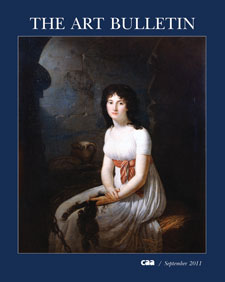 The September 2011 issue of The Art Bulletin, the leading publication of international art-historical scholarship, features an essay on Michelangelo’s drawings, in particular his cartoon for The Battle of Cascina (1504), and an article on urban scenes by the twentieth-century American painter John Sloan. Two additional contributions explore women and portraiture in postrevolutionary France and Roman mosaic labyrinths in North Africa. Book reviews on the art of Byzantium and imperial China, Mamluk culture, and the impact of modernist primitivism round out the issue.
In “Michelangelo, Drawing, and the Subject of Art,” Joost Keizer uncovers Michelangelo’s zeal for disegno, evasion of iconography, and emphasis on educational models for pupils—all of which contribute to art history via visual commentary on historical moments. In his study, Michael Lobel examines the significant body of work generated by John Sloan in 1907 that experiments with spatial orientation and pigment while challenging the artist’s identity as a painter, illuminated by meditations on New York as a shifting metropolis and his background in illustration.
Amy Freund’s cover essay for The Art Bulletin elucidates the importance of portraiture in France after 1789 in which female portraits, like that of Thérésia Cabarrus by Jean-Louis Laneuville in 1796, incorporated women into the French Revolution’s political presence and momentum toward engaged citizenship in the new republic. In “Roman Labyrinth Mosaics and the Experience of Motion,” Rebecca Molholt explores the effects of a transitory viewing experience within Roman baths in North Africa and the intermingling of architecture, myth, and the spectator.
The Reviews section has a particular emphasis on ancient cultures, starting with Jessica Rawson’s discussion of ancient commercial artists in China and Anthony J. Barbieri-Low’s book, Artisans in Early Imperial China. Charles Barber highlights the complexities of the Byzantine icon through the lens of innovations in fifteenth-century Cretan painting, as well as the sensory experience in Byzantium as described by Clemena Antonova in Space, Time, and Presence in the Icon and Bissera V. Pentcheva’s The Sensual Icon. Several books on the history of the Mamluk period, where military slaves became soldiers and eventually rulers of an empire across Egypt, the Arabian Peninsula, the Levant, and greater Syria, are reviewed by Heghnar Zeitlian Watenpaugh, including Cairo of the Mamluks by Doris Behrens-Abouseif. The final review is an analysis of the tension between African art and Western modernism by Elizabeth Harney, in which she sites Man Ray, African Art, and the Modernist Lens by Wendy A. Grossman and Picasso’s Collection of African and Oceanic Art by Peter Stepan as the newest sources to investigate the legacy of primitivism.
Please see the full table of contents for September to learn more. CAA sends The Art Bulletin to all institutional members and to those individuals who choose to receive the journal as a benefit of their membership.
The next issue of The Art Bulletin, to be published in December 2011, will feature essays on the portraiture of nuns in colonial Mexico, on the sociological context of Hokusai’s famous print Under the Wave off Kanagawa, and on Federico Zuccari’s painting The Encounter of Christ and Veronica on the Way to Calvary, among other articles and reviews.
Exhibitor and Advertiser Prospectus for the 2012 Annual Conference
posted by CAA — August 11, 2011
 The Exhibitor and Advertiser Prospectus for the 2012 Annual Conference in Los Angeles, California, is now available for download. Featuring essential details for participation in the Book and Trade Fair, the booklet also contains options for sponsorship opportunities and advertisements in conference publications and on the conference website.
The Exhibitor and Advertiser Prospectus will help you reach a core audience of artists, art historians, educators, students, and administrators, who will converge in Los Angeles for CAA’s 100th Annual Conference and Centennial Celebration, taking place February 22–25, 2012. With three days of exhibit time, the Book and Trade Fair will be centrally located in the Los Angeles Convention Center, where most programs sessions and special events take place. CAA offers several options for booths and tables that can help you to connect in person with conference attendees.
In addition, sponsorship packages will allow you to maintain a high profile throughout the conference. Companies, organizations, and publishers may choose one of three packages, sponsor specific areas and events such as Convocation, ARTspace, and the Distinguished Scholar Session, or work with CAA staff to design a custom visibility package. Advertising possibilities include the Conference Program, distributed to over five thousand registrants, and the conference website, seen by thousands more.
The priority deadline for Book and Trade Fair applications is Friday, October 28, 2011; the final deadline for all applications and full payments, and for sponsorships and advertisements in the Conference Program, is Friday, December 9, 2011.
Questions about the 2012 Book and Trade Fair? Please contact Paul Skiff, CAA assistant director for Annual Conference, at 212-392-4412. For sponsorship and advertising queries, speak to Helen Bayer, CAA marketing and communications associate, at 212-392-4426.
New Appointments to CAA’s Journals
posted by Christopher Howard — July 05, 2011
Earlier this spring, the president of the CAA Board of Directors, Barbara Nesin, has confirmed new appointments to the editorial boards of CAA’s three scholarly journals, in consultation with then–vice president for publications, Anne Collins Goodyear. The appointments took effect on July 1, 2011.
Art Journal
Art Journal has announced its next editor-in-chief: Lane Relyea, an art critic and associate professor in the Department of Art Theory and Practice at Northwestern University in Evanston, Illinois. Since the 1990s Relyea has contributed to Artforum, Parkett, Frieze, and Afterall, among other publications. His book D.I.Y. Culture Industry: Signifying Practices, Social Networks, and Other Instrumentalizations of Everyday Art is forthcoming from MIT Press. Relyea will succeed Katy Siegel of Hunter College, City University of New York, and begin his three-year term on July 1, 2012, with the preceding year as editor designate.
Joining the Art Journal Editorial Board for four-year terms are Doryun Chong, associate curator of painting and sculpture at the Museum of Modern Art in New York, and Saloni Mathur, associate professor at the University of California, Los Angeles. Chong is a contributing editor at Art Asia Pacific and worked as associate curator of visual arts at the Walker Art Center in Minneapolis, Minnesota, from 2003 to 2009. His recent exhibitions include Bruce Nauman: Days (2010) and Haegue Yang: Integrity of the Insider (2009–10). Mathur, a specialist in the art of South Asia, wrote India by Design: Colonial History and Cultural Display (Berkeley: University of California Press, 2007). Her recently compiled volume, The Migrant’s Time: Rethinking Art History and Diaspora, is forthcoming from Yale University Press.
The Art Bulletin
Rachael DeLue, assistant professor at Princeton University in Princeton, New Jersey, has been named the next reviews editor of The Art Bulletin, succeeding Michael Cole of Columbia University in New York. A specialist in American art, DeLue focuses on visual language in culture as it pertains to race, stereotypes, and beauty, and her most recent publication, Landscape Theory (New York: Routledge, 2008), coedited with James Elkins, considers its titular subject from an interdisciplinary perspective. DeLue will serve one year as reviews editor designate before beginning her three-year term on July 1, 2012.
In addition, two CAA members have joined the the Art Bulletin Editorial Board for four-year terms: Dana Leibsohn, Priscilla Paine Van der Poel Professor of Art at Smith College in Northampton, Massachusetts; and Steven Ostrow, professor at the University of Minnesota in Minneapolis and chair of its Department of Art History. Leibsohn concentrates on visual culture in colonial Latin America, highlighting the relevance of maps and modes of literacy in particular. A recent grant from the National Endowment for the Humanities is supporting her collaborative multimedia project, “Vistas: Colonial Latin American Visual Culture 1520–1820.” Ostrow has extensive knowledge of early Italian visual culture and has published on a variety of subjects, including sculpture and illuminated manuscripts, with an emphasis on patronage, iconography, and artistic practice. Most recently he contributed an essay to Rome Italy Renaissance: Essays in Art History Honoring Irving Lavin on His Sixtieth Birthday (New York: Italica, 2009).
The Art Bulletin Editorial Board also has a new chair, appointed from within its ranks: Thelma Thomas, associate professor at the Institute of Fine Arts, New York University, will serve for two years. Thomas specializes in Byzantine and Eastern Christian art and architecture, leading seminars such as “Material Culture in Late Antiquity: Textiles,” and “Byzantine Art and Architecture: 9th–15th Century.”
caa.reviews
The caa.reviews Editorial Board welcomes a new member, Tomoko Sakomura, assistant professor at Swarthmore College in Swarthmore, Pennsylvania, who will serve for four years. Currently the journal’s field editor for books on Japanese art, she is working on a book project called Poetry as Image: The Visual Culture of Waka Poetry in Late Medieval Japan.
Five new field editors for books and exhibitions have recently been chosen by the editorial board to serve three-year terms. Joseph Alchermes of Connecticut College in New London will commission reviews of exhibitions of pre-1800 art in New York and the Northeast, and Kirsten Swenson of the University of Nevada, Las Vegas, is field editor for exhibitions in the Southwest. Aida Wong of Brandeis University in Waltham, Massachusetts, will assign reviews of books on Chinese and Korean art; Pamela Jones of the University of Massachusetts, Boston, will do the same for books on early modern and southern European art; and Juliet Bellow of American University in Washington, DC, will cover books on nineteenth-century art.
Sheryl Reiss, lecturer at the University of Southern California in Los Angeles, began her three-year term as editor-in-chief of caa.reviews on July 1, 2011, succeeding Lucy Oakley, head of education and programs at the Grey Art Gallery, New York University. CAA will publish an interview with Reiss, who served on the journal’s editorial board from 2001 to 2005, later this summer.
June Issue of The Art Bulletin Publishes Essays on Bruegel, Guston, Degas, and Fragonard
posted by Christopher Howard — June 20, 2011
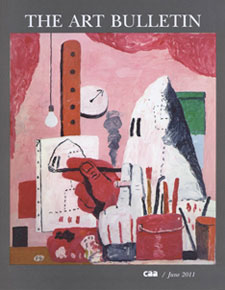 Essays in the June 2011 issue of The Art Bulletin, the leading publication of international art-historical scholarship, examine a range of topics that include works by Pieter Bruegel the Elder, Philip Guston, Edgar Degas, and Jean-Honoré Fragonard. A fifth essay on aesthetics and a collection of important book reviews round out the issue, which has been mailed to all individual CAA members who elect to receive the journal, and to all institutional members. The issue is dedicated to the memory of the late Anne L. Schroder, an expert on eighteenth- and nineteenth-century French art; one of her final essays appears in it.
Leading off the issue is Margaret A. Sullivan’s article that uncovers the beginnings of genre in Bruegel’s debt to stoicism, ancient satire, and the art of Pieter Aertsen. Next, Schroder explores Fragonard’s later career through two revived projects, his illustrations for La Fontaine’s Contes et nouvelles (1788–1809) and his unfinished painting series, the Progress of Love. For “Hegel’s Contested Legacy,” Jason Gaiger reexamines the Hegelian inheritance in art history in light of newly published transcripts of the lectures on aesthetics and, in doing so, raises broader questions about the concourse between art history and philosophy.
Looking at French art in the nineteenth century, André Dombrowski reveals layered political and historical significations embedded in Degas’s Place de la Concorde (ca. 1875), an urban genre portrait of Viscount Lepic and his daughters. For his contribution, Robert Slifkin finds that Guston’s unsettling return to figuration in the 1960s, which partook in a larger “1930s renaissance,” used the disjunction between two moments to comment on the present.
The June 2011 issue includes reviews of two books on humor in Greek vase painting and Roman visual culture, two on Chinese painting, one on medieval Buddhist sculpture, and one on forgery in premodern German art, as well as an exhibition review of Art of Two Germanys/Cold War Cultures, which appeared in Los Angeles, Nuremberg, and Berlin in 2009–10.
Please see the full table of contents for June for more details. The next issue, to be published in September 2011, will feature essays on Roman mosaic floors, an emblematic Michelangelo cartoon for a fresco, portraiture in France after 1789, and the American painter John Sloan.
Spring Art Journal Features Artist’s Project by Paul Sietsema and Centennial Essay by Richard Shiff
posted by Christopher Howard — June 15, 2011
 CAA recently published the Spring 2011 issue of Art Journal, which includes a Centennial essay by the noted scholar Richard Shiff and, on the front and back covers, a project by the Los Angeles–based artist Paul Sietsema.
The issue acknowledges CAA’s Centennial year with Shiff’s text, “Every Shiny Object Wants an Infant Who Will Love It,” a state-of-the-field essay on contemporary art. Beginning with the unfigured sensory experience of a Donald Judd installation in Marfa, Texas, the text examines the human impulse to organize and categorize the elements of aesthetic experience.
Paul Sietsema created two news works for the issue: Untitled Composition for the front cover and Painter’s Mussel for the back. Both are based on found photographs and slyly pun on the interplay between language and the working life of artists today.
The Spring issue also publishes an essay by Saloni Mathur that details the postcolonial context in which the American designers Charles and Ray Eames explored the traditional arts of India—and helped configure the industrial-design program of the newly emergent nation. Next, Christopher Bedford, chief curator of the Wexner Center for the Arts in Ohio, invited seven artists and curators to join him in pondering the peculiarities the art-speak word “project” (as used in the first paragraph of this news item). While some see it as a useful term, others find darker implications in its widespread use.
An essay by Karen Kurczynski called “Drawing Is the New Painting” suggests that the pressures of the contemporary marketplace can jeopardize drawing’s characteristics of expression and immediacy. In a monographic study titled “City of Degenerate Angels,” Ken D. Allan traces the art and publishing efforts of Wallace Berman in the context of the 1950s Los Angeles jazz scene in which the artist came of age. Additional audio evidence for Allan’s argument appears on the Art Journal website.
The Reviews section of the issue, edited by Howard Singerman, contains Michael Corris’s analysis of Julia Bryan-Wilson’s book, Art Workers: Radical Practice in the Vietnam War Era, and Alzo David-West’s assessment of two publications about art and visual culture in North Korea.