
CAA News Today
Should Libraries Toss Their Old Print Journals? A New Report on Digitizing Library Collections
posted by Christopher Howard — October 06, 2009
Many journals are sufficiently preserved digitally and housed in print repositories so that some libraries can responsibly withdraw their own print holdings, according to a new report published by Ithaka S+R. Written by Roger Schonfeld and Ross Housewright, “What to Withdraw: Print Collections Management in the Wake of Digitization” takes a system-wide approach to the needs of libraries and their users collectively, rather than focusing on regions, systems, or consortia.
“Libraries are right to push aggressively into the digital future but should do so with an awareness about risk and tradeoffs,” said Housewright, an analyst at Ithaka S+R, the strategy and research arm of the nonprofit organization ITHAKA, which is also the parent company of JSTOR and Portico.
Looking at reasons for retaining and preserving physical copies of scholarly journals, “What to Withdraw” proposes minimum time periods that require libraries to give access to both print and digital versions. It then offers a minimum number of required print copies to retain. Based on this analysis, the report concludes that certain print journal backfile sets are well enough digitized and contain few enough images that it is unlikely there will be future demand for them by users.
Some print materials, the authors warn, may not yet be ready for broad withdrawal without risk. For these materials, several strategies are recommended to give libraries more flexibility. First, organizations responsible for digitization programs should provide more transparency on the quality of their digitization work and participate in ongoing efforts to upgrade the quality of their scans. In addition, libraries should form deeper partnerships with publishers and other digitizers.
“There is an opportunity before us to make a system-wide impact on print collection management,” said Housewright, “but in order to do so libraries and digitizers need to commit to collaboration at a level unseen today.”
Resources for Catalogues Raisonnés and for Art Law and Cultural Property
posted by Christopher Howard — September 24, 2009
The International Foundation for Art Research (IFAR), a nonprofit educational and research organization dedicated to integrity in the visual arts, has launched two important resources for the art community on its recently expanded and redesigned website: the Catalogue Raisonné Database and Art Law and Cultural Property.
The Catalogue Raisonné Database comprises two integrated electronic databases—one for published catalogues raisonnés, the other for catalogues in preparation—that can be searched individually or in unison. IFAR asks anyone who is aware of a published or in-preparation catalogue raisonné not included in our database (currently at more than two thousand entries) to contact the organization by clicking on the link “Tell Us about Catalogues Raisonnés” and completing the electronic form.
Art Law and Cultural Property helps users to navigate the mushrooming and complex body of legislation and case law relating to the acquisition, ownership, and authenticity of art objects. The website has two principal components: International Cultural Property Ownership and Export Legislation, with texts in original language and English translation from, currently, more than eighty countries; and Case Law and Statutes, with summaries of legal cases in eight subject areas relating to IFAR’s fields of interest. A section on professional guidelines, a glossary, and images are also included.
These two double the offerings from IFAR’s current online educational resources, which also include Provenance Guide and Collectors’ Corner. CAA maintains its own website resource, Intellectual Property and the Arts.
September CAA News Published
posted by Christopher Howard — September 16, 2009
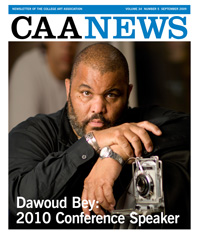 The September CAA News has just been published. All individual and institutional members may download the PDF from the CAA website.
Inside you’ll find early information about the upcoming Annual Conference. Among the special events for Chicago is a keynote address by the renowned photographer Dawoud Bey, who will speak at Convocation. In addition, the painter Phyllis Bramson has been named one of two artists to be interviewed in ARTspace.
Also included in the issue are details about two conference mentoring sessions—the Artists’ Portfolio Review and Career Development Mentoring—as well as an interview with Jackie Battenfield, the author of the recently published book, The Artist’s Guide: How to Make a Living Doing What You Love.
The September newsletter is the second in our return to a digital-only format. The layout has been changed to better fit your computer screen, and all images are now in color. If you prefer to read a hard copy, printed pages are clear and readable.
Submissions to the Endnotes section of the November CAA News are due by September 30; please review the guidelines before sending your listing. Questions or concerns? Please contact Christopher Howard, CAA managing editor.
Deadline for the Wyeth Book Grant Extended
posted by CAA — September 08, 2009
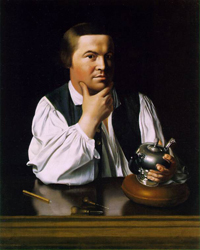 The deadline for the Wyeth Foundation for American Art Publication Grant, established in 2005 with funding from the Wyeth Foundation for American Art, has been extended to Friday, October 9, 2009.
The Wyeth grant supports book-length scholarly manuscripts in the history of American art, visual studies, and related subjects that have been accepted by a publisher on their merits but cannot be published in the most desirable form without a subsidy. For purposes of the program, “American art” is defined as art created in the United States, Canada, and Mexico prior to 1970.
For more information, please contact Alex Gershuny, CAA editorial associate, at 212-691-1051, ext. 254.
Image: John Singleton Copley, Paul Revere, 1768, oil on canvas, 35 1/8 x 28 1/2 in. Gift of Joseph W. Revere, William B. Revere and Edward H. R. Revere, 1930. 30.781 (artwork in the public domain)
September 2009 Issue of The Art Bulletin Published
posted by Christopher Howard — September 02, 2009
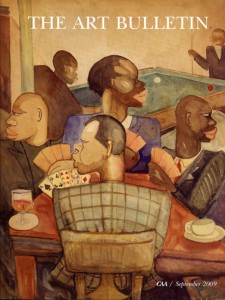 The September 2009 issue of The Art Bulletin, the leading publication of art-historical scholarship, has just been published. It will be mailed to those CAA members who elect to receive it, and to all institutional members.
Five articles make up the issue. Leading off is Rachel Kousser’s “Destruction and Memory on the Athenian Acropolis,” which argues that in the way it was commemorated, the Persians’ sack of the Acropolis in 480 BCE took on paradigmatic significance as an example of “Oriental violence.” Next is a text by Elena Boeck, who in “Simulating the Hippodrome: The Performance of Power in Kiev’s St. Sophia” analyzes strategies of display, appropriation, and simulation of Byzantine imperial symbols by Prince Iaroslav “the Wise” in the paintings of the hippodrome in Kiev’s St. Sophia.
In “Rubens and the Northern Past: The Michielsen Triptych and the Thresholds of Modernity,” Lynn F. Jacobs interrogates the miraculous thresholds of this work by Peter Paul Rubens, which negotiate relations between the donors and God and between the meanings inherent in the life and theology of Christ. Her essay is followed by “Nature and the Ideal in Khnopff’s Avec Verhaeren: Un Ange and Art, or the Caresses,” in which Brendan Cole examines the work of Fernand Khnopff from an iconographic perspective to reveal how the central concerns for all Symbolist artists—of duality and the reconciliation of opposites—are encoded in his paintings.
Last, Phoebe Wolfskill’s “Caricature and the New Negro in the Work of Archibald Motley Jr. and Palmer Hayden” evaluates the perplexing appearance of racial caricature in compositions by these two “New Negro” Renaissance painters and considers how pervasive stereotypes might inform self-perception. Hayden’s Nous quatre à Paris from ca. 1930 is the cover image for this issue.
Also included are seven reviews of books on Romanesque Partheny, Castilian culture, Inigo Jones, Utamaro, science in art, and more. Please read the full table of contents for more details.
caa.reviews Seeks Field Editors
posted by Betty Leigh Hutcheson — July 27, 2009
CAA invites nominations and self-nominations for two field editor positions for reviews of books and related media in caa.reviews for a four-year term, through June 30, 2013. Needed now are field editors for pre-1800 architecture and urbanism and for Egyptian and ancient Near Eastern art. This candidate may be an art historian, art critic, curator, or other art professional; institutional affiliation is not required.
Each field editor commissions reviews of books and related media for caa.reviews within an area of expertise. He or she selects books to be reviewed, commissions reviewers, determines the appropriate character of the reviews, and works with reviewers to develop manuscripts for publication. The field editor works with the caa.reviews Editorial Board as well as the caa.reviews editor-in-chief and CAA’s staff editor, and is expected to keep abreast of newly published and important books and related media in his or her field of expertise.
The Council of Field Editors meets annually at the CAA Annual Conference. Field editors must pay travel and lodging expenses to attend the conference.
Candidates must be current CAA members and should not be serving on the editorial board of a competitive journal or on another CAA editorial board or committee. Nominators should ascertain their nominee’s willingness to serve before submitting a name; self-nominations are also welcome. Please send a letter of interest, CV, and contact information to: Chair, caa.reviews Editorial Board, CAA, 275 Seventh Ave., 18th Floor, New York, NY 10001; caareviews@collegeart.org. Deadline: August 1, 2009.
Download the July Issue of CAA News
posted by Christopher Howard — July 22, 2009
The July CAA News has just been published and posted to the CAA website. All individual and institutional members can download a PDF of it now.
With this issue, CAA News returns to a digital-only format. The layout of the newsletter has changed to better fit your computer screen, and all images are now in color. If you prefer to read a hard copy, the printout pages are clear and readable.
Inside, CAA talks to Heather Darcy Bhandari and Jonathan Melber about their new book, Art/Work: Everything You Need to Know (and Do) As You Pursue Your Art Career (see pages 4–7). You can also read early details about the upcoming 2010 Annual Conference in Chicago: registration prices have just been announced (see page 16), and applications for a limited number of conference travel grants are available (pages 17–18).
Be sure to visit CAA News on the web on a regular basis. CAA will also continue using other forms of electronic communication—Facebook, Twitter, email blasts, and more—to get important organizational information to you.
New Faces for CAA Journals
posted by Christopher Howard — July 10, 2009
Paul Jaskot, president of the CAA Board of Directors, has made new appointments to CAA’s three scholarly journals.
Karen Lang, associate professor of art history at the University of Southern California, has been appointed the next editor-in-chief of The Art Bulletin, succeeding Richard J. Powell of Duke University. Lang begins her three-year term on July 1, 2010, with the preceding year as editor designate.
Michael Cole is the new reviews editor for The Art Bulletin, succeeding David J. Roxburgh of Harvard University, who served the journal for three years. Cole became reviews editor designate in February and took over from Roxburgh this month.
Joining the Art Bulletin Editorial Board for four-year terms beginning July 1, 2009, are: Linda Komaroff, Los Angeles County Museum of Art; Thelma K. Thomas, Institute of Fine Arts, New York University; and Eugene Wang, Harvard University. The newly selected editorial-board chair is Natalie Kampen of Barnard College, who will serve for two years.
At Art Journal, Howard Singerman of the University of Virginia has been appointed the new reviews editor; he will take over from Liz Kotz of the University of California, Riverside, and serve from July 1, 2010, to June 30, 2013, with a year as reviews editor designate starting this month.
Also at Art Journal, Rachel Weiss of the School of the Art Institute of Chicago and Constance DeJong of Hunter College, City University of New York, have joined the Art Journal Editorial Board for the next four years.
Now on the caa.reviews Editorial Board is Michael Ann Holly of the Sterling and Francine Clark Art Institute, who will serve for four years. In addition, seven new field editors for books and related media have been chosen:
- Molly Emma Aitken, City College, City University of New York, South and Southeast Asian art
- Darby English, University of Chicago, contemporary art
- Jonathan Massey, Syracuse University, architecture and urbanism, 1800–present
- Adelheid Mers, School of the Art Institute of Chicago, arts administration and museum studies (a new field-editor position)
- Tanya Sheehan, Rutgers University, photography
- Janis Tomlinson, University Museums at the University of Delaware, Spanish art
- Tony White, Indiana University, Bloomington, artist’s books and books for artists (a new field-editor position)
Field editors work with the journal for three years, starting on July 1, 2009.
All editors and editorial-board members are chosen from an open call for nominations and self-nominations, published in at least two issues of CAA News (usually January and March) and on the CAA website.
Avery Index to Architectural Periodicals Returns to Columbia University
posted by Christopher Howard — July 10, 2009
 The J. Paul Getty Trust in Los Angeles has returned full ownership of the Avery Index to Architectural Periodicals to Columbia University in New York. Produced since 1934 at Columbia’s Avery Architectural and Fine Arts Library, the internet-based index has been operated by both institutions for twenty-six years, with the Getty providing funding and technical and administrative support while Columbia managed its production.
An essential research tool, the Avery Index provides a comprehensive listing of journal articles published worldwide on architecture and design, city planning, interior design, landscape architecture, and historic preservation. At present, about 225 institutions are subscribers, which comprise nearly all major academic institutions internationally who support research in architecture.
Last spring, in connection with Getty-wide budget reductions, the Getty Research Institute (GRI) announced its intention to transfer the index back to Columbia. Moreover, says GRI director Thomas Gaehtgens, the index has become increasingly self-supporting.
Columbia and the Getty will ensure a seamless transition for users of the index, coordinating continuing distribution agreements as they have in the past. The Getty will continue providing administrative and technical support during the transition period from July 1, 2009 until December 31, 2009.
Summer 2009 Art Journal Published
posted by Christopher Howard — June 17, 2009
 The Summer 2009 issue of Art Journal has just been published. It will be mailed to those individual CAA members who elect to receive it, and to all institutional members.
“The marginalization of time-based projects in histories of twentieth-century art is overdetermined,” writes the editor-in-chief Judith F. Rodenbeck in her introduction, “as has long been recognized, by the movement of the human body and, in the case of dance, by gender.” The five essays in the current issue reconsider those margins and offer more inclusive points of view.
Featured in the order of their appearance are: Juliet Bellow, “Fashioning Cléopâtre: Sonia Delaunay’s New Woman”; Nell Andrew, “Living Art: Akarova and the Belgian Avant-Garde”; Kate Elswit, “Accessing Unison in the Age of Its Mechanical Reproducibility”; Janice Ross, “Atomizing Cause and Effect: Ann Halprin’s 1960s Summer Dance Workshops”; and Philip Glahn, “Brechtian Journeys: Yvonne Rainer’s Film as Counterpublic Art.”