CAA News Today
NEA Announces Research on Informal Arts Participation in Rural and Urban Areas
posted by Christopher Howard — March 26, 2010
Any serious reckoning of how Americans participate in arts and cultural activities must account for demographic and geographic diversity. Prior National Endowment for the Arts (NEA) publications, including the 2008 Survey of Public Participation in the Arts, already have examined the age, race and ethnicity, gender, and education and income status of arts-goers.
Another way to understand arts participation is by asking where it takes place. Come as You Are: Informal Arts Participation in Urban and Rural Communities is the NEA’s first research publication in several years to examine the “informal arts”—such as playing a musical instrument, attending an art event at a place of worship, or visiting a craft fair. This finding is part of new research from the NEA, announced earlier this during a visit by NEA Chairman Rocco Landesman to Chelsea, Michigan, as part of the NEA’s Art Works Tour. The publication provides an analysis of arts participation in rural and urban areas.
Come as You Are: Informal Arts Participation in Urban and Rural Communities is available in print and pdf on the NEA website.
March Issue of CAA News Published
posted by Christopher Howard — March 19, 2010
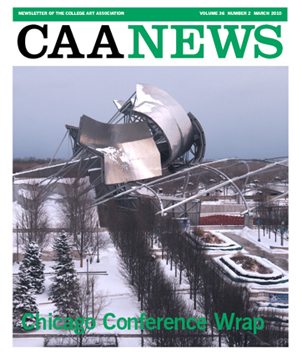 The March CAA News—which presents a wrap-up of the wildly successful 2010 Annual Conference in Chicago—has just been published. You may download a PDF of it immediately.
This issue offers conference summaries from multiple perspectives by key players, including CAA’s conference director Emmanuel Lemakis, Services to Artists Committee members Brian Bishop and Sabina Ott, and more. Dawoud Bey’s keynote address at Convocation is reprinted in full, and a report from the Board of Directors meeting is also included. And don’t miss the wide selection of full-color photographs from the many conference events.
If you missed the web article on the Coalition on the Academic Workforce’s statement on part-time faculty, or the calls for editorial-board members of CAA’s journals, you can catch up with the March newsletter.
The CAA News editor is still accepting submissions for the Endnotes section for the May issue. Please send your listings for recent solo exhibitions, books published, and exhibitions curated, as well as news about your new position or your grant or fellowship, to Christopher Howard.
Interested in advertising in CAA News? Please contact Bradford Nordeen at 212-691-1051, ext. 252.
JSTOR Creating Database for Auction Catalogues
posted by Christopher Howard — March 02, 2010
JSTOR is collaborating with two New York museums—the Frick Collection and the Metropolitan Museum of Art—in a pilot project designed to understand how auction catalogues can be best preserved for the long term and made most easily accessible for scholarly use. Vital for provenance research, auction catalogues are used for the study of art markets and the history of collecting.
Funded by the Andrew W. Mellon Foundation, JSTOR’s prototype site is open to the public through June 2010. If you are interested in this content and its importance to art research, please explore the site and take the brief survey. In June, JSTOR will evaluate use of the content and feedback it has received in order to help determine the future of the resource.
Publications Committee Members Sought
posted by CAA — February 19, 2010
CAA invites nominations and self-nominations for two members at large to serve on the Publications Committee for a three-year term, July 1, 2010–June 30, 2013.
Candidates must possess expertise appropriate to the committee’s work. Museum-based arts professionals with an interest and experience in book, journal, or museum publishing and those with experience in digital publishing are especially encouraged to apply.
The Publications Committee is a consultative body that advises the CAA Publications Department staff and the CAA Board of Directors on publications projects; supervises the editorial boards of The Art Bulletin, Art Journal, and caa.reviews, as well as CAA’s book-grant juries; sponsors a practicum session at the Annual Conference; and, with the CAA vice president for publications, serves as liaison to the board, membership, editorial boards, book-grant juries, and other CAA committees.
The committee meets three times a year, including once at the CAA Annual Conference; members pay travel and lodging expenses to attend the conference. Members of all committees volunteer their services to CAA without compensation.
Candidates must be current CAA members and should not serve concurrently on other CAA committees or editorial boards. Applicants may not be individuals who have served as members of a CAA editorial board within the past five years. Nominators should ascertain their nominee’s willingness to serve before submitting a name; self-nominations are also welcome. Appointments are made by the CAA president in consultation with the vice president for publications.
Please send a letter of interest describing your interest in and qualifications for appointment, a CV, and contact information to: Vice President for Publications, c/o Alexandra Gershuny, CAA, 275 Seventh Ave., 18th Floor, New York, NY 10001. Materials may also be submitted to agershuny@collegeart.org. Deadline: April 15, 2010.
Digital Book Publishing Still a Moving Target
posted by Christopher Howard — February 05, 2010
 Respondents to a recent survey on digital book publishing, produced by the Association of American University Presses (AAUP), say that digital book publishing is still a moving target, naming metadata bottlenecks, third-party vendors, and rights issues over images as major concerns.
The report, “Digital Publishing in the AAUP Community Survey Report: Winter 2009–2010,” shares responses to seven questions specifically about digital strategies, technologies, and concerns related to their book-publishing programs. The survey also collected new and updated information on specific e-publishing programs at member presses in order to update the association’s online directory of such projects.
According to the report, university presses are increasingly working to provide print-on-demand services for new and old titles, as well as partnering with digital aggregators such as Google Books for Publishers (91.5% of respondents), Amazon’s Search Inside the Book (76.3%), and Barnes and Noble See Inside (39%).
About 96.5% of AAUP member presses are working with the PDF, and 31.6% and 29.8% respectively using AZW (for Kindle) and EPUB formats. Many presses currently offer excerpts and chapters of books on their websites, and some have entire books available online.
Student and Emerging Professionals Committee Publishes Conference Survival Guide
posted by Vanessa Jalet — February 01, 2010
The Conference Survival Guide for the 2010 Annual Conference in Chicago was published in mid-December as a downloadable Word file. Written by CAA’s Student and Emerging Professionals Committee, the guide offers guidance to students, emerging professionals, and others attending their first conference for traveling to Chicago and navigating conference activities. Suggestions include:
- options for travel funding
- budget travel ideas and lodging information
- dining and transportation suggestions
- effective strategies for successful participation in the conference
- suggestions for networking during the four-day event
- city resources and sightseeing recommendations
For more details about the Conference Survival Guide and CAA committees, please contact Vanessa Jalet, CAA executive assistant.
Winter 2009 Issue of Art Journal Published
posted by Christopher Howard — January 26, 2010
 The Winter 2009 issue of Art Journal, CAA’s quarterly of cutting-edge art and ideas, has just been published. It has been mailed to those CAA members who elect to receive it and to all institutional members.
In a Forum called “The Shape of Time, Then and Now,” five authors explore the contemporary relevance of George Kubler’s 1962 book, The Shape of Time. As Judith Rodenbeck, the editor-in-chief of Art Journal, writes, the book “took up set theory to help think about traditional art-historical devices of temporal framing: style, influence, reference, oeuvre, and so on.” An outline of key concepts in Kubler’s book and important bibliographic references appear in Reva Wolf’s introduction. Next, Mary Miller gives a “fibrous” (to use Kubler’s words) account of Kubler’s project, and Shelley Rice details the importance of his ideas for critics in the 1960s, in particular Lawrence Alloway, her mentor. Two artists also contribute: Ellen K. Levy reviews Kublerian entwining of scientific and artistic discourses, while Suzanne Anker considers contemporary possibilities for his concept of the “prime object.”
The Winter issue also includes Time Drills, a related artists’ project by the collective Spurse, and features two essays on quite contemporary art—Qadri Ismail’s “Bound Together: On a Book of Antiwar Sri Lankan Drawing” and Nissim Gal’s “Bare Life: The Refugee in Contemporary Israeli Art and Critical Discourse.”
Photography is the focus of the Reviews section. Stephanie Schwartz evaluates Words without Pictures, a recent collection of essays by artists and theorists, published in book form and online, and Jason Weems reviews a trio of books: On Alexander Garndner’s Photographic Sketch Book of the Civil War, Lynching Photographs, and Weegee and Naked City.
The Winter 2009 issues sees the end of Rodenbeck three-year term as editor-in-chief. She handed the journal’s reigns the new editor, Katy Siegel, in July 2009. Siegel’s first issue, a combined Spring–Summer issue, will appear in early May.
National Arts Index Results Released
posted by Christopher Howard — January 22, 2010
 In 2008 the National Arts Index fell 4.2 points to a score of 98.4, reveals Americans for the Arts, a national nonprofit arts group. This means, among other things, that charitable giving and attendance at larger cultural institutions have declined, even as the number of artists and arts-related businesses grew.
Other findings from the index tell us that nonprofit arts organizations expanded from 73,000 to 104,000 between 1998 and 2008, but a third of them failed to balance their budgets. Also, demand for the arts has been mixed. Although millions of Americans attended concerts, plays, and museum exhibitions last year, the overall percentage of those who participate in such activities, compared to the total population, is decreasing. The good news is that those who create art, whether that’s making music, taking photographs, or drawing, is up. The demand for arts education is also strong.
Those involved in the National Arts Index herald its usefulness in shaping the future of the arts in the United States. “As with key business measures like the Dow or the GDP, we now have a way to measure the health of the arts in America,” said Albert Chao, a member of the Business Committee for the Arts, a business leadership program of Americans for the Arts. To that end, the Kresge Foundation has awarded a $1.2 million grant to Americans for the Arts to support that vision.
Read more about the index on the PR Newswire. The Americans for the Arts website has more detailed information, as well as PDF downloads of a detailed summary and the full report. There is also discussion and opinions on the organization’s blog.
Opt-Out Deadline for Google Book Settlement Approaching
posted by Christopher Howard — January 20, 2010
Following the submission of the amended Google Book Settlement in November 2009, the deadline for opting out was extended. The new deadline is January 28, 2010 (postmarked or submitted online on or before that date).
Those who had not opted out of the settlement may still do so, and those who had opted out may now opt in, if they so wish. If you wish to maintain your previous status, you need not do anything. (Under a class-action settlement, all class members remain in the class unless they opt out.)
Opt-out forms (to mail in) and instructions for opting out online are available at the settlement website. You may also read the settlement FAQ for more information.
Woman’s Art Journal Focuses on Paula Modersohn-Becker
posted by Christopher Howard — January 20, 2010
 The first American anthology of writings on the work of Paula Modersohn-Becker has just been published by Woman’s Art Journal (Fall/Winter 2009) in an issue devoted to the artist.
Modersohn-Becker (1876–1907) was a German painter who worked in styles ranging from Postimpressionism to early Expressionism. Influenced by Cézanne, Gauguin, and van Gogh, she is recognized today for her early feminist imagery.
The two lead articles were originally written for the catalogue of the Modersohn-Becker exhibition that was to have opened at the Neue Galerie in 2009 in New York (postponed): Anne Higonnet (Barnard College, Columbia University), “Making Babies, Painting Bodies: Women, Art, and Paula Modersohn-Becker’s Productivity”; Diane Radycki (Moravian College), “Pictures of Flesh: Modersohn-Becker and the Nude.”
The three following articles were first presented as talks at the 2009 CAA Annual Conference in Los Angeles. The session, chaired by Radycki, was called “Paula Modersohn-Becker: Art, Risk, Fame”:Rainer Stamm (Paula Modersohn-Becker Museum), “Paula Modersohn-Becker and the Body in Art”; Monica Strauss (author of Cruel Banquet: The Life and Loves of Frida Strindberg), “Helen Serger’s Galerie La Boetie: Paula Modersohn-Becker on Madison Avenue”; Michelle Vangen (Graduate Center, City University of New York), “Left and Right: Politics and Images of Motherhood in Weimar Germany.”
Published semiannually—May and November—since 1980, Woman’s Art Journal continues to represent the interests of women and art worldwide. Articles and reviews cover all areas of women in the visual arts, from antiquity to the present day.
Image: Paula Modersohn-Becker, Self-Portrait (Semi-Nude with Amber Necklace and Flowers II), 1906, oil on canvas, 61 x 50 cm (artwork in the public domain)