CAA News Today
Katy Siegel Named Art Journal Editor
posted by Christopher Howard — January 16, 2009
 Katy Siegel, associate professor of art history at Hunter College in New York, is the new editor-in-chief of Art Journal. She will begin her three-year term on July 1, 2009, and her first issue will appear in spring 2010. Siegel succeeds Judith Rodenbeck of Sarah Lawrence College, who has led the journal since July 2006.
In addition to her work in the City University of New York system, teaching at both Hunter and the Graduate Center, Siegel has also been a senior critic in the Yale University School of Art and was a visiting associate professor at Princeton University from 2007 to 2009. She earned her PhD at the University of Texas at Austin in 1995.
Siegel has published widely on modern and contemporary art, with essays in books and catalogues for Richard Tuttle, Dana Schutz, Takashi Murakami, Lisa Yuskavage, Bernard Frize, and more. Among her own books are Abstract Expressionism (forthcoming from Phaidon, 2010) and Art Works: Money (with Paul Mattick; New York: Thames and Hudson, 2004). She wrote the primary essay for Jeff Koons (Berlin: Taschen, 2008), and Reaktion Books will publish her latest project, ‘Since ’45’: Contemporary Art in the Age of Extremes.
A contributing editor to Artforum, she has written criticism, essays, and reviews for the magazine since 1998. Siegel also maintains a public face, participating in panels and delivering lectures and papers nationwide. At the 2009 CAA Annual Conference in Los Angeles, she is chairing a session entitled “The Age of Extremes.”
Her recent guest-curated exhibition, High Times, Hard Times: New York Painting, 1967–75, with the artist David Reed as advisor, traveled internationally from 2006 to 2008 to great critical acclaim.
Art Journal Conference Roundtable: Art and Transnationalism
posted by Christopher Howard — January 07, 2009
The editorial board of Art Journal seeks interested CAA members to join us at the 2009 Annual Conference in Los Angeles for a roundtable discussion on art and transnationalism.
Art in the twentieth century has been deeply shaped by exile, travel, and diaspora. Since about 1990, “globalization” has been driven by the trajectory of global finance and transnational capitalism, which in turn have intensified transnational circulation and art practice. Seen through this lens, the contemporary artist is a producer of commodified sameness, and even an unwitting vector for capitalist penetration into the peripheries. But transnational practice and exchange may also foster new imaginaries and solidarities at variance with capitalism. Can such practices transform the local by enabling a more direct social address? Postcolonial theory and globalization studies are enabling new ways of writing histories of modernisms as crossnational cultural forms. Thinking through transnationalism may productively reconfigure the disjunctive relationship between a local or national art history and a “global” art history of the modern and contemporary era.
Led by Art Journal editorial-board member Iftikhar Dadi, the roundtable discussion will be recorded and may provide material for publication in a future issue. The discussion will take place on Thursday, February 26, 2:00–4:00 PM, at a conference location to be announced.
Participation is by invitation. Please send a brief email describing your interest in the topic and how you foresee contributing to the discussion to mid1@cornell.edu. Invitations to participate will be sent around February 1. Deadline: January 20, 2009.
January CAA News Published
posted by Christopher Howard — January 06, 2009
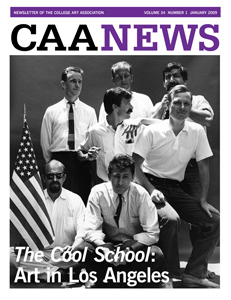 The first issue of CAA News for 2009 has just been posted to the CAA website. Click on the cover to download a PDF of the issue right away. Printed copies for individual and institutional members will be mailed soon, to begin arriving in mid-January.
The January issue includes statements and biographies of the six candidates for the CAA Board of Directors for 2009–13. Please read these texts, as well as view their short video statements online, before casting your vote.
Also featured are details on the upcoming Regional MFA Exhibition at the 97th Annual Conference in Los Angeles, which features the work of student artists from twelve graduate programs in southern California.
The deadline for submissions to, and advertisements for the March 2009 issue is January 10. Please see the newsletter submission guidelines for instructions or write to Christopher Howard, CAA managing editor.
Meet the Editors of CAA’s Journals
posted by CAA — December 30, 2008
Attendees of the CAA Annual Conference in Los Angeles are invited to meet the editors-in-chief of The Art Bulletin, Art Journal, and caa.reviews at the CAA booth in the Book and Trade Fair. Discuss the journals, present your ideas, learn how to submit material for consideration, and ask questions. Richard Powell of The Art Bulletin, Judith Rodenbeck of Art Journal, and Lucy Oakley of caa.reviews will be at the booth on Friday, February 27, 2008, 10:30–11:30 AM.
Los Angeles Art Magazine Editors in Conversation
posted by Christopher Howard — December 29, 2008
Los Angeles is home to several internationally distributed art magazines, including the triannual Afterall and the quarterly X-TRA, both nonprofit publications. In June 2008, CAA News talked via email with Elizabeth Pulsinelli, executive editor for X-TRA, and Stacey Allan, associate editor of Afterall, about their respective magazines.
Conference Survival Guide Published
posted by Vanessa Jalet — December 15, 2008
The Conference Survival Guide has just been published as a downloadable PDF. The guide offers guidance to students, emerging professionals, and others attending their first conference for traveling to Los Angeles and navigating conference activities. Suggestions provided in the guide include tips for finding travel funds, options for budget travel, suggestions for lodging and dining, information on transportation in Los Angeles, listings of events and ways to actively participate in the conference, and guidelines for successful networking during the four-day event. The Conference Survival Guide is an annual publication put together by CAA’s Student and Emerging Professionals Committee. For more details, contact Vanessa Jalet, CAA executive assistant.
CIHA Papers to Be Published in 2009
posted by Christopher Howard — December 11, 2008
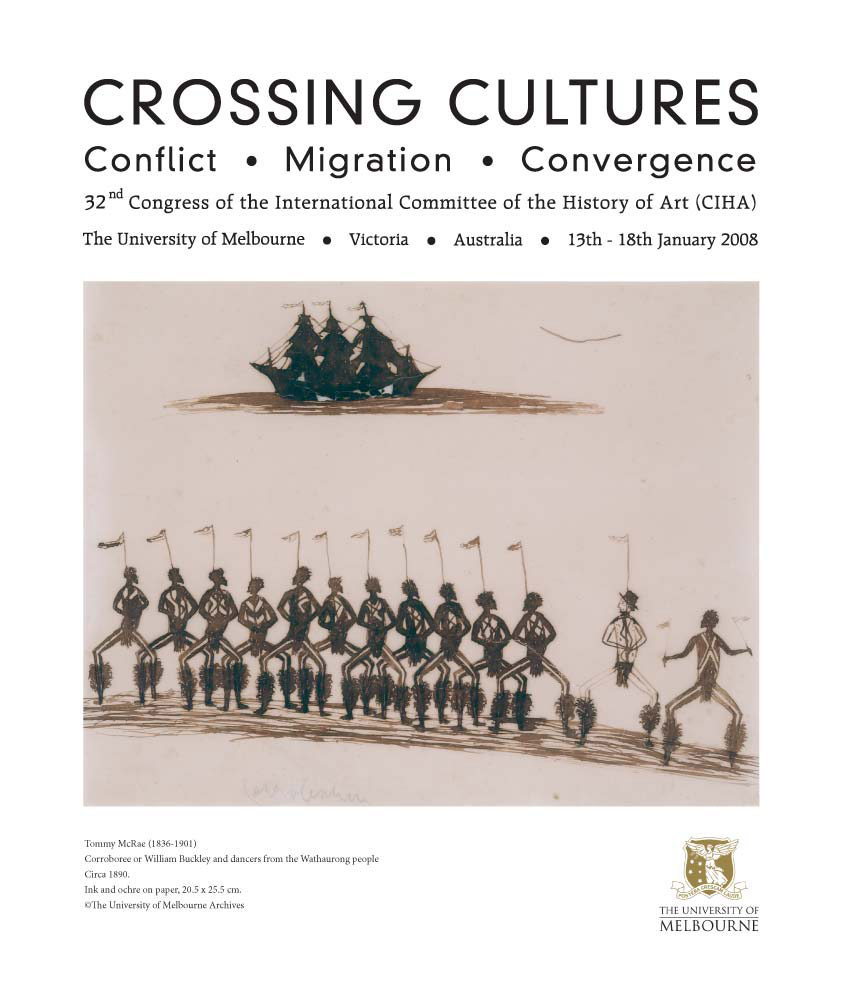 Conference papers from the 32nd Congress of the International Committee of the History of Art (CIHA), which convened in Melbourne, Australia, in January 2008, will soon be published by Miegunyah Press. Entitled Crossing Cultures: Conflict, Migration and Convergence, the book is edited by the conference convenor Jaynie Anderson.
Art and its history are not only created but are also discussed in one form or another on all the inhabited continents of the earth. Globalism has also assumed an art-historical aspect: indeed it has been described as art history’s most pressing issue. The themes are conflict, migration, and convergence in the visual, symbolic, and artistic exchanges between cultures throughout history. This publication will explore these themes.
This bound book is only available via a preorder form. It will not be available from any other outlets. Orders for this publication will be accepted until February 27, 2009—don’t miss this opportunity! Individual chapters of the book will also be available to purchase and download online in June 2009.
Preorder Graduate Programs in Art History
posted by CAA — December 05, 2008
 CAA is now taking preorders of Graduate Programs in Art History: The CAA Directory. This easy-to-use directory includes over 260 schools and English-language academic programs in the United States, Canada, Great Britain, and elsewhere worldwide. An index lists schools alphabetically and by state and country for quick reference.
Member Rate: $39.95 + shipping and handling
Nonmember Rate: $49.95 + shipping and handling
Please visit our online store to reserve your copy of the directory today. If you are ordering on behalf of an institution or department within a university, please use this form and submit via fax or post. At this time, online purchases can only be processed for individuals.
The directory is your indispensable, comprehensive guide to schools offering master’s, doctoral, and related degrees in art studies, including:
- History of Art and Architecture
- Visual Studies
- Museum Studies
- Curatorial Studies
- Arts Administration
- Library Science
Listings provide:
- Descriptions of specialized courses
- Number, names, and specializations of faculty
- Facilities such as libraries, image libraries, and labs
- Student opportunities for research and work
- Information on financial aid, fellowships, and assistantships
- Details on housing, health insurance, and other practical matters
Graduate Programs in the Visual Arts: The CAA Directory, which includes studio art, graphic design, applied arts and design, film production, art education, and conservation, will be available in early 2009.
Art Journal Conference Roundtable: Art and Transnationalism
posted by Christopher Howard — December 04, 2008
The editorial board of Art Journal seeks interested CAA members to join us at the 2009 Annual Conference in Los Angeles for a roundtable discussion on art and transnationalism.
Art in the twentieth century has been deeply shaped by exile, travel, and diaspora. Since about 1990, “globalization” has been driven by the trajectory of global finance and transnational capitalism, which in turn have intensified transnational circulation and art practice. Seen through this lens, the contemporary artist is a producer of commodified sameness, and even an unwitting vector for capitalist penetration into the peripheries. But transnational practice and exchange may also foster new imaginaries and solidarities at variance with capitalism. Can such practices transform the local by enabling a more direct social address? Postcolonial theory and globalization studies are enabling new ways of writing histories of modernisms as crossnational cultural forms. Thinking through transnationalism may productively reconfigure the disjunctive relationship between a local or national art history and a “global” art history of the modern and contemporary era.
Led by Art Journal editorial-board member Iftikhar Dadi, the roundtable discussion will be recorded and may provide material for publication in a future issue. The discussion will take place on Thursday, February 26, 2:00–4:00 PM, at a conference location to be announced.
Participation is by invitation. Please send a brief email describing your interest in the topic and how you foresee contributing to the discussion to mid1@cornell.edu. Invitations to participate will be sent around February 1. Deadline: January 20, 2009.
Troubling Study on US Higher Education
posted by Christopher Howard — December 03, 2008
 States are making little or no progress in providing affordable college opportunities or improving college completion rates for their residents, says a report released today by the National Center for Public Policy and Higher Education. The findings come as states face massive budget shortfalls that threaten higher-education funding, and the United States continues to lag behind other advanced nations on measures of higher-education performance.
Drawing on nearly two decades of data, the report, Measuring Up 2008, finds that while states have made modest gains in preparing students for college, more students are failing to graduate from high school. While college-enrollment rates for young adults are improving, enrollment rates are declining for older adults. The report also notes that the burden of paying for college is now higher for students in every state, and low college-completion rates have barely improved. Additionally, disparities persist in college access and success by income, race and ethnicity, and state.
According to the study, major gaps include:
- Affordability. The burden of paying for college has increased for all families but has increased substantially more for low- and middle-income families. Nationally, families in the lowest-income group (bottom 20 percent of the population) pay 55 percent of their income to attend public four-year colleges and universities (after accounting for all student financial aid)—a jump from 39 percent in 2000. Families in the middle-income group (middle 20 percent of the population) pay 25 percent of their income (up from 18 percent in 2000), and those in the top income group (top 20 percent of the population) pay 9 percent of their income (up from 7 percent in 2000). (See page 8 of Measuring Up 2008.)
- Additionally, college is more affordable in some states than others. At community colleges, the proportion of family income needed to pay for college expenses, after financial aid, has increased from 18 percent to 25 percent in Florida, and from 20 percent to 25 percent in Washington State. At public four-year institutions, the percentage of income needed to pay costs, after aid, has increased from 17 percent to 20 percent in Minnesota, from 19 percent to 34 percent in New Jersey, and from 29 percent to 41 percent in Pennsylvania. (See page 15.)
- High school completion. In Illinois, 95 percent of white young adults have a high school credential, compared with 82 percent of blacks. In Texas, 93 percent of white young adults have a high school credential, compared with 74 percent of Hispanics. (See page 14.)
- College attendance. In Connecticut and New York, 50 percent of white young adults are enrolled in college, compared with 34 percent of blacks. In California, 45 percent of whites are enrolled, compared with 27 percent of Hispanics. In Arizona, 40 percent of whites are enrolled, compared with 18 percent of Native Americans. (See page 14.)
- College graduation. In Delaware, 73 percent of white students complete a bachelor’s degree within six years of enrolling in college, compared with 41 percent of black students. In New York, 63 percent of whites do so, compared with 43 percent of Hispanics. In New Mexico, 47 percent of whites graduate within six years, compared with 25 percent of Native Americans. (See page 16.)
As a result of these inequities, US higher-education performance has been declining compared to other nations in recent years.
- In college completion, which has never been a strength of American higher education, the US falls in the middle of the pack: fifteenth among twenty-nine countries compared
- The US adult population ages thirty-five and older still ranks among the world leaders (second only to their peers in Canada) in the percentage who have college degrees, reflecting the educational progress of earlier times
- Among twenty-five- to thirty-four-year-olds, however, the US has slipped to tenth in the percentage having college degrees. This relative erosion of our national “educational capital” reflects the lack of significant improvement in the rates of college participation and completion in the US in recent years, compared with other countries
Measuring Up 2008 is the fifth in a series of biennial report cards issued by the National Center, based in San Jose, California. Like the earlier reports, this edition measures the performance of the nation and of each state in providing education and training beyond high school. Each state receives an A-to-F grade in each of five performance areas.
In addition to the national report card, detailed individual report cards are available for each of the fifty states. Upon release of Measuring Up 2008, the national and state report cards will be posted on the National Center’s website.
The National Center for Public Policy and Higher Education promotes public policies that enhance Americans’ opportunities to pursue and achieve a quality higher education. Established in 1998 by a consortium of national foundations, the center is an independent, nonprofit, nonpartisan organization. It is not associated with any institution of higher education, with any political party, or with any government agency. The National Center is solely responsible for Measuring Up 2008.