
CAA News Today
Grants, Awards, and Honors
posted by CAA — August 15, 2016
CAA recognizes its members for their professional achievements, be it a grant, fellowship, residency, book prize, honorary degree, or related award.
Grants, Awards, and Honors is published every two months: in February, April, June, August, October, and December. To learn more about submitting a listing, please follow the instructions on the main Member News page.
August 2016

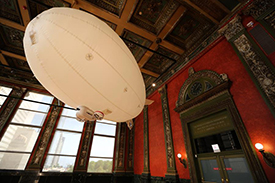 Paul Catanese, Visible from Space Field Test: Sidney R. Yates Gallery, 2015, installation, dimensions variable (artwork © Paul Catanese)
Paul Catanese, director of the interdisciplinary arts and media MFA program at Columbia University Chicago in Illinois, has embarked on a three-month residency at the Chicago Cultural Center’s Sidney R. Yates Gallery.

Ruth Ezra, a doctoral candidate in the Department of History of Art and Architecture at Harvard University in Cambridge, Massachusetts, has accepted a 2016–17 Henry Moore Institute Visiting Research Fellowship. She will work on “Eliding Sculpture and Plane in German Art, 1490–1523.”


Chiara Fabi from the City Council of Milan in Italy has been chosen as a short-term research scholar by the Smithsonian American Art Museum in Washington, DC. She will continue researching “American Sculptors in Italy, 1911–1949.”
Christine Göttler, professor of history of early modern art at the University of Bern in Switzerland, has completed a fellowship in residence at the Netherlands Institute for Advanced Study in the Humanities and Social Sciences in Amsterdam.

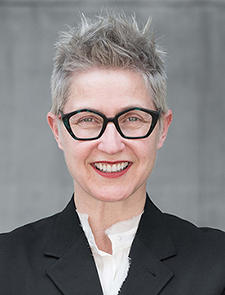 Mary Beth Heffernan (photograph by Marc Campos)
Mary Beth Heffernan, professor of art in the Department of Art and Art History at Occidental College in Los Angeles, California, has become an artist in residence at the Huntington Library, Art Collections, and Botanical Gardens in San Marino.
Patricia A. Johnston, chair of Department of Visual Arts at College of the Holy Cross in Worcester, Massachusetts, has been awarded a Terra Foundation Senior Fellowship in American Art for the 2016–17 academic year by the Smithsonian American Art Museum in Washington, DC. Her project is titled “Art and Global Knowledge in Early America.”
Kelly Kaczynski, an artist and lecturer for the School of the Art Institute of Chicago in Illinois, has been awarded a 2015 biennial grant from the Louis Comfort Tiffany Foundation in the amount of $20,000.
Margarita Karasoulas, a doctoral candidate in the Department of Art History at the University of Delaware in Newark, has received the Douglass Foundation Predoctoral Fellowship in American Art from the Smithsonian American Art Museum in Washington, DC. She will work on “Mapping Immigrant New York: Race and Place in Ashcan Visual Culture” during the 2016–17 academic year.
R. Tess Korobkin, a graduate student in the Department of the History of Art at Yale University in New Haven, Connecticut, has earned a 2016–17 predoctoral fellowship from the Smithsonian American Art Museum in Washington, DC. Her project is called “Sculptural Bodies of the Great Depression.”
Laurette E. McCarthy, an independent scholar based in Indianapolis, Indiana, has been named George Gurney Senior Fellow for 2016–17 at the Smithsonian American Art Museum in Washington, DC. She will research “Anarchists, Mormons, Blue Bloods, and the Armory Show: Sculpting America.”
Helina Metaferia, an interdisciplinary artist, has been placed at the San Francisco Art Institute in California for a second consecutive year as part of the Post-Graduate Teaching Fellowship program, organized by the Association of Independent Colleges of Art and Design. She will teach in the school’s New Genres program in fall 2016.
Alexander Nemerov, Carl and Marilynn Thoma Provostial Professor in the Arts and Humanities and chair of the Department of Art and Art History at Stanford University in Stanford, California, has been tapped to give the sixty-sixth annual A. W. Mellon Lectures in the Fine Arts at the National Gallery of Art in Washington, DC. His series of talks, “The Forest: America in the 1830s,” will take place in spring 2017.

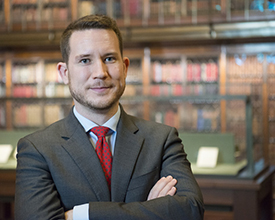 Joshua O’Driscoll (photograph by Graham S. Haber)
Joshua O’Driscoll, assistant curator in the Department of Medieval and Renaissance Manuscripts at the Morgan Library and Museum in New York, has received the prestigious Paul Clemen Prize, which promotes the study of art from Germany’s Rhineland area. O’Driscoll’s submission, in the form of his 2015 doctoral dissertation on illuminated manuscripts produced in Cologne around the year 1000, is the first English-language study to receive the award.
Corey Piper, a PhD candidate in art history in the University of Virginia’s McIntire Department of Art in Charlottesville, has been appointed a 2016–17 Wyeth Foundation Predoctoral Fellow by the Smithsonian American Art Museum in Washington, DC. Her project is called “Animal Pursuits: Hunting and the Visual Arts in Nineteenth-Century America.”
William L. Pressly, professor emeritus of art history for the University of Maryland in College Park, has become a 2016–17 senior fellow at the Smithsonian American Art Museum in Washington, DC. He will research “America’s Paper Money: A Canvas for an Emerging Nation.”
Sheryl E. Reiss, president of the Italian Art Society and former editor-in-chief of caa.reviews, has become the Sixteenth Century Society and Conference Fellow at the Newberry Library in Chicago, Illinois, for spring 2017. Her project is titled “A Portrait of a Medici Maecenas: Giulio de’ Medici (Pope Clement VII) as Patron of Art.”
Fabiola Martínez Rodríguez, coordinator of art history for Saint Louis University in Madrid, Spain, has been selected as a short-term research scholar by the Smithsonian American Art Museum in Washington, DC.
James Rosenow, a PhD candidate in the Department of Cinema and Media Studies at the University of Chicago in Illinois, has been named a 2016–17 predoctoral fellow by the Smithsonian American Art Museum in Washington, DC. His research topic is “‘For God’s Sake Don’t Call It Art’: The 1930s American Laboratory and Its Film Experiments.”
Claudia Sbrissa, professor of art and design at St. John’s University in Jamaica, New York, has accepted an artist’s fellowship from the Institute of Culture Brazil Italy Europe in Salvador, Bahia, Brazil, for July and August 2016.
Emily Thames, a graduate student in the Department of Art History at Florida State University in Tallahassee, has been named Joe and Wanda Corn Predoctoral Fellow at the Smithsonian American Art Museum in Washington, DC. During the 2016–17 academic year, she will research “The Life and Art of José Campeche: Enlightenment, Reform, and Identity in Late Eighteenth-Century Puerto Rico.”
Sajda van der Leeuw from the University of Oxford in England has been appointed Terra Foundation Predoctoral Fellow in American Art by the Smithsonian American Art Museum in Washington, DC. During the 2016–17 academic year, she will work on “Earth in Focus: The Origins of Land Art through the Lens of Photography and Film.”

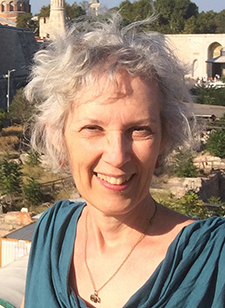 Nancy L. Wicker (photograph by Matthew L. Murray)
Nancy L. Wicker, professor of art history at the University of Mississippi, has been named Allen W. Clowes Fellow by the National Humanities Center in Research Triangle Park, North Carolina. Between September 2016 and May 2017, Wicker will work on a project focusing on the roles of people—patrons, artists, consumers, and subjects—in Viking art.
Nancy L. Wicker, professor of art history at the University of Mississippi, has been awarded a Digital Humanities Start-Up Grant by the National Endowment for the Humanities, codirected with colleagues at the Catholic University of America and the University of Virginia. The grant will support pilot implementation of Project Andvari, an online portal that will aggregate digital collections of northern European early medieval art.
Hannah Yohalem, a graduate student in the Department of Art and Archeology at Princeton University in Princeton, New Jersey, has been awarded a 2016–17 predoctoral fellowship from the Smithsonian American Art Museum in Washington, DC. Her research project is called “The Johns Device: Bodies, Words, and Objects in Jasper Johns’s Art, 1954–1968.”
Exhibitions Curated by CAA Members
posted by CAA — August 15, 2016
Check out details on recent shows organized by CAA members who are also curators.
Exhibitions Curated by CAA Members is published every two months: in February, April, June, August, October, and December. To learn more about submitting a listing, please follow the instructions on the main Member News page.
August 2016
Anne Collins Goodyear, Jonathan Frederick Walz, and Kathleen Merrill Campagnolo. This Is a Portrait If I Say So: Identity in American Art, 1912 to Today. Bowdoin College Museum of Art, Bowdoin College, Brunswick, Maine, June 25–October 23, 2016.
Alexandra Keiser. Archipenko: A Modern Legacy. Faulconer Gallery, Grinnell College, Grinnell, Iowa, September 30–December 11, 2016.
Valentina Locatelli. Without Restraint: Works by Mexican Women Artists from the Daros Latinamerica Collection. Kunstmuseum Bern, Bern, Switzerland, June 3–October 23, 2016.

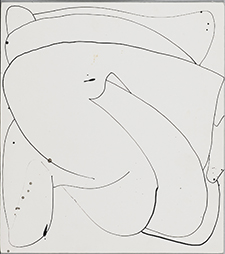 Sam Francis, Untitled, 1961, ink on paper, 10⅞ x 9¾ in. P.2012.1.10 (artwork © Sam Francis Foundation)
Gloria Williams. Drawing, Dreaming and Desire: Works on Paper by Sam Francis. Norton Simon Museum, Pasadena, California, April 8–July 25, 2016.
Books Published by CAA Members
posted by CAA — August 15, 2016
Publishing a book is a major milestone for artists and scholars—browse a list of recent titles below.
Books Published by CAA Members appears every two months: in February, April, June, August, October, and December. To learn more about submitting a listing, please follow the instructions on the main Member News page.
August 2016

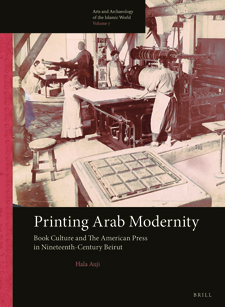
Hala Auji. Printing Arab Modernity: Book Culture and the American Press in Nineteenth-Century Beirut (Leiden, the Netherlands: Brill, 2016).

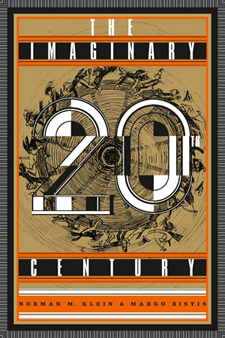
Norman M. Klein and Margo Bistis. The Imaginary 20th Century (Karlsruhe, Germany: ZKM | Center for Art and Media Karlsruhe, 2016).

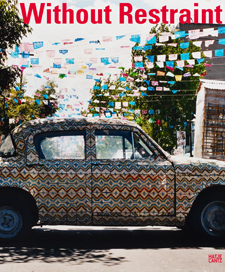
Valentina Locatelli, ed. Without Restraint: Works by Mexican Women Artists from the Daros Latinamerica Collection (Berlin: Hatje Cantz, 2016).

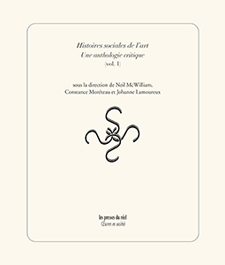
Neil McWilliam, Constance Moréteau, and Johanne Lamoureux, eds. Histoires sociales de l’art: Une anthologie critique (Dijon, France: Les Presses du réel, 2016). 2 vols.

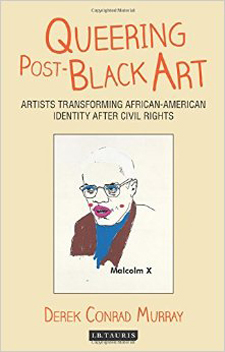
Derek Conrad Murray. Queering Post-Black Art: Artists Transforming African-American Identity after Civil Rights (London: I. B. Tauris, 2016).
CIHA 2016 in Beijing
posted by CAA — August 15, 2016
 The thirty-fourth World Congress of Art History, organized by the Comité International d’Histoire de l’Art (CIHA), will take place in Beijing, China, from September 15 to 22, 2016. Art and cultural historians from all over the world, and from a vast cross-section of disciplines and fields of professional interest, will discuss the ways of seeing, describing, analyzing, and classifying works of art. As the American affiliate to CIHA, the National Committee for the History of Art (NCHA), a group with strong institutional ties to CAA, is happy to encourage any and all interested art historians to attend.
The congress’s theme is “Terms.” Topics are divided into twenty-one sections to enable comparisons among different interpretations, definitions, and methods within art history. Each panel will comprise a program reflecting CIHA’s commitment to the idea of diversity, which should allow talks on different genres, epochs, and countries to be brought together. The congress uses the word “Terms” to draw a wide range of case studies.
The theme for the Beijing 2016 is the logical counterpart to the previous rubric, “The Challenge of the Object,” which was addressed at the Nuremberg 2012 CIHA Congress in Germany. In Beijing, it is a matter of questioning the words, the definitions, and the very concepts used to study art by different scientific traditions with this essential question: How can the methodology of our discipline be enriched by being conscious of the diversity of terms and approaches to art?
The 2016 congress will analyze different concepts of art in diverse cultures and strive to achieve three goals. The first one is to respond to the latest development of art history as a global discipline. The second is to explore art through different terms that underline its relationship to respective cultural frameworks, and the disparities between different cultures in various periods throughout history. The third goal is to gain a more comprehensive understanding of art as an essential part of human culture.
CIHA traces its roots back to the 1930s, when it was officially founded at the Brussels Congress. The organization has now vastly exceeded its original Euro-American emphasis and currently has national chapters on every continent. Next month’s meeting will be the organization’s first conference in China. In addition to the international gathering held every four years, CIHA also sponsors specific thematic art-history conferences such as “New Worlds: Frontiers, Inclusion, Utopias” in Rio de Janeiro, Brazil, which took place in August 2015.
New in caa.reviews
posted by CAA — August 12, 2016
Zeynep Çelik Alexander reads Spyros Papapetros’s On the Animation of the Inorganic: Art, Architecture, and the Extension of Life, “the latest foray into the late nineteenth-century Germanic discourse” known as “empathy theory.” Behind the author’s web of connections between figures such as Aby Warburg, Wilhelm Worringer, and Fernand Léger, “there is a radical historiographical proposition.” Read the full review at caa.reviews.
Frances Colpitt visits Melvin Edwards: Five Decades at the Nasher Sculpture Center. Curated by Catherine Craft and featuring over sixty sculptures along with maquettes and preparatory drawings, the traveling retrospective is a “fluid and compelling exhibition” that encompasses both the “clenching brutality” and “seductive formalism” of the artist’s work. Read the full review at caa.reviews.
Krystel Chehab reviews Rubens, Velázquez, and the King of Spain by Aneta Georgievka-Shine and Larry Silver, an examination of Peter Paul Rubens’s and Diego Velàzquez’s paintings for the Torre de la Parada, a royal hunting lodge near Madrid. The authors “commendably broaden an understanding of exchanges between these two leading seventeenth-century painters.” Read the full review at caa.reviews.
Michael Guadio examines Commercial Visions: Science, Trade, and Visual Culture in the Dutch Golden Age, Dániel Margócsy’s study of “science as commerce” in “the early capitalist economy of the Netherlands.” The book “tells a persuasive story about visual culture, commodification, and the mobility of knowledge in early modern science.” Read the full review at caa.reviews.
Caa.reviews publishes over 150 reviews each year. Founded in 1998, the site publishes timely scholarly and critical reviews of studies and projects in all areas and periods of art history, visual studies, and the fine arts, providing peer review for the disciplines served by the College Art Association. Publications and projects reviewed include books, articles, exhibitions, conferences, digital scholarship, and other works as appropriate. Read more reviews at caa.reviews.
News from the Art and Academic Worlds
posted by Christopher Howard — August 10, 2016
Each week CAA News publishes summaries of eight articles, published around the web, that CAA members may find interesting and useful in their professional and creative lives.
How to Finish Your Dissertation
I was hoping to finish my dissertation last year and graduate in May. But it’s August. I’m heading back for another year on campus and nowhere near finishing my degree. I would like to complete my dissertation and yet am not making any progress. (Read more from Inside Higher Ed.)
Back to Art School: Grayson Perry and Gillian Wearing Meet Tomorrow’s Stars
They are the art stars of tomorrow. So what are they making? Slime fountains and love machines, find the British artists Grayson Perry and Gillian Wearing as they visit two degree shows and recall their own student days. (Read more from the Guardian.)
Is Culture-Borrowing Always Theft?
American music has always been a great and complex exchange, but who gets to borrow from whom—and under what conditions—has become increasingly controversial. Paul Simon’s Graceland was criticized at the time of its release for his use of “African” musical elements. Now it’s almost impossible to imagine a white musician attempting a similar experiment. (Read more from Vulture.)
Artist Launches Reparations Website and “Social Experiment” on White Privilege
Launched as a modest project on Facebook in mid-July but soon expanded to a standalone website, Reparations is drawing international attention for its brazen approach to race relations, including condemnation from those who see it as a racially divisive tool that exploits white liberal guilt. But the Seattle-based artist Natasha Marin defended her project as a social experiment intended to explore “white privilege.” (Read more from the Los Angeles Times.)
The More Art Changes, the More Urgent a VARA Update Is
The 1990 Visual Artists Rights Act narrowly defines the type of art that is protected as paintings, sculptures, drawings, and graphic and photographic prints. But what if your medium is ceramics, graffiti, tattoos, tapestries, wildflowers, or something else that gives the feeling associated with art but doesn’t fit the legal definition? (Read more from the New York Observer.)
UK Copyright Extension on Designed Objects Is “Direct Assault” on 3D Printing
A recent extension of UK copyright for industrially manufactured artistic works represents “a direct assault on the 3D printing revolution,” says Rick Falkvinge. Last month the government extended copyright for designs from 25 years to the life of the designer plus 70 years. In practice, this is likely to mean a copyright term of over 100 years for furniture and other designed objects. (Read more from Ars Technica.)
Why Is Buying Art as an Investment Frowned Upon?
Using art as a means to make money or transfer assets isn’t new, but “investment” is almost a dirty word when used in the context of the art world. Why is it so frowned upon? Everybody working in the art market has to make a living, after all. (Read more from Artnet News.)
The Academic Advantages of Twitter
My mentor, who signed up for a Twitter account but admitted that he doesn’t really get it, may be near a tipping point: either ready to abandon the platform or just on the verge of getting it. Without wanting to sound like a hyped-up social-media evangelist, let me see if I can help. What can Twitter be for academics? (Read more from Inside Higher Ed.)
CAA Signs Letter Supporting Turkish Academic Freedom
posted by CAA — August 09, 2016
CAA has signed onto the letter reprinted below, written by the Middle East Studies Association (MESA) on July 21, 2016, and signed by dozens of organizations. To read the full list of signatories, please visit the MESA website.
Threats to Academic Freedom and Higher Education in Turkey
The above listed organizations collectively note with profound concern the apparent moves to dismantle much of the structure of Turkish higher education through purges, restrictions, and assertions of central control, a process begun earlier this year and accelerating now with alarming speed.
As scholarly associations, we are committed to the principles of academic freedom and freedom of expression. The recent moves in Turkey herald a massive and virtually unprecedented assault on those principles. One of the Middle East region’s leading systems of higher education is under severe threat as a result, as are the careers and livelihoods of many of its faculty members and academic administrators.
Our concern about the situation in Turkish universities has been mounting over the past year, as Turkish authorities have moved to retaliate against academics for expressing their political views—some merely signing an “Academics for Peace” petition criticizing human rights violations.
Yet the threat to academic freedom and higher education has recently worsened in a dramatic fashion. In the aftermath of the failed coup attempt of July 15–16, 2016, the Turkish government has moved to purge government officials in the Ministry of Education and has called for the resignation of all university deans across the country’s public and private universities. As of this writing, it appears that more than 15,000 employees at the education ministry have been fired and nearly 1,600 deans—1,176 from public universities and 401 from private universities—have been asked to resign. In addition, 21,000 private school teachers have had their teaching licenses cancelled. Further, reports suggest that travel restrictions have been imposed on academics at public universities and that Turkish academics abroad were required to return to Turkey. The scale of the travel restrictions, suspensions, and imposed resignations in the education sector seemingly go much farther than the targeting of individuals who might have had any connection to the attempted coup.
The crackdown on the education sector creates the appearance of a purge of those deemed inadequately loyal to the current government. Moreover, the removal of all of the deans across the country represents a direct assault on the institutional autonomy of Turkey’s universities. The replacement of every university’s administration simultaneously by the executive-controlled Higher Education Council would give the government direct administrative control of all Turkish universities. Such concentration and centralization of power over all universities is clearly inimical to academic freedom. Moreover, the government’s existing record of requiring university administrators’ to undertake sweeping disciplinary actions against perceived opponents—as was the case against the Academics for Peace petition signatories—lends credence to fears that the change in university administrations will be the first step in an even broader purge against academics in Turkey.
Earlier this year, it was already clear that the Turkish government, in a matter of months, had amassed a staggering record of violations of academic freedom and freedom of expression. The aftermath of the attempted coup may have accelerated those attacks on academic freedom in even more alarming ways.
As scholarly organizations, we collectively call for respect for academic freedom—including freedom of expression, opinion, association, and travel—and the autonomy of universities in Turkey, offer our support to our Turkish colleagues, second the Middle East Studies Association’s “call for action” of January 15, request that Turkey’s diplomatic interlocutors (both states and international organizations) advocate vigorously for the rights of Turkish scholars and the autonomy of Turkish universities, suggest other scholarly organizations speak forcefully about the threat to the Turkish academy, and alert academic institutions throughout the world that Turkish colleagues are likely to need moral and substantive support in the days ahead.
Note
Organizations wishing to be included as signatories on the above statement should contact Amy Newhall at amy@mesana.org.
Propose a Paper or Presentation for the 2017 Annual Conference
posted by CAA — August 08, 2016
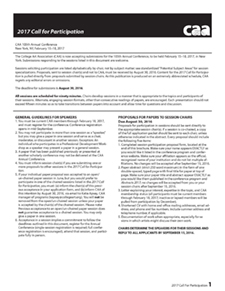 The 2017 Call for Participation for CAA’s 105th Annual Conference, taking place February 15–18, 2017, in New York, describes many of next year’s programs sessions. The chairs of these sessions invite your participation: please follow the instructions in the booklet to submit a proposal for a paper or presentation. This publication also includes a call for Poster Session proposals.
Listing 127 panels, the 2017 Call for Participation is only available as a PDF download; CAA will not mail hard copies of this thirty-seven-page document.
The deadline for proposals of papers and presentations for the New York conference is Tuesday, August 30, 2016. The deadline for Poster Sessions proposals is Thursday, September 15, 2016.
In addition to dozens of wide-ranging panels on art history, studio art, contemporary issues, and professional and educational practices, CAA conference attendees can expect participation from many area schools, museums, galleries, and other institutions. The Hilton New York Midtown is the conference headquarters, holding most sessions, Career Services, the Book and Trade Fair, ARTspace, special events, and more.
Contact
For more information about proposals of papers and presentations for the 2017 Annual Conference, please contact Katie Apsey, CAA manager of programs, or Tiffany Dugan, CAA director of programs.
New in caa.reviews
posted by CAA — August 05, 2016
Abigail McEwan reviews Alejandro Anreus’s Luis Cruz Azaceta, the tenth volume in the A Ver: Revisioning Art History series, which publishes monographs on Latino artists. Focusing on the career of Luis Cruz Azaceta, a Cuban American artist, the book interweaves “biographical and diasporic coordinates within a richly informed social history of his work.” Read the full review at caa.reviews.
Stella Ramage visits the Fiona Pardington: A Beautiful Hesitation exhibition. Held at three venues in New Zealand, the show is a “survey of thirty years’ work by one of New Zealand’s most prolific photographers,” showcasing Fiona Pardington’s “unashamed, lyrical romanticism” and “persistent preoccupations with mortality and memory.” Read the full review at caa.reviews.
Rosemary Hawker examines The Photograph and Australia, an exhibition that “brings together over five hundred photographs from major Australian collections of historical and contemporary works.” The Art Gallery of New South Wales Curator Judy Annear “helps us find multiple ways to think about the photographic record of Australia and what Australian photography might be.” Read the full review at caa.reviews.
Caa.reviews publishes over 150 reviews each year. Founded in 1998, the site publishes timely scholarly and critical reviews of studies and projects in all areas and periods of art history, visual studies, and the fine arts, providing peer review for the disciplines served by the College Art Association. Publications and projects reviewed include books, articles, exhibitions, conferences, digital scholarship, and other works as appropriate. Read more reviews at caa.reviews.
A Fair Use Code Changes Practice in the Visual Arts: The Numbers
posted by CAA — August 04, 2016
How much difference has the release of the College Art Association’s Code of Best Practices in Fair Use for the Visual Arts made so far? Even a few months after the release in February 2015, there was significant change in the field’s practice.
A survey of more than two thousand members of the College Art Association, starting seven months after the launch of the Code and winding up in January 2016, was analyzed by American University faculty and graduate students. Here’s what we know:
By and large, and as expected, patterns documented in a 2013 survey remained in place in the few months after the CAA Code was launched. The great majority of visual arts professionals still default to permissions, even though they have some experience of fair use when permissions processes fail. That choice is often costly. About a third of the respondents continue to report problems with avoiding projects, abandoning existing projects, and serious delays of more than three months, because of permissions.
But as well, we saw some real changes.
- The Code spurred a significant group of people to try fair use for the first time. Some 11% of those who have employed fair use did so for the first time after the Code came out.
- The Code spurred institutions to revise their policies. More than half—57%–of respondents who reported some institutional policy change said it had happened after the Code was released.
- Editors reported the largest amount of change, of any occupational group. This reflects the fact that several institutions publicly announced a change in policy, including the College Art Association. CAA’s author agreement now encourages a default to fair use where in line with the Code.
These changes, which occurred after only months of experience with the Code, happened because of widespread and networked knowledge.
o Two-thirds of respondents said they had heard of the Code before they took the survey.
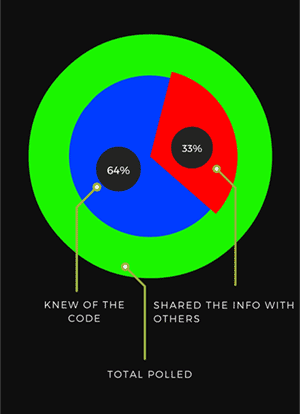
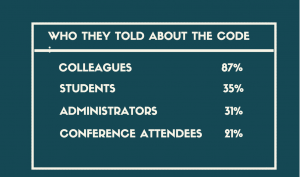
o Most heard from multiple sources, but CAA was the most common source, whether through the conference, a newsletter or the website.
o A third of those who had heard about it had shared the news with someone else—a gesture that shows trust in the information, and confidence that it will be useful.
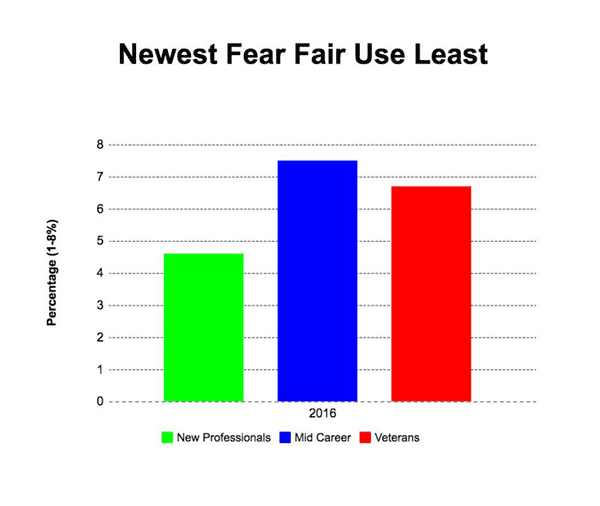
o Mid-career and veteran members of the field were much more likely to have heard about it than the newer entrants.
This is only the beginning, though. There’s still a lot to do.
- More than a fifth of respondents said they simply did not know whether fair use was valuable or not in their work. For a tool so fundamental to the functioning of the field, that is an alarming information gap.
- Only half of those who had heard about the Code went on to use it in the months after its release.
The survey results provide some next steps:
- Knowledge matters. The more confident and grounded respondents are in their understanding of fair use, the more likely they are to use it. So sharing your knowledge about the Code is crucial.
- Veteran leadership matters. Newer entrants to the field are less likely to have heard about the Code or to have experience with fair use.
- It’s worthwhile investing in the newest entrants. Although they were less familiar with the Code or fair use, they were the most likely to recognize that fair use is valuable to their work. They also are the most likely, they say, to change behavior with greater confidence in their knowledge.
- Institutions are really important in changing practices–to set terms, spread the word, and by publicly announcing their decisions to give confidence to others.
- Higher education is particularly important, especially for those, like artists, who may not be consistently working within institutions as they develop their careers. Universities, colleges, and art schools can educate the next generation about the new normal.
For more information about the Code, including informational videos, infographics, and frequently asked questions, visit the Fair Use page on the CAA website.
Originally published by the Center for Media and Social Impact in the School of Communication at American University.