
CAA News Today
Exhibitions Curated by CAA Members
posted by CAA — October 15, 2012
Check out details on recent shows organized by CAA members who are also curators.
Exhibitions Curated by CAA Members is published every two months: in February, April, June, August, October, and December. To learn more about submitting a listing, please follow the instructions on the main Member News page.
October 2012

Reni Gower. Heated Exchange. Upstairs Artspace, Tryon, North Carolina, September 21–November 17, 2012.

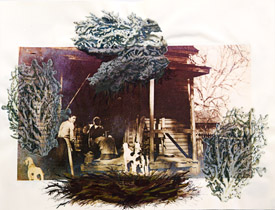 Martha Jackson Jarvis, Ancestors’ Bones #4, 2010–11, mixed-media drawing with black walnut ink, watercolor, oil, wax, raw pigment, collage, and photo transfer, 20 x 26¼ in. (photograph provided by Martha Jackson Jarvis Studio)
Julie L. McGee. Martha Jackson Jarvis: Ancestors’ Bones. Mechanical Hall Gallery, University of Delaware, Newark, Delaware, September 5–December 9, 2012.

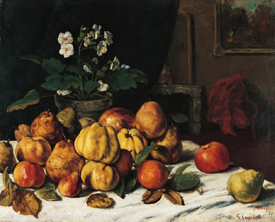 Gustave Courbet, Apples, Pears, and Primroses on a Table, 1871–72, oil on canvas, 23½ x 28¾ in. Norton Simon Art Foundation (artwork in the public domain)
Gloria Williams Sander. Significant Objects: The Spell of Still Life. Norton Simon Museum of Art, Pasadena, California, July 20, 2012–January 21, 2013.
Cortney Lane Stell. Something about the State of Being. Philip J. Steele Gallery, Rocky Mountain College of Art and Design, Denver, Colorado, August 31–October 13, 2012.
Books Published by CAA Members
posted by CAA — October 15, 2012
Publishing a book is a major milestone for artists and scholars—browse a list of recent titles below.
Books Published by CAA Members appears every two months: in February, April, June, August, October, and December. To learn more about submitting a listing, please follow the instructions on the main Member News page.
October 2012

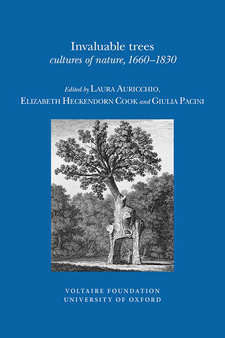
Laura Auricchio, Elizabeth Heckendorn Cook, and Giulia Pacini, eds. Invaluable Trees: Cultures of Nature, 1660–1830 (Oxford, UK: Voltaire Foundation, 2012).

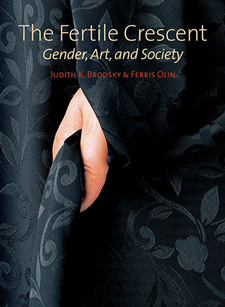
Judith K. Brodsky and Ferris Olin, eds. The Fertile Crescent: Gender, Art, and Society (New Brunswick, NJ: Institute for Women and Art, Rutgers University, 2012).

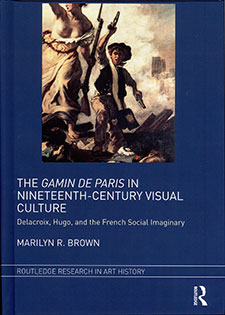
Kathryn Brown. Women Readers in French Painting 1870–1890: A Space for the Imagination (Burlington, VT: Ashgate, 2012).

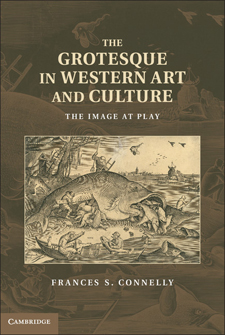
Frances S. Connelly. The Grotesque in Western Art and Culture: The Image at Play (New York: Cambridge University Press, 2012).


Zoya Kocur and Simon Leung, eds. Theory in Contemporary Art since 1985, 2nd ed. (Oxford, UK: Wiley-Blackwell, 2012).

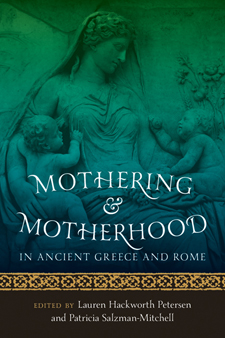
Lauren Hackworth Petersen and Patricia Salzman-Mitchell, eds. Mothering and Motherhood in Ancient Greece and Rome (Austin: University of Texas Press, 2012).


Ming Tiampo. Gutai: Decentering Modernism (Chicago: University of Chicago Press, 2011).

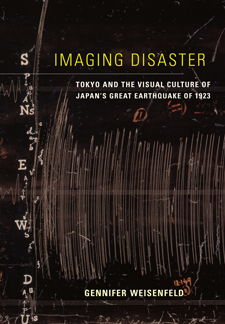
Gennifer Weisenfeld. Imaging Disaster: Tokyo and the Visual Culture of Japan’s Great Earthquake of 1923 (Berkeley: University of California Press, 2012).
MIRA SCHOR AT THE 2013 ANNUAL ARTISTS’ INTERVIEWS
posted by Christopher Howard — October 03, 2012
Mira Schor, a painter and writer based in New York and Provincetown, Massachusetts, will participate in CAA’s next Annual Artists’ Interviews, hosted by ARTspace during the 2013 Annual Conference in New York. This session will be the thirteenth installment of the popular series, which features two major practicing artists in back-to-back interviews. The other artist who will be interviewed is Janine Antoni. The talks will be held on Friday, February 15, 2013, from 2:30 to 5:00 PM at the Hilton in New York. Stuart Horodner, artistic director of the Atlanta Contemporary Art Center, will interview Schor.
Mira Schor
Mira Schor (photograph © 2012 Mary Jones)
Mira Schor is a painter, writer, and educator who was born in 1950 into a family of artists in Manhattan. Entering her fifth decade as an artist, she has used the medium of painting to address a wide range of issues: language, corporal materiality, feminist politics, art history, and critical theory. She has also worked in artist’s books and sculpture and has a longstanding engagement with works on paper.
As an art writer and editor, Schor works in the belletristic tradition of John Berger and Virginia Woolf, with her essays combining the candor of a village storyteller with the rigor of a critical approach and maverick fearlessness. Schor’s first decade of writing on contemporary art and culture is collected in Wet: On Painting, Feminism, and Art Culture (Durham: Duke University Press, 1997). Composed during the Culture Wars of the 1980s and 1990s, the book addresses the work of David Salle, Ida Applebroog, Mary Kelly, and the Guerrilla Girls. In the often-cited essay “Figure/Ground,” Schor’s distinctly feminist voice, seeped in the history of modernism, discusses the perseverance of painting in light of contemporary aesthetic debates. Her latest book is A Decade of Negative Thinking: Essays on Art, Politics, and Daily Life (Durham: Duke University Press, 2009), and she writes regularly about the intersection of art and life for her blog A Year of Positive Thinking, for which she received support from the Arts Writers Grant Program in 2009. Entries include “You Put a Spell on Me,” about the relationship of African art and Renaissance portraiture at the Metropolitan Museum of Art; “Youthfulness in Old Age,” about the late paintings of Joan Mitchell and Roberto Matta; and “Books Are Like People,” an exegesis on the life and destruction of the free library at Occupy Wall Street.
Schor maintains a dialectical understanding of the relationship between politics and aesthetics. In a 2011 conversation with Bradley Rubenstein for Culture Catch, she explained, “I speak of two ‘politics,’ what is happening in the world, and art politics, examining which definitions of art are hosts for different types of power. My identity as a painter has always been caught, in a generative way, between the traditions of painting and the proclamations of the death of painting, of the object, of the individual artist, of private studio practice—everything that has become the doxa of contemporary art.”
Mira Schor, Silence….speech, noise, 2010, ink, oil, and gesso on linen, 18 x 30 in. (artwork © Mira Schor; photograph provided by the artist)
Her most recent solo exhibition, Voice and Speech, was held at Marvelli Gallery in New York in spring 2012. A recurring motif in the show was a pensive, schematically sketched figure, what Schor has called an “avatar of self.” In each painting, handwriting, sometimes contained in thought-balloon rectangles, conveys a sense of cartoonish yet poetic immediacy. In a review of the show, the New York Times critic Roberta Smith wrote, “Mira Schor’s small, sharp, quirky paintings have been thorns in the side of the medium for more than three decades now…. Abjuring largeness and portentous brushwork as before, these works tackle more directly the immense subject of creativity itself and diagram it in ways both pointedly humorous and expansive.” The paintings, all modestly scaled, convey a sense of private urgency, like torn-out pages from a notebook. In a 2002 interview with the painter Joan Waltemath, published in the Brooklyn Rail, Schor discusses the specificity of painted language, and how her visual art relates to her writing: “the direction of my painting and writing are intimately linked in a constant interplay between practice and theory—I find it hard to place one before the other as I speak: I paint writing and in some cases I paint the (critical/theoretical) writing that I’m writing. I certainly never gave up on visual pleasure. On the contrary I am interested in embedding verbal writing as image into the rich materiality of painting so that the two cannot be disentwined.”
Mira Schor, Slit of Paint, 1994, oil on canvas, 12 x 16 in. (artwork © Mira Schor; photograph provided by the artist)
Schor earned an MFA in 1973 from the newly formed California Institute of the Arts in Valencia. At CalArts she came into contact with Fluxus art tactics from artist professors such as Alison Knowles and the poet Emmett Williams. Schor was actively involved in the Feminist Art Program, one of the first of its kind in the country, started by Judy Chicago and Miriam Shapiro. Schor fondly recalls the “goofy spirit” of the school, comparing it to the television show created by her fellow student, Paul Reubens’s Pee-Wee’s Playhouse. The atmosphere was “subversive but in a sweet, slightly anarchic rather than nihilistic manner.”
Teaching studio art and art history to several generations of artists has been an important component of Schor’s life as an artist. She has been an associate teaching professor of fine art at New York’s Parsons the New School for Design since 1989. Recently, she has served as a guest lecturer at the School of Visual Art’s MFA in art criticism program and a resident artist at the Skowhegan School of Painting and Sculpture. Over the years she has taught at many schools, including the Rhode Island School of Design—where Janine Antoni, the second CAA interviewee, was her student—Sarah Lawrence College, Vermont College, and the Cooper Union for the Advancement of Science and Art.
Schor’s solo exhibitions include Painting in the Space Where Painting Used to Be at Some Walls in Oakland in 2011, Mira Schor: Paintings from the Nineties to Now at CB1 Gallery in Los Angeles in 2010, and Suddenly: New Paintings by Mira Schor at Momenta Art in Brooklyn in 2009. With Susan Bee, she founded and led the art journal M/E/A/N/I/N/G/, which was active in print between 1986 and 1996; it continues as an online publication (a twenty-fifth anniversary edition was published in late 2011). A collection of texts from this publication, titled M/E/A/N/I/N/G/: An Anthology of Artists’ Writings, Theory, and Criticism, was published in 2000. Schor is also the editor of The Extreme of the Middle: Writings of Jack Tworkov (New Haven: Yale University Press, 2009).
Schor has received awards in painting from the John Simon Guggenheim Memorial Foundation, the Rockefeller Foundation, the Marie Walsh Sharpe Art Foundation, and the Pollock-Krasner Foundation. In 1999, CAA recognized her writing with its Frank Jewett Mather Award. She is currently represented by CB1 Gallery in Los Angeles and by Marvelli Gallery in New York.
Stuart Horodner
Stuart Horodner is artistic director of the Atlanta Contemporary Art Center in Georgia. He has held positions as visual arts curator at the Portland Institute for Contemporary Art in Oregon and director of the Bucknell University Art Gallery in Lewisburg, Pennsylvania. He was also a coowner of the Horodner Romley Gallery in New York. Horodner has curated numerous solo and group exhibitions and has worked with artists including Leon Golub, Jessica Jackson Hutchins, Judy Linn, Melanie Manchot, William Pope.L, Kay Rosen, Joe Sola, Jessica Stockholder, and Jack Whitten.
His criticism has appeared in journals and magazines, including Art Issues, Art Lies, Art on Paper, Bomb Magazine, and Sculpture. Horodner’s new book, The Art Life: On Creativity and Career (Atlanta: Atlanta Contemporary Art Center, 2012), collects statements and texts by visual artists, writers, filmmakers, and performers that address the Sisyphean task of sustaining a lifelong career in the arts. (Read an interview with Horodner about The Art Life in ArtsATL, published in March 2012.) He has served in an advisory capacity to organizations, including Artadia: The Fund for Art and Dialogue, Creative Capital, the Ford Family Foundation, and the MacDowell Colony.
JANINE ANTONI AT THE 2013 ANNUAL ARTISTS’ INTERVIEWS
posted by Christopher Howard — October 03, 2012
Janine Antoni, an artist based in New York, will participate in CAA’s next Annual Artists’ Interviews, hosted by ARTspace during the 2013 Annual Conference in New York. This session will be the thirteenth installment of the popular series, which features two major practicing artists in back-to-back interviews. The other artist who will be interviewed is the painter and writer Mira Schor. The talks will be held on Friday, February 15, 2013, from 2:30 to 5:00 PM at the Hilton in New York. Klaus Ottmann, director of the Center for the Study of Modern Art and a curator at large at the Phillips Collection in Washington, DC, will interview Antoni.
Janine Antoni
Janine Antoni, Loving Care, 1992, performance with Loving Care hair dye Natural Black, dimensions variable (artwork © Janine Antoni; photograph provided by the artist and Luhring Augustine, New York, and taken by Prudence Cumming Associates at Anthony d’Offay Gallery, London, 1993)
Janine Antoni’s work is an amalgam of shamanistic ritual, quotidian task, and daredevil action. Her performances include using her dye-soaked hair to mop a gallery floor; sleeping in a bed set up in a gallery and then weaving a blanket based on the pattern of her rapid eye movements; and walking across a tightrope of hand-plied hemp that she made herself, suspended eight feet above the ground. The arduous process of the performance is often combined into installations with sculpture, photography, and video. It is Antoni’s desire that her artwork be understood as a felt experience, one that combines emotional content and intellectual engagement. In each piece, no matter the medium or image, a conveyed physicality speaks directly to the viewer’s body.
In a conversation published in 2011 in the Brooklyn Rail, she elaborates on the importance of this imagined relationship with her work’s audience: “When I’m making work I spend a lot of time fantasizing about what the viewer will do and think; I enter their body, and imagine them walking up to my sculpture. My work is a way for me to feel connected and to feel present in the world. I try to make work that elicits empathy. I’ve been known for chewing 600 pounds of chocolate, being dumped in tubs of lard, and mopping the floor with my hair. I do these extreme acts because I feel like it puts the viewer in a very emphatic relationship to my sculpture.”
In Antoni’s work, a charged relationship between the symbolic nature of her preferred materials (chocolate, lard, soap, hemp) and the artist’s given task to transform raw material, results in a highly personal, metaphysical evocation. For the installation Gnaw (1992), Antoni wanted to use her own body as a tool to redefine what a figurative sculpture could be. She chewed on a block of chocolate and a block of lard, spitting out pieces of each to be melted down and respectively repackaged as heart-shaped chocolates and lipstick. In Lick & Lather (1993), she sculpted two self-portrait busts out of chocolate and soap, generating a nearly tangible sensation of taste and touch.
Janine Antoni, Gnaw, 1992, 600 lbs. of chocolate, gnawed by the artist, 24 x 24 x 24 in.; 600 lbs. of lard, gnawed by the artist, 24 x 24 x 24 in.; 45 heart-shaped packages for chocolate made from chewed chocolate removed from the chocolate cube; 400 lipsticks made with pigment, beeswax, and chewed lard removed from the lard cube displayed in glass case (artwork © Janine Antoni; photograph provided by the artist and Luhring Augustine, New York)
Another recurring theme in Antoni’s art is the lasting enigma of the family. She has staged photographs of her parents dressed in drag as each other, which results in a comical yet strangely moving portrait of a couple. In 2008 she photographed her toddler daughter attempting to feed her mother through her bellybutton. The doublings and life cycles in both series transcend mere performance or enactment to become lasting meditations on human relationships. In a 2009 interview in Art in America, she states, “My work occupies the territory between object, performance and relic. For each piece, I ask myself what the piece needs, how much I should tell and how much I should leave to the viewer’s imagination. With earlier projects, I spoke through the work in a very direct way, and I thought that was a generous gesture. Now, I’m more interested in leaving a space for the viewer’s imagination.” This new, more open-ended approach to her practice is evident in Tear (2008), an installation that pairs a video projection of a close-up of Antoni’s eye blinking in unison to a thudding sound. The video is screened in a room which contains a visibly scarred, lead wrecking ball that had been used in the demolition of a building. The artwork implies a triangulated relationship among all three components; tension and mystery are built from the unseen elements in the narrative.
Antoni was born in 1964 in Freeport, Bahamas. She received her BA from Sarah Lawrence College in 1986 and an MFA from Rhode Island School of Design in 1989. Mira Schor was an influential professor for Antoni in graduate school, introducing the younger woman to the work of three feminist artists from the 1970s whose physical bodies were integral to their art practice: Ana Mendieta, Hannah Wilke, and Carolee Schneeman.
Janine Antoni, Slumber, 1993, performance with loom, yarn, bed, nightgown, PSG machine, and artist’s REM reading, dimensions variable (artwork © Janine Antoni; photograph provided by the artist and Luhring Augustine, New York)
Antoni has shown her work in more than twenty-five solo exhibitions across the United States and abroad. Her most recent was Touch (2011) at the Museum Kunst der Westküste in Alkersum/Föhr, Germany. She has participated in international biennials in Venice, Johannesburg, Istanbul, and Kwangju and domestically in the Whitney Biennial in New York, SITE Santa Fe in New Mexico, and Prospect.1 in New Orleans. The artist has received a MacArthur Fellowship, a Larry Aldrich Foundation Award, a Joan Mitchell Painting and Sculpture Award, a Creative Capital Grant, and a John Simon Guggenheim Memorial Foundation Fellowship. She is represented by Luhring Augustine Gallery in New York.
Antoni lives and works in New York. She participated in the 2011 Annual Conference, speaking on the popular Centennial session “Parallel Practices: When the Mind Isn’t Focused on Art.”
Klaus Ottmann
Klaus Ottmann is director of the Center for the Study of Modern Art and curator at large at the Phillips Collection in Washington, DC. He is the author of Yves Klein by Himself: His Life and Thought (Paris: Éditions Dilecta, 2010), The Genius Decision: The Extraordinary and the Postmodern Condition (New York: Spring Publications, 2004), and The Essential Mark Rothko (New York: Harry N. Abrams, 2003). In 2006 he translated and edited Yves Klein’s complete writings for the book Overcoming the Problematics of Art: The Writings of Yves Klein, published by Spring Publications.
Ottmann has curated more than forty international exhibitions, including Per Kirkeby: Paintings and Sculpture; Still Points of the Turning World: SITE Santa Fe’s Sixth International Biennial; Life, Love, and Death: The Work of James Lee Byars; Wolfgang Laib: A Retrospective; Rackstraw Downes: Onsite Paintings, 1972–2008; and Fairfield Porter Raw: The Creative Process of an American Master.
NEW ART JOURNAL REVIEWS EDITOR
posted by Christopher Howard — September 04, 2012
Michael Corris (2013–16)
Michael Corris, incoming Art Journal reviews editor
Michael Corris, professor of art and chair of the Division of Art in the Meadows School of the Arts at Southern Methodist University in Dallas, Texas, has been appointed reviews editor of Art Journal. He will serve one year as reviews editor designate, taking over from Howard Singerman of the University of Virginia in July 2013.
As both an artist and an author of many works on postwar and contemporary art and theory, Corris is looking forward to bringing new voices and perspectives into the conversation that surrounds the literature of art. For Corris this means a thorough investigation into myriad ways in which scholars and artists are reading art history today, both inside the classroom and in the larger art world. He writes, “I’d like to know what artists are reading and why; what goes into the construction of a bibliography for students at all levels; and how technology and social media alter the way we reflect critically on art and culture. In short, how the dialogue on art is authorized, shaped, and sustained through all sorts of textual means.” The social reality of art making and writing about art has always been present in Corris’s work. In his new role as reviews editor he is committed to seeking out non-Western art practices and those that merge with political activism.
With a comparative perspective on studio-art and art-history programs from his substantial teaching record in the United States and England, Corris sees both countries as “facing a crisis in higher education” and laments the fact that programs in art education and art history “are constantly under threat to justify their existence in purely economic terms.” However, the academic intensity of art schools in England holds a great appeal for Corris: “The British higher-education system places great emphasis on individual and small-group tutorials; it also demands a great deal more of students in terms of written output. Studio-art undergraduates are generally required to produce a research paper of up to 10,000 words; master’s level students may have to produce a research paper of up to 20,000 words. This is all in addition to their artwork.”
As a visual artist who slips easily into the role of critic, and as a critic who is equally at home in academia, Corris is long familiar with the fluidity of all three roles. He also recognizes the importance of a playful attitude as a way to explore new spaces of thought production. “It’s no longer surprising to find an artist who writes, a writer who draws, or a studio-art professor who curates art. The challenge here is to find ways to destabilize all these terms: visual artist, editor, writer, and educator. I turned my office at Southern Methodist University into the Free Museum of Dallas to offset the drudgery and power of academic bureaucracy. I’m constantly seeking ways to collectivize the various activities that I engage in or fall into. When it comes to my role as educator, my current concern is trying to figure out the precise shape of this Faustian bargain called tenure and my limits of tolerance to the trend to subject the arts and humanities to a corporate logic. My great joy is that the students remain engaged and delightfully open.”
Concurrent with his position at Art Journal, Corris will remain an editor at Transmission Annual, a peer-reviewed journal of contemporary art and culture, cofounded in 2008 with Sharon Kivland and Jaspar Joseph-Lester, both professors at Sheffield Hallam University in England. “We came up with the idea to publish an annual collection of essays, structured correspondence, and artist’s projects that revisited the themes of the school’s weekly artist and theorist lecture series, while allowing academics the luxury to experiment with forms of exposition. Our first issue was based on the theme of hospitality, the second on the theme of provocation, and the third on the theme of catastrophe. We anticipate a fourth issue on the theme of agency, so you see there is a glimmer of reality amongst the poetry.” Corris hopes his Transmission Annual experience will inspire new formats for Art Journal devoted to the critical review of literature on art.
Corris received a BA from Brooklyn College, City University of New York, in 1970. Two years later he earned an MFA in painting and media from the Hoffberger School of Painting at Maryland Institute College of Art in Baltimore, and later was awarded a scholarship to attend the Skowhegan School of Painting and Sculpture in Maine. In 1971 he began participating in the Conceptual-art collective Art & Language (whose transatlantic members included Terry Atkinson, Joseph Kosuth, Mel Ramsden, and Charles Harrison) and contributed to the group’s journal, Art-Language. As a member of the collective, and as a solo artist, Corris has exhibited his artwork in galleries and museums across the United States and abroad, including the Museum of Modern Art and the Whitney Museum of American Art, both in New York, and the Victoria and Albert Museum in London.
Michael Corris, ed., Conceptual Art: Theory, Myth, and Practice (New York: Cambridge University Press, 2004)
The relationship of writing and language to the visual arts has been a paramount concern of Corris’s throughout his career. His editorial experience began with cofounding the artist-run journals The Fox in 1975 and Red-Herring in 1977. The move from art making into publishing was a natural extension of his essayistic art practice. For Corris, and for the other Art & Language artists, these journals served as “sites of artistic production and were intentionally set in opposition to the values and institutions that sustained a managerial culture of art.” His early essays, such as “The Organization of Culture under Monopoly Capitalism,” published in The Fox in 1976, and “Frameworks and Phantoms,” written with Mel Ramsden for Art-Language in 1973, reflect this radical ethos. Since then Corris has written essays and reviews for Artforum, Art History, and Art Monthly that cover a wide spectrum of artists working today, from Jeff Koons to Alfredo Jaar and Tracey Emin.
Corris’s PhD dissertation, completed in 1996 at University College London, formed the basis for a monograph, Ad Reinhardt, published by Reaktion Books in 2008. A 2006 winner of the first CAA Publication Grant, the book recontextualizes an overlooked aspect of Reinhardt’s art practice: the political cartoons and illustrations that were published in the 1930s through the 1950s in New Masses and Soviet Russia Today. Corris’s lifelong commitment to the intersection of art and politics is evident in Ad Reinhardt, as well as in two forthcoming books: The Artist Out of Work: Selected Writings on Art (Les Presses du Reel/JRP Ringier) and What Do Artists Know? Art’s Encounter with Philosophy (Reaktion). Corris is also the author of a volume on the painter David Diao, published by TimeZone8 Books in 2005, and coauthor, with John Dixon Hunt and David Lomas, of Art, Word, and Image: 2,000 Years of Visual/Textual Interaction, published by Reaktion in 2010.
A selection of Corris’s academic appointments include visiting lecturer in history of art at the Courtauld Institute of Art in London (1999–2001); head of the Department of Art and Photography at the University of Wales, Newport (2003–7); visiting professor of art theory at the Bergen National Academy of Art in Norway (2005–7); and professor of fine art at Art and Design Research Center, Sheffield Hallam University (2007–9).
Solo Exhibitions by Artist Members
posted by CAA — August 22, 2012
See when and where CAA members are exhibiting their art, and view images of their work.
Solo Exhibitions by Artist Members is published every two months: in February, April, June, August, October, and December. To learn more about submitting a listing, please follow the instructions on the main Member News page.
August 2012
Abroad

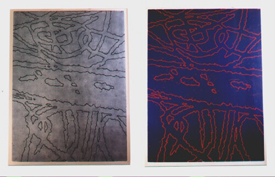 Two podographs by Mark Staff Brandl, 2012 (artwork © Mark Staff Brandl)
Mark Staff Brandl. Saint Mangen Church and Exhibition Space, Saint Gallen, Switzerland, May 25–August 17, 2012. Podographs in Church. Monoprints.

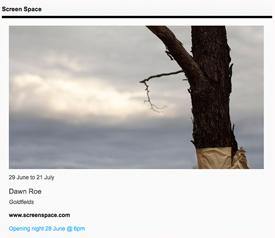 Exhibition announcement in Art Guide Australia reproducing Dawn Roe, Goldfields, 2012, video still, three-channel HD video installation, 5:29 min (artwork © Dawn Roe)
Dawn Roe. Screen Space, Melbourne, Victoria, Australia, June 29–July 21, 2012. Goldfields. Video installation.
Mid-Atlantic

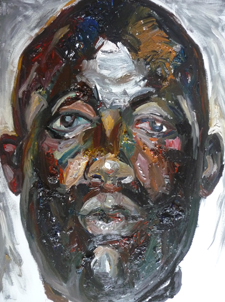 Elise Dodeles, San Francisco Area Fighter 956, 2012, oil on linen, 30 x 40 in. (artwork © Elise Dodeles)
Elise Dodeles. Quiet Life Gallery, Lambertville, NJ, August 10–September 30, 2012. Fearless: Fighters’ Portraits by Elise Dodeles. Painting.

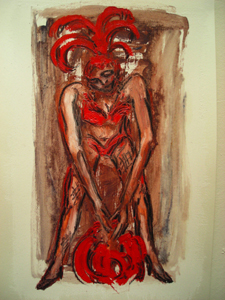 Jan Wurm, Showgirls, 2012, mixed media on paper, approximately 18 x 14 in. (artwork © Jan Wurm)
Jan Wurm. Christine Fréchard Gallery, Pittsburgh, Pennsylvania, August 18–September 21, 2012. Jan Wurm: Serious Play. Painting.
Midwest
Adriane Herman. Western Exhibitions, Chicago, Illinois, May 25–June 30, 2012. Adriane Herman. Mixed media.
Northeast
Francis Cape. ICA at MECA, Porteous Building, Maine College of Art, Portland, Maine, June 13-August 5, 2012. Utopian Benches. Sculpture.

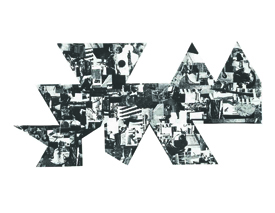 Thomas Lail, Untitled (Map II), 2011, cut paper on paper, 30 x 40 in. (artwork © Thomas Lail)
Thomas Lail. Architecture Omni, Omi International Arts Center, Ghent, New York, July 7–late 2012. Thomas Lail: Notes for the Future. Xerography painting, works on paper, and outdoor sculpture.
South
Reni Gower. Sawhill Gallery, James Madison University, Harrisonburg, Virginia, August 27–October 13, 2012. Strange Loops: Thirty Years of Painting. Painting.

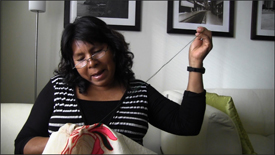 Maria Lino, still from Drawn Stitches, 2012, color video with sound (artwork © Maria Lino)
Maria Lino. Patricia and Philip Frost Art Museum, Florida International University, Miami, Florida, July 18–September 30, 2012. Shared Threads: Maria Lino’s Portrait of a Shipibo Healer. Video.

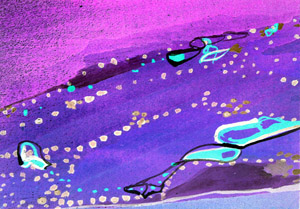 Jennifer Laura Palmer, Untitled I from the A Little World All to Myself series, 2012, mixed media on poplar, 3½ x 4¼ in. (artwork © Jennifer Laura Palmer)
Jennifer Palmer. Westbrook Gallery, Ferst Center for the Arts, Georgia Institute of Technology, Atlanta, Georgia, July 2–August 31, 2012. Lost in the Sea. Painting and drawing.
West

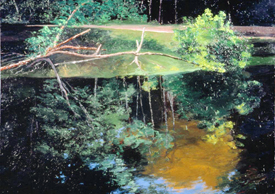 Diane Burko, Petit Creuse, Wissahickon, 1995, oil on canvas, 65 x 92 in. (artwork © Diane Burko)
Diane Burko. LewAllen Gallery, Santa Fe, New Mexico, June 8–July 15, 2012. Diane Burko: Water Matters. Painting.

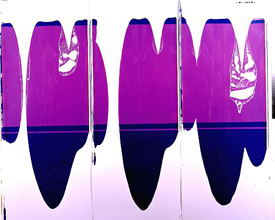 Ellen Carey, Pulls with Filigrees and Pod Mixes, 2005, three Polaroid 20 x 24 color positive prints, 80 x 22 each or 80 x 66 total (artwork © Ellen Carey)
Ellen Carey. Joseph Bellows Gallery, La Jolla, California, June 2–July 14, 2012. Ellen Carey: Photography Degree Zero. Polaroid lens-based art.
People in the News
posted by CAA — August 17, 2012
People in the News lists new hires, positions, and promotions in three sections: Academe, Museums and Galleries, and Organizations and Publications.
The section is published every two months: in February, April, June, August, October, and December. To learn more about submitting a listing, please follow the instructions on the main Member News page.
August 2012
Academe

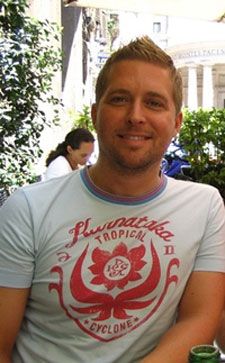 Sinclair Bell
Sinclair Bell, assistant professor of art history at Northern Illinois University in Dekalb, has been granted tenure and promoted to the rank of associate professor. Bell is a specialist in ancient Roman and Etruscan art.

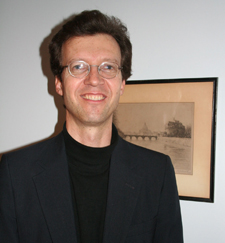 Charles S. Buchanan
Charles S. Buchanan, associate professor of art and architectural history at Ohio University in Athens, has been named interim director of the School of Interdisciplinary Arts, a doctoral program within the university.

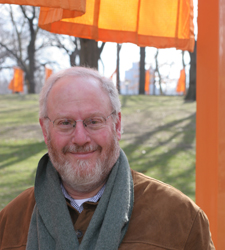 Jonathan Fineberg
Jonathan Fineberg, the Gutgsell Professor of Art History Emeritus at the University of Illinois in Urbana-Champaign, has been appointed the Visiting Presidential Professor at the University of Nebraska in Lincoln for academic year 2012–13. Fineberg will deliver four lectures that address modern art, neuroscience, and the “origin of the image.”

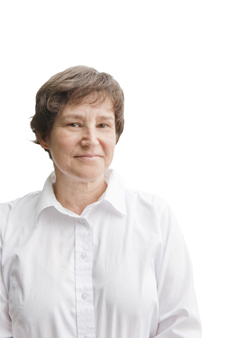 Amy Hauft
Amy Hauft, an artist and chair of the Sculpture Department at Virginia Commonwealth University in Richmond, has joined the University of Texas at Austin as the Leslie Waggener Professor of Art in the College of Fine Arts.
Kriszta Kotsis, an assistant professor of ancient and medieval art, has been granted tenure by the University of Puget Sound in Tacoma, Washington.
Sara M. Picard has accepted a position as assistant professor of art history at Rhode Island College in Providence.

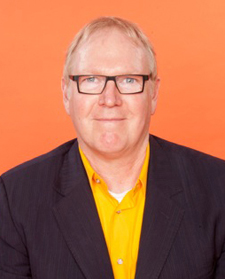 Jack Risley
Jack Risley, an artist and associate dean of academic affairs at Virginia Commonwealth University in Richmond, has been hired by the University of Texas at Austin to be Ruth Head Centennial Professor and chair of the school’s Department of Art and Art History.

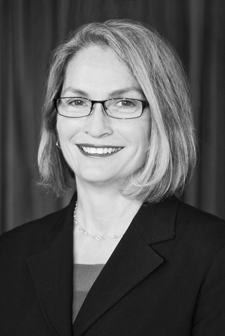 Karen M. Wirth (photograph by Rik Sferra)
Karen M. Wirth, an artist, professor, and former chair of the Fine Arts Department at the Minneapolis College of Art and Design in Minnesota, has been appointed vice president of academic affairs at her school.
Museums and Galleries
Lisa Hostetler, curator of photographs at the Milwaukee Art Museum in Wisconsin, will join the Smithsonian American Art Museum in Washington, DC, as its new curator of photography. In her seven years at the Milwaukee Art Museum, Hostetler was responsible for many critically acclaimed exhibitions, including the first major survey of the photographer Taryn Simon.
Barbara Buhler Lynes, curator at the Georgia O’Keeffe Museum in Santa Fe, New Mexico, has resigned her position at the museum. Lynes was the museum’s first curator as well as its Emily Fisher Landau Director of the museum’s research center.

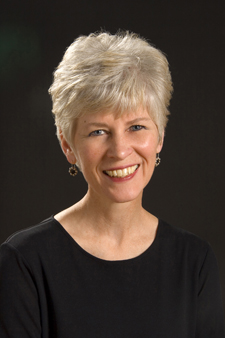 Patricia McDonnell
Patricia McDonnell, director of the Ulrich Museum of Art at Wichita State University in Kansas, has accepted a position as the executive director of the Wichita Art Museum. A member of the CAA Board of Directors, McDonnell succeeds Charles K. Steiner, who stepped down as executive director at the end of 2011 after twelve years of service.

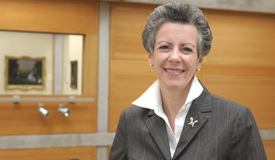 Amy Meyers
Amy Meyers, director of the Yale Center for British Art in New Haven, Connecticut, has been reappointed for a third five-year term as director.

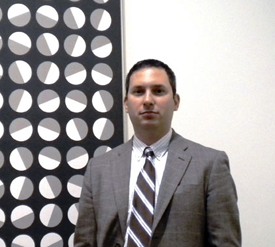 Matthew Palczynski
Matthew Palczynski, staff lecturer for Western art at the Philadelphia Museum of Art in Pennsylvania, has been appointed curator of the Woodmere Art Museum, also in Philadelphia.
Daniel H. Weiss, a scholar of medieval art and the president of Lafayette College in Easton, Pennsylvania, has been chosed to lead Haverford College in Haverford, Pennsylvania, as president, He begins the new position in July 2013.

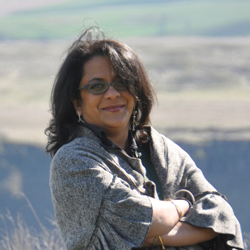 Namita Gupta Wiggers
Namita Gupta Wiggers, a curator at the Museum of Contemporary Craft, in partnership with Pacific Northwest College of Art in Portland, Oregon, has been named the director and chief curator of the museum.
Organizations and Publications
Thomas W. Lollar, a ceramicist and scholar of fine-art prints, has left his position as director of the Brodsky Center for Innovative Editions at Rutgers University in New Brunswick, New Jersey. He will join Paul Limperopulos as codirector of the Benefit Print Project in New York.
Dena Muller has been appointed to the newly established position of director of new initiatives at the New York Foundation for the Arts, based in Brooklyn. Previously, Muller was the executive director at ArtTable in New York, an organization that promotes women in the arts through outreach programs and mentorship.
Institutional News
posted by CAA — August 17, 2012
Read about the latest news from institutional members.
Institutional News is published every two months: in February, April, June, August, October, and December. To learn more about submitting a listing, please follow the instructions on the main Member News page.
August 2012
The Amon Carter Museum of American Art in Fort Worth, Texas, has received a $75,000 grant from the National Endowment for the Humanities to support an online cataloguing project of eight American photographers of the twentieth century: Carlotta Corpron, Nell Dorr, Laura Gilpin, Eliot Porter, Helen Post, Clara Sipprell, Erwin E. Smith, and Karl Struss.

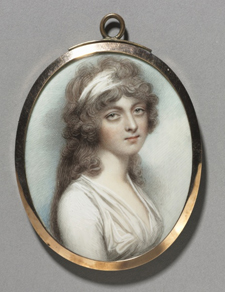 Andrew Plimer, Portrait of Anna Walmesley, 1795, watercolor on ivory, 2½ x 3 3/16 in. (artwork in the public domain)
The Cleveland Museum of Art in Ohio is creating an online catalogue of fifty-four British portrait miniatures from the museum’s collection of miniature painting from the seventeenth, eighteenth, and nineteenth centuries. The catalogue will allow the paintings to be viewed at actual size and in great detail; an essay by Cory Korkow, a curatorial fellow at the museum, will accompany the work.
The Indianapolis Museum of Art in Indiana has received a $190,000 grant from the National Endowment for the Humanities to digitize and catalogue primary materials about Miller House and Garden, a modernist home designed by Eero Saarinen that was registered as a national historic landmark in 2000 and is owned and cared for by the museum. The collection includes blueprints, correspondence, textile samples, sketches, and photographs related to the house.
The University of the Arts in Philadelphia, Pennsylvania, is the recipient of a $500,000 gift from a university trustee, Irvin J. Borowsky, and his wife, Laurie Wagman, to establish the annual Irvin Borowsky Prize in Glass Art. The donation will also fund the Irvin Borowsky Center for Glass Arts, a 3,700-square-foot studio and exhibition space.
The Wadsworth Atheneum Museum of Art in Hartford, Connecticut, has been awarded a $2 million grant from the Connecticut State Bond Commission and an additional $2.5 million from foundations and individuals to support an extensive renovation due to be completed in 2014. Affecting 70,000 square feet, the project will focus on creating additional gallery space, energy conservation, and improving storage facilities.
Grants, Awards, and Honors
posted by CAA — August 15, 2012
CAA recognizes its members for their professional achievements, be it a grant, fellowship, residency, book prize, honorary degree, or related award.
Grants, Awards, and Honors is published every two months: in February, April, June, August, October, and December. To learn more about submitting a listing, please follow the instructions on the main Member News page.
August 2012
Hartmut Austen, a painter, has been appointed Grant Wood Fellow in Painting and Drawing at the School of Art and Art History at the University of Iowa in Iowa City for academic year 2012–13. The fellowship comes with the faculty rank of visiting assistant professor; studio space is provided for independent work.


Lacey Baradel, a doctoral candidate in art history at the University of Pennsylvania in Philadelphia, has been awarded a Henry Luce Foundation/American Council of Learned Societies Dissertation Fellowship in American Art. Baradel’s dissertation is titled “Mobile Americans: Locomotion and Identity in US Visual Culture, ca. 1860–1915.”

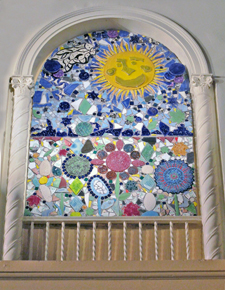 Julia Whitney Barnes, in collaboration with members of the Sirovich Senior Center, view of one section of Refracted Nature, 2012, mixed-media mosaic (artwork © Julia Whitney Barnes)
Julia Whitney Barnes, an artist based in Brooklyn, New York, received a commission to design and install a permanent public mosaic at the Sirovich Senior Center in Manhattan’s East Village, where she had been an artist in residence. With support from the Lower Manhattan Cultural Council and the New York City Department of Cultural Affairs, Barnes unveiled the mosaic in June 2012.
Phillip Bloom, a PhD candidate in the Department of History of Art and Architecture at Harvard University in Cambridge, Massachusetts, had been granted a Mellon Foundation/American Council of Learned Societies Dissertation Completion Fellowship for “Descent of the Deities: Early Icons of the Water-Land Ritual and the Transformation of the Visual Culture of Song (960–1279) Religion.”

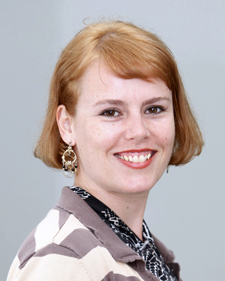 Caetlynn Booth (photograph by J Somers Photography, LLC)
Caetlynn Booth, an American artist living and working in Berlin, Germany, has been awarded a DAAD Fellowship for 2012–13 and a grant from the John Hanson Kittredge Fund for her current painting and research project, “The Work of Adam Elsheimer and the Spiritual Power of Painting,” which she began as a Fulbright fellow in 2011.
Katherine Colin, a painter and an MFA student at the University of Dallas in Texas, has won a 2012 Arch and Anne Giles Kimbrough Fund Award from the Dallas Museum of Art. Open to residents of Texas under the age of thirty, the Kimbrough fund was established in 1980 to recognize exceptional talent and potential in young visual artists who show a commitment to continuing their artistic endeavors.
Jess Riva Cooper, a sculptor from Toronto, Canada, has been awarded a scholarship for a summer residency at the Archie Bray Foundation in Helena, Montana. Cooper’s residency will be funded by a Windgate Scholarship, which provides a $700 grant for each recipient.
Andrew Eschelbacher, a doctoral candidate in art history in the Department of Art History and Archaeology at the University of Maryland in College Park, has received a Mellon Foundation/American Council of Learned Societies Dissertation Completion Fellowship for his dissertation, “Labor in the Cauldron of Progress: Jules Dalou, the Inconstant Worker, and Paris’s Memorial Landscape.”
Andrew Gilliatt, a ceramicist, has received the Speyer Fellowship from the Archie Bray Foundation in Helena, Montana. The fellowship comprises a $5,000 award and a one-year residency at the foundation to pursue independent work.

 View of Cill Rialaig Artist’s Village in Ireland
Heather Ryan Kelley, professor of art at McNeese State University in Lake Charles, Louisiana, has been awarded a residency at the Cill Rialaig Project in County Kerry, Ireland. She will work on a series of prints, artist books, and collages based on James Joyce’s Finnegans Wake.
Miriam Kienle, a doctoral candidate in art history in the School of Art and Design at the University of Illinois in Urbana-Champaign, has received a Henry Luce Foundation/American Council of Learned Societies Dissertation Fellowship in American Art. Kienle’s dissertation is titled “Community at a Distance: The Networked Art of Ray Johnson.”
Debbie Kupinsky, a ceramicist and sculptor from Appleton, Wisconsin, has been awarded a Windgate Scholarship of $700 to attend a summer residency at the Archie Bray Foundation in Helena, Montana.
Matthew Levy, a PhD candidate at the Institute of Fine Arts, New York University, has accepted a Henry Luce Foundation/American Council of Learned Societies Dissertation Fellowship in American Art. Levy is working on a dissertation, “Abstract Painting after the Minimalist Critiques: Robert Mangold, David Novros, Jo Baer,” that examines the practice of three painters.
Emily Liebert, a doctoral candidate in the Department of Art History and Archeology at Columbia University in New York, has been awarded a Henry Luce Foundation/American Council of Learned Societies Dissertation Fellowship in American Art for “Roles Recast: Eleanor Antin and the 1970s.”
Joseph Madura, a doctoral student in the Art History Department at Emory University in Atlanta, Georgia, has earned a Henry Luce Foundation/American Council of Learned Societies Dissertation Fellowship in American Art for his research project, “Minimal Art in the AIDS Crises: 1984–1998.”
Christopher Oliver, a PhD candidate in the McIntire Department of Art at the University of Virginia in Charlottesville, has earned a Henry Luce Foundation/American Council of Learned Societies Dissertation Fellowship in American Art. Oliver’s dissertation is titled “Civic Visions: The Panorama and Popular Amusement in American Art and Society, 1845–1870.”
Mike Osbourne, an artist based in Austin, Texas, whose work examines the intersection of technology, urbanism, and the landscape, has earned a 2012 Otis and Velma Dozier Travel Grant from the Dallas Museum of Art. Osborne will travel to the Brazil and Peru to conduct research for a photography and video project that will address how the mythologized Amazonian landscape collides with the forces of modernity.
Julie Anne Plax, professor of art history at the University of Tucson in Arizona, has earned a 2012–13 John H. Daniels Fellowship from the National Sporting Library and Museum, based in Middleburg, Virginia. During her scholar in residence, Plax will work on a book project called “J. B. Oudry’s Tapestry Series Les Chasses Royales, the Chasse à Courre, and Royal Identity.”
Lisa Pon, associate professor of art history at Southern Methodist University in Dallas, Texas, has received an American Council of Learned Societies Fellowship for her project, “Venice and the Early Modern Plague.”
Austin Porter, a doctoral candidate in the Department of History of Art and Architecture at Boston University in Massachusetts, has been awarded a Henry Luce Foundation/American Council of Learned Societies Dissertation Fellowship in American Art for his research project, “Paper Bullets: The Visual Culture of American World War II Print Propaganda.”
Britt Ragsdale, an artist based in Houston, Texas, has been awarded an Individual Artist Grant from the Houston Arts Alliance. The competitive grant program supports local artists working in a range of media and promotes the city as a magnet for cultural tourism.
Alice Y. Tseng, an associate professor of art history and chair of the Department of History of Art and Architecture at Boston University in Massachusetts, has been granted an American Council of Learned Societies Fellowship for her project, titled “Conspicuous Construction: New Monuments to Imperial Lineage in Modern Kyoto.”
Murtaza Vali, a freelance art critic and curator, has been named guest curator of the fifth edition of the Abraaj Capitol Art Prize. Vali joins the committee that will select the five winning artists; he will also assist the artists in completing their projects, to be exhibited at Art Dubai in March 2013.
Sandra Zalman, an assistant professor of art history at the University of Houston in Texas, has been granted an American Council of Learned Societies Fellowship for her project, “Surrealism and its Afterlife in American Art 1936–1986,” which examines the far-reaching influence Surrealism had on mass culture in the United States.
Exhibitions Curated by CAA Members
posted by CAA — August 15, 2012
Check out details on recent shows organized by CAA members who are also curators.
Exhibitions Curated by CAA Members is published every two months: in February, April, June, August, October, and December. To learn more about submitting a listing, please follow the instructions on the main Member News page.
August 2012

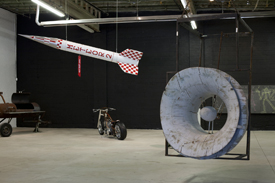 Installation view of Post-Industrial Complex (photograph by Corine Vermeulen)
Katie Grace McGowan and Jon Brumit. Post-Industrial Complex. Museum of Contemporary Art Detroit, Detroit, Michigan, May 11–July 29, 2012.
Matthew Palczynski. Haunting Narratives: Detours from Philadelphia Realism, 1935 to the Present. Woodmere Art Museum, Philadelphia, Pennsylvania, May 12–July 15, 2012.
Matthew Palczynski. Salvatore Pinto: A Retrospective Celebrating the Barnes Legacy. Woodmere Art Museum, Philadelphia, Pennsylvania, May 12–July 15, 2012.

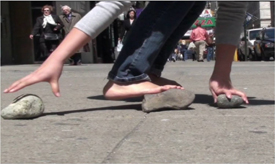 Kyoung eun Kang, video still from Islands, 2009 (artwork © Kyoung eun Kang)
Jennifer Wilkinson. Bivalence: Working Space 12. Cuchifritos, Essex Street Market, New York, July 12–August 12, 2012.