
CAA News Today
Recent Deaths in the Arts
posted Jul 09, 2012
In its monthly roundup of obituaries, CAA recognizes the lives and achievements of the following artists, curators, designers, photographers, filmmakers, and other men and women whose work has had a significant impact on the visual arts. This month was marked by the loss of the Pop art dealer Ivan Karp, the film scholar Andrew Sarris, and the feminist art historian Paula Hays Harper.
- Carl F. Barnes Jr., a former president of the International Center of Medieval Art, died on May 25, 2012, at the age of 77. Barnes was a professor emeritus of art history at Oakland University in Rochester, Michigan, where he had taught from 1971 to 2001. A specialist in European medieval art, he wrote extensively on the thirteenth-century French artist Villard de Honnecourt
- Barton Lidice Benes, a sculptor and collector, died on May 30, 2012, at the age of 69. Benes made art from the raw materials of everyday life, drawing support and controversy for using medical equipment associated with AIDS/HIV treatment and the cremated remains of friends who perished from the disease. His object and art-filled apartment is now being meticulously re-created as an installation at the North Dakota Museum of Art in Grand Forks
- Willard Bond, an artist known for his vibrant paintings of yachts and seascapes, died on May 19, 2012. He was 85 years old. Bond was a versatile artist, influenced in equal parts by the teaching of Buckminster Fuller and by his own experience as a pier master at New York’s South Street Seaport. Admirers claim that his paintings embody the ineffable experience of being on a boat at sea
- Frederick J. Brown, a figurative painter deeply inspired by jazz music and the legacy of Abstract Expressionism, passed away on May 5, 2012. He was 67 years old. Brown created colorful, highly expressionistic portraits of people whom he admired, such as the avant-garde composer Anthony Braxton and the painter Willem de Kooning. His artworks were exhibited at the Studio Museum in Harlem, the Smithsonian Institution’s National Portrait Gallery, and the New Orleans Museum of Art
- Paula Hays Harper, an art historian who challenged the discipline with her feminist perspective, died on June 3, 2012, at the age of 81. In the 1970s, Harper was instrumental in establishing the feminist art program at California Institute of the Arts and for three decades was a professor at the University of Miami in Florida. She also coauthored a biography of the Impressionist painter Camille Pissarro
- Paul Jenkins, an American abstract painter known for his poured-paint technique, died on June 9, 2012, at the age of 88. In the 1950s Jenkins spent extensive time working and showing in Europe, a factor that made him less visible in the New York art scene than his aesthetic peers, Jackson Pollock, Helen Frankenthaler, and Morris Louis. Jenkins’s art, though, was wildly popular, and the artist had many prominent patrons and museum exhibitions throughout the United States, France, and Great Britain. On a side note to his career arc, Jenkins’s paintings were featured in the 1978 film, An Unmarried Woman
- Gerhard Kallmann, an architect known for his controversial modernist design for Boston City Hall, died on June 19, 2012, at the age of 97. Built in 1968, the Brutalist building was criticized and praised, sometimes at the same time. Ada Louise Huxtable, architecture critic for the New York Times, wrote that Boston now had “one of the handsomest buildings around, and thus far, one of the least understood”
- Ivan Karp, an art dealer and gallery owner who championed Pop art in its early days, passed away on June 28, 2012. He was 86 years old. Karp served as codirector of the Leo Castelli Gallery and in 1969 opened his own space, OK Harris, in SoHo, which established the fledgling artist neighborhood as the new gallery mecca in Manhattan. Artists whom Karp promoted include Andy Warhol, John Chamberlain, Roy Lichtenstein, and Claes Oldenburg
- Jeff Keen, a British experimental filmmaker, visual artist, and poet, passed away on June 21, 2012. He was 88 years old. In his late 30s Keen hit his stride as an artist with a series of short, surrealistic films that combined collage techniques and innovative sound tracks. Keen was a founding member of the London Film-Makers Co-op in 1966 and actively participated in the counterculture movement
- Mary Katharine MacGregor, a former curator of prints and drawings at the Joslyn Art Museum in Omaha, Nebraska, died on May 16, 2012, at the age of 89. MacGregor was affiliated with several New York art museums, including the Museum of Modern Art, before she returned to her native Iowa to pursue a curatorial position at the Print and Drawing Study Room at the University of Iowa’s Museum of Art
- Georges Mathieu, a French abstract painter, passed away on June 10, 2012. He was 91 years old. In the 1940s and 1950s Mathieu worked in the mode of Lyrical Abstraction, a French counterpart to Abstract Expressionism in the United States. He often performed his paintings in front of a live audience as a demonstration of his dramatic, freeform technique
- LeRoy Neiman, an artist and illustrator of the good life, died on June 20, 2012, at the age of 91. Like a contemporary Norman Rockwell, Neiman worked in a space between the fine-art and magazine worlds. He painted illustrations of sporting events for Playboy in the 1950s and taught for many years at the School of the Art Institute of Chicago
- Justine Price, a professor of art history at Canisius College in Buffalo, New York, died on October 24, 2011, at the age of 42. A faculty member of Canisius College since 2005, she had recently received tenure and been named the director of the college’s art-history program. Her scholarly interests extended from American Pop art to contemporary Polish photography
- Michael Rabe, a scholar of South Asian art and a professor at Xavier University in Chicago, died in late March 2012. Rabe’s colleague Andrew Cohen has written a special obituary for CAA
- Andrew Sarris, a film critic and scholar who wrote for the Village Voice for many years, passed away on June 20, 2012, at the age of 83. A champion of auteur theory, Sarris wrote a seminal book on the subject, The American Cinema: Directors and Directions 1929–1968 (1968). He had taught at Columbia University’s School of the Arts and was an inspirational figure to several generations of film critics and historians
- A. Richard Turner, an expert on Italian Renaissance art, particularly the legacy of Leonardo da Vinci, died on September 9, 2011. He was 79 years old. Turner was the author of Inventing Leonardo (1993), a book that analyzed five centuries of critical dialogue on the artist. Turner had a long teaching career that included stints at the University of Michigan, Princeton University, and Middlebury College before he became the director of the Institute of Fine Arts at New York University in 1979
- Jeff West, a champion of the arts in Dallas, Texas, died on May 22, 2012, at the age of 54. The executive director of the Shakespeare Festival of Dallas, West had helped bring film culture to the city with the AFI Dallas International Film Festival. He also worked for eleven years as executive director of the Sixth Floor Museum at Dealey Plaza, an institution that preserves the memory of President John F. Kennedy’s assassination
Read all past obituaries in the arts in CAA News, which include special texts written for CAA. Please send links to published obituaries to Christopher Howard, CAA managing editor, for the August list.
Affiliated Society News for July 2012
posted Jul 09, 2012
American Council for Southern Asian Art
The Bulletin of the American Council for Southern Asian Art (ACSAA) will be available to all ACSAA members this summer. As printed versions of the bulletin were discontinued in 2011, members should visit the ACSAA website to download the latest edition in PDF format, as well as all past Bulletins and Newsletters that have now been digitized.
American Society of Hispanic Art Historical Studies

The American Society of Hispanic Art Historical Studies (ASHAHS) announced its awards winners at the 2012 CAA Annual Conference. Jessica Weiss of the University of Texas at Austin is the recipient of the Photographs Grant, given to support the acquisition of photographs by graduate students who are preparing their doctoral dissertation or MA thesis on the topic of Spanish or Portuguese art history. Weiss’s dissertation is entitled “Juan de Flandes and the Commoditization of Aesthetics in Isabelline Spain.”
The Eleanor Tufts Award, which recognizes an outstanding English-language publication in the area of Spanish or Portuguese art history, went to Contested Visions in the Spanish Colonial World (Los Angeles: Los Angeles County Museum of Art, 2011), edited by Ilona Katzew. In addition, the jurors selected two books for honorable mention: Book of Honors for Empress Maria of Austria: Composed by the College of the Society of Jesus of Madrid on the Occasion of Her Death (1603) (Philadelphia: Saint Joseph’s University Press, 2011), edited by Antonio Bernat Vistarini, John T. Cull, and Tamás Sajó; and Maruja Mallo and the Spanish Avant-Garde (Burlington, VT: Ashgate, 2010), by Shirley Mangini.
Art, Literature, and Music in Symbolism and Decadence
Art, Literature, and Music in Symbolism and Decadence (ALMSD) thanks everyone who helped make its recent conference, “The Symbolist Movement: Its Origins and Its Consequences,” a success. The event took place April 25–28, 2012, at Allerton Park in Monticello, Illinois. Visit the conference website for complete program information and to watch a video of the opening. ALMSD has signed a contract with a publisher to publish an annual journal, to be called Art, Literature, and Music in Symbolism, Its Origins, and Its Consequences, beginning in 2013. The organization invites interested scholars working on aspects of the Symbolist movement to learn more about membership in the organization. Please contact Rosina Neginsky to contribute to the annual newsletter.
Association for Textual Scholarship in Art History
The Association for Textual Scholarship in Art History (ATSAH) seeks papers for a special session during CAA’s 101st Annual Conference in New York, taking place February 13–16, 2013. The session will examine how stained glass evolved as an art form between the years 1400 and 1900. Papers may also address how images are derived from the Bible, mythology, history, and literature. Please send abstracts to Liana Cheney, ATSAH president.
Association of Historians of American Art
The Association of Historians of American Art (AHAA) will sponsor two sessions at CAA’s 2013 Annual Conference in New York. Elizabeth Lee of Dickinson College and Robin Vedder of Pennsylvania State University will chair the scholarly session, “The Body of the Artist and the Artist as Body in American Artistic Practice.” Jaleen Grove and Douglas Dowd, both of Washington University in Saint Louis, will chair the professional session, “The Art History of American Periodical Illustration.” See the AHAA website for more information on the two panels.
The second AHAA symposium, “American Art: the Academy, Museums, and the Market,” will feature Holland Cotter, art critic for the New York Times, as the keynote speaker. The event will take place at the Boston Athenaeum in Massachusetts on October 11–13, 2012. The full schedule of speakers and registration information can be found online. Registration opened on June 1, 2012.
Association of Research Institutes in Art History
The Association of Research Institutes in Art History (ARIAH) invites nominations and self-nominations for the newly established ARIAH Prize for Online Publishing. This award, which carries a $1,000 cash prize, seeks to encourage and promote scholarly standards in online publishing in all fields of art history. The prize will be awarded annually to the author(s) of a distinguished article or essay published online in the past three years in the form of an ejournal or a short-form epublication that advances the study of art history and visual culture. The article should either appear exclusively online, or should be substantially distinct from any print version, creatively capitalizing on the potential of digital publishing.
Community College Professors of Art and Art History
Community College Professors of Art and Art History (CCPAAH) is reaching out to new members: please visit the new blog and watch for a Facebook page that is being developed. The organization seeks papers for a symposium, “Teaching All of Our Students: Few Majors, Fewer Transfers, Many Others,” to be held at the next CAA Annual Conference, taking place February 13–16, 2013, in New York. The symposium will explore the diverse make-up of the community-college student body and consider how best to teach art and art history to students who may have no interest in pursuing a major in the field. Panelists will be asked to share an example of a “best practice” that they feel addresses this concern. For more information about the upcoming symposium and for general inquiries about CCPAAH, please write to communitycollegeart@gmail.com.
CCPAAH invites its members to submit proposals for papers for Foundations in Art: Theory and Education’s next conference, “postHaus,” taking place April 3–6, 2013, in Savannah, Georgia. The session topic, “The Value of Writing in the Foundation Year: Exploring New Approaches,” will examine the importance of writing in both studio and art-history courses in the foundation year. Paper topics might include: how writing is integrated into your studio course; writing assignments beyond the standard art-history research paper; and using technology to get students writing. Please address all questions regarding FATE proposals to communitycollegeart@gmail.com.
Historians of Eighteenth-Century Art and Architecture
Michael Yonan, associate professor at the University of Missouri in Columbia, has been elected the new president of the Historians of Eighteenth-Century Art and Architecture (HECAA).
HECAA will be represented at the next American Society for Eighteenth Century Studies conference, taking place April 4–7, 2013, in Cleveland, Ohio, with two panels, chaired by Christopher Johns and Heather McPherson. Proposals for papers are due by September 15, 2012, and should be sent directly to the seminar chairs. HECAA will also host its annual luncheon and its business meeting at the conference.
Historians of Islamic Art Association

Registration is open for “Looking Widely, Looking Closely,” the third biennial symposium of the Historians of Islamic Art Association (HIAA), hosted by the Metropolitan Museum of Art in New York, October 18–20, 2012. Early registration ends on August 1. For more information about registration, travel tips, and hotels, please visit the website.
HIAA welcomes Jennifer Pruitt to the organization’s executive board as interim webmaster, succeeding Lara Tohme, who served for two years, from 2011 to 2012.
International Sculpture Center

Registration is now open for the twenty-third International Sculpture Conference of the International Sculpture Center (ISC), taking place October 4–6, 2012, in Chicago, Illinois. The conference will bring together people from around the world and across the field of contemporary sculpture to Chicago for ARTSlams, mentoring sessions, and an invigorating roster of presenters, including two keynote speakers: the artists Sophie Ryder and Sanford Biggers. This is an event you don’t want to miss!
ISConnects is hosting three upcoming summer and fall events in 2012. On July 21 in Omaha, Nebraska, ISC, KANEKO, and Bemis Center for Contemporary Arts will present a full day of discussions and artist-led tours with Nathalie Miebach and Michael Jones McKean, coinciding with McKean’s Bemis exhibition, The Rainbow: Certain Principles of Light and Shapes between Forms. On August 25, ISC and Grounds for Sculpture will host tours and an exciting panel discussion exploring the evolution and transformation of sculpture, followed by a reception in the Grounds for Sculpture Museum in Hamilton, New Jersey. Funded in part by the Johnson Art and Education Foundation, ISConnects explores the unique perspectives on sculpture in the contemporary art world. With partner organizations, ISC offers intimate programming that addresses cutting-edge, timely trends in sculpture through lively and insightful discourse.
Italian Art Society
The Italian Art Society (IAS) seeks nominations and self-nominations for various committee positions; please review the list of vacancies for more information on how to apply for a position. The deadline for nominations is November 1, 2012. Those interested in submitting proposals for papers for four linked sessions at the forty-eighth International Congress on Medieval Studies in Kalamazoo, Michigan, taking place May 9–12, 2013, should review the online call for additional information.
Leonardo Education and Art Forum
Patricia Olynyk, an artist and chair of the Leonardo Education and Art Forum (LEAF), will moderate a panel, “Eco-Art + the Evolving Landscape of Social and Situated Practices,” at the eighteenth International Symposium on Electronic Art, to be held September 19–24, 2012, in Albuquerque, New Mexico. The panelists include Linda Weintraub, Sam Bower, and Saul Ostrow, and the focus will be on education and the complex triad of ecoart, situated practices, and project-based public work that embraces various democratic processes and inspires progressive social, cultural, and environmental change. Jill Scott and Ellen K. Levy are cochairs of another ISEA panel, “Synaptic Scenarios for Ecological Environments,” which addresses cognitive issues in relation to ecology with the goal of gaining a greater embodied sense of place within the ecological environment. The panelists include Patricia Olynyk, Nicole Ottiger, Angelika Hilbeck, and Alison Hawthorne Deming.
LEAF seeks panelists for its session at CAA’s 2013 Annual Conference in New York. Entitled “Re/Search: Art, Science, and Information Technology (ASIT): What Would Leonardo da Vinci Have Thought?” and moderated by Joe Lewis of the University of California, Irvine, the session takes a close look at art projects that involve the intersection of science and technology. When Leonardo da Vinci introduced himself to the Duke of Milan, he did not reveal himself as an artist but instead presented a proposal to create military weapons to protect the duke’s city in times of siege. What entrepreneurial ideas have contemporary artists developed to provide funding for their projects? Please submit proposals to Joe Lewis by July 31, 2012.
Mid-America College Art Association

The Mid-America College Art Association (MACAA) will hold its biannual conference from October 3 to 6, 2012, in Detroit, Michigan. The James Pearson Duffy Department of Art and Art History at Wayne State University will host the conference. Programming will include three featured speakers; panels on art, design, art history, and visual resources; and studio workshops, member exhibitions, and museum visits. The conference will have two content areas, “Meaning and Making” and “Community and Collaboration.” Visit the Detroit conference website to learn more about the event, travel and hotel information, and how to become an MACAA member.
National Alliance of Artists from Historically Black Colleges and Universities
Lee Ransaw, chairman and founder of the National Alliance of Artists from Historically Black Colleges and Universities (NAAHBCU), was a panelist on the 2012 James A. Porter Colloquium at Howard University in Washington, DC. He presented on “The Growth and Development of the National Alliance of Artists from Historically Black Colleges and Universities.” The James A. Porter Colloquium is the leading forum for scholars, artists, curators, and individuals in the field of African American Art and Visual Culture. Established at Howard University in 1990, the colloquium is named in honor of James A. Porter, the pioneering art historian and professor, whose 1943 publication Modern Negro Art laid the foundation for the field.
The annual NAAHBCU meeting was held June 29–30, 2012, in Atlanta, Georgia. Coinciding with the meeting was an exhibition, Influence and Legacy: Shaping the Future while Preserving the Past, featuring NAAHBCU artists and held at the Stewart McClain Gallery in Atlanta.
National Council of Arts Administrators
The National Council of Arts Administrators (NCAA) board seeks proposals for the presentation of case studies for its annual conference, “Granting Permission,” taking place November 7–10, 2012, and hosted by Ohio State University and Columbus College of Art and Design. Topics might include but are not limited to: leadership and management; interpersonal communication; succeeding with external constituencies; budget management; personnel evaluation; issues related to promotion and tenure; personal growth; career paths; and any topical area related to arts administration and leadership. Please outline your proposal, or send an actual case study, in 350 words or less to Lydia Thompson or Amy Hauft. Proposals are due by Friday, July 31, 2012. Selected entries will be notified by September 1, 2012. Confirmation of presenters will be posted at NCAA’s website and formally acknowledged by the NCAA board.
New Media Caucus
The New Media Caucus (NMC) extends a warm welcome to its new board members: Elizabeth Demaray, Rutgers University; Margaret Dolinsky, Indiana University Bloomington; Conrad Gleber, La Salle University; Claudia Hart, School of the Art Institute of Chicago; Krista Hoefle, Saint Mary’s College; Meredith Hoy, University of Massachusetts, Boston; Patrick Lichty, Columbia College Chicago; Gail Rubini, Florida State University; and Joyce Rudinsky, University of North Carolina, Chapel Hill. These outstanding artist practitioners, educators, and academics will join continuing board members and officers.
Public Art Dialogue

Public Art Dialogue (PAD) has published the latest issue of its eponymous journal, which features a theme of “Audience Response.” Public art today is often commissioned with community input, but very little is known about how such art is received initially and over time. Although “the public” is often invoked, the actual audience is rarely consulted after a work is in place. In this issue, Public Art Dialogue aims to document this elusive but critical aspect of public art and suggest a methodology for its study.
The fourth annual PAD award for achievement in the field of public art was presented to the media artist Ben Rubin at the 2012 CAA Annual Conference in Los Angeles. Rubin treated all in attendance to a unique glimpse into the behind-the-scenes happenings of his new public project, Shakespeare Machine. Commissioned by New York City’s Percent for Art program, the site-specific sculpture will be installed in the lobby of the Public Theater in New York. After the presentation, Rubin shared some of the joys and obstacles of the public art process in an intimate question-and-answer session.
Society for Photographic Education

This fall the Society for Photographic Education (SPE) will host regional conferences in Rochester, New York; Jersey City, New Jersey; Daytona Beach, Florida; Starkville, Mississippi; Cincinnati, Ohio; Fort Collins, Colorado; and Eugene, Oregon. Photographic artists, educators, students, and professionals will gather on an intimate scale for discussions on programming, photography critiques, exhibitions, tours, receptions, and more. Regional conferences are great opportunities to meet other members of the organization. If you are not an SPE member, you can still attend the conferences at a nonmember rate. Visit the SPE website to find out more about the regional conferences, including registration and proposal deadlines.
Society for the Study of Early Modern Women
The Society for the Study of Early Modern Women (SSEMW) has elected the following officers for the current year: Allyson M. Poska, professor of history, University of Mary Washington, president; Jane Couchman, professor emeritus, York University, vice president; Deborah Uman, professor of English, Saint John Fisher College, treasurer; Abby Zanger, independent scholar, secretary; and Karen Nelson, Center for Literary and Comparative Studies, University of Maryland, webmaster.
Society of Architectural Historians
At its sixty-fifth annual conference in Detroit in April 2012, members of the Society of Architectural Historians (SAH) warmly welcomed a new slate of officers: Abigail A. Van Slyck, Connecticut College, president; Kenneth Breisch University of Southern California, first vice president; Ken Tadashi Oshima, University of Washington, second vice president; Gail Fenske, Roger Williams University, secretary; and Jan M. Grayson, treasurer. SAH also welcomes the following incoming board members, who will serve three years: Michael J. Gibson, Greenberg, Whitcombe & Takeuchi; Duanfang Lu, University of Sydney; Robert Nauman, University of Colorado, Boulder; Donna Robertson, Illinois Institute of Technology; and Gary Van Zante, MIT Museum.
Visual Resources Association

The Visual Resources Association (VRA) presented the winners of its highest honors at an awards luncheon on April 19, 2012, which took place during the organization’s thirtieth annual conference, held in Albuquerque, New Mexico. Kathe Hicks Albrecht of American University received the Distinguished Service Award for her contributions to visual resources and image management. The ceremony featured comments from Albrecht’s nominators and a discussion of her engagement with visual resources advocacy, service to the profession, and long term involvement with VRA and the VRA Foundation over her twenty-one year career. In addition, VRA presented two Nancy DeLaurier Awards for distinguished achievement to Sheila M. Hannah of the University of New Mexico and Patti McRae Baley of the University of Nevada in Las Vegas. Hannah was honored for her early, innovative development of image automation: the Visual Information Checklist, the development of Visual Resources Catalog of Native American Artists, and the implementation of a thriving internship program. Baley was honored for her long and successful role as the “Empress” of the VRA conference; inaugurating the “VRAffle,” which provides income for the Tansey Travel Awards; and immediate involvement in the association for new and veteran conference attendees. You can find images and information about the awards presentation and a selection of multimedia illustrated conference presentations on the VRA website.
Michael Rabe: In Memoriam
posted Jul 09, 2012
Andrew Cohen is a professor and chair of the Department of Art and Design at Monmouth University in West Long Branch, New Jersey.

Michael Rabe
At the inquisitively early age of five, Michael Rabe (1947–2012) started his long and passionate engagement with India. His father Rudolph Rabe followed a “calling” to do missionary work and in 1952 moved with his wife Eleanore and their sons Michael and Gregg to the Gadag district in the state of Karnataka, India. The area is home to many art-historical landmarks of the Later Calukyan period, such as the Trikutesvara temple complex built in the eleventh century. Rabe spoke happily of his youth in India, especially his schooling at Kodaikanal International School in Tamil Nadu. While his family stayed in India, he was sent to Minnesota to live with an uncle, where he finished his last year of high school. He continued his undergraduate and graduate education at the University of Minnesota, receiving a BA in philosophy in 1969, with a minor in Sanskrit. In 1973 he earned an MA in South Asian languages and literature and completed a PhD in 1987, with the dissertation “The Monolithic Temples of the Pallava Dynasty: A Chronology.” Frederick M. Asher was his advisor, and Rabe was the first of many PhD students to work closely with this professor.
Since 1983 Rabe was an associate professor in the Department of Art and Design at Saint Xavier University in Chicago, where he taught courses in a wide selection of Western and Asian art history. With ease he would explicate the symbolism of global monuments. Eager to share his enthusiasm for South Asian art, he also taught as an adjunct professor at the School of the Art Institute of Chicago from 1986 to the present. A passionate teacher who did not limit himself to the classroom, Rabe was a veritable fountain of knowledge who shared freely with students and colleagues. I first met Michael in Chicago during the early 1980s, and from then on I always knew him as a scholar whose love for South Asian art was contagious. No doubt many members of the American Council for Southern Asian Art (ACSAA) have their own stories of lengthy, at times overwhelming, conversations with him regarding a full array of Indian art and cultural topics.

Rabe was fearless in the pursuit of learning. While never challenging without good reasons, he insisted on questioning the soundness of scholarship. Among his passions was the study of forged or copied works of art, especially South Indian sculptures. I recall more than one ACSAA panel where he questioned the validity, or originality, of certain artworks. One of the last email correspondences we had concerned a bronze that was being promoted as a Vijayanagara period work. Because certain compositional elements seemed “wrong” to me, I asked Rabe for his thoughts; he immediately and accurately identified inconsistencies with the bronze. Recalling this exchange I remember fondly my friend’s joy that came from looking at art, as well as his pursuit of clear vision. During this exchange, while eloquently sharing his thoughts, he was suffering terribly from a relapse of cancer (which he didn’t bother to mention).
Rabe is perhaps most widely known for his Pallava study, especially the densely researched book The Great Penance at Māmallapuram: Deciphering a Visual Text (Chennai, India: Institute of Asian Studies, 2001). Gathering painstakingly detailed visual and literary references, he argued that the ultimate meaning of the large Māmallapuram relief is a Pallava praśasti, a visual counterpart of a celebratory lineage recitation, while maintaining as secondary meaning the more commonly accepted narratives of Arjuna’s penance and of Ganga’s descent. There are other articles where he ties the literary with the visual, such as in “Sexual Imagery on the ‘Phantasmogorical Castles’ at Khajuraho,” published by the International Journal of Tantric Studies in 1996. In his spare time Rabe was working on a textbook to serve as an introduction to comparative themes in Asian religious art.
On behalf of Michael Rabe’s family, friends, and colleagues, I will miss his intellectual prowess and his insightful and generous scholarly sharing. His gregarious, good-natured friendship is what remains the most fondly remembered. Rabe is survived by his wife Duangdow Arjsiri and his three children, Rachel, Dylan, and (from a previous marriage) Daniel.
THE REMARKABLE JOURNEY OF JUDY PETER
posted Jul 03, 2012
Ann Albritton is a professor of modern and contemporary art history at Ringling College of Art and Design in Sarasota, Florida, and chair of CAA’s International Committee.
Judy Peter, a scholar at the University of Johannesburg in South Africa, speaks at a meeting of CAA International Travel Grant recipients at the 2012 Annual Conference in Los Angeles (photograph by Bradley Marks)
A short time before the 2012 CAA Annual Conference in Los Angeles, Judy Peter and I began sending occasional emails back and forth from Johannesburg, South Africa, to Sarasota, Florida. As incoming chair of the International Committee, I had been assigned to Peter, one of twenty recipients of the CAA International Travel Grant Program, generously funded by the Getty Foundation. We had been paired based on a shared academic pursuit: teaching contemporary issues in art. Her short biography describing her as head of the Department of Jewellery Design and Manufacture at the University of Johannesburg gave me a brief introduction that made me curious to meet her. We met face-to-face early on the first morning of the conference and went with several other grant recipients and their hosts to a large roundtable breakfast at the Hotel Figueroa. It was there that I began getting to know her as a fellow art historian and theorist who was delighted to be at the conference and determined to make the most of the experience.
Peter is a dedicated scholar who has the distinction of being the first black person in South Africa to complete a PhD in visual studies: she earned her degree in 2011 at the University of Pretoria. Even though her country has been a democracy for eighteen years, many blacks and women in academia must still confront, and break through, the proverbial glass ceiling. Peter describes her research as a “critical reading of the politics of gender and identity issues in a new South Africa.” She is currently studying the work of thirteen female South African artists, looking at myriad geographical and historical influences that have affected their art practice. Each artist she has chosen to write on is working with identity, place, and displacement.
Between visits to the J. Paul Getty Museum and the Los Angeles County Museum of Art, Peter attended sessions she felt were useful to her, including the CAA International Committee panel, “Internationalizing the Field: A Discussion of Global Networks for Art Historians,” and others, such as “Black Venus: They Called Her Hottentot.” These sessions, she writes, “allowed me to compare teaching and learning practices between institutions in the United States and in South Africa.” In addition, Peter attended two of CAA’s Professional Development Workshops: “Advice for New Instructors” and “The Syllabus: Mapping Out Your Semester.” At the latter she made a connection with a workshop presenter, Steven Bleicher, a professor of visual arts at Coastal University in South Carolina. Since the conference, the two have been in communication regarding opportunities for scholars at the University of Johannesburg to contribute to Bleicher’s new book.
For the international scholars, networking within their diverse group was among the most important benefits of being a travel-grant recipient. Discovering common areas of research, exploring conflicting views, and sharing divergent teaching practices made for dynamic discussions and brought various groupings of scholars together. Isolation remains a common problem for many of the grantees, and the conference provided immediate and long-range opportunities for them to build new communities. In fact, many of them have continued these conversations online; several are making concrete plans for future collaborations.
Like even the most seasoned of CAA conference goers, Peter and the other international scholars attended a whirlwind of workshops, sessions, panels, meetings, and museums without much time for reflection. Directly following the event in Los Angeles, however, most travel-grant recipients flew across the country to spend a few days at the Sterling and Francine Clark Art Institute in Williamstown, Massachusetts. At the Clark they were able to relax and get to know each other in a less formal environment, and to start to lay the groundwork for future work together.
I look forward to keeping in touch with Judy Peter in order to keep learning about the vastly different social and political landscape that artists and art historians inhabit in South Africa. I’m especially interested in her research on female artists active from 1994 to 2004. We’ll continue to exchange ideas, share our writing with one another, and possibly collaborate on a project.
Read about another travel-grant recipient, Dóra Sallay from Hungary, and review a report on all activities from the 2012 CAA International Travel Grant Program.
CAA Joins JSTOR Register & Read Program
posted Jul 02, 2012
 CAA has joined JSTOR’s new Register & Read program, which offers free, read-online access to a wide-range of academic journals to independent scholars and researchers. The service is designed to make scholarship available to those not affiliated with a subscribing institution by allowing them to register for a MyJSTOR account.
CAA is pleased to contribute the full back run of The Art Bulletin and Art Journal, through 2008, to an expanding, eclectic list that includes BOMB Magazine, Film Quarterly, Modern Law Review, and American Journal of Sociology. All articles from The Art Bulletin and Art Journal during this time will be available for individuals to read and, in some instances, to download and purchase as a PDF file.
Since JSTOR launched Register & Read in January 2012, approximately forty publishers have contributed material from seventy-seven journals to the beta site. The user-friendly program mimics the experience of a library by allowing visitors to store up to three articles on a virtual shelf for two weeks before exchanging items. Feedback is key to improving the borrowing service that Register & Read provides. JSTOR plans to perfect the functionality of the program and enlarge its scope to meet the unique research needs of the scholarly community.
Propose a Session for the 2014 Annual Conference in Chicago
posted Jun 26, 2012
 CAA invites individual members to propose a session for the 102nd Annual Conference, taking place February 12–15, 2014, in Chicago, Illinois. Proposals should cover the breadth of current thought and research in visual art, art and architectural history, theory and criticism, pedagogical issues, museum and curatorial practice, conservation, and developments in technology. For full details on the submission process for the conference, please review the information published on the Chair a 2014 Annual Conference Session webpage.
The Annual Conference Committee welcomes session proposals from established artists and scholars, along with those from younger scholars, emerging and midcareer artists, and graduate students. Particularly welcome are proposals that highlight interdisciplinary work. Artists are especially encouraged to propose sessions appropriate to dialogue and information exchange relevant to artists.
The submission process for the 2014 conference is now open. In order to submit a proposal, you must be a current CAA member. Deadline extended: September 14, 2012; no late applications are accepted.
Image: Georges Seurat, A Sunday on La Grande Jatte — 1884, 1884–86, oil on canvas, 81¾ x 121¼ in. Art Institute of Chicago (artwork in the public domain)
Intellectual Property and the Arts
posted Jun 25, 2012
The Committee on Intellectual Property (CIP) is pleased to announce the posting of the revised and expanded Intellectual Property and the Arts pages on CAA’s website. CIP monitors and interprets copyright legislation for the benefit of CAA’s various constituencies. In so doing, it seeks to offer educational programs and opportunities for discussion and debate in response to copyright legislation affecting educators, scholars, museum professionals, and artists.
The section is divided into the following eight categories: US Copyright: Fundamentals & Documents; Visual Art/Visual Artists; Publishing in the Visual Arts; Libraries, Archives, and Museums; Image Sources and Rights Clearance Agencies; Fair Use Guidelines, Practices, and Policies; Copyright Outside the United States; and Legal Assistance.
Education is essential for informed communication. The committee hopes that the resources presented in the updated pages will answer your questions about intellectual property and inform your discussions and debates.
Solo Exhibitions by Artist Members
posted Jun 22, 2012
See when and where CAA members are exhibiting their art, and view images of their work.
Solo Exhibitions by Artist Members is published every two months: in February, April, June, August, October, and December. To learn more about submitting a listing, please follow the instructions on the main Member News page.
June 2012
Abroad

 Gesche Würfel, Go for Gold! 2009 The Blue Fence | Olympic Stadium 4, 2007, digital C-type print, 20 x 20 in. (artwork © Gesche Würfel)
Gesche Würfel. Underground Gallery, London, United Kingdom, July 26–August 9, 2012. Go for Gold! Photography.
Mid-Atlantic

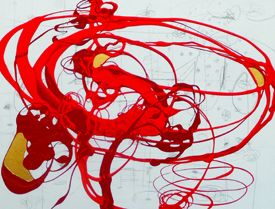 Serena Bocchino, 99º (Fever) Hold Me Tight, 2012, enamel, graphite, and gold leaf on canvas, 38 x 48 in. (artwork © Serena Bocchino)
Serena Bocchino. Simon Gallery, Morristown, New Jersey, May 29–July 31, 2012. Fever. Painting and work on paper.
Midwest

Neil Goodman. Perimeter Gallery, Chicago, Illinois, April 20–May 26, 2012. Breadth. Sculpture.
Northeast

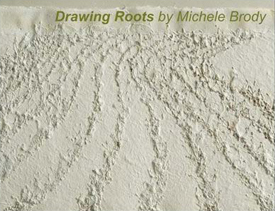
Michele Brody. Guild Gallery II, New York, April 19–June 12, 2012. Drawing Roots. Drawing on handmade paper.
Lisi Raskin. Churner and Churner, New York, February 23–March 31, 2012. Shots in the Dark. Sculpture, drawing, and collage.

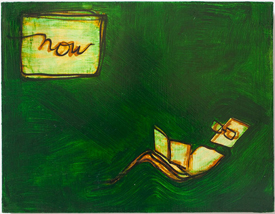 Mira Schor, Now, 2011, ink, oil, and gesso on linen 14 x 18 in. (artwork © Mira Schor)
Mira Schor. Marvelli Gallery, New York, March 29–April 28, 2012. Mira Schor: Voice and Speech. Painting.

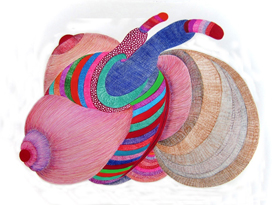 Dee Shapiro, Comfort Zone, 2011, ink and Flashe paint on paper, 22 x 30 in. (artwork © Dee Shapiro)
Dee Shapiro. Andre Zarre Gallery, New York, June 19–July 28, 2012. Sexing the Polymorphs. Drawing.
Annie Shaver-Crandell. SiteImages Chelsea, New York, April 19–28, 2012. Steeds, Sofas, and Pistas: The Figure at Home, Abroad, and Afield. Painting.

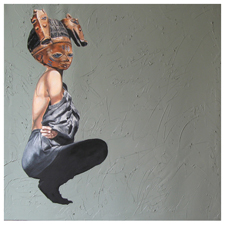 Margaret Rose Vendryes, Gelede Cherrelle – African Diva, 2012, oil and cold wax on canvas with paper, 30 x 30 in. (artwork © Margaret Rose Vendryes)
Margaret Rose Vendryes. Gelabert Studios Gallery, New York, May 29–June 16, 2012. 33⅓ Pushing the Needle: The African Diva Project. Painting and African masks.
South

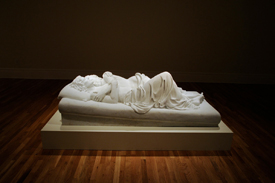 Patricia Cronin, Memorial to a Marriage, 2002, over life-sized Carrara marble (artwork © Patricia Cronin; photograph provided by the artist)
Patricia Cronin. Newcomb Art Gallery, Tulane University, New Orleans, Louisiana, April 25–June 30, 2012. Patricia Cronin: All Is Not Lost. Watercolor and sculpture.
Patricia Cronin. Arthur Roger Gallery, New Orleans, Louisiana, April 7–June 30, 2012. Patricia Cronin: Memorial to a Marriage. Sculpture.
Ruth Dusseault. Robert C. Williams Paper Museum, Institute of Paper Science and Technology, Georgia Institute of Technology, Atlanta, Georgia, April 20–June 8, 2012. The Innermost Room. Photography and video.
West

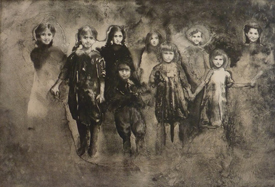 Ruth Weisberg, Together Again, 1975, color lithograph, 15 x 22 in. (artwork © Ruth Weisberg)
Ruth Weisberg. Sylvia White Gallery, North Gallery, Ventura, California, April 11–May 13, 2012. Then and Now. Monotype.
Survey Results on Contingent Faculty in Higher Education
posted Jun 20, 2012
 The results of a 2010 survey of contingent faculty members and instructors in American higher education, published today by the Coalition on the Academic Workforce (CAW), have confirmed much of what has been reported anecdotally: part-time faculty members demonstrate a dedicated level of commitment to teaching and to the institutions that employ them, but this commitment is not reciprocated by those institutions through compensation or other professional support. The findings also describe larger course loads for teachers, imbalances in compensation in relation to not only professional credentials but also gender and race, and minimal participation in academic decision-making. Further, contingent faculty face longer durations of provisional employment and slim prospects for career advancement, with schools failing to meet their preference for full-time status.
According to a 2009 government study, 75.5 percent of all faculty members at colleges and universities in the United States are contingent: that is, they hold part-time or adjunct positions, have full-time non-tenure-track jobs, or serve as graduate-student teaching assistants. Part-timers alone make up nearly half the total professoriate. The US Department of Education, however, has not kept statistics on contingent-faculty salaries since 2003, when it last carried out its National Study of Postsecondary Faculty. CAW’s comprehensive survey, administered in fall 2010, was conducted in an effort to provide meaningful data for this rapidly growing concern. Of the nearly 30,000 survey respondents, 1,102 were CAA members: 591 in studio art and design, 362 in art history, and 149 in art education. The CAW report focuses on the largest group of contingent faculty: part-timers.
CAA is a founding member (1997) of CAW, which is a group of higher-education associations, disciplinary associations, and faculty organizations committed to addressing issues associated with deteriorating faculty working conditions and their effect on college and university students in the United States. Specifically, CAW’s purpose is to: collect and disseminate information on the use and treatment of full- and part-time faculty members serving off the tenure track and the implications for students, parents, other faculty members, and institutions; articulate and clarify differences in the extent and consequences of changes in the faculty within and among the various academic disciplines and fields of study; evaluate the short-term and long-term consequences of changes in the academic workforce for society and the public good; identify and promote strategies for solving the problems created by inappropriate use and exploitation of part-time, adjunct, and similar faculty appointments; promote conditions by which all faculty members, including full- and part-time non-tenure-track faculty members, can strengthen their teaching and scholarship, better serve their students, and advance their professional careers.
Andrew Delbanco, the author of College: What It Was, Is, and Should Be (2012), stated that, in 1975, 60 percent of college professors were full-time faculty with tenure. The reasons for the accelerated shift toward contingent labor since that time are many. Decreases in state funding, capital expansion without commensurate revenue, increases in specialized knowledge requiring thousands of course offerings, and swelling student enrollment all have had a detrimental effect on faculty budgets, more so than on any other area of expenditures in higher education. Jane Wellman, who led the Delta Project on Postsecondary Education Costs, Productivity, and Accountability, affirmed these observations in a recent New York Times interview:
What the evidence shows is that we’ve done more to cut costs in the faculty area than elsewhere in the budget, and we’ve done it by bringing in more adjuncts and part-timers. So there’s a handful of professors with tenure, who don’t teach very much, and then there’s [a] lot of people who have no benefits who do more of the teaching. I think it’s probably hurting academic quality, especially at institutions where the students are not well prepared. The attrition [of students] is mostly in the first two years, and that’s mostly where the adjuncts are.
While no hard evidence has determined that an increase of adjuncts has diminished the quality of teaching in higher education, the CAW survey results clearly demonstrate pressure on part-time faculty due to not only expanding workloads and larger classes—especially for part-time faculty teaching at multiple institutions—but also expectations to be involved in academic decision-making without additional compensation.
Professors of studio art and art history are acutely aware of all these issues. Enrollment has risen persistently for art-history and studio courses for years, while tenured positions have diminished. The survey results do bring some slightly positive news: median pay for contingent faculty in studio art and design and in art history is $3,000 per three-credit course (the nationwide median is approximately $2,700). In addition, workers at campuses with a union presence earn more than those at nonunion schools. Compensation is lower, however, for survey respondents who identified themselves as black, although the number of African Americans who participated in the survey was low. Please visit the CAW website for details on these issues and more.
The CAW report will provide important data for discussions taking place in several of CAA’s Professional Interests, Practices, and Standards Committees. The Student and Emerging Professionals Committee will be addressing contingent-faculty issues at a panel at the 2013 Annual Conference in New York, which will include Michael Bérubé, president of the Modern Language Association and director of the Institute for the Arts and Humanities at Pennsylvania State University, who will present an overview of the Academic Workforce Data Center, a compilation of historical data of the growth of contingent faculty by universities. Bérubé will also discuss the need to nationalize the academic-job market. Jeanne Brody, an adjunct professor at Villanova University and Saint Joseph’s University, will summarize the ways in which adjunct faculty members are effectively organizing and advocating better treatment within the university system. Victoria H. F. Scott of Emory University will discuss the establishment of an Art History Society of the Americas, which would explore abolishing adjunct position types, raising salaries, collecting statistics, and setting policies to improve and monitor working conditions.
The Committee on Women in the Arts, which focuses on women’s issues in the workplace and beyond, will respond to survey results on gender. Although women make up two-thirds of all CAA members, they tend to occupy the lowest rungs of academia, while men continue filling the higher-ranking and higher-paid positions. To continue the discussion, the committee will present a panel at the 2013 conference, chaired by the artist and professor Claudia Sbrissa, on how the “feminization” of art history may have contributed to lower salaries and prestige for women.
Similarly, the Committee on Diversity Practices will discuss issues related to retention of faculty members of color during its panel at the 2013 conference.
CAA would like to thank the individuals who generously volunteered their time and expertise to develop and tabulate CAW’s survey: John Curtis, director of research and public policy, American Association of University Professors; David Laurence, director of research, Modern Language Association; Kathleen Terry-Sharp, director of academic relations and practicing and applied programs, American Anthropological Society; Craig Smith, director of higher education, American Federation of Teachers; and Robert B. Townsend, deputy director, American Historical Association.
Survey Results on Contingent Faculty in Higher Education
posted Jun 20, 2012
The results of a 2010 survey of contingent faculty members and instructors in American higher education, published today by the Coalition on the Academic Workforce (CAW), have confirmed much of what has been reported anecdotally: part-time faculty members demonstrate a dedicated level of commitment to teaching and to the institutions that employ them, but this commitment is not reciprocated by those institutions through compensation or other professional support. The findings also describe larger course loads for teachers, imbalances in compensation in relation to not only professional credentials but also gender and race, and minimal participation in academic decision-making. Further, contingent faculty face longer durations of provisional employment and slim prospects for career advancement, with schools failing to meet their preference for full-time status.
According to a 2009 government study, 75.5 percent of all faculty members at colleges and universities in the United States are contingent: that is, they hold part-time or adjunct positions, have full-time non-tenure-track jobs, or serve as graduate-student teaching assistants. Part-timers alone make up nearly half the total professoriate. The US Department of Education, however, has not kept statistics on contingent-faculty salaries since 2003, when it last carried out its National Study of Postsecondary Faculty. CAW’s comprehensive survey, administered in fall 2010, was conducted in an effort to provide meaningful data for this rapidly growing concern. Of the nearly 30,000 survey respondents, 1,102 were CAA members: 591 in studio art and design, 362 in art history, and 149 in art education. The CAW report focuses on the largest group of contingent faculty: part-timers.
CAA is a founding member (1997) of CAW, which is a group of higher-education associations, disciplinary associations, and faculty organizations committed to addressing issues associated with deteriorating faculty working conditions and their effect on college and university students in the United States. Specifically, CAW’s purpose is to: collect and disseminate information on the use and treatment of full- and part-time faculty members serving off the tenure track and the implications for students, parents, other faculty members, and institutions; articulate and clarify differences in the extent and consequences of changes in the faculty within and among the various academic disciplines and fields of study; evaluate the short-term and long-term consequences of changes in the academic workforce for society and the public good; identify and promote strategies for solving the problems created by inappropriate use and exploitation of part-time, adjunct, and similar faculty appointments; promote conditions by which all faculty members, including full- and part-time non-tenure-track faculty members, can strengthen their teaching and scholarship, better serve their students, and advance their professional careers.
Andrew Delbanco, the author of College: What It Was, Is, and Should Be (2012), stated that, in 1975, 60 percent of college professors were full-time faculty with tenure. The reasons for the accelerated shift toward contingent labor since that time are many. Decreases in state funding, capital expansion without commensurate revenue, increases in specialized knowledge requiring thousands of course offerings, and swelling student enrollment all have had a detrimental effect on faculty budgets, more so than on any other area of expenditures in higher education. Jane Wellman, who led the Delta Project on Postsecondary Education Costs, Productivity, and Accountability, affirmed these observations in a recent New York Times interview:
What the evidence shows is that we’ve done more to cut costs in the faculty area than elsewhere in the budget, and we’ve done it by bringing in more adjuncts and part-timers. So there’s a handful of professors with tenure, who don’t teach very much, and then there’s [a] lot of people who have no benefits who do more of the teaching. I think it’s probably hurting academic quality, especially at institutions where the students are not well prepared. The attrition [of students] is mostly in the first two years, and that’s mostly where the adjuncts are.
While no hard evidence has determined that an increase of adjuncts has diminished the quality of teaching in higher education, the CAW survey results clearly demonstrate pressure on part-time faculty due to not only expanding workloads and larger classes—especially for part-time faculty teaching at multiple institutions—but also expectations to be involved in academic decision-making without additional compensation.
Professors of studio art and art history are acutely aware of all these issues. Enrollment has risen persistently for art-history and studio courses for years, while tenured positions have diminished. The survey results do bring some slightly positive news: median pay for contingent faculty in studio art and design and in art history is $3,000 per three-credit course (the nationwide median is approximately $2,700). In addition, workers at campuses with a union presence earn more than those at nonunion schools. Compensation is lower, however, for survey respondents who identified themselves as black, although the number of African Americans who participated in the survey was low. Please visit the CAW website for details on these issues and more.
The CAW report will provide important data for discussions taking place in several of CAA’s Professional Interests, Practices, and Standards Committees. The Student and Emerging Professionals Committee will be addressing contingent-faculty issues at a panel at the 2013 Annual Conference in New York, which will include Michael Bérubé, president of the Modern Language Association and director of the Institute for the Arts and Humanities at Pennsylvania State University, who will present an overview of the Academic Workforce Data Center, a compilation of historical data of the growth of contingent faculty by universities. Bérubé will also discuss the need to nationalize the academic-job market. Jeanne Brody, an adjunct professor at Villanova University and Saint Joseph’s University, will summarize the ways in which adjunct faculty members are effectively organizing and advocating better treatment within the university system. Victoria H. F. Scott of Emory University will discuss the establishment of an Art History Society of the Americas, which would explore abolishing adjunct position types, raising salaries, collecting statistics, and setting policies to improve and monitor working conditions.
The Committee on Women in the Arts, which focuses on women’s issues in the workplace and beyond, will respond to survey results on gender. Although women make up two-thirds of all CAA members, they tend to occupy the lowest rungs of academia, while men continue filling the higher-ranking and higher-paid positions. To continue the discussion, the committee will present a panel at the 2013 conference, chaired by the artist and professor Claudia Sbrissa, on how the “feminization” of art history may have contributed to lower salaries and prestige for women.
Similarly, the Committee on Diversity Practices will discuss issues related to retention of faculty members of color during its panel at the 2013 conference.
CAA would like to thank the individuals who generously volunteered their time and expertise to develop and tabulate CAW’s survey: John Curtis, director of research and public policy, American Association of University Professors; David Laurence, director of research, Modern Language Association; Kathleen Terry-Sharp, director of academic relations and practicing and applied programs, American Anthropological Society; Craig Smith, director of higher education, American Federation of Teachers; and Robert B. Townsend, deputy director, American Historical Association.