
CAA News Today
Digital Book Publishing Still a Moving Target
posted Feb 05, 2010
 Respondents to a recent survey on digital book publishing, produced by the Association of American University Presses (AAUP), say that digital book publishing is still a moving target, naming metadata bottlenecks, third-party vendors, and rights issues over images as major concerns.
The report, “Digital Publishing in the AAUP Community Survey Report: Winter 2009–2010,” shares responses to seven questions specifically about digital strategies, technologies, and concerns related to their book-publishing programs. The survey also collected new and updated information on specific e-publishing programs at member presses in order to update the association’s online directory of such projects.
According to the report, university presses are increasingly working to provide print-on-demand services for new and old titles, as well as partnering with digital aggregators such as Google Books for Publishers (91.5% of respondents), Amazon’s Search Inside the Book (76.3%), and Barnes and Noble See Inside (39%).
About 96.5% of AAUP member presses are working with the PDF, and 31.6% and 29.8% respectively using AZW (for Kindle) and EPUB formats. Many presses currently offer excerpts and chapters of books on their websites, and some have entire books available online.
Student and Emerging Professionals Committee Offers Conference Sessions on Job-Interview Techniques
posted Feb 05, 2010
Aristotle once remarked, “We are what we repeatedly do. Excellence, then, is not an act, but a habit.” Interviewing well is one such skill that is built not only through sheer practice, but also with constructive feedback.
With this in mind, CAA’s Student and Emerging Professionals Committee will help you polish your interview style and tailor your comments appropriately during two events at the 2010 Annual Conference in Chicago. Both sessions will be held on Thursday, February 11, in the Student and Emerging Professionals (SEP) Lounge, found in the Wrigley Room, West Tower, Bronze Level, at the Hyatt Regency Chicago.
The first event is a morning lecture and discussion about interviewing techniques, where you can learn how to perfect an “elevator speech.” The second is a special afternoon panel devoted to practice interviews, conducted by seasoned CAA members. Both are moderated by Daniel Larkin, administrative assistant, Friends of Materials for the Arts; and Niku Kashef, artist and adjunct instructor, California State University, Northridge, and Woodbury University. Details are below.
Interviewing Strategies: Interview Techniques and Perfecting Your Elevator Speech
Thursday, February 11, 9:15–10:15 AM
This panel discussion will be an honest and frank discussion on interviewing techniques, focusing on gauging and adapting to the cues of the interviewer, appropriate levels of intellectual detail, and how to keep your “elevator speech” crisp.
Mock Interview Session
Thursday, February 11, 1:00–4:00 PM
These fifteen-minute mock interviews will allow conference attendees to practice interview questioning and techniques, applying what was learned in the morning session. CAA volunteer interviewers include art-history professors, studio-art professors, artists, and more. To schedule an interview, please call Daniel Larkin at 646-246-5497 between 10:00 AM and 10:00 PM (any day of the week). Please note that interviews will be made on a first-come, first-served basis.
The Students and Emerging Professionals Committee looks forward to dynamic discussions and hopes you can join us. If you have questions about these events, or about the committee itself, feel free to contact Daniel Larkin at the phone number listed above.
Rescue Public Murals Seeks Photographs for Digital Archive
posted Feb 04, 2010
Rescue Public Murals invites artists and arts organizations to contribute photographs of American outdoor murals, to be deposited in a special collection in the ARTstor Digital Library and made available for educational use.
The images in the Rescue Public Murals (Heritage Preservation) collection will serve as a valuable record of murals in the United States and place them in the context of other works in the arts, architecture, and humanities. Your photographs can join the more than five thousand catalogued mural photographs already contributed by Rescue Public Murals cochair, Timothy Drescher.
Images may be submitted online and should be high-resolution TIFF or JPEG files at 3,000 pixels on one side. Assistance is also available to scan slides. The online submission site includes fields to complete with identifying information about the mural, including artist name, title, date, location, medium, dimensions, photographer, and copyright information. Rescue Public Murals staff will facilitate their inclusion in ARTstor by providing cataloging and technical assistance.
Submissions are accepted until March 31, 2010. Artists and arts organizations that are considering submissions can email Kristen Laise or call 202-233-0824 for more information.
In 2006, Heritage Preservation launched Rescue Public Murals, an initiative to bring public attention to US murals, document their unique artistic and historic contributions, and secure the expertise and support to save them. While much of the effort is focused on the physical preservation of community murals, it is inevitable that some important murals will not survive. As another means of preserving this distinctive American art form, Rescue Public Murals also collects photographs and archival documentation related to murals.
Funding for this project comes from the Getty Foundation and National Endowment for the Arts. Rescue Public Murals has also received support from the Booth Heritage Foundation, Friends of Heritage Preservation, and the Wyeth Foundation for American Art.
Rescue Public Murals Seeks Photographs for Archive
posted Feb 04, 2010
Rescue Public Murals invites artists and arts organizations to contribute photographs of American outdoor murals, to be deposited in a special collection in the ARTstor Digital Library and made available for educational use.
The images in the Rescue Public Murals (Heritage Preservation) collection will serve as a valuable record of murals in the United States and place them in the context of other works in the arts, architecture, and humanities. Your photographs can join the more than five thousand catalogued mural photographs already contributed by Rescue Public Murals cochair, Timothy Drescher.
Images may be submitted online and should be high-resolution TIFF or JPEG files at 3,000 pixels on one side. Assistance is also available to scan slides. The online submission site includes fields to complete with identifying information about the mural, including artist name, title, date, location, medium, dimensions, photographer, and copyright information. Rescue Public Murals staff will facilitate their inclusion in ARTstor by providing cataloging and technical assistance.
Submissions are accepted until March 31, 2010. Artists and arts organizations that are considering submissions can email Kristen Laise or call 202-233-0824 for more information.
In 2006, Heritage Preservation launched Rescue Public Murals, an initiative to bring public attention to US murals, document their unique artistic and historic contributions, and secure the expertise and support to save them. While much of the effort is focused on the physical preservation of community murals, it is inevitable that some important murals will not survive. As another means of preserving this distinctive American art form, Rescue Public Murals also collects photographs and archival documentation related to murals.
Funding for this project comes from the Getty Foundation and National Endowment for the Arts. Rescue Public Murals has also received support from the Booth Heritage Foundation, Friends of Heritage Preservation, and the Wyeth Foundation for American Art.
Streaming-Video Debate Positions a Media Trade Group against UCLA
posted Feb 04, 2010
The Association for Information and Media Equipment, a group of educational film and video producers and distributors dealing with copyright issues related to libraries, universities, and media centers, has threatened to sue the University of California, Los Angeles for streaming copyrighted video content on course websites. UCLA is claiming fair use, but the issue—involving royalty payments, academic-subsidized research, and current copyright law—is much more complex.
Steve Kolowich of Inside Higher Ed reports that negotiations between the organization and the school are private, and a debate about the legality of libraries making digital copies of DVDs it owns for wider dissemination to students has arisen. In his article Kolowich talks to librarians, professors, and media-industry experts to provide a larger, if not clearer, picture of what is at stake.
February 5 update: J. B. DeVries of Academic Impressions discusses policy issues when dealing with streaming video.
Voice Your Concerns at CAA’s Annual Business Meeting
posted Feb 03, 2010
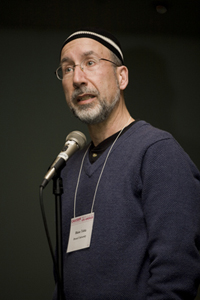 While at next week’s Annual Conference in Chicago, be sure to attend the Annual Members’ Business Meeting on Friday, February 12, 5:15–6:15 PM. The meeting—held in Grand EF, East Tower, Gold Level, Hyatt Regency Chicago—is open to all current CAA members. CAA President Paul Jaskot will preside
Representatives from the Board of Directors and members of the CAA staff will review the year’s accomplishments and financial status, and the results of the 2010 board election will be announced. The board and staff will also be on hand to respond to your questions, so please come and share your insights and concerns.
Image: Blaise Tobia, professor of digital media at Drexel University, speaks at the 2009 Annual Members’ Business Meeting (photograph by Kenna Love)
Online Career Center Job Statistics
posted Feb 02, 2010
Are schools mostly looking for professors of Renaissance or modern art? Does California have more teaching jobs than New York? Are there fewer open positions now compared to last year?
CAA’s Online Career Center, which publishes job classifieds in higher education and the museum world, is also an indicator of professional trends in the visual arts. In advance of next week’s Annual Conference, CAA has prepared basic statistics culled from this website, answering the questions above and giving members a sense of what job prospects might be like in Chicago and nationwide.
Using CAA’s two most recent fiscal years and the first half of the current one, this web-only article presents the total number of jobs posted in the Online Career Center, the top-ten specializations within studio art and art history, and the US states with the most open positions, among other facts. The article also compares the number of employers interviewing in Chicago to those at the Los Angeles and Dallas–Fort Worth conferences in 2009 and 2008, respectively.
Career Services Guide Published
posted Feb 02, 2010
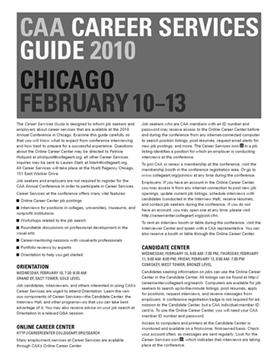 The Career Services Guide is designed to inform job seekers and employers about career services at the 2010 Annual Conference in Chicago. The publication, which will help you navigate Career Services events and provides answers to frequently asked questions, is available now as a PDF. Study this guide carefully so that you will know what to expect from conference interviewing and how best to prepare for a successful experience.
Job candidates can review the basics of the conference employment search. Read about Orientation, the introduction to Career Services where you can ask questions, and the Candidate Center, your home base at the conference. Also, learn more about the Online Career Center, where you can search for position listings, post application materials, and arrange interviews. The guide includes tips for improving your CV, portfolio, and supplemental application materials.
Employers will find details in the guide for renting interview booths or tables as well as recommendations for posting jobs and conducting interviews at the conference. You can begin preparations now for Career Services through the Online Career Center or onsite at the Interviewer Center.
The Career Services Guide will also be published with the January 2010 issue of CAA News, and copies will be handed out at Orientation and in the Candidate’s Center. All conference Career Services will take place at the Hyatt Regency Chicago. For more information about job searching, professional-development workshops, and more, visit the Career Services section of the conference website.
Haitian Libraries and Archives Spared from Earthquake Damage
posted Feb 01, 2010
The following letter comes from Brooke Wooldridge of the Digital Library of the Caribbean (dLOC). A cooperative digital library for resources from and about the Caribbean and circum-Caribbean, dLOC provides access to digitized versions of Caribbean cultural, historical, and research materials currently held in archives, libraries, and private collections.
There has been significant confusion as to the state of the four main patrimonial libraries in Port-au-Prince after the earthquake on January 12, 2010. Based on information that I have received from the Digital Library of the Caribbean partner libraries in Haiti, all four of the following library buildings are standing:
- Archives nationales d’Haïti
- Bibliothèque haïtienne des Pères du Saint-Esprit / San Martial [though the collection will need to be evacuated, as the building cannot be salvaged]
- Bibliothèque haïtienne des Frères de l’Instruction Chrétienne / Saint Louis de Gonzague
- Bibliothèque nationale d’Haïti
Importantly, the library at Saint Louis de Gonzague (FIC) was NOT destroyed. The reporter that stated the library had fallen was incorrect.
According to the director of the National Library, Mme. Francoise Thybulle, the structures must be inspected before the local staff can assess the situation and prepare detailed plans that will certainly ask for international assistance. While the buildings are standing, this does not diminish what will be the very real need for assistance once the local leadership is able to assess the situation. All of the library directors have asked that interested parties work together to help preserve the collections [and] bring these libraries/archives back into service.
Many institutions and individuals have expressed an interest in supporting the Haitian libraries/archives as they begin to rebuild. The outpouring of support and interest for the preservation of Haitian patrimony is unprecedented. Many of you are already in contact with colleagues regarding ways to help. I am trying to serve as a clearinghouse for the Haitian libraries of the different people, institutions or groups that would like to offer support to the libraries. Once I have feedback from the partner libraries in Haiti, I will share a working document of the projects I am aware of and an online survey for interested individuals to complete via www.dloc.com. Feel free to contact me personally at dloc@fiu.edu or preferably via the dLOC Facebook Group if you are already planning a project locally.
The Digital Library of the Caribbean has been working with partners in Haiti since it began in 2004. The National Archives in Haiti was a founding member of dLOC, and in the last few years we have developed strong relationships with both the National Library and the Fathers of the Holy Spirit (San Martial) Library. As more information becomes available from the local leadership, I will share it as widely as possible. I have been hesitant to send a large response until now because of the many conflicting reports. This information is confirmed, and comes from the directors of each library/archive.
As the many researchers that have worked in these four libraries know, their directors are completely dedicated to the preservation of their national patrimonial collections. All four have been fighting to preserve these collections for decades, and I am confident with support from the international community these collections will be preserved and accessible for many years to come.
Haitian Libraries and Archives Spared from Earthquake Damage
posted Feb 01, 2010
The following letter comes from Brooke Wooldridge of the Digital Library of the Caribbean (dLOC). A cooperative digital library for resources from and about the Caribbean and circum-Caribbean, dLOC provides access to digitized versions of Caribbean cultural, historical, and research materials currently held in archives, libraries, and private collections.
There has been significant confusion as to the state of the four main patrimonial libraries in Port-au-Prince after the earthquake on January 12, 2010. Based on information that I have received from the Digital Library of the Caribbean partner libraries in Haiti, all four of the following library buildings are standing:
- Archives nationales d’Haïti
- Bibliothèque haïtienne des Pères du Saint-Esprit / San Martial [though the collection will need to be evacuated, as the building cannot be salvaged]
- Bibliothèque haïtienne des Frères de l’Instruction Chrétienne / Saint Louis de Gonzague
- Bibliothèque nationale d’Haïti
Importantly, the library at Saint Louis de Gonzague (FIC) was NOT destroyed. The reporter that stated the library had fallen was incorrect.
According to the director of the National Library, Mme. Francoise Thybulle, the structures must be inspected before the local staff can assess the situation and prepare detailed plans that will certainly ask for international assistance. While the buildings are standing, this does not diminish what will be the very real need for assistance once the local leadership is able to assess the situation. All of the library directors have asked that interested parties work together to help preserve the collections [and] bring these libraries/archives back into service.
Many institutions and individuals have expressed an interest in supporting the Haitian libraries/archives as they begin to rebuild. The outpouring of support and interest for the preservation of Haitian patrimony is unprecedented. Many of you are already in contact with colleagues regarding ways to help. I am trying to serve as a clearinghouse for the Haitian libraries of the different people, institutions or groups that would like to offer support to the libraries. Once I have feedback from the partner libraries in Haiti, I will share a working document of the projects I am aware of and an online survey for interested individuals to complete via www.dloc.com. Feel free to contact me personally at dloc@fiu.edu or preferably via the dLOC Facebook Group if you are already planning a project locally.
The Digital Library of the Caribbean has been working with partners in Haiti since it began in 2004. The National Archives in Haiti was a founding member of dLOC, and in the last few years we have developed strong relationships with both the National Library and the Fathers of the Holy Spirit (San Martial) Library. As more information becomes available from the local leadership, I will share it as widely as possible. I have been hesitant to send a large response until now because of the many conflicting reports. This information is confirmed, and comes from the directors of each library/archive.
As the many researchers that have worked in these four libraries know, their directors are completely dedicated to the preservation of their national patrimonial collections. All four have been fighting to preserve these collections for decades, and I am confident with support from the international community these collections will be preserved and accessible for many years to come.